
Life, 1901-11-28 · page 4 of 22
Life — November 28, 1901 — page 4: what you’re looking at
What you’re looking at
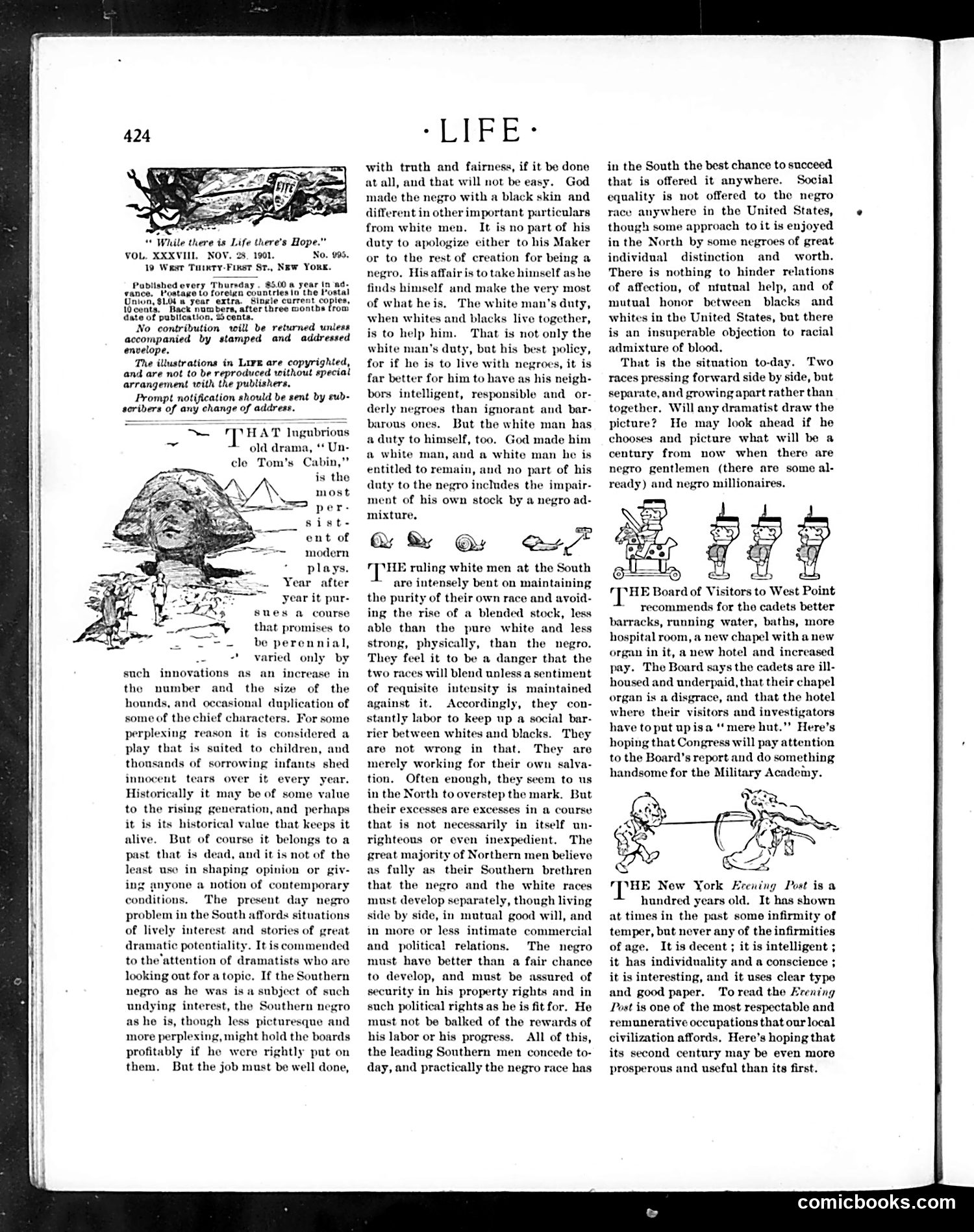
This page contains editorial commentary on race relations rather than traditional political cartoons. The illustrations appear to be decorative vignettes rather than satirical commentary. The text addresses contemporary debates about racial separation in the American South, specifically discussing whether whites and blacks should live separately or together. The author argues against racial mixing while acknowledging the Negro's humanity and right to fair treatment. The brief mention of the New York *Evening Post* (celebrating its centennial) and West Point military recommendations at the bottom are administrative notes rather than satirical content. The overall tone reflects early 1900s attitudes on segregation—attempting to balance paternalistic racial ideology with claims of fairness, a perspective that would be considered deeply racist by modern standards.
📄 Transcribed text from this page (OCR, searchable)
Machine-transcribed from the original scan — historical spelling and the odd misread are preserved.
Pabiished every Thursday . $5.00 a year in ad. vance. Postage to foreign countries to the Postal Union, $L.0 a year extra. Single current copies, 1D cents. “ack numbers, after three months {row date of publication, % cents. No contribution will be returned unless accompanied by stamped and addressed envelope. The illustrations in Lure are copyrighted, and are not to be reproduced without special arrangement with the publishers. Prompt notification should be sent by sub- soribers of any change of address. ~ T HAT Ingubrious ~— old drama, ‘* Un- cle Tom's Cabin,” is the most per- sist- ent of modern plays. - Year after year it pur- sues a course that promises to be perennial, . varied only by such innovations as an increase in the number and the size of the hounds, and occasional duplication of some of the chief characters. For some perplexing reason it is considered a play that is suited to children, and thousands of sorrowing infants shed innocent tears over it every year. Historically it may be of some value to the rising generation, and perhaps it is its historical value that keeps it alive. But of course it belongs to a past that is dead, and it is not of the least uso in shaping opinion or giv- nyone a notion of contemporary ions. ‘The present day negro problem in the South affords situations of lively interest and stories of great dramatic potentiality. It is commended to the'attention of dramatists who are looking out for a topic. If the Southern negro as he was is a subject of such undying interest, the Southern negro as he is, though less picturesque and more perplexing, might hold the boards profitably if he were rightly put on them. But the job must be well done, cond ‘LEP * with truth and fairness, if it be done at all, and that will not be easy. God made the negro with a black skin and different in other important particulars from white men. It is no part of his duty to apologize either to his Maker or to the rest of creation for being a negro. His affair is to take himself ashe finds himself and make the very most of what he is, The white man’s duty, when whites and blacks live together, is to help him. That is not only the white man’s duty, but his best policy, for if he is to live with negroes, it is far better for him to have as his neigh- bors intelligent, responsible and or- derly negroes than ignorant and bar- barous ones. But the white man has a duty to himself, too. God made him a white man, and a white man he is entitled to remain, and no part of his duty to the negro includes the impair- ment of his own stock by a negro ad- mixture, = & & G@ ary” HE ruling white men at the South are intensely bent on maintaining the purity of their own race and avoid- ing the rise of a blended stock, less able than the pure white and less strong, physically, than the negro. They feel it to be a danger that the two races will blend unless a sentiment of requisite intensity is maintained against it. Accordingly, they con- stantly labor to keep up a social bar- rier between whites and blacks. They are not wrong in that. They are merely working for their own salva- tion. Often enough, they seem to us in the North to overstep the mark. But their excesses are exce! in a course that is not necessarily in itself un- righteous or even inexpedient. The great majority of Northern men believe as fully as their Southern brethren that the negro and the white races must develop separately, though living side by side, in mutual good will, and in more or less intimate commercial and political relations. The negro must have better than a fair chance to develop, and must be assured of security in his property rights and in such political rights as he is fit for. He must not be balked of the rewards of his labor or his progress. All of this, the leading Southern men concede to- day, and practically the negro race has in the South the best chance to succeed that is offered it anywhere. Social equality is not offered to the negro race anywhere in the United States, though some approach to it is enjoyed in the North by some negroes of great individual distinction and worth. There is nothing to hinder relations of affection, of ntutual help, and of mutual honor between blacks and whites in the United States, but there is an insuperable objection to racial admixture of blood. That is the situation to-day. Two races pressing forward side by side, but separate, and growing apart rather than together. Will any dramatist draw the picture? He may look ahead if he chooses and picture what will be a century from now when there are negro gentlemen (there are some al- ready) and negro millionaires. ‘THE Board of Visitors to West Point recommends for the cadets better barracks, running water, baths, more hospital room, a new chapel with a new organ in it, a new hotel and increased pay. The Board says the cadets are ill- housed and underpaid, that their chapel organ is a disgrace, and that the hotel where their visitors and investigators have toput up isa “mere hut.”” Here’s hoping that Congress will pay attention to the Board’s report and do something handsome for the Military Academy. a Ree. & ae « il ‘4 vile fPHE New York Evening Post isa hundred years old. It has shown at timesin the past some infirmity of temper, but never any of the infirmities of age. It is decent ; it is intelligent ; it has individuality and a conscience ; it is interesting, and it uses clear type and good paper. To read the Evening Post is one of the most respectable and remunerative occupations that our local civilization affords, Here’s hoping that its second century may be even more prosperous and useful than its first. comicbooks.com