
A complete issue · 20 pages · 1901
Life — August 15, 1901
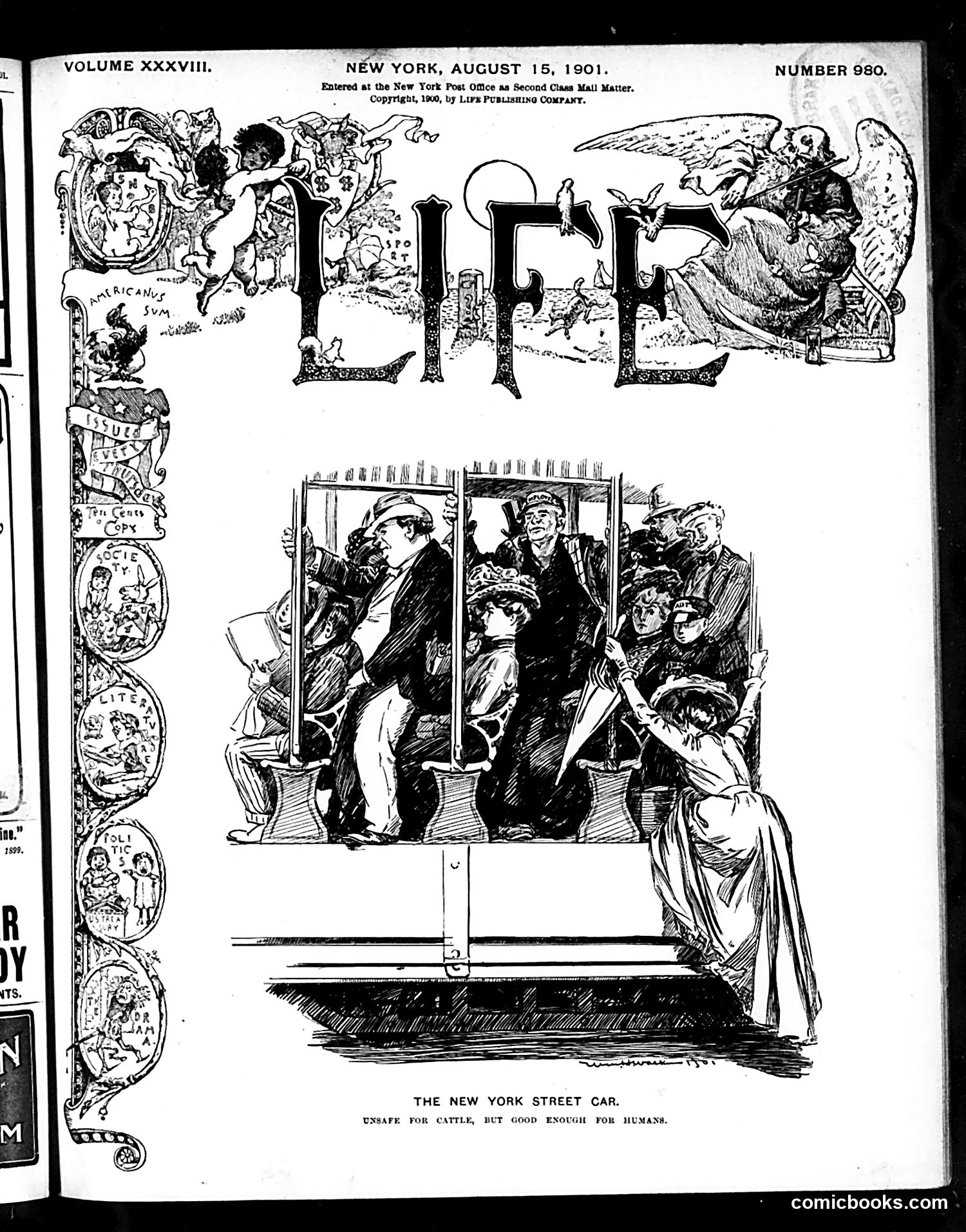
This political cartoon satirizes conditions in New York City's newly electrified streetcars. The caption reads "Unsafe for Cattle, but Good Enough for Humans," suggesting that the overcrowded, poorly maintained cars subjected passengers to conditions worse than those deemed acceptable for livestock. The illustration shows a packed streetcar with multiple figures—men in suits and hats, women, and children—crammed together in unsafe proximity. The satirical point criticizes the transit company's disregard for passenger safety and comfort. By comparing human passengers unfavorably to cattle, Life's cartoonist highlights corporate indifference to public welfare and poor working conditions during the Gilded Age, when urban infrastructure prioritized profit over people's wellbeing.
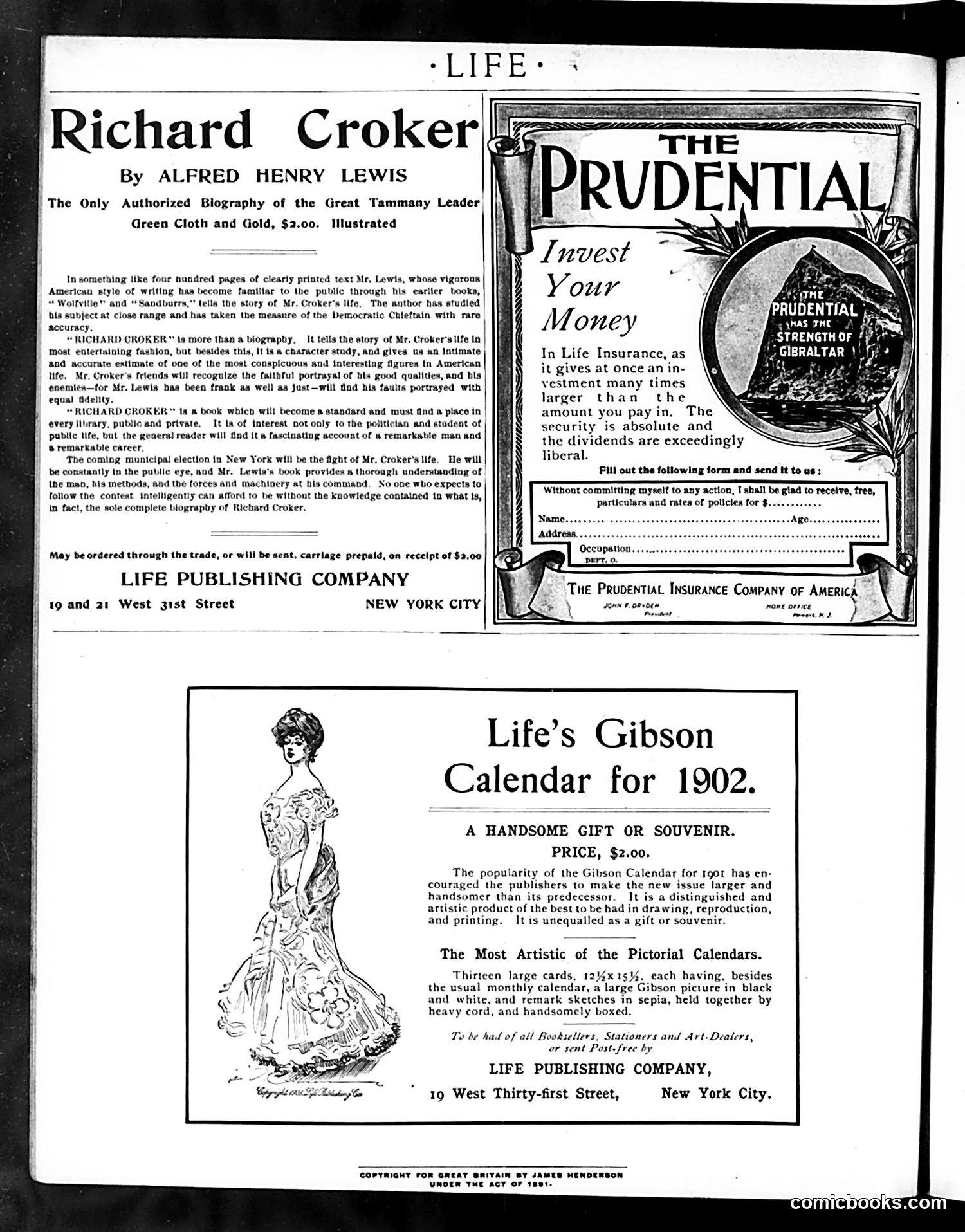
This page is primarily **advertising**, not political satire. It contains three distinct ads: 1. **Richard Croker biography** (top left): Promotes Alfred Henry Lewis's authorized biography of Richard Croker, described as a "Tammany Leader." Croker was a powerful New York Democratic politician and Tammany Hall boss. The text notes an upcoming mayoral election in New York will be "the fight of Mr. Croker's life." 2. **Prudential Insurance ad** (top right): Standard insurance advertisement. 3. **Gibson Calendar** (bottom): Promotes Life Publishing Company's 1902 calendar featuring Charles Dana Gibson's illustrations—Gibson Girls were popular cultural icons of the era. The page reflects early 1900s American commercial culture rather than containing satirical political commentary.
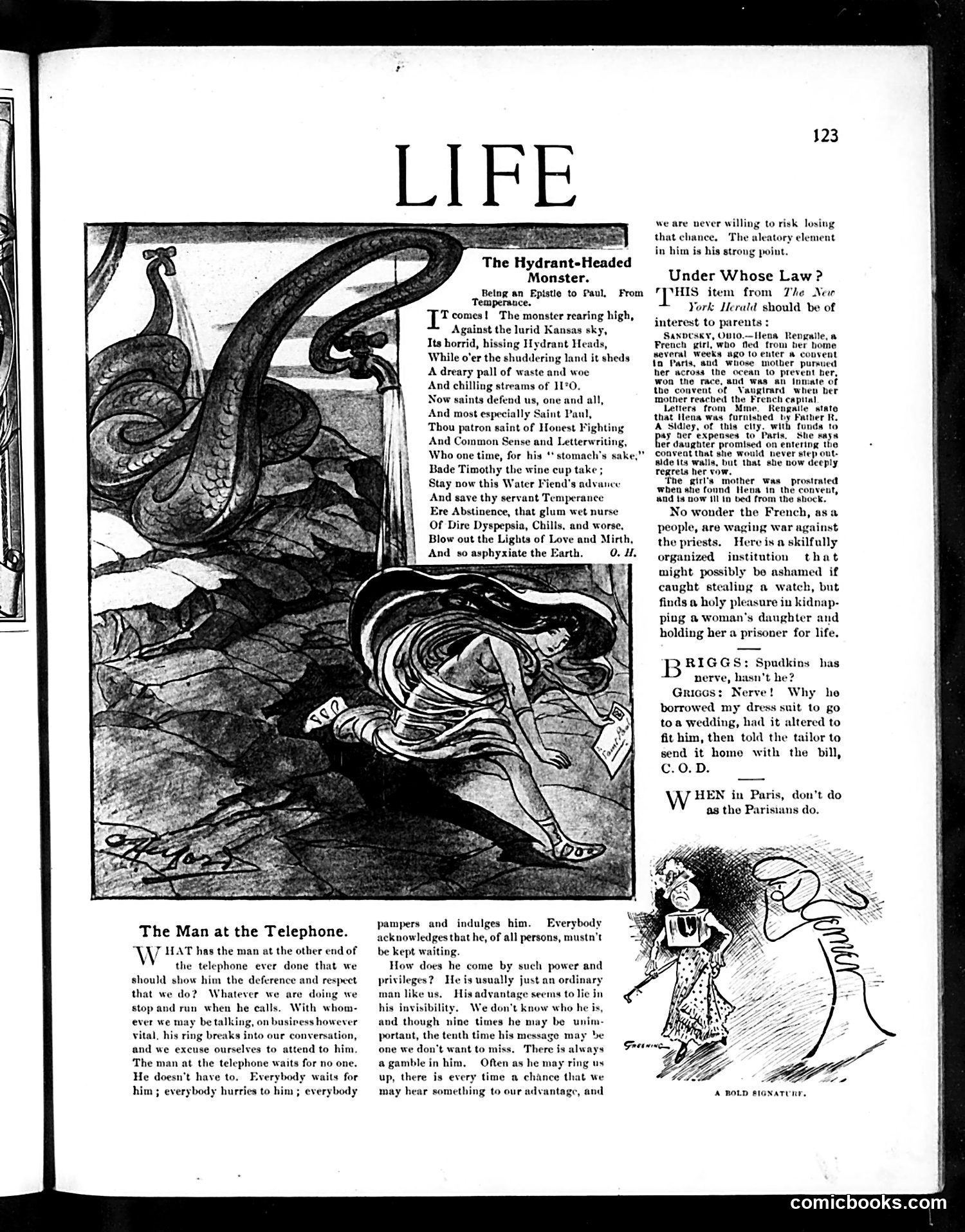
**"The Hydrant-Headed Monster"** (top left): A grotesque creature with a hydrant for a head confronts Saint Paul. The poem warns of water-related dangers ("Dire Dyspepsia, Chills") and invokes religious protection. This appears to satirize concerns about urban water quality or contaminated water supplies—a genuine public health issue in early 20th-century American cities. **"The Man at the Telephone"** (bottom left): Commentary on telephone etiquette, mocking how people monopolize conversations and treat callers with inconsistent respect. The satirist notes the telephone's mysterious power—people answer instantly yet remain invisible, creating social inequality. **Right column**: Brief anecdotes about social pretension and French customs, with a small cartoon about a "bold signatur[e]." The page focuses on modern urban anxieties and social manners.
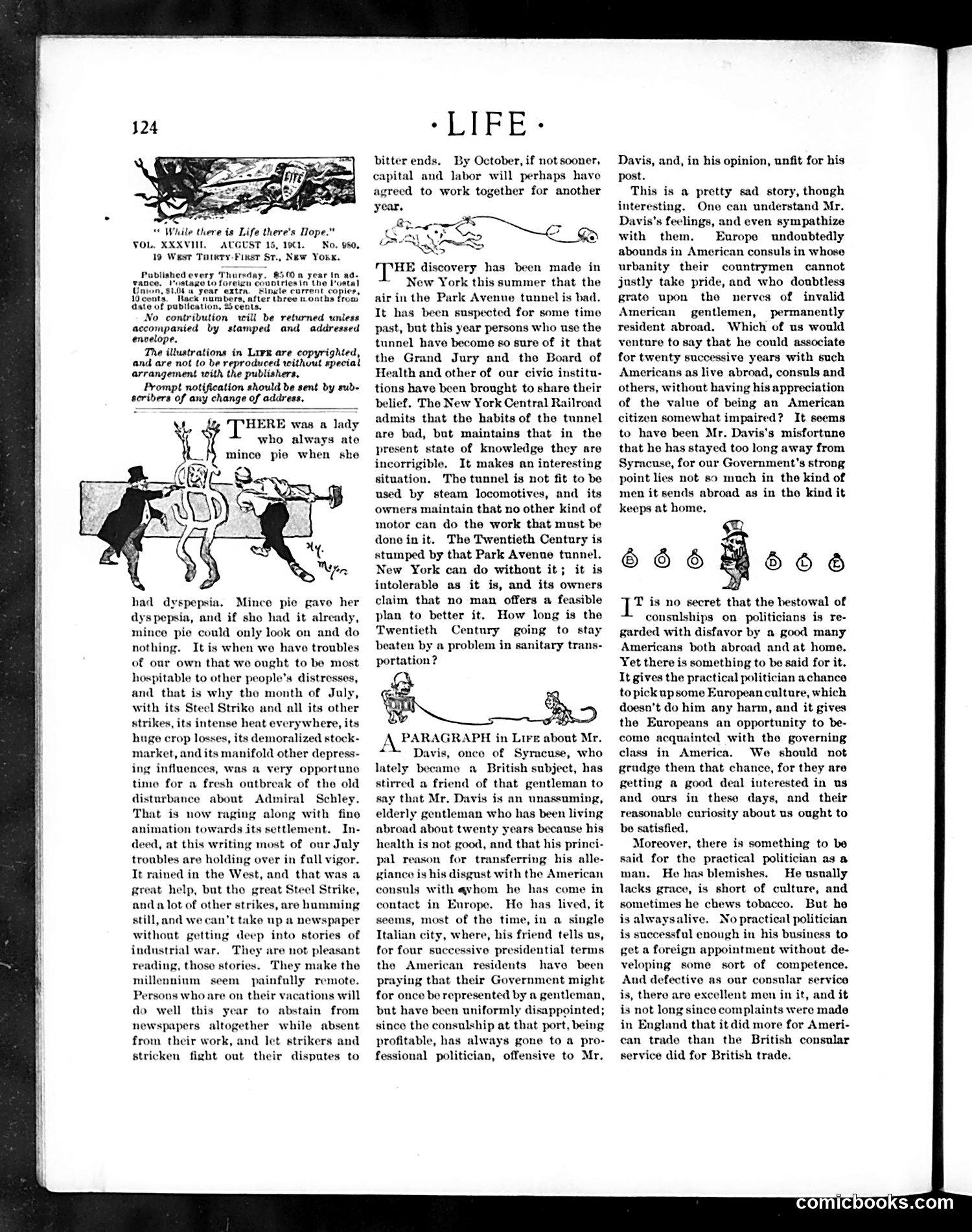
The cartoon depicts **a lady who "who always had dyspepsia"** being violently jolted by a mince pie, while a man in formal dress and another figure interact nearby. The illustration satirizes the physical digestive distress caused by rich foods. The accompanying text discusses **Mr. Davis of Syracuse**, who became a British subject and is now living abroad in Italy. The article critiques American consuls abroad, suggesting they lack the business acumen of British counterparts. It argues that practical politicians should be appointed to consular positions to better serve American commercial interests—a jab at what Life viewed as ineffectual diplomatic appointments of the era. The overall theme addresses both personal indulgence and diplomatic competence.
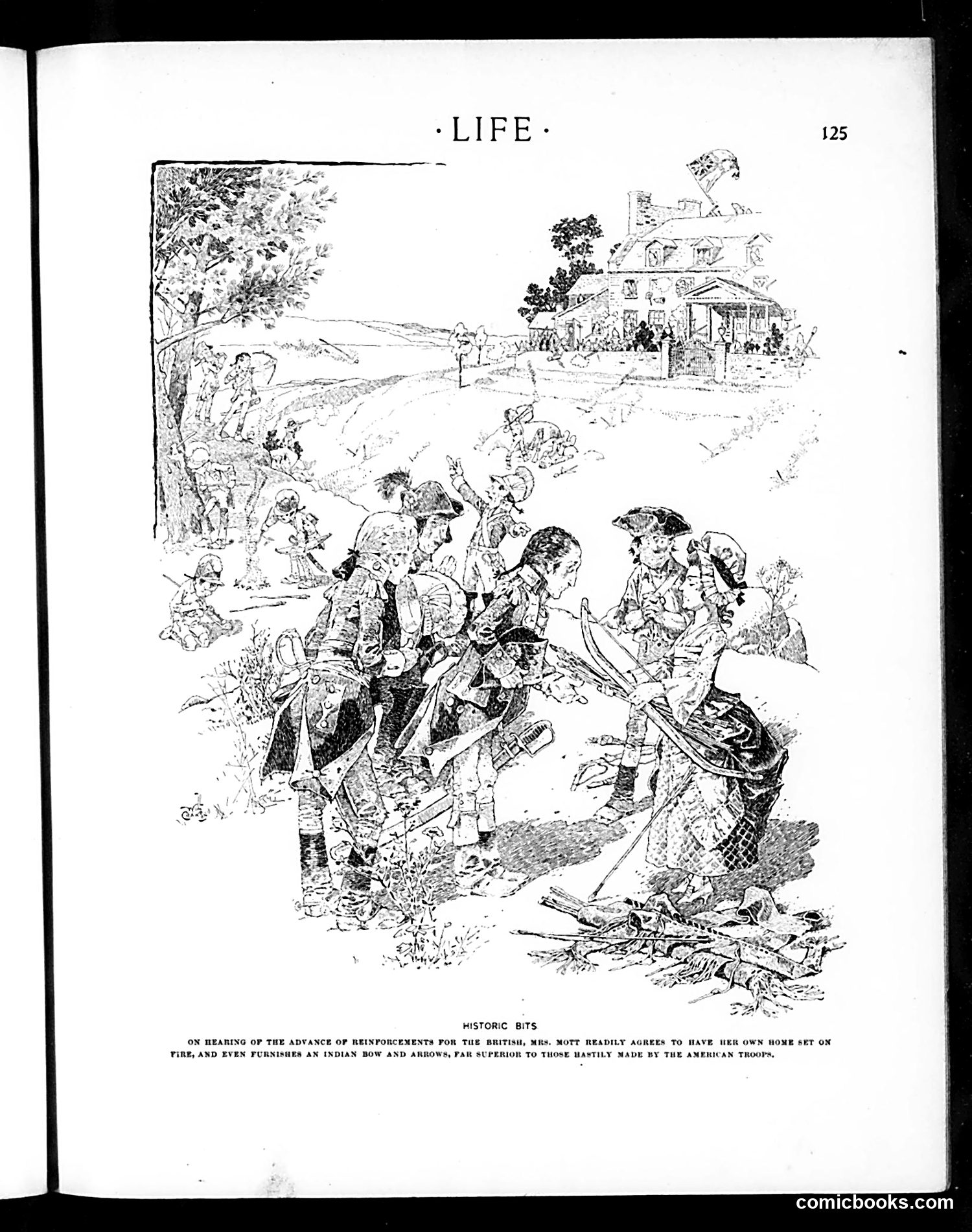
This satirical cartoon depicts British military figures in colonial dress encountering Native Americans. The caption references British reinforcements and Mrs. Mott's supposed readiness to "set on fire" and furnish an "Indian bow and arrows, far superior to those hastily made by the American troops." The satire appears to mock British overconfidence during what is likely the American Revolutionary War or a colonial conflict. By suggesting a British woman would arm herself with Native American weapons against American forces, the cartoon ridicules British dependency on indigenous allies and implies their military preparedness is laughably improvised compared to American forces. The rural setting with colonial homestead in background emphasizes the frontier context of such conflicts.
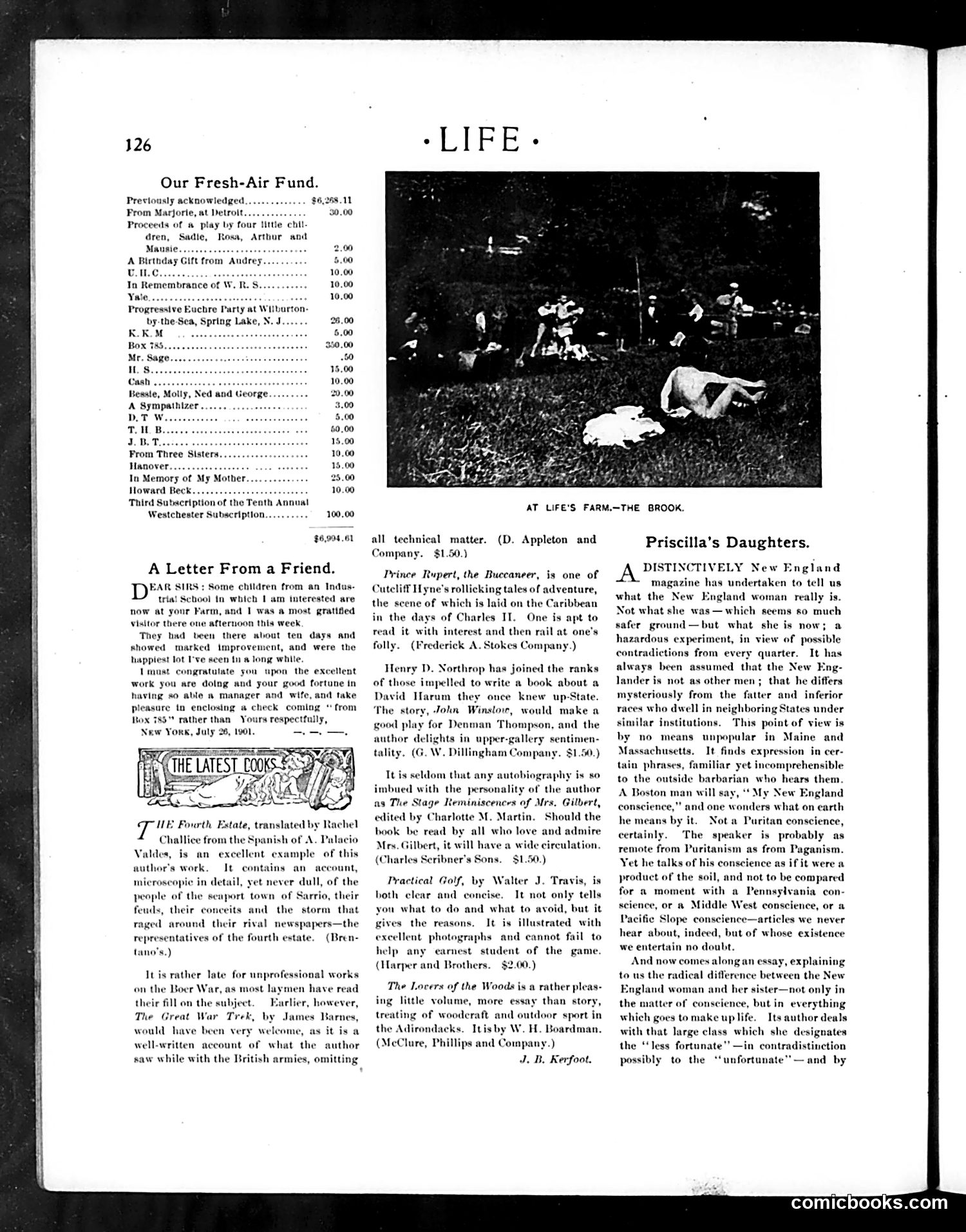
The main image shows a pastoral scene titled "At Life's Farm—The Brook," depicting people relaxing outdoors by a stream. This appears to be an illustrative photograph rather than a political cartoon, showcasing leisure and nature in an idealized, peaceful setting. The page primarily contains book reviews and a fund-raising list for the "Fresh-Air Fund"—a charitable organization providing outdoor recreation for urban children. The text discusses new publications including works on war, golf, and New England society. The article "Priscilla's Daughters" examines what defines the modern New England woman, contrasting her with historical Puritan ancestors while exploring regional identity and character. This is largely non-satirical editorial and literary content rather than political commentary.
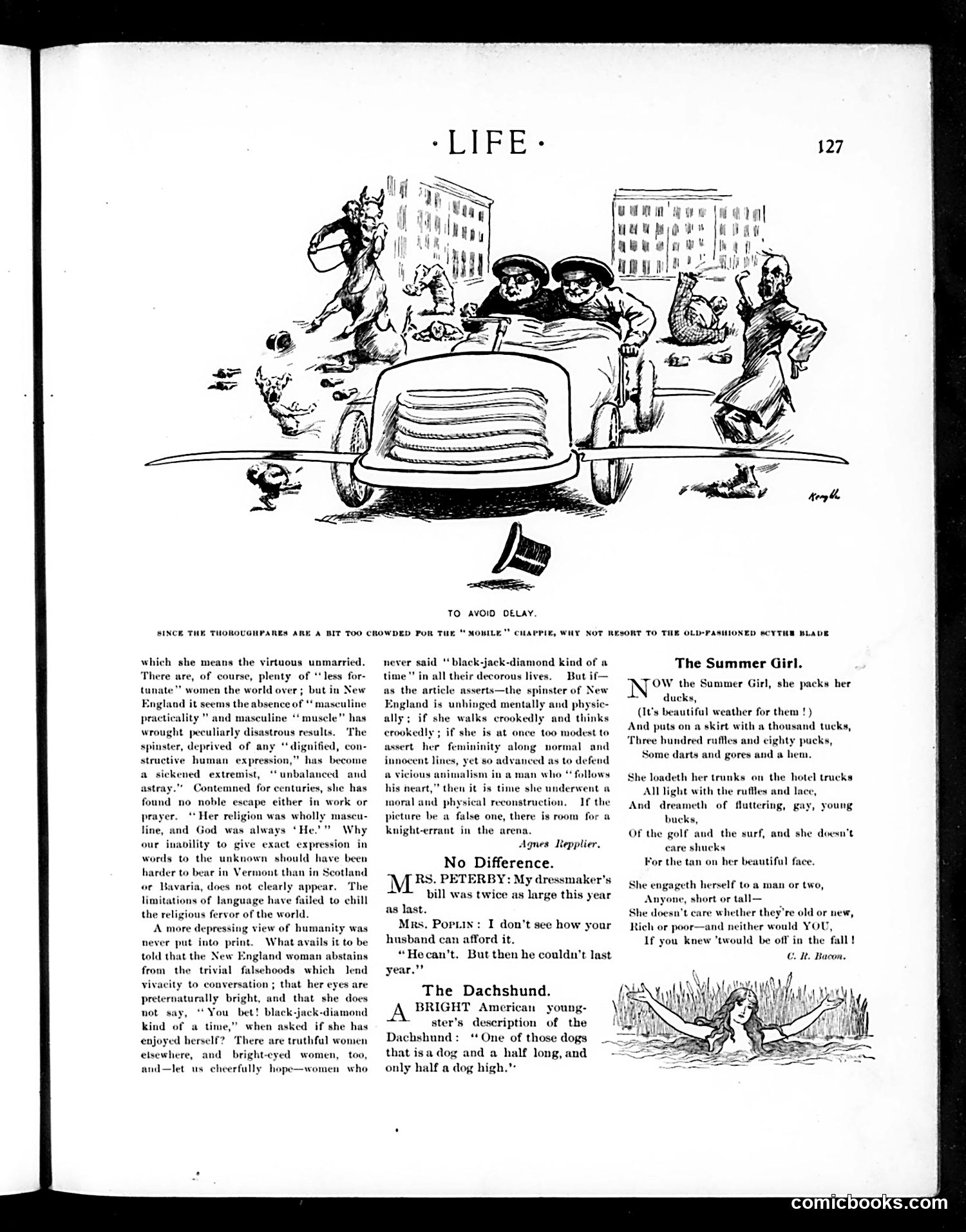
The top cartoon, titled "To Avoid Delay," satirizes overcrowded automobiles. It depicts a car so packed with passengers that people literally sit on top of the vehicle's hood and hanging off its sides, with more figures standing around it. The caption suggests that because streetcars are "too crowded for the 'mobile' Chaple," people resort to automobiles—which clearly creates an equally absurd overcrowding problem, just in a different form. Below are three humor pieces: "The Summer Girl" (a poem about a woman in fashionable dress), "No Difference" (a brief dialogue joke about dressmaker bills), and "The Dachshund" (a one-liner about the dog's peculiar proportions). These appear to be typical magazine filler content rather than political satire.
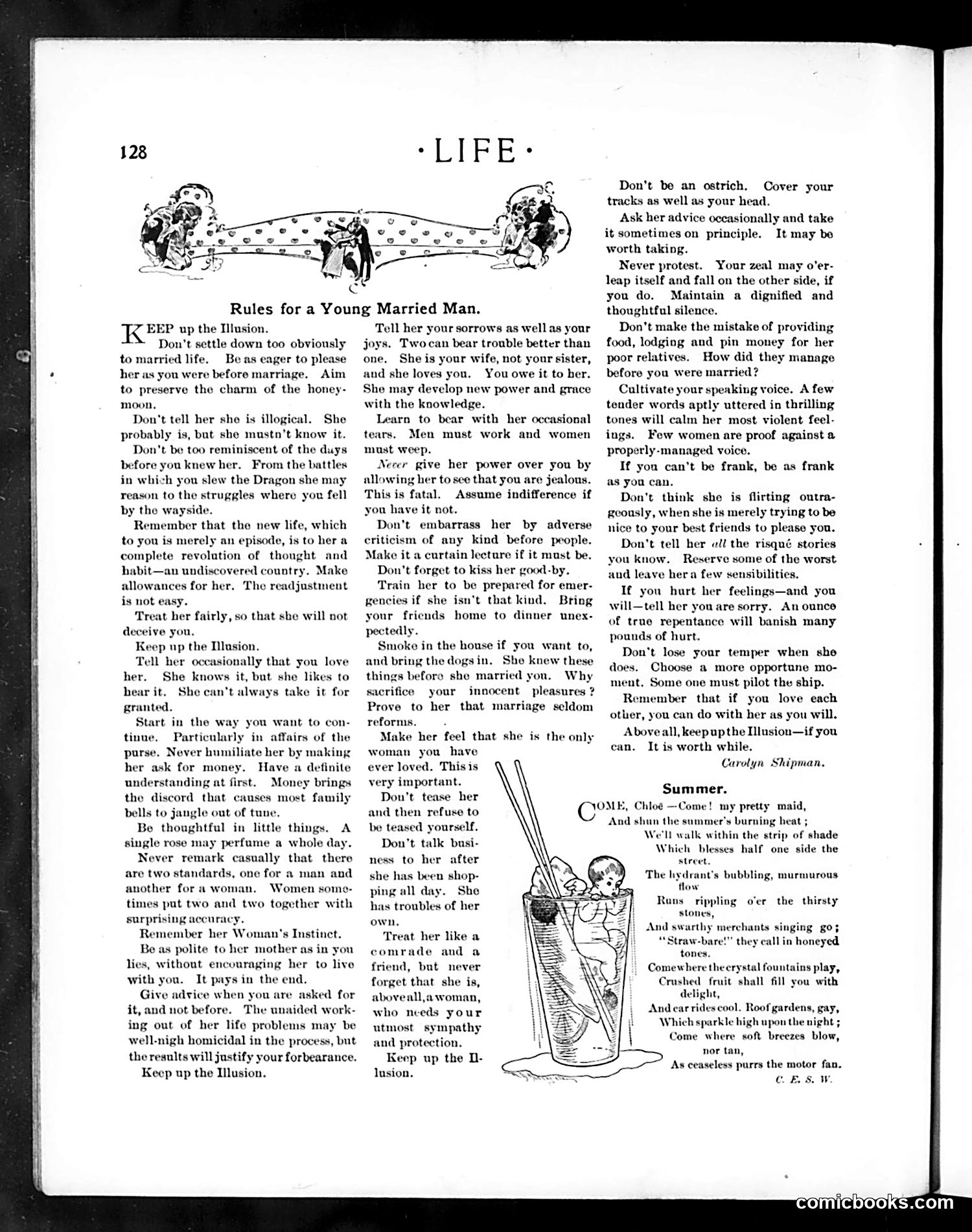
This page contains two distinct pieces: **Left column:** Satirical advice for newlywed husbands, written by Cordyn Shipman. It mockingly suggests husbands should hide their jealousy, tolerate wives' flirtation, manage finances carefully, and generally maintain romantic illusions in marriage. The tone is gently cynical about marital realities—advising men to overlook their wives' "troubles" and "power over you" while keeping "up the Illusion." This reflects early 20th-century gender dynamics and marital expectations. **Right column:** A poem titled "Summer" celebrating warm-weather pleasures (fountains, ice drinks, gardens, fans). Accompanied by an illustration of a tall refreshing beverage, likely lemonade or similar summer drink. The page demonstrates *Life* magazine's blend of satirical social commentary with lighter seasonal content.
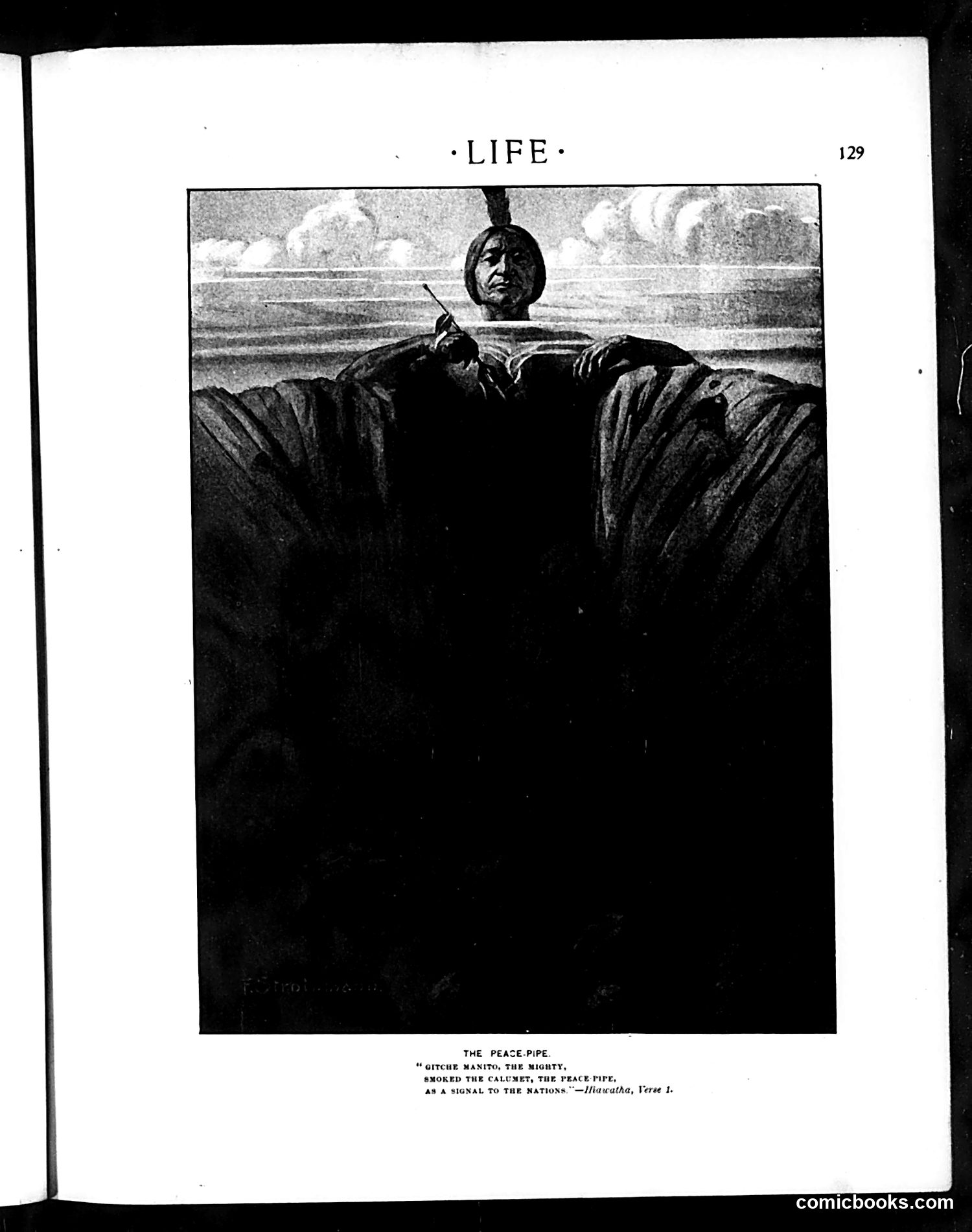
This illustration depicts a figure standing in a trench, holding aloft a calumet (Native American peace pipe). The caption quotes from Hiawatha: "Gitche Manito, the Mighty, / Smoked the calumet, the peace pipe, / As a signal to the nations." The satire appears to reference World War I peace efforts, using the peace pipe as a symbol of negotiation between warring nations. The figure's position in the trench emphasizes the military context. By invoking Hiawatha's imagery of the peace pipe as a universal signal, the cartoonist suggests that achieving peace among the "nations" locked in trench warfare requires something as fundamental and transcendent as Native American diplomatic tradition—implying that conventional diplomacy has failed and only such powerful symbolism might end the conflict.
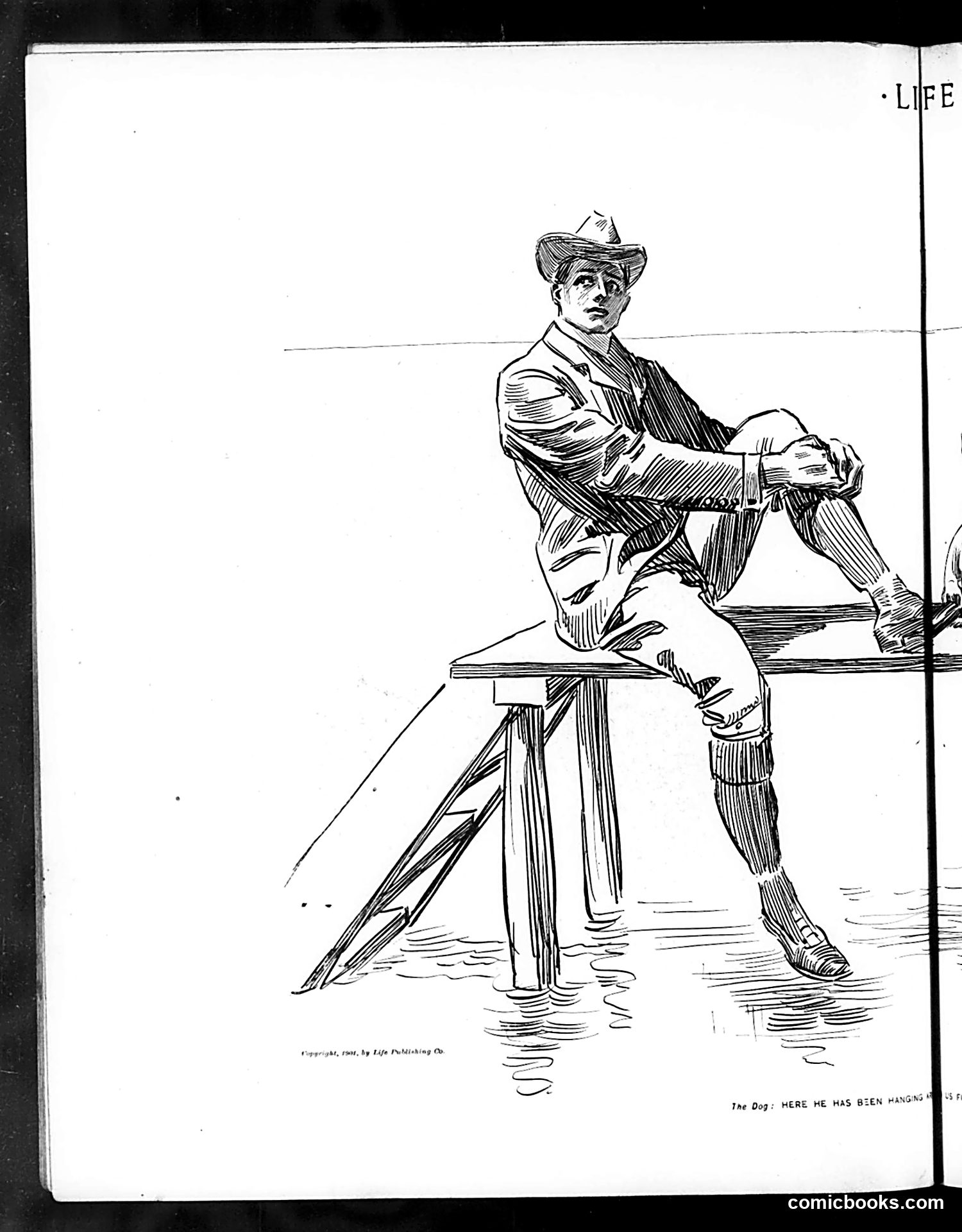
This is a satirical cartoon titled "The Dog: Here He Has Been Hanged" (visible at bottom right). The image shows a man in Western attire (cowboy hat, boots) sitting on a stool near what appears to be a gallows or hanging apparatus in shallow water. The satire likely comments on vigilante justice or frontier lynching practices in the American West. The figure represents either a specific historical character or a type—someone associated with extrajudicial execution. The casual pose and the "hanged" reference suggest ironic commentary on violence normalized in Western culture or frontier mythology. The exact target of satire remains unclear without additional context about the publication date or contemporary events Life was addressing.
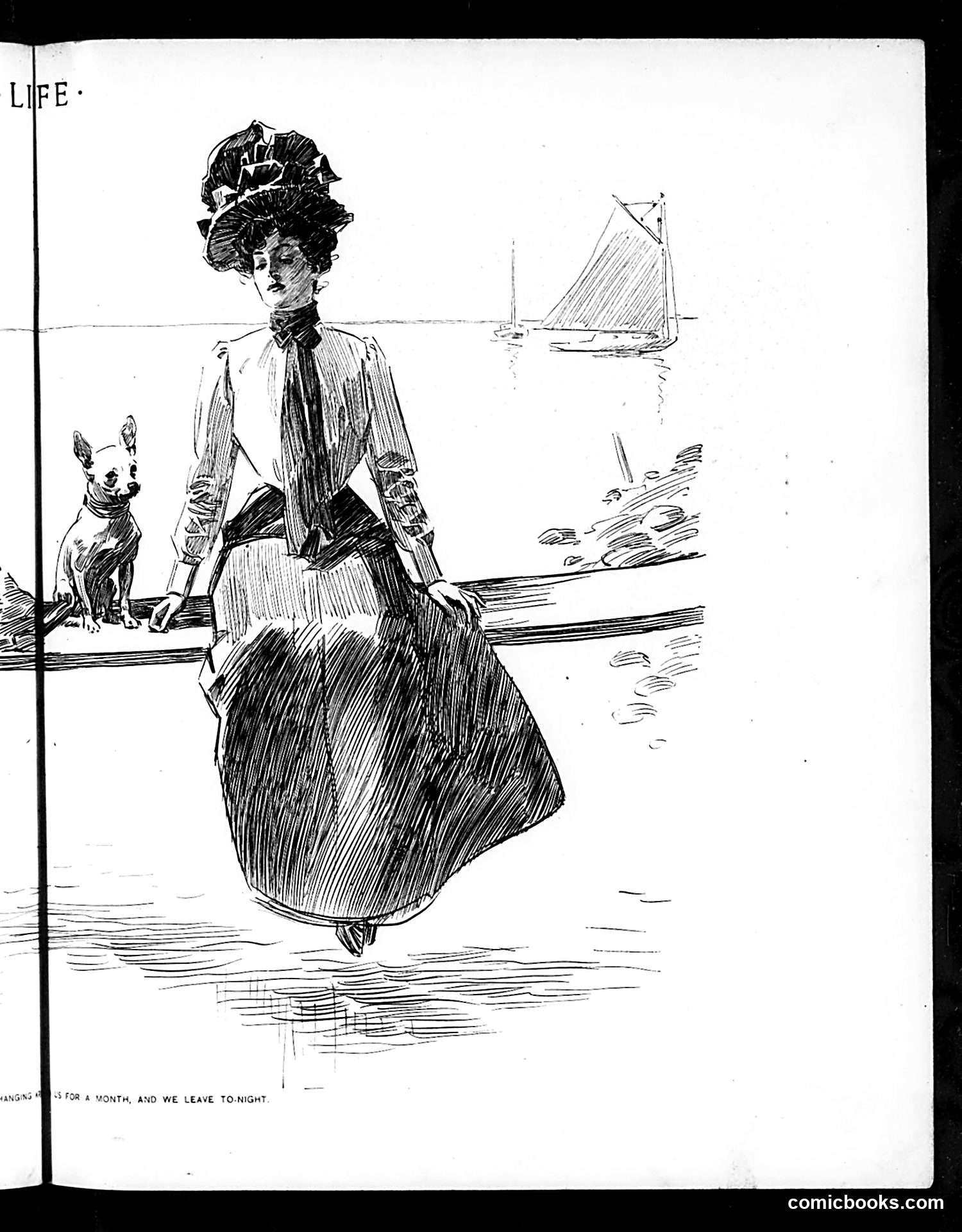
This illustration titled "LIFE" depicts an elegantly dressed woman in Edwardian-era fashion—complete with an elaborate feathered hat and fitted jacket—standing on a beach with a small dog. Sailboats appear in the background. The partial text at bottom reads "...ST FOR A MONTH, AND WE LEAVE TO-NIGHT," suggesting a vacation or leisure scenario. The satire appears to target the leisure class and their casual attitudes toward extended vacations. The woman's ostentatious dress and accessories emphasize wealth and social status, while the brevity of her seaside stay (implied by "leave to-night") satirizes the frivolous nature of high-society recreational habits—arriving fashionably for brief social appearances rather than genuine relaxation. The work exemplifies *Life* magazine's characteristic social satire of the early 20th century.
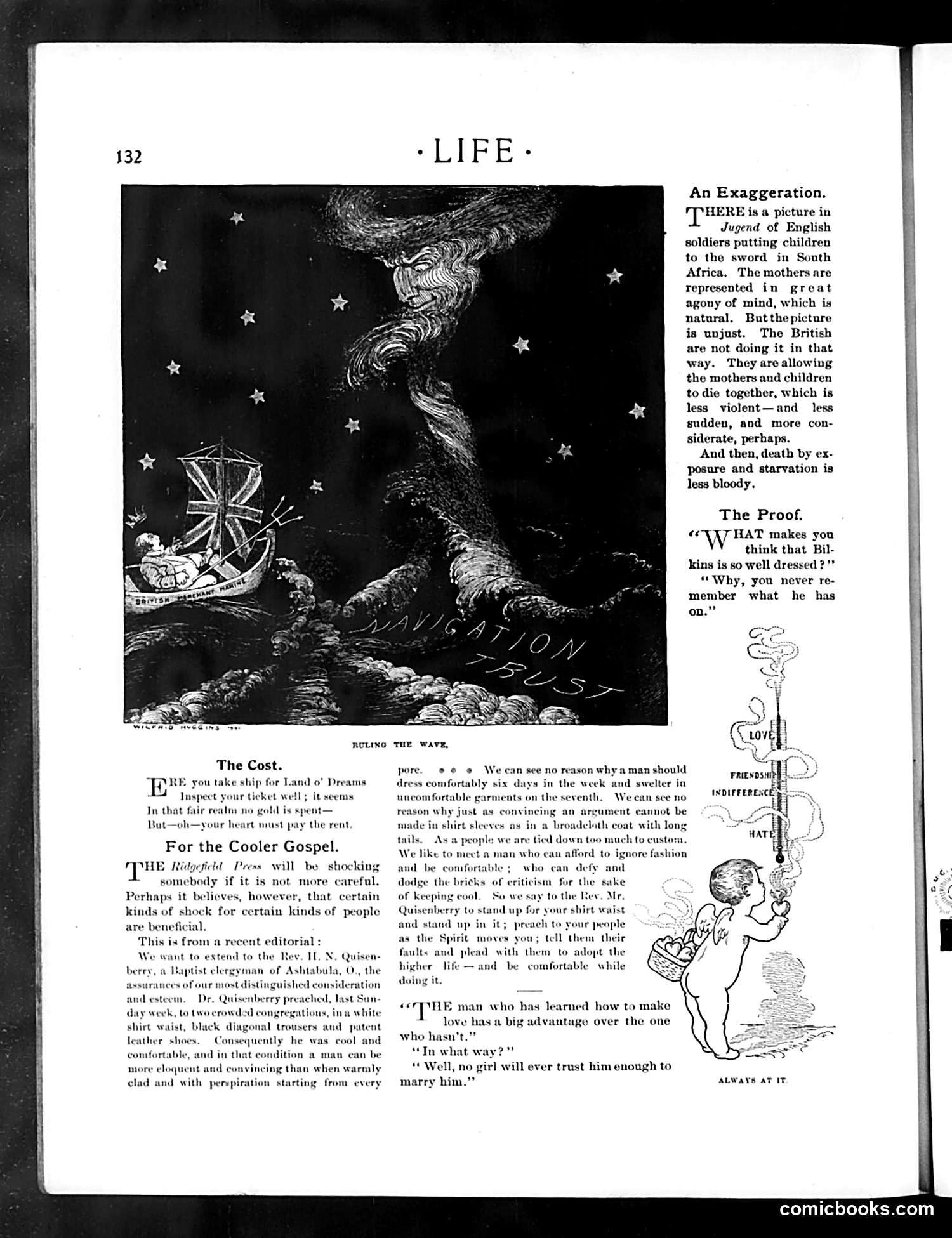
The main illustration titled "RULING THE WAVE" depicts a giant figure (likely representing Britain or British imperialism) looming over a small ship with the British flag. The accompanying text "An Exaggeration" critiques a picture in *Jugend* (a German magazine) showing British soldiers forcing children to use swords in South Africa—referencing the Boer War era. Life's editors argue the depiction is unfair: British policy allows mothers and children to die together through exposure and starvation rather than combat, which they frame as more "considerate" than violent death. This darkly sarcastic defense actually condemns British colonial practices while mocking German criticism as exaggerated. The page also includes unrelated humor pieces about dress codes and dating advice.
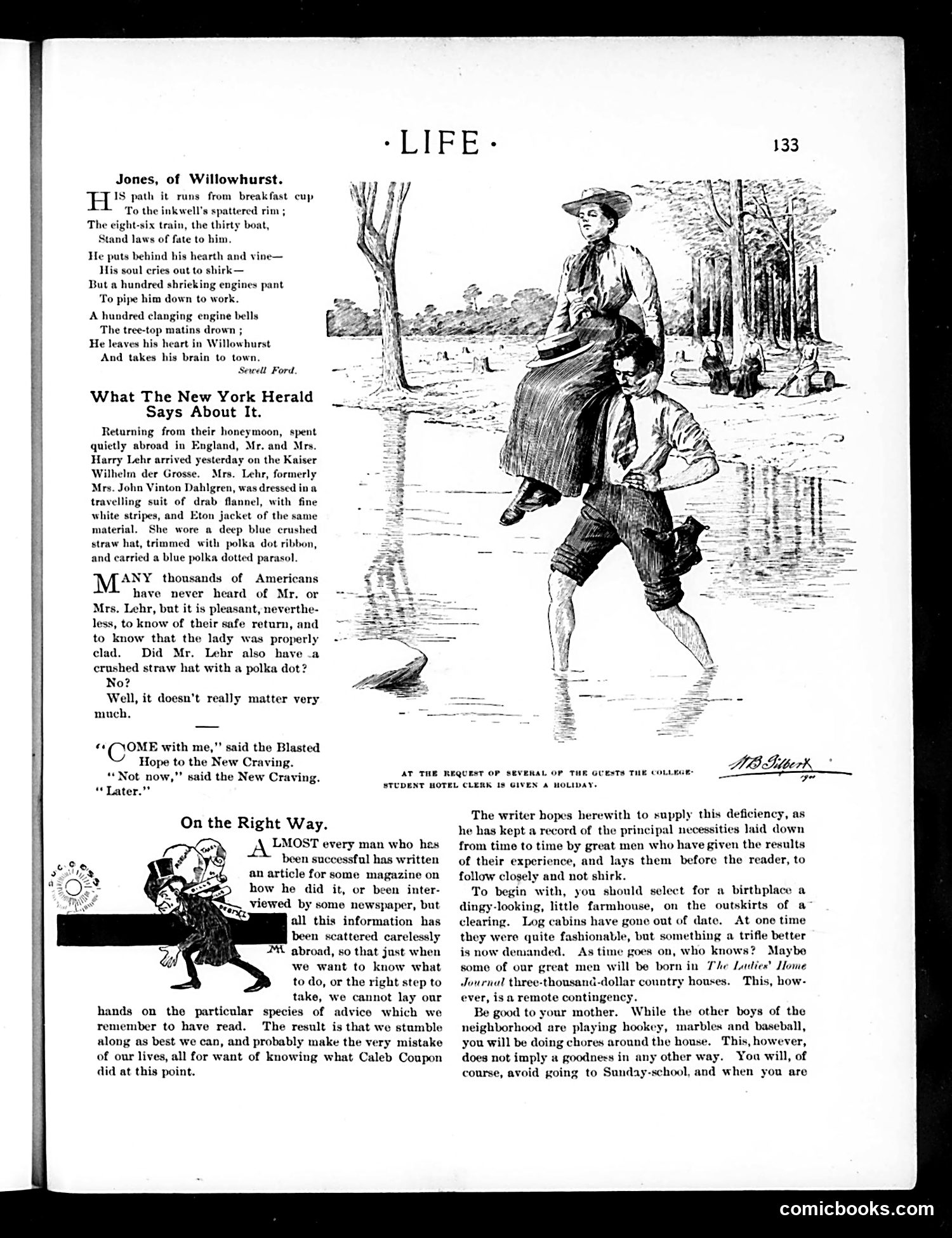
This 1900s *Life* magazine page contains satirical commentary on American life and social aspirations. **"Jones of Willowhurst"** is a poem mocking the commuter lifestyle—a man who leaves his peaceful suburban heart behind daily, compelled by industrial "shrieking engines" to work in the city. It critiques the dehumanizing demands of modern employment. **"What the New York Herald Says About It"** satirizes society-page obsession with trivial fashion details. The Herald's breathless coverage of Mrs. Lehr's honeymoon return focuses absurdly on her hat and parasol's polka dots, while the satire notes nobody actually cares—and humorously questions whether her husband wore a matching hat. **"On the Right Way"** parodies self-help advice columns popular with ambitious men. It mocks the cliché "rags-to-riches" narrative formula by suggesting one must be born in a dingy farmhouse, be dutiful (but not *too* moral), and follow prescribed steps to success—lampooning both the formulaic nature of success literature and American meritocracy mythology.
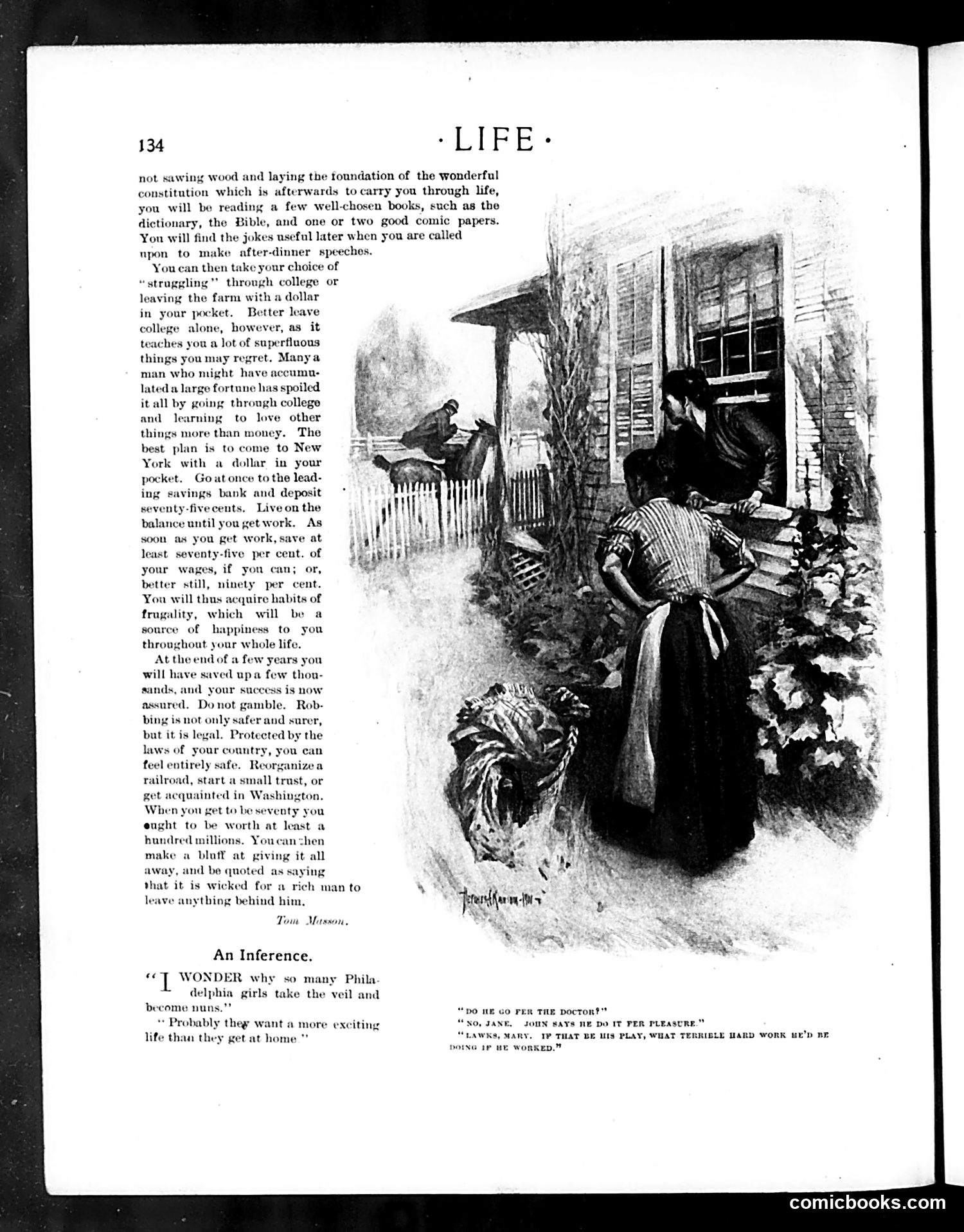
This short satirical piece contrasts two views of women's life choices. The opening question—why Philadelphia girls become nuns—suggests convent life as escape. The inference offered is that they seek excitement absent at home. The accompanying illustration depicts working-class women (likely domestic servants or laborers) engaged in physical toil, with dialogue mocking the idea that hard work constitutes "pleasure." The satire works by inverting expectations: if convent life seems preferable to home life, what must home life entail? The working women's exchange implies that those choosing nunnery actually seek *rest* from exhausting labor, not excitement—a wry comment on the grim drudgery of working-class female existence in early 20th-century America. The joke exposes the desperation behind women's choices rather than mocking the women themselves.
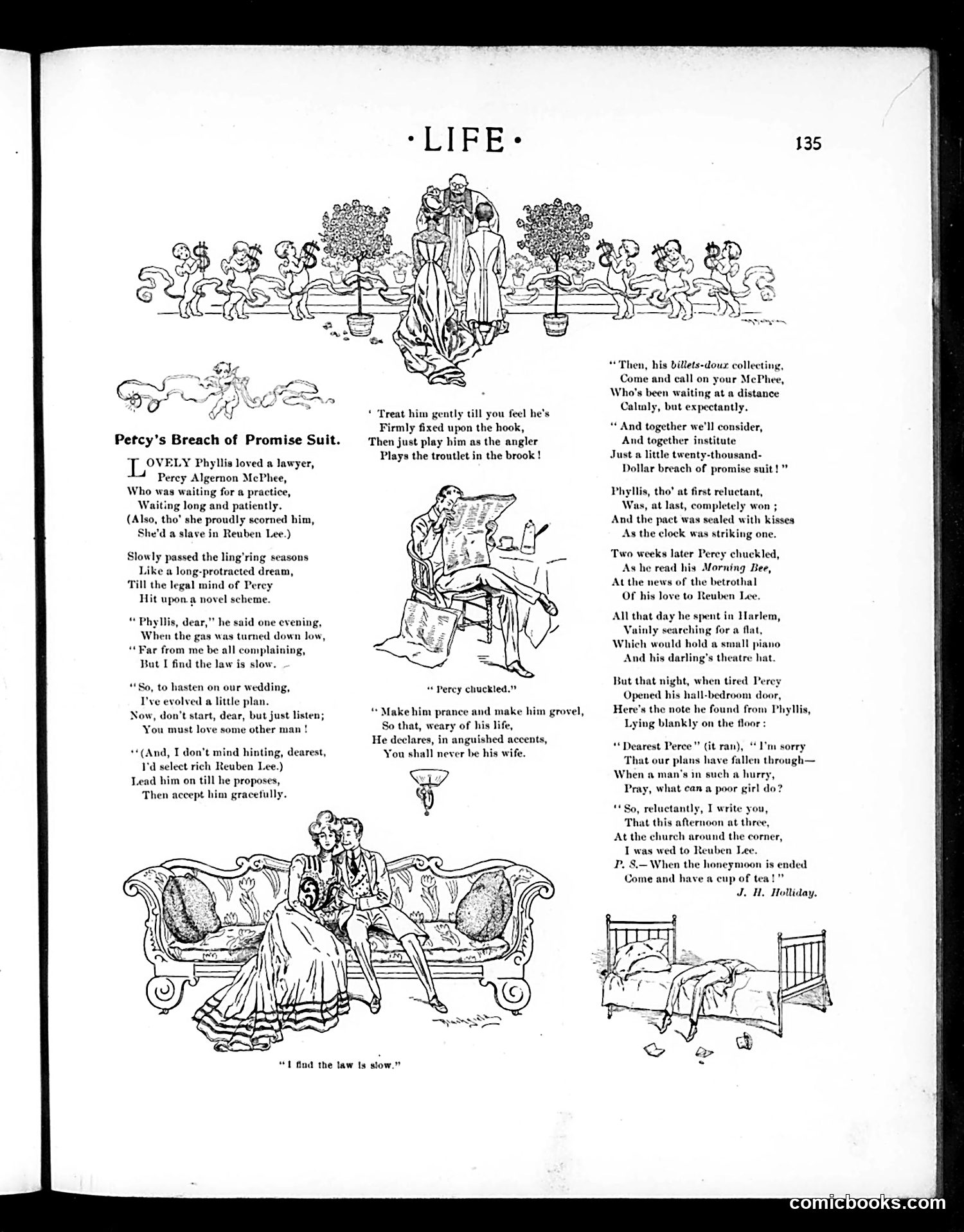
This satirical poem mocks a cynical legal scheme. Percy McPhee, an unsuccessful lawyer waiting for his practice to grow, devises a plan to profit from a "breach of promise" lawsuit—a real legal action available when someone broke an engagement. Percy instructs his girlfriend Phyllis to seduce the wealthy Reuben Lee, get him to propose, then reject him. Percy would then sue Lee for breach of promise, expecting a large settlement (twenty thousand dollars) that would fund their marriage. The joke: the plan backfires completely. Phyllis actually marries Reuben instead, leaving Percy a note inviting him to tea *after the honeymoon*—a humiliating outcome for the schemer. The satire targets both shady lawyers seeking easy money through dubious legal technicalities and the desperation of young men like Percy unable to establish themselves professionally.
This page consists primarily of **humorous anecdotes and verse rather than political cartoons**. The main pieces include: 1. **"Ant Scissors at Nulls"** (top): A poem satirizing modern conveniences by listing things stripped of their essential components—"coatless man," "hutless girl," "horseless carriage," "leadless bullet." The joke: removing key elements leaves only absurdity, mocking both technological progress and modern romance. 2. **Biographical sketch** of "Flavius Josephus Cook": Describes a deceased preacher known for bombastic rhetoric ("He said things with a bang") rather than scholarship, mocking religious charlatans who dazzled audiences through showmanship. 3. **Frontier justice anecdote**: A satirical tale of an Arizona judge with no legal training convicting a defendant through circular logic, mocking incompetent frontier law. 4. **Science joke**: Scientists prove grasshoppers hear through legs by removing them—absurdist humor about pseudo-science. The page is **primarily satirical commentary on American life, religion, and progress**, not political in nature.
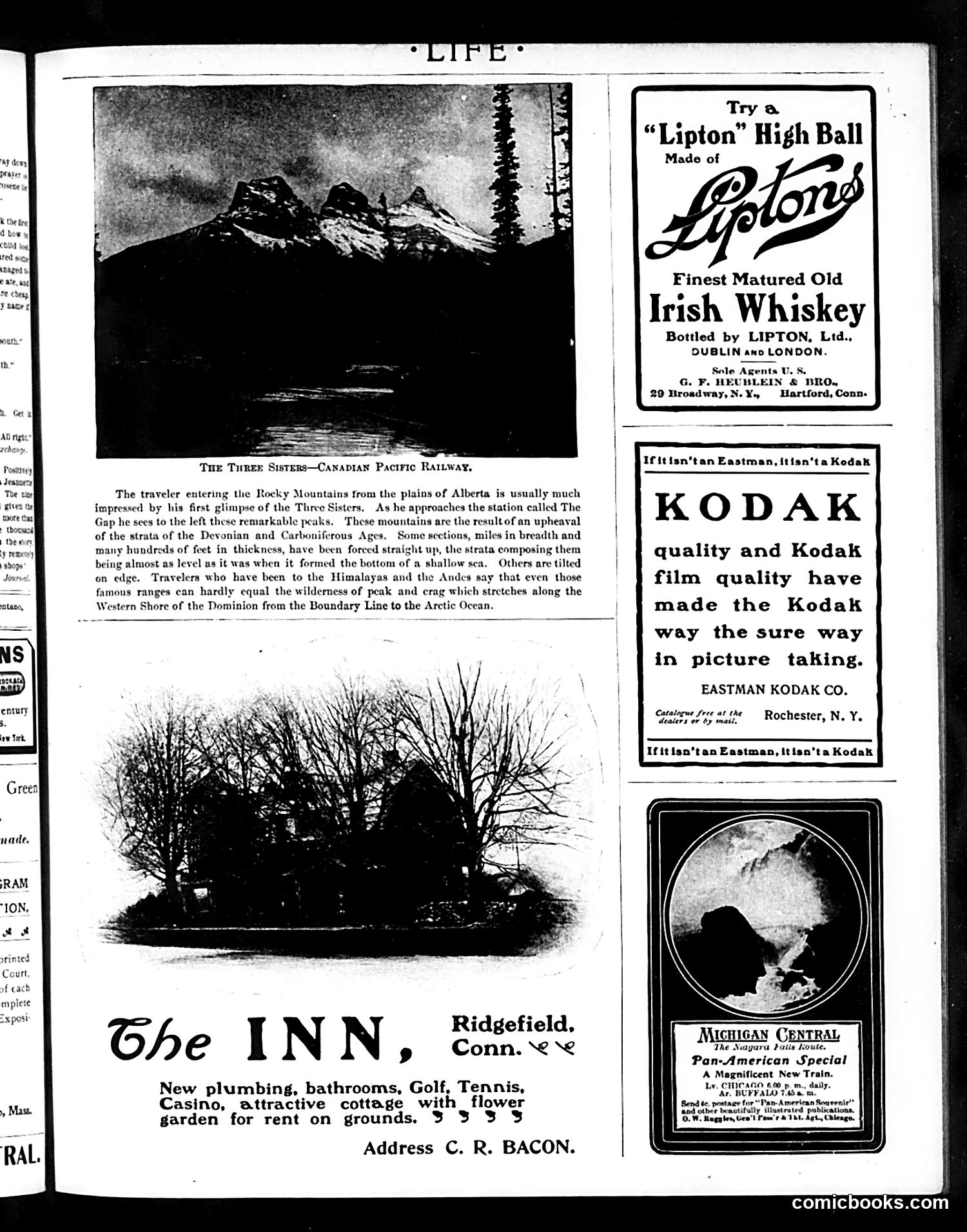
This is **not a satirical cartoon page**, but rather a travel and advertising feature. The main content is educational/descriptive rather than political or comedic. The left side features a landscape photograph and text about **"The Three Sisters,"** a mountain formation in the Canadian Rockies accessible via Canadian Pacific Railway. The writing—comparing these peaks favorably to the Himalayas and Andes—functions as travel promotion, emphasizing natural grandeur to attract tourists. The page is dominated by **advertisements** typical of early 20th-century Life magazine: Lipton Irish Whiskey, Kodak film, The Inn resort in Ridgefield Connecticut, and Michigan Central Railway. These ads reflect the magazine's affluent readership and leisure culture. There is **no visible political satire or social commentary** on this particular page. It represents Life's mixed editorial-advertising format rather than its satirical cartoon tradition.
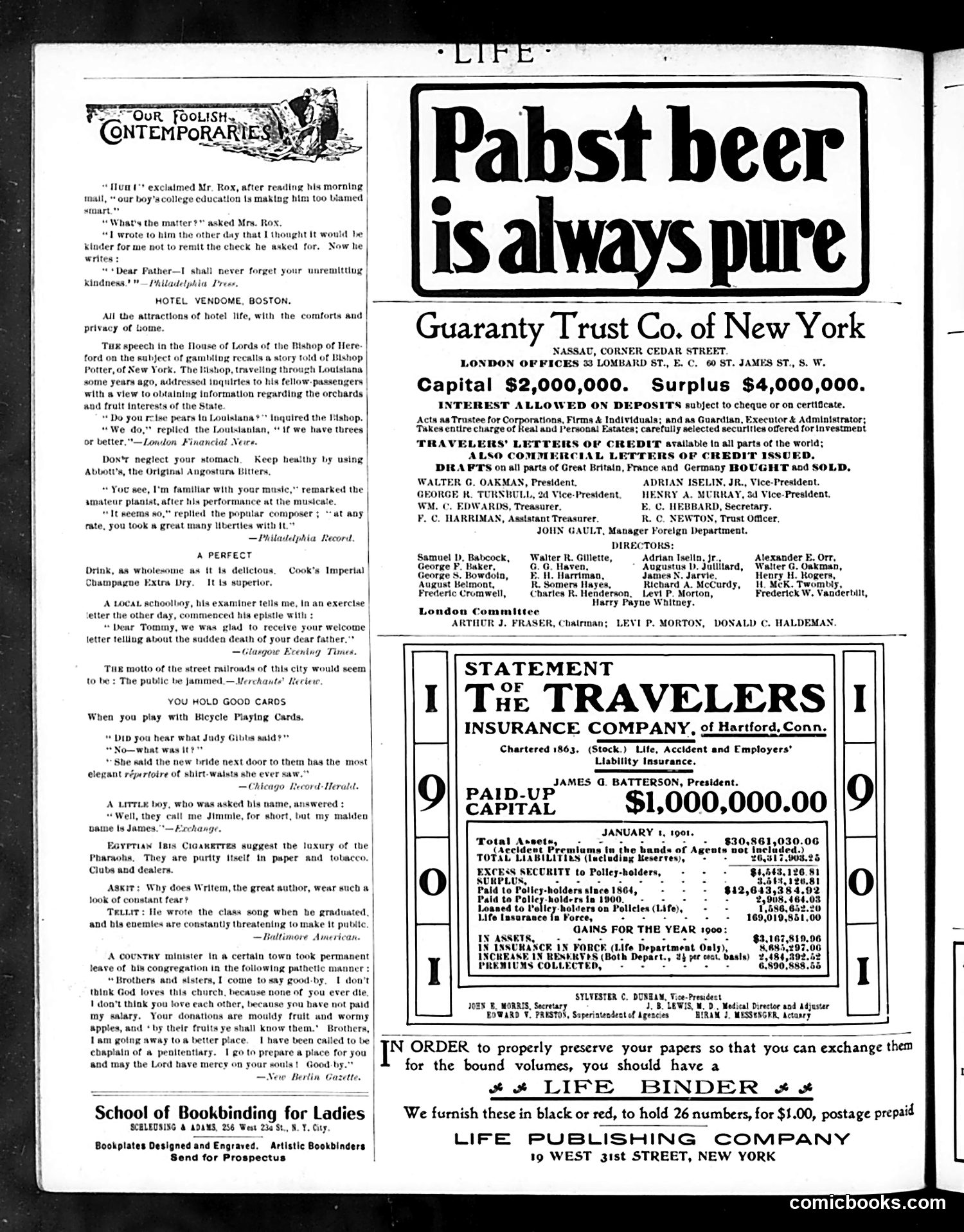
This page from **Life** magazine (appears to be early 1900s based on styling) is primarily a **collection of brief humorous anecdotes and advertisements** rather than political cartoons. The small cartoon "Our Foolish Contemporary" at top-left uses visual satire—a figure appears entangled or foolish—to mock something contemporary, though the specific target is unclear from the visible text. The bulk of the page consists of **short jokes and witty observations** about everyday life: a father questioning his son's education, a bishop's wordplay about pears in Louisiana, complaints about street railroads jamming passengers, and a country minister's farewell sermon sarcastically comparing his congregation unfavorably to a penitentiary. These reflect typical *Life* magazine humor: gentle social criticism targeting education, religion, transportation, and domestic life rather than partisan politics. The large advertisements (Pabst Beer, Guaranty Trust Co., The Travelers Insurance Company, and bookbinding school) indicate this was a commercial publication relying heavily on paid content. **No specific political figures or events are clearly identifiable** on this page.
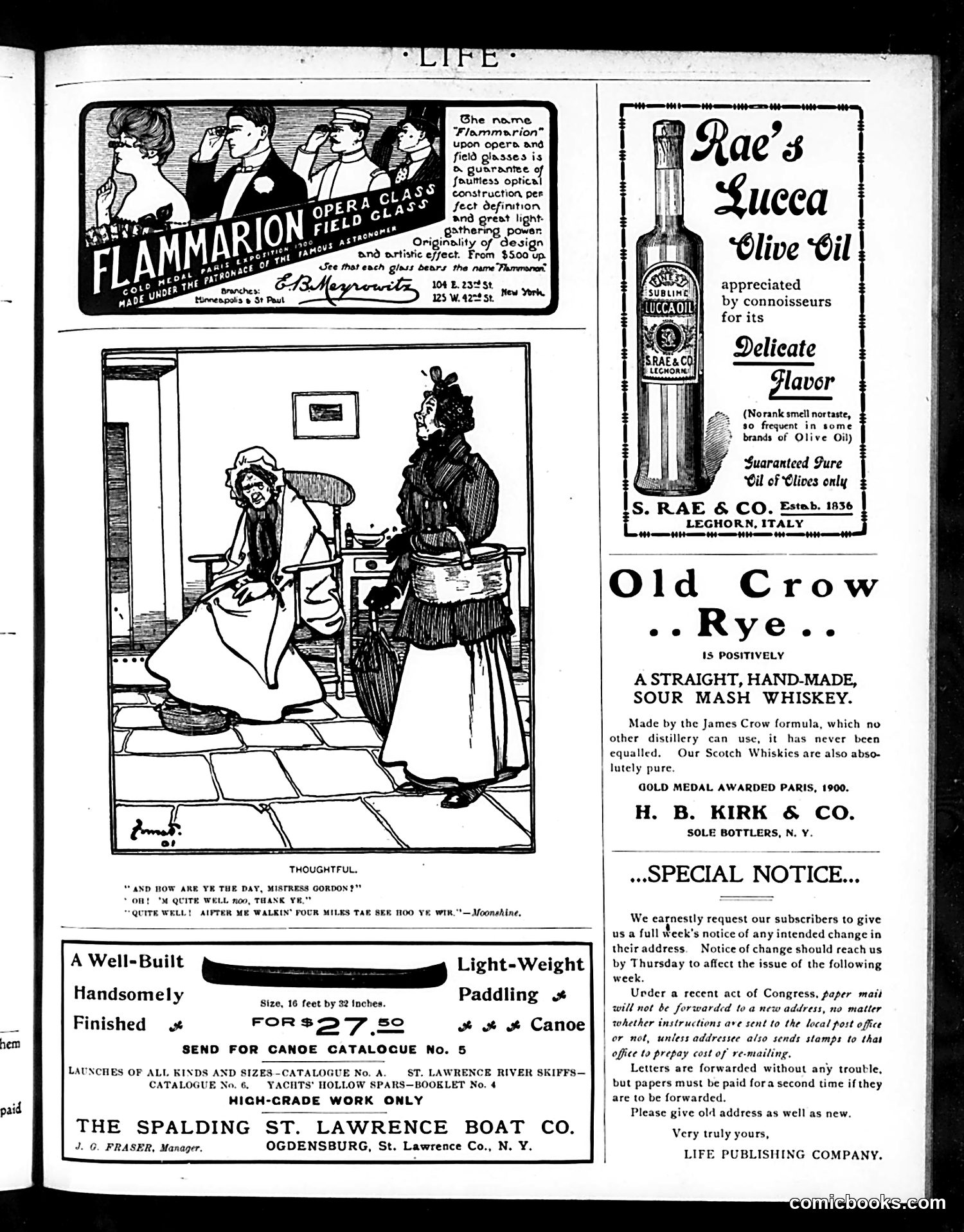
This page contains **primarily advertisements** interspersed with one cartoon. The main cartoon, titled "Thoughtful," depicts an Irish domestic servant and her mistress in conversation. The servant reports she is "quite well" despite having walked "four miles" to see someone ("Ye Wik"), attributed to *Moonshine* magazine. The humor relies on ethnic/class stereotyping common to the era—the servant's dialect and the contrast between her exhaustion and cheerful demeanor. This reflects early 20th-century American attitudes toward Irish immigrant workers, presented as comedic fodder. The advertisements promote luxury goods (Flammarion opera glasses, canoes, olive oil, whiskey) typical of *Life's* affluent readership. The page is primarily commercial content rather than political satire, reflecting *Life's* dual role as humor magazine and advertising vehicle.
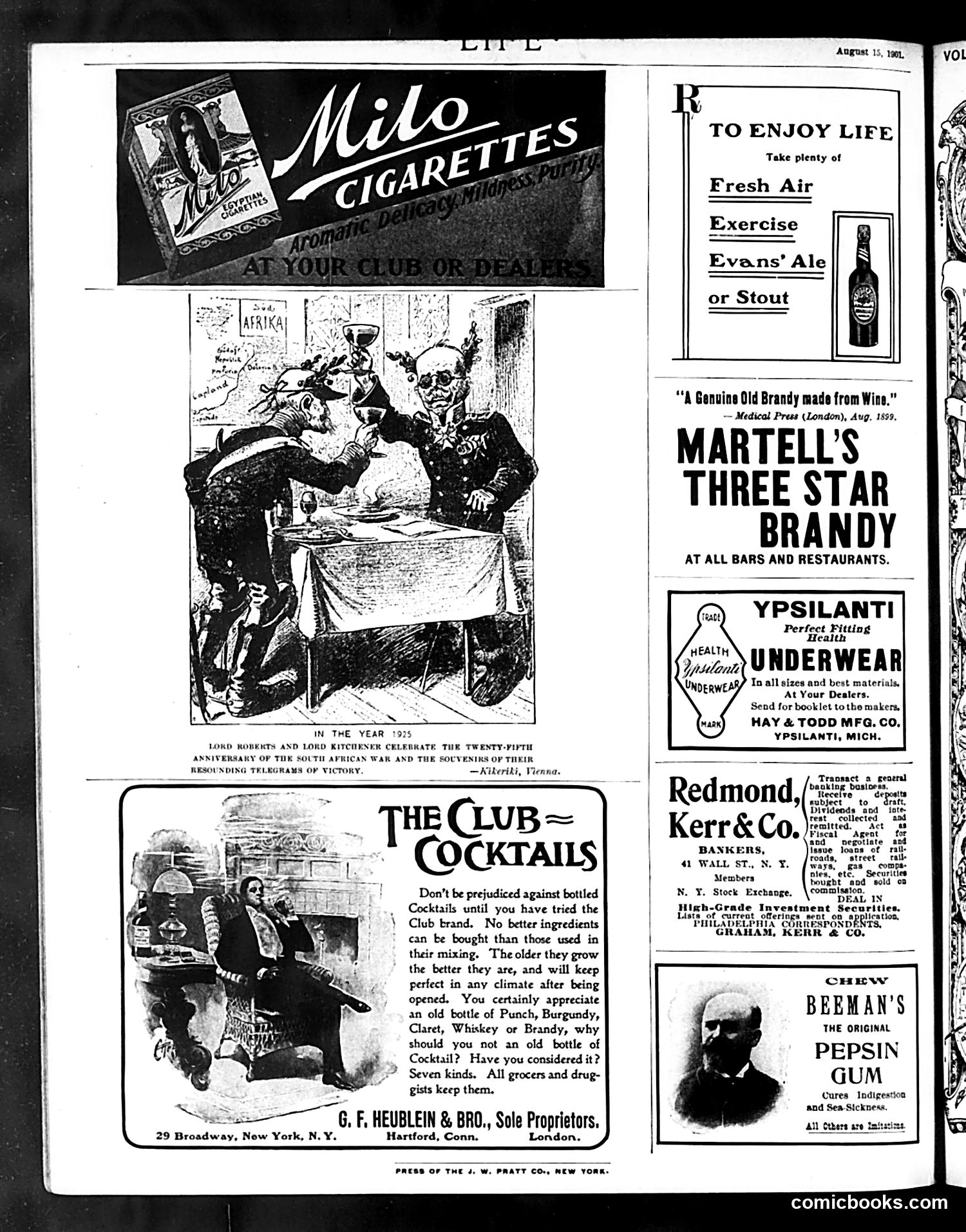
The main cartoon satirizes British imperial nostalgia. It depicts **Lord Roberts and Lord Kitchener**—famous British military commanders from the Boer War (1899-1902)—celebrating the war's 25th anniversary in 1925. The caption credits the Viennese satirical magazine *Kikeriki*. The joke mocks how these aging generals sentimentally reminisce over old "telegrams of victory," treating wartime communications as cherished souvenirs. By 1925, the Boer War was already distant history, and the cartoon likely critiques British militarism and the glorification of colonial conflict. The figures' caricatured elderly appearance emphasizes how they cling to past glories rather than addressing present concerns. The remaining content is advertising (cigarettes, brandy, cocktails, underwear, banking services, and chewing gum)—typical of *Life* magazine's revenue model. The page reflects early 1920s consumer culture and leisure marketing.