
Life, 1901-08-15 · page 6 of 20
Life — August 15, 1901 — page 6: what you’re looking at
What you’re looking at
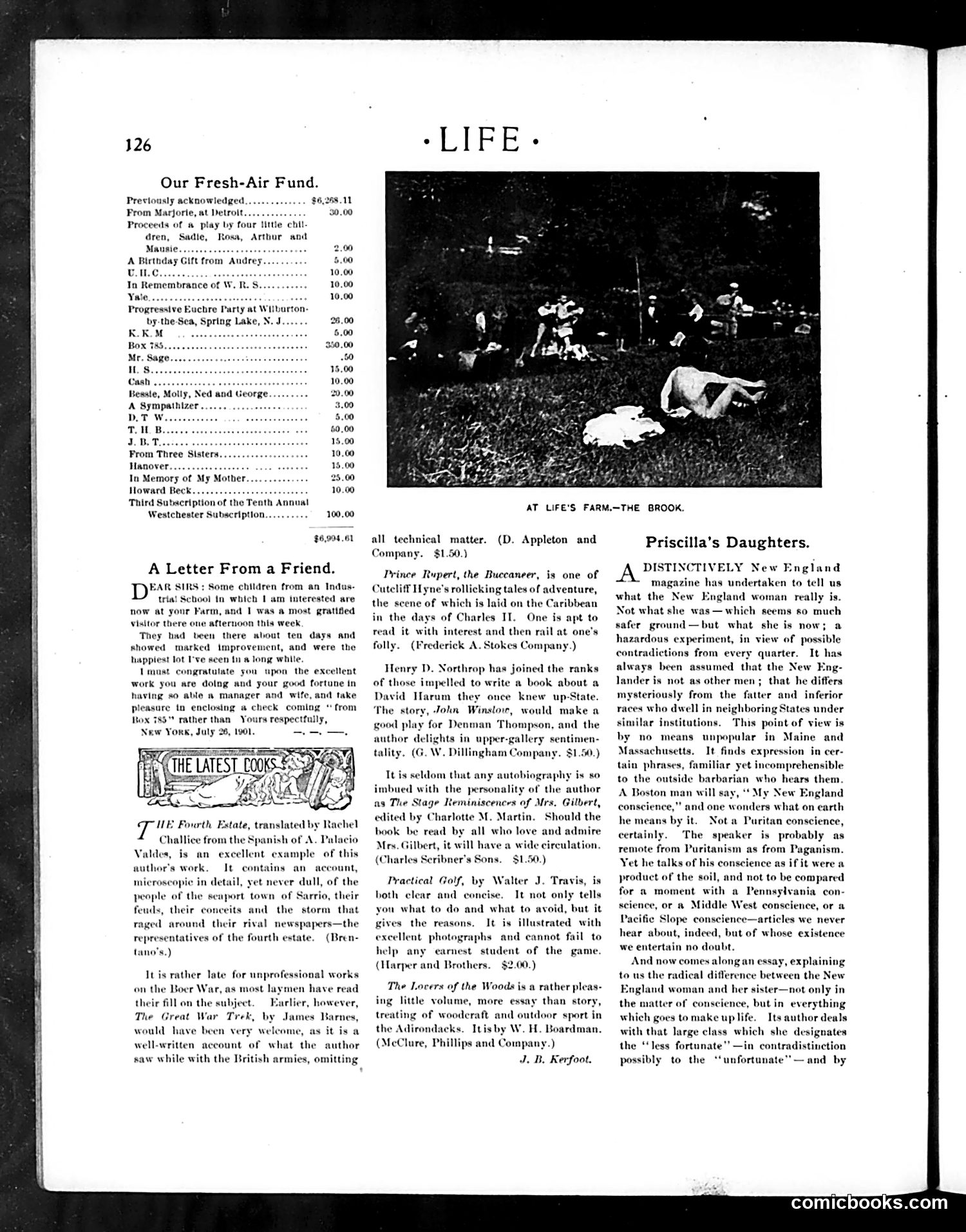
The main image shows a pastoral scene titled "At Life's Farm—The Brook," depicting people relaxing outdoors by a stream. This appears to be an illustrative photograph rather than a political cartoon, showcasing leisure and nature in an idealized, peaceful setting. The page primarily contains book reviews and a fund-raising list for the "Fresh-Air Fund"—a charitable organization providing outdoor recreation for urban children. The text discusses new publications including works on war, golf, and New England society. The article "Priscilla's Daughters" examines what defines the modern New England woman, contrasting her with historical Puritan ancestors while exploring regional identity and character. This is largely non-satirical editorial and literary content rather than political commentary.
📄 Transcribed text from this page (OCR, searchable)
Machine-transcribed from the original scan — historical spelling and the odd misread are preserved.
126 Our Fresh-Air Fund. Previously acknowledged............ From Marjorie, at Detroit Proceeds of # play by four tittle chil. dren, Sadie, Arthur and Mausie......... — A Birthday Gift from Audrey. In Remembrance of W, R. S..... Progressive Euchre Party at W by-the-Sea, Spring Lake, N ROK TB cca sevceesecses Mr. Sage....... Ls. Cash . $6,288.11 30.00 Rosa, Besste, Molly, Ned and George. A Sympathizer...... Hanoverssicesssercesiee In Memory of My Mother. Howard Beck.......-..+ Third Subscription of the Tenth Annual Westchester Subscription.......... 100. $6,998 A Letter From a Friend. DEAE SIRS: Some children from an Indus- tria! School In which fam tnterested are now at yonr Farm, and 1 was a most gratified visitor there one afternoon this week They bad been there about ten days and showed marked improvement, and were the happiest lot I've seen fn a long while. Tmust congratulate you upon the excellent work you are doing and your good fortune in having so able a manager and wife, and take pleasure tn enclosing check coming “from Hox 785" rather than Yours respectfully, ew YORK, July 26, 1901. TER eae (THE LATEST C " Challice from the Spanish of A. Palacio Valdes, is an excellent example of this author's work. It n det tains an account, yet never dull, of the people of the seaport town of Sarrio, their ls, their conceits and the storm that raged around their rival newspapers—the representatives of the fourth estate. (Bren- It is rather late for unprofessional works on the Boer War, as most lay their fill on the subject The Great War Trek, by James Barnes, would have been very welcome, as it is a well-written account of what th en have read Earlier, however, author saw while with the British armies, omitting AT LIFE'S FARM.—THE BROOK. all technical matter. Company. $1.50.) (D. Appleton and Prince Rupert, the Buccaneer, is one of Cutcliff Hyne’s rollicking tales of adventure, the scene of which is laid on the Caribbean in the days of Charles IT. One is apt to read it with interest and then rail at one’s folly. (Frederick A. Stokes Company.) Henry D. Northrop has joined the ranks of those impelled to write a book about a avid Harum they once knew up-State. he story, John Winslow, would make a I play for Denman Thompson, and the author delights in upper-gallery sentimen- tality. (G. W. Dillingham Company. $1.50.) Tt is seldom that any autobiography is so imbued with the personality of the author as The Stage Reminiscences of Mrs. Gilbert, edited by Charlotte M. Martin. Should the book be read by all who love and admire Mrs. Gilbert, it will have a wide circulation, (Charles Scribner's Sons. $1.50.) Practical Golf, by Walter J. Travis, is both clear and It not only tells you what to do and what to avoid, but it gives the reasons. It is illustrated with excellent photographs and cannot fail to help any earnest student of the game. (ILarper and Brothers. $2.00.) The Lovers of the Woods is a rather pleas- ing little volume, more essay than story, treating of wooderaft and outdoor sport in the Adirondacks. Itisby W. H. Boardman, (McClure, Phillips and Company.) J.B. Kerfoot. Priscilla’s Daughters. DISTINCTIVELY New England magazine has undertaken to tell us what the New England woman really is. Not what she was— which seems so much safer ground—but what she is now; a hazardous experiment, in view of possible contradictions from every quarter. It has always been assumed that the New Eng- lander is not as other men; that he differs mysteriously from the fatter and inferior races who dwell in neighboring States under similar institutions. This point of view is by no means unpopular in Maine and Massachusetts. It finds expression in cer- tain phrases, familiar yet incomprehensible to the outside barbarian who hears them. A Boston man will say, “My New England conscience,” and one wonders what on earth he means by it. Not a Puritan conscience, certainly. The speaker is probably as remote from Puritanism as from Paganism. Yet he talks of his conscience as if it were a product of the soil, and not to be compared for a moment with a Pennsylvania con- science, or a Middle West conscience, or a Pacific Slope conscience—articles we never hear about, indeed, but of whose existence we entertain no doubt. And now comes along an essay, explaining to us the radical difference between the New England woman and her sister—not only in the matter of conscience, butin everything which goes to make up life. Its author deals with that large class which she designates the “less fortunate" —in contradistinction possibly to the ‘unfortunate —and by comicbooks.com