
Life, 1901-08-15 · page 4 of 20
Life — August 15, 1901 — page 4: what you’re looking at
What you’re looking at
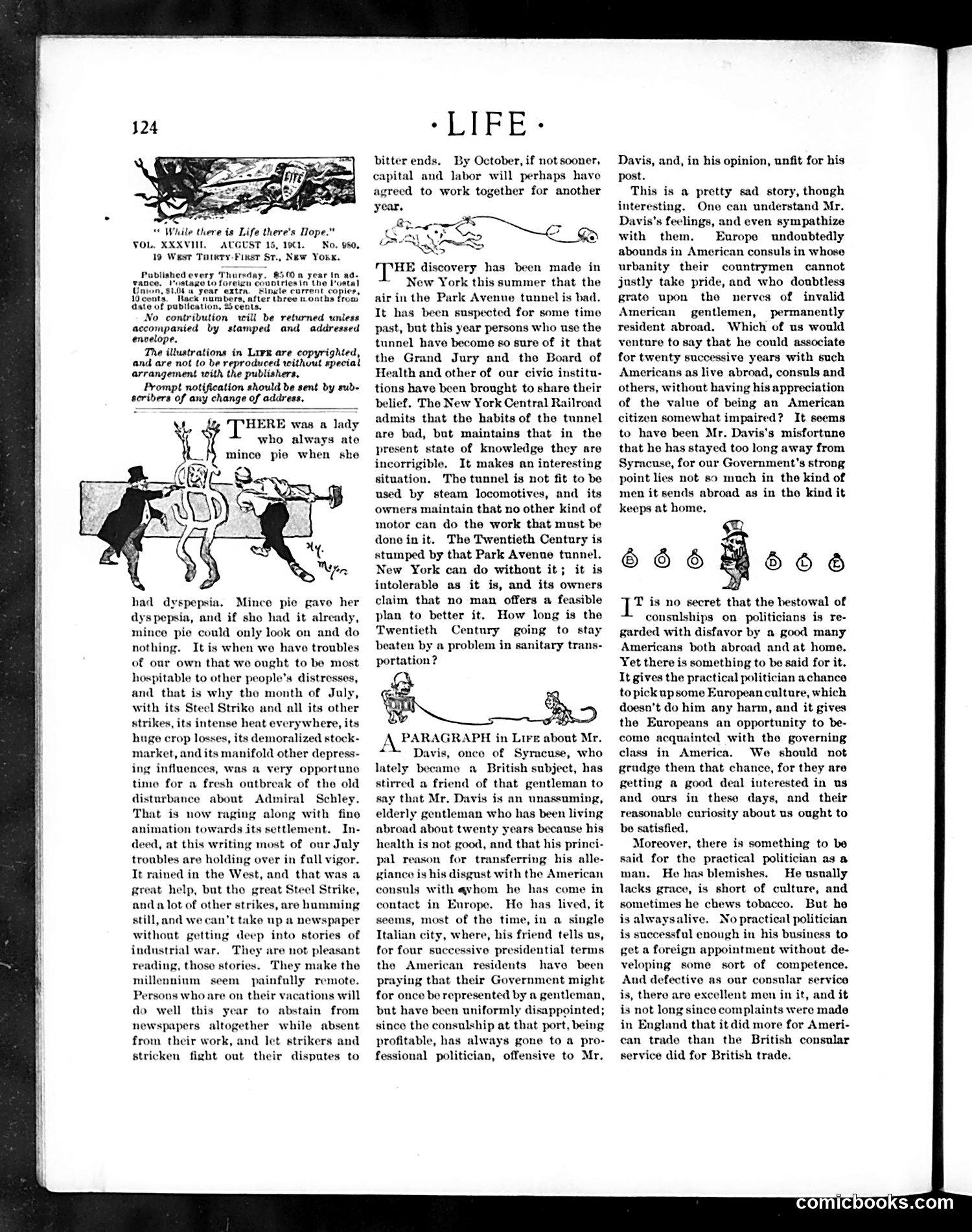
The cartoon depicts **a lady who "who always had dyspepsia"** being violently jolted by a mince pie, while a man in formal dress and another figure interact nearby. The illustration satirizes the physical digestive distress caused by rich foods. The accompanying text discusses **Mr. Davis of Syracuse**, who became a British subject and is now living abroad in Italy. The article critiques American consuls abroad, suggesting they lack the business acumen of British counterparts. It argues that practical politicians should be appointed to consular positions to better serve American commercial interests—a jab at what Life viewed as ineffectual diplomatic appointments of the era. The overall theme addresses both personal indulgence and diplomatic competence.
📄 Transcribed text from this page (OCR, searchable)
Machine-transcribed from the original scan — historical spelling and the odd misread are preserved.
"While there is Life there's Hope.” VOL. XXXVI, AUGUST 15, 1901. No. 980, 19 West Totety-Fikst St., New Youx. Published every Thursday. 8500 year in ad- ance. Hostage to foreizu countries in the lostal U1 SLOG u year extra. Single current copier, tp. ltack numbers. after three s.onths from Gato of publication. sects. No contribution will be returned unless accompanied by stamped and addressed envelope. The illustrations in Lxve are copyrighted, and are not to be reproduced withuut special arrangement with the publishers. Prompt notification should be sent by sub- seribera of any change of address. HERE was a lady who always ate mince pie when she had dyspepsia, Mince pie gavo her dyspepsia, and if sho had it already, mince pie could only look on and do nothing. It is when we have troubles of our own that we ought to be most hospitable to other people’s distresses, and that is why tho month of July, with its Steel Strike and all its other strikes, its intense heat everywhere, its huge crop losses, its demoralized stock- market, and its manifold other depress- ing influences, was a very opportune time for a fresh outbreak of the old disturbance about Admiral Schley. That is now raging along with fine animation towards its settlement. In- deed, at this writing most of our July troubles are holding over in full vigor. It rained in the West, and that was a great help, but the great Steel Strike, anda lot of other strikes, are hamming still, and we can’t take up a newspaper without getting deep into stories of industrial war. They are not pleasant reading, those stories. They make the millennium seem painfully remote. Persons who are on their vacations will do well this year to abstain from newspapers altogether while absent from their work, and let strikers and stricken fight out their disputes to LIFE bitter ends. By October, if not sooner, capital and labor will perhaps have agreed to work together for another year, THE eorex has been made in New York this summer that the airinthe Park Avenue tunnel is bad. It has been suspected for some time past, but this year persons who use the tunnel have become so sure of it that the Grand Jury and the Board of Health and other of our civic institu- tions have been brought to share their belief. The New York Central Railroad admits that the habits of the tunnel are bad, but maintains that in the present state of knowledge they are incorrigible. It makes an interesting situation. The tunnel is not fit to be used by steam locomotives, and its owners maintain that no other kind of motor can do the work that must be done init. The Twentieth Century is stumped by that Park Avenue tunnel. New York can do without it; it is intolerable as it is, and its owners claim that no man offers a feasible plan to better it. How long is the Twentieth Century going to stay beaten by a problem in sanitary trans- portation? A PAR AGRAPH in Lire about Mr. = yuvis, onco of Syracuse, who lately became a British subject, has stirred a friend of that gentleman to say that Mr. Davis is an unassuming, elderly gentleman who has been living abroad about twenty years because his health is not good, and that his princi- pal reason for transferring his alle- giance is his disgust with the American consuls with qvhom he has come in contact in Europe. Ho has lived, it seems, most of the e, in a single Italian city, where, his friend tells us, for four successive presidential terms the American residents have been praying that their Government might for once be represented by a gentleman, but have been uniformly disappointed; since the consulship at that port, being profitable, has always gone to a pro- fessional politician, offensive to Mr. Davis, and, in his opinion, unfit for his post. This is a pretty sad story, though interesting, One can understand Mr. Davis's feelings, and even sympathize with them. Europe undoubtedly abounds in American consuls in whose urbanity their countrymen cannot justly take pride, and who doubtless grate upon the nerves of invalid American gentlemen, permanently resident abroad. Which of us would venture to say that he could associate for twenty successive years with such Americans as live abroad, consuls and others, without having his appreciation of the value of being an American citizen somewhat impaired? It seems to have been Mr. Davis's misfortune that he has stayed too long away from Syracuse, for our Government's strong point lies not so much in the kind of men it sends abroad as in tho kind it keeps at home, 666 56 6 T is no secret that the bestowal of consulships on politicians is re- garded with disfavor by a good many Americans both abroad and at home. Yet there is something to be said for it. It gives the practical politician achance topick upsome European culture, which doesn't do him any harm, and it gives the Europeans an opportunity to be- come acquainted with the governing class in America. We should not grudge them that chance, for they are getting a good deal interested in us and ours in these days, and their reasonable curiosity about us ought to be satisfied. Moreover, there is something to be said for the practical politician as a man. He has blemishes. He usually lacks grace, is short of culture, and sometimes he chews tobacco. But he is alwaysalive. No practical politician is successful enough in his business to get a foreign appointment without de- veloping some sort of competence. And defective as our consular servico is, there are excellent men in it, and it is not long since complaints were made in England that it did more for Ameri- can trade than the British consular service did for British trade. comicbooks.com