
A complete issue · 20 pages · 1901
Life — January 10, 1901
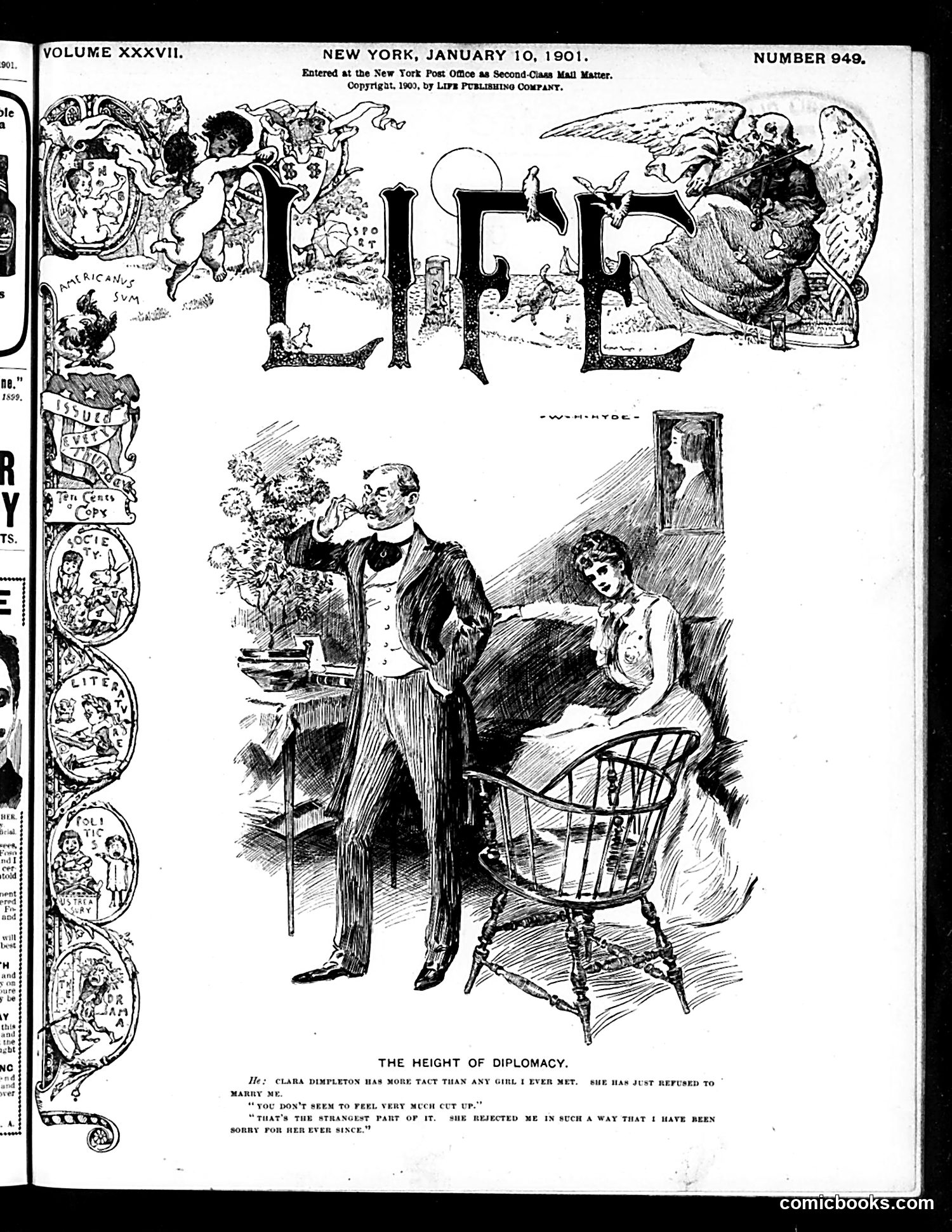
This cartoon satirizes a romantic rejection. The caption reveals that Clara Dimpleton has refused a marriage proposal from the gentleman suitor, who attempts to downplay his hurt feelings. His dialogue ("You don't seem to feel very much cut up") contrasts with his actual emotional state—he's holding flowers and appears dejected while she sits in a chair, seemingly unmoved. The satire mocks male courtship conventions of the Edwardian era, particularly the tension between masculine pride and romantic vulnerability. The term "diplomacy" in the title ironically refers to his clumsy attempt to maintain composure after rejection. The cartoon critiques both his transparent pretense and the power dynamics of courtship during this period.
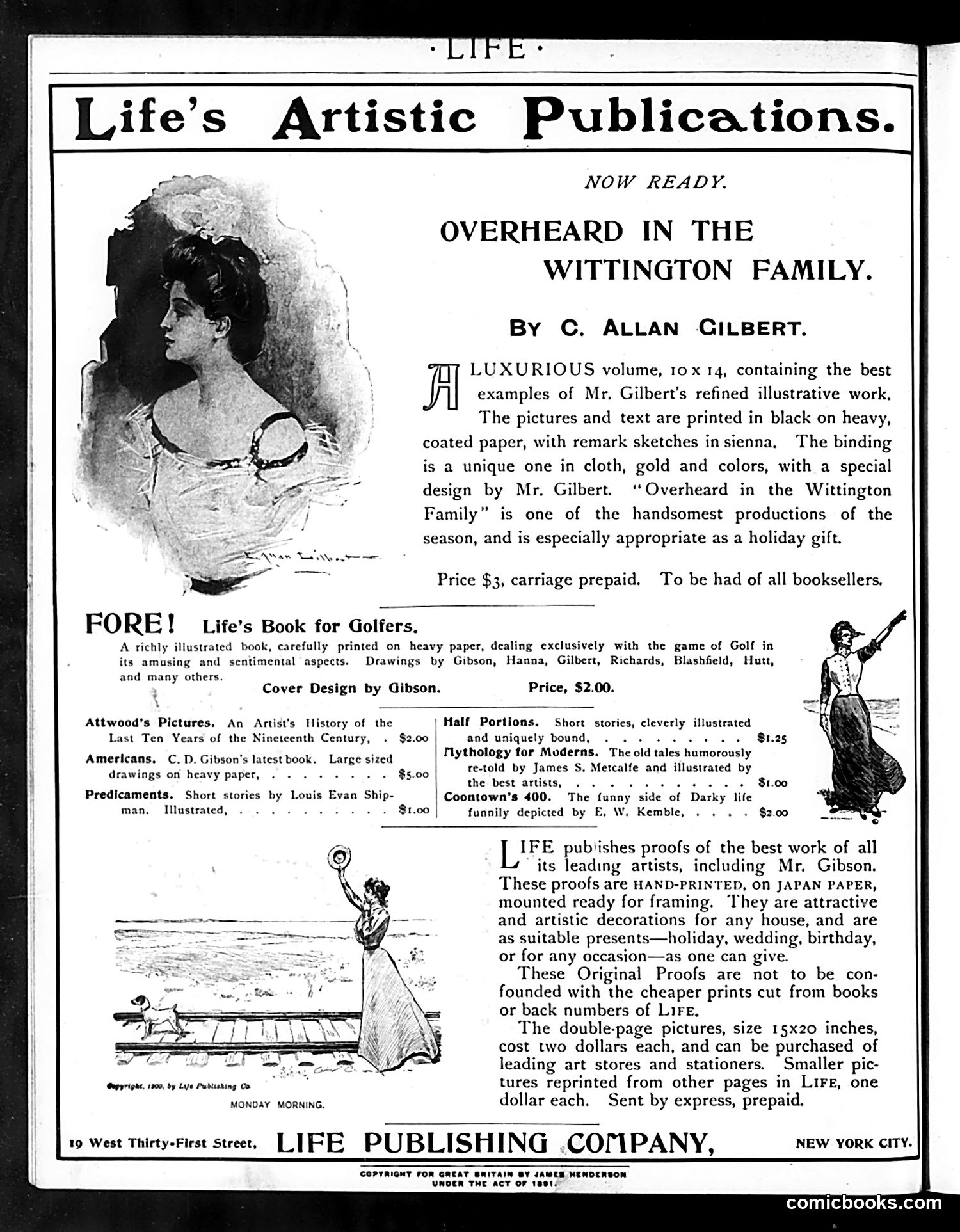
This page is primarily **advertising for Life Publishing Company's artistic publications** rather than political satire or comics. The main advertisement promotes "Overheard in the Wittington Family" by C. Allan Gilbert—a luxury illustrated book ($3, carriage prepaid). Gilbert was evidently a respected illustrator of the era. Below are listings for other Life publications: "Life's Book for Golfers" (cover design by Gibson, $2), plus various other illustrated books and short story collections at modest prices ($1-$3). The page also advertises Life's art proofs—hand-printed reproductions suitable for framing, available in multiple sizes at one to two dollars each. The small illustration labeled "MONDAY MORNING" appears to be sample artwork, likely demonstrating the quality of Life's published illustrations. This is essentially a **catalog page showcasing Life's publishing ventures** in fine books and art reproductions.
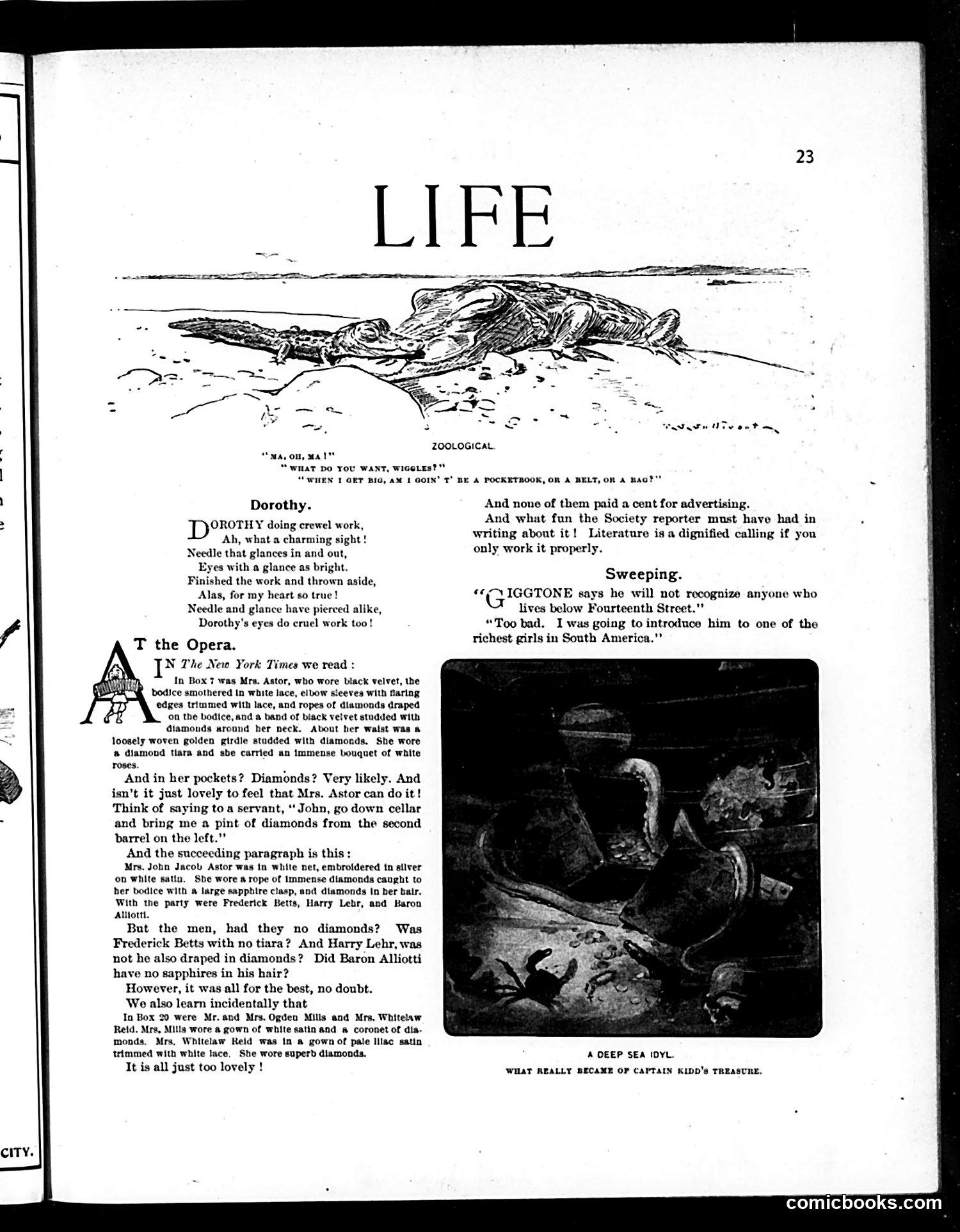
This page contains three satirical pieces typical of early 20th-century Life magazine: 1. **"Dorothy"** - A poem mocking a woman named Dorothy, criticizing her affected mannerisms and superficial charm at social events. 2. **"At the Opera"** - Social satire about wealthy attendees at the New York Times opera box, focusing on ostentatious diamond displays by Mrs. Astor and other socialites. The humor lies in mocking the conspicuous consumption and competitive jewelry-wearing among the elite. 3. **"Sweeping"** - A brief joke about someone named Giggone refusing to associate with anyone living below Fourteenth Street (an exclusive Manhattan neighborhood boundary). 4. **"A Deep Sea Idyl"** - An illustration captioned as "What Really Became of Captain Kidd's Treasure," showing what appears to be underwater discovery or decay. The page reflects Life's focus on satirizing wealthy society's pretensions and status-consciousness.
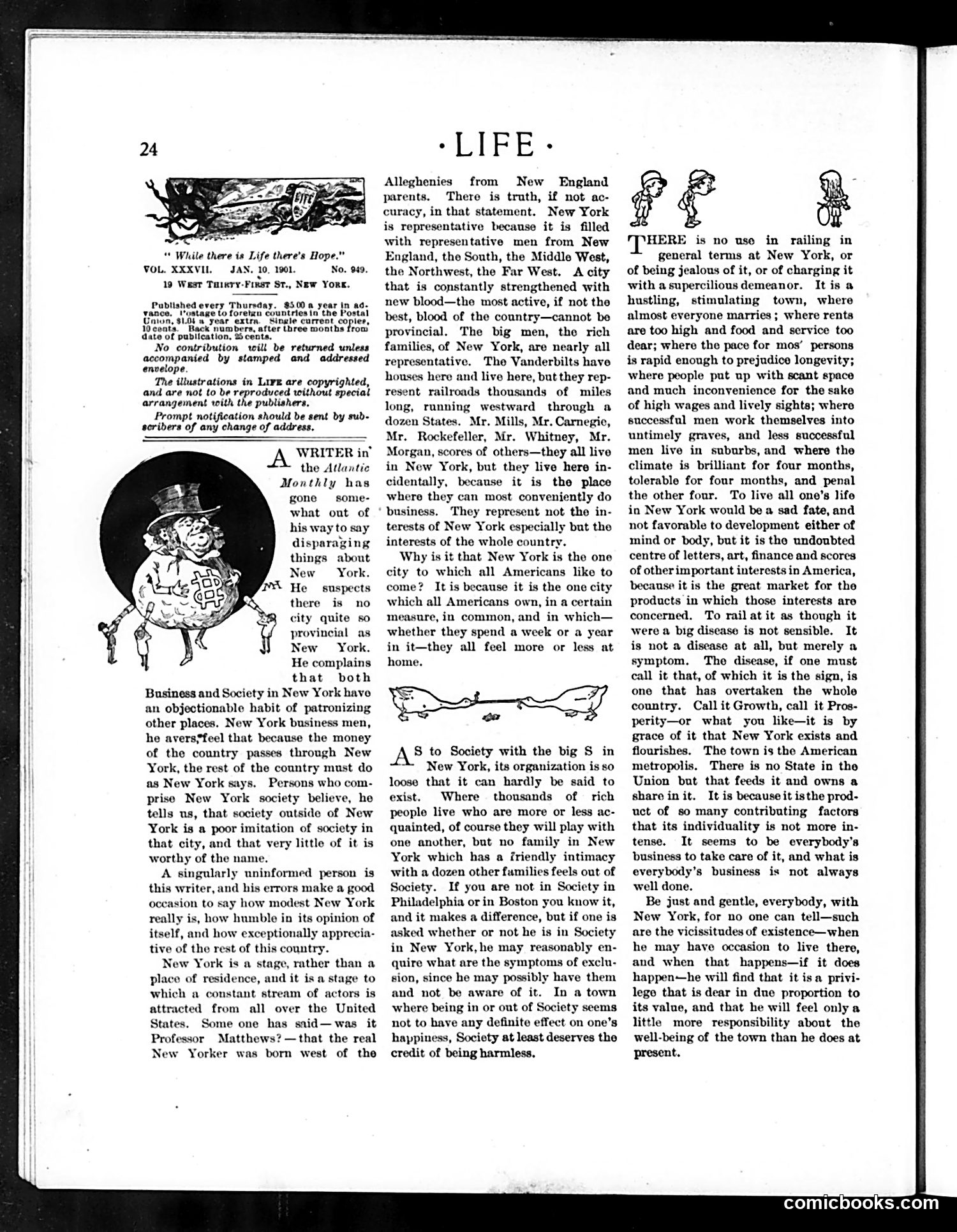
The page contains two main elements: **Left side:** A cartoon titled "While there is Life there's Hope" shows a rotund, well-dressed figure (appearing to represent a New York businessman or society type) looking somewhat dismayed or contemplative. The figure wears formal attire and a top hat, suggesting wealthy urban society. **Right side:** An article titled "A Writer in the Monthly" discusses New York's prominence as America's business and cultural center. The text argues that New York attracts ambitious people nationwide and represents American interests broadly, while acknowledging it has a reputation for being objectionable and patronizing toward other regions. The cartoon likely satirizes New York society's self-importance and pretensions, complementing the article's critique of how New Yorkers view themselves versus their actual influence on American life.
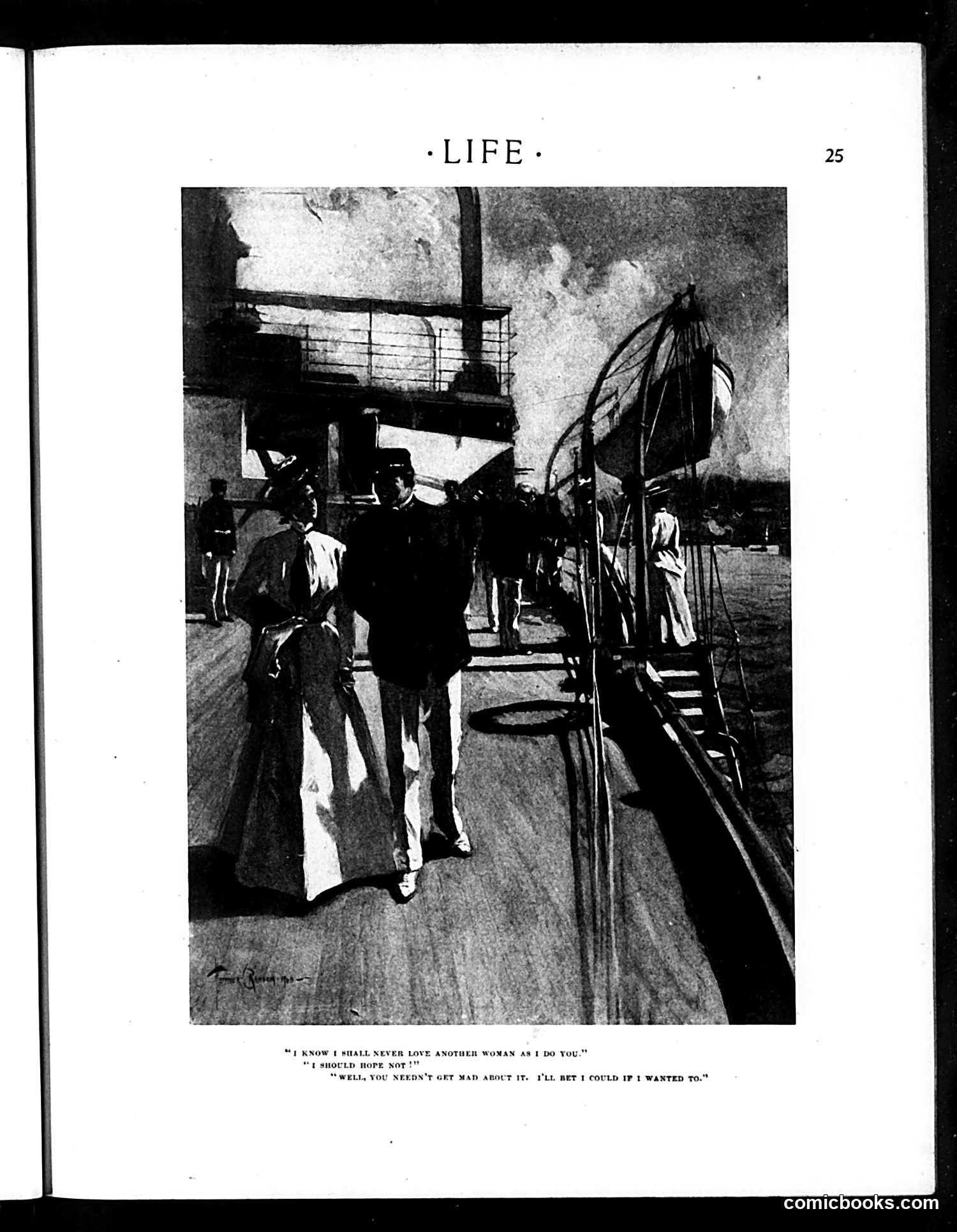
This appears to be a dramatic scene from a play or theatrical production, not a political cartoon. The image shows two figures in period costume on what looks like a ship's deck, with dialogue printed below: "I KNOW I SHALL NEVER LOVE ANOTHER WOMAN AS I DO YOU." "I SHOULD HOPE NOT!" "WELL, YOU NEEDN'T GET MAD ABOUT IT. I'LL BET I COULD IF I WANTED TO." The satire targets romantic melodrama and male infidelity—a common theme in early 20th-century popular entertainment. The joke mocks the protagonist's clumsy reassurance to his female companion, essentially admitting he *could* be unfaithful if he chose. This reflects period attitudes toward relationships and gender dynamics rather than political commentary.
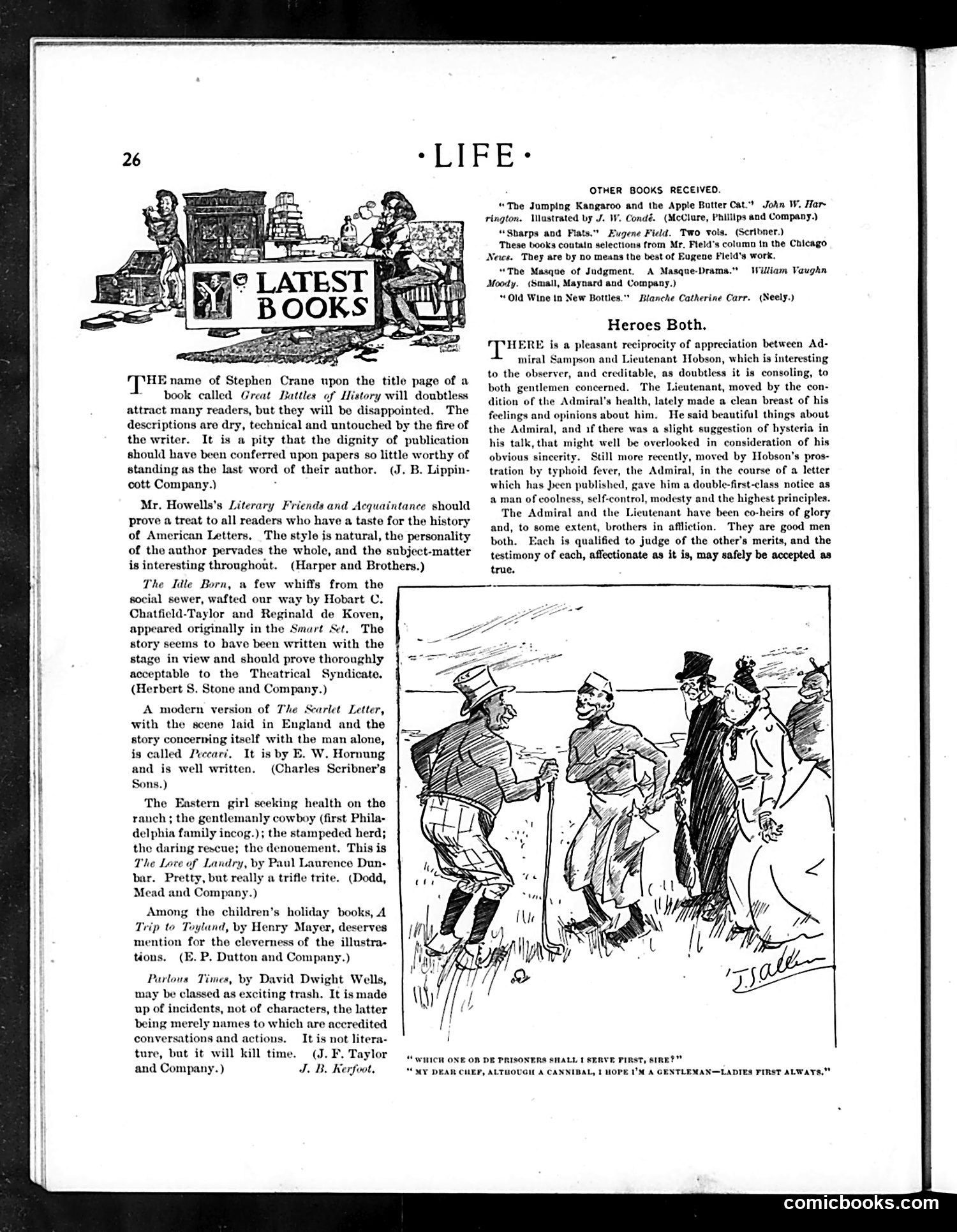
This page primarily reviews recently published books rather than presenting political satire. The main cartoon depicts a comedic scene with the caption addressing etiquette among gentlemen: "Which one of de prisoners shall I serve first, sir?" and "My dear chief, although a cannibal, I hope I'm a gentleman—ladies first always." The joke plays on Victorian social conventions—specifically the principle that gentlemen prioritize ladies' safety and comfort. The absurdist humor comes from applying these refined manners in an extreme, savage context (cannibals deciding whom to eat). This reflects turn-of-the-century satirical humor that found comedy in contrasting "civilized" behavior with primitive settings. The cartoon likely accompanies a book review on the page, though the specific literary connection isn't entirely clear from the visible text.
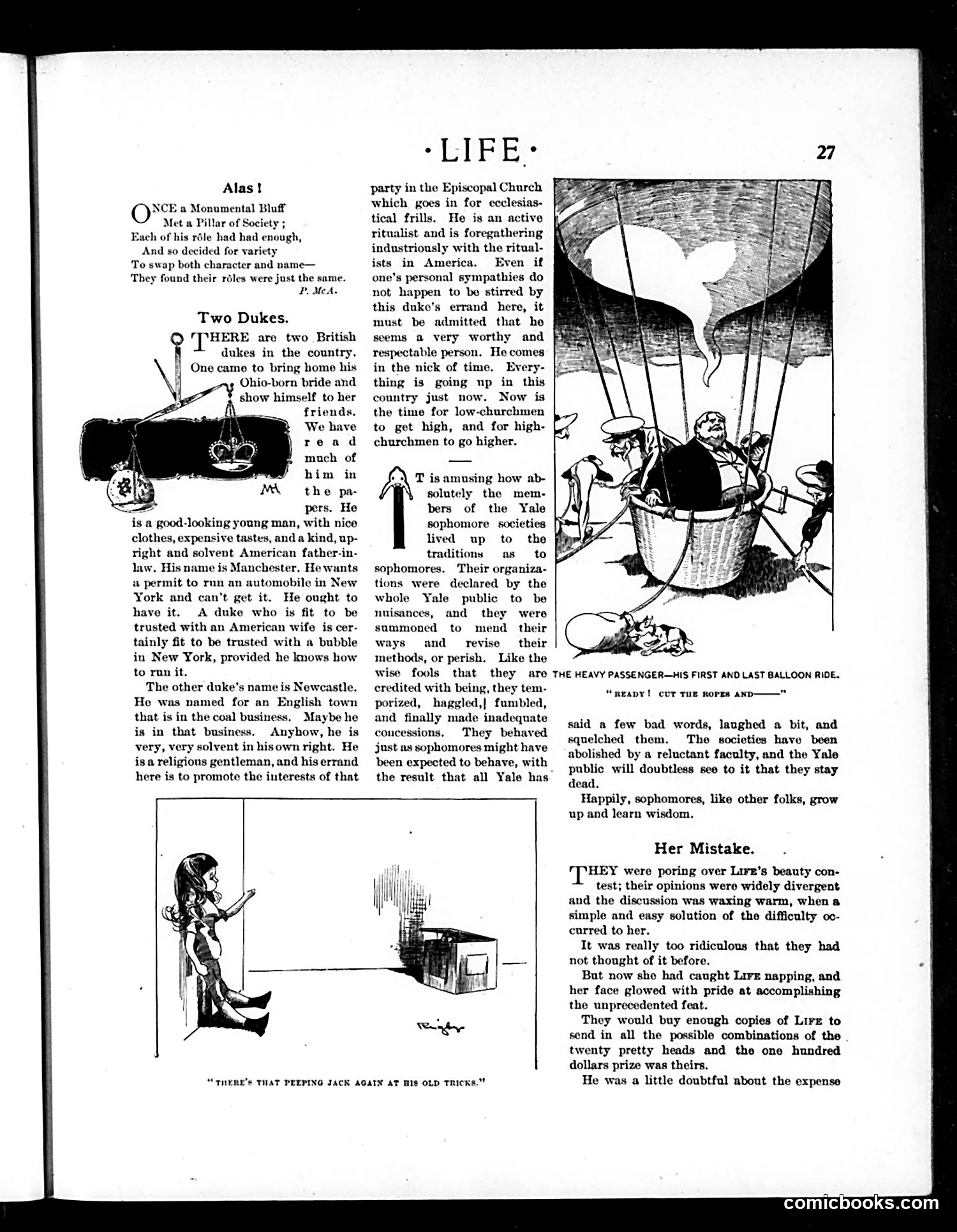
This 1920s *Life* page contains social satire about the American upper class. The main article "Two Dukes" mocks two British aristocrats visiting America—one named Manchester seeking an automobile permit in New York, the other Newcastle promoting ritualism in the Episcopal Church. The satire suggests these foreign nobles are out of touch and self-important. A secondary piece, "Her Mistake," ridicules Yale sophomore social societies. The satire notes these students absurdly believed *Life* magazine would help them win a beauty contest by purchasing enough copies to sway votes with "twenty pretty heads and one hundred dollars prize." The cartoon "There's that peeping Jack again at his old tricks" appears to show voyeurism, likely satirizing invasive behavior or scandal-mongering in high society. The humor targets class pretension and youthful naïveté.
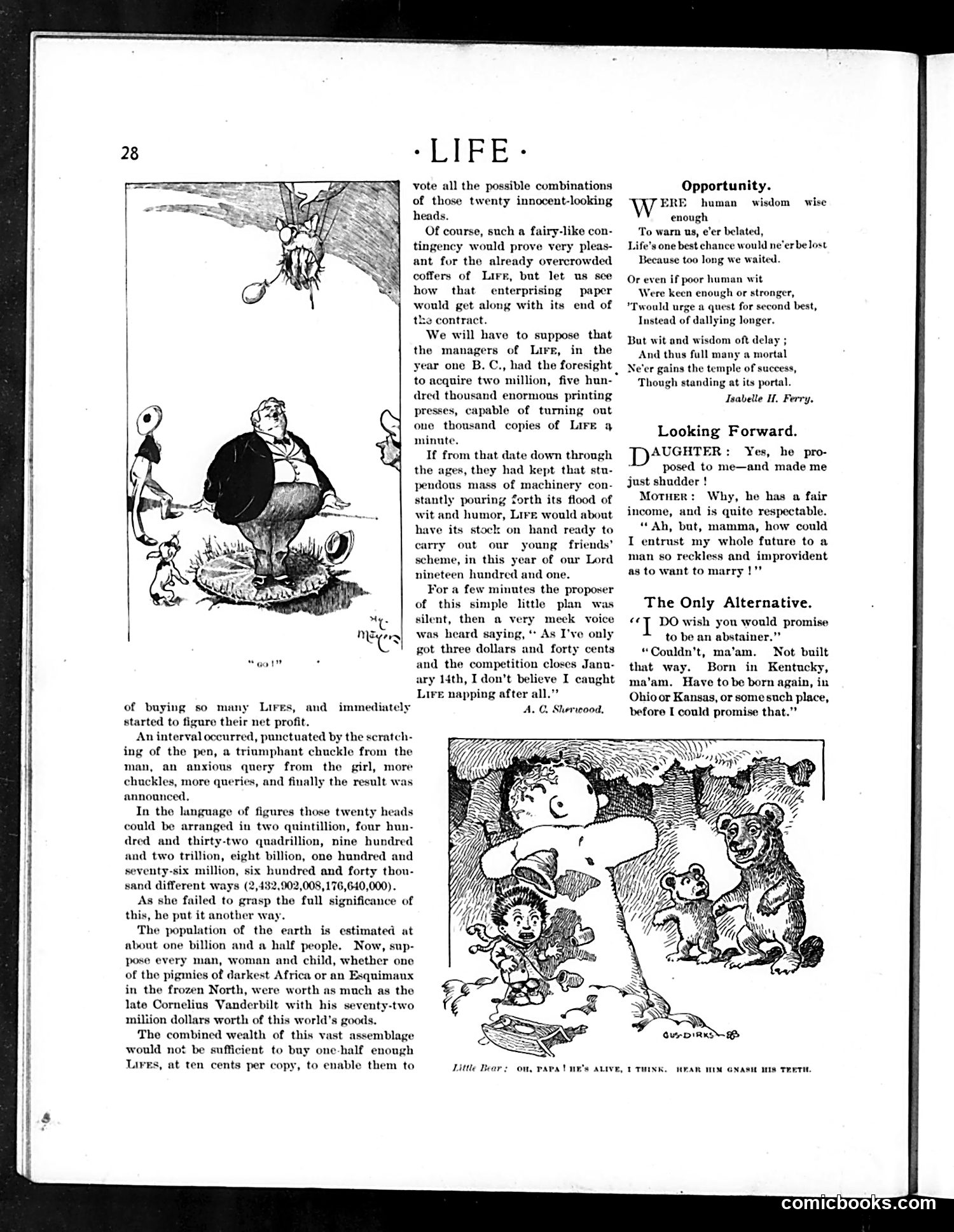
The main cartoon shows a portly man surrounded by small figures (appearing to be children or imps) with the caption "Go!" This satirizes a scheme to distribute LIFE magazines cheaply—the text mentions acquiring "two million, five hundred thousand enormous printing presses" to produce thousands of copies yearly. The satire mocks the impracticality of such mass production: the man represents magazine management grappling with an impossible business plan. The small figures likely represent the competition or chaos resulting from oversaturation. The right column contains three separate pieces: a poem on "Opportunity," a domestic dialogue titled "Looking Forward," and "The Only Alternative"—seemingly unrelated satirical vignettes about human ambition and limitation. The bottom illustration depicts a bear with cubs, captioned "Little Bear: 'On, Papa! He's alive, I think. Hear him gnash his teeth.'"—a humorous nature scene.
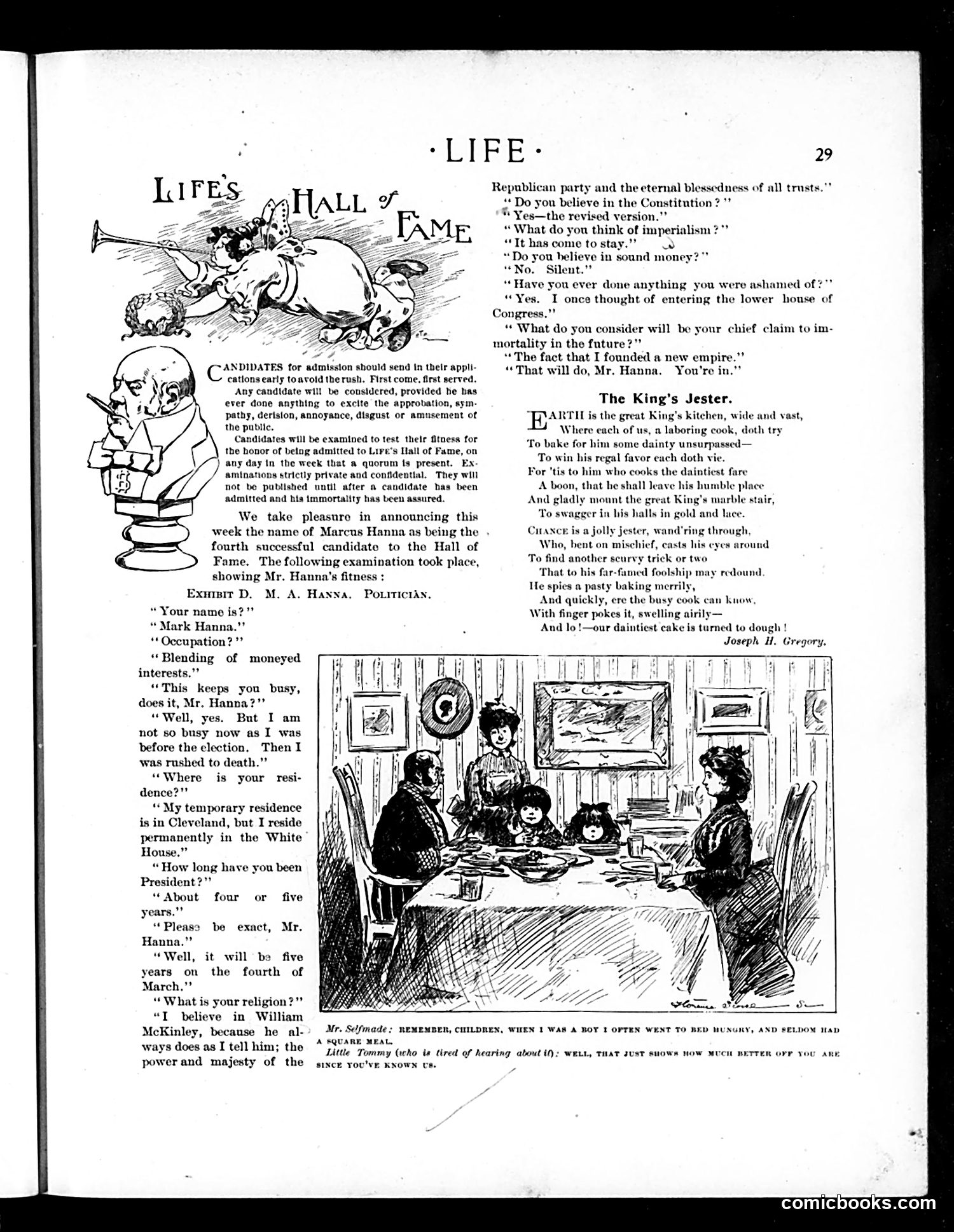
This page features "Life's Hall of Fame," satirizing Marcus Hanna's admission as a candidate. The upper left caricature depicts Hanna as a politician whose "monoeyed interests" keep him perpetually busy. The examination-style Q&A mocks his qualifications, questioning his beliefs in the Constitution, imperialism, and "sound money"—revealing shallow or evasive answers typical of Gilded Age political satire. "The King's Jester" poem below ridicules chance and corruption in politics, suggesting political advancement depends more on luck and favor than merit. The dinner scene illustration labeled "Mr. Schmads" appears to satirize social pretension, with a character boasting about improved circumstances since childhood. Overall, the page attacks wealthy industrialist influence in politics and the superficiality of political candidacy during the Progressive Era.
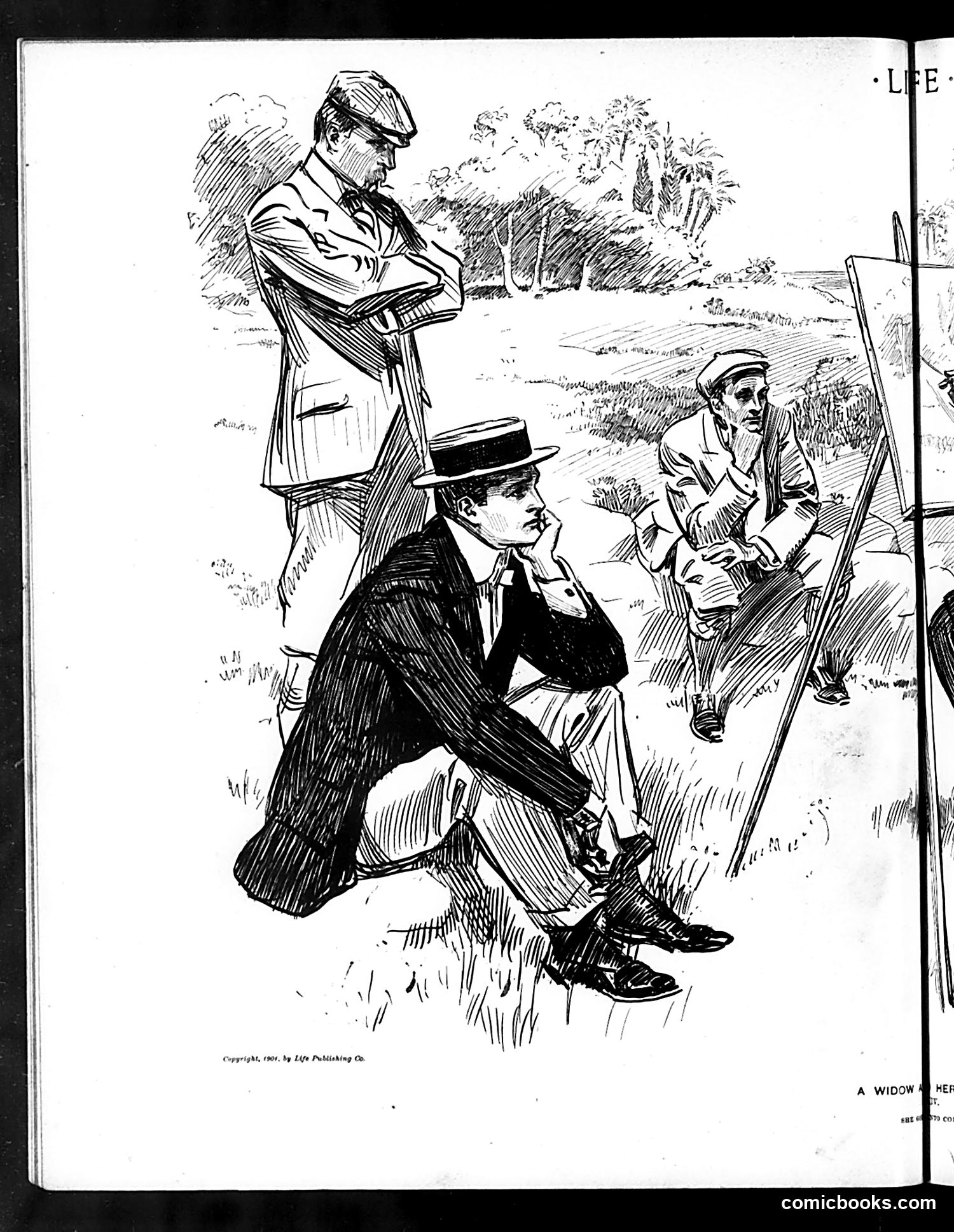
This appears to be a satirical cartoon from *Life* magazine (copyright 1907, per the visible text). The image shows three men in an outdoor setting: one standing prominently in a suit and cap, one seated in the foreground wearing a hat and appearing contemplative, and a third figure in the background. The partial caption visible reads "A WIDOW'S..." suggesting a domestic or relationship-themed satire, though the complete text is cut off. Without the full caption or additional context, the specific satirical point remains unclear. The cartoon's style and composition suggest social commentary on class, relationships, or contemporary behavior, but I cannot definitively identify the figures or the precise political/social reference intended without more information.
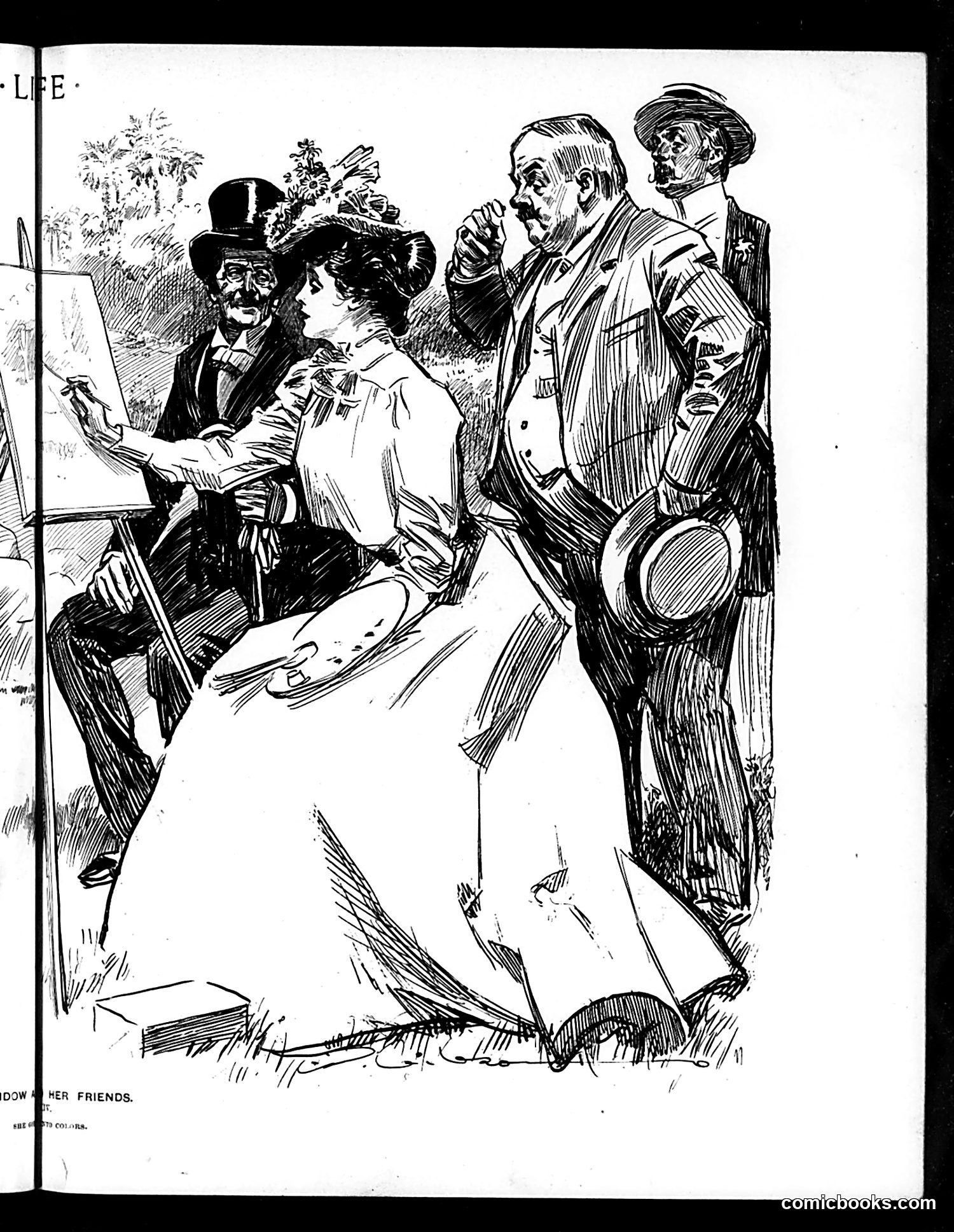
This Life magazine cartoon depicts a woman showing her artistic work to a group of men—likely friends or critics. The visible text reference to "HER FRIENDS" at the bottom suggests this is satirizing how a female artist presents her work to an audience. The humor appears to target either: (1) the pretentiousness of amateur female artists seeking validation, or (2) the patronizing attitudes of male viewers critiquing "lady artists." The woman holds what appears to be a palette and canvas, while the men's expressions—ranging from skeptical to politely interested—suggest they're offering the kind of genteel but insincere praise often given to women's creative endeavors in this era. The satire likely mocks either gender dynamics in the art world or amateur aestheticism among the leisure class.
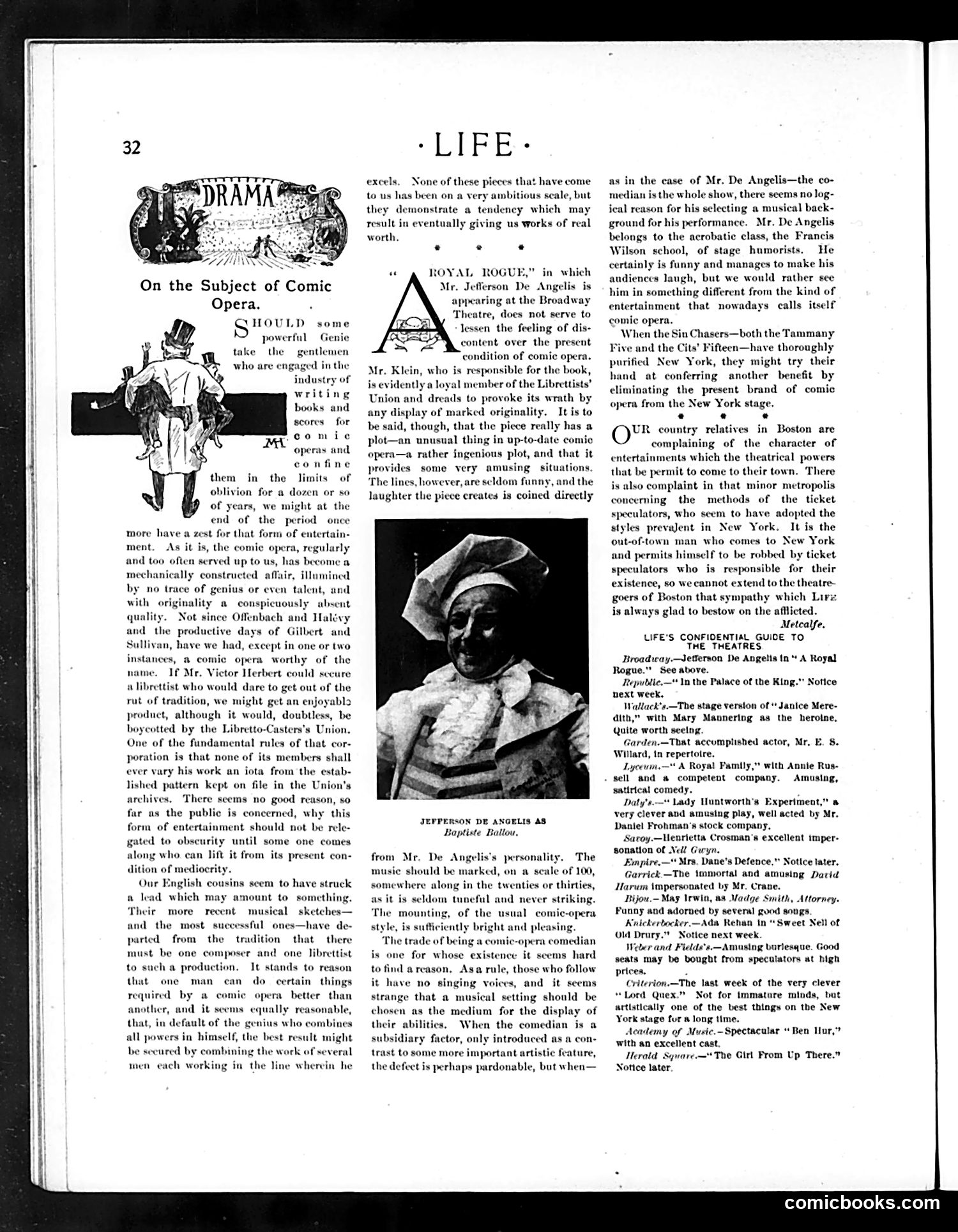
This satirical article critiques the state of comic opera in early 20th-century American theater. The illustration shows a caricatured figure in formal dress, appearing to represent a theatrical personality or composer associated with comic opera. The text argues that comic operas have become formulaic and mediocre—mechanically constructed rather than genuinely creative. The author criticizes that such works lack originality and wit, noting they're "limited by no trace of genius or great talent." A key complaint targets how comic opera has devolved into a commercial product controlled by theatrical unions and industry standards rather than artistic merit. The piece advocates for returning to tradition while lamenting that audiences accept inferior entertainment under the "comic opera" label. The review includes a section on Jefferson De Angelis performing in "A Royal Rogue," critiquing both the production and broader theatrical trends.
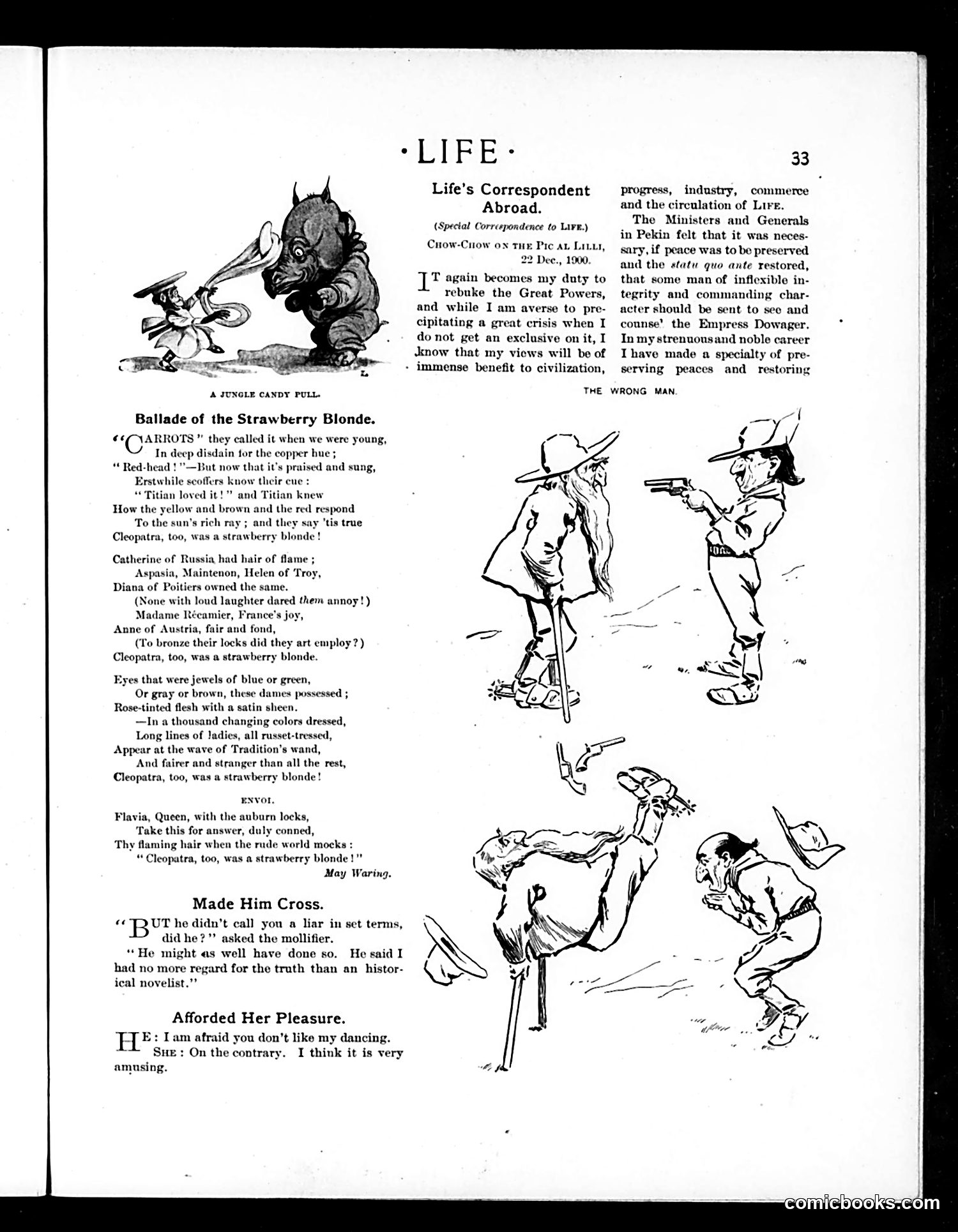
This page contains three separate satirical pieces: **"A Jungle Candy Pull"** (top left): A caricatured demon or devil figure—likely representing greed or vice—pulling taffy with another figure. The title suggests exploitation or corruption disguised as innocent activity. **"Ballade of the Strawberry Blonde"**: A poem celebrating red-haired women by comparing them to historical beauties (Cleopatra, Catherine of Russia, etc.). The satire appears to mock both the romanticization of physical traits and the revisionist history used to validate current fashion preferences—red hair was once mocked ("carrots") but is now praised. **"Life's Correspondent Abroad"** (right): A satirical piece dated December 2, 1900, during the Boxer Rebellion in China. The correspondent ironically claims expertise in preserving peace and restoring order in Peking, while cartoons show comically incompetent diplomats or military figures. The piece mocks American journalists and officials who presumed to advise on foreign affairs despite limited understanding—"The Wrong Man" is sent to counsel the Empress Dowager.
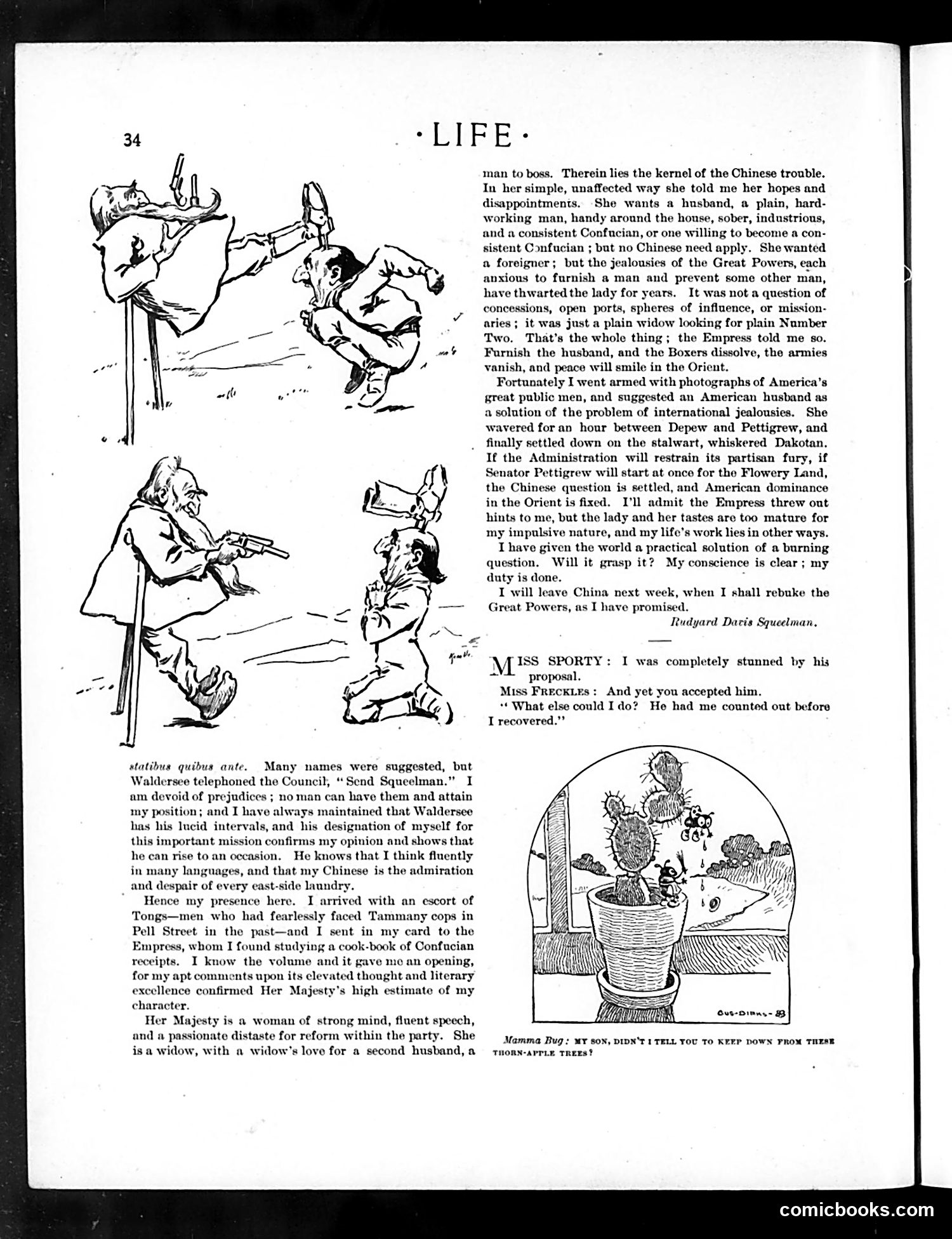
This page satirizes American intervention in the Boxer Rebellion and geopolitical maneuvering in China around 1900. The main text, signed "Rudyard Davis Squeelman," parodies imperialist presumption—a pompous American diplomat claims to have solved the "Chinese question" by proposing an American husband (Senator Pettigrew of Dakota) to the Chinese Empress Dowager, treating complex international conflict as a domestic matchmaking problem. The cartoons on the left appear to mock the Great Powers' military posturing and competition for influence in China, depicted as farcical violence or clumsy maneuvering. The bottom cartoon about "Mamma Bug" and thorn-apple trees is unrelated domestic humor. The satire mocks American overconfidence in solving foreign crises through crude, often ridiculous proposals, and critiques the era's imperial power politics.
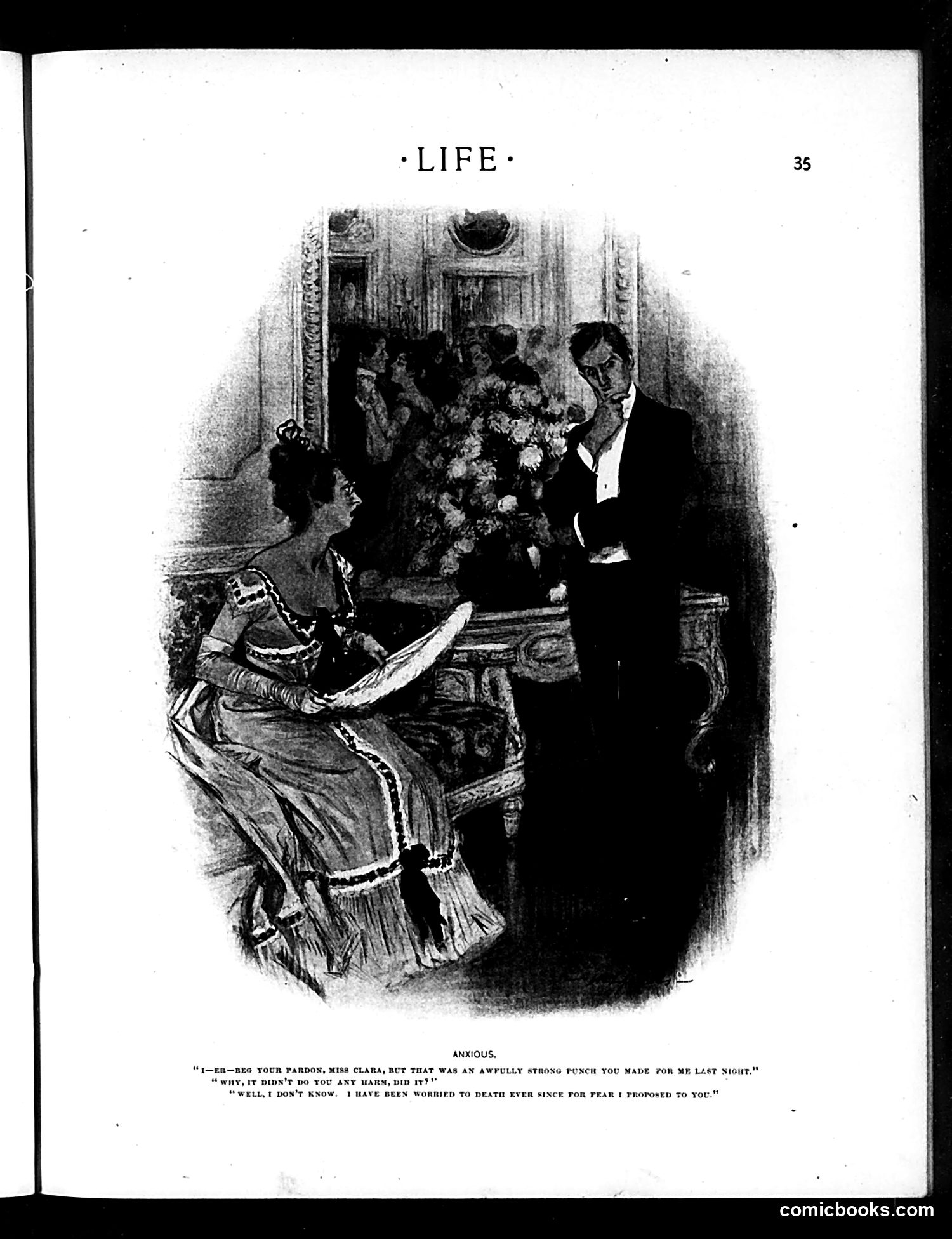
This is a satirical cartoon titled "Anxious" playing on a double meaning of "punch." A man apologizes to a woman named Clara about a strong "punch" from the previous night. She dismissively asks if it hurt him. He responds that he's been "worried to death" since then—but not from physical pain. Instead, he's anxious because he proposed to her while intoxicated, and now fears the consequences of that drunken proposal. The joke hinges on the contrast between the literal punch (a beverage, likely alcoholic) and the figurative "punch" of an unwanted marriage proposal. The cartoon satirizes male anxiety about commitment and the regret of making romantic decisions while drunk—suggesting the woman's strong drink may have been responsible for his rash proposal.
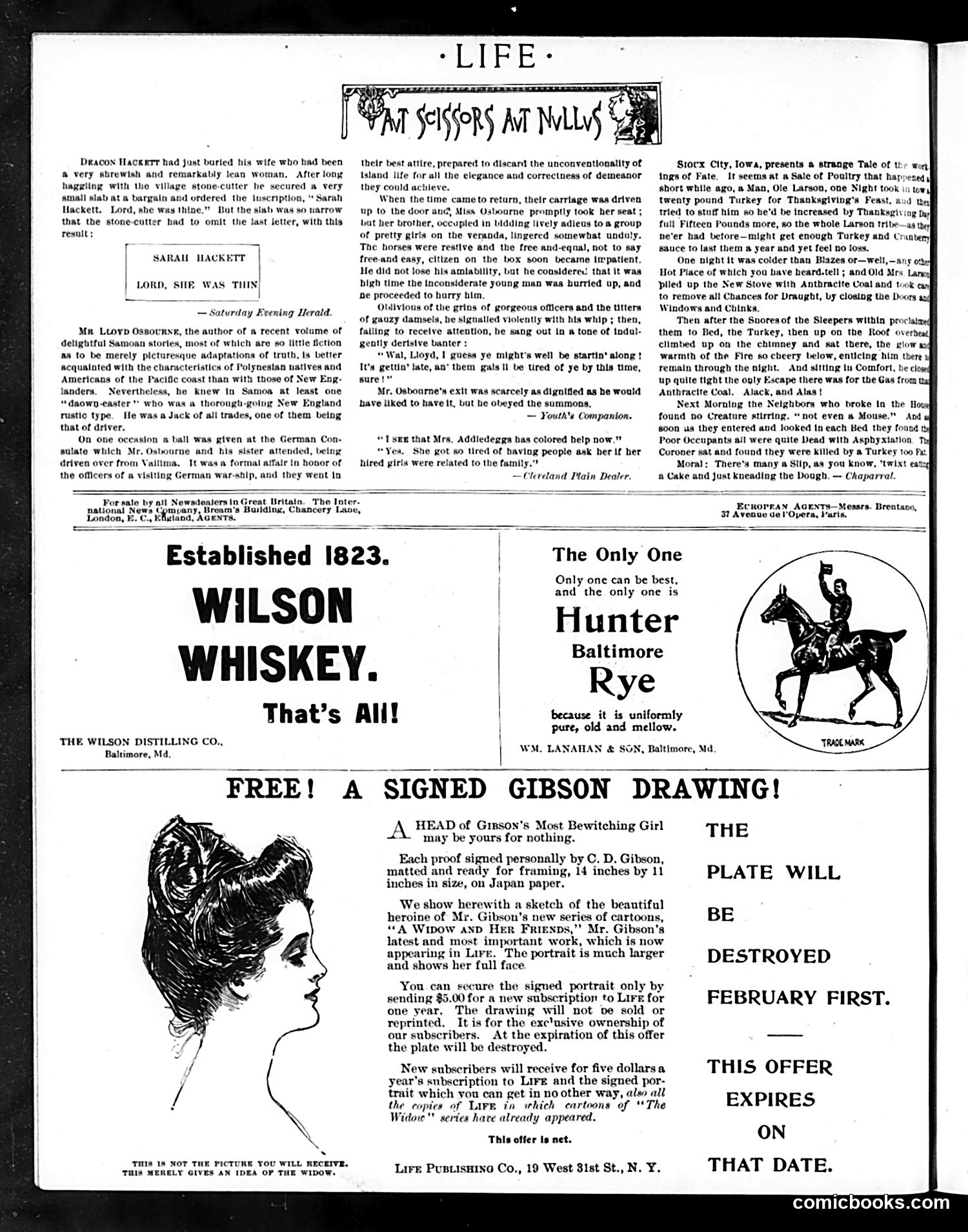
This page contains three distinct items: **Main Content:** Two humorous anecdotes. The first is a brief joke about a stone-cutter's error on a gravestone inscription (misspelling "THINE" as "TUIN" due to space constraints). The second recounts Lloyd Osbourne's experience at a diplomatic ball in Samoa, where an impatient carriage driver hurries him with colloquial mockery—a contrast between refined society and plain-spoken New England rusticity. **Advertisements:** Two whiskey/liquor ads (Wilson Whiskey, Hunter Baltimore Rye) typical of early 1900s magazine content. **Gibson Girl Promotion:** An offer of a signed C.D. Gibson drawing of a young woman for new Life magazine subscriptions—referencing Gibson's famous illustrations of idealized American femininity. The page reflects *Life*'s satirical focus on social manners, class differences, and American types, while also promoting popular illustrated content of the era.
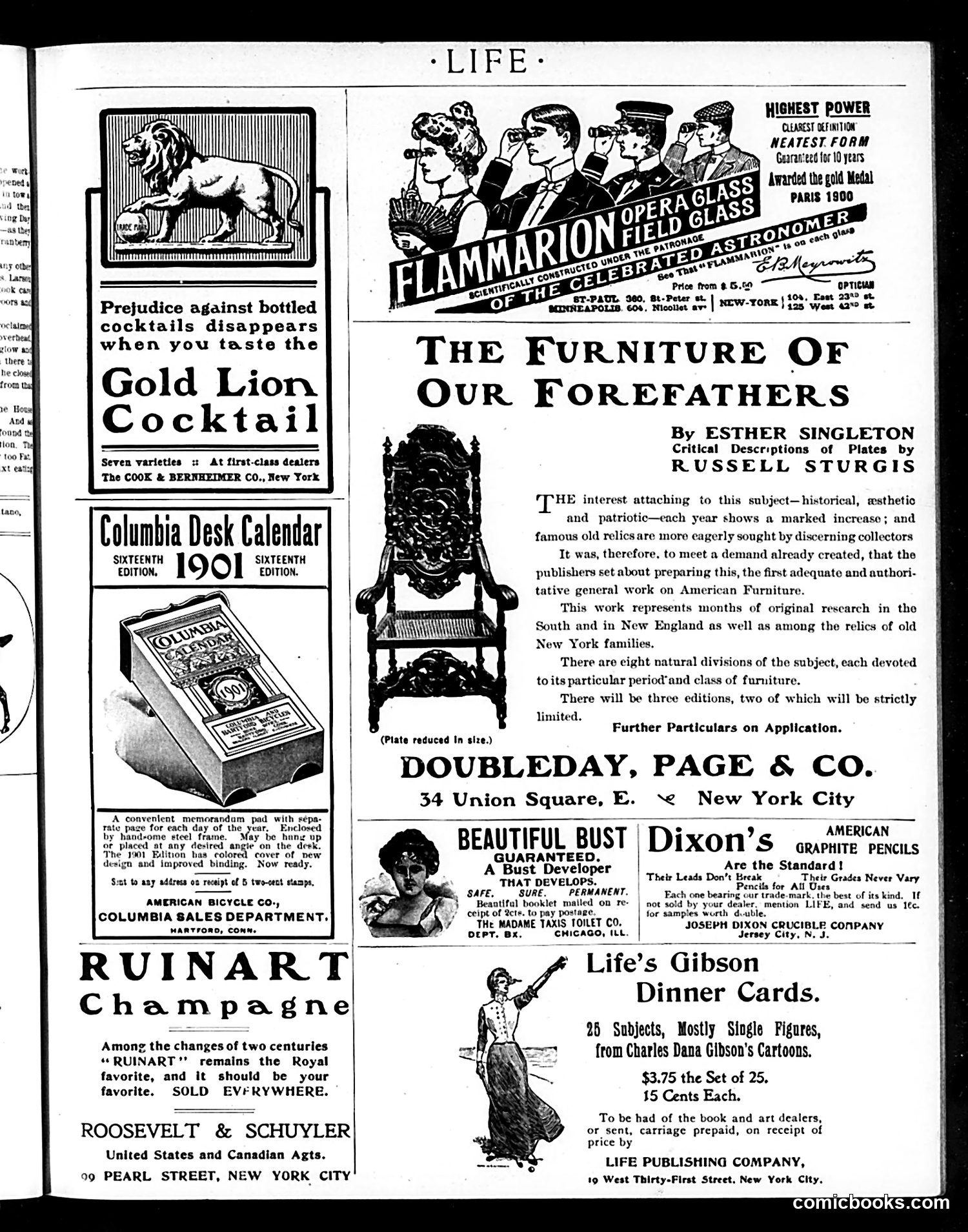
This is primarily an **advertising page** from Life magazine (circa 1901, based on the Columbia Calendar reference). While it contains no political cartoons, the ads reflect turn-of-the-century American commercial culture. Notable content includes: - **Gold Lion Cocktail** and **Ruinart Champagne** ads—reflecting the era's consumption of luxury imported goods and cocktail culture - **"The Furniture of Our Forefathers"** by Esther Singleton—a book advertisement tapping into period interest in American colonial heritage and antique collecting, framed as patriotic nostalgia - **Gibson Dinner Cards**—promoting Charles Dana Gibson's famous illustrated "Gibson Girl" figure, which defined American beauty standards of the era - Various product ads (pencils, calendars, bust developers) representing typical early 1900s consumer goods The page demonstrates how Life functioned partly as a commercial vehicle while maintaining its satirical editorial mission elsewhere. The "forefathers" book ad is most historically suggestive, revealing Edwardian-era enthusiasm for recovering and valorizing American colonial material culture.
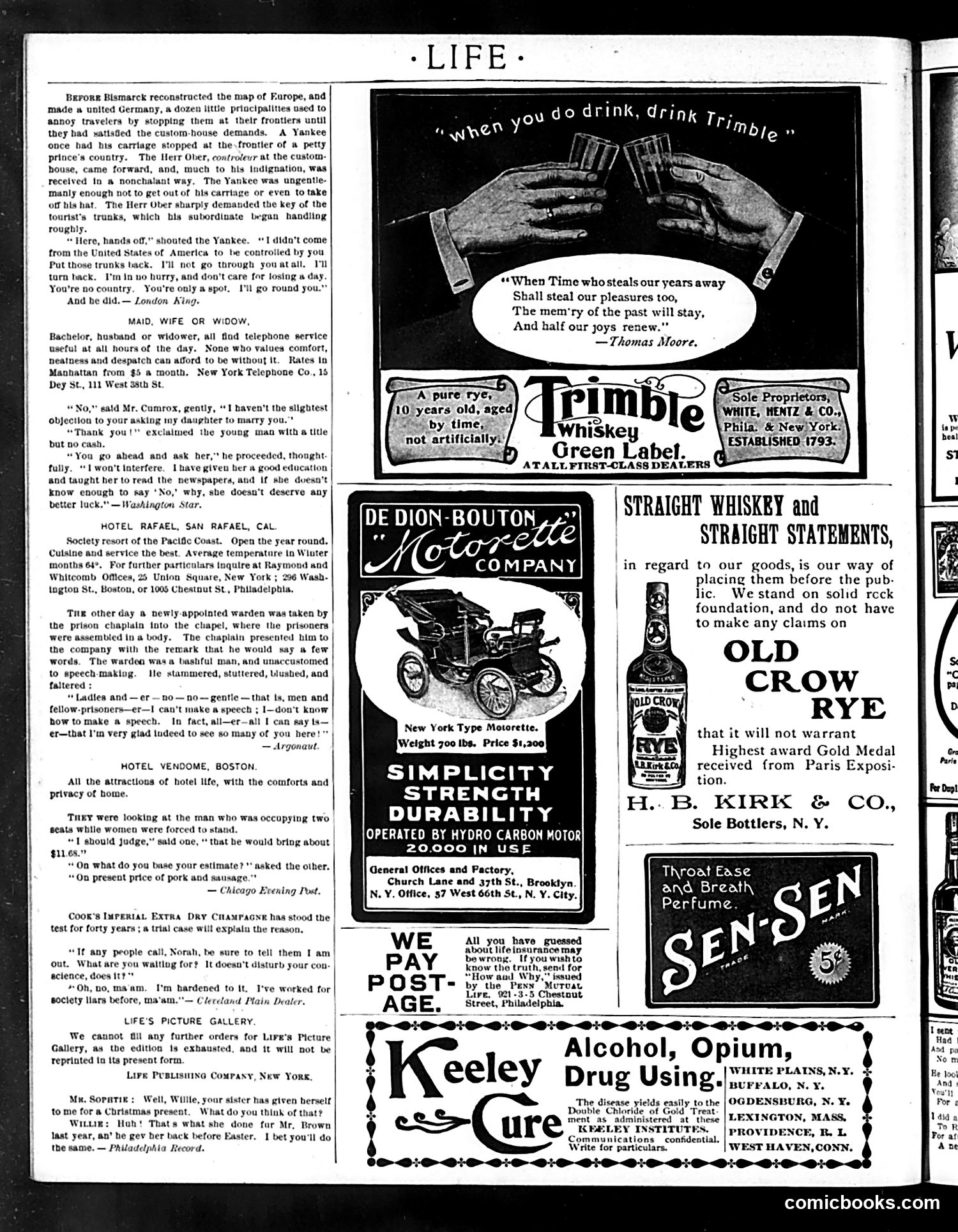
This page from *Life* (an American satirical magazine) contains multiple short humorous anecdotes and advertisements typical of early 20th-century periodicals. The main cartoon/story depicts a confrontation between an American tourist and a German customs official at a petty principality's border. The satire mocks both German bureaucratic pomposity (the officious customs officer) and American rudeness (the Yankee who refuses to remove his hat or leave his carriage). The joke celebrates American independence—the tourist simply turns back rather than submit to petty authority, dismissing the tiny state as "only a spot" rather than a real country. This reflects period tensions between American individualism and European formality. Other brief anecdotes satirize social pretension, gender relations, and workplace hierarchies. The advertisements (Trimble Whiskey, De Dion-Bouton motorcars, Old Crow Rye) represent period commercial interests. The overall tone is genteel satire aimed at middle-class readers amused by social absurdities and international stereotypes.
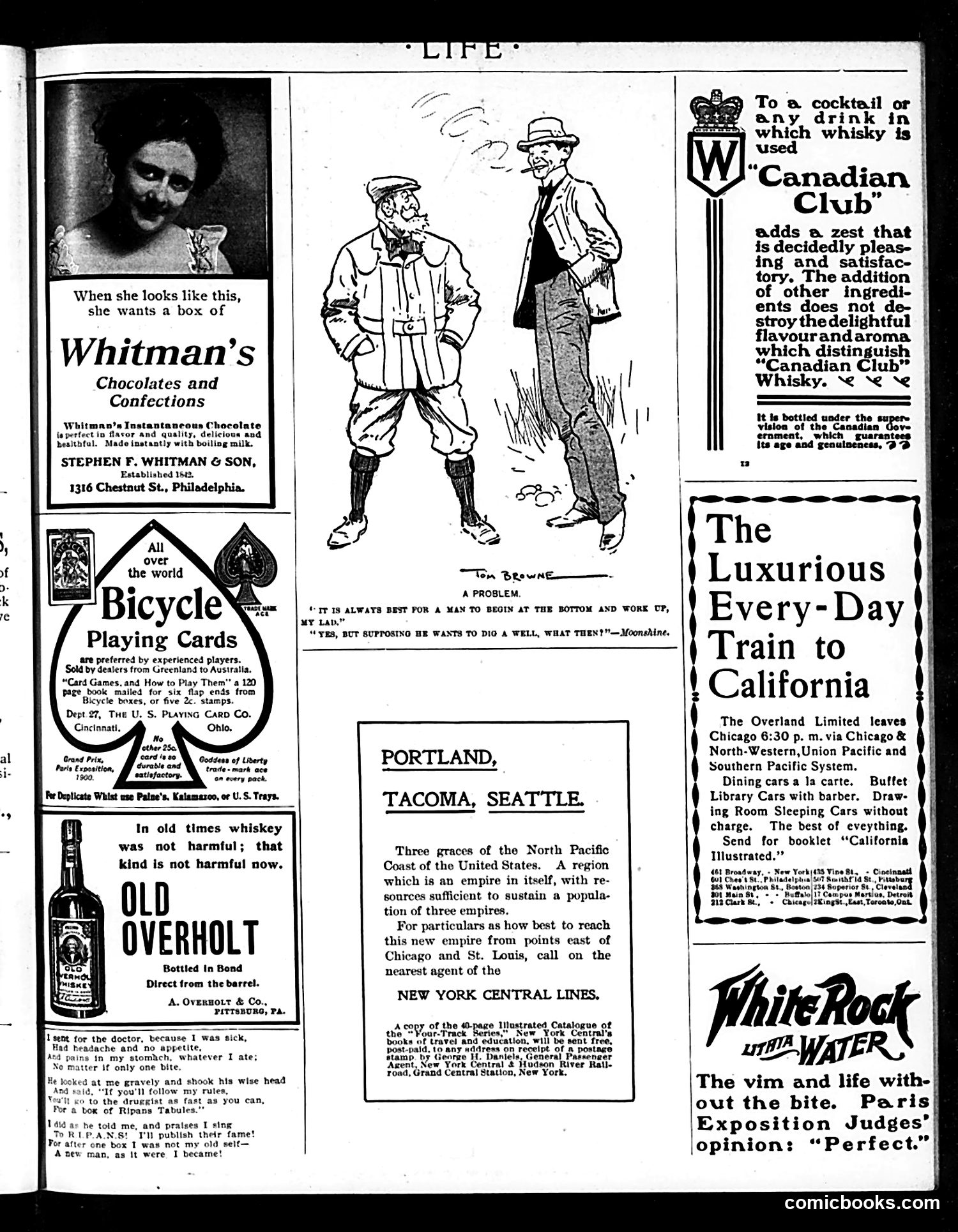
This is primarily an **advertising page** with one small cartoon. The main cartoon, titled "A Problem," depicts two men in conversation. The caption reads: "It is always best for a man to begin at the bottom and work up, my law." The second man replies: "Yes, but supposing he wants to dig a well, what then?" This is a **visual pun**—a joke playing on the double meaning of "bottom." The first man's advice about starting at the bottom of a career is absurd when applied literally to well-digging, where you actually must start at the top and work downward. The humor comes from treating figurative advice as literal instruction. The cartoon is credited to Tom Browne (visible signature). The rest of the page consists of period advertisements for products including Whitman's chocolates, Bicycle playing cards, Old Overholt whiskey, Ripans Tabules (patent medicine), Canadian Club whisky, and California train travel—typical early 20th-century marketing appearing in *Life* magazine.
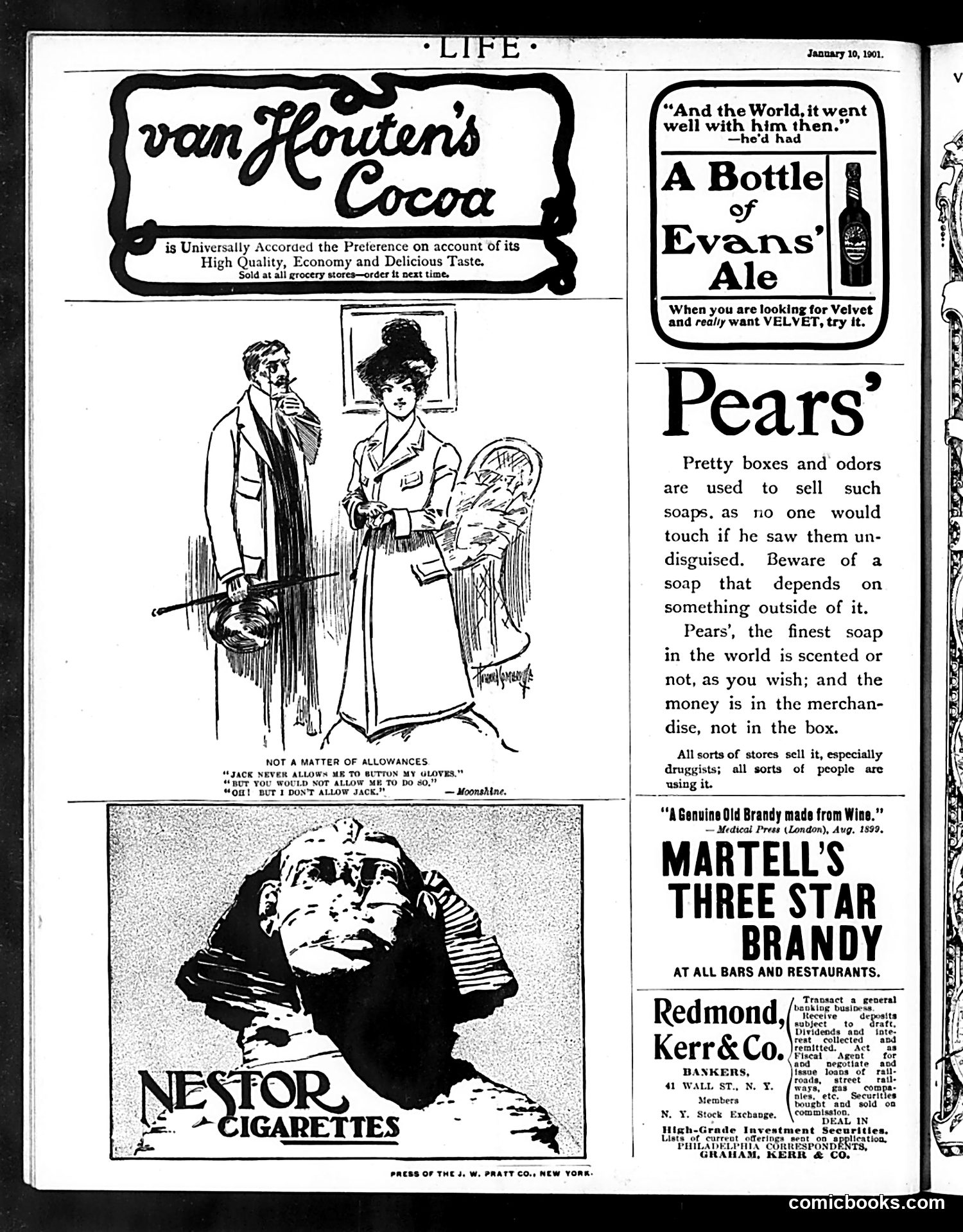
The main cartoon titled "Not a Matter of Allowances" satirizes marital dynamics of the era. A husband complains to his wife that she won't allow him to button his coat, while she counters she won't allow him to do certain things—establishing a power struggle over domestic authority. The humor lies in the reversal: the wife controls household finances and decisions, contradicting the period's presumption of male dominance. The cartoon critiques early 1900s gender relations, suggesting wives wielded significant financial and domestic control despite legal and social structures favoring husbands. The dialogue mocks both spouses' attempts to assert authority through "allowances"—pocket money—implying financial dependency on both sides. The page is primarily filled with period advertisements (cocoa, ale, soap, brandy, cigarettes, banking services), typical of Life's satirical magazine format, which blended humor with commercial content.