
Life, 1901-01-10 · page 4 of 20
Life — January 10, 1901 — page 4: what you’re looking at
What you’re looking at
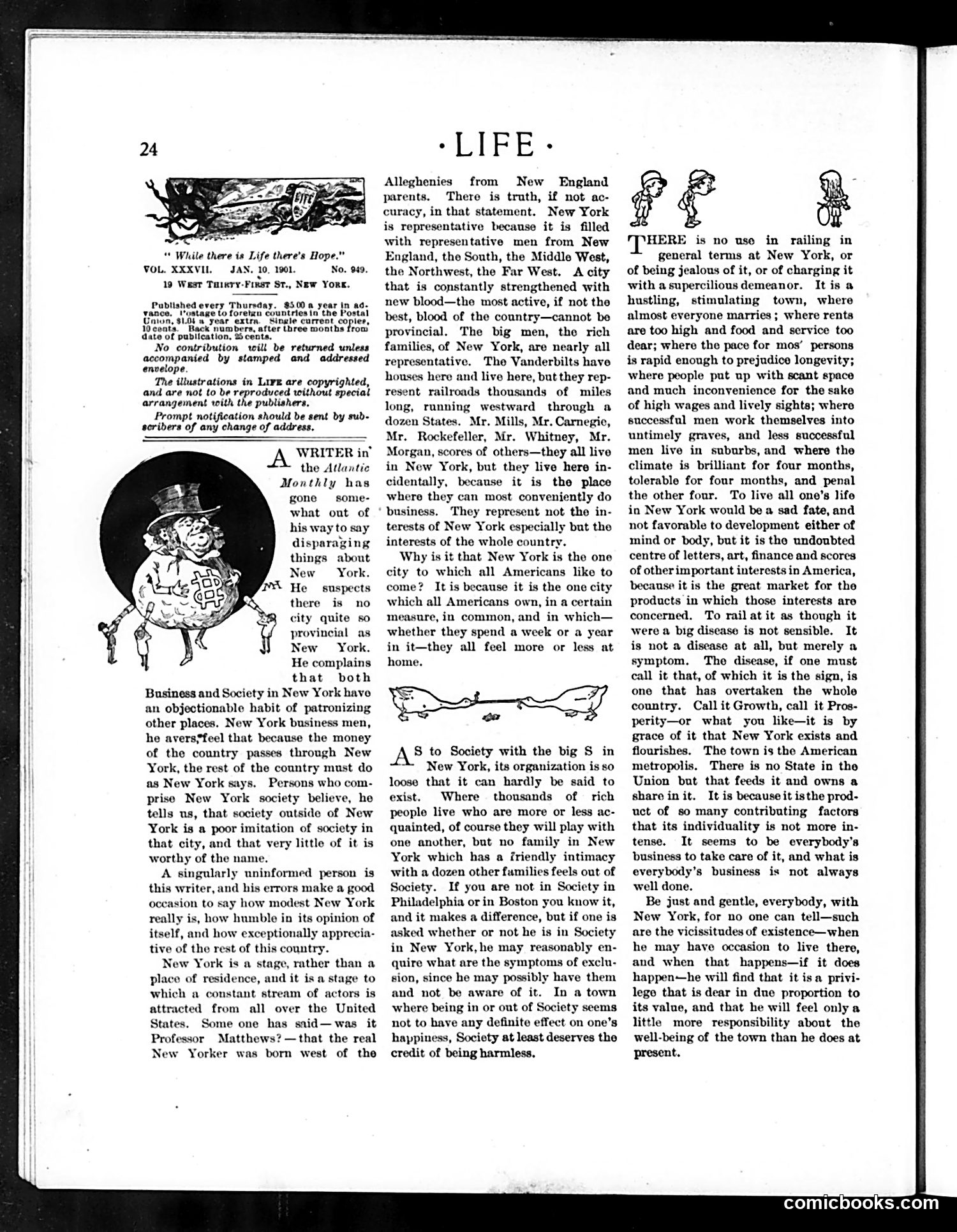
The page contains two main elements: **Left side:** A cartoon titled "While there is Life there's Hope" shows a rotund, well-dressed figure (appearing to represent a New York businessman or society type) looking somewhat dismayed or contemplative. The figure wears formal attire and a top hat, suggesting wealthy urban society. **Right side:** An article titled "A Writer in the Monthly" discusses New York's prominence as America's business and cultural center. The text argues that New York attracts ambitious people nationwide and represents American interests broadly, while acknowledging it has a reputation for being objectionable and patronizing toward other regions. The cartoon likely satirizes New York society's self-importance and pretensions, complementing the article's critique of how New Yorkers view themselves versus their actual influence on American life.
📄 Transcribed text from this page (OCR, searchable)
Machine-transcribed from the original scan — historical spelling and the odd misread are preserved.
“* While there is Life there's Hope.” VOL. XXXVI. JAN, 10. 1901. No. 949. 19 Wast Taikry-Finst St., New Yor«. Published every Thursday. $5.00 a year in ad- vance. lostage to foretzn countries to the Postal Coun. $104.9 year extra. | Single current copier, Weonts. ‘Back numbers, after three months dato of publication, % cents, No contribution will be returned unless accompanied by stamped and addressed envelope. The illustrations in Live are copyrighted, and are not to be reproduced without special arrangement with the publishers, Prompt notification should be sent by sub- scribers of any change of address. WRITER in” the Atlantic Monthly has gone some- what ont of his way to say disparaging things about New = York. He suspects there is no city quite so provincial as New York. He complains that both Business and Society in New York havo an objectionable habit of patronizing other places. New York business men, he avers*feel that because the money of the country passes through New York, the rest of the country must do as New York says. Persons who com- prise New York society believe, he tells us, that society outside of New York is a poor imitation of society in that city, and that very little of it is worthy of the name. A singularly uninformed person is this writer, and his errors make a good occasion to say how modest New York really is, how humble in its opinion of itself, and how exceptionally apprecia- tive of tho rest of this country. New York is a stage, rather than a place of residence, and it isa stage to which a constant stream of actors is attracted from all over the United States. Some one has said—was it Professor Matthews? —that the real New Yorker was born west of the Alleghenies from New England parents. There is truth, if not ac- curacy, in that statement. New York is representative because it is filled with representative men from New England, the South, the Middle West, the Northwest, the Far West. A city that is constantly strengthened with new blood—the most active, if not the best, blood of the country—cannot be provincial. The big men, the rich families, of New York, are nearly all representative. The Vanderbilts have houses here and live here, but they rep- resent railroads thousands of miles long, running westward through a dozen States. Mr. Mills, Mr. Carnegie, Mr. Rockefeller, Mr. Whitney, Mr. Morgan, scores of others—they all live in New York, but they live here in- cidentally, because it is the place where they can most conveniently do business. They represent not the in- terests of New York especially but the interests of the whole country. Why is it that New York is the one city to which all Americans like to come? It is because it is the one city which all Americans own, in a certain measure, in common, and in which— whether they spend a week or a year in it—they all feel more or less at home. AS to Society with the big S in New York, its organization is so loose that it can hardly be said to exist. Where thousands of rich people live who are more or less ac- quainted, of course they will play with one another, but no family in New York which has a friendly intimacy with a dozen other families feels out of Society. If you are not in Society in Philadelphia or in Boston you know it, and it makes a difference, but if one is asked whether or not he is in Society in New York,he may reasonably en- quire what are the symptoms of exclu- sion, since he may possibly have them and not be aware of it. In a town where being in or out of Society seems. not to have any definite effect on one’s happiness, Society at least deserves the credit of being harmless, (THERE is no use in railing in general terms at New York, or of being jealous of it, or of charging it with a supercilious demeanor. It is a hustling, stimulating town, where almost everyone marries; where rents are too high and food and service too dear; where the pace for mos’ persons is rapid enough to prejudice longevity; where people put up with scant space and much inconvenience for the sake of high wages and lively sights; where successful men work themselves into untimely graves, and less successful men live in suburbs, and where the climate is brilliant for four months, tolerable for four months, and penal the other four. To live all one’s life in New York would be a sad fate, and not favorable to development either of mind or body, but it is tho undoubted centre of letters, art, finance and scores of other important interests in America, because it is the great market for the products in which those interests are concerned. To rail at it as thongh it were a big disease is not sensible. It is not a disease at all, but merely a symptom. The disease, if one must call it that, of which it is the sign, is one that has overtaken the whole country. Call it Growth, call it Pros- perity—or what you like—it is by grace of it that New York exists and flourishes. The town is the American metropolis. There is no State in the Union but that feeds it and owns a share init. It is because it isthe prod- uct of so many contributing factors that its individuality is not more in- tense. It seems to be everybody's business to take care of it, and what is everybody’s business is not always well done. Be just and gentle, everybody, with New York, for no one can tell—such are the vicissitudes of existence—when he may have occasion to live there, and when that happens—if it does happen—he will find that it isa privi- lege that is dear in due proportion to its value, and that he will feel only a little more responsibility about the well-being of the town than he does at present. comicbooks.com