
Life, 1901-01-10 · page 12 of 20
Life — January 10, 1901 — page 12: what you’re looking at
What you’re looking at
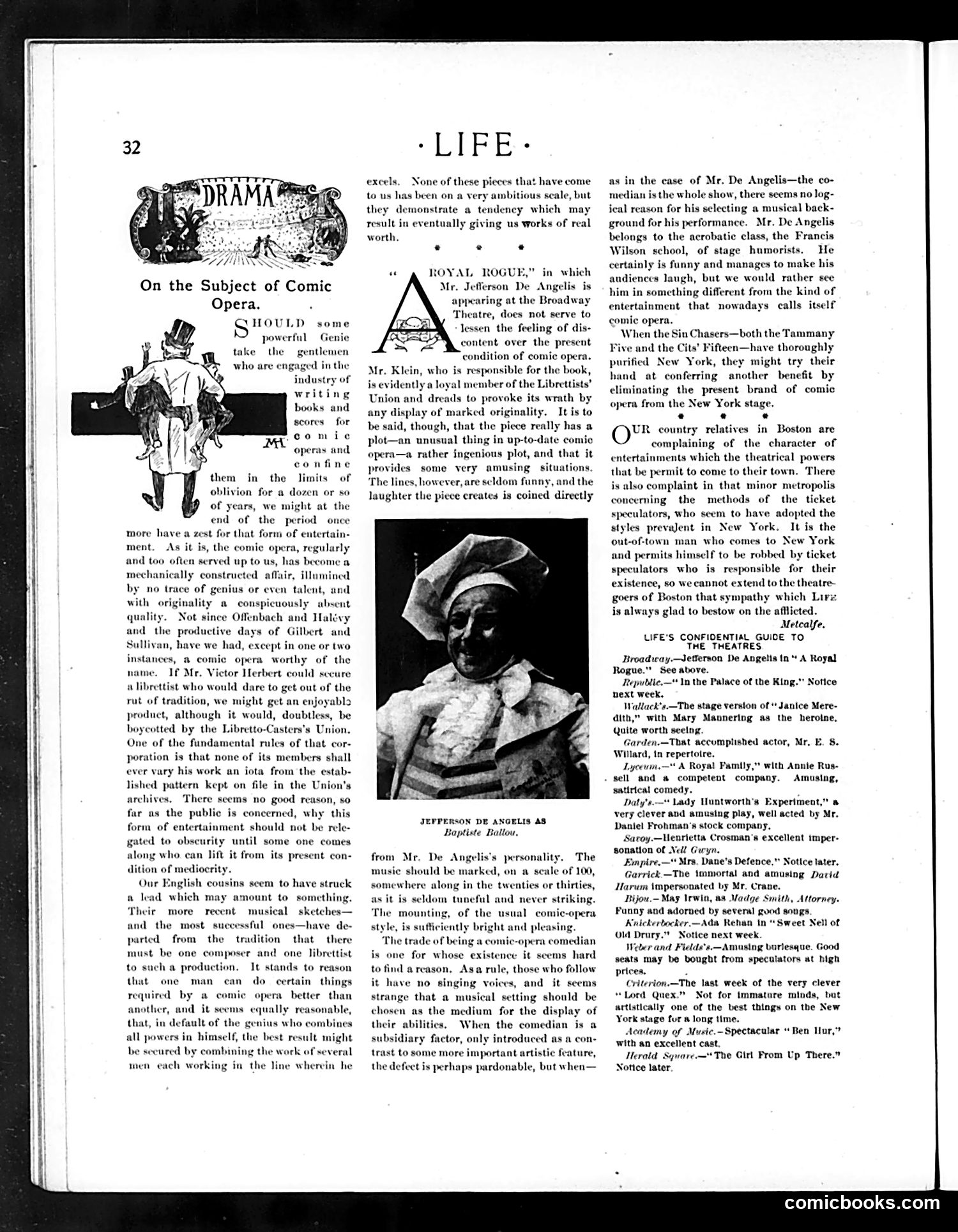
This satirical article critiques the state of comic opera in early 20th-century American theater. The illustration shows a caricatured figure in formal dress, appearing to represent a theatrical personality or composer associated with comic opera. The text argues that comic operas have become formulaic and mediocre—mechanically constructed rather than genuinely creative. The author criticizes that such works lack originality and wit, noting they're "limited by no trace of genius or great talent." A key complaint targets how comic opera has devolved into a commercial product controlled by theatrical unions and industry standards rather than artistic merit. The piece advocates for returning to tradition while lamenting that audiences accept inferior entertainment under the "comic opera" label. The review includes a section on Jefferson De Angelis performing in "A Royal Rogue," critiquing both the production and broader theatrical trends.
📄 Transcribed text from this page (OCR, searchable)
Machine-transcribed from the original scan — historical spelling and the odd misread are preserved.
On the Subject of Comic Opera. YHOULD powerful Genie take the who are eng: some gentlemen ged inthe industry of writing books and scores for pcomic operas and onfine A them in the limits of oblivion for a dozen or so of years, we might at the end of the period more have a zest for that of entertai! ment. As it is, the comic opera, regularly and too often served up to us, has beer mech: by no trace once talent, and vously absent nce Offenbach and Halevy productive days of Gilbert and Sullivan, have we had, except in one or two instances, a comic opera worthy of the If Mr. Victor Herbert could secure a librettist who would dare to get out of the rut of tradition, we might get an enjoyablo product, although it would, doubtless, be boycotted by the Libretto-Casters's Union. One of the fundamental rules of that cor- poration is that none of its members shall ever vary his work an iota from the es lished pattern kept on file in the Union's archives. There seems no good reason, so far as the public is concerned, why this form of entertainment should not be rele- gated to obscurity until some one name. mes along who can lift it from its present con- fa lead which m Their more and the parted amount to something. recent musical sketch most successful ones—have de- from the tradition that there must be one composer and one librettist to such a production. It stands to reason that man can do. certain. things required by a comic opera better than nother, and it seems equally reasonable, that, in default of the genius who combines all powers in himself, the best result might be secured by combining the work of « men each working in the line whe one - LUPE: None of these pieces that have come to us has been on a very ambitious scale, but they demonstrate a tendency which may result in eventually giving us works of real worth. excels, . e * ROYAL ROGUE,” in Mr. Jefferson De Any appearing at the Broadway ‘Theatre, does not serve to lessen the feeling of dis content over the present condition of comic opera. Mr. Klein, who is responsible for the bool is evidently a loyal member of the Librett Union and dreads to provoke its wrath by any display of marked originality. It is to be said, though, that the piece really has a plot—an unusual thing in up-to-date comic opel rather ingenious plot, and that it provides some very amusing sit ‘The lines, however, are seldom funny, and the laughter the piece creates is coined directly which ations. JEPPERSON DE ANGELIS AS Baptiste Ballou. from Mr, De Angelis’s personality. music should be marked, on a seal The 100, somewhere along in the twenties or thirties, as it is seldom tuneful and never striking. The mounting, of the usual comic-opera style, is sufficiently bright and pleasing. The trade of being a comic-opera comedian is one for whose existence it scems hard to find arcason, Asa rule, those who follow it have no singing voices, and it seems strange that a musical setting should be chosen as the medium for the display of their abilities. When the comedian is a subsidiary factor, only introduced as a con- trast to some more important artistic feature, the defect is perhaps pardonable, but when— as in the case of Mr. De Angelis—the co- median is the whole show, there seems no log- ical reason for his selecting a musical back- ground for his performance. Mr. De Angelis belongs to the acrobatic class, the Francis Wilson school, of stage humorists. He certainly is funny and manages to make his audiences laugh, but we would rather see him in something different from the kind of entertainment that nowadays calls itself comic opera. When the Sin Chasers—both the Tammany Five and the Cits’ Fifteen—have thoroughly purified New York, they might try their hand at conferring another benefit by eliminating the present brand of comic opera from the New York stage. e e e ov country relatives in Boston are complaining of the character of entertainments which the theatrical powers that be permit to come to their town. There is also complaint in that minor metropolis concerning the methods of the ticket speculators, who seem to have adopted the styles prevaJent in New York. It is the out-of-town man who comes to New York and permits himself to be robbed by ticket speculators who is responsible for their existence, so we cannot extend to the theatre- goers of Boston that sympathy which Lirz is always glad to bestow on the afflicted. Metcalfe, LIFE'S CONFIDENTIAL GUIDE TO THE THEATRES Broadway.—Jetferson De Angelis in“ A Royal Rogue.” See above. Republic.—* In the Palace of the King.” next week. Wallack’e.—The stage version of “Janice Mere- aith,” with Mary Mannering as the heroine, Quite worth seeing. Garden.—That accomplished actor, Mr, E. 8. Willard, in repertoire. Lycevm.—" A Royal Family,” with Annie Rus- sell and a competent company. Amusing, satirical comedy. Daty's.—" Lady Huntworth's Experiment,” a very clever and amusing play, well acted by Mr. Danlel Frohman’s stock company, Saroy.—llenrietta Crosman’s excellent tmper- sonation of Vell Gyn. Empire,—* Mrs. Dane's Defence. Notice later. Garrick —The immortal and amusing Darid Harum \mpersonated by Mr. Crane. Bijou.—May Irwin, a8 Madge Smith, Attorney. Panny and adorned by several good songs. Knickertocker.—Ada Rehan in "Sweet Nell of Old Drury." Notice next week Weber and Fields'e.—Amusing burlesque. Good seats may be bought from speculators at high prices, ‘ Criterion.—The last week of the very clever ‘Lord Quex.” Not for tmmature minds, bat artistically one of the best things on the New York stage fur a long time. Academy of Music.—Spectacular “ Ben Hur,” with an excellent cast, Herald Syvare—*The Girl From Up There.” Notice later, ottce comicbooks.com