
Life, 1901-01-10 · page 6 of 20
Life — January 10, 1901 — page 6: what you’re looking at
What you’re looking at
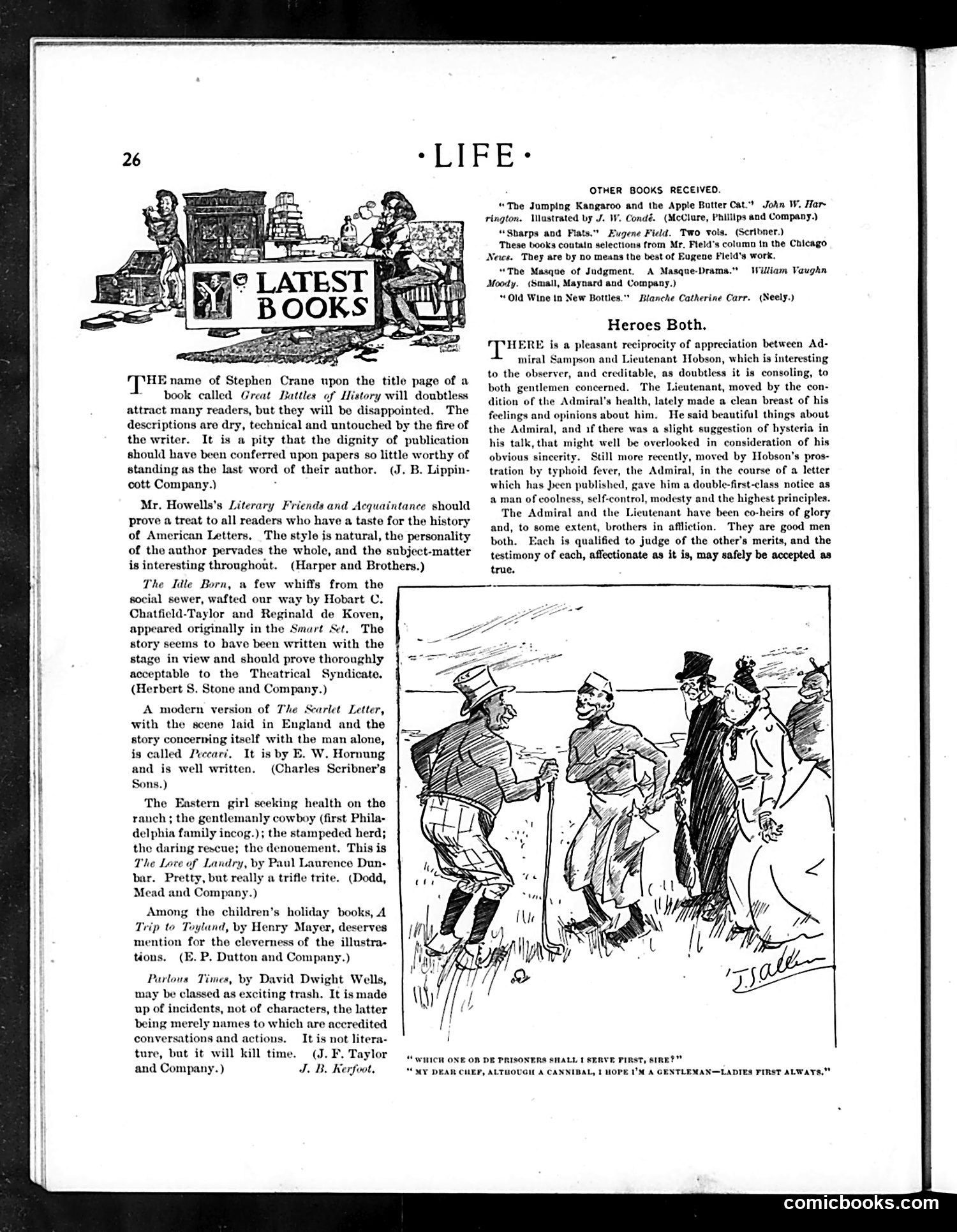
This page primarily reviews recently published books rather than presenting political satire. The main cartoon depicts a comedic scene with the caption addressing etiquette among gentlemen: "Which one of de prisoners shall I serve first, sir?" and "My dear chief, although a cannibal, I hope I'm a gentleman—ladies first always." The joke plays on Victorian social conventions—specifically the principle that gentlemen prioritize ladies' safety and comfort. The absurdist humor comes from applying these refined manners in an extreme, savage context (cannibals deciding whom to eat). This reflects turn-of-the-century satirical humor that found comedy in contrasting "civilized" behavior with primitive settings. The cartoon likely accompanies a book review on the page, though the specific literary connection isn't entirely clear from the visible text.
📄 Transcribed text from this page (OCR, searchable)
Machine-transcribed from the original scan — historical spelling and the odd misread are preserved.
“LIFE aT eal i (THE name of Stephen Crane upon the title page of a book called Great Battles of History will doubtless attract many readers, but they will be disappointed. The descriptions are dry, technical and untouched by the fire of the writer. It is a pity that the dignity of publication should have been conferred upon papers 80 little worthy of standing as the last word of their author. (J. B. Lippin- cott Company.) Mr. Howells's Literary Friends and Acquaintance should prove a treat to all readers who have a taste for the history of American Letters. The style is natural, the personality of the author pervades the whole, and the subject-matter is interesting throughout. (Harper and Brothers.) The Idle Born, «a few whiffs from the social sewer, wafted our way by Hobart C. Chatfield-Taylor and Reginald de Koven, appeared originally in the Smart Set, The story seems to bave been written with the stage in view and should prove thoroughly acceptable to the Theatrical Syndicate. (Herbert S. Stone and Company.) A modern version of The Scarlet Letter, with the scene laid in England and the story concerning itself with the man alone, is called Peceari. It is by E, W. Hornung and is well written, (Charles Scribner’s Sons.) The Eastern girl seeking health on the ranch; the gentlemanly cowboy (first Phila- delphia family incog.); the stampeded herd; the daring rescue; the denouement. This is The Love of Landry, by Paul Laurence Dun- bar. Pretty, but really a triffe trite. (Dodd, Mead and Company.) Among the children’s holiday books, A Trip to Toyland, by Henry Mayer, deserves mention for the cleverness of the illustra- tions. (E. P, Dutton and Company.) Parlous Times, by David Dwight Wells, may be classed as exciting trash. It is made up of incidents, not of characters, the latter being merely names to which are accredited conversations and actions. — It is not litera- ture, but it will kill time. (J. F. Taylor and Company.) J.B. Kerfoot, OTHER BOOKS RECEIVED. “The Jumping Kangaroo and the Apple Butter Cat. John W. Har rington. Mlustrated by J. W. Condé. (McClure, Phillips and Company.) “Sharps and Fiats." Eugene Field. Two vols. (Scribner.) These books coutain selections from Mr, Field's column in the Chicago News. They are by no means the best of Eugene Fleid’s work. “The Masque of Judgment. A Masque-Drama.” Moody. (Small, Maynard and Company.) “Old Wine in New Bottles." Blanche Catherine Carr. William Vaughn (Neely.) Heroes Both. HERE is a pleasant reciprocity of appreciation between Ad- miral Sampson and Lieutenant Hobson, which is interesting to the observer, and creditable, as doubtless it is consoling, to both gentlemen concerned. The Lieutenant, moved by the con- dition of the Admiral’s health, lately made a clean breast of his feelings and opinions about him. He said beautiful things about the Admiral, and af there was a slight suggestion of hysteria in his talk, that might well be overlooked in consideration of his obvious sincerity. Still more recently, moved by Hobson's pros- tration by typhoid fever, the Admiral, in the course of a letter which has een published, gave him a double-first-class notice as a man of coolness, self-control, modesty and the highest principles. The Admiral and the Lieutenant have been co-heirs of glory and, to some extent, brothers in affliction. They are good men both. Each is qualified to judge of the other's merits, and the testimony of each, affectionate as it is, may safely be accepted as HICH ONE O DE PRISONERS SMALL 1 SERVE FIRST, SIRE?” MY DEAR CHEP, ALTHOUGH A CANNIBAL, I HOPE 'M A GENTLEMAN—LADIES FIRST ALWAYS,” comicbooks.com