
A complete issue · 20 pages · 1900
Life — November 8, 1900
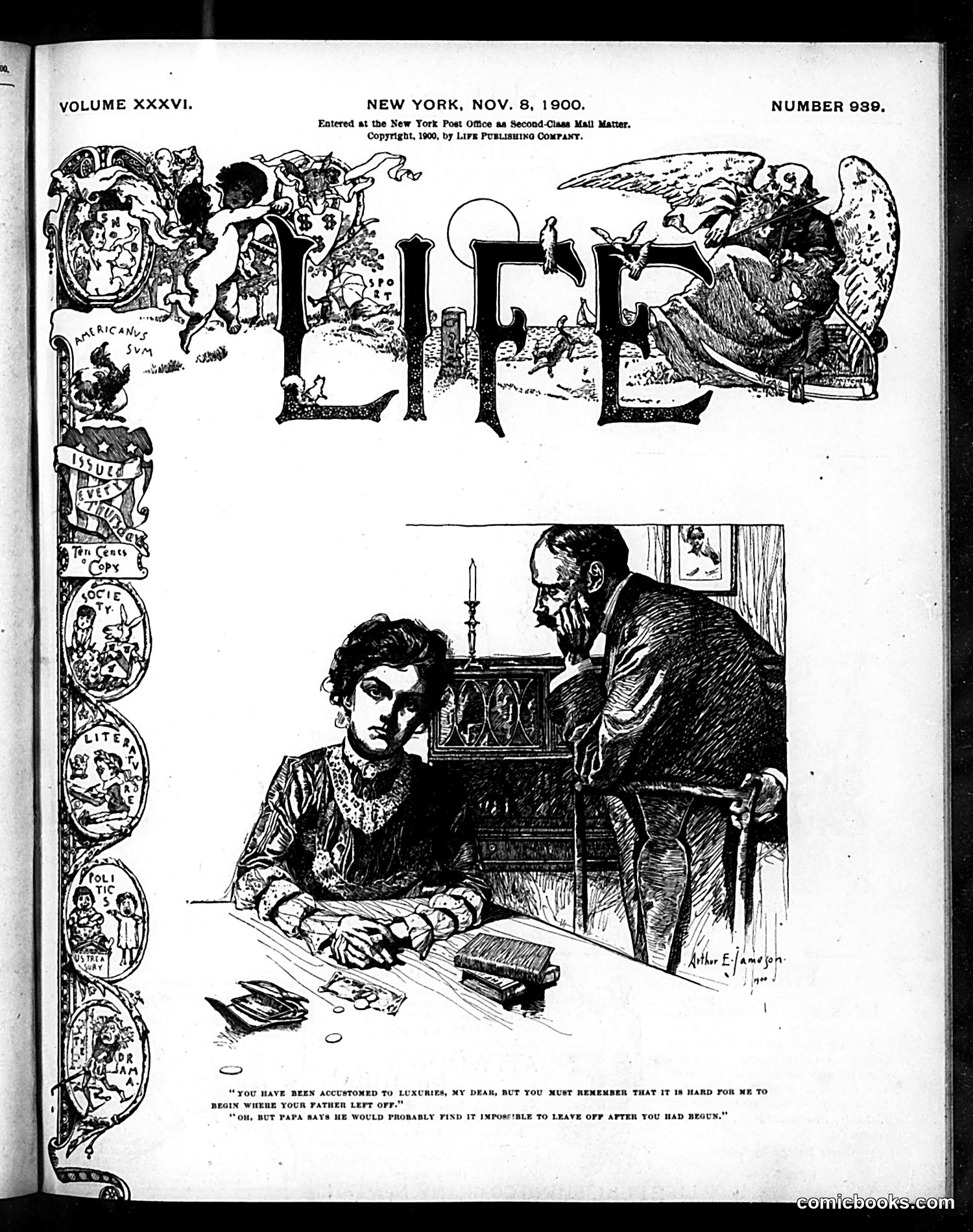
This page features an illustration depicting a domestic scene where a man confronts a woman at a desk. The caption reads: "You have been accustomed to luxuries, my dear, but you must remember that it is hard for me to begin where your father left off...Why, but papa says he would probably find it impossible to leave off after you had begun." The cartoon satirizes the financial expectations and class anxieties of wealthy families during the Gilded Age. It mocks a husband's complaint about his wife's expensive tastes while humorously suggesting her father spoiled her with unlimited spending. The joke hinges on the double meaning of "leave off"—stopping versus continuing—implying the wife's spending habits are insatiable and inherited from paternal indulgence.
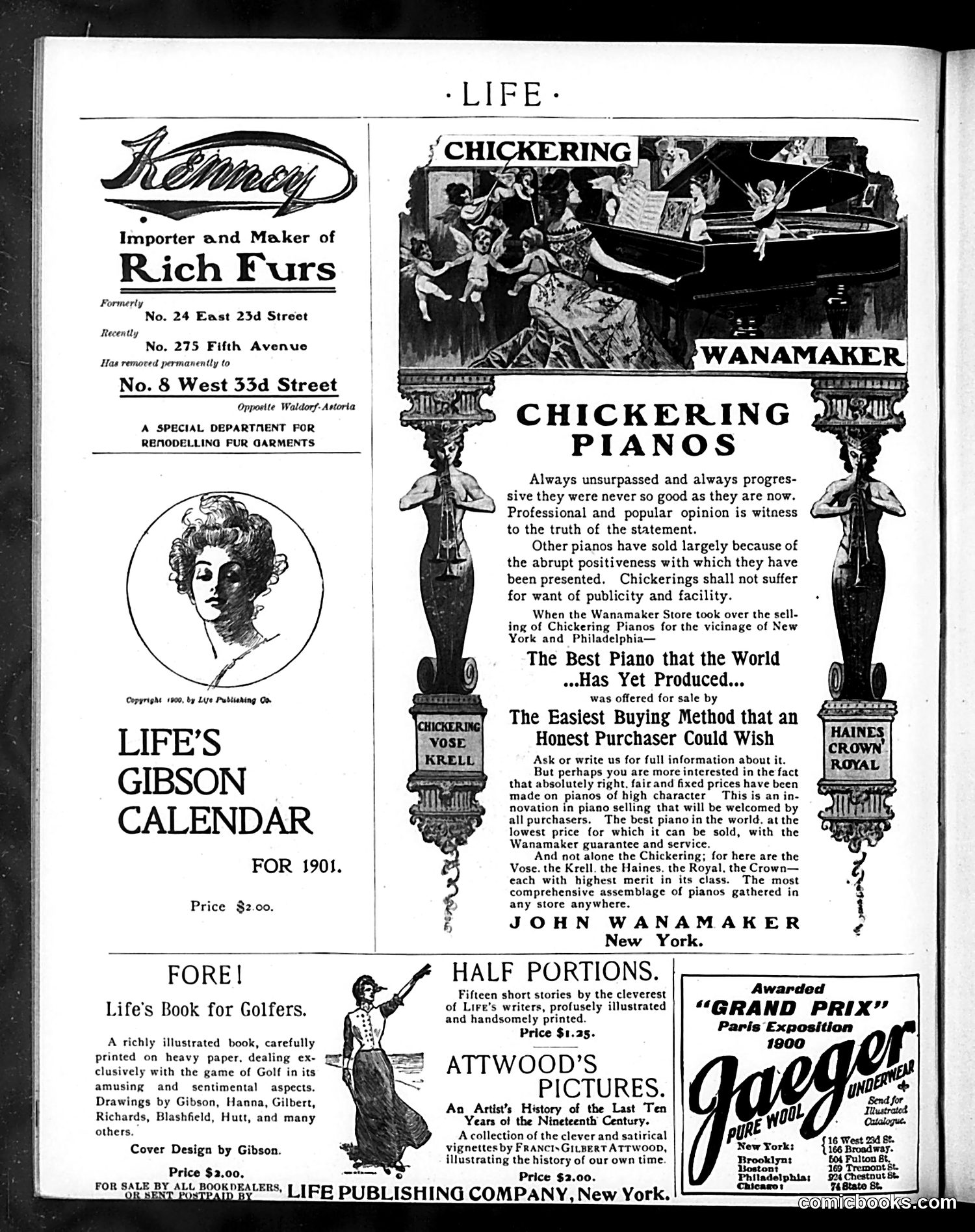
This page is **primarily advertising** rather than editorial content or political satire. The advertisements include: - Hemmway furs (relocation notice) - Life's Gibson Calendar for 1901 - Life's Book for Golfers - Chickering Pianos (the dominant ad, featuring an ornate piano) - Attwood's Pictures (art history book) - Half Portions (short stories collection) - Jaeger pure wool clothing The only potentially satirical element is the **Gibson Girl portrait** on the left side—the iconic idealized woman character created by Charles Dana Gibson that became emblematic of early 1900s American femininity and beauty standards. However, here it serves primarily as promotional material for Life's 1901 calendar rather than social commentary.
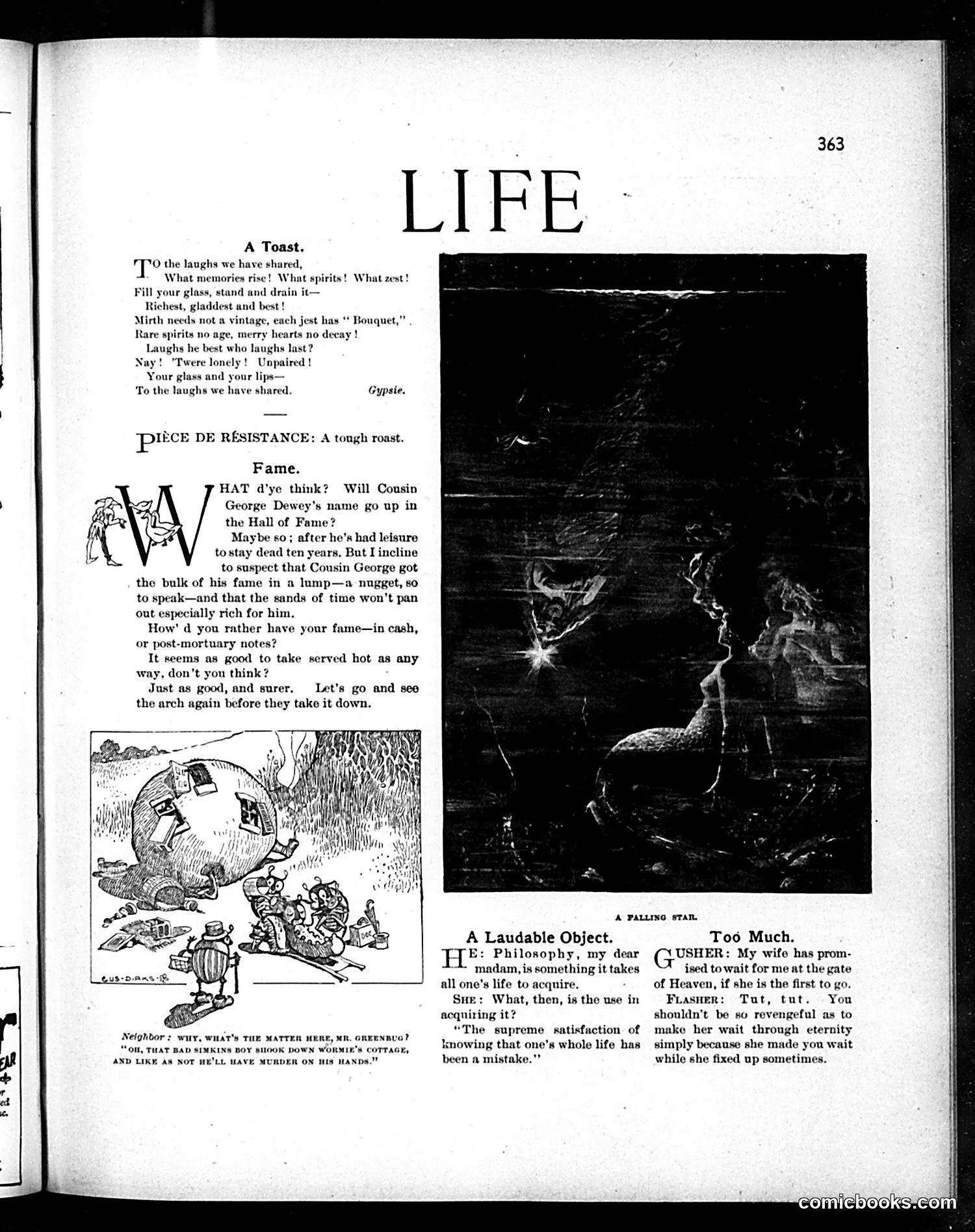
This page contains several satirical pieces and illustrations typical of early 20th-century Life magazine humor. **"A Toast"** is a poem by Gypsia celebrating shared laughter and camaraderie, with a French phrase ("Pièce de Résistance") marking a transition. **"Fame"** discusses Cousin George Dewey's legacy, questioning whether his fame will endure after his death, preferring practical memorials over monuments. **The illustrated cartoon** (lower left) appears to satirize wealth or materialism—showing a large spherical object surrounded by small figures and money, with a caption about "wondered on his hands," suggesting commentary on greed or excessive accumulation. **"A Laudable Object"** and **"Too Much"** are brief humorous dialogues about life philosophy and spousal relationships, representing typical Life magazine's light social satire of the era. The page emphasizes witty commentary on fame, wealth, and domestic life.
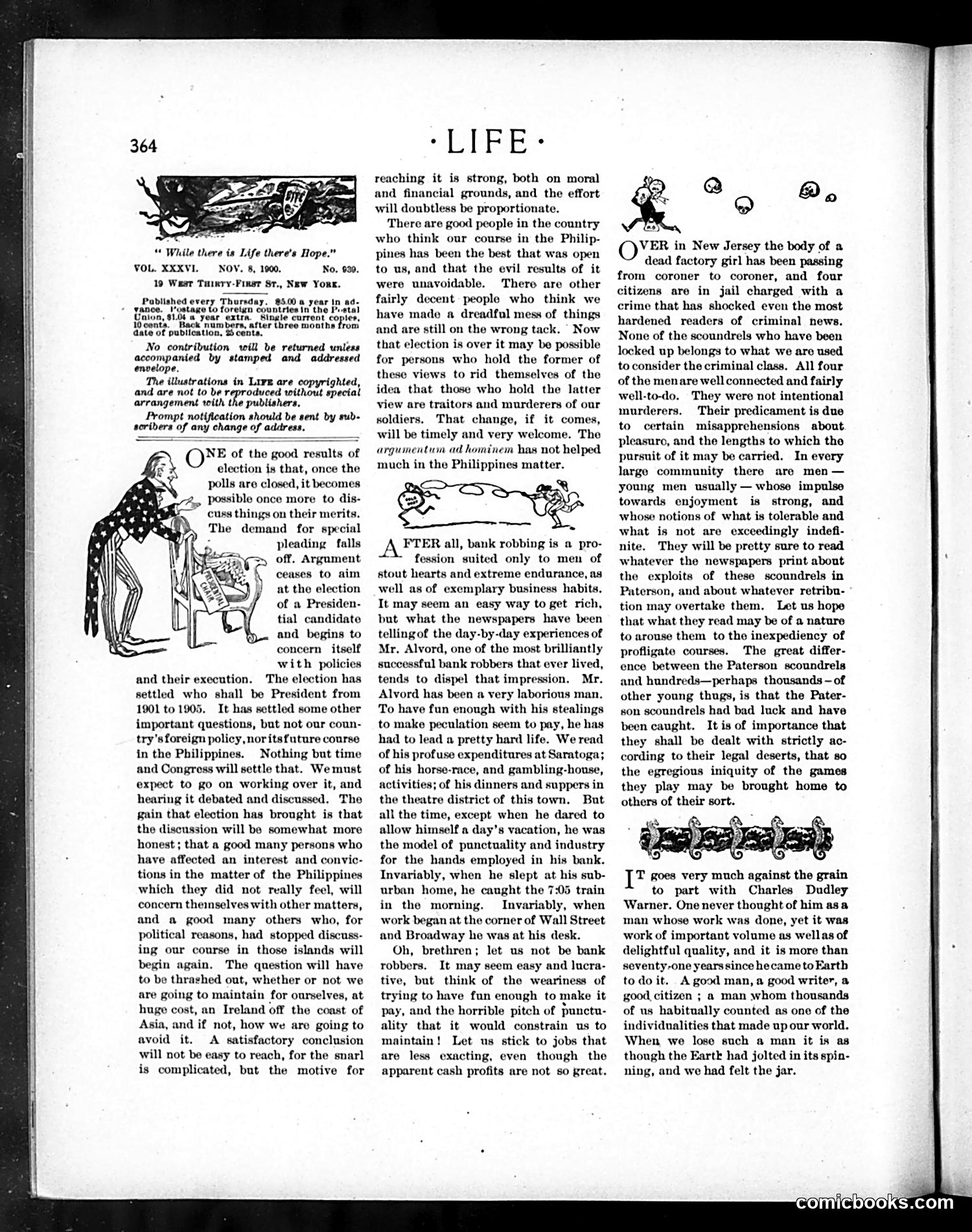
This page contains two editorial cartoons and accompanying text discussing early 1900s American politics and social issues. The **left cartoon** depicts an Uncle Sam figure (identified by stars-and-stripes clothing) appearing to discipline or confront a smaller figure, likely representing the Philippines—referencing U.S. colonial involvement there following the Spanish-American War. The **right section** includes a decorative header with small illustrated figures and discusses bank robbery as a profession, referencing the case of Mr. Alvord, described as "one of the most brilliantly successful bank robbers that ever lived." The text satirizes how some view bank robbery as requiring skill and "extreme endurance," while critiquing this romanticization of crime. The overall tone mocks both American imperialism in the Philippines and the glorification of criminals in popular discourse.
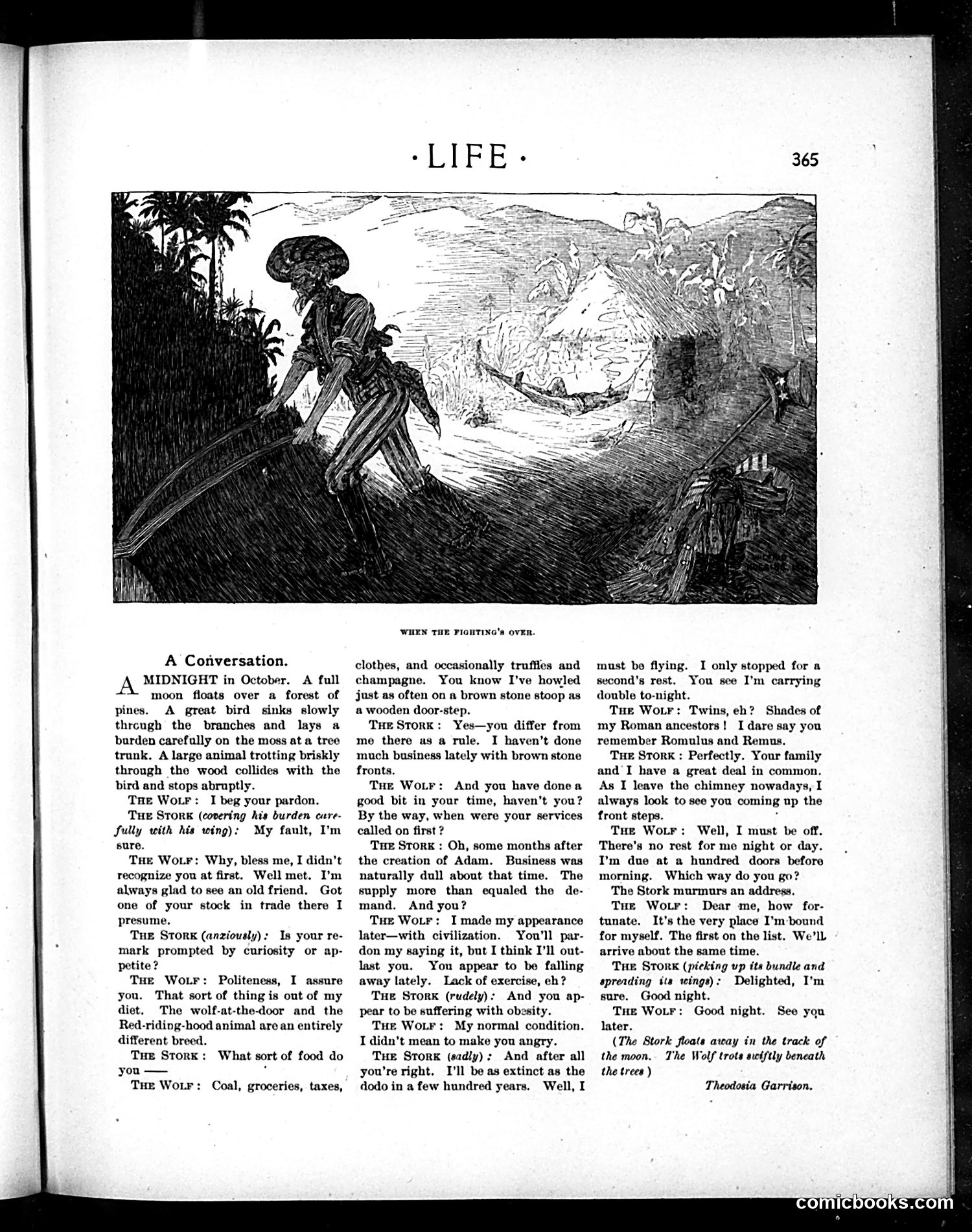
This page presents a satirical dialogue between a **Wolf and a Stork**, illustrated by the engraving "When the Fighting's Over." The conversation adapts the classical Aesop's fable to social commentary. The Wolf boasts of his predatory nature and endless appetite ("coal, groceries, taxes"), while the Stork—characterized as refined and civilized—represents the working class or common people being consumed by exploitative forces. The Wolf's admission that he'll be "extinct...in a few hundred years" suggests commentary on unsustainable rapacity. The stork's departure "carrying double to-night" implies burden and exhaustion from serving the Wolf's demands. This appears to be **social/economic satire about exploitation**—the traditional fable reframed as critique of predatory capitalism or tyranny consuming society's resources.
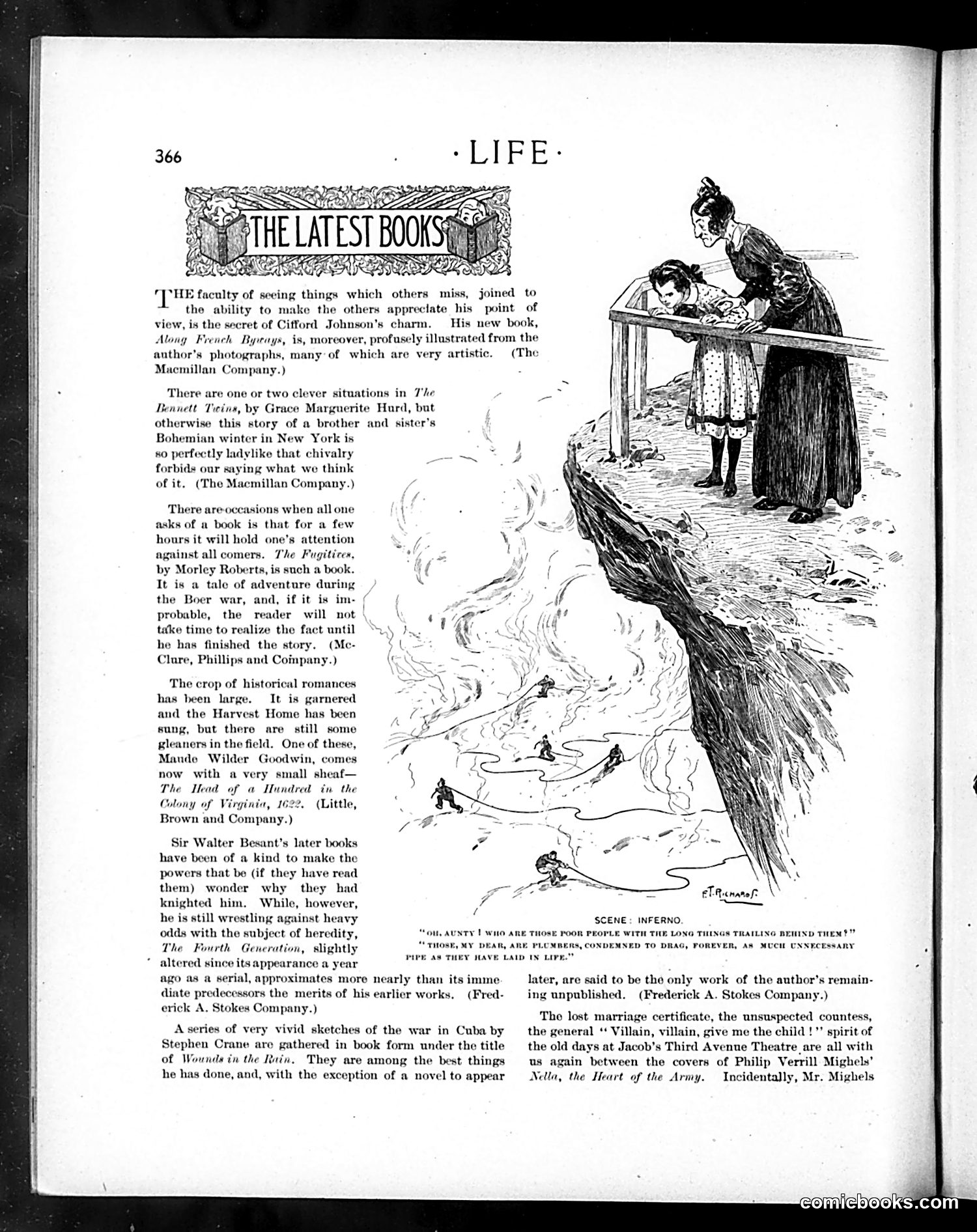
This page is primarily a **book review section** titled "The Latest Books," not political satire. It discusses contemporary literary works including *Along French Byways* by Clifford Johnson and *The Board Fence* by Grace Margueritte Hurd. The illustration labeled "Scene: Inferno" depicts figures in a hellish landscape with the caption: "Oh, aunty! Who are those poor people with the long things trailing behind them?" / "Those, my dear, are plumbers, condemned to drag, forever, as much unnecessary pipe as they have laid in life." This is **occupational satire**—a joke about plumbers allegedly wasting materials and overcharging customers by installing unnecessary pipes. It reflects early 20th-century consumer frustration with tradesman practices, using humor rather than political commentary.
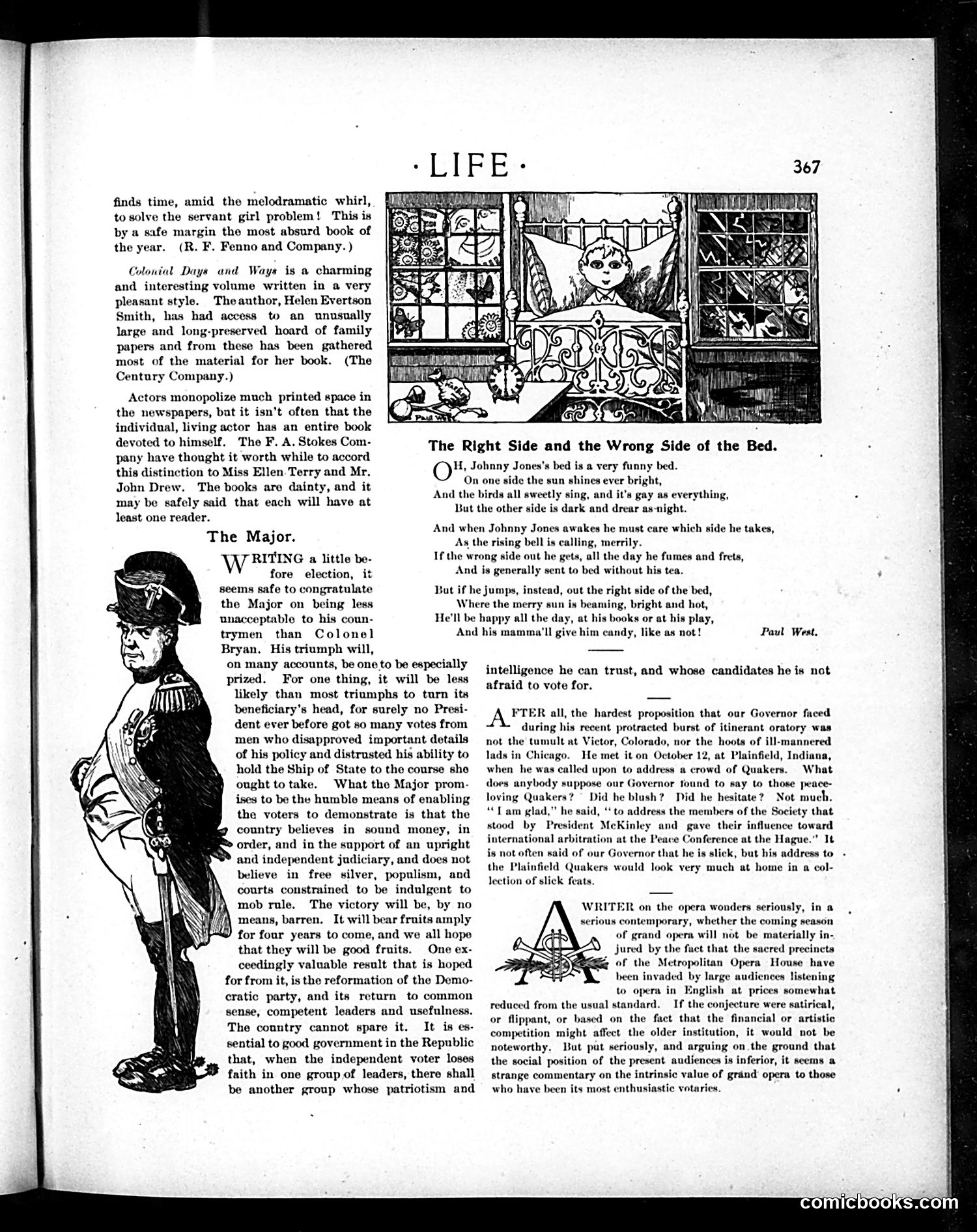
This page contains three distinct pieces of content: 1. **"The Major" (left)**: A caricatured military figure in uniform with exaggerated features, accompanying text congratulating "Colonel Bryan" on his election triumph. The piece satirizes Bryan's political victory and his appeal to voters, while mocking him for claiming to represent democracy and sound money despite backing questionable policies. 2. **"The Right Side and the Wrong Side of the Bed"** (top right): A children's poem by Paul West about Johnny Jones's good and bad days depending on which side of bed he wakes from—lighthearted domestic humor. 3. **"A" section (bottom)**: Commentary on opera in English at reduced prices, debating whether such performances damage grand opera's cultural prestige. The page blends political satire with entertainment discussion typical of Life magazine's format.
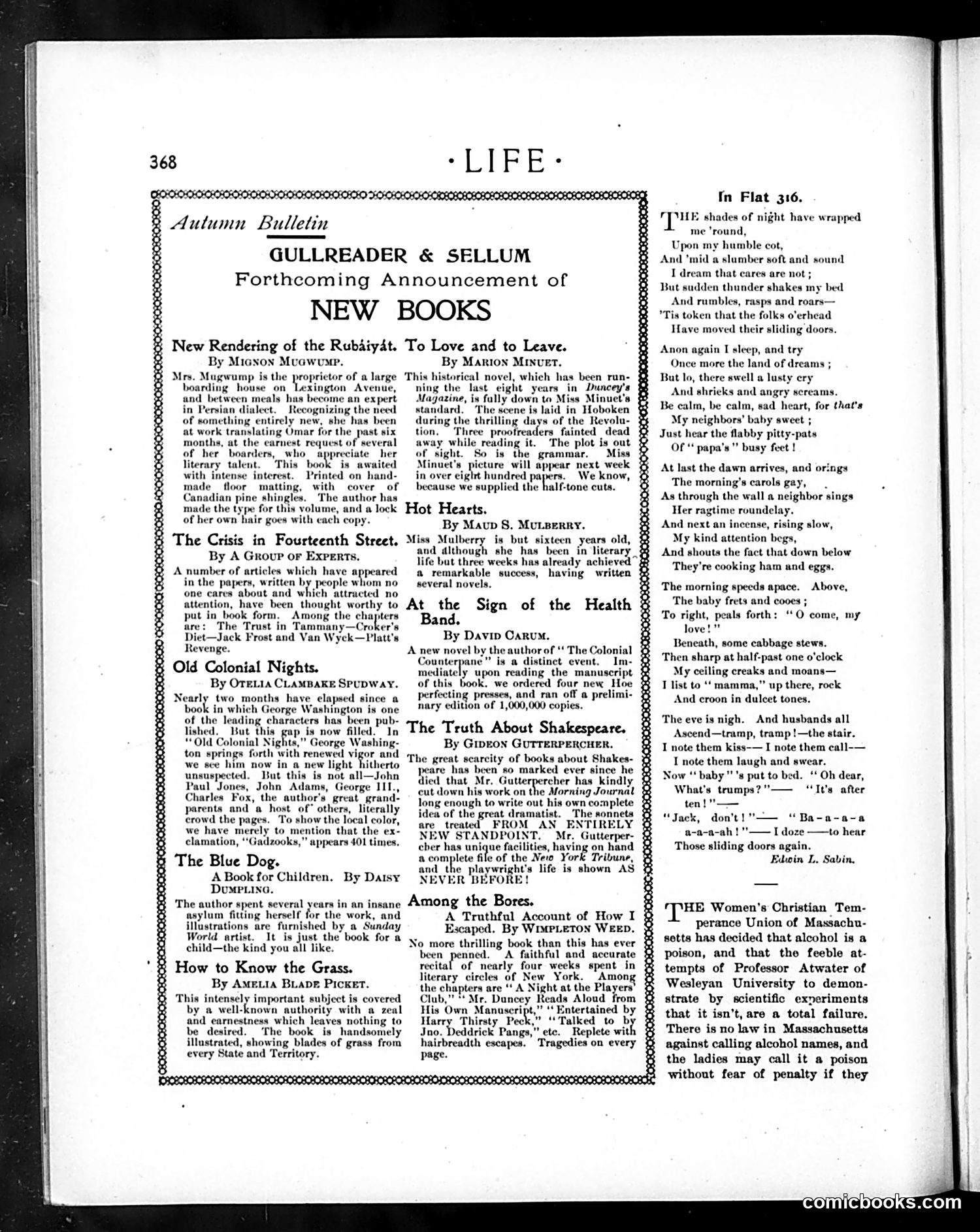
This page is primarily a **book announcement section** ("Autumn Bulletin") from Gullreader & Sellum publishers, listing forthcoming titles. It's not a political cartoon or satirical content requiring historical context. The right side contains a **poem** titled "In Flat 316" about domestic life—a neighbor's baby, thunder, dreams, and household sounds. It's gentle, domestic humor rather than political satire. The left side advertises various books including titles about Washington, Shakespeare, temperance, and grass identification—typical early 20th-century publishing fare. **This is essentially a book advertisement page with light domestic poetry.** There are no political cartoons, caricatures, or satirical commentary requiring historical unpacking. The page reflects period literary interests but contains no hidden meanings to decode.
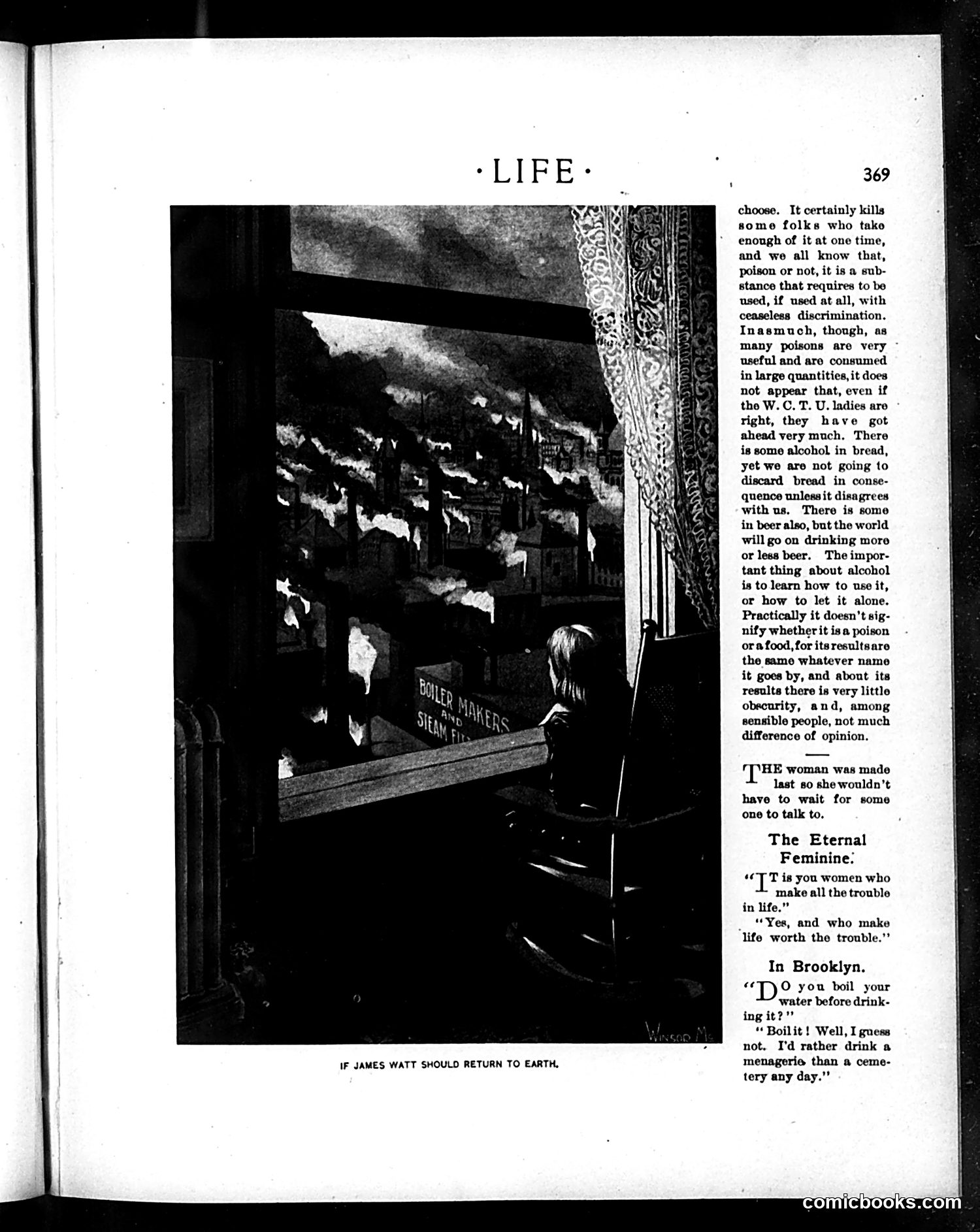
The main image shows an industrial scene labeled "IF JAMES WATT SHOULD RETURN TO EARTH," depicting a massive steam boiler/factory with workers. This is a satirical commentary on industrial progress: James Watt, the 18th-century Scottish engineer who improved the steam engine, is imagined observing modern industrial scale and mechanization. The accompanying text discusses alcohol—poisons, bread with alcohol content, and beer consumption—appearing to be a piece satirizing Prohibition-era debates about the regulation of intoxicating substances. Below are humorous quotes, including "The Eternal Feminine" dialogue and a Brooklyn anecdote about boiling water and drinking menagerie rather than cemetery water—likely absurdist humor mocking folk remedies or superstitious practices. The overall tone is satirical commentary on modern industrial society and social habits.
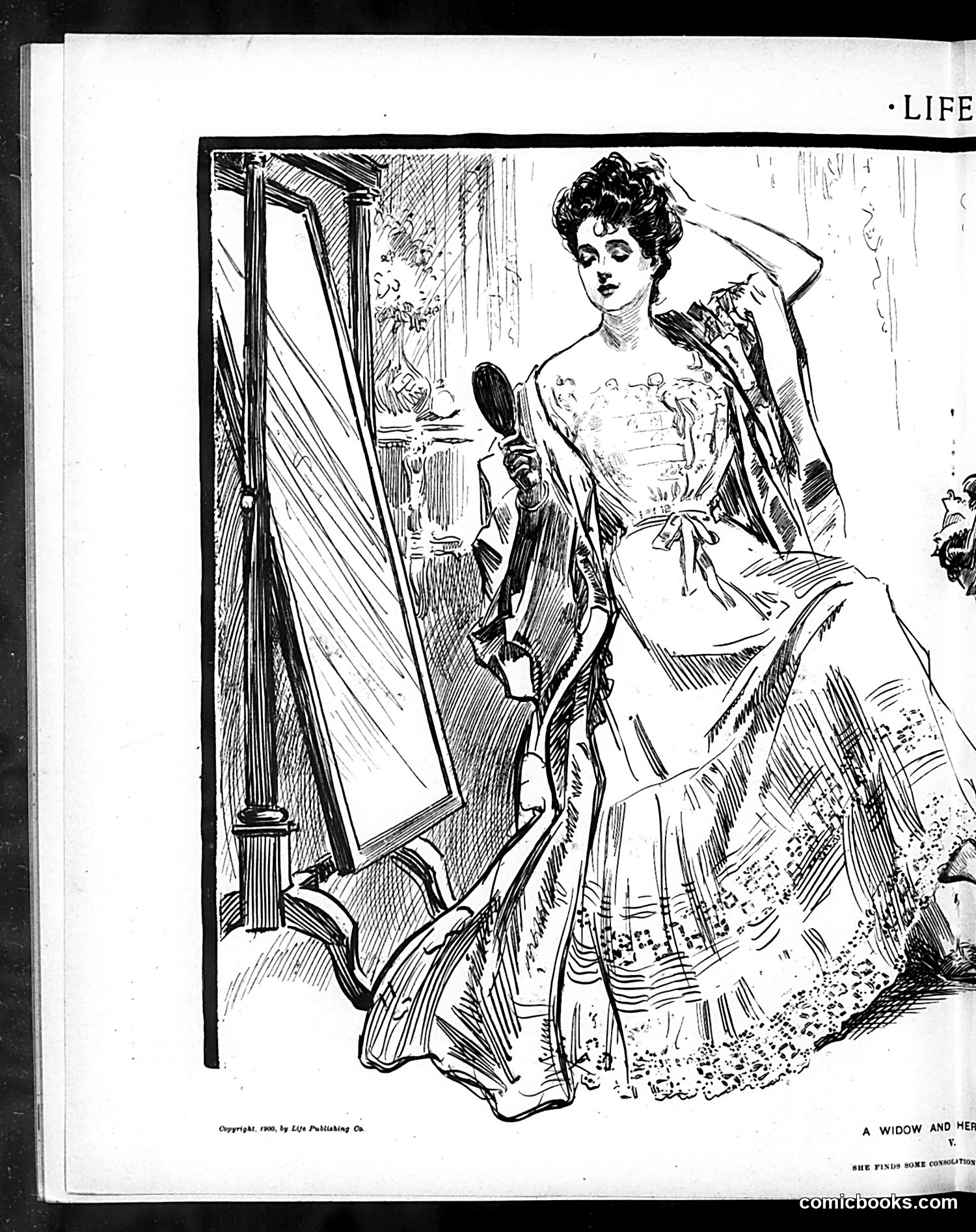
This is an illustration from Life magazine (copyright 1908, per visible text) titled "A Widow and Her..." with a subtitle beginning "She Finds Some Consolation." The image shows a elegantly dressed woman in Edwardian-era clothing examining herself in a mirror, holding a hand mirror. The satirical point appears to relate to widowhood and vanity—the incomplete title suggests the humor concerns how a widow finds "consolation" (implied: romantic or social attention) through her appearance and attractiveness. The illustration exemplifies early 1900s Life magazine's social satire targeting upper-class manners and female behavior. The detailed rendering of her fashionable dress and composed demeanor suggests commentary on how wealthy widows navigate society and remarriage prospects through attention to personal presentation rather than genuine grief.
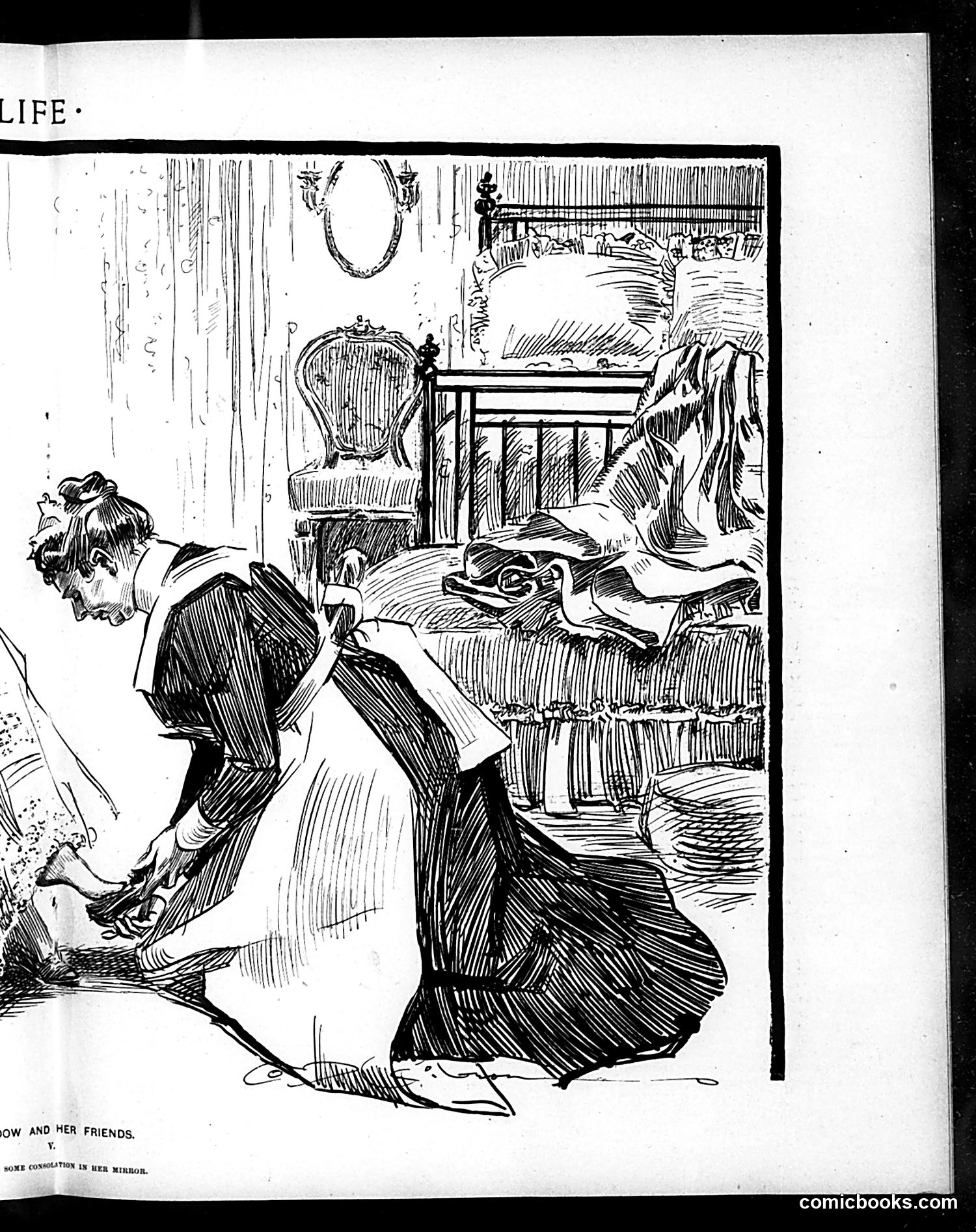
This appears to be a domestic humor illustration from *Life* magazine showing a woman in Victorian dress kneeling or bending down in a bedroom, examining what looks like a small object on the floor. A man in formal attire (coat and vest) is visible in the background near a bed. The visible caption text reads "...AND HER FRIENDS" and mentions something about "CONTEMPLATION IN HER MIRROR." The humor appears to be satirizing Victorian-era domestic life and gender relations—likely poking fun at women's preoccupations or domestic routines. Without the complete caption, the specific social commentary is unclear, but the bedroom setting and the woman's focused attention on a small object suggest satire about either vanity, domestic detail-obsession, or marital dynamics typical of *Life* magazine's genteel social commentary from the late 1800s/early 1900s.
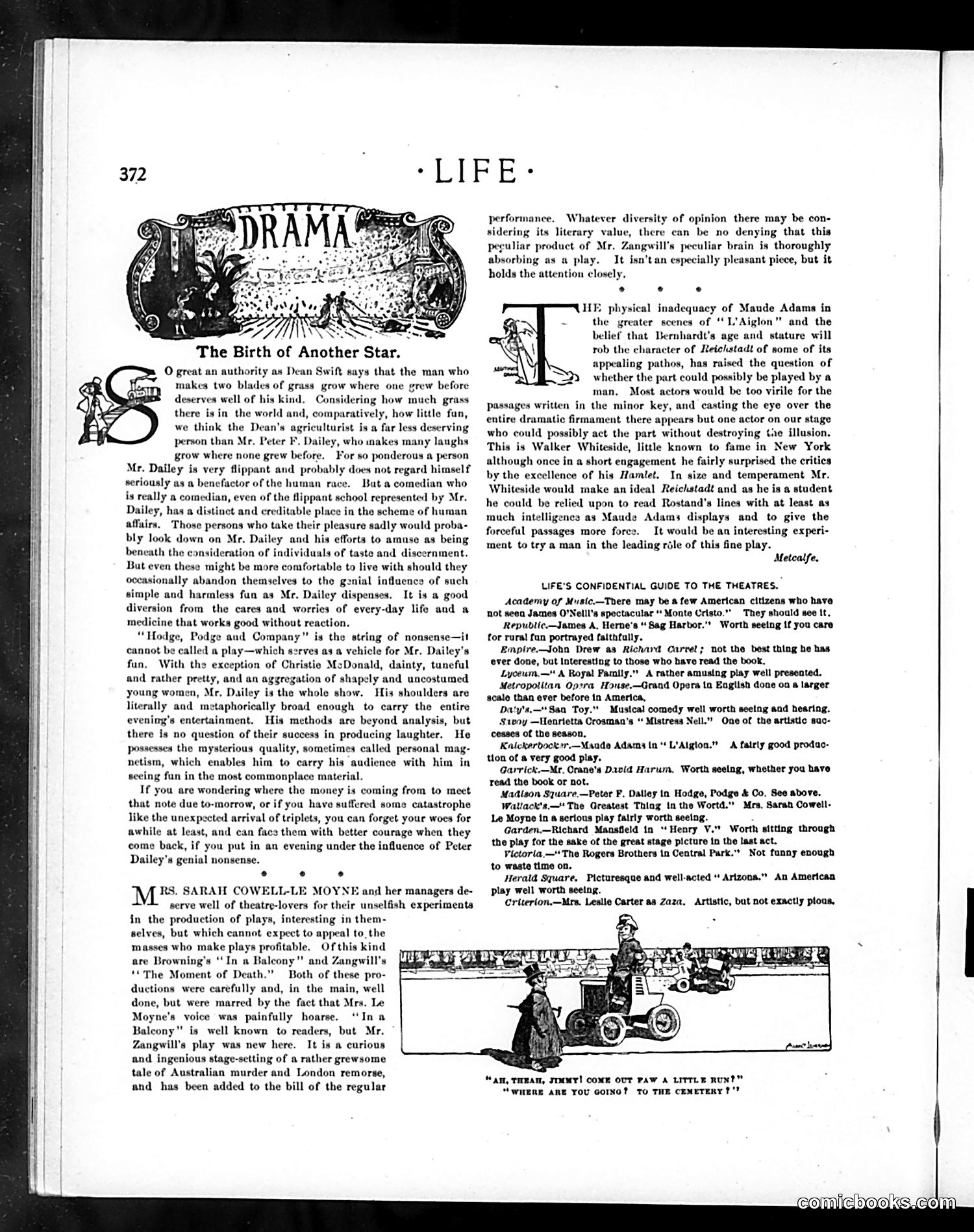
This page is primarily **drama criticism** rather than political satire. It reviews theatrical performances, including discussions of plays like "L'Aiglon" (starring Maude Adams) and works by various actors. The **cartoon at bottom** shows a woman in period dress confronting a man on what appears to be a motorcycle or early automobile. The caption reads: "Ah, there, Jimmy! Come out for a little run? Where are you going? To the cemetery?" This appears to be **social satire about courtship and automobiles**—the joke likely concerns the dangers of early motorcars or automobiles as recreational vehicles for young couples. The "cemetery" reference suggests either reckless driving or perhaps anxiety about modern dating practices involving vehicles. The page demonstrates Life's dual focus on theater criticism and social humor.
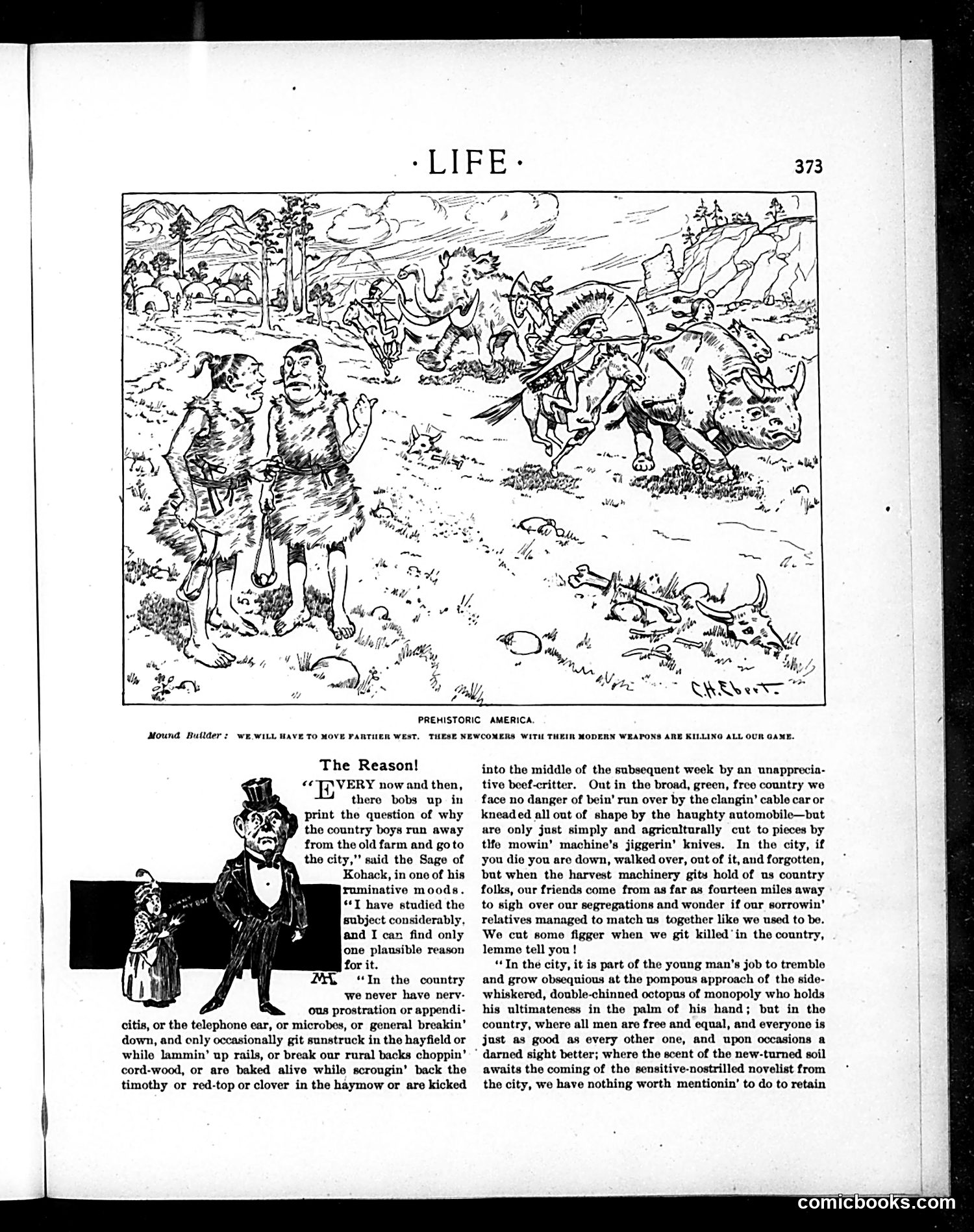
The page contains two separate satirical pieces: **Top cartoon ("Prehistoric America"):** Shows Native Americans observing armed settlers with rifles killing game animals. The caption references "mound builders" and modern weapons displacing indigenous peoples westward—a dark satire on Manifest Destiny and westward expansion's displacement of Native populations. **Bottom article ("The Reason!"):** A monologue by "the Sage of Kohack" humorously contrasts rural and urban life. The speaker argues country boys leave farms for cities not because rural life is dangerous (farm accidents, machinery injuries, animal attacks are routine), but because death in the country carries social significance—"we cut some figger when we git killed"—whereas city life offers anonymity and the indignity of being "walked over, out of it, and forgotten." The satire ironically inverts expectations: he claims rural life is equally hazardous but socially dignified, while city life offers only disposability and servitude to wealthy "monopoly" interests. The piece critiques both urban alienation and rural hardship through deliberately exaggerated, folk-voiced reasoning.
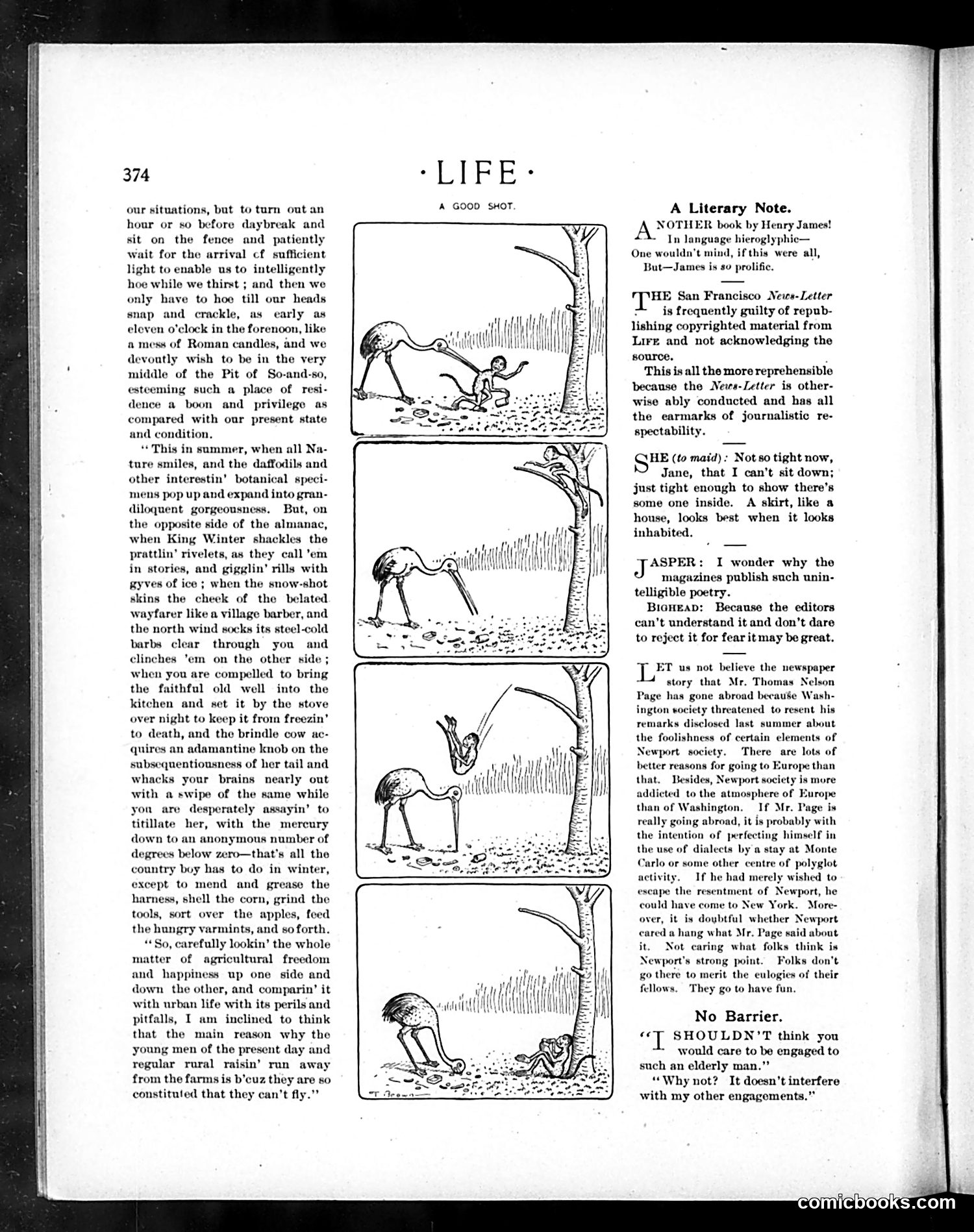
This page presents a multi-panel comic strip depicting a hunter repeatedly attempting to shoot at a small animal (appears to be a rabbit or similar creature) near a tree. The humor lies in the hunter's consistent failure—across five sequential panels, he aims and shoots, but the creature escapes or evades each attempt. The satire works through visual repetition and anticlimax: readers expect eventual success, but the hunter remains perpetually unsuccessful. This likely mocks either incompetent sportsmen or the futility of pursuing difficult goals—a common theme in Life magazine's humor. The surrounding text on the page includes unrelated literary commentary (criticizing Henry James's prolific output and discussing journalistic ethics), plus conversational quips about fashion and Newport society. These elements were typical Life magazine content from this era, mixing visual satire with brief social commentary.
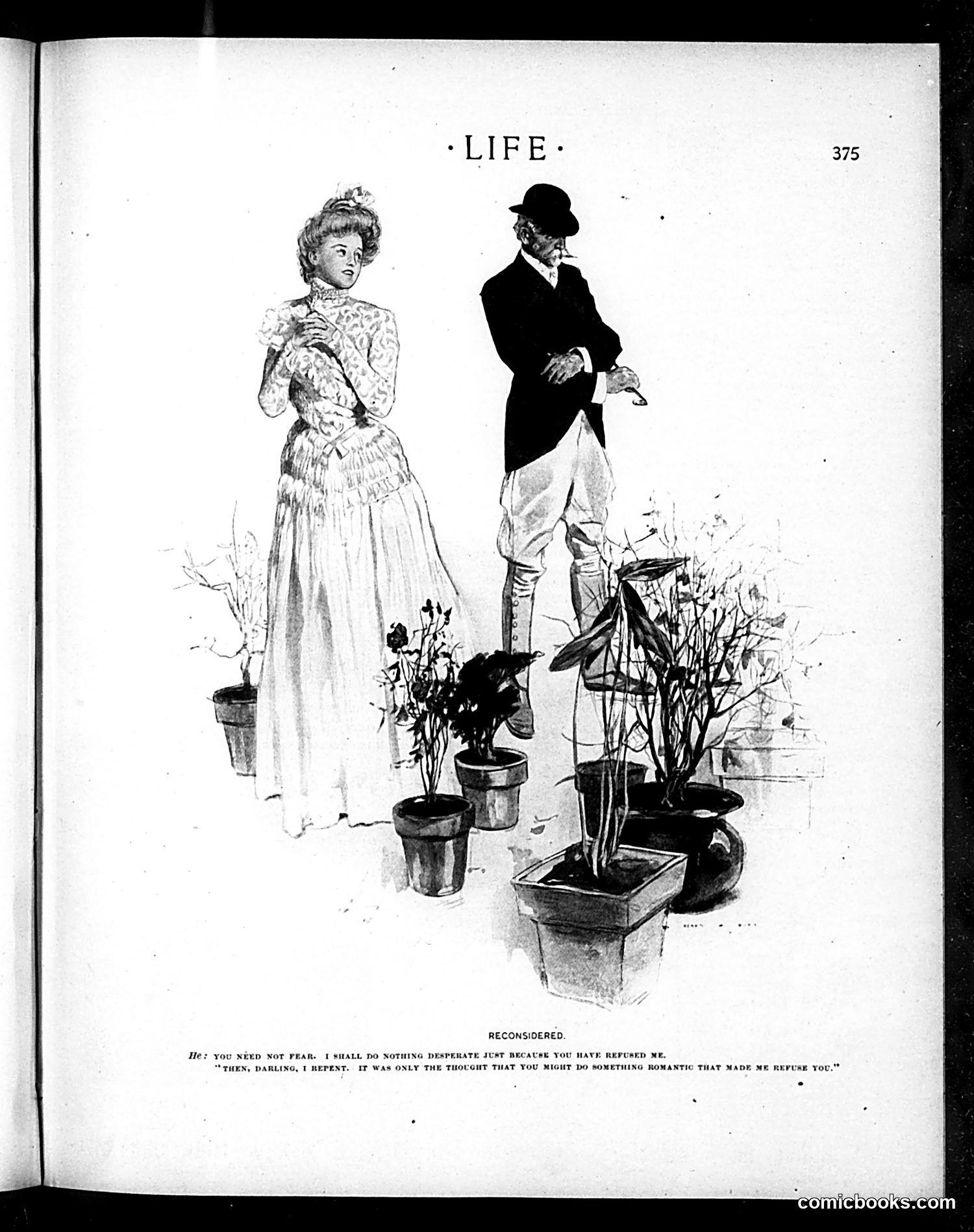
This illustration satirizes courtship and romantic rejection in early 20th-century society. A well-dressed man in riding clothes stands among potted plants, reassuring a woman that he won't do anything "desperate" after her refusal of his (presumably romantic) advances. The satire targets Victorian/Edwardian romance conventions: the woman's fear that rejection might drive him to grand, "romantic" gestures (possibly dramatic or even dangerous acts). Her admission that she rejected him *specifically* because she feared he'd become romantically reckless mocks both genders—his predictability and her manipulation of expected male behavior. The potted plants appear decorative rather than symbolic. The joke relies on the audience recognizing period dating rituals and the exaggerated emotional responses expected from suitors.
This page contains **humorous anecdotes** rather than political cartoons. The content satirizes legal and professional pretension through several jokes: 1. **"The Club Fellow"** poem mocks sentimental sports writing, ending with the narrator's real concern: he lost money betting on football. 2. **Justice McFarland anecdote** satirizes overconfidence. A law-exam failure boasts he'll pass next time because the Supreme Court "never renders the same decision twice"—the joke being his illogical reasoning. 3. **Francis Macdonagh story** ridicules legal pomposity: a young Irish barrister writes "I am clearly of opinion" until a senior lawyer advises never claiming certainty on law points, only "preponderance of doubt." 4. **Israel Zangwill anecdote** gently mocks celebrity worship: when asked to write in a boy's diary, Zangwill simply writes his name—yet the hosts treated his mundane comments as profound. The satire targets **professional arrogance, legal pretension, and the public's deference to authority figures**—themes relevant across eras.
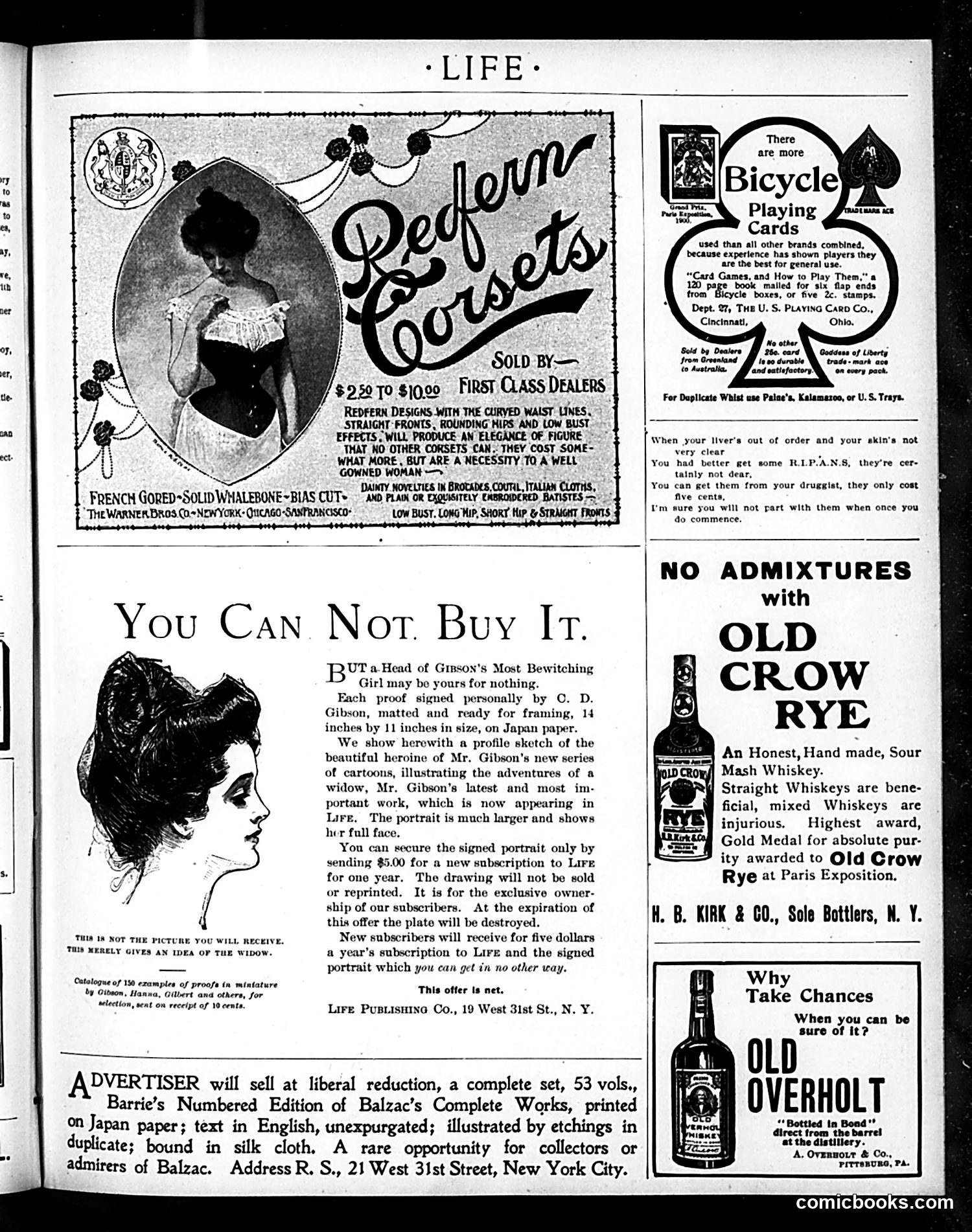
This page is primarily **advertising**, with minimal editorial cartoon content. The main elements are: **"You Can Not Buy It"** (center): A promotional offer from Life Publishing featuring C.D. Gibson's illustration of a widow character from his serialized cartoon series appearing in *Life* magazine. The offer promises a signed, personalized portrait (14"x11") to new annual subscribers for $5—unavailable any other way, with the plate destroyed after the offer ends. This was a common early 1900s subscription incentive. **Side Advertisements**: The rest consists of product ads typical of the era—Redfern corsets (emphasizing fashionable silhouette), Bicycle Playing Cards, R.I.P.A.N.S digestive remedy, Old Crow Rye whiskey, and Balzac's complete works. These reveal period consumer interests and advertising conventions. **Historical context**: No political satire or social commentary appears here; it's a straightforward commercial page reflecting early 20th-century magazine business practices and consumer culture.
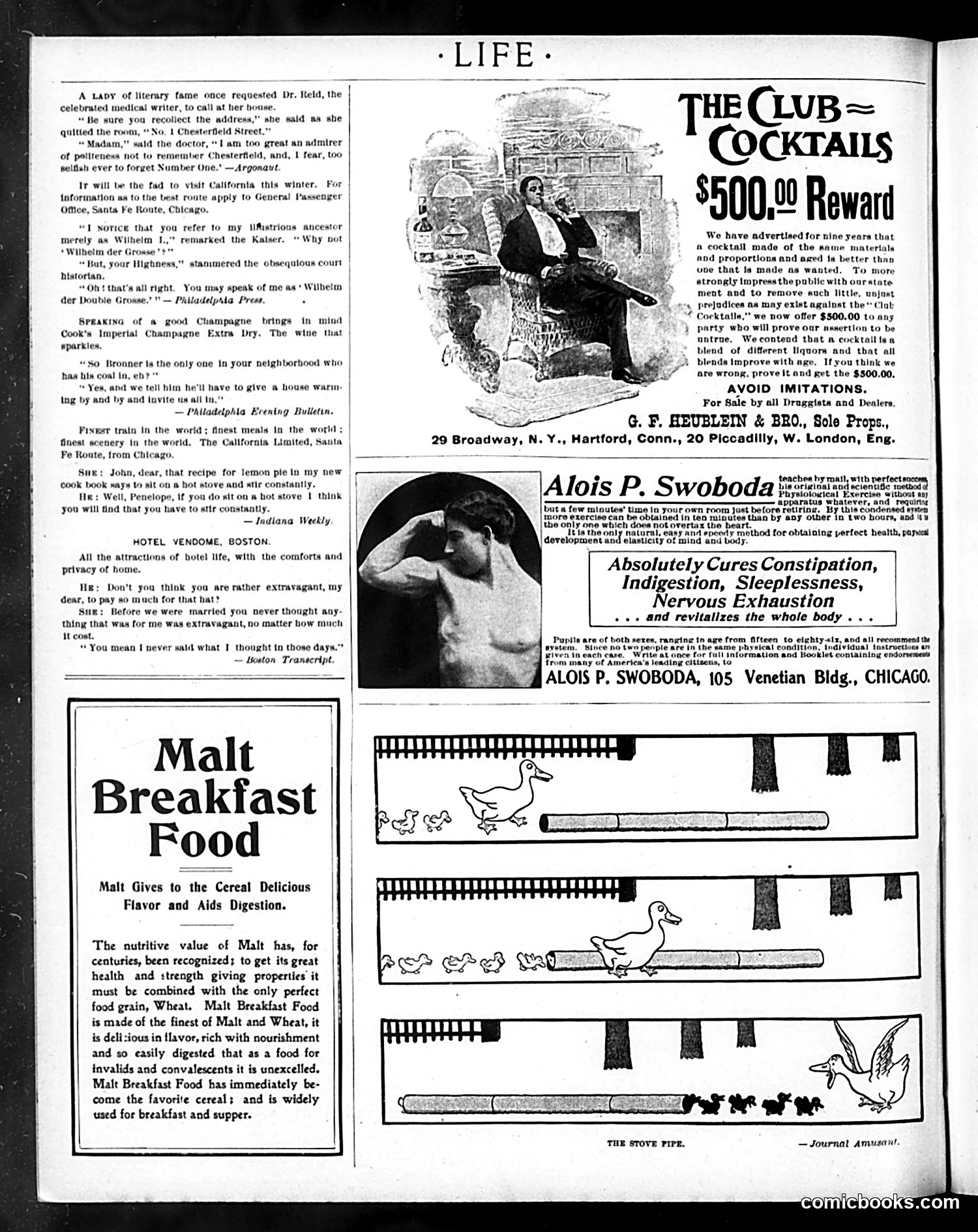
This page is primarily **advertisements and light humor anecdotes** rather than political satire. The content includes: **Anecdotes**: Brief comedic stories about social etiquette (a doctor remembering "Number One"/himself), marital banter about extravagance, and a recipe mishap about sitting on a hot stove. **One substantive reference**: A joke about Kaiser Wilhelm I, where the Kaiser corrects someone calling him "Wilhelm der Grosse" (Wilhelm the Great), insisting instead on "Wilhelm der Double Grosse"—a self-aggrandizing pun suggesting he's doubly great. This mocks the Kaiser's vanity. **Advertisements dominate**: Malt Breakfast Food, Champagne, the Santa Fe railway, a Boston hotel, and notably **Heublein's Club Cocktails** offering a $500 reward to anyone proving their aged cocktails aren't superior to freshly-made ones—a competitive marketing claim. The page reflects early 1900s advertising practices and gentle humor typical of *Life* magazine's satirical but not overtly political content during this era.
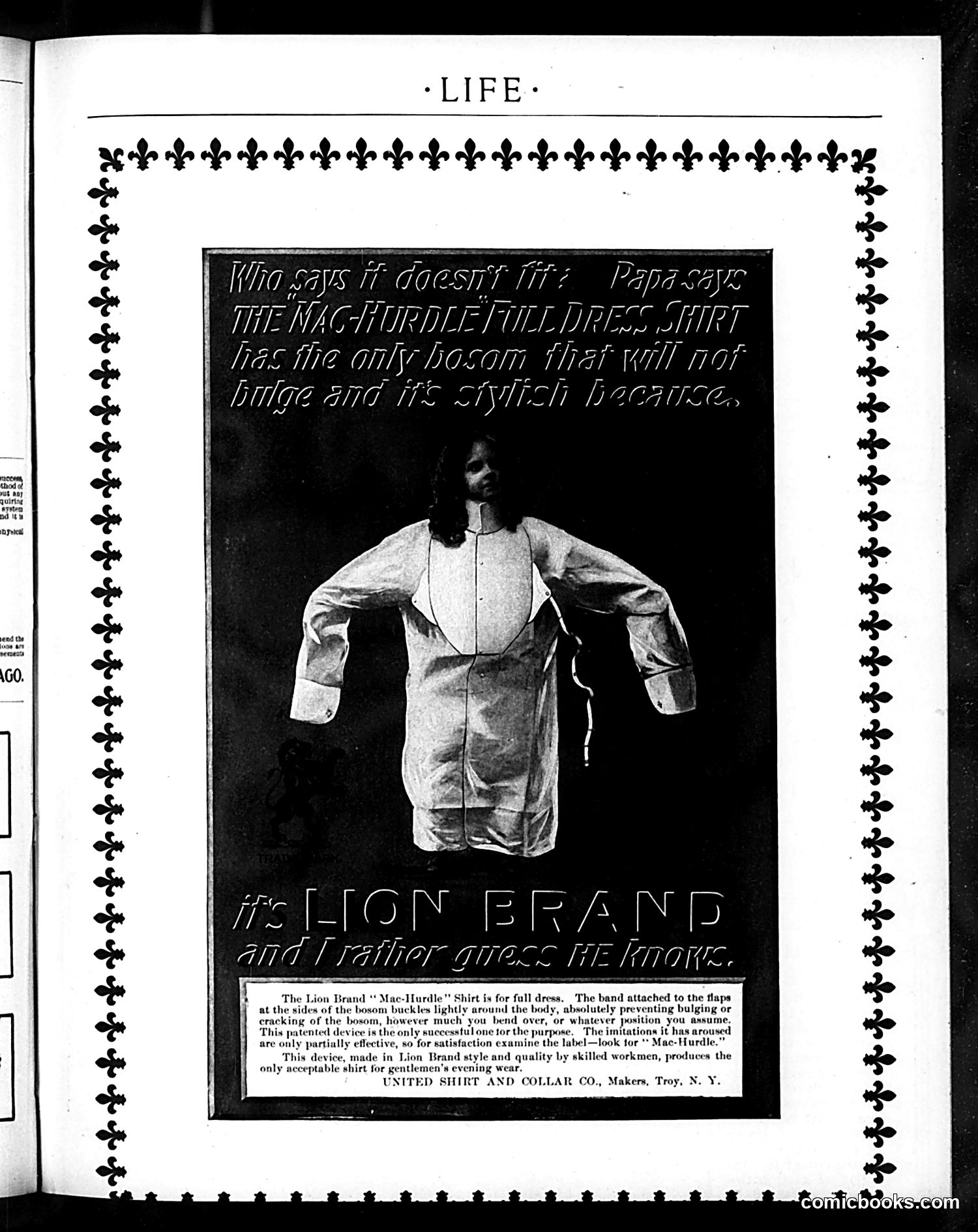
This is a **product advertisement**, not political satire. It promotes the "Mae-Hurdle" dress shirt by United Shirt and Collar Co. (Troy, N.Y.). The ad uses humor to sell a practical feature: the shirt's band prevents the bosom from bunching or bulging when bent over—a real problem with formal wear of that era. The joke plays on a child asking "Who says it doesn't fit?" while a father figure ("Papa") endorses the product's stylish solution to a common embarrassment. The advertisement targets gentlemen seeking proper evening wear, emphasizing that this shirt maintains its appearance and dignity under movement, unlike competitors' designs. The humor derives from the relatable social anxiety about maintaining a polished appearance—a concern that resonated with early 20th-century male readers concerned with respectability.
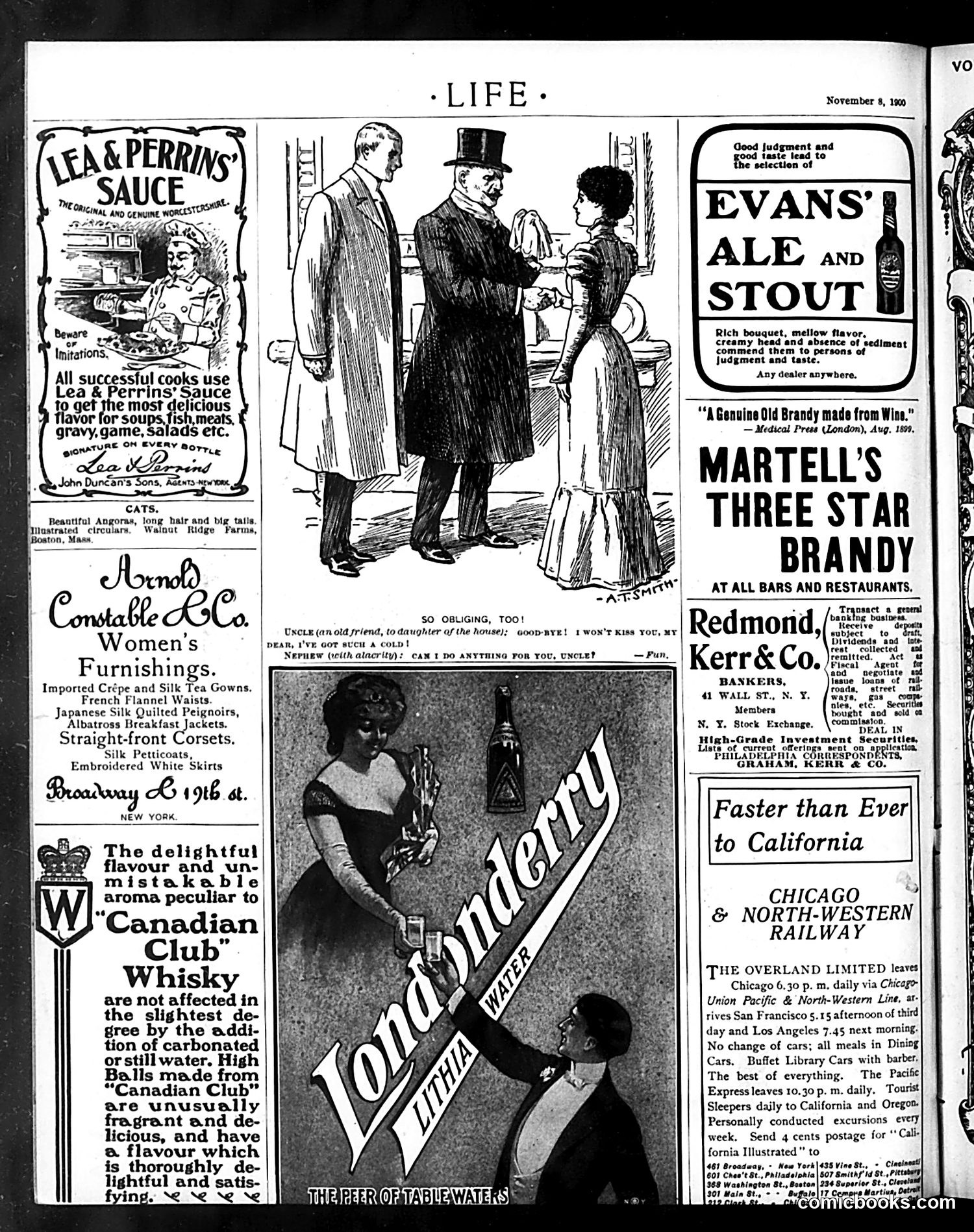
The main cartoon depicts a social scene where an elderly gentleman (labeled "Uncle") is departing, claiming he has a cold and cannot kiss the young woman of the house goodbye. The daughter immediately offers, "Can I do anything for you, Uncle?" — responding with eager helpfulness the moment physical contact is declined. The satire targets Victorian-era social hypocrisy: the uncle uses his cold as a polite excuse to avoid intimacy, yet the daughter's instant shift to solicitous behavior suggests the real motivation was avoidance of familial obligation rather than actual concern for health. The joke exposes how Victorian propriety allowed people to dodge unwanted social rituals under transparent pretexts. The page is primarily **advertising** — featuring products like Lea & Perrins' sauce, women's furnishings, Canadian Club whisky, and railway services typical of 1900 commercial publications. Life magazine supported itself through these advertisements while featuring occasional satirical cartoons.