
Life, 1900-11-08 · page 13 of 20
Life — November 8, 1900 — page 13: what you’re looking at
What you’re looking at
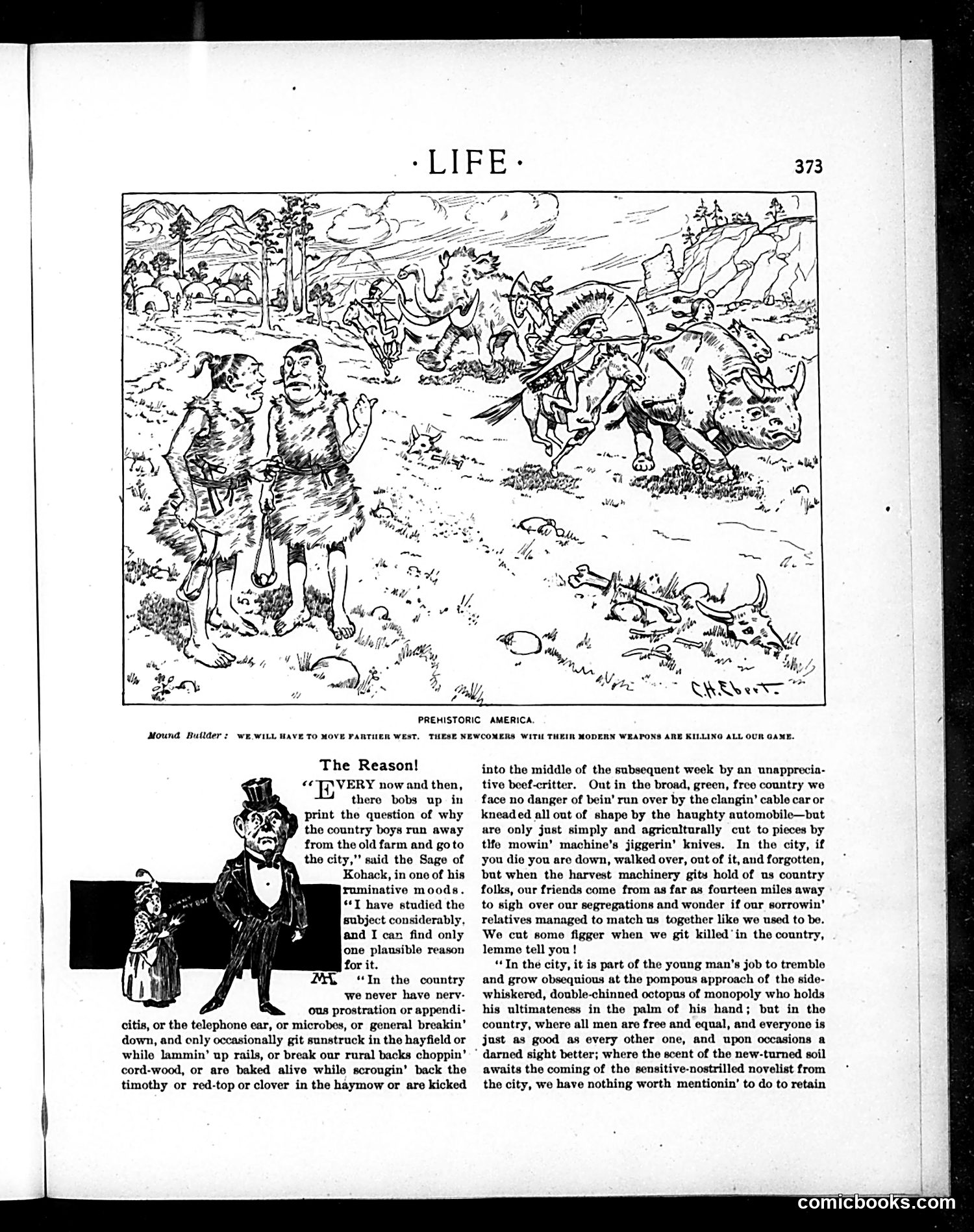
The page contains two separate satirical pieces: **Top cartoon ("Prehistoric America"):** Shows Native Americans observing armed settlers with rifles killing game animals. The caption references "mound builders" and modern weapons displacing indigenous peoples westward—a dark satire on Manifest Destiny and westward expansion's displacement of Native populations. **Bottom article ("The Reason!"):** A monologue by "the Sage of Kohack" humorously contrasts rural and urban life. The speaker argues country boys leave farms for cities not because rural life is dangerous (farm accidents, machinery injuries, animal attacks are routine), but because death in the country carries social significance—"we cut some figger when we git killed"—whereas city life offers anonymity and the indignity of being "walked over, out of it, and forgotten." The satire ironically inverts expectations: he claims rural life is equally hazardous but socially dignified, while city life offers only disposability and servitude to wealthy "monopoly" interests. The piece critiques both urban alienation and rural hardship through deliberately exaggerated, folk-voiced reasoning.
📄 Transcribed text from this page (OCR, searchable)
Machine-transcribed from the original scan — historical spelling and the odd misread are preserved.
PREHISTORIC AMERICA. WE.WILL HAVE TO MOVE FARTHER WEST, THESE NEWCOMERS WITH THEIR MODERN WEAPONS ARE KILLING ALL OUR GAME. Mound Butlder : The Reason! <<). VERY now and then, E there bobs up in print the question of why the country boys run away from the old farm and goto the city,” said the Sage of Kohack, in one of his raminative moods. “T have studied the subject considerably, and I can find only one plausible reason for it. “In the country we never have nerv- ous prostration or appendi- citis, or the ‘elagious ear, or microbes, or general breakin’ down, and only occasionally git sunstruck in the hayfield or while lammin’ up rails, or break our rural backs choppin’ cord-wood, or are baked alive while scrougin’ back the timothy or red-top or clover in the haymow or are kicked at into the middle of the subsequent week by an unapprecia- tive beef-critter. Out in the broad, green, free country we face no danger of bein’ run over by the clangin’ cable car or kneaded all out of shape by the haughty automobile—but are only just simply and agriculturally cut to pieces by tlfe mowin’ machine's jiggerin’ knives. In the city, if you die you are down, walked over, out of it, and forgotten, but when the harvest machinery gits hold of us country folks, our friends come from as far as fourteen miles away to sigh over our segregations and wonder if our sorrowin’ relatives managed to match us together like we used to be. We cut some figger when we git killed’in the country, lemme tell you ! “In the city, it is part of the young man’s job to tremble and grow obsequious at the pompous approach of the side- whiskered, double-chinned octopus of monopoly who holds his ultimateness in the palm of his hand; but in the country, where all men are free and equal, and everyone is just as good as every other one, and upon occasions a * darned sight better; where the scent of the new-turned soil awaits the coming of the sensitive-nostrilled novelist from the city, we have nothing worth mentionin’ to do to retain 4 comicbooks.com