
Life, 1900-11-08 · page 14 of 20
Life — November 8, 1900 — page 14: what you’re looking at
What you’re looking at
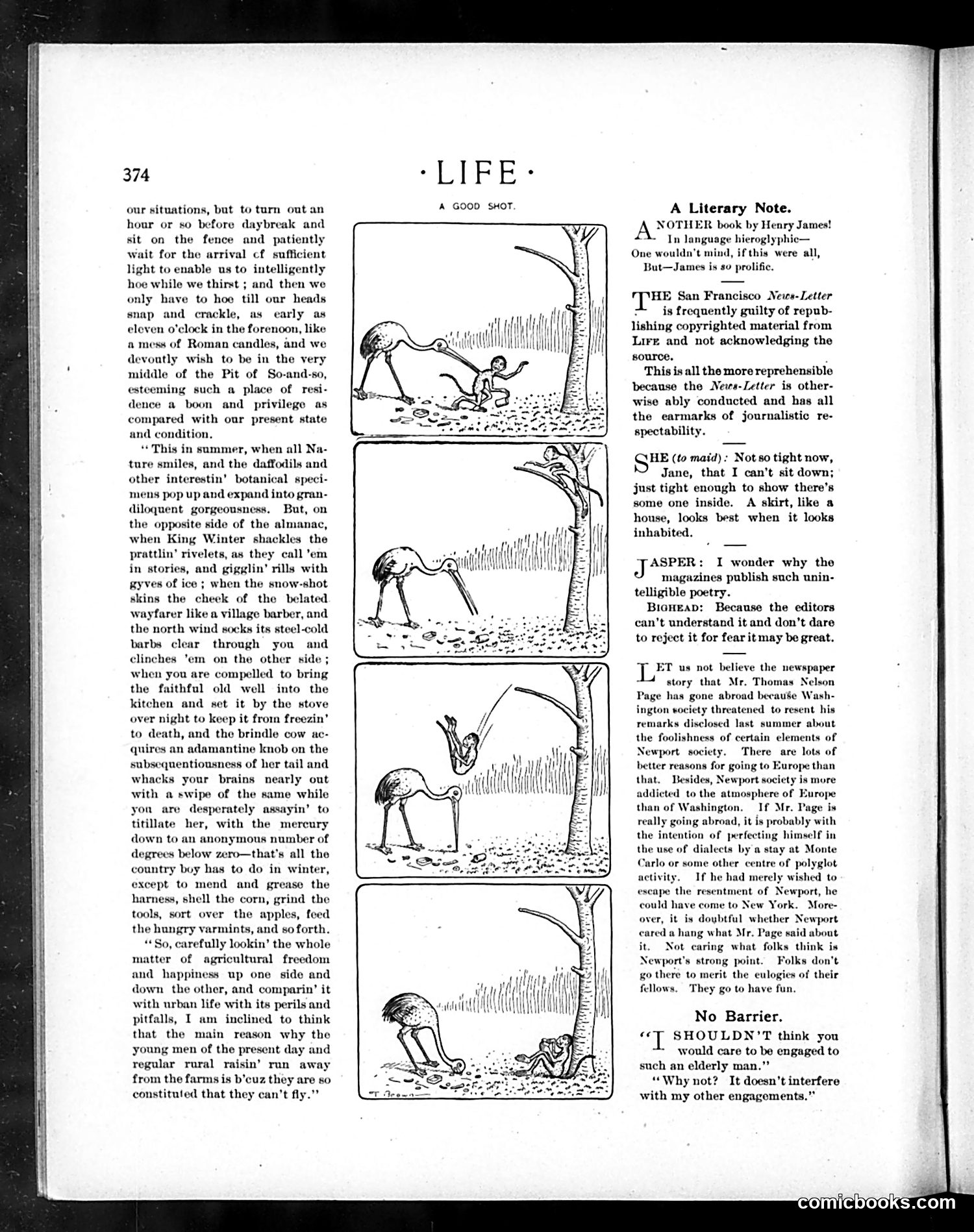
This page presents a multi-panel comic strip depicting a hunter repeatedly attempting to shoot at a small animal (appears to be a rabbit or similar creature) near a tree. The humor lies in the hunter's consistent failure—across five sequential panels, he aims and shoots, but the creature escapes or evades each attempt. The satire works through visual repetition and anticlimax: readers expect eventual success, but the hunter remains perpetually unsuccessful. This likely mocks either incompetent sportsmen or the futility of pursuing difficult goals—a common theme in Life magazine's humor. The surrounding text on the page includes unrelated literary commentary (criticizing Henry James's prolific output and discussing journalistic ethics), plus conversational quips about fashion and Newport society. These elements were typical Life magazine content from this era, mixing visual satire with brief social commentary.
📄 Transcribed text from this page (OCR, searchable)
Machine-transcribed from the original scan — historical spelling and the odd misread are preserved.
374 our situations, but to turn out an hour or so before daybreak and sit on the fence and patiently wait for the arrival cf sufficient light to enable us to intelligently hoe while we thirst ; and then we only have to hoe till our heads snap and crackle, as early as eleven o'clock in the forenoon, like a mess of Roman candles, and we devoutly wish to be in the very middle of the Pit of So-and-so, estceming such a place of resi- dence a boon and privilege as compared with our present state and condition, “ This in summer, when all Na- ture smiles, and the daffodils and other interestin’ botanical speci- mens pop up and expand into gran- diloquent gorgeousness. But, on the opposite side of the almanac, when King Winter shackles the prattlin’ rivelets, as they call ’em in stories, and gigglin’ rills with gyves of ice ; when the snow-shot skins the cheek of the belated wayfarer like a village barber, and the north wind socks its steel-cold barbs clear through you and clinches ‘em on the other side ; when you are compelled to bring the faithful old well into the kitchen and set it by the stove over night to keep it from freezin’ to death, and the brindle cow ac- quires an adamantine knob on the subsequentiousness of her tail and whacks your brains nearly out with a swipe of the same while you are desperately assayin’ to titillate her, with the mercury down to an anonymous number of degrees below zero—that’s all the country boy has to do in winter, except to mend and grease the harness, shell the corn, grind the tools, sort over the apples, feed the hungry varmints, and so forth. So, carefully lookin’ the whole matter of agricultural freedom and happiness up one side and down the other, and comparin’ it with urban life with its perils and pitfalls, I am inclined to think that the main reason why the young men of the present day and regular rural raisin’ run away from the farms is b’cuz they are so constituted that they can’t fly.”” LIFE ‘A GOOD SHOT. i se ttl A Literary Note. A NOTHER book by Henry James! In language hieroglyphic— One wouldn't mind, if this were all, But—James is so prolific. HE San Francisco News-Letter is frequently guilty of repub- lishing copyrighted material from Lire and not acknowledging the source. This is all the more reprehensible because the News-Letter is other- wise ably conducted and has all the earmarks of journalistic re- spectability. HE (to maid): Notso tight now, Jane, that I can't sit down; just tight enough to show there’s some one inside. A skirt, like a house, looks best when it looks inhabited. ASPER: I wonder why the magazines publish such unin- telligible poetry. Bicneap: Because the editors can’t understand it and don’t dare to reject it for fear it may be great. 27 us not believe the newspaper +4 story that Mr. Thomas Nelson Page has gone abroad becauée Wash- ington society threatened to resent his remarks disclosed last summer about the foolishness of certain elements of Newport society. There are lots of better reasons for going to Europe than that, Besides, Newport society is more addicted to the atmosphere of Europe than of Washington. If Mr. really going abroad, it is probably with the intention of perfecting himself in the use of dialects by'a stay at Monte Carlo or some other centre of polyglot activity. If he had merely wished to escape the resentment of Newport, he could have come to New York. More- over, it is doybtful whether Newport cared a hang what Mr. Page said about. it, Not caring what folks think is Newport's strong point. Folks don't go there to merit the eulogies of their fellows. ‘They go to have fun, No Barrier. a | SHOULDN'’T think you - would care to be engaged to such an elderly man.” “Why not? It doesn’t interfere with my other engagements.”