
Life, 1900-11-08 · page 5 of 20
Life — November 8, 1900 — page 5: what you’re looking at
What you’re looking at
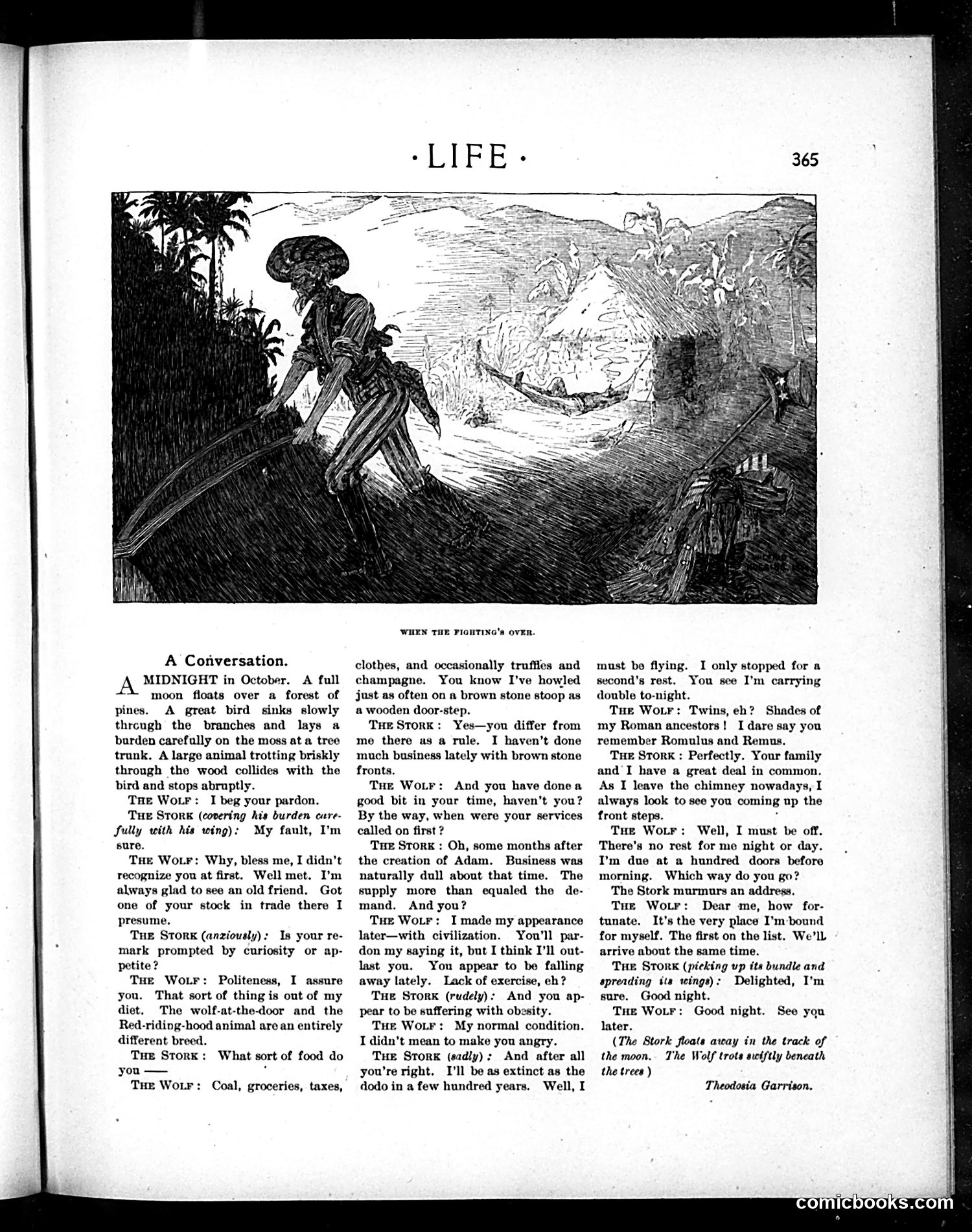
This page presents a satirical dialogue between a **Wolf and a Stork**, illustrated by the engraving "When the Fighting's Over." The conversation adapts the classical Aesop's fable to social commentary. The Wolf boasts of his predatory nature and endless appetite ("coal, groceries, taxes"), while the Stork—characterized as refined and civilized—represents the working class or common people being consumed by exploitative forces. The Wolf's admission that he'll be "extinct...in a few hundred years" suggests commentary on unsustainable rapacity. The stork's departure "carrying double to-night" implies burden and exhaustion from serving the Wolf's demands. This appears to be **social/economic satire about exploitation**—the traditional fable reframed as critique of predatory capitalism or tyranny consuming society's resources.
📄 Transcribed text from this page (OCR, searchable)
Machine-transcribed from the original scan — historical spelling and the odd misread are preserved.
A Conversation. MIDNIGHT in October. A full moon floats over a forest of pines. A great bird sinks slowly thrcugh the branches and lays a burden carefully on the moss at a tree trunk. A large animal trotting briskly through the wood collides with the bird and stops abruptly. Tue Wotr: I beg your pardon. Tue StorK (covering his burden care- Sully with his wing): My fault, I'm sure. Tue Wotr: Why, bless me, I didn’t recognize you at first. Well met. I’m always glad to see an old friend. Got one of your stock in trade there I presume. Tue Stork (anziously): Is your re- mark prompted by curiosity or ap- petite? Tue WoLFr: Politeness, I assure you. That sort of thing is out of my diet. The wolf-at-the-door and the Red-riding-hood animal are an entirely different breed. Tue Stork: What sort of food do you —— 7 Tue WoLF: Coal, groceries, taxes, WHEN THE PIoNTING's OVER. clothes, and occasionally truffles and champagne. You know I've howled just as often on a brown stone stoop as a wooden door-step. Tue Stork: Yes—you differ from me there as a rule. I haven’t done much business lately with brown stone fronts. Tue Wotr: And you have donea good bit in your time, haven't you? By the way, when were your services called on first ? Tue Stork : Oh, some months after the creation of Adam. Business was naturally dull about that time. The supply more than equaled the de- mand. And you? Tue WotF: I made my appearance later—with civilization. You'll par- don my saying it, but I think I’ll out- last you. You appear to be falling away lately. Lack of exercise, eh? Tue Stork (rudely): And you ap- pear to be suffering with obesity. Tue WoLr: My normal condition. I didn’t mean to make you angry. Tue Stork (sadly); And after all you’re right. I'll be as extinct as the dodo in a few hundred years. Well, I must be flying. I only stopped for a second’s rest. You see I’m carrying double to-night. Tue WotF: Twins, eh? Shades of my Roman ancestors! I dare say you remember Romulus and Remus. Tue Stork : Perfectly. Your family and I have a great deal in common. As I leave the chimney nowadays, I always look to see you coming up the front steps. : Tue Wotr: Well, I must be off. There's no rest for me night or day. I’m due at a hundred doors before morning. Which way do you go? The Stork murmurs an address. Tue Wotr: Dear me, how for- tunate. It's the very place I'm bound for myself. The first on the list. We’lL arrive about the same time. Tre Stork (picking up its bundle and spreading its wings): Delighted, I'm sure. Good night. Tue Wotr: Good night. See you later. (The Stork floats aveay in the track of the moon. The Wolf trots swiftly beneath the trees) Theodosia Garrison.