
Life, 1900-11-08 · page 12 of 20
Life — November 8, 1900 — page 12: what you’re looking at
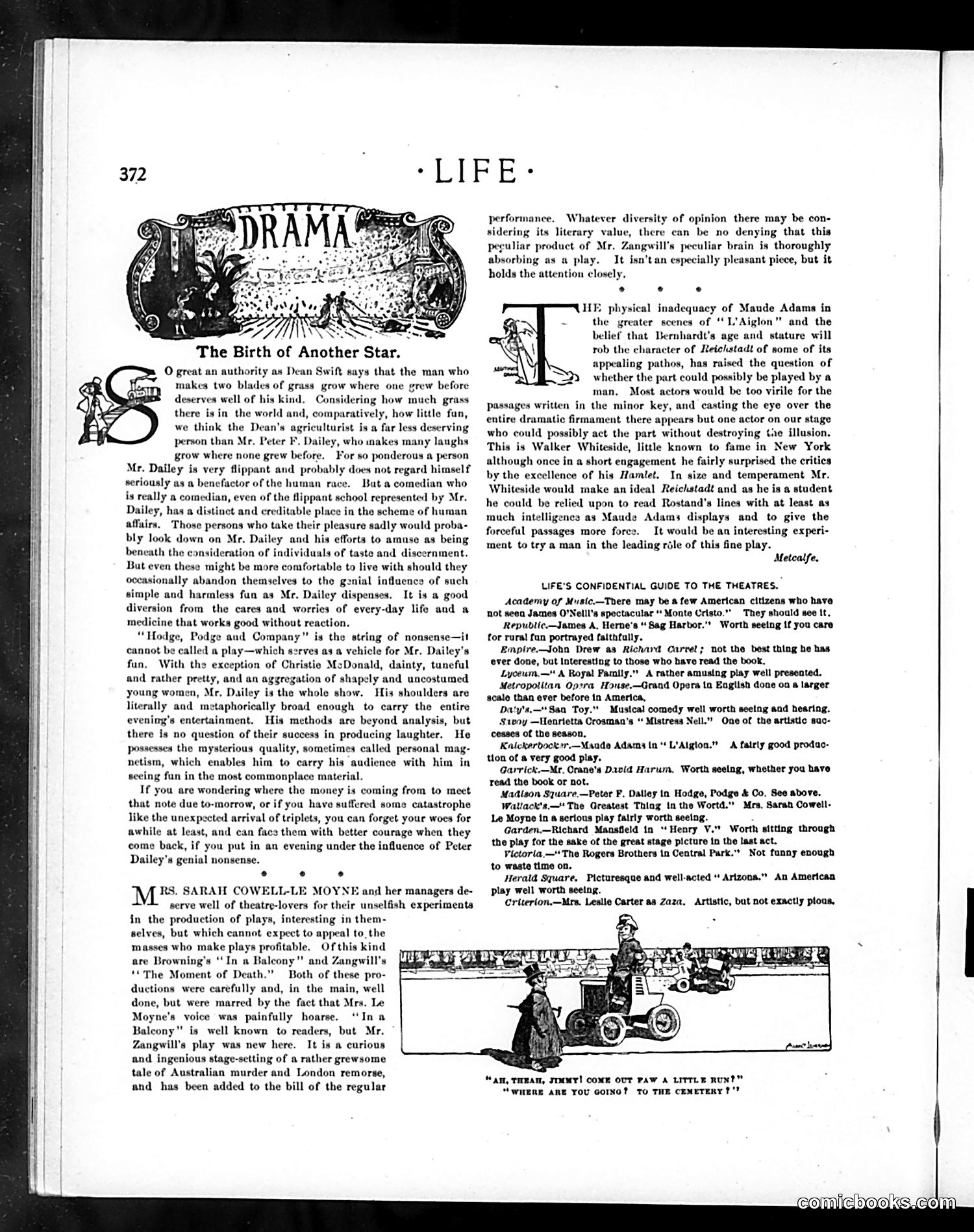
What you’re looking at
This page is primarily **drama criticism** rather than political satire. It reviews theatrical performances, including discussions of plays like "L'Aiglon" (starring Maude Adams) and works by various actors. The **cartoon at bottom** shows a woman in period dress confronting a man on what appears to be a motorcycle or early automobile. The caption reads: "Ah, there, Jimmy! Come out for a little run? Where are you going? To the cemetery?" This appears to be **social satire about courtship and automobiles**—the joke likely concerns the dangers of early motorcars or automobiles as recreational vehicles for young couples. The "cemetery" reference suggests either reckless driving or perhaps anxiety about modern dating practices involving vehicles. The page demonstrates Life's dual focus on theater criticism and social humor.
📄 Transcribed text from this page (OCR, searchable)
Machine-transcribed from the original scan — historical spelling and the odd misread are preserved.
The Birth of Another Star. O great an authority as Dean Swift says that the man who makes two blades of grass grow where one grew before deserves well of his kind. Considering how much grass there is in the world and, comparatively, how little fan, we think the Dean's agriculturist is a far less deserving person than Mr, Peter F, Dailey, who makes many laughs grow where none grew before. For so ponderous a person Mr. Dailey is very flippant and probably does not regard himself seriously as a benefactor of the human race. But a comedian who is really a comedian, even of the flippant school represented by Mr. Dailey, has a distinct and creditable place in the scheme of human affairs, Those persons who take their pleasure sadly would proba- bly look down on Mr. Dailey and his efforts to amuse as being beneath the consideration of individuals of taste and discernment. But even these might be more comfortable to live with should they occasionally abandon themselves to the genial influence of such simple and harmless fun as Mr, Dailey dispenses. It is a good diversion from the cares and worries of every-day life and a medicine that works good without reaction. “Hodge, Podge and Company” is the string of nonsense—it cannot be called a play—which serves as a vehicle for Mr. Dailey’s fun, With the exception of Christie McDonald, dainty, tuneful and rather pretty, and an aggregation of shapely and uncostumed young women, Mr. Dailey is the whole show. His shoulders are literally and metaphorically broad enough to carry the entire evening's entertainment. His methods are beyond analysis, but there is no question of their success in producing laughter. He possesses the mysterious quality, sometimes called personal mag- m, which enables him to carry his audience with him in ing fun in the most commonplace material. If you are wondering where the money is coming from to meet that note due to-morrow, or if you have suffered some catastrophe like the unexpected arrival of triplets, you can forget your woes for awhile at least, and can face them with better courage when they come back, if you put in an evening under the influence of Peter Dailey's genial nonsense. ° ° . RS. SARAH COWELL-LE MOYNE and her managers de- serve well of theatre-lovers for their unselfish experiments in the production of plays, interesting in them- selves, but which cannot expect to appeal to, the masses who make plays profitable. Of this id are Browning's ‘In a Balcony” and Zangwill’s ke * LiF E performance. Whatever diversity of opinion there may be con- sidering its literary value, there can be no denying that this peguliar product of Mr. Zangwill’s peculiar brain is thoroughly absorbing as a play. It isn’t an especially pleasant piece, but it holds the attention closely, ° ° . HE physical inadequacy of Maude Adams in ~ the greater scenes of ‘L'Aiglon” and the i belief that Dernhardt's age and stature will \ rob the character of Reichstadt of some of its appealing pathos, has raised the question of whether the part could possibly be played by a man. Most actors would be too virile for the passages written in the minor key, and casting the eye over the entire dramatic firmament there appears but one actor on our stage who could possibly act the part without destroying the illusion. This is Walker Whiteside, little known to fame in New York although once in a short engagement he fairly surprised the critics by the excellence of his Hamlet. In size and temperament Mr. Whiteside would make an ideal Reichstadt and as he is a student he could be relied upon to read Rostand’s lines with at least as much intelligence as Maude Adams displays and to give the forceful passages more force. It would be an interesting experi- ment to tey a man in the leading réle of this fine play. Metcalfe, LIFE'S CONFIDENTIAL GUIDE TO THE THEATRES. Academy of Music.—Toere may be afew American citizens who have not seen James O'Nelll's spectacular“ Monte Cristo.” They should see It. Republic—James A, Herne’s “ Sag Harbor."* Worth seeing If you care for rural fan portrayed faithfally. Empire.—John Drew as Richard Cartel; not the best thing he has ever done, but Interesting to those who have read the book. Lyceum.— A Royal Pamily.” A rather amusing piay well presented. Metropolitan Op:ra Honse.—Grand Opera tn Engilsh done on a larger scale than ever before in America, Daty's.—" San Toy.” Musteal comedy well worth seeing and hearing. ‘S1voy —Henrletta Crosman’s “ Mistress Nell.” One of the artistic suc- cesses of the season, Kalckerbockr.—Maude Adams in“ L'Aigion.” A fairly good prodac- ton of a very good play. Garrick.—Mr. Crane's David Harum, Worth seeing, whether you have read the book or not. Madison Square.—Petor FP. Dalley in Hodge, Podge & Co, See above. Watlack's.—"The Greatest Thing in the Wortd.” Mra, Saran Cowell- Le Moyne in a serious play fairly worth seeing. Garden.—Richard Mansfield in “Henry V." Worth sitting through the play for the sake of the great stage picture in the last act. Victoria.“ The Rogers Brothers in Central Park.” Not funny enough to waste time on, Herald Square, Picturesque and well-acted “ Arizona." An American play well worth seeing. Criterion.—Mra. Lesile Carter as Zaza, Artistic, but not exactly ploas, ‘*The Moment of Death.” Both of these pro- ductions were carefully and, in the main, well done, but were marred by the fact that Mrs. Le Moyne’s voice was painfully hoarse. “In a Balcony” is well known to readers, but Mr. Zangwill’s play was new here. It is a curious and ingenious stage-setting of a rather grewsome tale of Australian murder and London remorse, and has been added to the bill of the regular “Al, THEAM, JNOCY! COME OUT PAW A LITTLE RUN?" “WHERE ARE YoU GoINo? To THR CEMETERY ?'?