
Life, 1900-11-08 · page 7 of 20
Life — November 8, 1900 — page 7: what you’re looking at
What you’re looking at
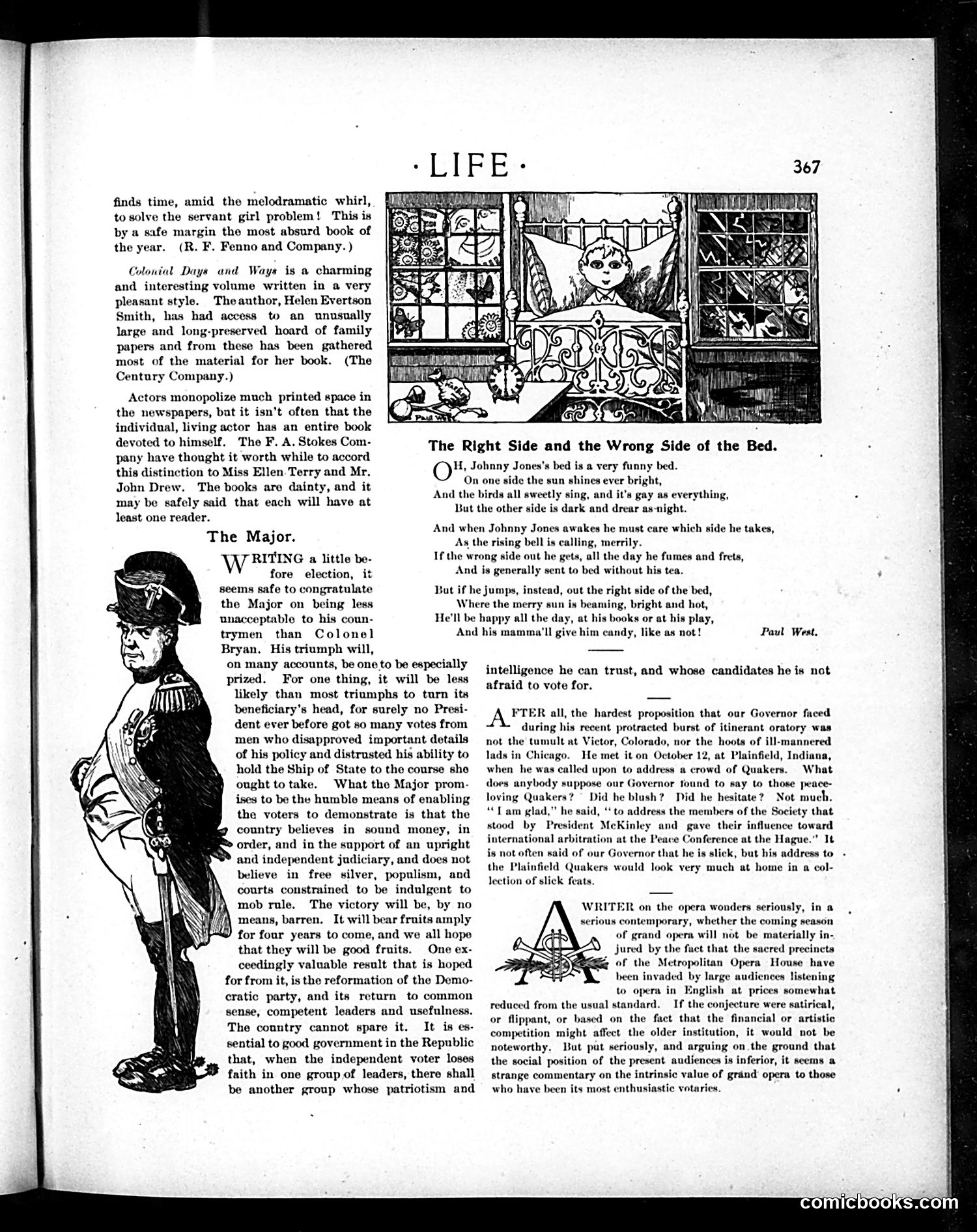
This page contains three distinct pieces of content: 1. **"The Major" (left)**: A caricatured military figure in uniform with exaggerated features, accompanying text congratulating "Colonel Bryan" on his election triumph. The piece satirizes Bryan's political victory and his appeal to voters, while mocking him for claiming to represent democracy and sound money despite backing questionable policies. 2. **"The Right Side and the Wrong Side of the Bed"** (top right): A children's poem by Paul West about Johnny Jones's good and bad days depending on which side of bed he wakes from—lighthearted domestic humor. 3. **"A" section (bottom)**: Commentary on opera in English at reduced prices, debating whether such performances damage grand opera's cultural prestige. The page blends political satire with entertainment discussion typical of Life magazine's format.
📄 Transcribed text from this page (OCR, searchable)
Machine-transcribed from the original scan — historical spelling and the odd misread are preserved.
finds time, amid the melodramatic whirl, to solve the servant girl problem! This is by a safe margin the most absurd book of the year. (R. F. Fenno and Company.) Colonial Daye and Ways is a charming and interesting volume written in a very pleasant style. Theauthor, Helen Evertson Smith, has had access to an unusually large and long-preserved hoard of family papers and from these has been gathered most of the material for her book. (The Century Company.) Actors monopolize much printed space in the newspapers, bat it isn’t often that the individual, living actor has an entire book devoted to himself, The F. A. Stokes Com- pany have thought it worth while to accord this distinction to Miss Ellen. Terry and Mr. John Drew. The books are dainty, and it may be safely said that each will have at least one reader. The Major. The Right Side and the Wrong Side of the Bed. H, Johnny Jones's bed is a very funny bed. On one side the sun shines ever bright, And the birds all sweetly sing, and it’s gay as everything, But the other side is dark and drear as-night. And when Johnny Jones awakes he must care which side he takes, As the rising bell is calling, merrily. W Biting a little be- fore election, it seems safe to congratulate the Major on being less unacceptable to his coun- trymen than Colonel Bryan. His triumph will, on many accounts, be one to be especially prized. For one thing, it will be less likely than most triumphs to turn its beneficiary's head, for surely no Presi- dent ever before got so many votes from men who disapproved important details of his policy and distrusted his ability to hold the Ship of State to the course sho ought to take. What the Major prom- ises to be the humble means of enabling the voters to demonstrate is that the country believes in sound money, in order, and in the support of an upright and independent judiciary, and does not believe in free silver, populism, and courts constrained to be indulgent to mob rule. The victory will be, by no means, barren. It will bear fruits amply for four years to come, and we all hope that they will be good fruits. One ex- ceedingly valuable result that is hoped for from it, is the reformation of the Demo- cratic party, and its return to common sense, competent leaders and usefulness. The country cannot spare it. It is es- sential to good government in the Republic that, when the independent voter loses faith in one group of leaders, there shall be another group whose patriotism and But if he jumps, instead, out the right si Where the merry sun is beaming, bright and hot, He'll be happy all the day, at his books or at his play, And his mamma'll give him candy, like as not! If the wrong side out he gets, all the day he fumes and frets, And is generally sent to bed without his tea. f the bed, Paul Weat. intelligence he can trust, and whose candidates he is not afraid to vote for. Ae all, the hardest proposition that our Governor faced during his recent protracted burst of itinerant oratory was not the tumult at Victor, Colorado, nor the hoots of ill-mannered lads in Chicago. He met it on October 12, at Plainfield, Indiana, when he was called upon to address a crowd of Quakers. What does anybody suppose our Governor found to say to those peace- loving Quakers? — Did he blush? Did he hesitate? Not much. “Tam glad,” he said, ‘‘ to address the members of the Society that stood by President McKinley and gave their influence toward international arbitration at the Peace Conference at the Hague.” It is not often said of our Governor that he is slick, but his address to - the Plainfield Quakers would look very much at home in a col- lection of slick feats. WRITER on the opera wonders seriously, in a serious contemporary, whether the coming season of grand opera will not be materially in- jured by the fact that the sacred precincts % of the Metropolitan Opera House have been invaded by large audiences listening to opera in English at prices somewhat reduced from the usual standard. If the conjecture were satirical, or flippant, or based on the fact that the financial or artistic competition might affect the older institution, it would not be noteworthy. But put seriously, and arguing on the ground that the social position of the present audiences is inferior, it seems a strange commentary on the intrinsic value of grand opera to those who have been its most enthusiastic votaries.