
Life, 1900-11-08 · page 6 of 20
Life — November 8, 1900 — page 6: what you’re looking at
What you’re looking at
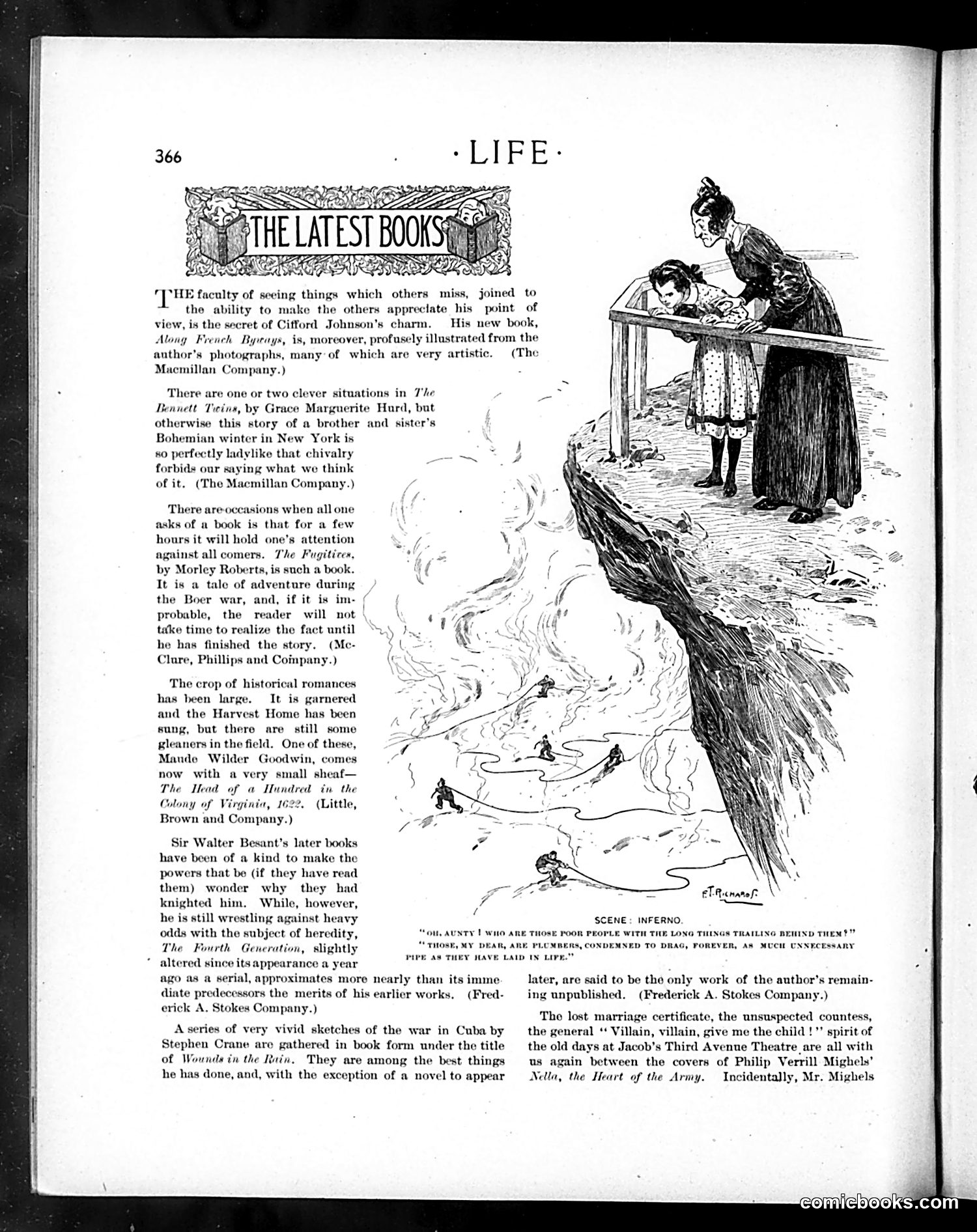
This page is primarily a **book review section** titled "The Latest Books," not political satire. It discusses contemporary literary works including *Along French Byways* by Clifford Johnson and *The Board Fence* by Grace Margueritte Hurd. The illustration labeled "Scene: Inferno" depicts figures in a hellish landscape with the caption: "Oh, aunty! Who are those poor people with the long things trailing behind them?" / "Those, my dear, are plumbers, condemned to drag, forever, as much unnecessary pipe as they have laid in life." This is **occupational satire**—a joke about plumbers allegedly wasting materials and overcharging customers by installing unnecessary pipes. It reflects early 20th-century consumer frustration with tradesman practices, using humor rather than political commentary.
📄 Transcribed text from this page (OCR, searchable)
Machine-transcribed from the original scan — historical spelling and the odd misread are preserved.
‘THE faculty of seeing things which others miss, joined to the ability to make the others appreciate his point of view, is the secret of Cifford Johnson's charm. Along Frenck Byeays, is, moreover, profuse author's photographs, many:of which are very artistic. Macmillan Company.) There are one or two clever situations in The Bennett Twins, by Grace Marguerite Hurd, but otherwise this story of a brother and sister's Bohemian winter in New York is so perfectly ladylike that chivalry forbids our saying what we think of it. (The Macmillan Company.) There areoccasions when all one asks of a book is that for a few hours it will hold one’s attention against all comers. The Fugitives, by Morley Roberts, is such a book. It is a tale of adventure during the Boer war, and, if it is im- probable, the reader will not take time to realize the fact until he has finished the story. (Mc- Clare, Phillips and Company.) The crop of historical romances has been large. It is garnered and the Harvest Home has been sung, but there are still some gleaners in the field. One of these, Mande Wilder Goodwin, comes now with a very small sheaf— The Head of a Hundred in the Colony of iniad, 1622, (Little, Brown and Company.) Sir Walter Besant’s later books have been of a kind to make the powers that be (if they them) wonder why they had knighted him, While, however, he is still wrestling against heavy odds with the subject of heredity, The Fourth Generation, slightly ei * altered since its appearance a year ago as a serial, approximates more nearly than its imme diate predecessors the merits of his earlier works, (Fred- erick A. Stokes Company.) A series of very vid sketches of the war in Cuba by Stephen Crane are gathered in book form under the title of Wounds in the Ruin, They are among the best things he has done, and, with the exception of a novel to appear ‘OM, AUNTY E WHO ARE THOSE POOR PEOPLE WITH TIE LONG THINGS TRAILING Y DEAR, ARE, AS THEY HAVE LAID IN Lire.” His new book, y illustrated from the (The SCENE: INFERNO. EHIND THEM?" JOMBERS, CONDEMNED TO DRAG, POREVER, AX MUCH UNNYCESSARY later, are said to be the onl, ing unpublished. work of the author's remain- (Frederick A. Stokes Company.) Tho lost marriage certificate, the unsuspected countess, the general * Villain, villain, give me the child !”’ spirit of the old days at Jacob’s Third Avenue Theatre are all with us again between the covers of Philip Verrill Mighels’ Nella, the Heart of the Army. Incidentally, Mr. Mighels