
A complete issue · 22 pages · 1900
Life — October 18, 1900
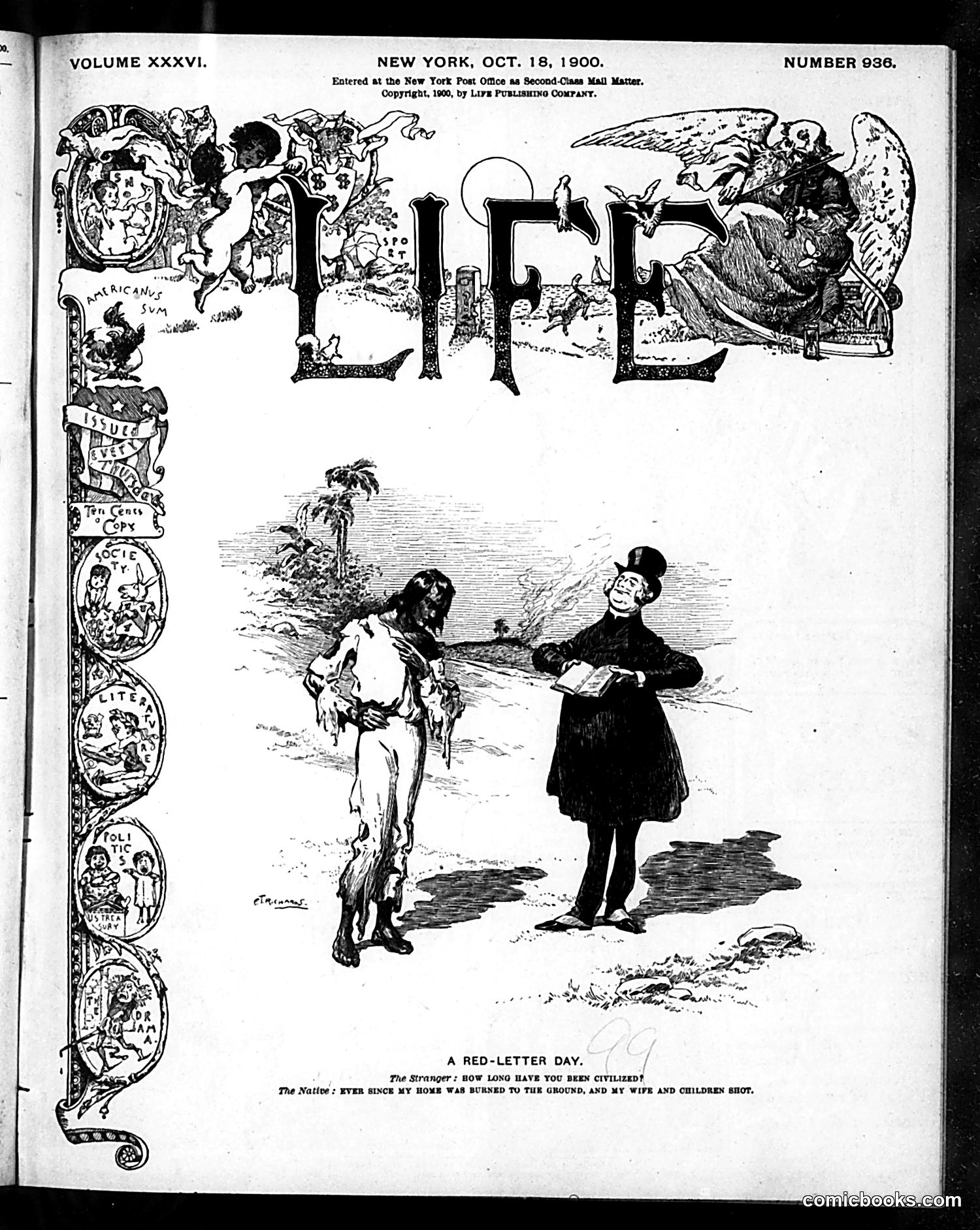
This cartoon satirizes the Boer War (1899-1902) between Britain and the Transvaal/Orange Free State republics in South Africa. The well-dressed British figure represents a British citizen or official; the ragged, distressed figure appears to be a Boer fighter or colonist. The caption's bitter irony is clear: the "stranger" (British) boasts of civilizing influence, while the "native" (Boer) describes devastating losses—his home burned, wife and children killed. The satire critiques British imperial justifications for the war, exposing the human cost and suffering inflicted on the colonial population in the name of "civilization." The cartoon challenges contemporary pro-war sentiment prevalent in 1900 America and Britain.
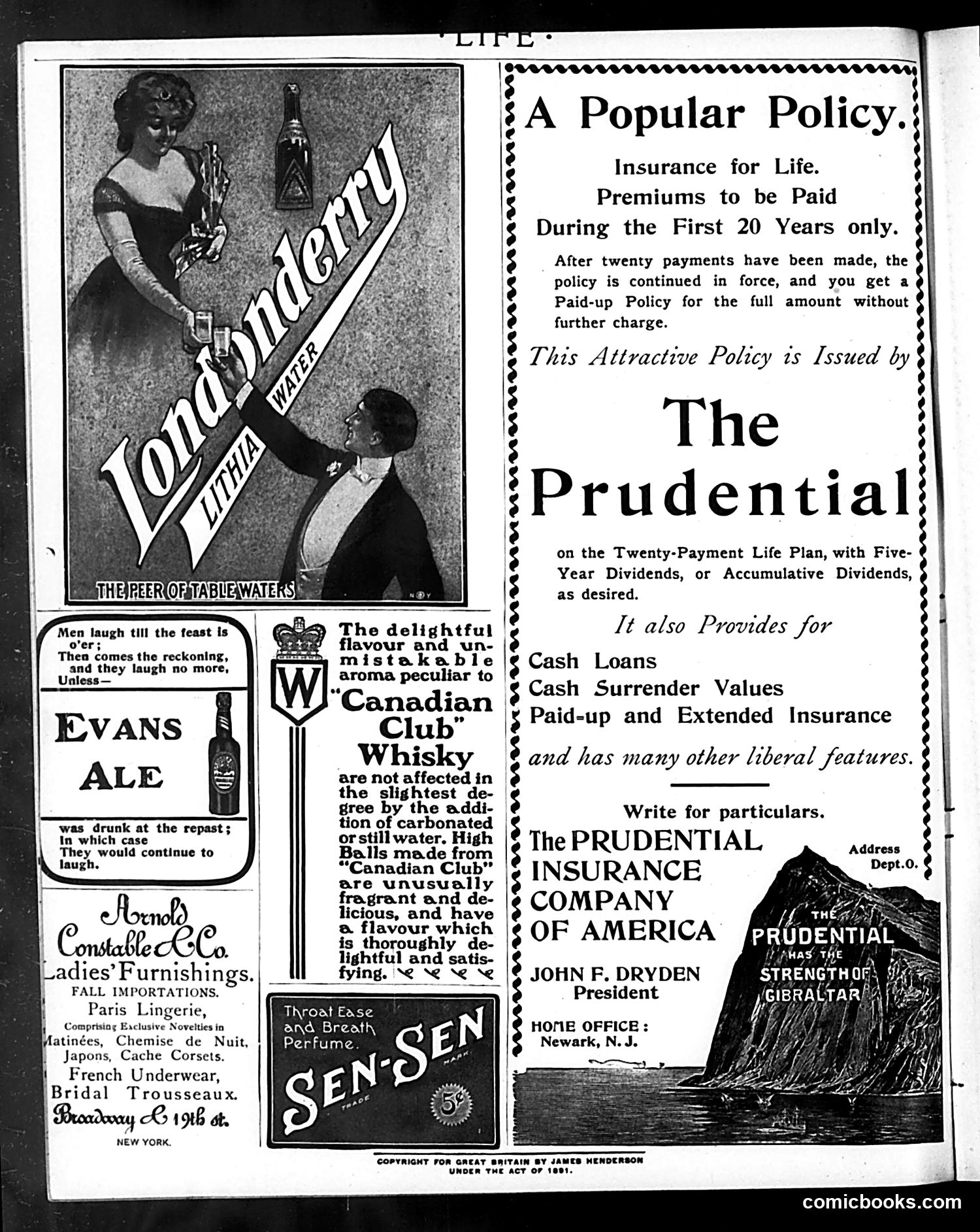
This page is primarily **advertising**, not satire or political commentary. The large right panel advertises The Prudential Insurance Company's life insurance policy, emphasizing affordable 20-year payment plans and various benefits like cash loans and surrender values. The left side contains separate ads: Evans Ale (with a humorous caption about laughter at feasts), Arnold Constable & Co. (ladies' fashions and French undergarments), and Sen-Sen perfume. The top-left illustration titled "The Peer of Table Waters" appears to be a generic promotional image showing a well-dressed woman and man, likely advertising beverages or table goods—not a political cartoon. There is **no political satire or social commentary** evident on this page. It represents early 20th-century magazine advertising practices.
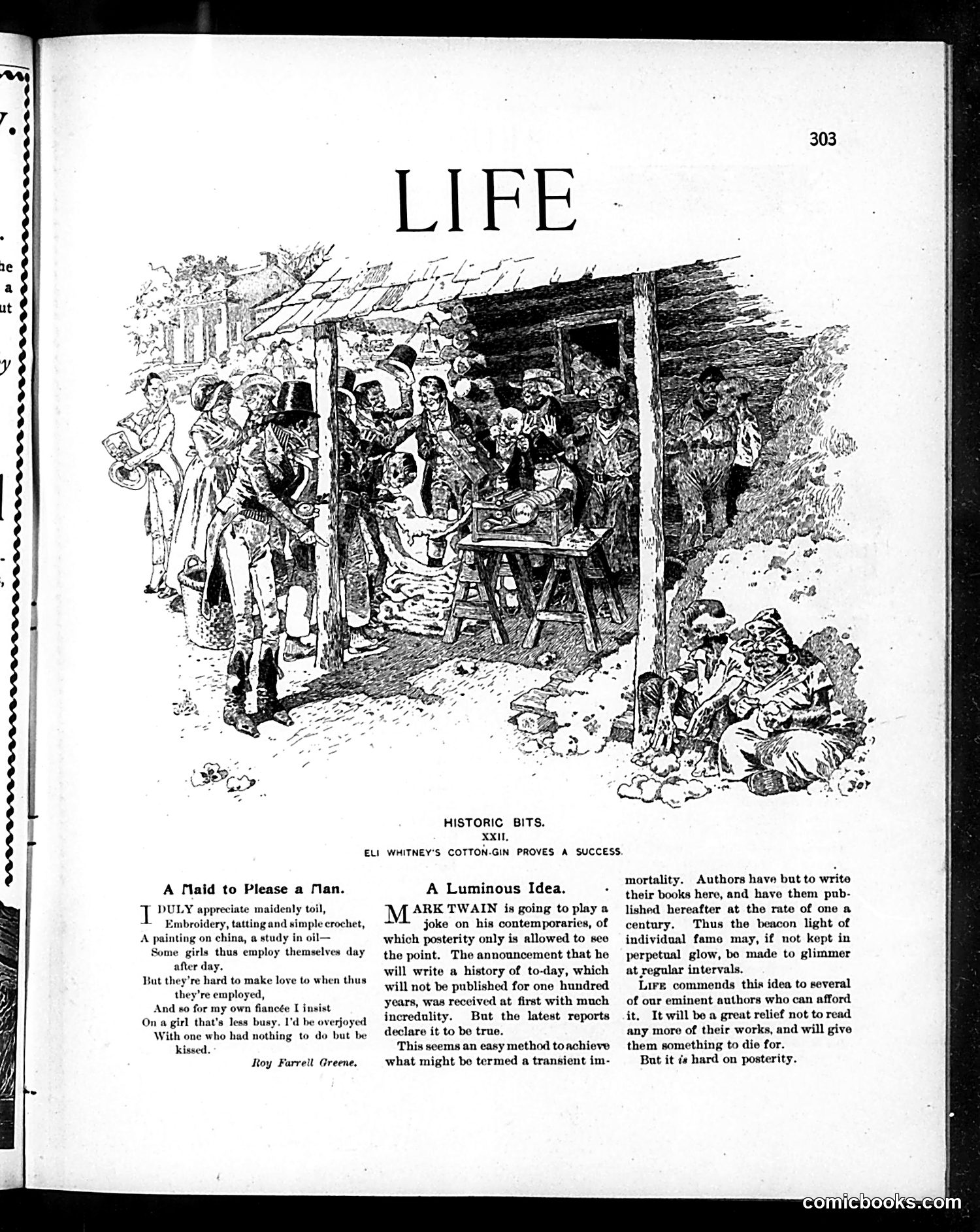
This page features two separate items: **"A Maid to Please a Plan"** (left): A poem by Roy Farrell Greene about the difficulties of courtship, using domestic service as metaphor. It humorously describes a suitor's frustration that winning affection requires effort. **"A Luminous Idea"** (center-right): Commentary on Mark Twain announcing he will write a history of today but delay publication 100 years. The article suggests this allows authors to avoid contemporary criticism and achieve "posterity" safely—a satirical jab at how delayed publication lets writers escape accountability for controversial statements about current affairs. The section header "Historic Bits" indicates these are brief cultural observations. The large illustration shows a social gathering, likely accompanying one of these pieces.
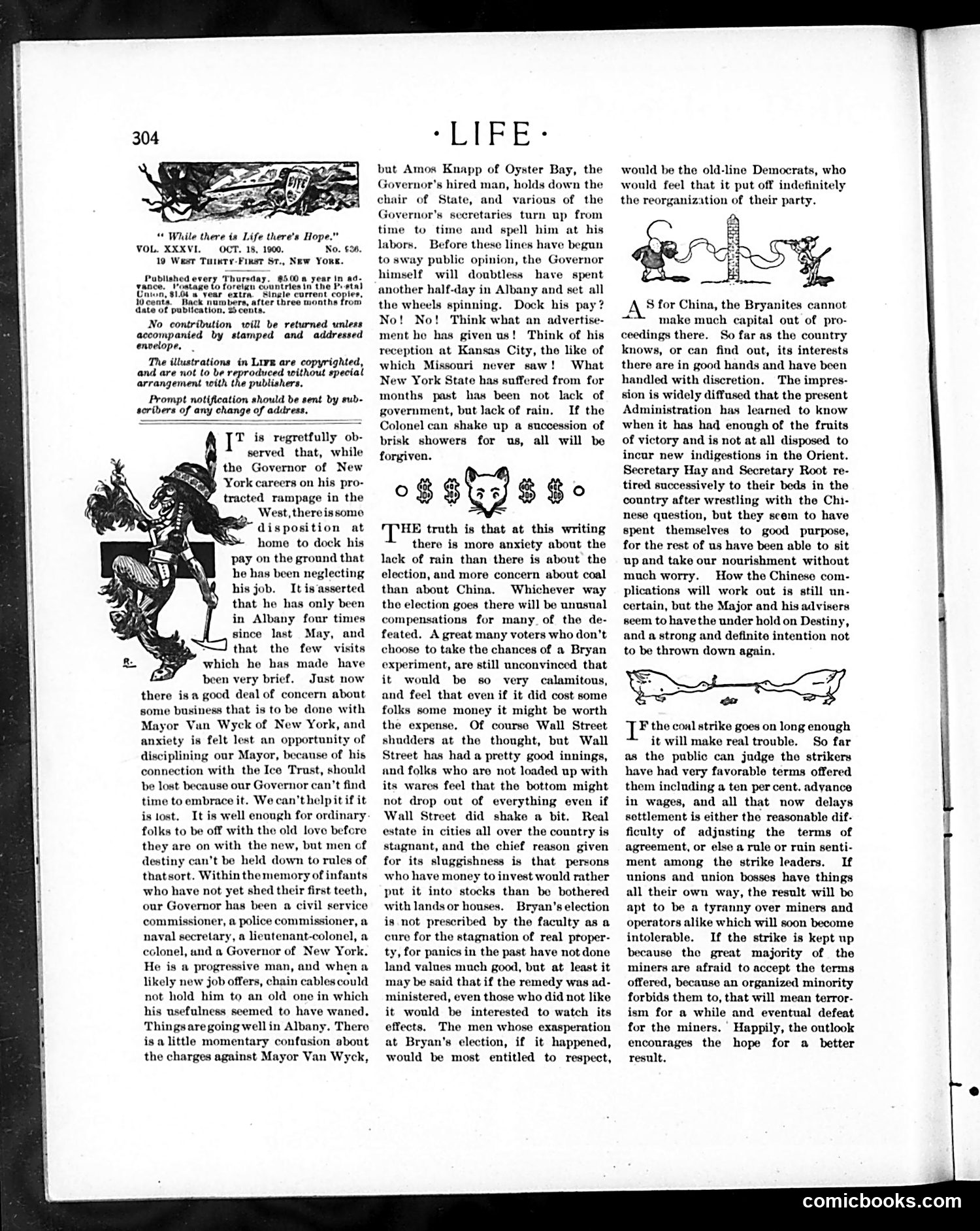
This page from *Life* magazine contains two main cartoons critiquing New York politics, likely from the early 1900s. The left cartoon depicts Mayor Van Wyck in an unflattering caricature, apparently mocking his political troubles and connections. The text references his relationship with Governor's policies and various administrative controversies. The right cartoon features what appears to be a cat or fox-like figure amid dollar signs, likely satirizing Wall Street's influence on politics and Bryan's election prospects. The accompanying text discusses anxieties about Bryan, coal strikes, and whether wealthy investors would support his candidacy. Both cartoons employ exaggerated physical caricature typical of *Life's* satirical style to criticize political corruption, corporate influence, and mayoral/gubernatorial governance failures during this Progressive Era period.
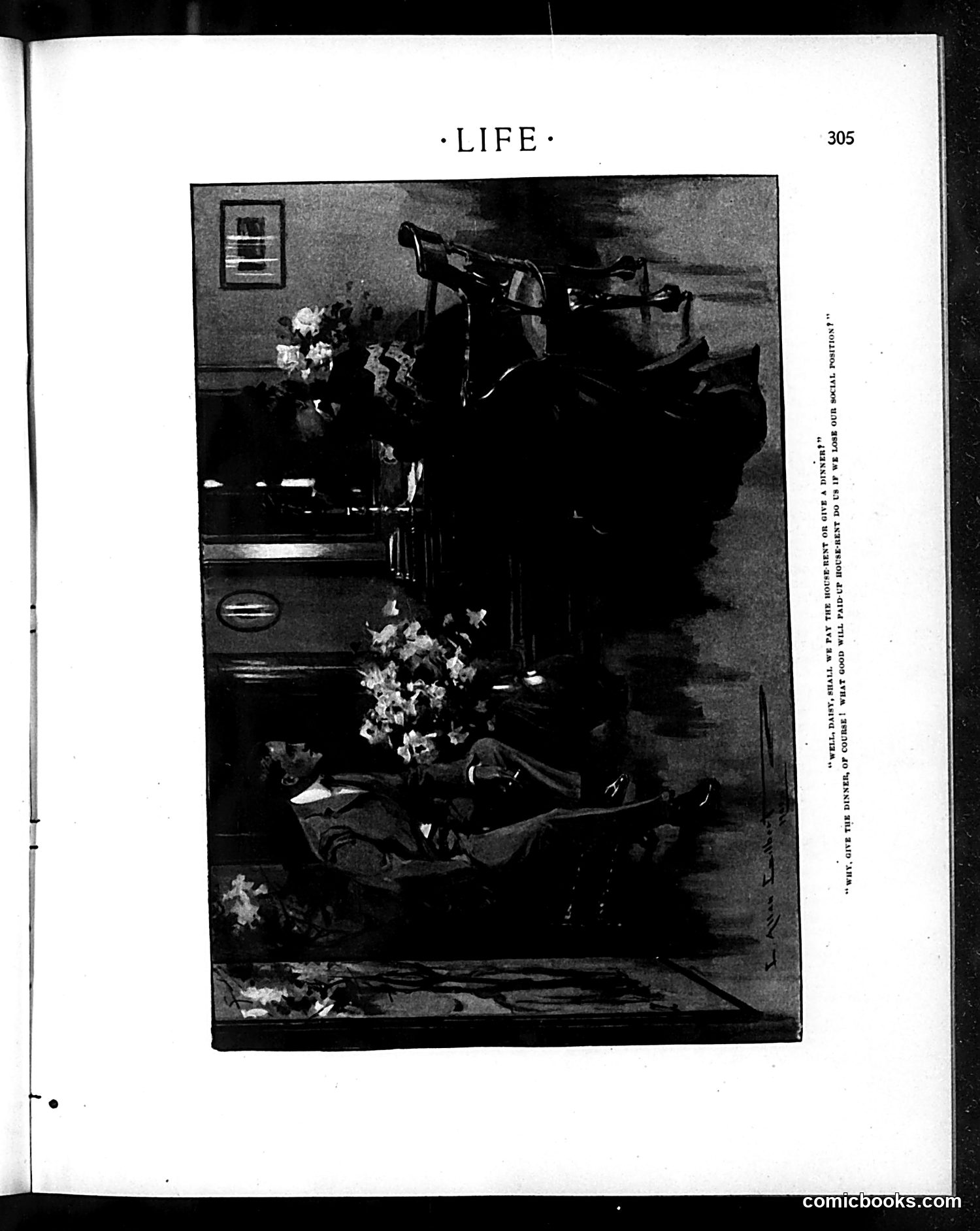
I can see this is page 305 from Life magazine, but the image quality and contrast make it difficult to read the caption text clearly enough to identify specific figures or explain the cartoon's subject with confidence. The photograph appears to show an interior scene with multiple figures and what looks like period furniture or machinery, but without legible caption text, I cannot reliably identify who is depicted, what political or social event is referenced, or what point the satire makes. To provide accurate historical context, I would need either a clearer image of the accompanying text or additional information about the publication date. I cannot confidently assert specifics here without risking historical inaccuracy.
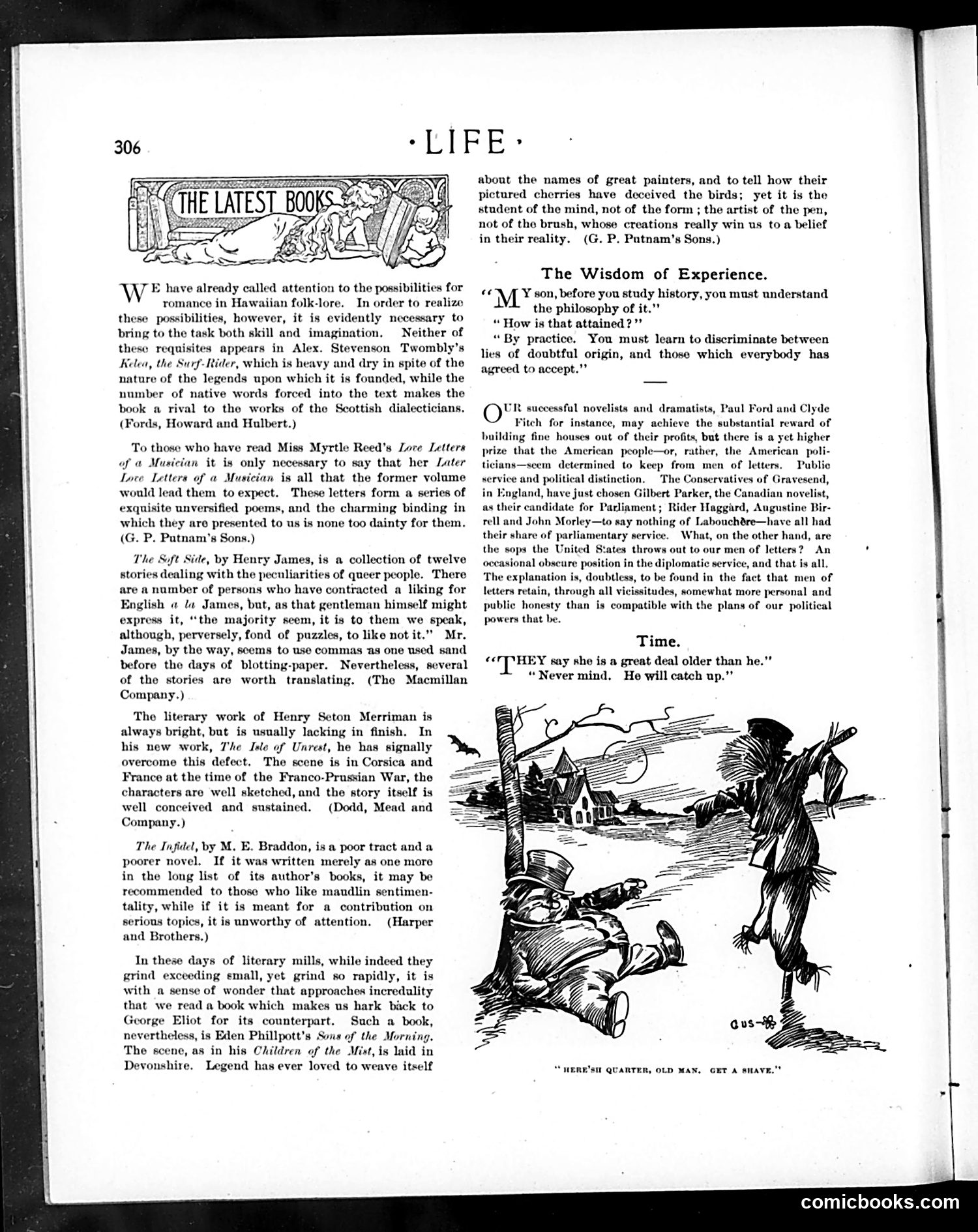
This page is primarily a book review section titled "The Latest Books," discussing recent literary works by authors like Henry James, Henry Seton Merriman, and M.E. Braddon. The single cartoon illustrates a section titled "Time" with the dialogue: "They say she is a great deal older than he" / "Never mind. He will catch up." The sketch depicts an old man with a scythe (representing Time personified) approaching a couple, suggesting that age differences between partners will eventually become irrelevant as both grow older. This is a gentle satirical commentary on age-gap relationships, using the traditional iconography of Father Time as the vehicle for the joke's dark humor.
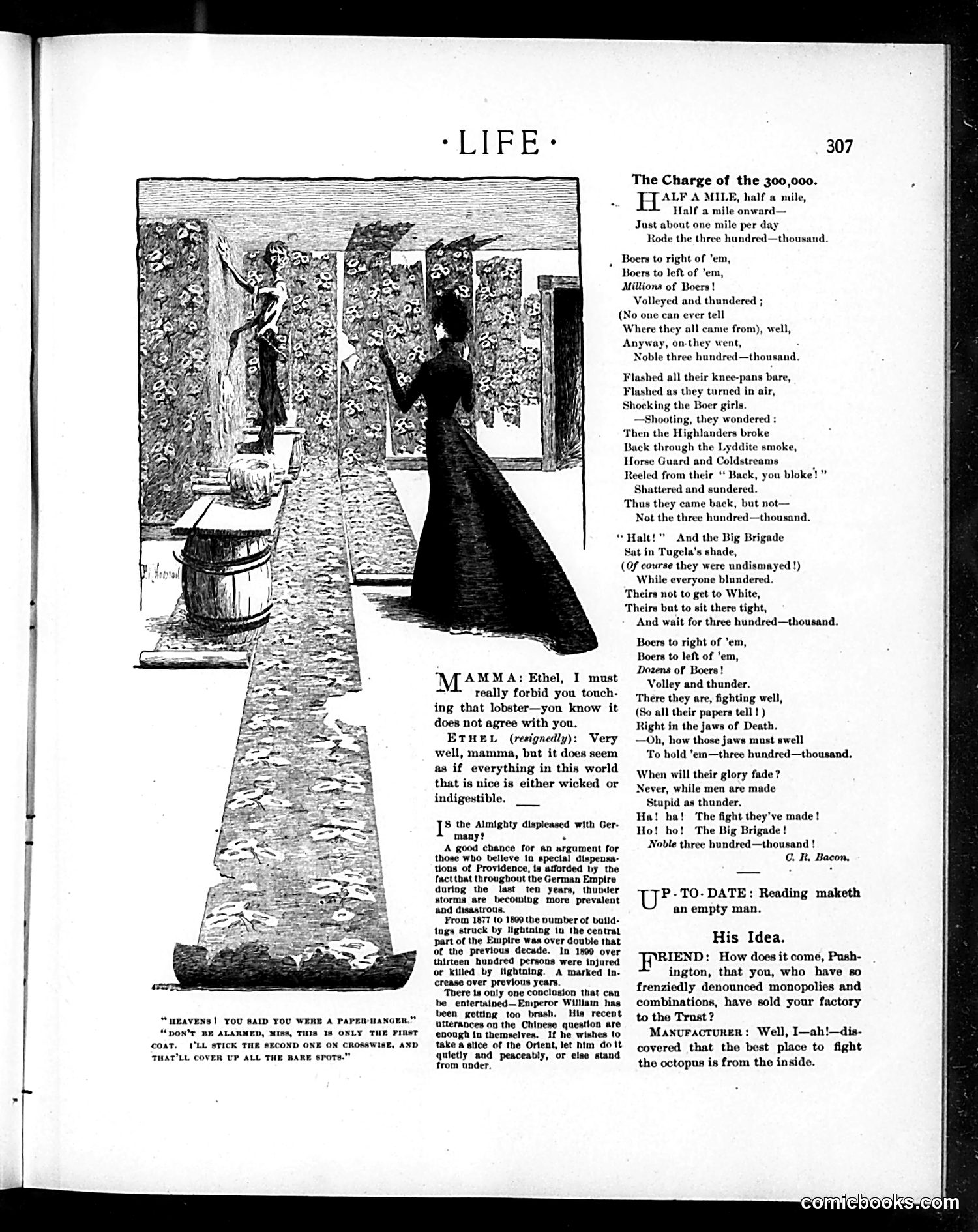
This page contains two distinct pieces: **"The Charge of the 300,000"** — A poem (attributed to G. H. Bacon) with accompanying illustration depicting a woman in a corridor. The text references a military charge of "three hundred—thousand" and mentions "Boers," "Highlands," and "Horse Guard." This appears to satirize the Second Boer War (1899-1902), likely mocking either British military strategy or recruitment efforts. The repeated phrase "three hundred—thousand" suggests absurdity about troop numbers. **"His Idea"** — A brief dialogue section below discussing monopolies, trusts, and fighting "the octopus" from inside. This appears to be social/political commentary on corporate power during the Progressive Era, though the specific context is unclear without more background. The magazine's satirical intent targets both military matters and economic power structures of the period.
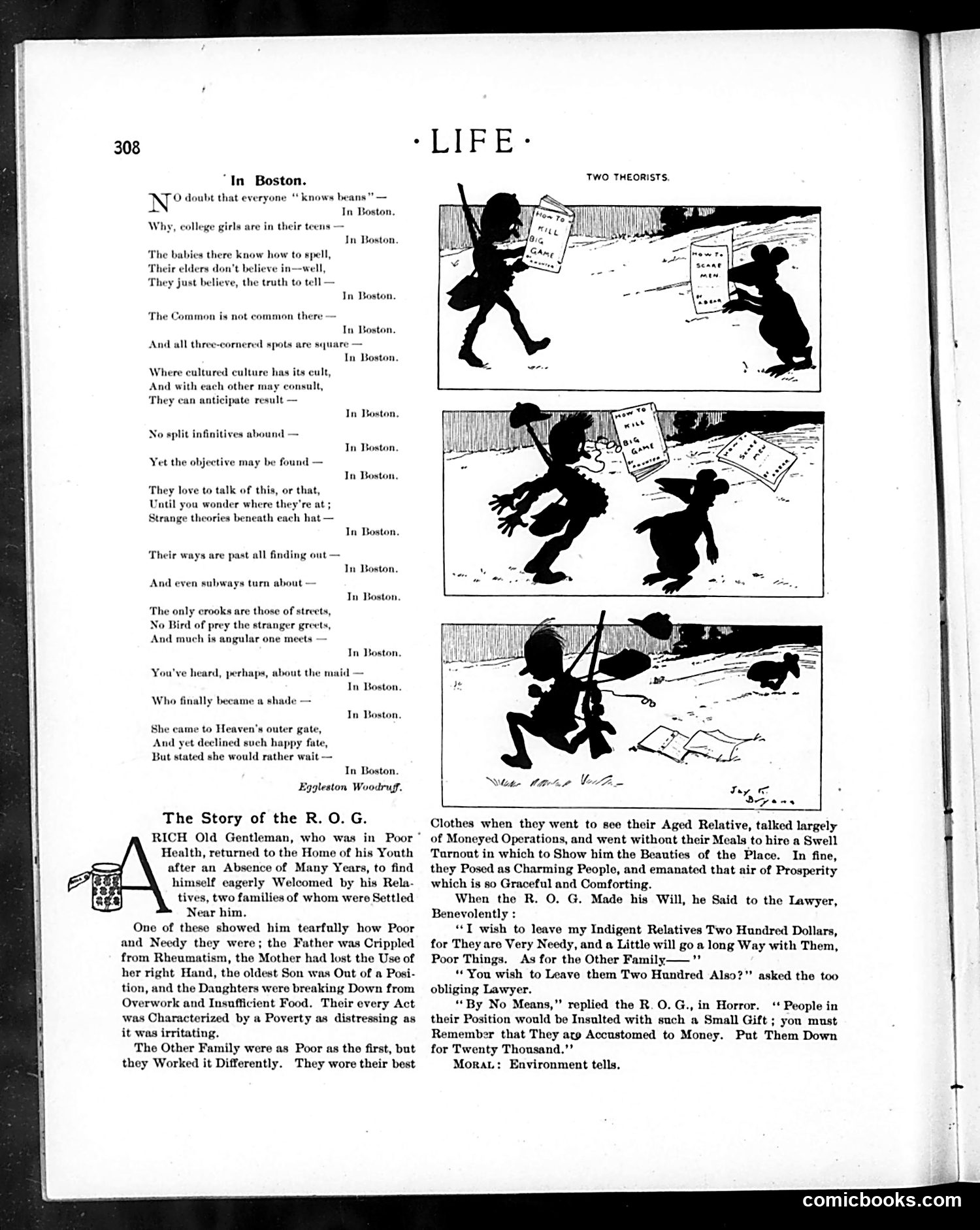
The upper comic strip titled "Two Theorists" shows silhouetted children debating theories while holding papers labeled with geometric principles and mathematical concepts. The joke appears to mock Boston's reputation for intellectual pretension—the accompanying poem "In Boston" repeatedly emphasizes how Bostonians discuss abstract ideas and "strange theories." The lower section, "The Story of the R.O.G.," satirizes wealthy Boston families' assumptions about poor relatives. A "Rich Old Gentleman" bequeaths money to impoverished relatives, expecting gratitude, but insists on leaving it to the lawyer rather than directly to them—revealing class condescension. The moral states "Environment tells," suggesting circumstances, not character, determine outcomes. The satire critiques paternalistic charity and class prejudice.
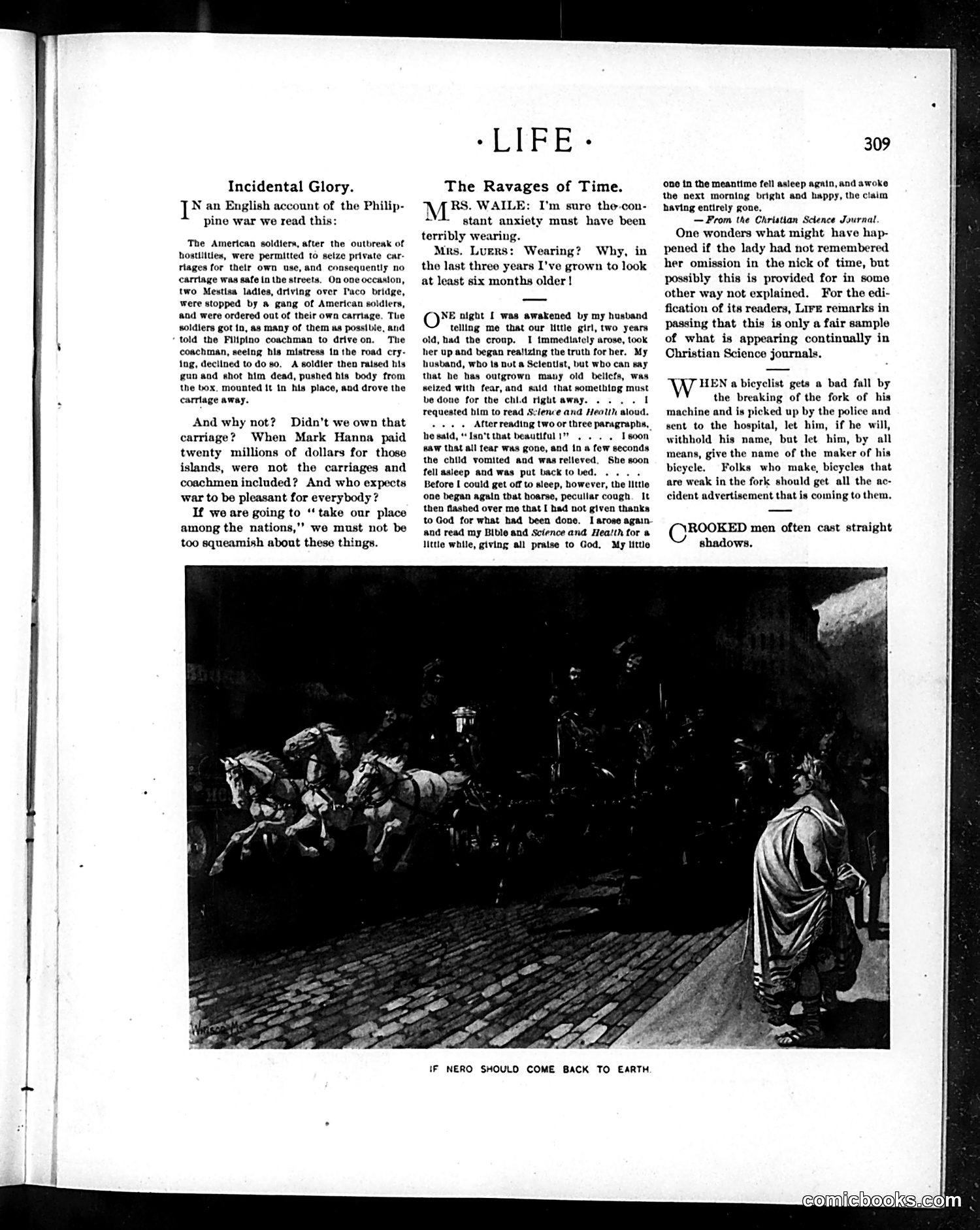
This page contains two separate pieces. "Incidental Glory" discusses the Philippine-American War, critiquing American military conduct and questioning whether owning the Philippines justified the expense and casualties. The author sarcastically questions why Americans should care about taking "our place among the nations" while supporting costly imperial expansion. "The Ravages of Time" presents a domestic anecdote about a woman (Mrs. Waile) appearing aged after three years, attributed to her child's illness and recovery. The accompanying illustration, captioned "If Hero Should Come Back to Earth," depicts mounted soldiers or cavalry in a nighttime street scene, likely satirizing military glory or the romanticization of war—contrasting the dramatic imagery with the practical realities discussed in the text.
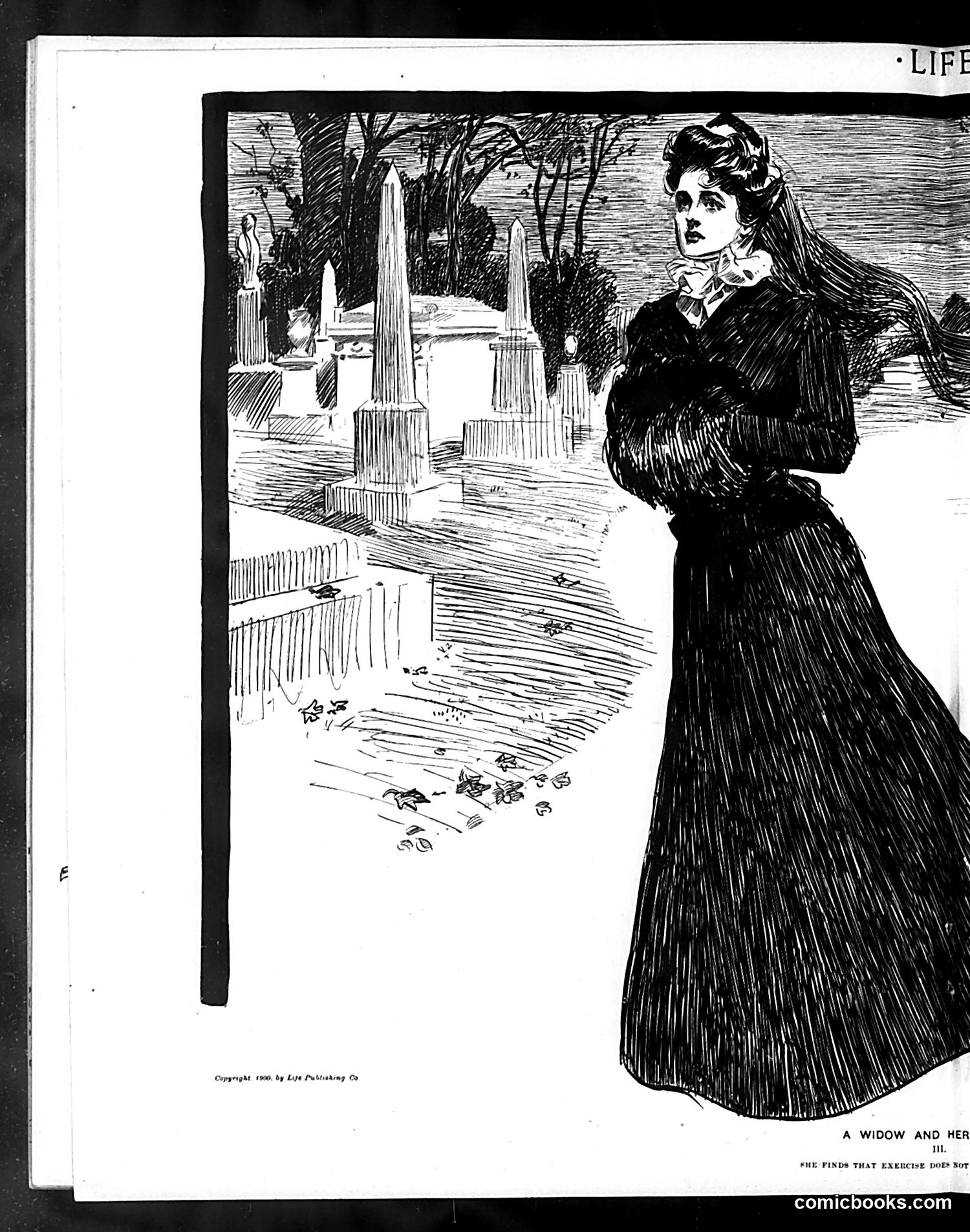
This is an illustration titled "A Widow and Her Ill" (subtitle: "The Finds That Exercise Does Not"). The image shows a woman in black mourning dress standing in what appears to be a cemetery or garden with obelisk monuments. The scattered objects at her feet seem to represent "finds" or discoveries. The satire appears to target the Victorian-era belief in exercise as a cure-all remedy. The widow, dressed in mourning, represents someone experiencing grief—a condition the caption suggests cannot be remedied merely through physical activity. The "finds" scattered about likely symbolize the futility of attempting to heal emotional wounds through exercise alone. This mocks the period's tendency to prescribe vigorous activity as treatment for psychological distress, particularly among grieving women, suggesting emotional suffering requires deeper remedies than simple physical exertion.
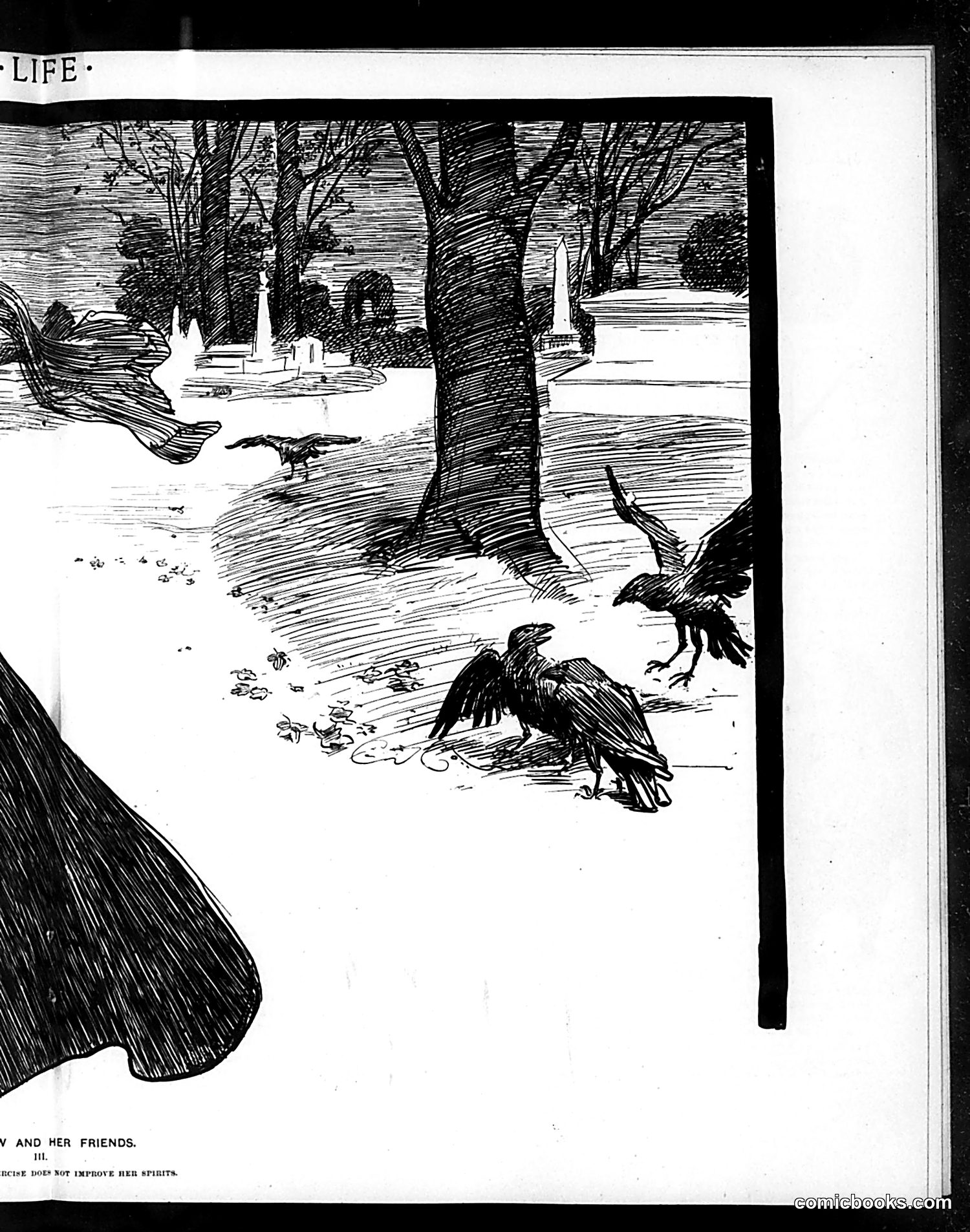
This appears to be an illustrated scene from Life magazine showing birds in a natural landscape with bare trees near water. The visible caption fragments reference "AND HER FRIENDS" and mention something about "EXERCISE" and "IMPROVE HER SPIRITS." Without being able to read the complete title or accompanying text, I cannot definitively identify which specific social commentary or satirical point this illustration makes. The scene depicts what appear to be crows or similar dark birds in a winter or early spring setting, suggesting this may be nature-based humor or social satire using animals as stand-ins for human characters or behaviors. The artistic style—detailed pen-and-ink crosshatching—is consistent with early-to-mid 20th century Life magazine illustration. However, without the full text or clearer caption, I cannot accurately explain the specific satirical meaning to a modern reader.
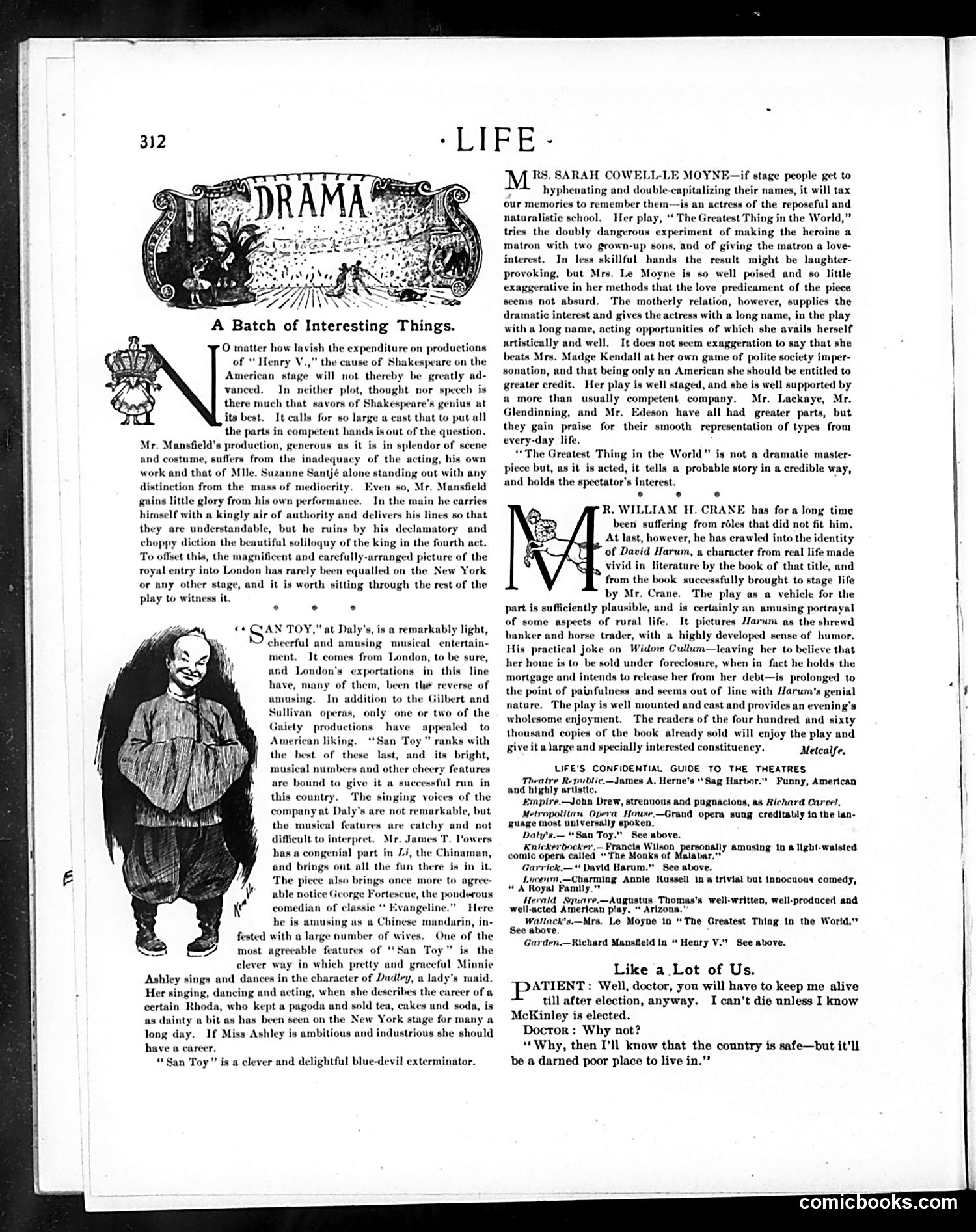
This page is a **drama review section** from Life magazine, discussing theatrical productions. The left column reviews "San Toy," a musical comedy featuring an actress named Ashley in the role of Dudley, a lady's maid. The review praises the production's lightness and entertainment value, calling it "a clever and delightful blue-devil exterminator." The accompanying **cartoon illustration** (left side) depicts a character in Asian costume—likely representing the "San Toy" production's Oriental-themed setting—drawn in exaggerated style typical of early 20th-century theatrical caricature. The page also reviews other plays and includes a brief comic dialogue at bottom titled "Like a Lot of Us" about election anxieties. This represents Life's coverage of New York theater during the period.
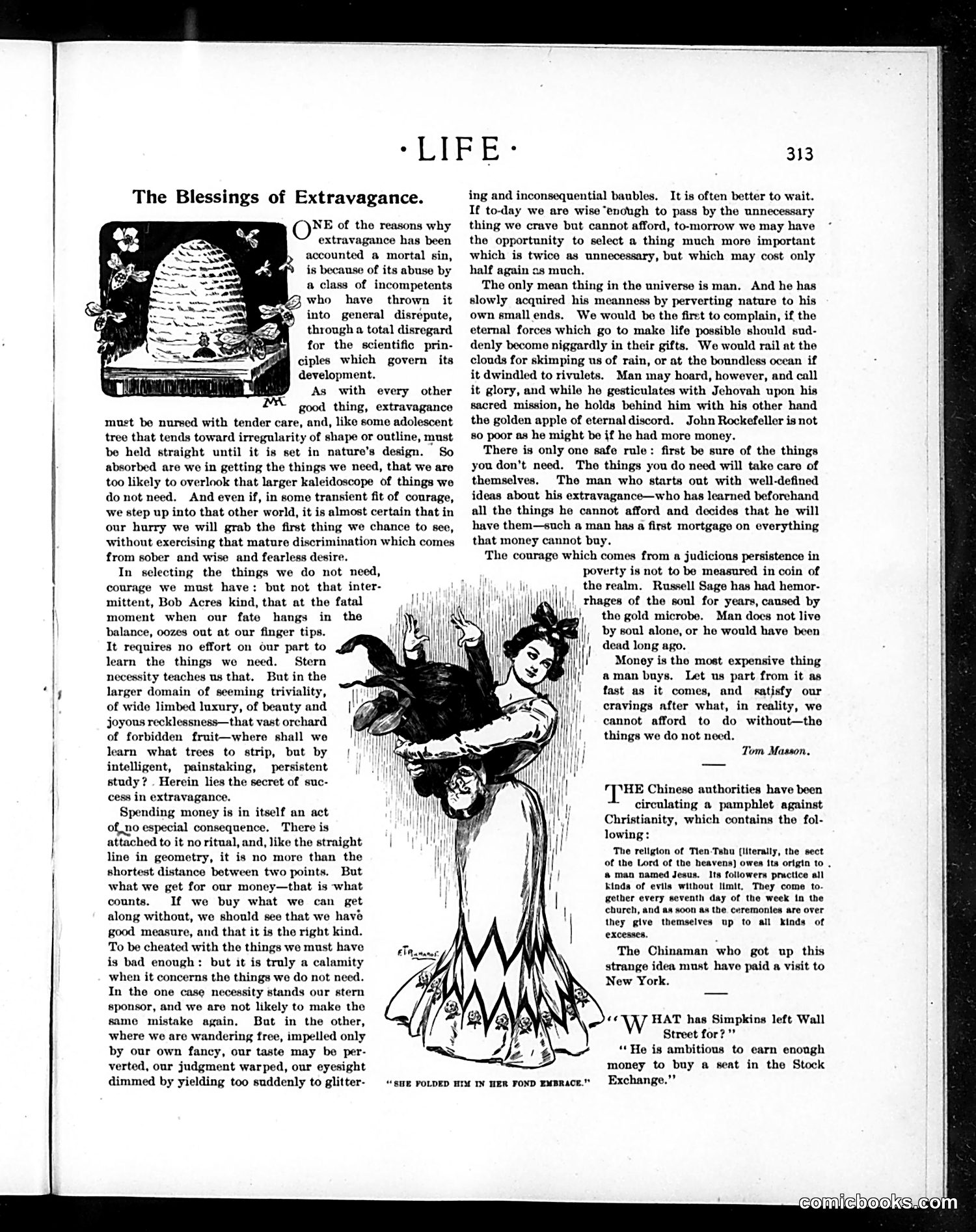
This page presents an essay titled "The Blessings of Extravagance," arguing paradoxically that wasteful spending, when done *thoughtfully*, reflects wisdom rather than sin. The accompanying illustration depicts a woman in an elaborate dress embracing what appears to be decorative cherubs or putti, captioned "She Folded Him in Her Fond Embrace"—likely satirizing sentimental, frivolous luxury purchases. The essay's main argument: extravagance has been condemned because incompetent people practice it poorly. However, *intelligent* spending on non-essentials—pursued with study and discrimination—represents a virtue. The author attacks miserliness (referencing John Rockefeller) while defending luxury as humanity's proper expression of abundance. The piece concludes with unrelated items about anti-Christian pamphlets in China and a quip about someone named Simpkins leaving Wall Street to buy stock exchange seats—typical period satirical brevity. The satire targets American attitudes toward wealth and consumption during the Gilded Age, defending conspicuous consumption as philosophically sound when practiced with taste.
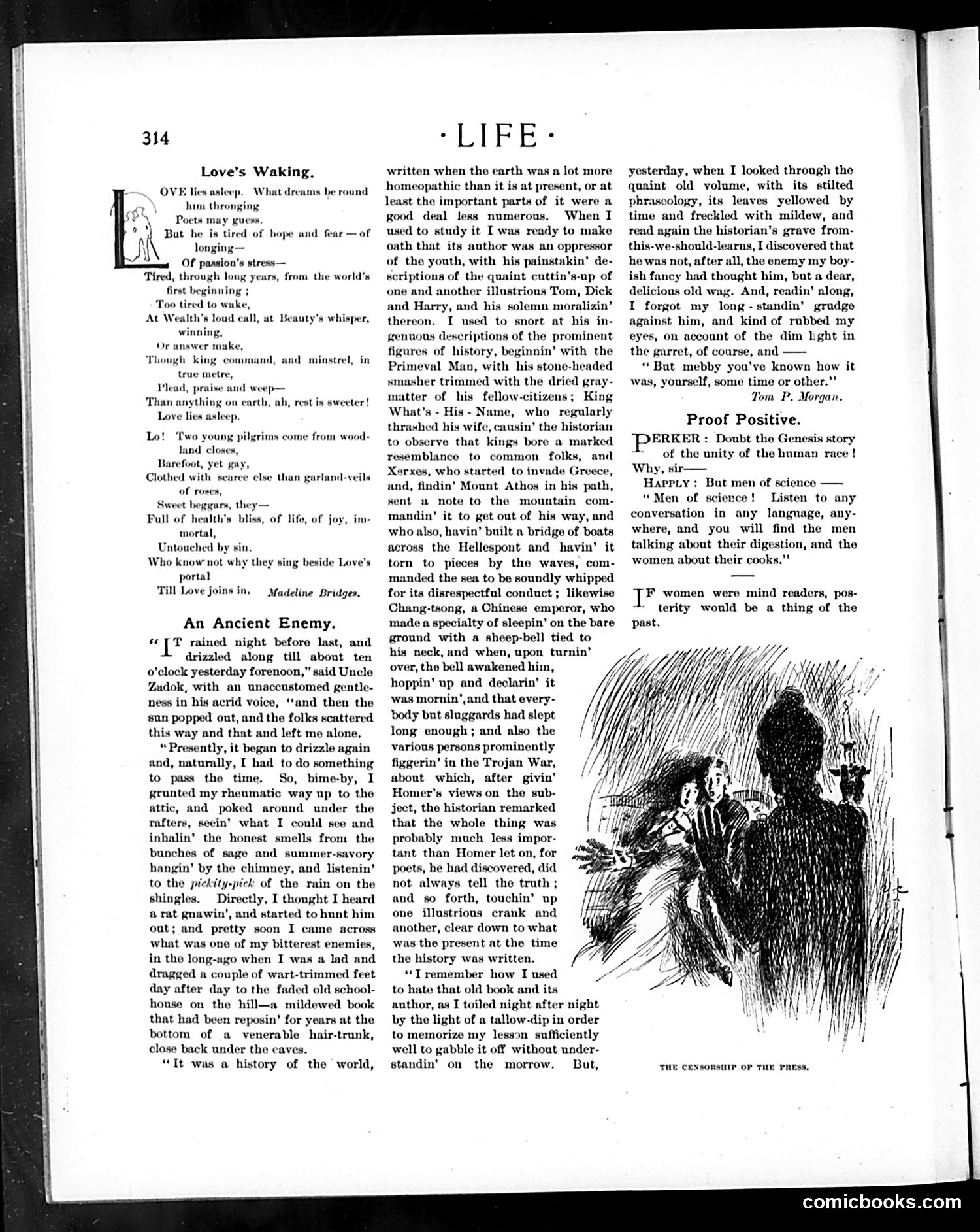
This page contains two distinct literary pieces rather than political cartoons: **"Love's Waking"** (poem by Madeline Bridges): A romantic verse about Love personified as a sleeping figure awakened by two young pilgrims from the woods, symbolizing youth and innocence stirring romance. **"An Ancient Enemy"** (story): Uncle Zadok discovers a moldy old history textbook in his attic—his childhood nemesis. The humor lies in his bitter retrospective on the book's pompous, moralizing tone and its trivializing of historical figures. He mocks how the author treated grand historical events (Persian invasions, Trojan War, Chinese emperors) with condescending commentary, and criticized Homer for poetic exaggeration. The satire targets pretentious historical writing and the disconnect between actual events and their scholarly treatment. This reflects period skepticism about academic authority and overwrought educational materials.
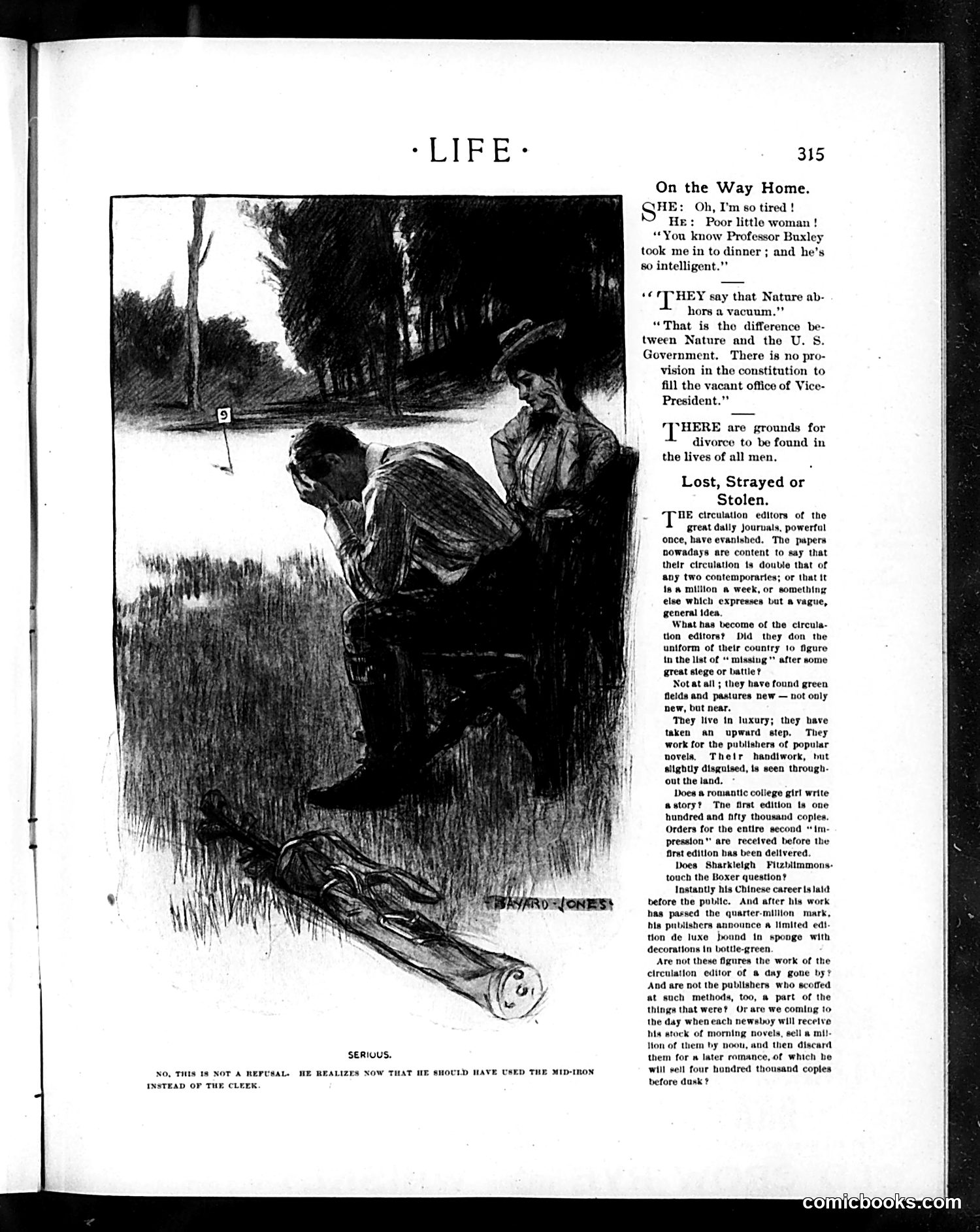
This page contains two satirical pieces: **The main cartoon** ("On the Way Home") depicts a tired husband and wife discussing their evening. The wife mentions Professor Buxley's intelligence, prompting the husband's quip about the Constitution lacking provisions to fill a vacant Vice-President position—likely referencing contemporary political vacancy or incompetence. **"Lost, Strayed or Stolen"** is a prose satire mocking newspaper circulation editors' disappearance from the publishing industry. The author sarcastically suggests they've become literary publicists for popular novels instead. The piece criticizes inflated sales figures for romance novels—claiming first editions sell 150,000 copies with "second impression" orders arriving before the first ships. The satire culminates by questioning whether newsboys will soon treat novels like disposable commodities, selling millions by noon and discarding them for newer romances by evening. The satire targets both vanished professional standards and the commercialization of publishing.
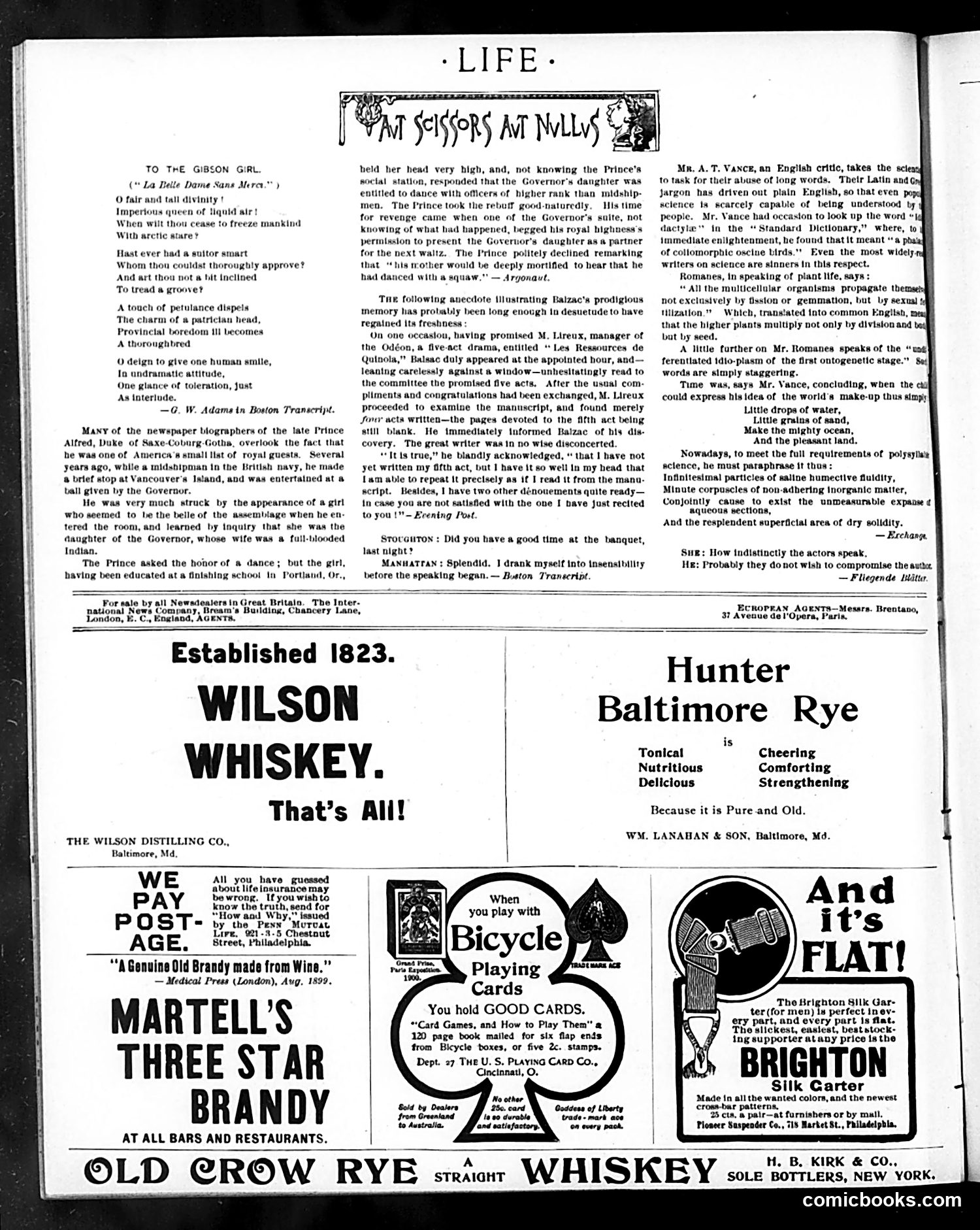
This page combines satirical commentary with period advertisements. The main content targets the "Gibson Girl"—the idealized American woman of the era—with a poem pleading for her to show human warmth beneath her aloof, aristocratic demeanor. Two anecdotes follow: one mocking a Governor's half-Indigenous daughter who snubbed a British prince (later revealed as royalty), and another about author Balzac improvising a theatrical work, claiming to have memorized an unwritten fifth act—satire on artistic pretension. A brief joke compares excessive sociability between "Stoughton" and "Manhattan" characters, and a final critique attacks scientific and medical writers for using incomprehensibly ornate Latin terminology instead of plain English. The advertisements (Wilson Whiskey, Martell's Brandy, Bicycle Playing Cards, Brighton Silk Garters) are typical period commercial content, not satirical.
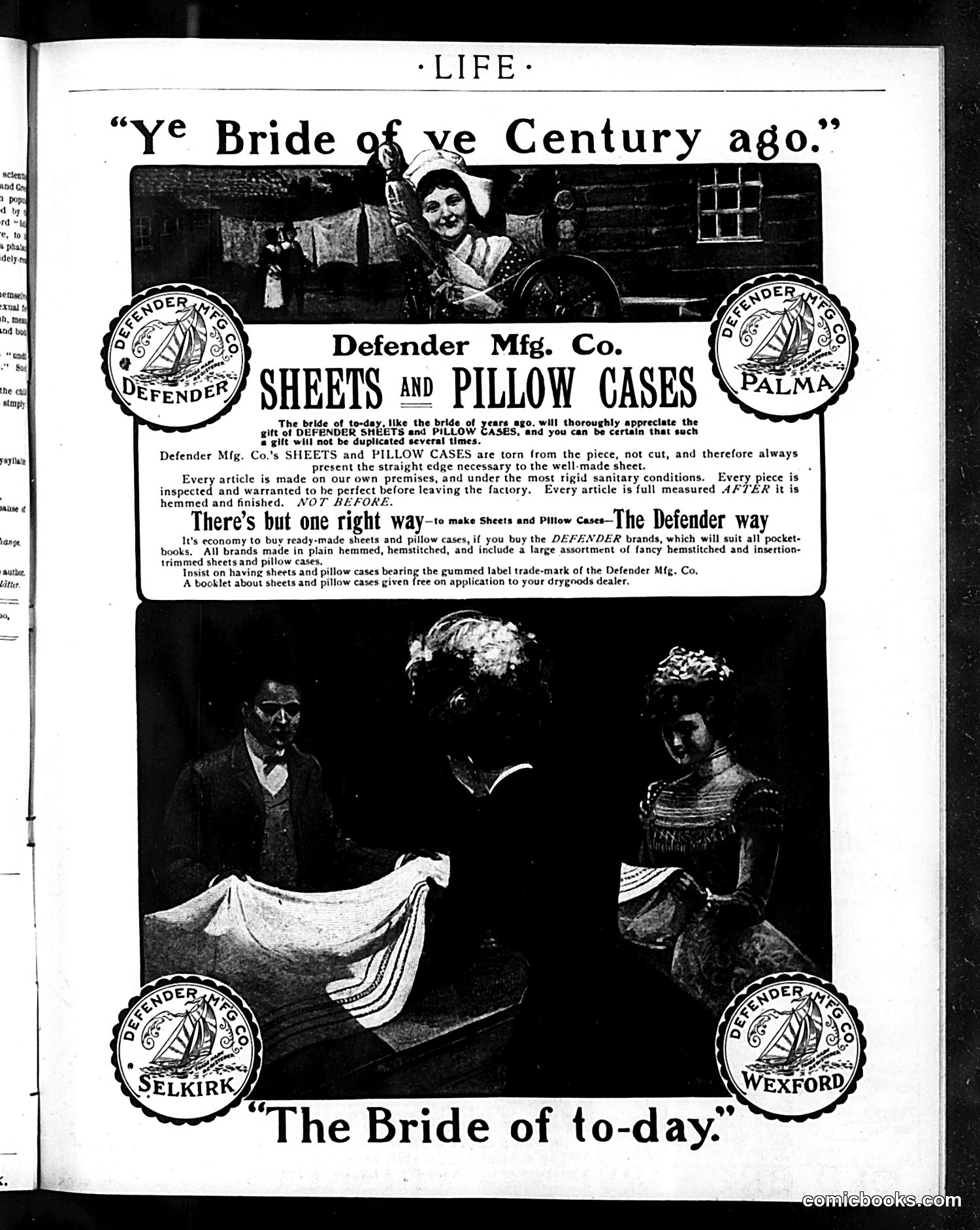
This is primarily a **product advertisement** for Defender Manufacturing Company's sheets and pillow cases, not political satire. The page uses a "then vs. now" comparison framework: the top image shows "Ye Bride of ye Century ago" (historical/old-fashioned bride), while the bottom image depicts "The Bride of to-day" (modern bride). The visual contrast emphasizes that quality linens remain an appreciated gift across time periods. The advertisement emphasizes manufacturing superiority: Defender's sheets are "torn from the piece, not cut," made under "rigid sanitary conditions," and inspected *after* hemming rather than before. The marketing message positions Defender products as the economical, quality choice across price points. The decorative circular logos reference different varieties or regional distribution: Defender, Palma, Selkirk, and Wexford. This represents early 20th-century advertising strategy—using historical imagery and quality assurance messaging to build consumer confidence in manufactured household goods.
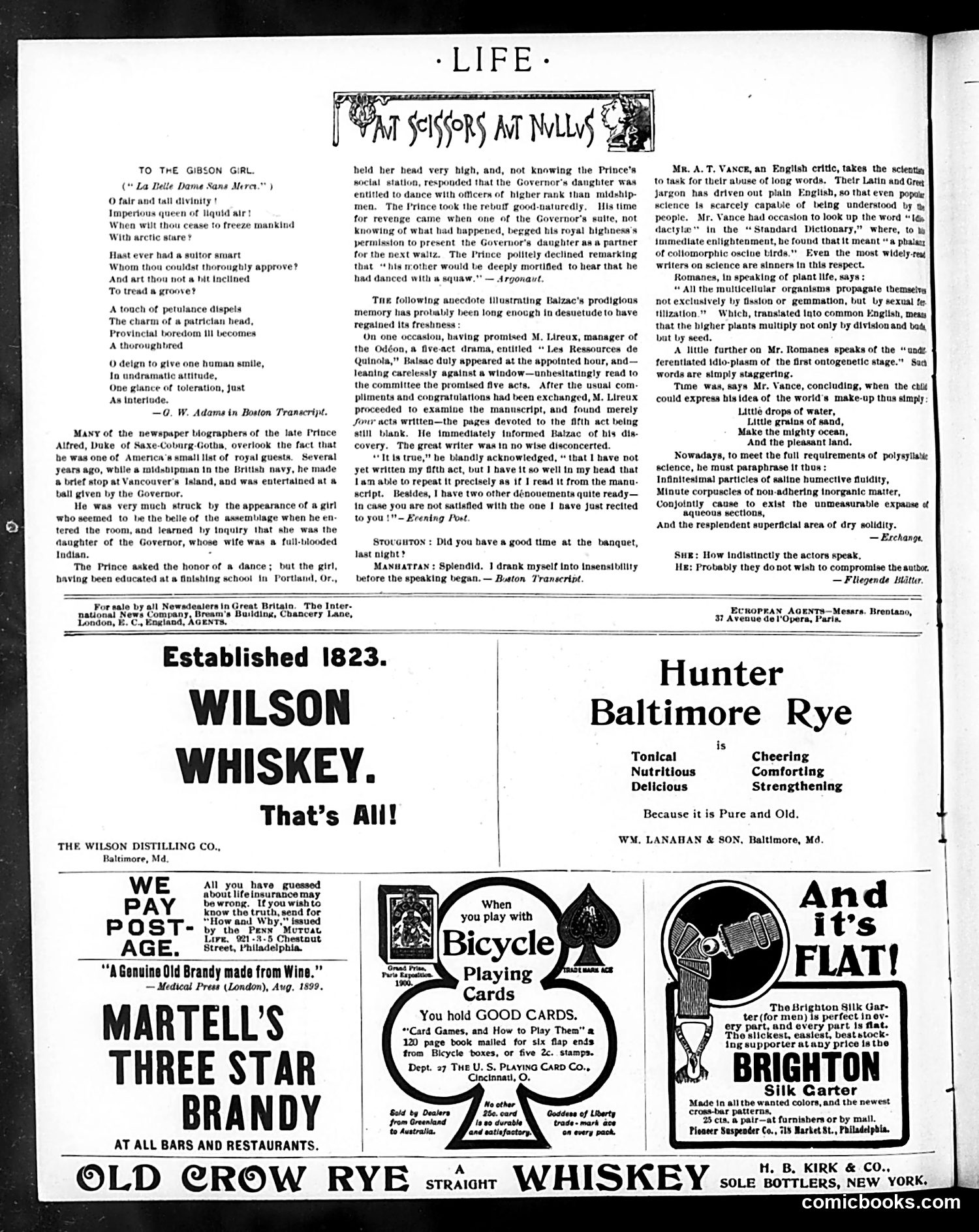
This page from *Life* magazine (a satirical publication) contains primarily **poetry, anecdotes, and advertisements** rather than political cartoons. The main literary content includes: 1. **"To the Gibson Girl"** — A poem addressing the famous "Gibson Girl" (the idealized feminine beauty type of the era), asking why she remains so coldly aloof and won't show human warmth or approval to suitors. 2. **Anecdotes** about Prince Alfred of Saxe-Coburg-Gotha snubbing a Governor's daughter in Portland, Oregon (who was part-Indigenous) after she refused to dance with him as a midshipman; and about French writer Balzac's prodigious memory for reciting an unpublished play. 3. **A brief joke** about someone drinking through a banquet's speeches. 4. **Social criticism** of scientists' overuse of obscure Latin/Greek terminology, making science incomprehensible to ordinary readers. The page is otherwise dominated by **period advertisements** for whiskey, brandy, playing cards, and other products—typical of *Life*'s revenue model.
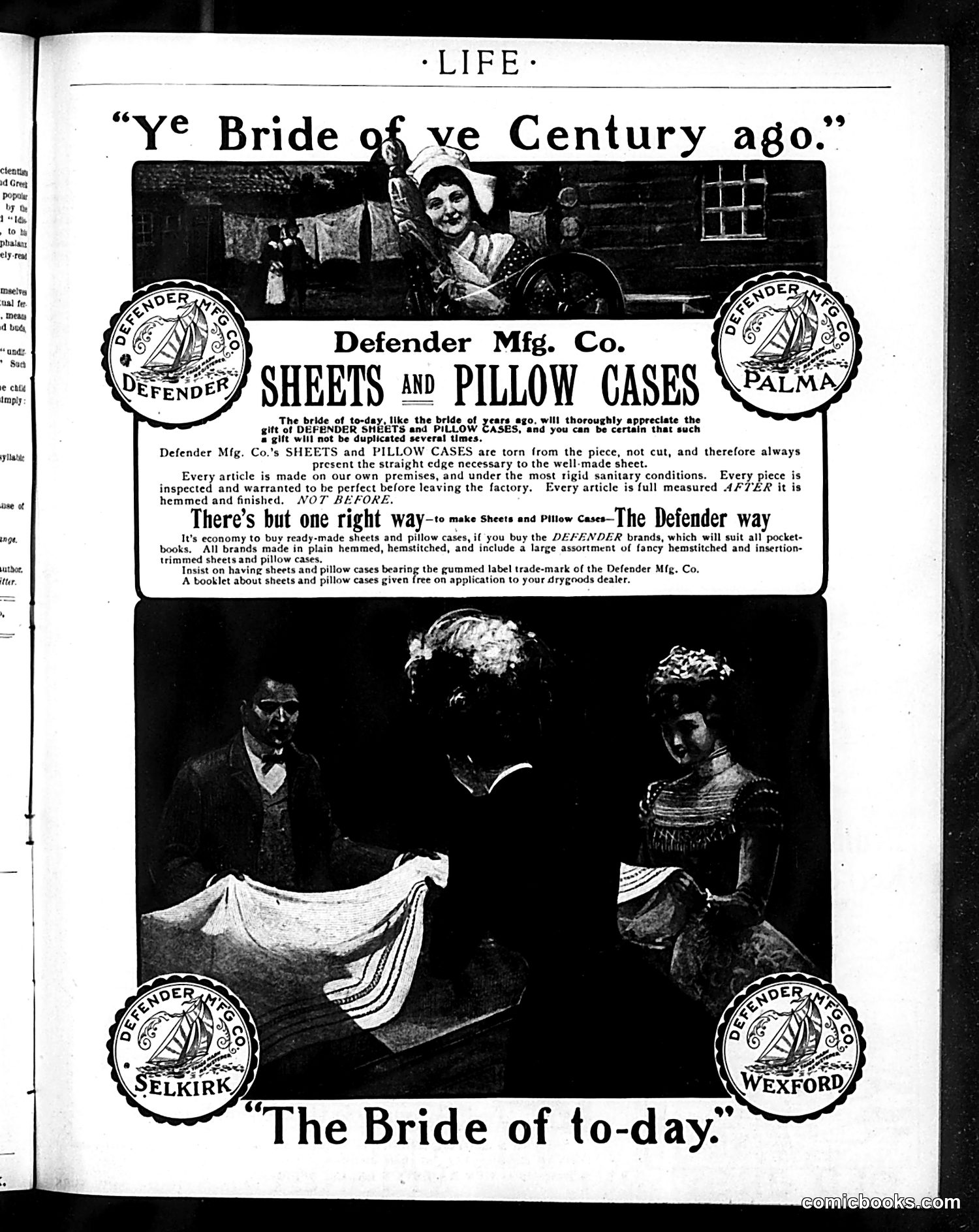
This page is primarily **advertising**, not political satire. It's a Defender Manufacturing Company ad for sheets and pillowcases, using a "then vs. now" comparison format. The top image shows "Ye Bride of ye Century ago"—a woman in historical/colonial dress with a spinning wheel, representing domestic labor of the past. The bottom image shows "The Bride of to-day"—a modern woman (early 1900s) in fashionable dress, being presented with fine linens as a gift. **The sales pitch**: Modern brides no longer need to make their own linens through exhausting domestic work; they can simply receive quality ready-made Defender sheets as gifts. This positioning appeals to middle-class aspirations by suggesting that purchasing manufactured goods is a sign of progress and convenience. The four circular seals indicate regional distribution points (Palma, Selkirk, Wexford, and one unclear location). The satire/humor is gentle—contrasting old domestic drudgery with new consumer convenience—serving to sell the product to both gift-givers and brides.
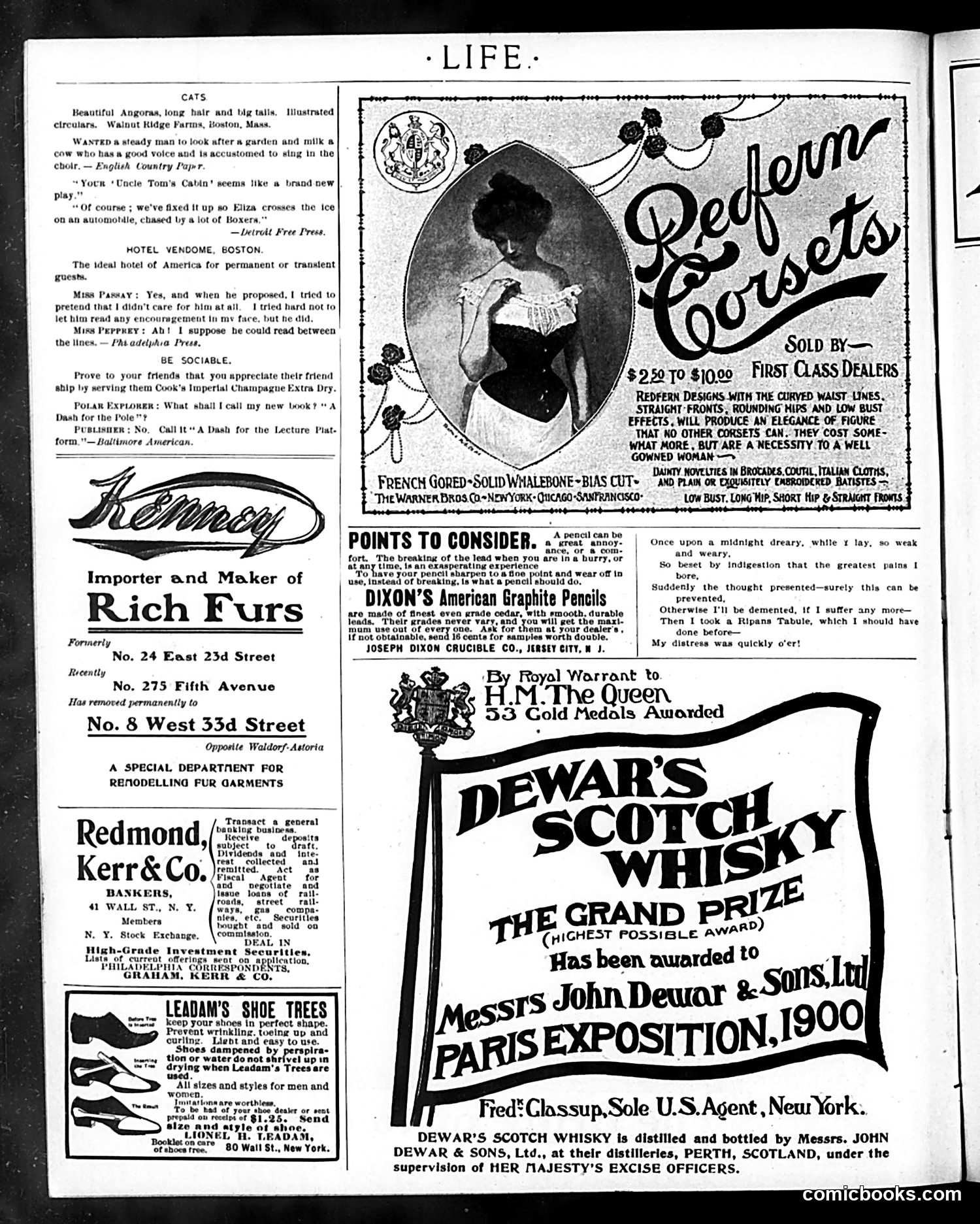
This page is primarily **advertising** with scattered short humorous snippets typical of Life magazine's format. The main cartoon/advertisement features a woman in a corset—specifically Redfern corsets, which the ad promotes as creating fashionable silhouettes with "curved waist lines" and "straight fronts." This reflects early 1900s women's fashion obsessions with achieving specific body shapes through restrictive garments. The short jokes scattered throughout mock contemporary absurdities: a modern "Uncle Tom's Cabin" production where Eliza crosses ice "on an automobile"; a polar explorer considering calling his book "A Dash for the Lecture Platform" (satirizing how explorers monetized their expeditions through lecture tours); and a woman pretending indifference when proposed to, only to be "read" by her suitor. The remaining content consists of business advertisements: fur importers, bankers, shoe trees, pencils, champagne, whisky, and remedies—typical of Life's revenue model. The page offers no coherent satirical argument, instead functioning as miscellaneous filler between advertisements.
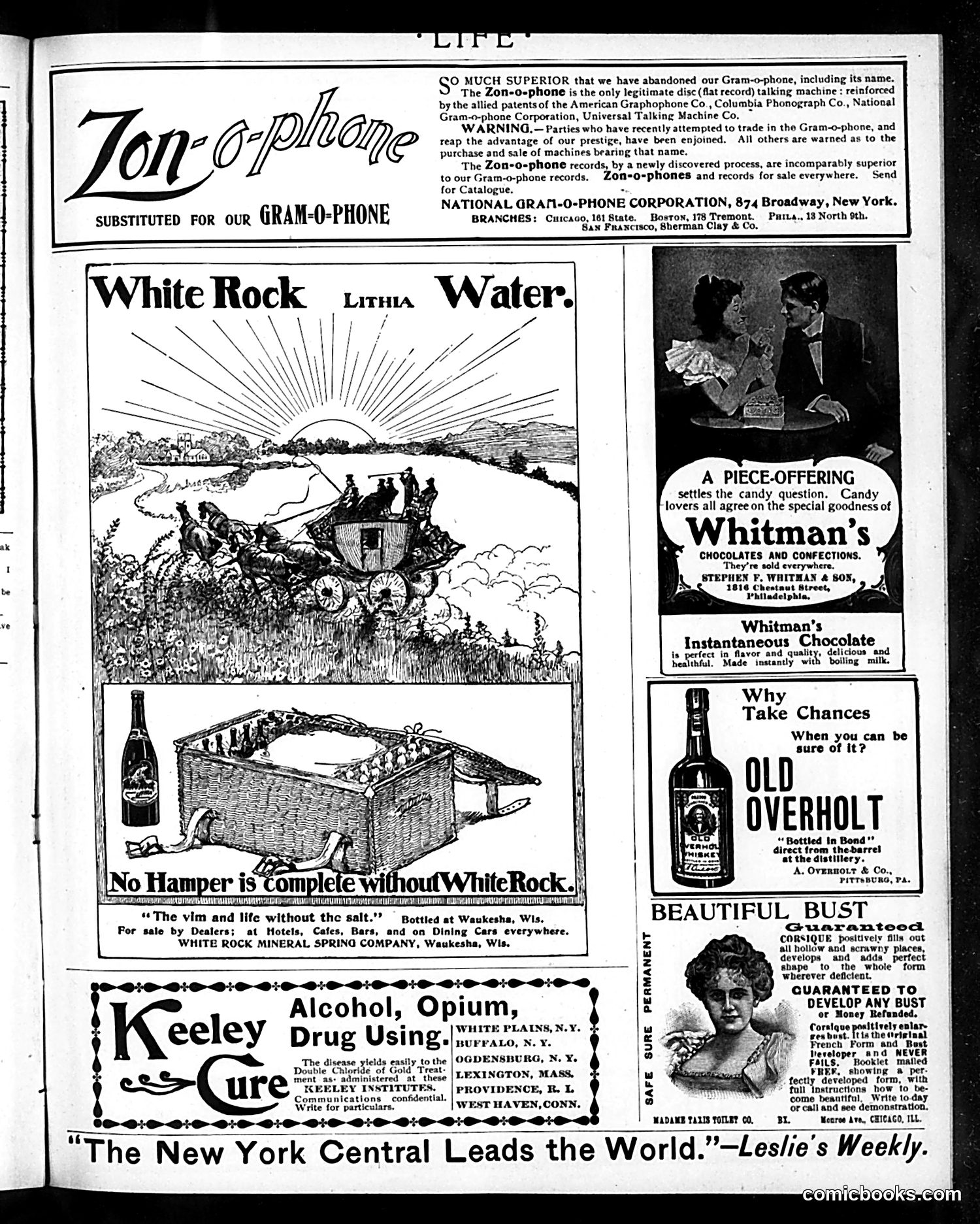
This page is primarily **advertising**, not editorial satire. The main content consists of commercial advertisements typical of early 20th-century magazines. The **Zon-o-phone ad** (top) represents a patent dispute in the emerging phonograph industry. The company claims their disc format is superior to the competing "Gram-o-phone" and warns against counterfeit machines—reflecting intense corporate competition over early sound-recording technology. Other advertisements include: - **White Rock Lithia Water** (mineral spring product with pastoral imagery) - **Whitman's Chocolates** (candy) - **Old Overholt** (whiskey) - **Keeley Cure** (addiction treatment for alcohol and opium) - **Corsique** (bust-development product, reflecting period beauty standards) The **Keeley Cure ad** is historically notable: it advertised treatment for substance addiction at a time when opium and alcohol dependency were widespread public concerns without modern medical frameworks. The page reflects early 1900s consumer culture and social anxieties now largely obsolete.
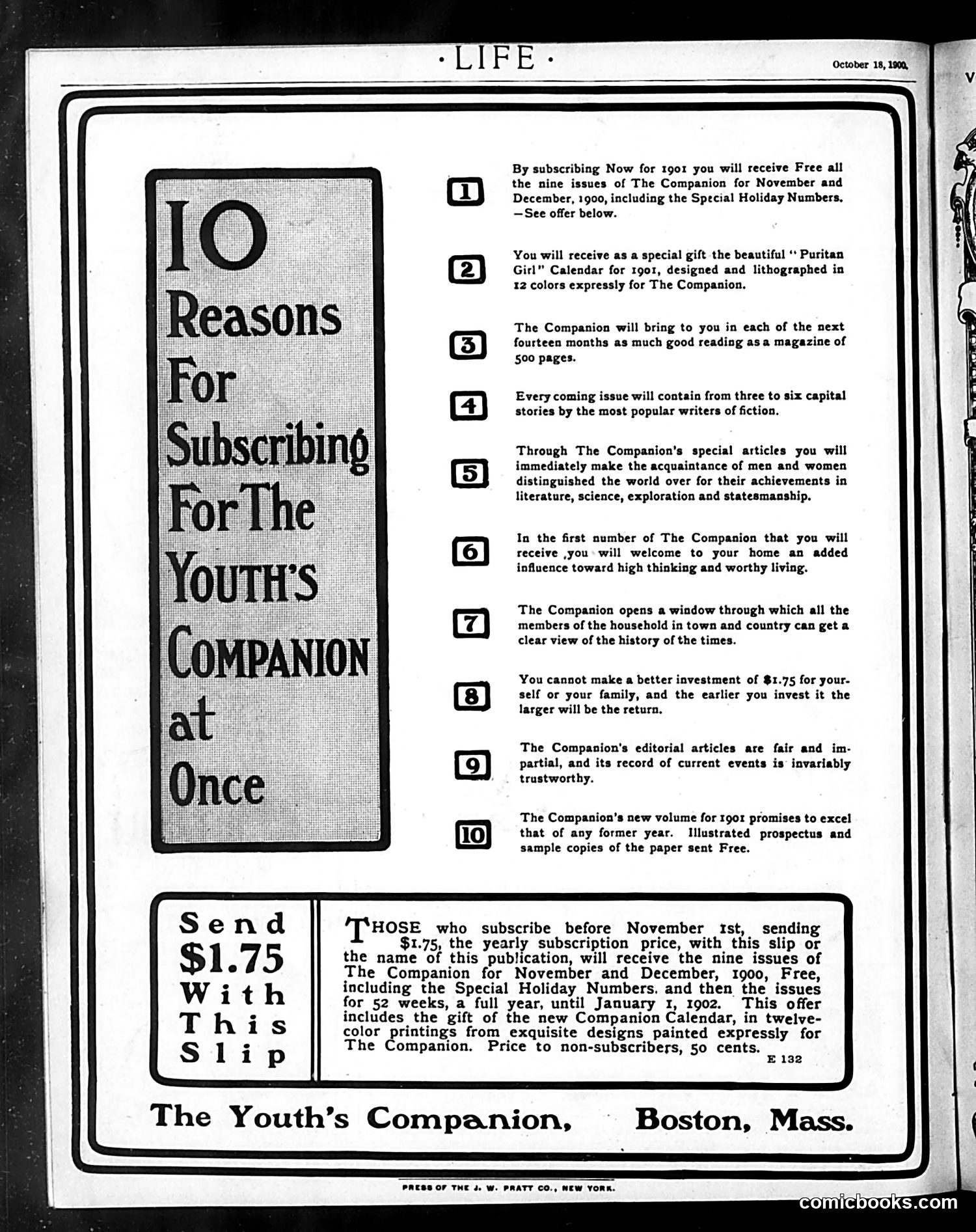
This is a full-page advertisement for *The Youth's Companion*, a Boston-based magazine, appearing in *Life* on October 18, 1900. It's not a political cartoon but rather a subscription pitch. The ad lists "10 Reasons For Subscribing" to promote the 1901 subscription at $1.75 yearly. The appeal emphasizes wholesome content: stories by popular writers, articles about distinguished figures in literature and science, moral influence ("high thinking and worthy living"), and reliable news coverage. The incentives include nine free issues (November-December 1900) and a gift calendar featuring the "Puritan Girl" design—reflecting the publication's appeal to middle-class American families seeking educational, morally uplifting reading for young people. The "Puritan" branding invokes cultural values of the era. This represents turn-of-the-century magazine marketing targeting households seeking respectable, improving literature for their children.