
Life, 1900-10-18 · page 8 of 22
Life — October 18, 1900 — page 8: what you’re looking at
What you’re looking at
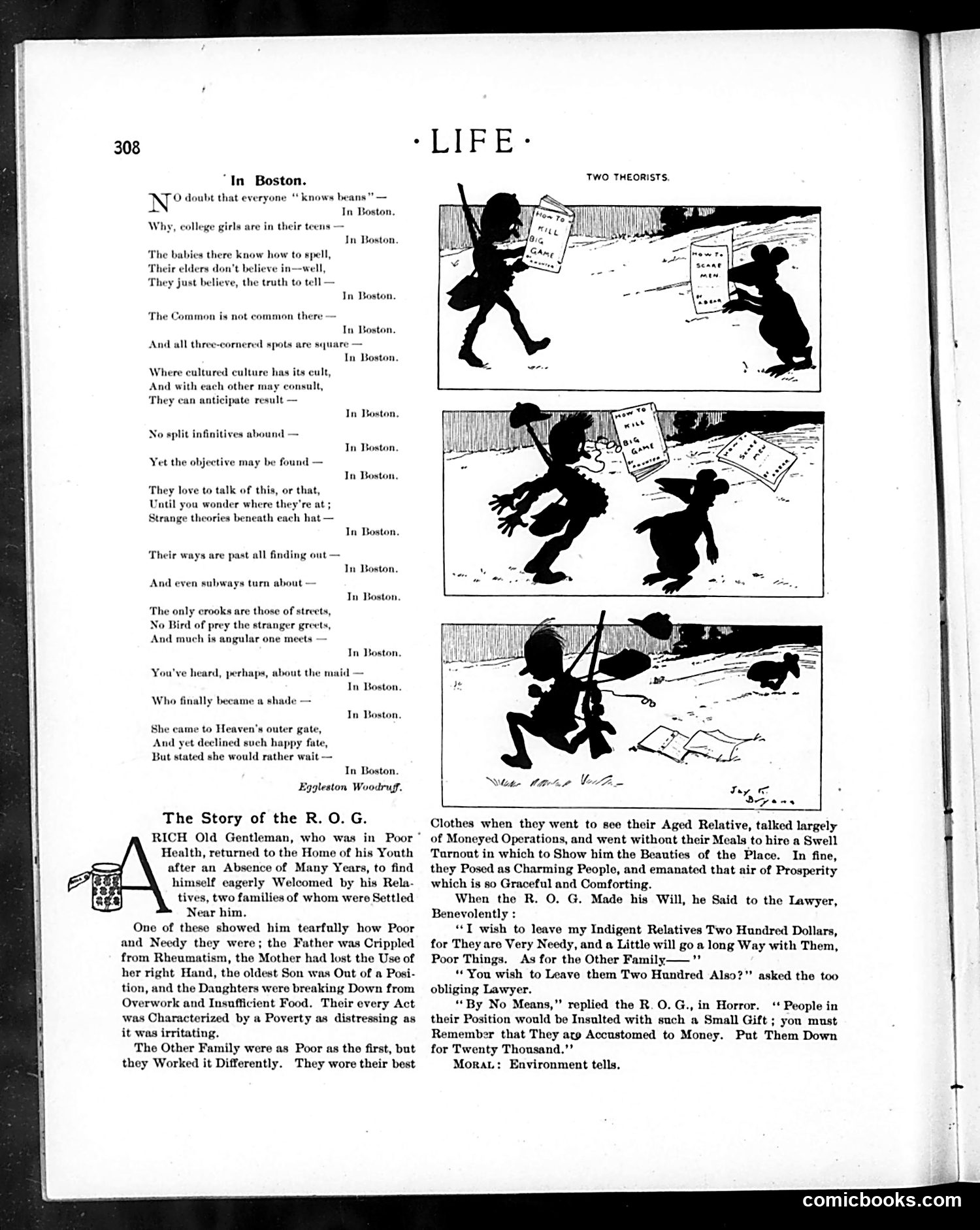
The upper comic strip titled "Two Theorists" shows silhouetted children debating theories while holding papers labeled with geometric principles and mathematical concepts. The joke appears to mock Boston's reputation for intellectual pretension—the accompanying poem "In Boston" repeatedly emphasizes how Bostonians discuss abstract ideas and "strange theories." The lower section, "The Story of the R.O.G.," satirizes wealthy Boston families' assumptions about poor relatives. A "Rich Old Gentleman" bequeaths money to impoverished relatives, expecting gratitude, but insists on leaving it to the lawyer rather than directly to them—revealing class condescension. The moral states "Environment tells," suggesting circumstances, not character, determine outcomes. The satire critiques paternalistic charity and class prejudice.
📄 Transcribed text from this page (OCR, searchable)
Machine-transcribed from the original scan — historical spelling and the odd misread are preserved.
“In Boston. abt that everyone “knows beans” — In Boston, Vhy, college girls are in their teens — In Boston ¢ babies there know how to spell, elders don’t believe in—well, Just believe, the truth to tell — They In Boston. The Common is not common there — ‘ In Boston. And all three-cornered spots are square — In Boston. Where cultured culture has its cult, And with each other may consult, They can anticipate result — In Boston, No split infinitives abound — In Boston, Yet the objective may be found — In Boston, ‘They love to talk of this, or that, pu wonder where they're at ; Strange theories beneath each hat — In Boston. Their ways are past all finding out — | And even subways turn about ~ The only crooks are those of streets, No Bird of prey the stranger greets, In Boston. In Boston, And much is angular one meets In Boston. You've heard, perhaps, about the maid — In Boston, Who finally became a shade — In Boston, She came to Heaven's outer gate And yet declined such happy fi But stated she would rather wait — In Boston. Eggleston Woodruf. The Story of the R. O. G. RICH Old Gentleman, who was in Health, returned to the Home of his Youth after an Absence of Many Years, to find himself eagerly Welcomed by his Rela- tives, two families of whom were Settled Near him. One of these showed him tearfully how Poor and Needy they were; the Father was Crippled from Rheumatism, the Mother had lost the Use of her right Hand, the oldest Son was Out of a Posi- tion, and the Daughters were breaking Down from Overwork and Insufficient Food. Their every Act was Characterized by a Poverty as distressing as it was irritating. The Other Family were as Poor as the first, but they Worked it Differently. They wore their best Poor * Mite Mirae NewA Ge M47 fey Bens Clothes when they went to see their Aged Relative, talked largely of Moneyed Operations, and went without their Meals to hire a Swell Turnout in which to Show him the Beauties of the Place. In fine, they Posed as Charming People, and emanated that air of Prosperity which is so Graceful and Comforting. When the R. O. G. Made his Will, he Said to the Lawyer, Benevolently : “I wish to leave my Indigent Relatives Two Hundred Dollars, for They are Very Needy, and a Little will go a long Way with Them, Poor Things. As for the Other Family —"’ “You wish to Leave them Two Hunired Also?” asked the too obliging Lawyer. “By No Means,” replied the R. O.G., in Horror. ‘ People in their Position would be Insulted with such a Small Gift; you must Remember that They arg Accustomed to Money. Put Them Down for Twenty Thousand.” Mora.: Environment tells. comicbooks.com