
Life, 1900-10-18 · page 13 of 22
Life — October 18, 1900 — page 13: what you’re looking at
What you’re looking at
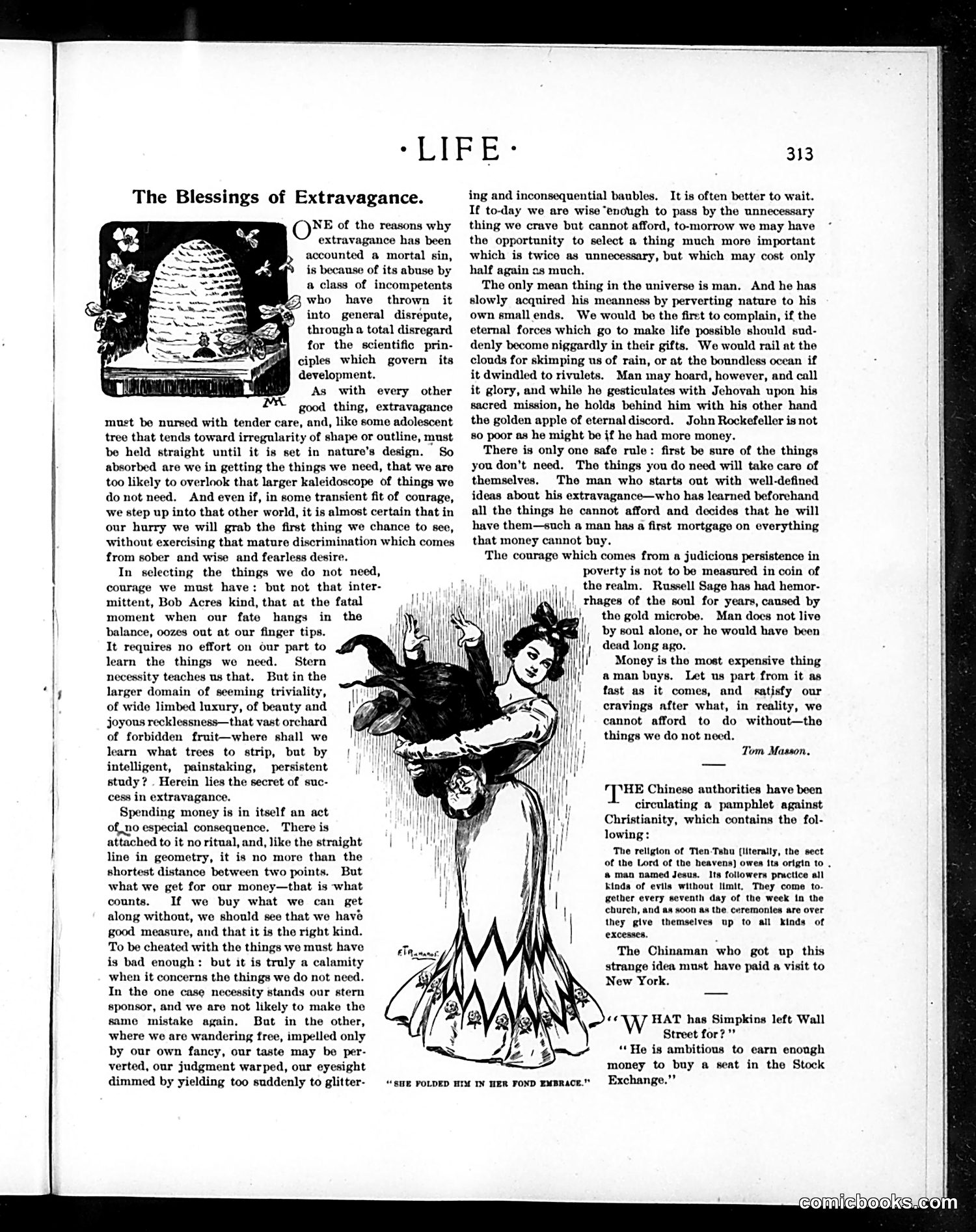
This page presents an essay titled "The Blessings of Extravagance," arguing paradoxically that wasteful spending, when done *thoughtfully*, reflects wisdom rather than sin. The accompanying illustration depicts a woman in an elaborate dress embracing what appears to be decorative cherubs or putti, captioned "She Folded Him in Her Fond Embrace"—likely satirizing sentimental, frivolous luxury purchases. The essay's main argument: extravagance has been condemned because incompetent people practice it poorly. However, *intelligent* spending on non-essentials—pursued with study and discrimination—represents a virtue. The author attacks miserliness (referencing John Rockefeller) while defending luxury as humanity's proper expression of abundance. The piece concludes with unrelated items about anti-Christian pamphlets in China and a quip about someone named Simpkins leaving Wall Street to buy stock exchange seats—typical period satirical brevity. The satire targets American attitudes toward wealth and consumption during the Gilded Age, defending conspicuous consumption as philosophically sound when practiced with taste.
📄 Transcribed text from this page (OCR, searchable)
Machine-transcribed from the original scan — historical spelling and the odd misread are preserved.
The Blessings of Extravagance. ORE of the reasons why extravagance has been accounted a mortal sin, is because of its abuse by a class of incompetents #3 who have thrown it @ into general disrepute, through a total disregard for the scientific prin- ciples which govern its development. Y As with every other MX good thing, extravagance must be nursed with tender care, and, like some adolescent tree that tends toward irregularity of shape or outline, must be held straight until it is set in nature’s design. So absorbed are we in getting the things we need, that we aro too likely to overlook that larger kaleidoscope of things we do not need. And even if, in some transient fit of courage, we step up into that other world, it is almost certain that in our hurry we will grab the first thing we chance to see, without exercising that mature discrimination which comes from sober and wise and fearless desire. In selecting the things we do not need, courage we must have: but not that inter- mittent, Bob Acres kind, that at the fatal moment when our fate hangs in the | balance, oozes out at our finger tips. It requires no effort on our part to learn the things we need. Stern necessity teaches us that. But in the 1 larger domain of seeming triviality, of wide limbed luxury, of beauty and joyous recklessness—that vast orchard ' of forbidden fruit—where shall we learn what trees to strip, but by intelligent, painstaking, persistent study? . Herein lies the secret of suc- cess in extravagance. Spending money is in itself an act of. no especial consequence, There is attached to it no ritual, and, like the straight [Er line in geometry, it is no more than the {| shortest distance between two points. But { what we get for our money—that is what counts. If we buy what we can get along without, we should see that we have good measure, and that it is the right kind. To be cheated with the things we must have is bad enough: but it is truly a calamity when it concerns the things we do not need. In the one case necessity stands our stern sponsor, and we are not likely to make the same mistake again, But in the other, where we are wandering free, impelled only by our own fancy, our taste may be per- verted, our judgment warped, our eyesight dimmed by yielding too suddenly to glitter- + ETRE “SHE POLDED HIM IN HER FOND EMBRACE." 313 ing and inconsequential baubles. It is often better to wait. If to-day we are wise “enough to pass by the unnecessary thing we crave but cannot afford, to-morrow we may have the opportunity to select a thing much more important which is twice as unnecessary, but which may cost only half again as much. The only mean thing in the universe is man. And he has slowly acquired his meanness by perverting nature to his own smallends. We would be the firet to complain, if the eternal forces which go to make life possible should sud- denly become niggardly in their gifts. We would rail at the clouds for skimping us of rain, or at the boundless ocean if it dwindled to rivulets. Man may hoard, however, and call it glory, and while he gesticulates with Jehovah upon his sacred mission, he holds behind him with his other hand the golden apple of eternal discord. John Rockefeller is not so poor as he might be if he had more money. There is only one safe rule: first be sure of the things you don’t need. The things you do need will take care of themselves. The man who starts out with well-defined ideas about his extravagance—who has learned beforehand all the things he cannot afford and decides that he will have them—such a man has a first mortgage on everything that money cannot buy. The courage which comes from a judicious persistence in poverty is not to be measured in coin of Jit, nt the realm. Russell Sage has had hemor- bill! rhages of the soul for years, caused by Wu} the gold microbe. Man docs not live by soul alone, or he would have been dead long ago. Money is the most expensive thing aman buys. Let us part from it as fast as it comes, and satisfy our cravings after what, in reality, we cannot afford to do without—the things we do not need. Tom Masson. HE Chinese authorities have been circulating a pamphlet against Christianity, which contains the fol- lowing: The religion of Tien-Tshu {literaily, the sect of the Lord of the heavens) owes its origin to . | & man named Jesus. Its followers practice all Kinda of evils without limit, They come to- | gether every seventh day of the week in the I, church, and as soon as the ceremontes are over they give themselves up to all kinds of excesses, The Chinaman who got up this strange idea must have paid a visit to New York. “W HAT has Simpkins left Wall Street for?” “‘He is ambitious to earn enough money to buy a seat in the Stock Exchange.”’