
Life, 1900-10-18 · page 3 of 22
Life — October 18, 1900 — page 3: what you’re looking at
What you’re looking at
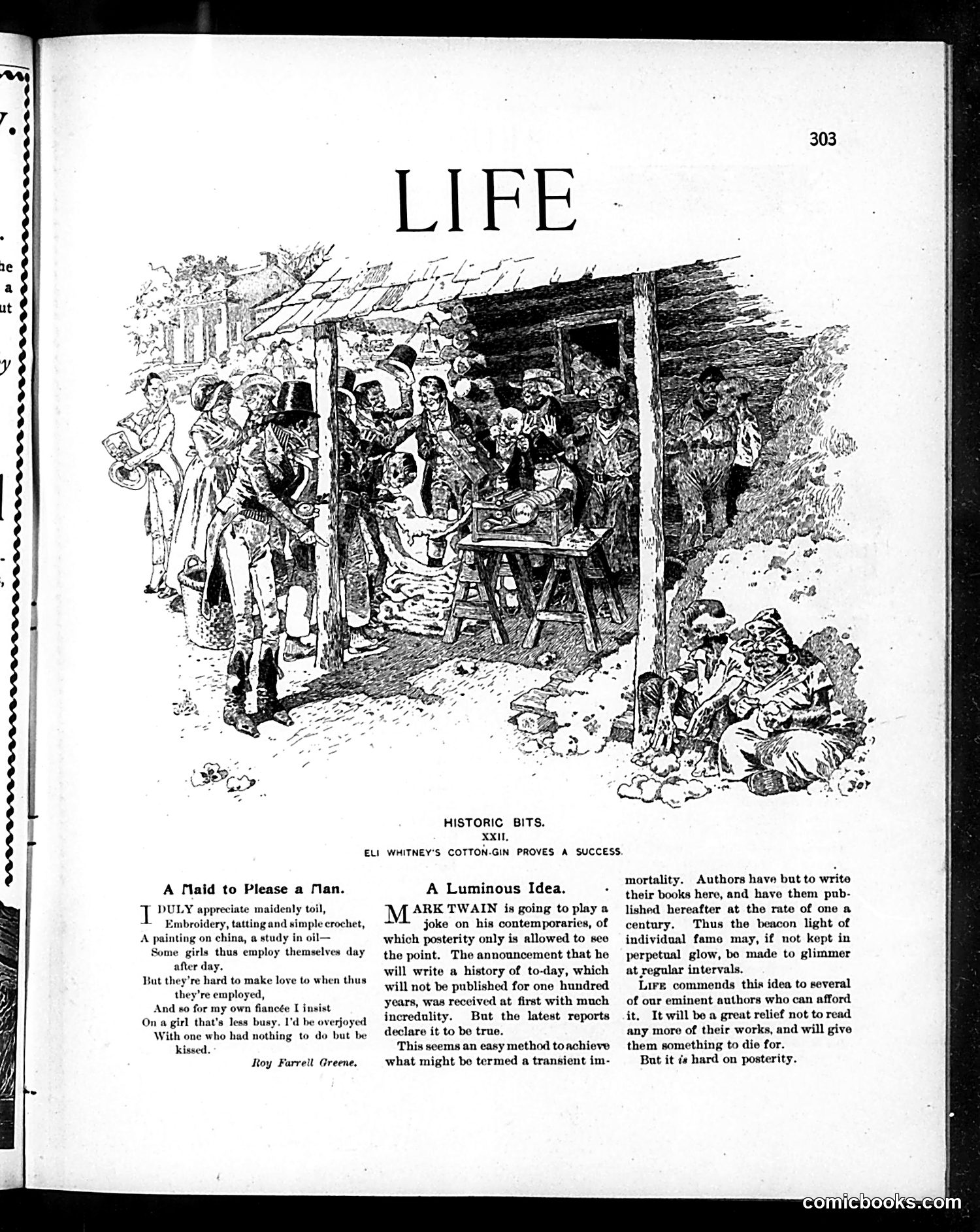
This page features two separate items: **"A Maid to Please a Plan"** (left): A poem by Roy Farrell Greene about the difficulties of courtship, using domestic service as metaphor. It humorously describes a suitor's frustration that winning affection requires effort. **"A Luminous Idea"** (center-right): Commentary on Mark Twain announcing he will write a history of today but delay publication 100 years. The article suggests this allows authors to avoid contemporary criticism and achieve "posterity" safely—a satirical jab at how delayed publication lets writers escape accountability for controversial statements about current affairs. The section header "Historic Bits" indicates these are brief cultural observations. The large illustration shows a social gathering, likely accompanying one of these pieces.
📄 Transcribed text from this page (OCR, searchable)
Machine-transcribed from the original scan — historical spelling and the odd misread are preserved.
ELI WHITNEY'S COTTON.GIN PROVES A SUCCESS. A Maid to Please a Man. DULY appreciate maidenly toil, Embroidery, tatting and simple crochet, A painting on china, a study in ofl— Some girls thus employ themselves day after day. But they're hard to make love to when thus they’re employed, And so for my own fiancée I insist On a girl that's less busy. I'd be overjoyed With one who had nothing to do but be kissed. Roy Farrell Greene. HISTORIC BITS. XXII, A Luminous Idea. ARK TWAIN is going to play a joke on his contemporaries, of which posterity only is allowed to seo the point. The announcement that he will write a history of to-day, which will not be published for one hundred years, was received at first with much incredulity. But the latest reports declare it to be true. This seems an easy method toachieve what might be termed a transient im- mortality. Authors have but to write their books here, and have them pub- lished hereafter at the rate of one a century. Thus the beacon light of individual famo may, if not kept in perpetual glow, bo made to glimmer at regular intervals. Lire commends this idea to several of our eminent authors who can afford it. It will be a great relief not to read any more of their works, and will give them something to die for. But it ¢s hard on posterity.