
Life, 1900-10-18 · page 12 of 22
Life — October 18, 1900 — page 12: what you’re looking at
What you’re looking at
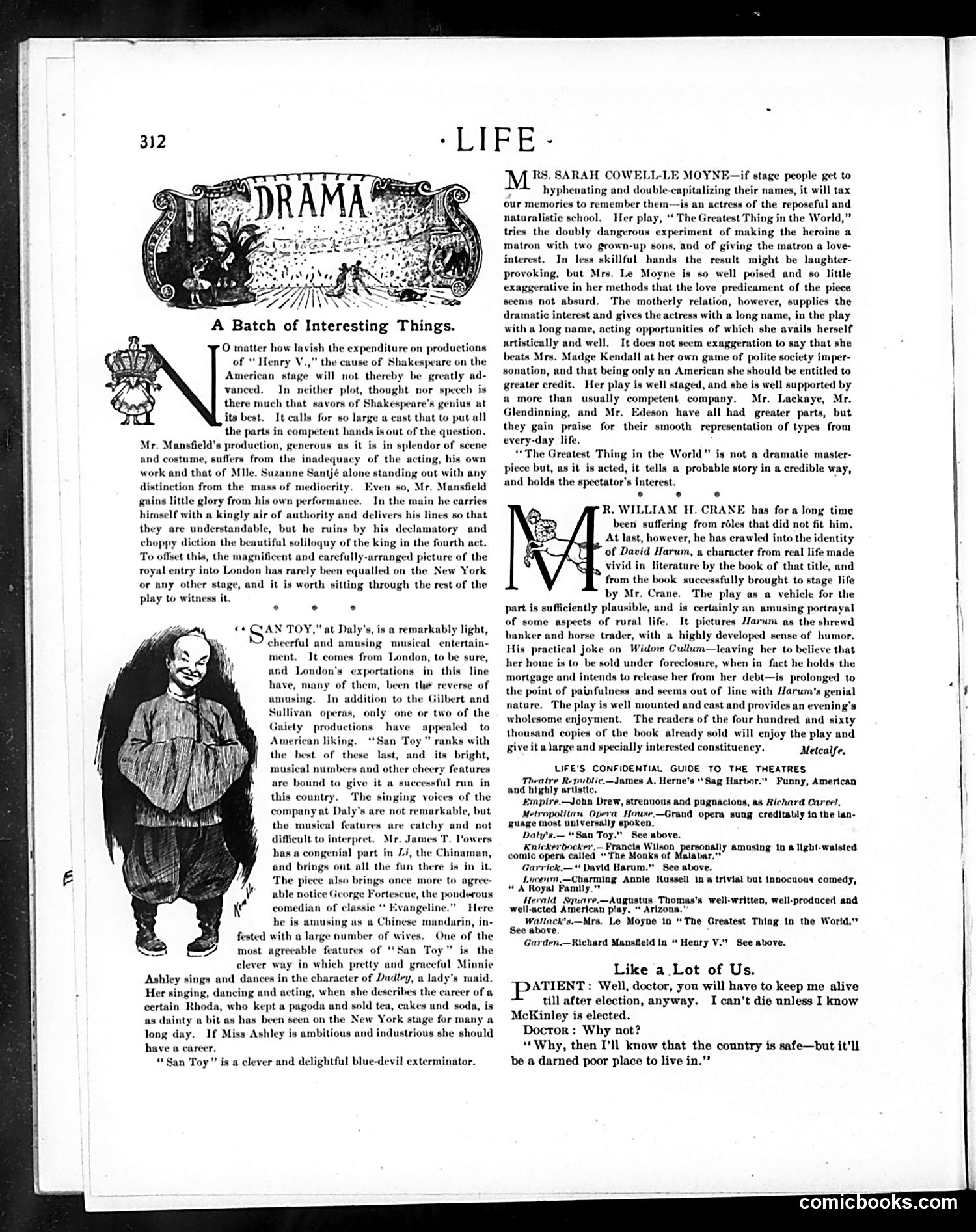
This page is a **drama review section** from Life magazine, discussing theatrical productions. The left column reviews "San Toy," a musical comedy featuring an actress named Ashley in the role of Dudley, a lady's maid. The review praises the production's lightness and entertainment value, calling it "a clever and delightful blue-devil exterminator." The accompanying **cartoon illustration** (left side) depicts a character in Asian costume—likely representing the "San Toy" production's Oriental-themed setting—drawn in exaggerated style typical of early 20th-century theatrical caricature. The page also reviews other plays and includes a brief comic dialogue at bottom titled "Like a Lot of Us" about election anxieties. This represents Life's coverage of New York theater during the period.
📄 Transcribed text from this page (OCR, searchable)
Machine-transcribed from the original scan — historical spelling and the odd misread are preserved.
A Batch of Interesting Things. O matter how lavish the expenditure on productions of “Henry V.,” the cause of Shakespeare on the American stage will not thereby be greatly ad- vanced. In neither plot, thought nor specch is there much that savors of Shakespeare's genius at its best. It calls for so large a cast that to put all the parts in competent hands is out of the question. Mr. Mansfield’s production, generous as 1 splendor of scene and costume, suffers from the inadequacy of the acting, his own work and that of Mile. Suzanne Santjé alone standing out with any distinction from the mass of mediocrity. Even so, Mr. Mansfield gains little glory from his own performance. In the main he carries himself with a kingly air of authority and delivers his lines so that they are understandable, but he ruins by his declamatory and choppy diction the beautiful soliloquy of the king in the fourth act, ‘To offset this, the magnificent and carefully-arranged picture of the royal entry into London has rarely been equalled on the New York or any other stage, and it is worth sitting through the rest of the play to witness it, Sax TOY," at Daly's, is a remarkably light, cheerful and amusing musical entertain- met It comes from London, to be sure, and London's exportations in this line have, many of them, been the reverse of amusing. In addition to the Gilbert and Sullivan operas, only one or two of the Gaiety productions have appealed to American liking. “San Toy ranks with the best of these last, and its bright, musical numbers and other cheery features are bound to give it a successful run in this country. The singing voices of the company at Daly's are not remarkable, but the musical features are catchy and not difficult to interpret. Mr. James T. Powers has a congenial part in Li, the Chinaman, and brings out all the fun there is in it. The piece also brings once more to agri able notice George Fortescue, the ponderous comedian of classic ‘* Evangel: Here he is amusing as a Chinese mandarin, in- fested with a large number of wives. One of the most agreeable features of “San Toy” is the clever way in which pretty and graceful M Ashley sings and dances in the character of Dudlry, a lady's maid. Her singing, dancing and acting, when she describes the career of a certain Rhoda, who kept a pagoda and sold tea, cakes and soda, is as dainty a bit as has been seen on the New York stage for many a long day. If} Ashley is ambitious and industrious she should have a career. “San Toy” is a clever and delightful blue-devil exterminator. —if stage people get to hyphenating and double-capitalizing their names, it will tax our memories to remember them—is an actress of the reposeful and naturalistic school. Her play, ‘‘ The Greatest Thing in the World,” tries the doubly dangerous experiment of making the heroine a matron with two grown-up sons, and of giving the matron a love- interest. In less skillful hands the result might be laughter- provoking, but Mrs. Le Moyne is so well poised and so little exaggerative in her methods that the love predicament of the piece seems not absurd. The motherly relation, however, supplies the dramatic interest and gives the actress with a long name, in the play with a long name, acting opportunities of which she avails herself artistically and well. It does not seem exaggeration to say that she beats Mrs. Madge Kendall at her own game of polite society imper- sonation, and that being only an American she should be entitled to greater credit. Her play is well staged, and she is well supported by a more than usually competent. company. Mr. Lackaye, Mr. Glendinning, and Mr. Edeson have all had greater parts, but they gain praise for their smooth representation of types from every-day life. “The Greatest Thing in the World” is not a dramatic master- piece but, as it is acted, it tells a probable story in a credible way, and holds the spectator's interest. , e ° ° R. WILLIAM H. CRANE has for a long time been suffering from roles that did not fit him. At last, however, he has crawled into the identity of David Harum, a character from real life made , Vivid in literature by the book of that title, and from the book successfully brought to stage life by Mr. Crane. The play as a vehicle for the part is sufficiently plausible, and is certainly an amusing portrayal of some aspects of rural life. It pictures Harum as the shrewd banker and horse trader, with a highly developed sense of humor. His practical joke on Widow Cullum—leaving her to believe that her home is to be sold under foreclosure, when in fact he holds the mortgage and intends to release her from her debt—is prolonged to the point of painfulness and seems out of line with Harum’s genial nature. The play is well mounted and cast and provides an evening's wholesome enjoyment. The readers of the four hundred and sixty thousand copies of the book already sold will enjoy the play and give ita large and specially interested constituency, Metcalfe, LIFE'S CONFIDENTIAL GUIDE TO THE THEATRES. Theatre R-pubtic.—dJames A. Herne’s Sag Harbor.” Funny, American and highly artistic. Empire.—Jobn Drew, strenuous and pugnacious, as Richard Carce!, Metropolitan Opera House.—Grand opera sung creditably ta the lan- guage most universally spoken, Daty’s.— “San Toy." See above. Knickerbocker. Francis Wilson personally amusing 1n @ light-watsted comic opera called “The Monks of Malabar."* Garriel David Harum.” See above. Lucenm.—Charming Annie Russell in trivial bat innocuous comedy, “ A Royal Family.” Heratd Square.—Augustus Thomas's well-written, well-prodaced and well-acted Amertean play, Arizona.” Wallack's.—Mra. Le Moyne in “The Greatest Thing in the World." See above. Garden.—Richard Mansfeld in “ Henry V."" See above. Like a Lot of Us. ‘PATIENT : Well, doctor, you will have to keep me alive till after election, anyway. I can’t die unless I know McKinley is elected. Doctor: Why not? “Why, then I'll know that the country is safe—but it'll be a darned poor place to live in.” comicbooks.com