
Life, 1900-10-18 · page 6 of 22
Life — October 18, 1900 — page 6: what you’re looking at
What you’re looking at
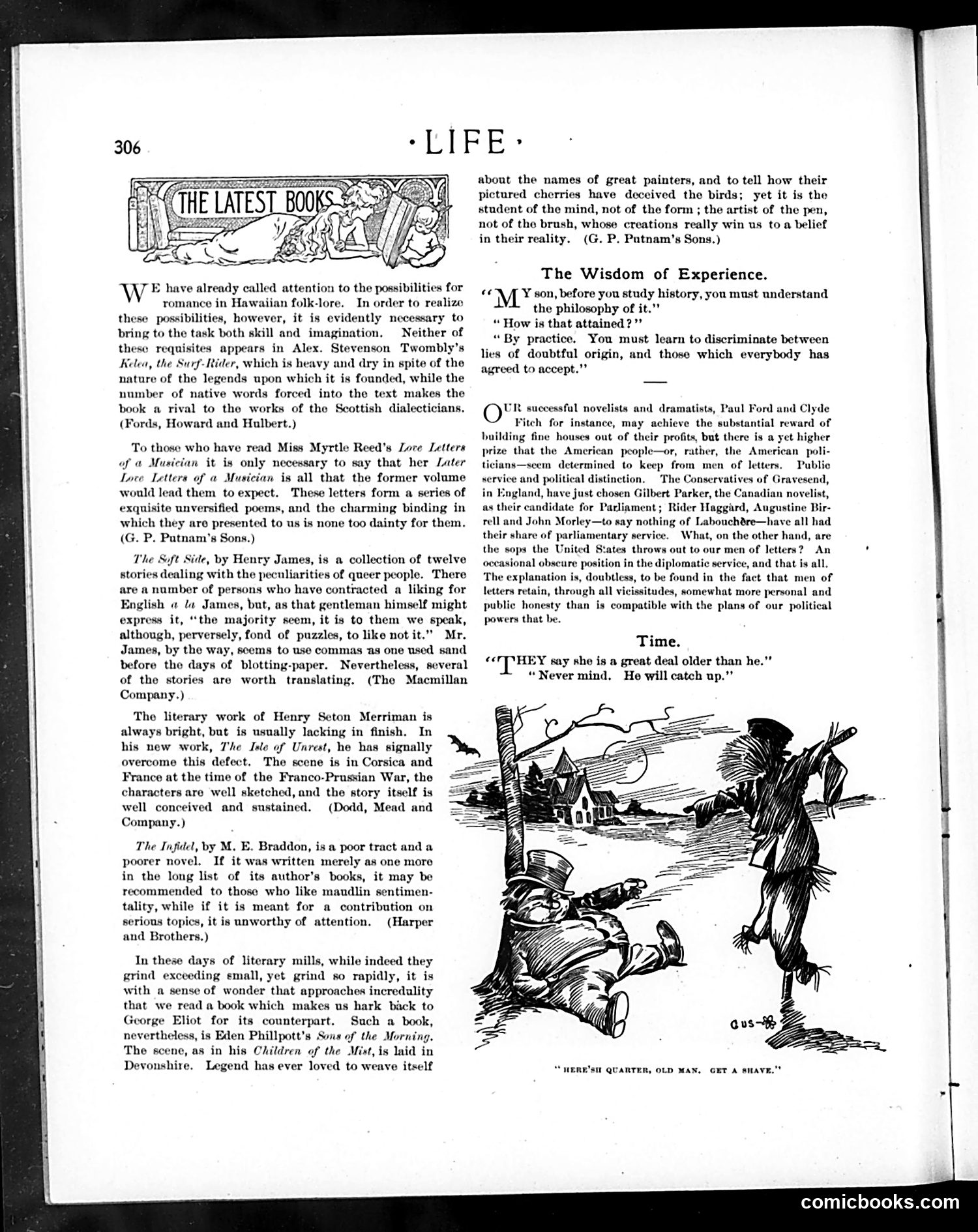
This page is primarily a book review section titled "The Latest Books," discussing recent literary works by authors like Henry James, Henry Seton Merriman, and M.E. Braddon. The single cartoon illustrates a section titled "Time" with the dialogue: "They say she is a great deal older than he" / "Never mind. He will catch up." The sketch depicts an old man with a scythe (representing Time personified) approaching a couple, suggesting that age differences between partners will eventually become irrelevant as both grow older. This is a gentle satirical commentary on age-gap relationships, using the traditional iconography of Father Time as the vehicle for the joke's dark humor.
📄 Transcribed text from this page (OCR, searchable)
Machine-transcribed from the original scan — historical spelling and the odd misread are preserved.
W E have already called attention to the possibilities for romance in Hawaiian folk-lore. In order to realizo these possibilities, however, it is evidently necessary to bring to the task both skill and imagination. Neither of these requisites appears in Alex. Stevenson Twombly’s Kelea, the Surf-Rider, which is heavy and dry in spite of the nature of the legends upon which it is founded, while the number of native words forced into the text makes the book a rival to the works of the Scottish dialecticians, (Fords, Howard and Hulbert.) To those who have read Miss Myrtle Reed's Lore Letters of a@ Musician it is only necessary to say that her Later Lace Letters of a Musician is all that the former volume would lead them to expect. These letters form a series of exquisite unversified poems, and the charming binding in which they are presented to us is none too dainty for them. (G. P. Putnam's Sons.) The Soft Side, by Henry James, is a collection of twelve stories dealing with the peculiarities of queer people. There are a number of persons who have contracted a liking for English « 4 James, but, as that gentleman himself might express it, “the majority seem, it is to them we speak, although, perversely, fond of puzzles, to like not it.” Mr. James, by the way, scems to use commas as one used sand before the days of blotting-paper. Nevertheless, several of the stories are worth translating. (The Macmillan Company.) The literary work of Henry Seton Merriman is always bright, but is usually lacking in finish. In his new work, 7T’he Isle of Unrest, he has signally overcome this defect. The scene is in Corsica and France at the time of the Franco-Prussian War, the characters are well sketched, and the story itself is well conceived and sustained. (Dodd, Mead and Company.) The Infidel, by M. E. Braddon, is a poor tract and a poorer novel. If it was written merely as one more in the long list of its author's books, it may be recommended to those who like maudlin sentimen- tality, while if it is meant for a contribution on serious topics, it is unworthy of attention. (Harper and Brothers.) In these days of literary mills, while indeed they grind exceeding small, yet grind so rapidly, it is with a sense of wonder that approaches incredulity that we read a book which makes us hark back to George Eliot for its counterpart. Such a book, nevertheless, is Eden Phillpott’s Sons of the Morning, The scene, as in his Children of the Mist, is laid in Devonshire. Legend has ever loved to weave itself ‘LIPS * about the names of great painters, and to tell how their pictured cherries have deceived the birds; yet it is the student of the mind, not of the form ; the artist of the pen, not of the brush, whose creations really win us to a belief in their reality. (G. P. Putnam's Sons.) The Wisdom of Experience. OM ¥ son, before you study history, you must understand the philosophy of it.’” “ How is that attained?” “ By practice, You must learn to discriminate between lies of doubtful origin, and those which everybody has agreed to accept.” UE successful novelists and dramatists, Paul Ford and Clyde Fitch for instance, may achieve the substantial reward of building fine houses out of their profits, but there is a yet higher prize that the American pcople—or, rather, the American poli- ticians—seem determined to keep from men of letters, Public service and political distinction, ‘The Conservatives of Gravesend, in England, have just chosen Gilbert Parker, the Canadian novelist, as their candidate for Parliament; Rider Haggard, Augustine Bir- rell and John Morley—to say nothing of Labouch&re—have all had their share of parliamentary service. What, on the other hand, are the sops the United States throws out to our men of letters? An occasional obscure position in the diplomatic service, and that is all. The explanation is, doubtless, to be found in the fact that men of letters retain, through all vicissitudes, somewhat more personal and public honesty than is compatible with the plans of our political powers that be. Time. «(Df HEY say she is a great deal older than he."’ “Never mind. He will catch up.”’ “WERE'SH QUARTER, OLD MAN, GET A SHAVE." comicbooks.com