
A complete issue · 20 pages · 1900
Life — August 30, 1900
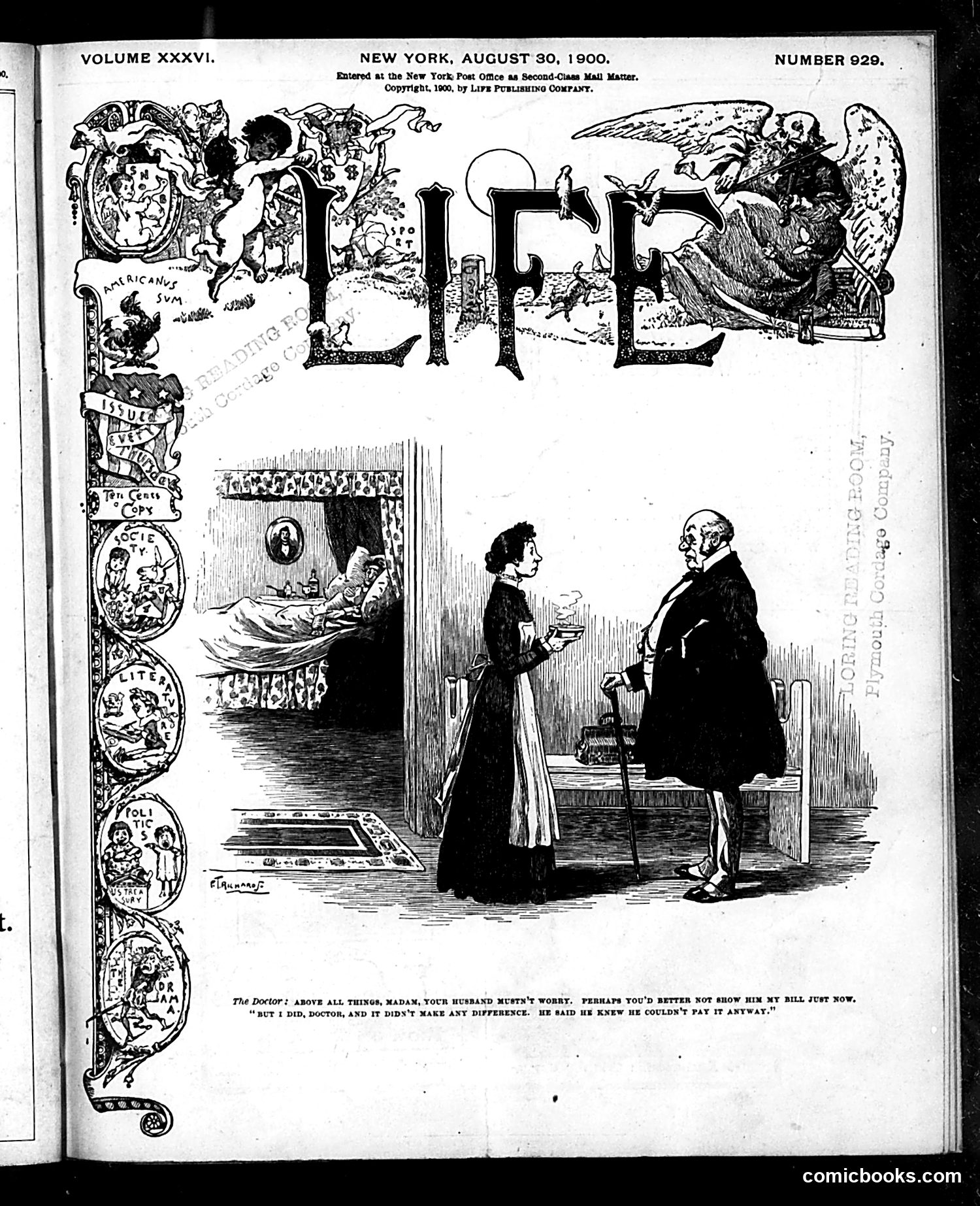
This page features a single-panel cartoon titled "The Doctor" depicting a domestic scene. A woman (the patient's wife) confronts a bald, rotund doctor about his medical bill, while a bedridden patient is visible in the background. The caption reads: "Above all things, madam, your husband mustn't worry. Perhaps you'd better not show him my bill just now. But I did, doctor, and it didn't make any difference. He said he knew he couldn't pay it anyway." **The satire targets:** medical billing practices and doctors' inflated fees in 1900. The joke mocks the assumption that patients worry about paying physicians, while simultaneously suggesting patients are resigned to unpayable debt regardless. It's social commentary on healthcare costs and doctor-patient financial anxiety—remarkably timeless themes.
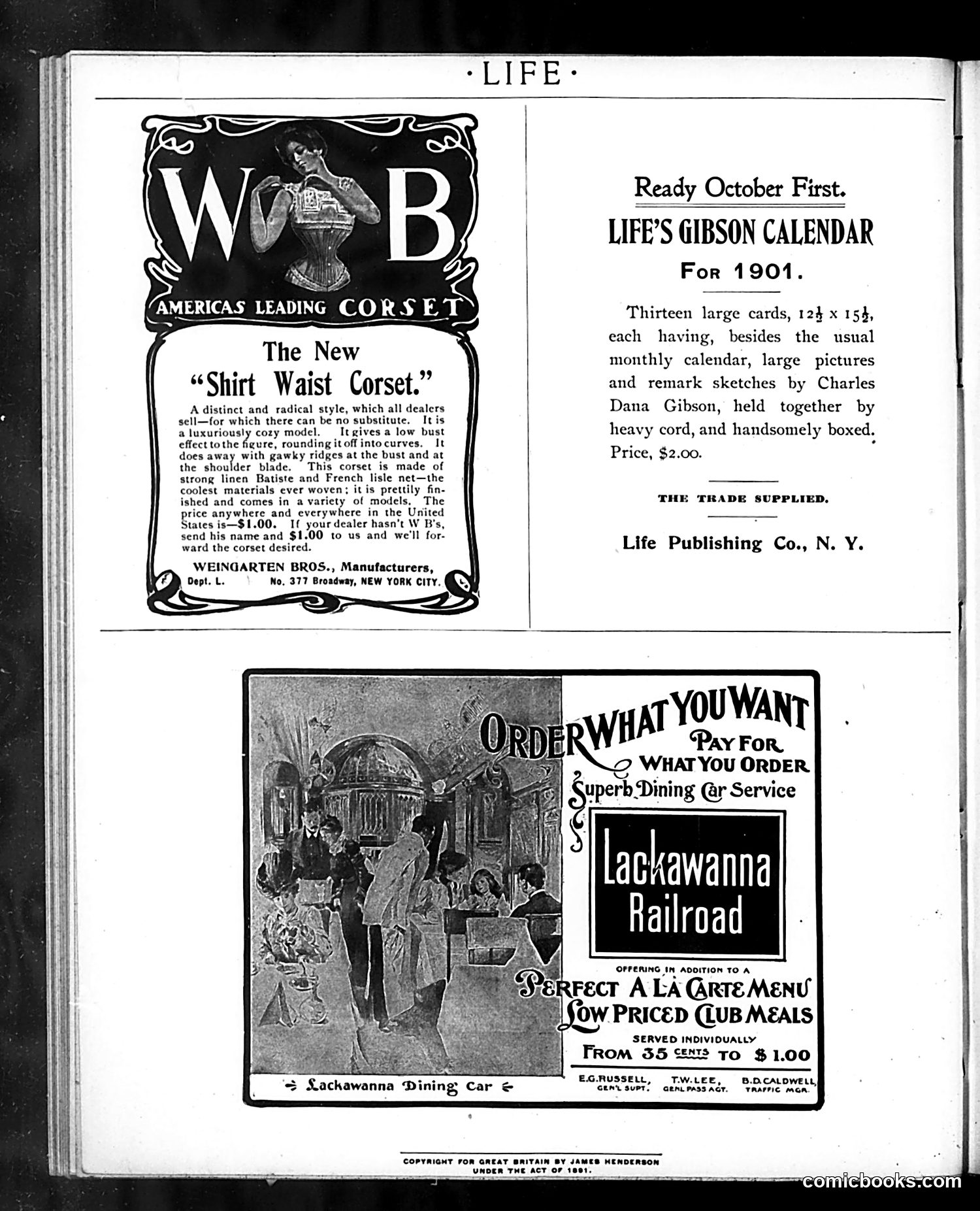
This page is **primarily advertising** rather than satirical content. The top half features two ads: one for W.B.'s "Shirt Waist Corset" by Weingartern Bros. (a corset manufacturer claiming innovation in design), and an announcement for Life's Gibson Calendar for 1901 featuring Charles Dana Gibson's artwork. The bottom half advertises the **Lackawanna Railroad's dining car service**, emphasizing their "Superb Dining Car Service" with "Perfect A La Carte Menu" and "Low Priced Club Meals" (35 cents to $1.00). The accompanying illustration shows passengers dining in an elegant railcar interior. No political satire is evident on this page—it's a commercial publication page typical of early 1900s magazines.
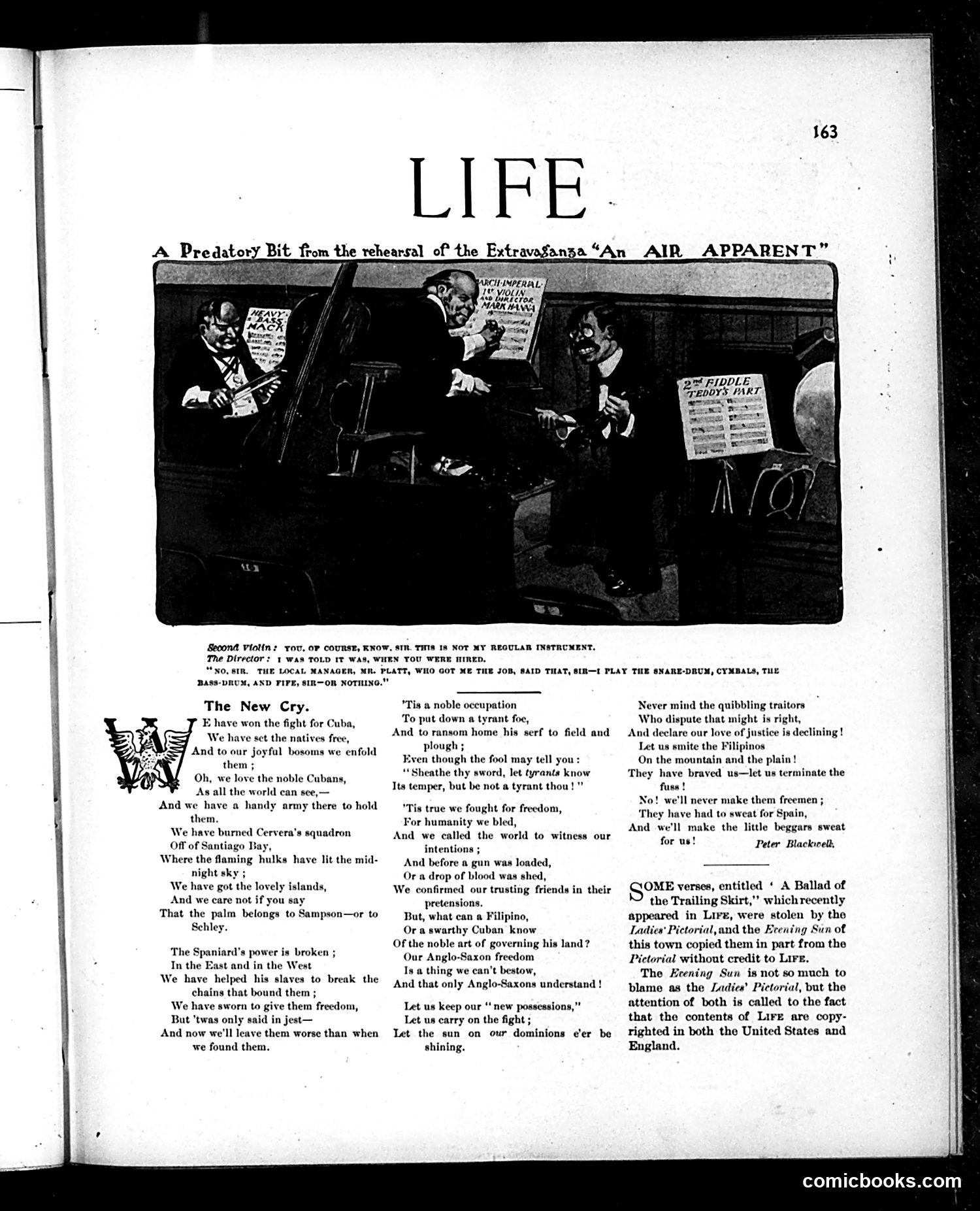
This page features content related to a theatrical extravaganza called "An Air Apparent." The top image shows a rehearsal scene with performers and visible signs/placards, though specific identities are unclear from the image alone. Below is "The New Cry," a patriotic poem addressing Cuba and Philippine independence issues. The verse appears to criticize American imperialism, referencing Cervera's squadron (Spanish-American War), and advocating for Filipino freedom against "Anglo-Saxon" colonial rule. Lines like "We have broken Cervera's squadron / Off of Santiago Bay" reference the 1898 naval battle. The footer notes that verses titled "A Ballad of the Trailing Skirt" were stolen by the *Ladies' Pictorial* and *Evening Sun*, with Life claiming copyright. This is a copyright dispute notice rather than satirical content. The overall page mixes theatrical promotion with anti-imperialist political commentary characteristic of Life magazine's satirical stance.
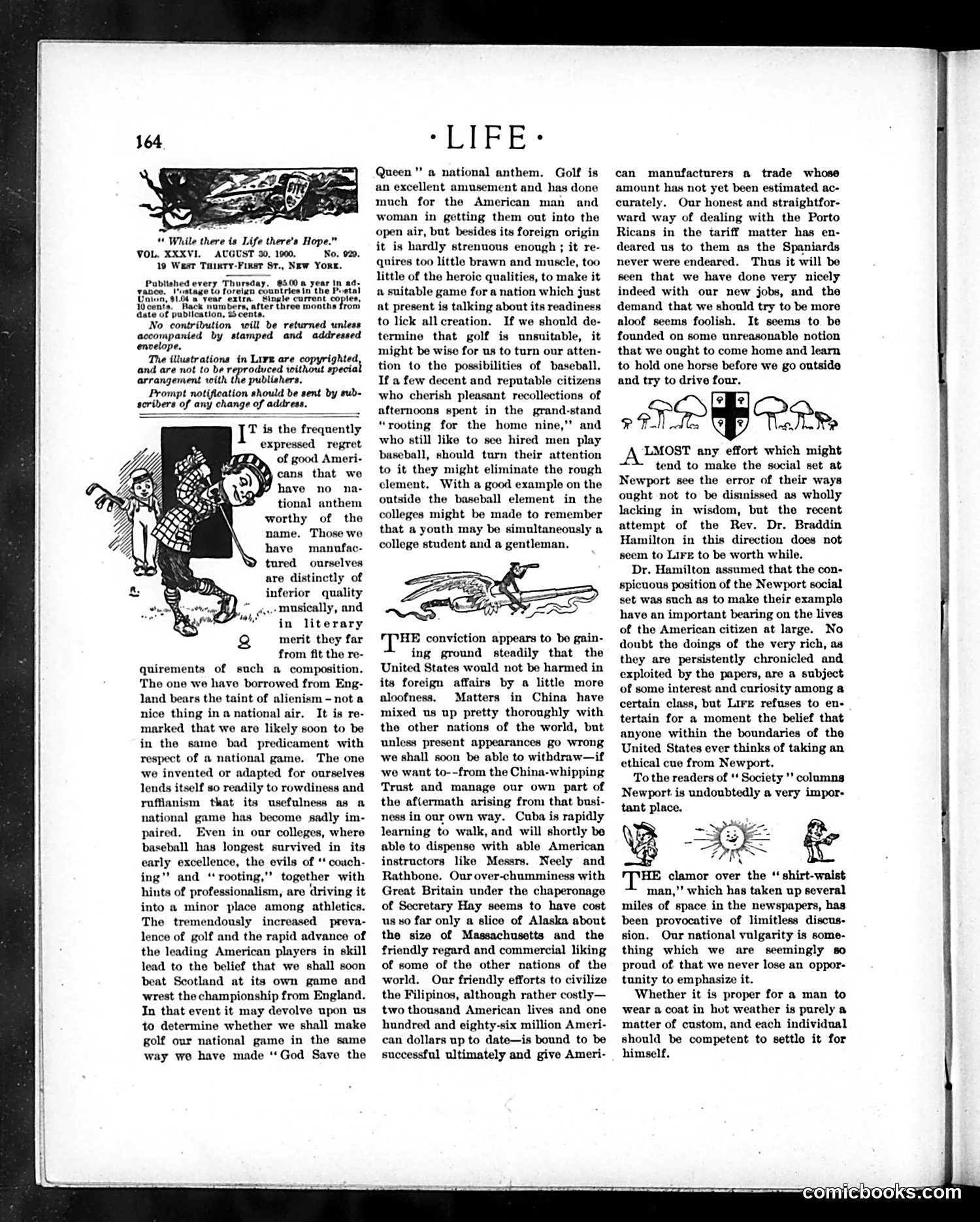
The page contains editorial text debating whether golf should be America's national game instead of baseball. The left margin features a small cartoon showing a figure labeled with what appears to be a golf club, though details are unclear in the image quality. The main argument criticizes golf as foreign and unsuitable for American character, advocating baseball as the "national game" instead. References include mentions of Secretary Hay's diplomacy regarding China and Alaska, suggesting this reflects 1900s foreign policy debates. A second cartoon appears lower on the page depicting figures with a sun, though its specific meaning is unclear from the image. The satire primarily targets elite American adoption of British golf culture over democratic baseball traditions.
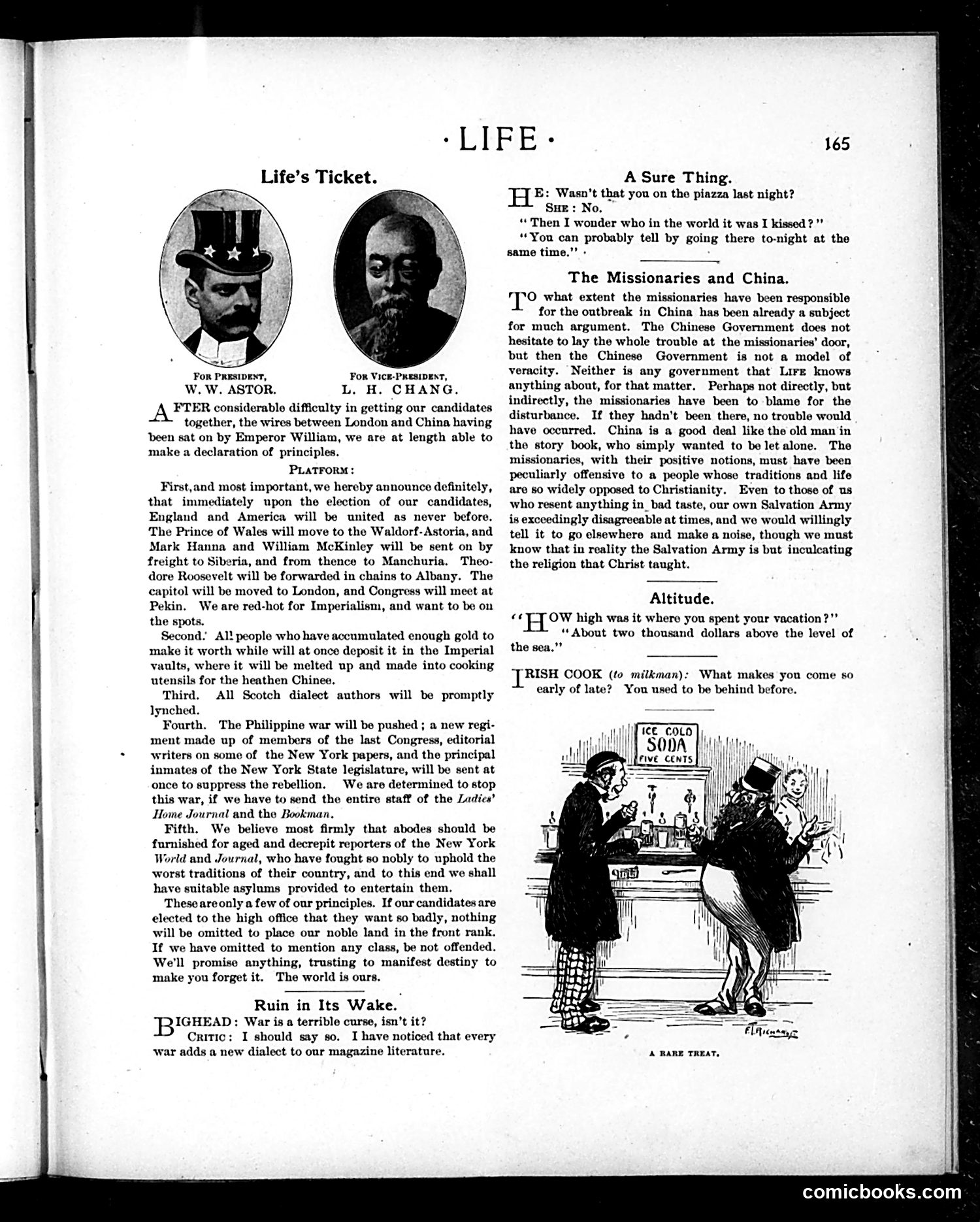
**Top Section - "Life's Ticket":** Two portrait caricatures labeled "For President: W.W. Astor" and "For Vice-President: L.H. Chang" accompany a satirical political platform. The joke appears to target wealthy industrialist W.W. Astor as a presidential candidate, proposing absurd policies: moving the capital to London, shipping gold to China, lynching Scottish authors, and suppressing newspapers. This is clearly satirizing both Astor's wealth-based political influence and contemporary imperialist attitudes toward China. **Bottom Section - "A Bare Treat":** A cartoon shows a street vendor selling "Ice Cold Soda - Five Cents" to a poorly-dressed customer. The humor plays on class contrast and the irony of selling luxury refreshment to someone who appears destitute, suggesting the economic inequality of the era.
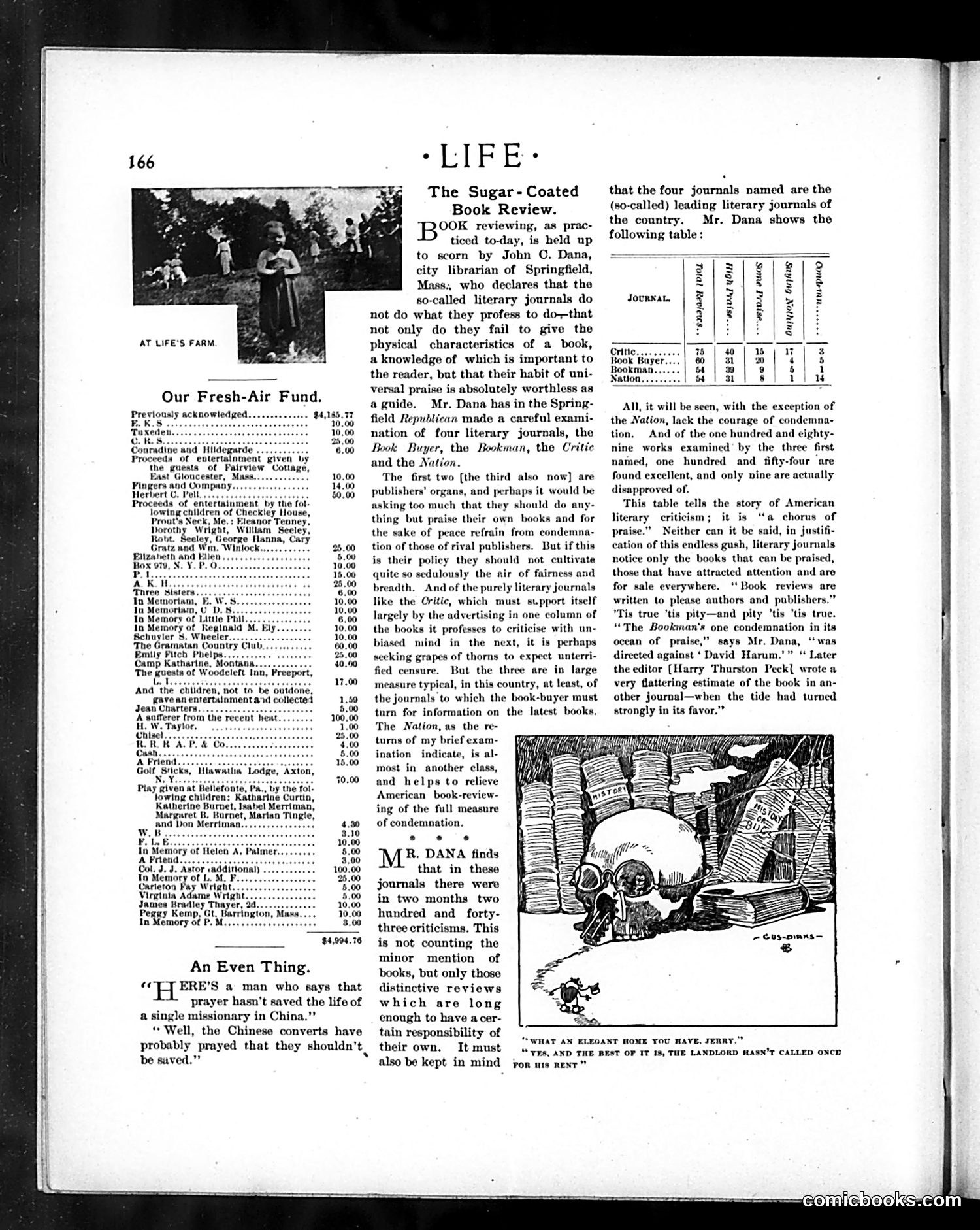
The cartoon at the bottom of the page shows a landlord and tenant in conversation. The caption reads: "Yes, and the rest of it is, the landlord hasn't called once for his rent." This is a joke about tenant-landlord relations, likely from the early 20th century. The humor relies on the irony that the tenant considers his home "elegant" primarily because the landlord hasn't bothered to collect rent—suggesting the tenant is behind on payments. The implication is that an absent landlord (who doesn't demand payment) is the tenant's ideal scenario. It's satirizing both the financial struggles of renters and the sometimes-neglectful nature of landlord-tenant relationships during this era.
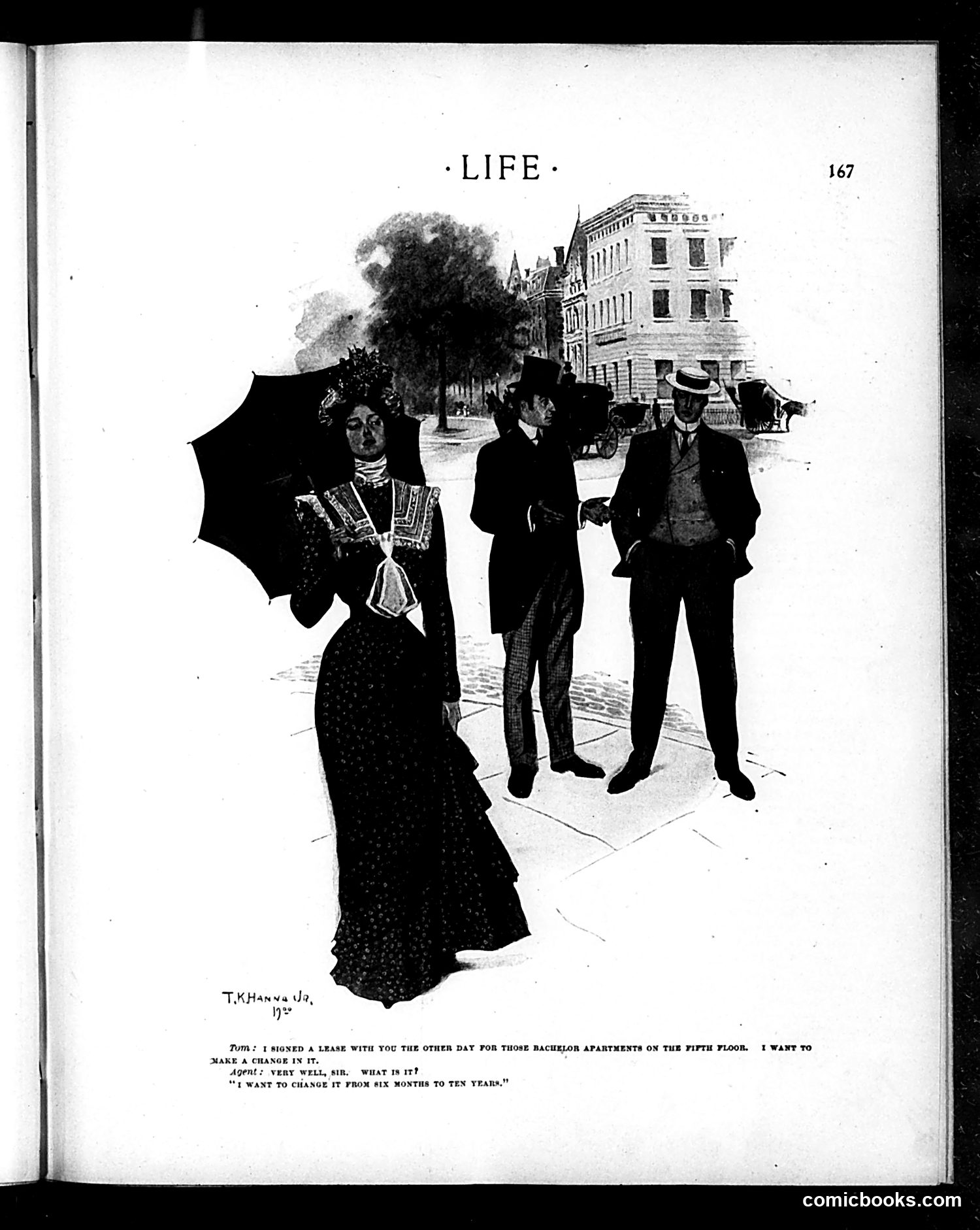
This is a satirical cartoon from *Life* magazine (page 167) depicting a street scene where a woman in elaborate dress holding a parasol confronts two men about an apartment lease. The cartoon mocks wealthy women's attitudes toward rental agreements. The woman's ornate clothing and imperious posture suggest she's wealthy or pretentious. She wants to change a lease term from six months to ten years—an unusual and unreasonable request. The joke targets upper-class women's entitlement and their willingness to make arbitrary demands of service providers (the real estate agent), expecting compliance simply due to their social status. The artist is T.K. Hanna (signed lower left). The humor derives from the absurdity of her negotiating position and the agent's polite but bewildered response to her demand.
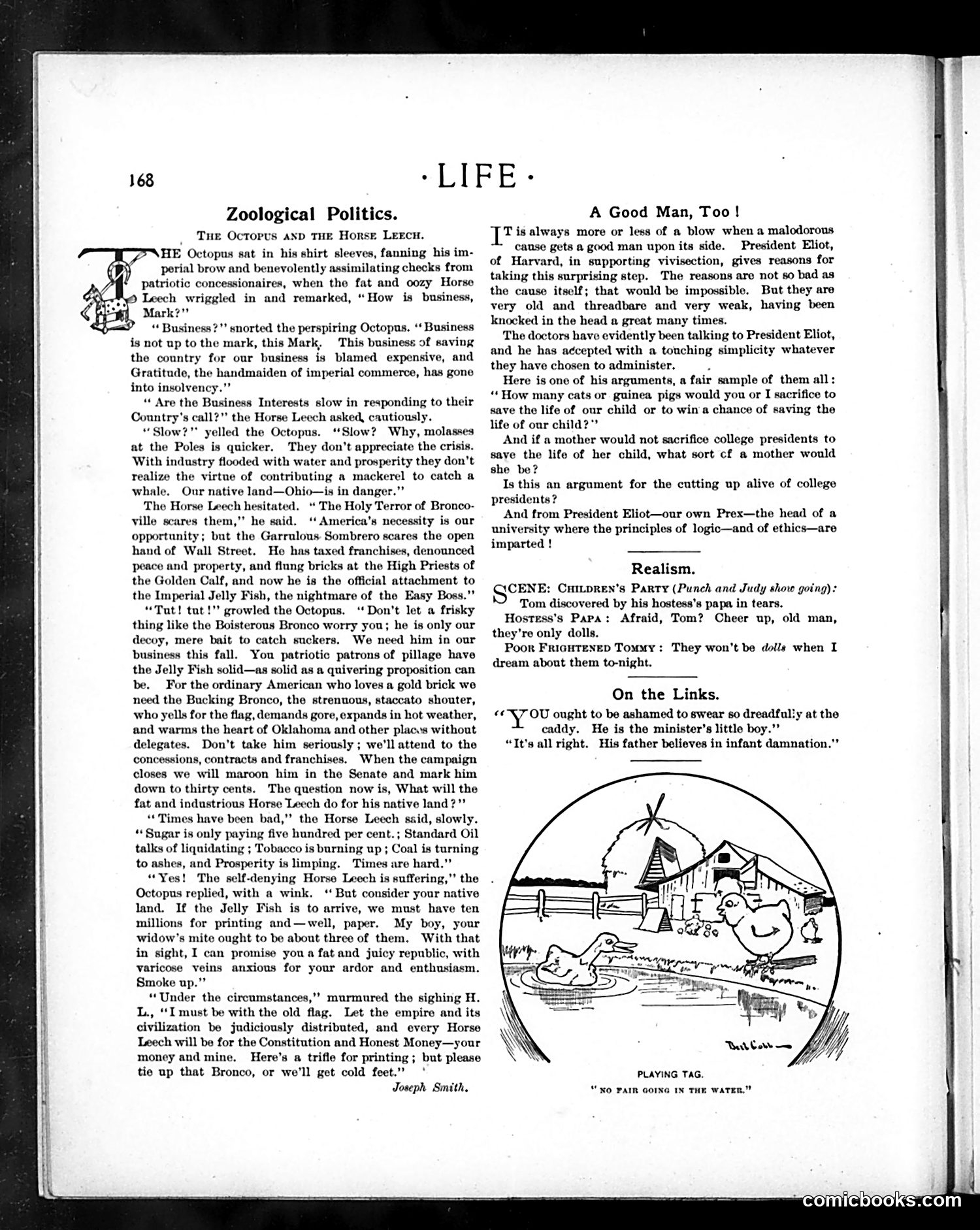
This page contains satirical commentary on President Charles W. Eliot of Harvard University. The "Zoological Politics" section mocks Eliot's public statements about sacrificing animals (cats, guinea pigs) to save human lives—specifically college presidents' lives. The Octopus and Horse Leech characters debate whether Eliot's utilitarian logic is sound, with the Horse Leech sarcastically defending American business interests and imperial expansion. The "On the Links" illustration humorously depicts a minister's son swearing at golf, with a brief morality-tale exchange about childhood behavior and religious instruction. The satire targets Eliot's apparent hypocrisy: advocating animal sacrifice while defending brutal industrial capitalism and imperialism as necessary evils—mocking the era's elite justifications for ruthlessness in pursuit of "civilization."
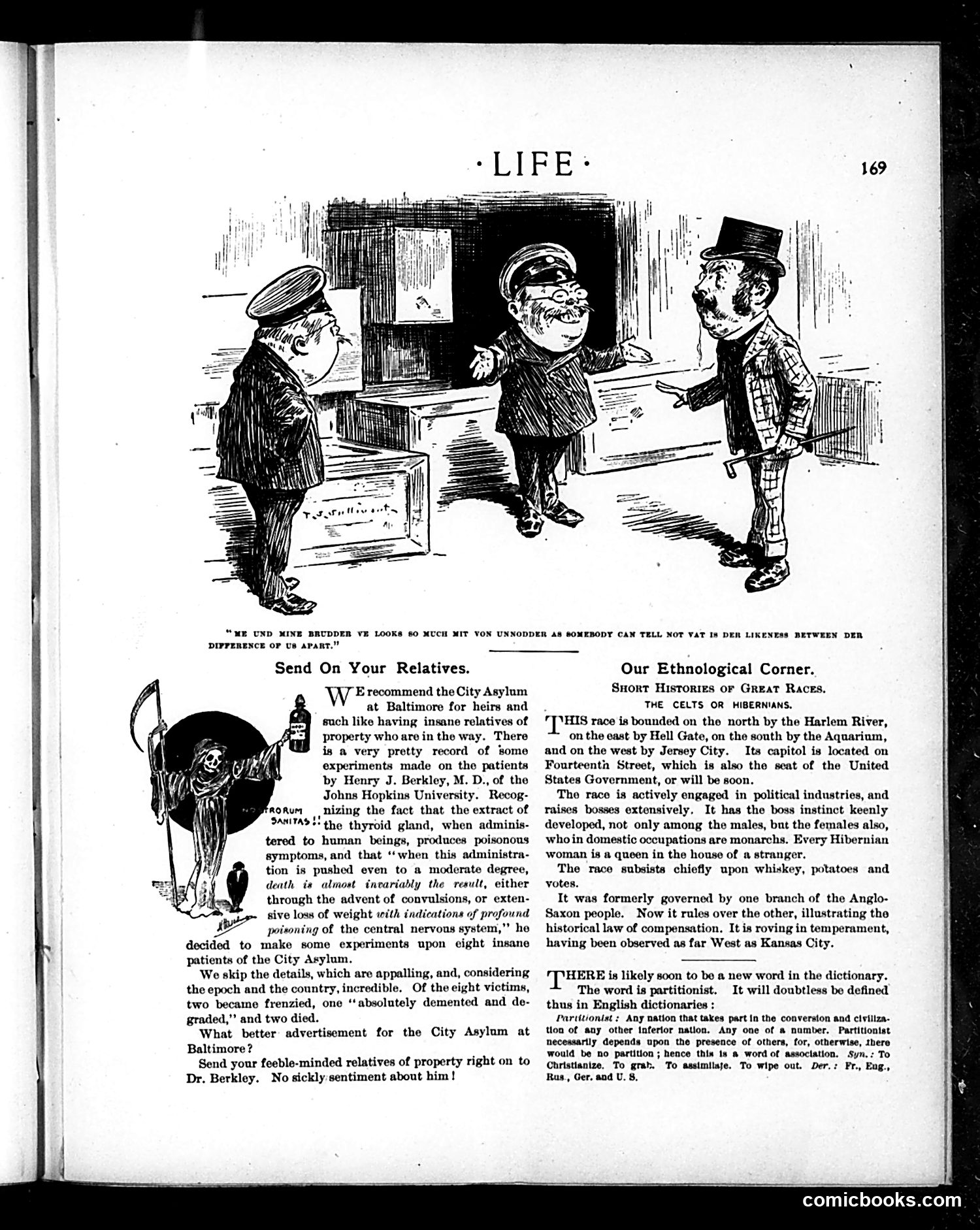
The top cartoon satirizes Irish immigrants in Baltimore. Three caricatured men—depicted with exaggerated features typical of anti-Irish propaganda—discuss sending relatives from a city asylum. The caption quotes one saying relatives look so similar that "you couldn't as somebody can tell not vat is der likeness between der difference of us apart," mocking Irish accents and suggesting the asylum's Irish patients are indistinguishable from their free relatives. The accompanying text sarcastically recommends Dr. Berkley's City Asylum as an "advertisement," noting it conducted thyroid experiments on eight institutionalized patients, two of whom died. The satire targets both the asylum's unethical medical practices and anti-Irish xenophobia—suggesting sending poor Irish relatives there as a solution.
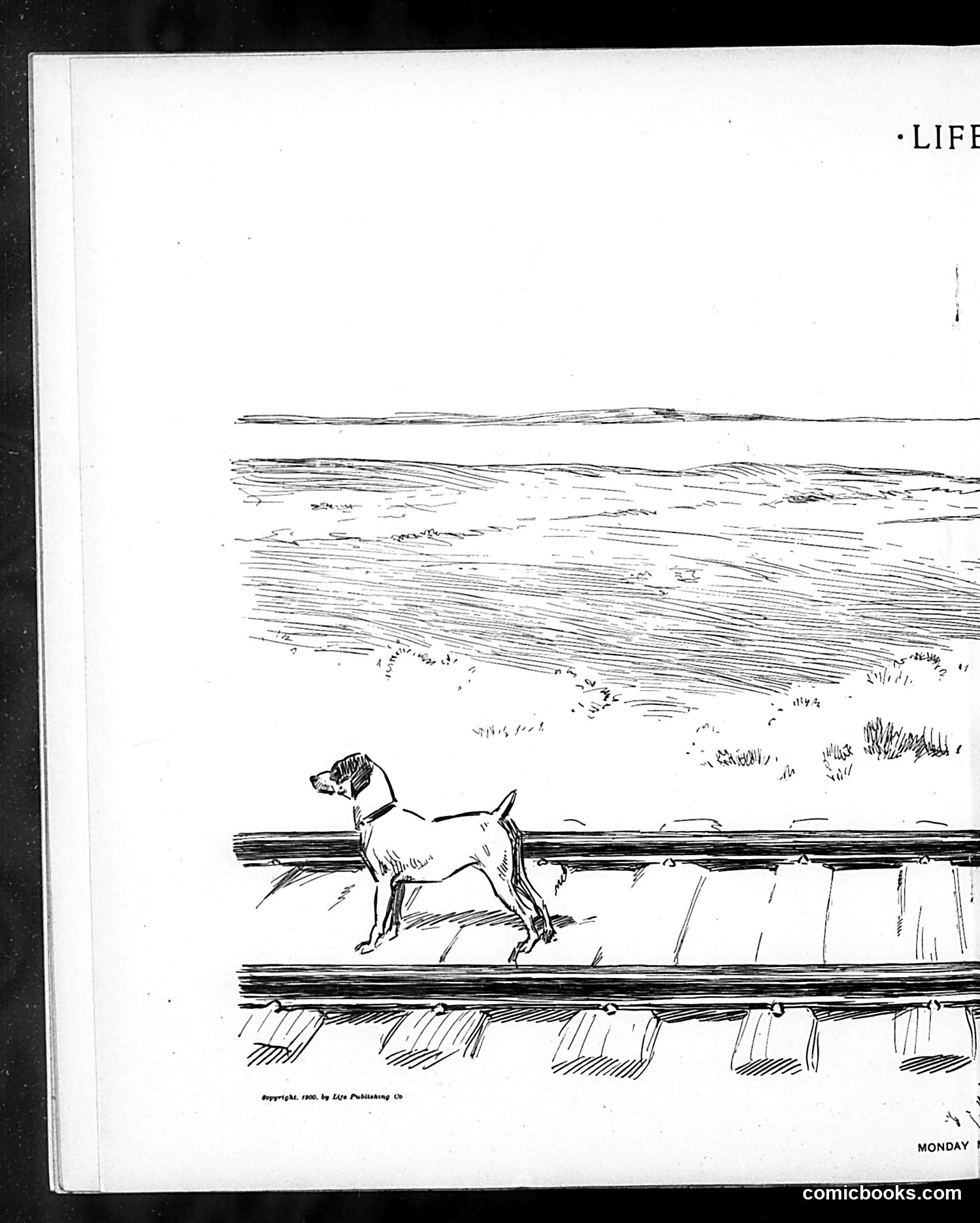
This appears to be a simple illustration rather than a political cartoon. It depicts a small dog standing on a wooden fence, looking out over a rural landscape with rolling hills and scattered vegetation in the background. The drawing is rendered in a minimalist ink sketch style typical of early-to-mid 20th century magazine illustrations. There is a copyright notice at the bottom crediting "Life Publishing Co." Without accompanying text, caption, or satirical commentary visible on this page, the image appears to be a straightforward, observational illustration—possibly meant to accompany a story, article, or serve as filler content. The dog's alert posture suggests watchfulness or contemplation, but no specific political or social commentary is evident from the image alone.
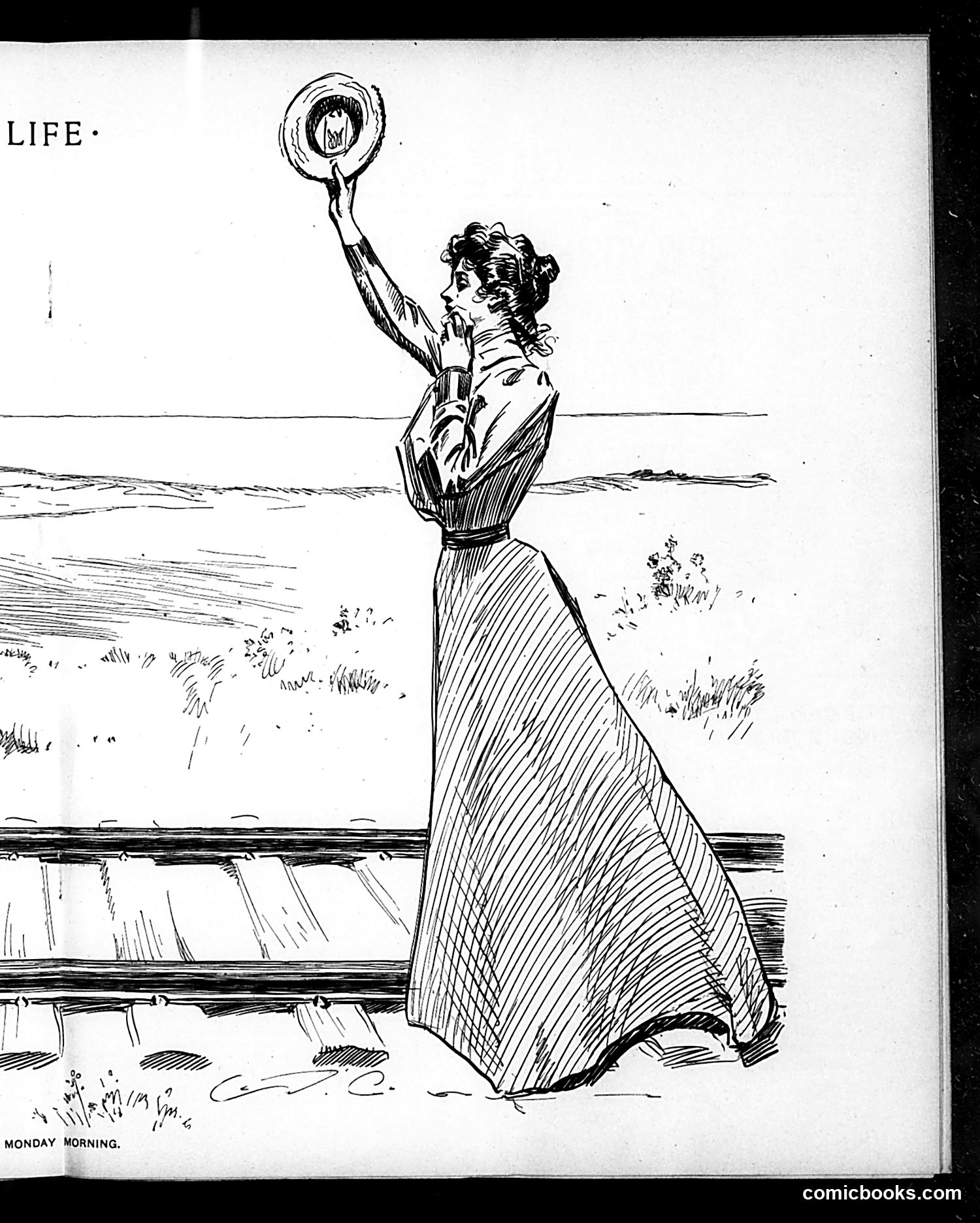
This is a cover page from *Life* magazine titled "Monday Morning," showing a woman in Edwardian-era dress standing on a wooden fence, holding up her hat triumphantly while gazing toward the horizon and water. The cartoon appears to be a social commentary on women's independence or optimism, likely from the early 1900s based on the clothing style and illustration technique. The woman's elevated position and upward gaze suggest aspirational themes—possibly commenting on women's expanding opportunities or newfound freedoms of that era. However, without additional context or visible accompanying text explaining the specific satirical point, the exact social or political reference remains unclear. The title "Monday Morning" might reference weekly routines or fresh starts, but the precise satirical target cannot be determined from the image alone.
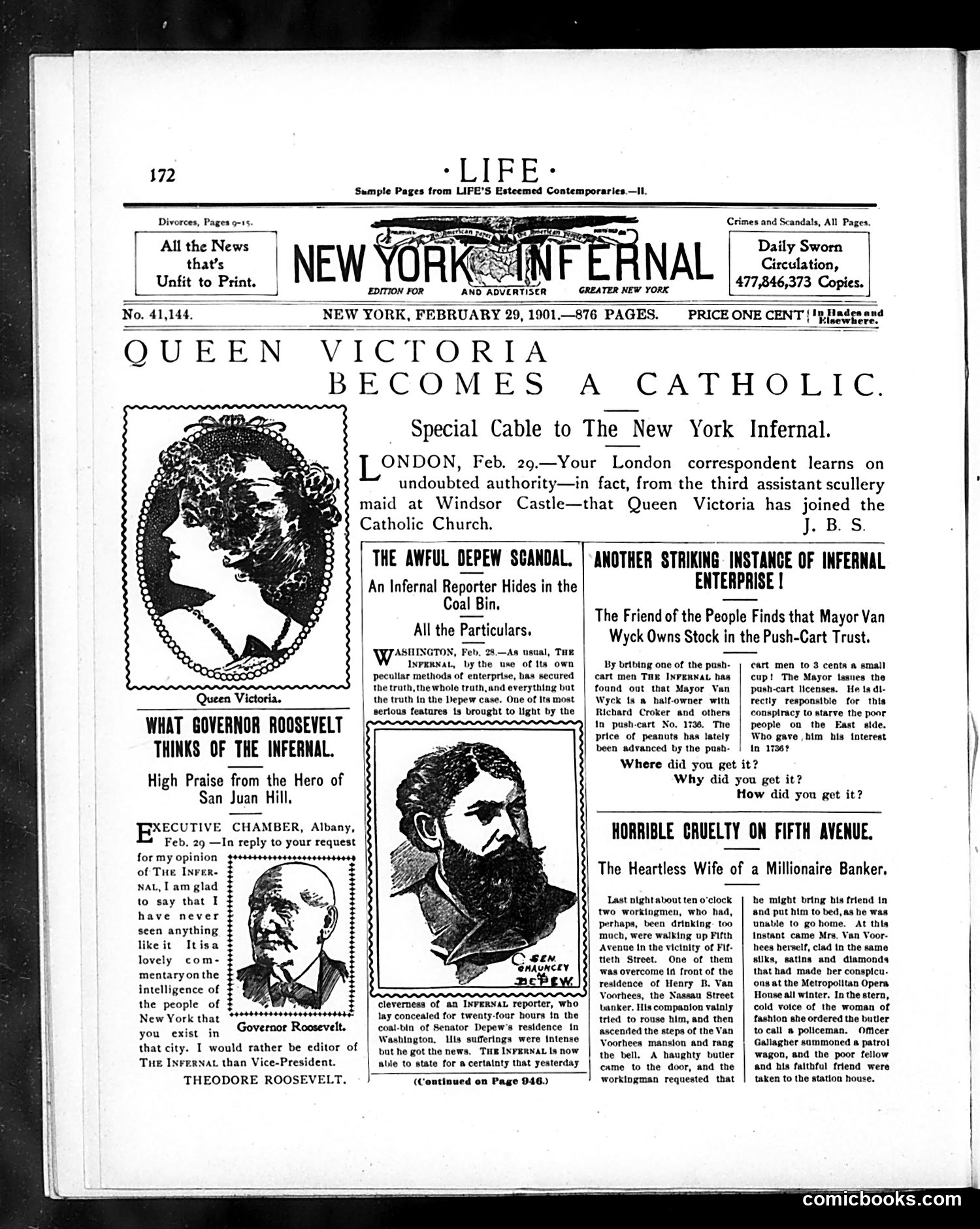
This page from *Life* magazine (February 20, 1901) is primarily **news content, not political cartoons**. The main article announces Queen Victoria's conversion to Catholicism—presented as satirical "news" with the headline "QUEEN VICTORIA BECOMES A CATHOLIC." The page includes portraits of Queen Victoria and what appears to be a bearded man (labeled "BEN BRANDT, SCREW"), alongside commentary sections. One section features Governor Roosevelt's (likely Theodore Roosevelt) mock praise of *The Infernal* newspaper. The content satirizes sensationalism in journalism. The "striking instances" and scandal stories—including tales of Mayor Van Wyck and Fifth Avenue cruelty—exemplify the type of lurid content *Life* was mocking. This reflects early 1900s media criticism of yellow journalism and scandal-mongering.
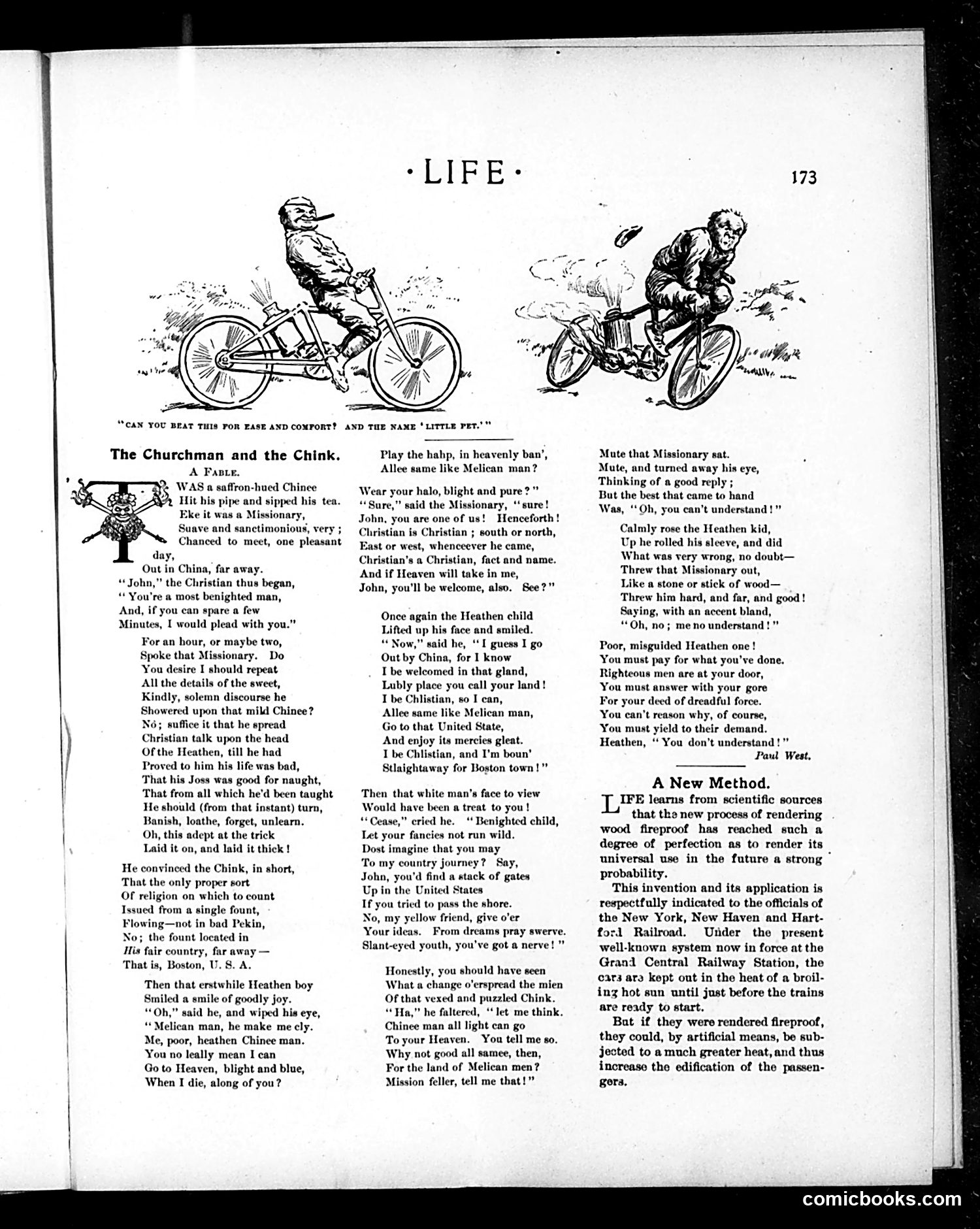
This satirical poem mocks Christian missionary hypocrisy. A white Christian missionary in China converts a Chinese man ("the Chink") to Christianity, assuring him all Christians are equal regardless of nationality. The convert, now believing he's welcome in America, announces he'll move to Boston. The missionary's face falls—he frantically backpedals, insisting the convert cannot actually immigrate to the United States, citing restrictive immigration laws. The convert, seeing the contradiction between the missionary's preaching and practice, throws him out in disgust. **The satire targets**: American Christian missionaries who preach universal brotherhood abroad while supporting racial exclusion and discriminatory immigration policies at home (likely referencing late 19th/early 20th-century anti-Chinese immigration sentiment). The poem exposes the moral gap between Christian universalism and American racial prejudice.
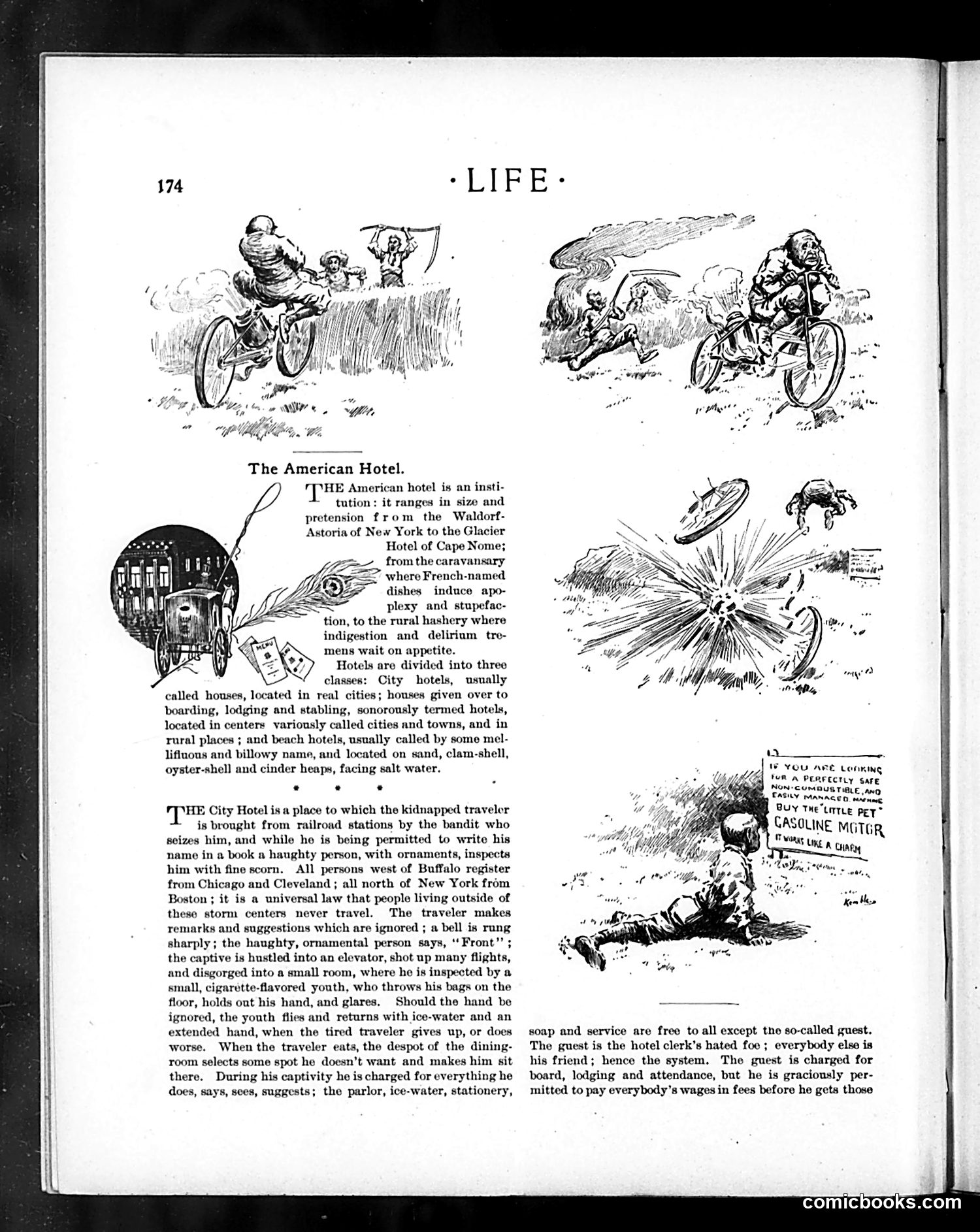
This *Life* magazine article satirizes the American hotel system as exploitative and absurd. The text describes hotels as institutions ranging from luxurious (Waldorf-Astoria) to dismal (Cape Nome), but focuses on the "City Hotel" experience—depicting travelers as "kidnapped" victims subjected to contempt by staff. The satire's target: hotels treat paying guests as adversaries while befriending everyone else. Guests are charged for everything (soap, ice-water, stationery) while staff wages are extracted through mandatory tipping. The haughty clerk, the dismissive bellhop, the dictatorial dining-room manager—all conspire to extract maximum fees from the trapped traveler. The accompanying cartoons show cyclists fleeing disaster and a character sitting among chaos with a sign advertising "gasoline motors"—likely mocking modern conveniences as unreliable alternatives to traditional travel. The satire suggests American hotels represent a uniquely exploitative system where the customer, paradoxically, is treated worst despite paying most.
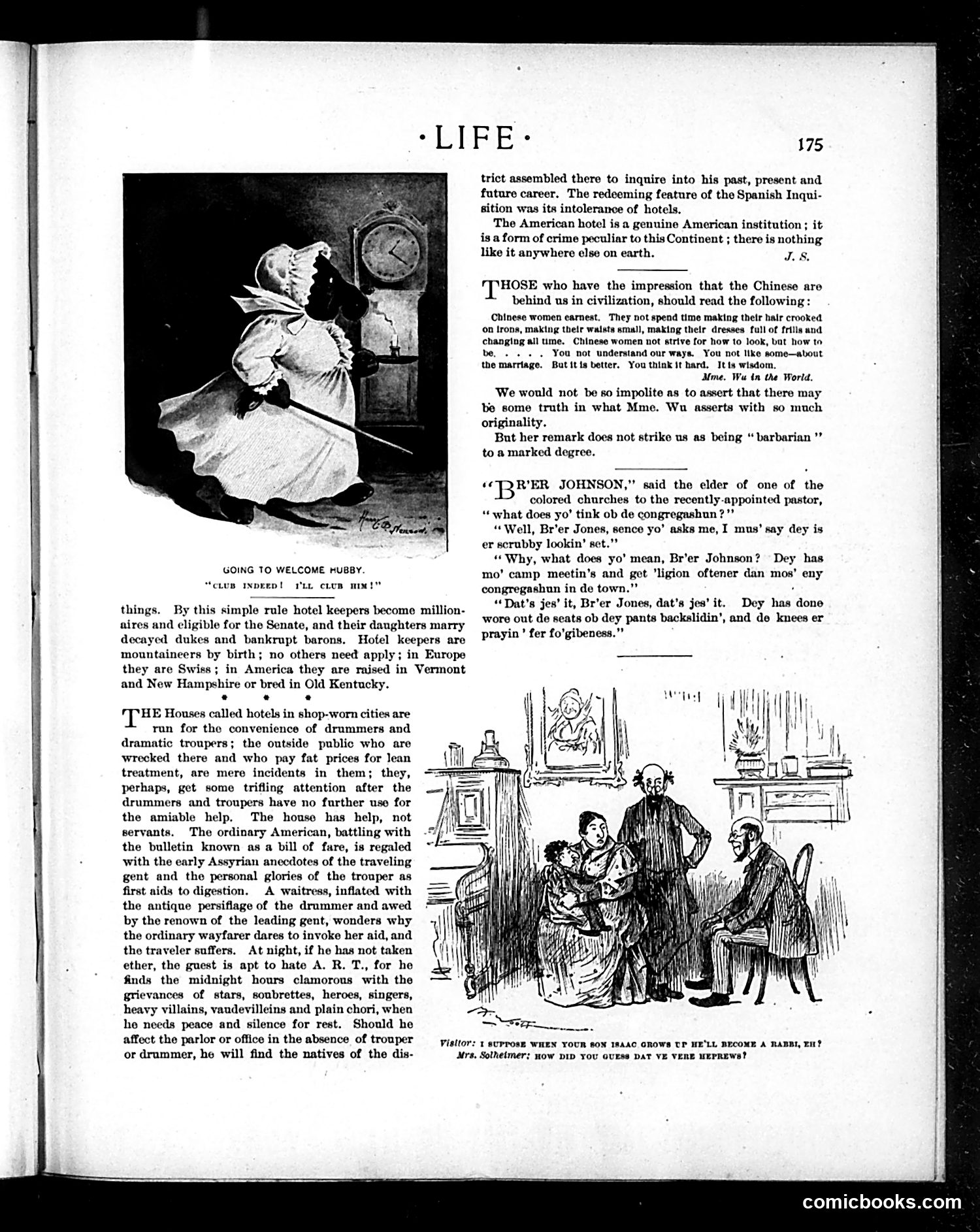
**Top Cartoon ("Going to Welcome Hubby"):** A woman checks a clock while waiting for her husband, implying he's delayed at a hotel. The satire critiques American hotels as institutions run primarily for traveling salesmen ("drummers") and theatrical troupers, with ordinary guests treated as afterthoughts. **Hotel Commentary:** The text savagely attacks American hotels as uniquely American failures—worse than Spanish Inquisition dungeons. Hotels allegedly prioritize entertainers' gossip over guest comfort, with staff indifferent to regular patrons and waitresses awed by performers. **Chinese Women Section:** Quotes "Mme. Wu," appearing to contrast Chinese women's practical focus on virtue versus American women's obsession with appearance (tight corsets, elaborate dress). The satire cuts both ways—the author questions whether dismissing this as "barbaric" is fair. **Bottom Cartoon:** Features dialect-heavy dialogue between Black church members discussing moral lapses (worn pants from "backsliding," worn knees from prayer). The crude phonetic spelling reflects period racist stereotyping typical of American humor magazines.
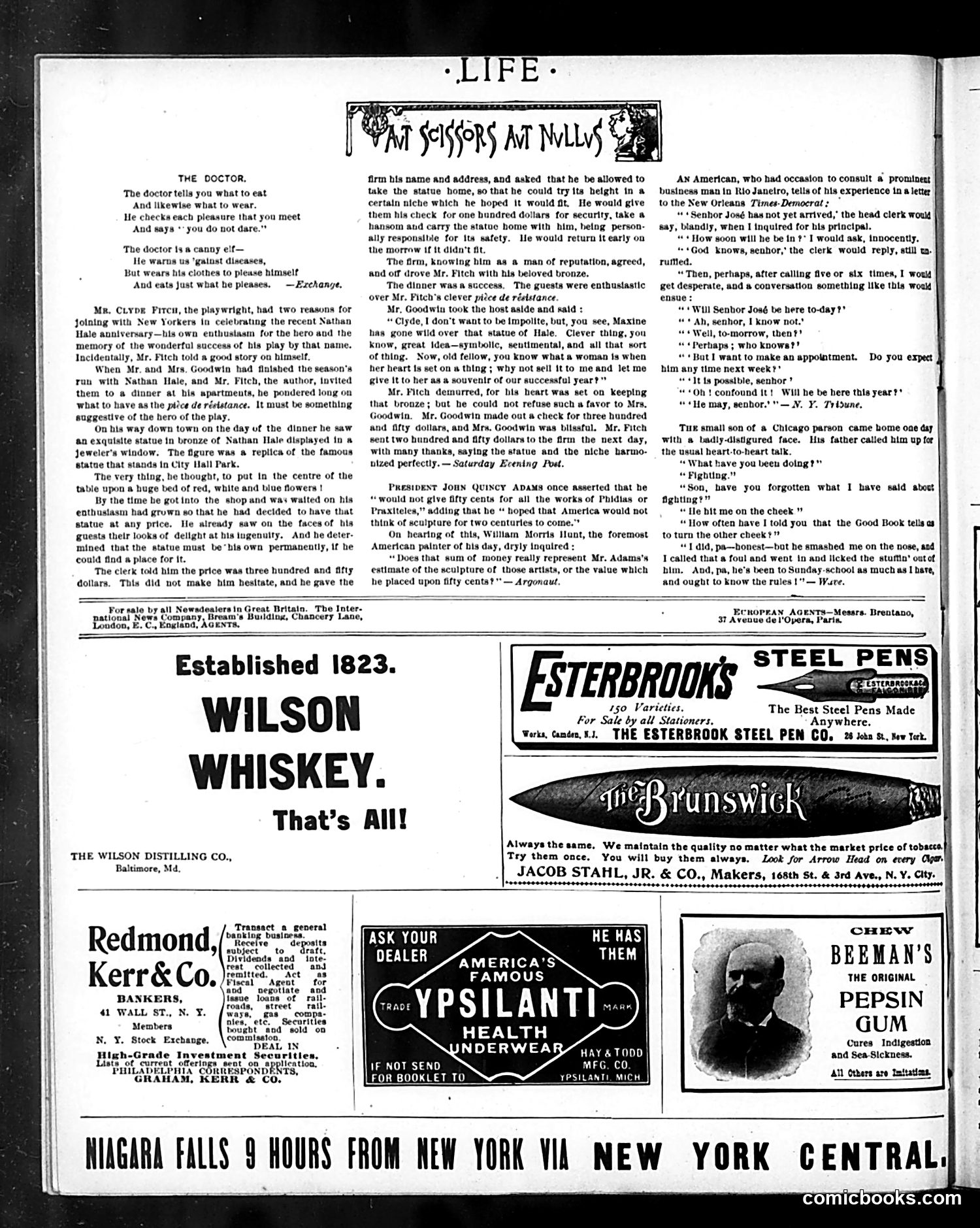
This page comprises mostly **short humorous anecdotes** rather than political cartoons. The main pieces are: 1. **"The Doctor"** — A brief satirical poem mocking physicians who dispense medical advice while ignoring it themselves (warning patients against pleasures they personally enjoy). 2. **Clyde Fitch Anecdote** — A story about the famous American playwright who impulsively purchases a bronze statue of Nathan Hale for a dinner centerpiece after seeing it in a jeweler's window, then loses it when a guest (Mrs. Goodwin) admires it and her husband buys it from him. 3. **John Quincy Adams Story** — An anecdote where President Adams dismisses classical sculpture as worthless, prompting painter William Morris Hunt to sarcastically question whether this represents Adams's actual artistic judgment or merely his stingy nature. The page also contains period advertisements (Wilson Whiskey, Esterbrook Steel Pens, Brunswick cigars, etc.). These are genteel, satirical observations targeting hypocrisy and vanity rather than specific political figures.
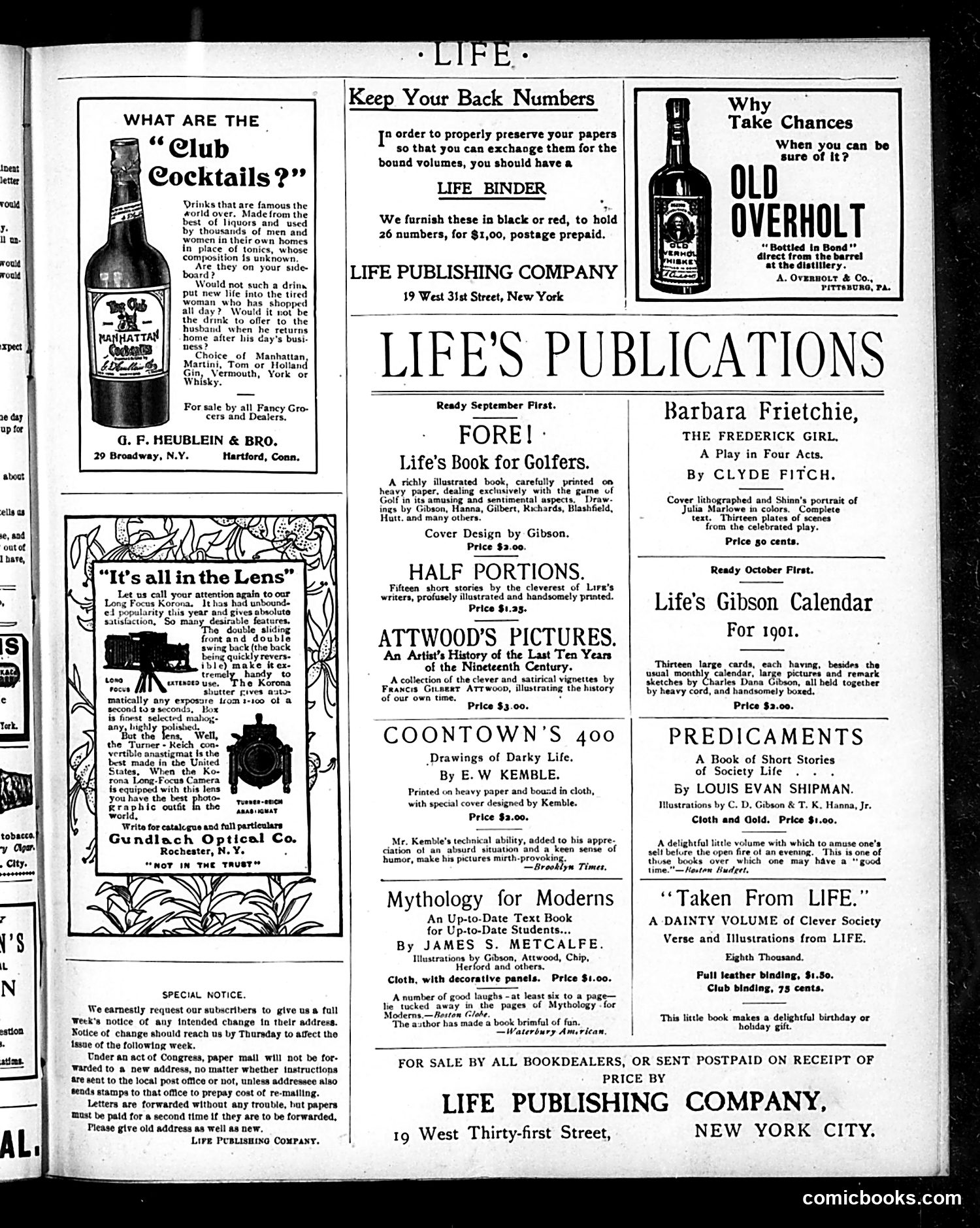
This is primarily an **advertising and announcements page** from Life magazine, with limited satirical content. The only significant cartoon is **"It's all in the Lens"** (lower left), advertising Gundlach Optical Company cameras. It's a straightforward product advertisement using decorative art-nouveau styling—not political satire. The page predominantly features: - **Alcohol advertisements** (Manhattan cocktails, Old Overholt whiskey) marketed as tonics for tired shoppers and businessmen—reflecting early 1900s attitudes toward liquor as legitimate medicinal/restorative - **Book and calendar promotions** from Life Publishing Company - **Administrative notices** about address changes and subscription procedures The only dated cultural reference is **"Coontown's 400"** by E.W. Kemble—a book of racist caricatures mocking Black Americans. This reflects the deeply racist visual humor that was mainstream in 1900s American publications, though it requires modern readers to understand it represents *offensive period attitudes*, not endorsed content. Overall: This is a **business/promotional page** rather than satirical commentary.
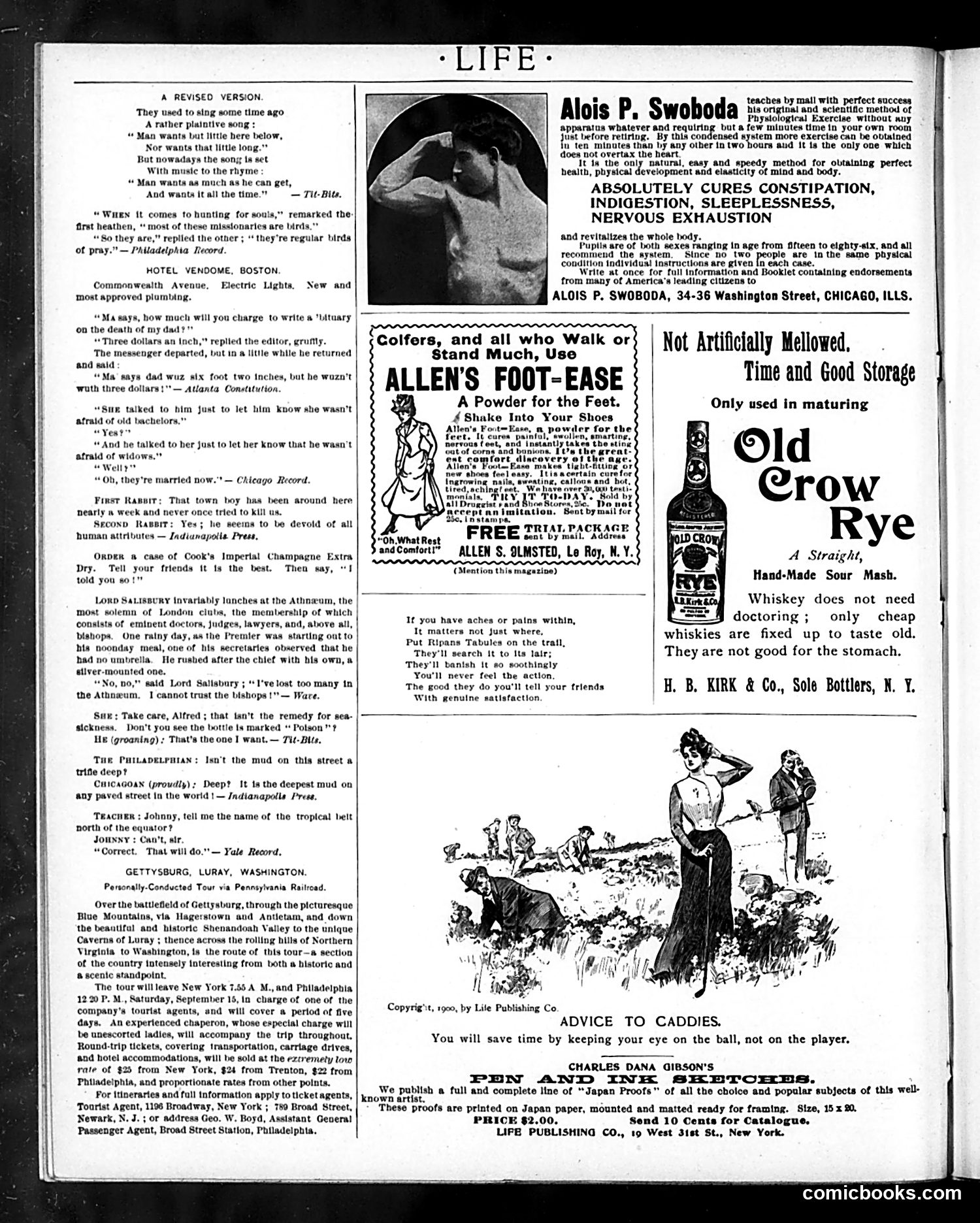
This page is primarily **advertisements and humor snippets** rather than political cartoons requiring historical context. The main content includes: **Advertisements:** - Alois P. Swoboda's mail-order physiological exercise system (appearing to be an early 20th-century fitness program) - Allen's Foot-Ease powder - Old Crow Rye whiskey - Hotel Vendome, Boston - Charles Dana Gibson's art prints **Humor pieces:** Brief jokes and anecdotes from various newspapers (Philadelphia Record, Chicago Record, Indianapolis Press, Yale Record) covering everyday topics—missionaries, editor rates, small-town life, champagne recommendations—with no apparent political satire. **Notable joke:** Lord Salisbury won't borrow an umbrella at the Athenaeum club because he's "lost too many in the Athnwum. I cannot trust the bishops!"—a mild jab at clergy, likely reflecting general Victorian-era skepticism toward religious institutions rather than specific political commentary. The page reflects Life's format as a humor and satirical magazine mixing advertisements with miscellaneous jokes.
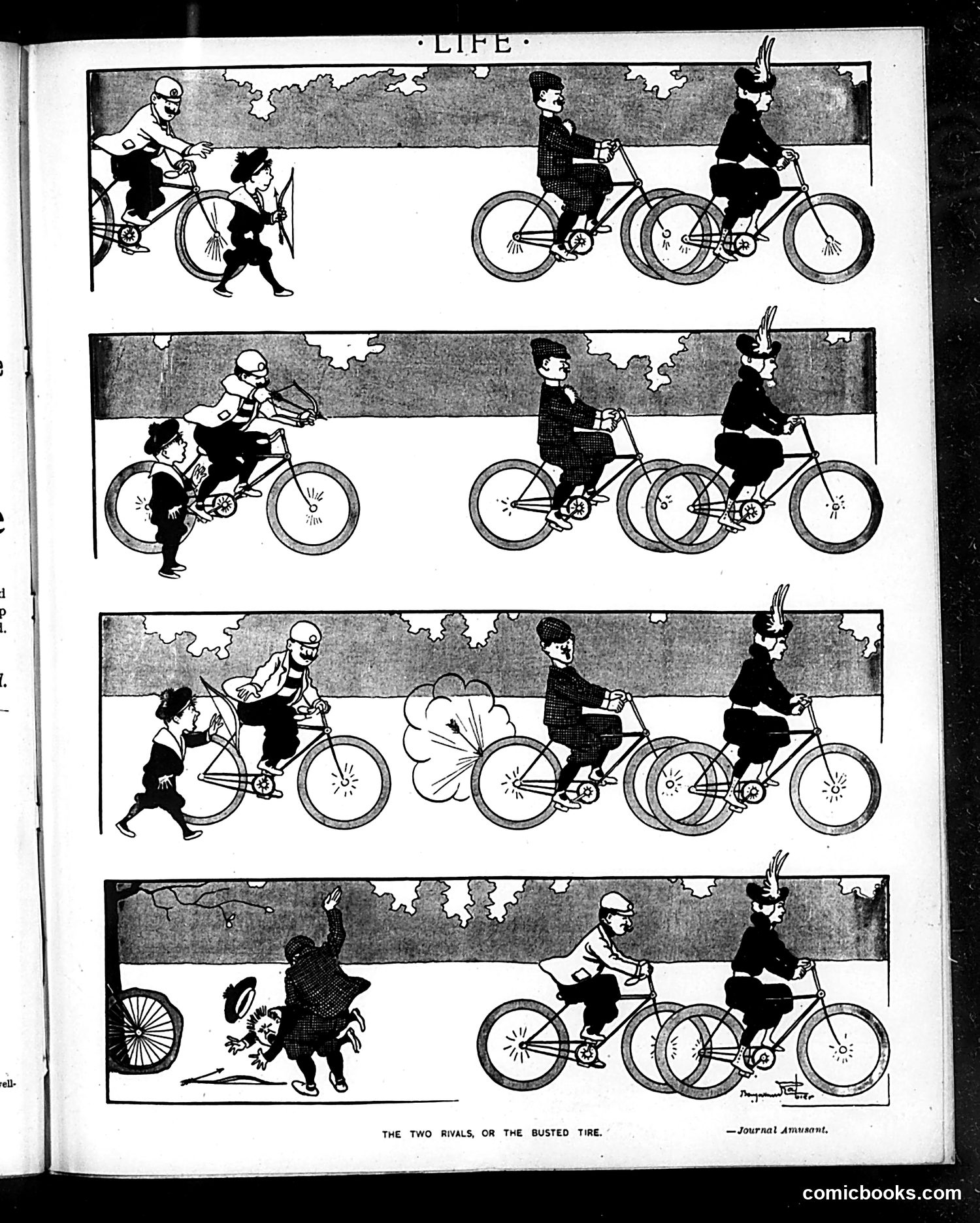
This is a four-panel sequential comic strip showing two cyclists in competition. The narrative progresses from the cyclists racing neck-and-neck, to one rider's tire visibly bursting (panel 3, shown with a large cloud effect), to the unfortunate competitor being thrown from his bicycle while the other continues riding away victoriously. The humor derives from slapstick physical comedy—the sudden misfortune of the tire failure and the resulting crash. This appears to be a humorous take on competitive cycling, a popular sport in late 19th/early 20th-century Europe (the credit to "Journal Amusant," a French publication, confirms the source). The joke is simply that mechanical failure decides the race rather than athleticism.
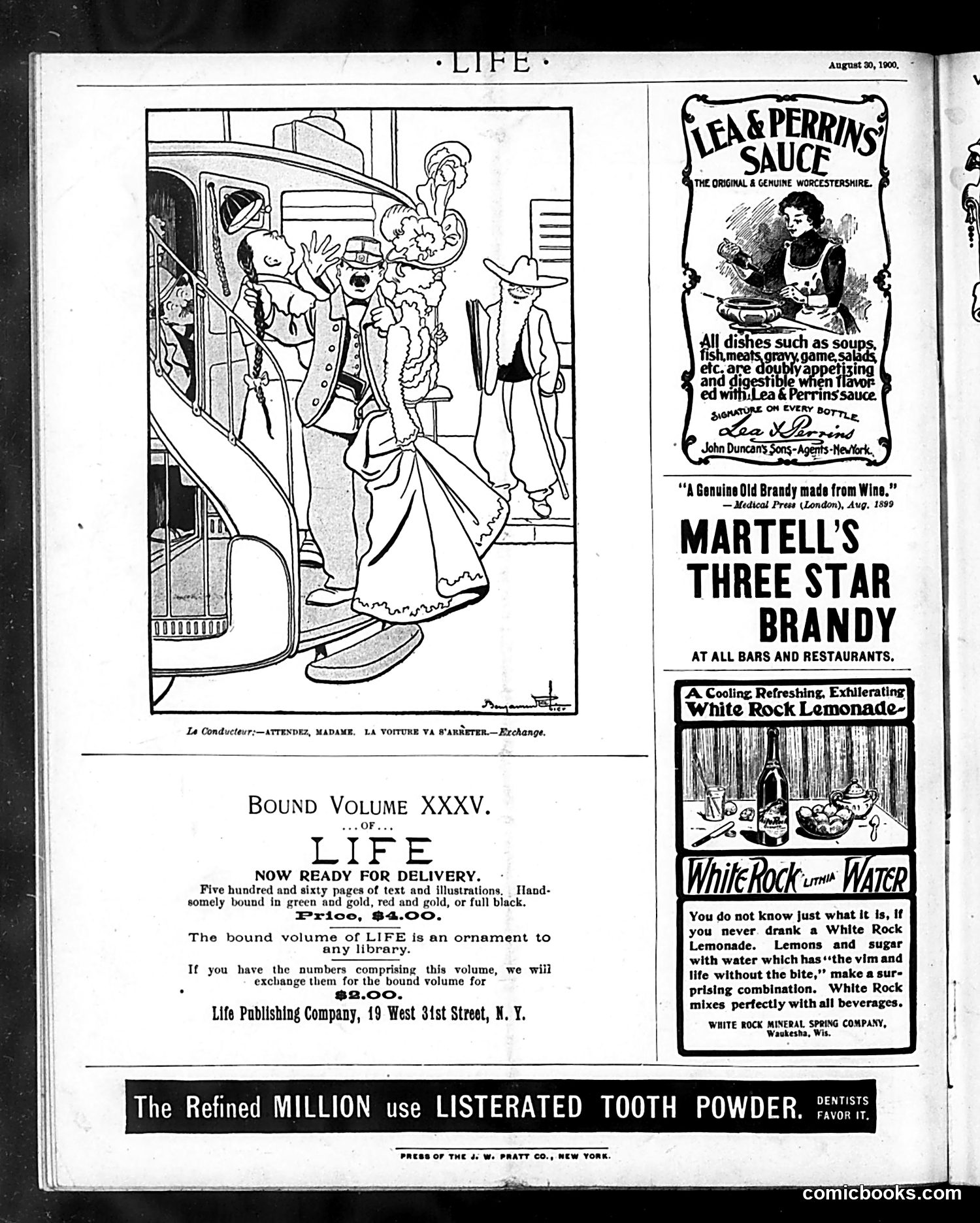
This page is primarily **advertising and promotional content** rather than editorial satire. The main cartoon depicts a French train conductor telling a well-dressed woman "The carriage will stop" (translated caption). The humor appears light and situational rather than politically pointed. The page's primary content announces **Bound Volume XXXV of Life magazine** available for $4.00—a compilation of 560 pages. Surrounding this announcement are period advertisements for luxury goods: Lea & Perrins Sauce, Martell's brandy, White Rock lemonade, and Listerated tooth powder. The cartoon's French setting and formal attire suggest upper-class leisure travel, typical of Life's audience at the time. Without additional context, the specific joke remains unclear to modern readers, though it likely contains subtle social commentary about transportation or courtship customs of the era.