
Life, 1900-08-30 · page 4 of 20
Life — August 30, 1900 — page 4: what you’re looking at
What you’re looking at
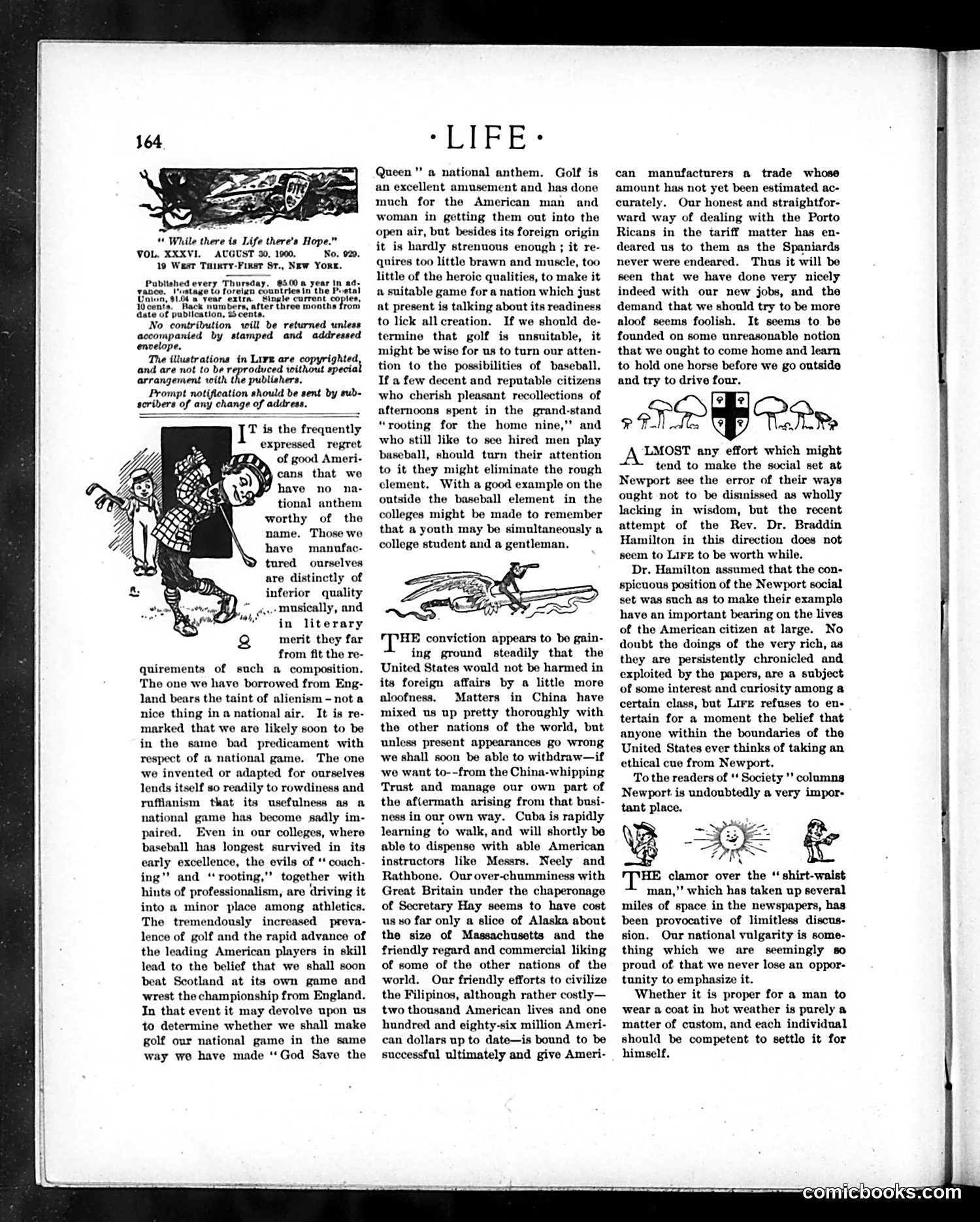
The page contains editorial text debating whether golf should be America's national game instead of baseball. The left margin features a small cartoon showing a figure labeled with what appears to be a golf club, though details are unclear in the image quality. The main argument criticizes golf as foreign and unsuitable for American character, advocating baseball as the "national game" instead. References include mentions of Secretary Hay's diplomacy regarding China and Alaska, suggesting this reflects 1900s foreign policy debates. A second cartoon appears lower on the page depicting figures with a sun, though its specific meaning is unclear from the image. The satire primarily targets elite American adoption of British golf culture over democratic baseball traditions.
📄 Transcribed text from this page (OCR, searchable)
Machine-transcribed from the original scan — historical spelling and the odd misread are preserved.
“While there ts Life there’s Hope.” VOL. XXXVI. AUGUST 90, 1900. No. 929. 19 West Taiety-Fixst St., New Your. edevery Thursday. 95,00 a year in tage to foreign countries to the a Year extra. Single current Pubi van Union, $1 , Icents. | Rack numbers, after three months frow date of publication, 2 cents. No contribution will be returned unless accompanied by stamped and addressed envelope, The illustrations in Live are copyrighted, and are not to be reproduced without special arrangement toith the publishers. Prompt notification should be sent by sub- soribers of any change of address. J" is the frequently expressed regret of good Ameri- cans that wo no na- tional anthem worthy of the name. Those we have manufac- tured ourselves are distinctly of inferior quality musically, and in literary coy merit they far from fit the re- quirements of such a composition. The one we have borrowed from Eng- land bears the taint of alienism - not a nice thing in a national air. It is re- marked that we are likely soon to be in the same bad predicament with respect of a national game. The one we invented or adapted for ourselves lends itself so readily to rowdiness and ruffianism that its usefulness as a national game has become sadly im- paired, Even in our colleges, where baseball has longest survived in its early excellence, the evils of ‘‘ couch- ing’? and ‘ rooting,” together with hints of professionalism, are riving it into a minor place among athletics. The tremendously increased preva- lence of golf and the rapid advance of the leading American players in skill lead to the belief that we shall soon beat Scotland at its own game and wrest the championship from England. In that event it may devolve upon us to determine whether we shall make golf our national game in the same way wo have made ‘‘God Save the ‘LIFE: Queen” a national anthem. Golf is an excellent amusement and has done much for the American man and woman in getting them out into the open air, but besides its foreign origin it is hardly strenuous enough ; it re- quires too little brawn and muscle, too little of the heroic qualities, to make it a suitable game fora nation which just at present is talking about its readiness to lick all creation. If we should de- termine that golf is unsuitable, it might be wise for us to turn our atten- tion to the possibilities of baseball. If a few decent and reputable citizens who cherish pleasant recollections of afternoons spent in the grand-stand “rooting for the home nine,’ and who still like to see hired men play baseball, should turn their attention to it they might eliminate the rough clement. With a good example on the outside the baseball element in the colleges might be made to remember that a youth may be simultaneously a college student and a gentleman, A Wars conviction appears to be gain- ing ground steadily that the United States would not be harmed in its foreign affairs by a little more aloofness, Matters in China have mixed us up pretty thoroughly with the other nations of the world, but unless present appearances go wrong we shall soon be able to withdraw—if we want to--from the China-whipping Trust and manage our own part of the aftermath arising from that busi- ness in our own way. Cuba is rapidly learning to walk, and will shortly be able to dispense with able American instructors like Messrs. Neely and Rathbone. Our over-chumminess with Great Britain under the chaperonage of Secretary Hay seems to have cost us so far only a slice of Alaska about the size of Massachusetts and the friendly regard and commercial liking of some of the other nations of the world. Our friendly efforts to civilize the Filipinos, although rather costly— two thousand American lives and one hundred and eighty-six million Ameri- can dollars up to date—is bound to be successful ultimately and give Ameri- can manufacturers a trade whose amount has not yet been estimated ac- curately, Our honest and straightfor- ward way of dealing with the Porto Ricans in the tariff matter has en- deared us to them as the Spaniards never were endeared. Thus it will be seen that we have done very nicely indeed with our new jobs, and the demand that we should try to be more aloof seems foolish. It seems to be founded on some unreasonable notion that we ought to come home and learn to hold one horse before we go outside and try to drive four. cael, aes A Most any effort which might tend to make the social set at Newport see the error of their ways ought not to be disnissed as wholly lacking in wisdom, but the recent attempt of the Rev. Dr. Braddin Hamilton in this direction does not seem to Lire to be worth while. Dr. Hamilton assumed that the con- spicuous position of the Newport social set was such as to make their example have an important bearing on the lives of the American citizen at large. No doubt the doings of the very rich, as they are persistently chronicled and exploited by the papers, are a subject of some interest and curiosity among a certain class, but Lire refuses to en- tertain for a moment the belief that anyone within the boundaries of the United States ever thinks of taking an ethical cue from Newport. To the readers of ‘‘ Society ’ columns Newport is undoubtedly a very impor- tant place. HE clamor over the “ shirt-waist man,’’ which has taken up several miles of space in the newspapers, has been provocative of limitless discus- sion. Our national vulgarity is some- thing which we are seemingly 80 proud of that we never lose an oppor- tunity to emphasize it. Whether it is proper for a man to wear a coat in hot weather is purely a matter of custom, and each individual should be competent to settle it for himself.