
Life, 1900-08-30 · page 6 of 20
Life — August 30, 1900 — page 6: what you’re looking at
What you’re looking at
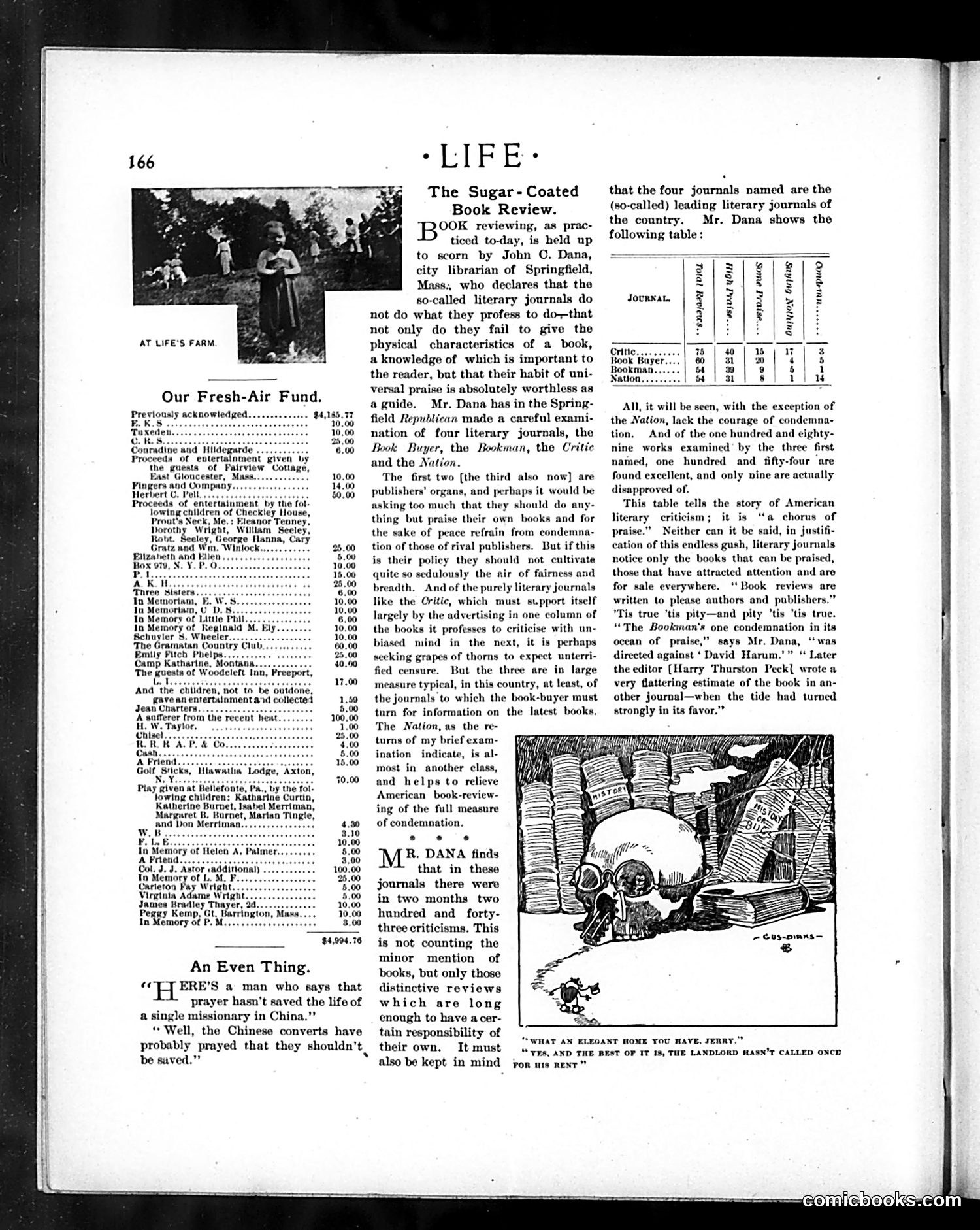
The cartoon at the bottom of the page shows a landlord and tenant in conversation. The caption reads: "Yes, and the rest of it is, the landlord hasn't called once for his rent." This is a joke about tenant-landlord relations, likely from the early 20th century. The humor relies on the irony that the tenant considers his home "elegant" primarily because the landlord hasn't bothered to collect rent—suggesting the tenant is behind on payments. The implication is that an absent landlord (who doesn't demand payment) is the tenant's ideal scenario. It's satirizing both the financial struggles of renters and the sometimes-neglectful nature of landlord-tenant relationships during this era.
📄 Transcribed text from this page (OCR, searchable)
Machine-transcribed from the original scan — historical spelling and the odd misread are preserved.
AT LIFE'S FARM. Our Fresh-Air Fund. Previously acknowledged, $4,185.77 B.K.S. u Taxeden. RS. Proceeds’ of entertalament given 8 of Fairview Cottage, lowing calidren of Prout’s S Doroth: eckley House, ck, jeanor Tenney, Wright, William Seeley, Robt. Seeley, George Hanna, Cary Gratz and Wm. Winloc! th and Ellen. NLY.P.O. Iu Memortan In Memory of In Memory of Reginald M. E Schuyler 8, Wheeler... ‘The Gramatan Country Club, Emily Fitch Phelps. Camp Katharine, Montana. The guests of Woodcleft | bn Te And’‘ine’ cilidrets not to ‘be Sidon, iravean entertainment ard collected Jean Charters. ‘A sufferer from H.W. Taylo Wee Aw eG SBSSassovSsov s & 88888885 & SESESSESSSSEeS 3 Soe larguret B. Burnet, Martan Ting! wy, ANd Don Merriman. a ¥, In Memory of Helen A. Palmer A Priend }. J. Astor agaironsh . In Memory of L. M. F Garieton Fay Weight Virginia Adame Wrig! James Bradley Thayer, ‘zy Kemp, Gt, Barr eSSor8SerSee S88sessesese : 2 3 An Even Thing. ERE’S a man who says that prayer hasn't saved the life of a single missionary in China.” ‘Well, the Chinese converts have probably prayed that they shouldn’t be saved.”” LIFE The Sugar- Coated Book Review. BOOK reviewing, as prac- ticed to-day, is held up to scorn by John C. Dana, city librarian of Springfield, Mass., who declares that the so-called literary journals do not do what they profess to do-that not only do they fail to give the physical characteristics of a book, a knowledge of which is important to the reader, but that their habit of uni- versal praise is absolutely worthless as a guide. Mr. Dana has in the Spring- field Republican made a careful exami- nation of four literary journals, the Book Buyer, the Bookman, the Critic and the Nation. The first two (the third also now] are publishers’ organs, and perhaps it would be asking too much that they should do any- thing but praise their own books and for the sake of peace refrain from condemna- tion of those of rival publishers. But if this is their policy they should not cultivate quite so sedulously the air of fairness and breadth. And of the purely literary journals like the Critic, which must support itself largely by the advertising in one column of the books it professes to ct ise with un- biased mind in the next, it is perhaps seeking grapes of thorns to expect unterri- fied censure. But the three are in large measure typical, in this country, at least, of the journals to which the book-buyer must. turn for information on the latest books. The Nation, as the re- urns of my brief exam- ination indicate, is al- most in another class, and helps to relieve American book-review- ing of the full measure of condemnation, eo 8 6 R. DANA finds that in these journals there were in two months two hundred and _forty- three criticisms. This is not counting the minor mention of books, but only those distinctive reviews which are long enough to have acer- tain responsibility of their own. It must also be kept in mind Por wis RENT" that the four journals named are the (so-called) leading literary journals of the country. Mr. Dana shows the following table: OByDiT MULOS Ouion 6uyans Rook Bayer. Bookman. Nation, seez| ‘snayaay 10104 | All, it will be seen, with the exception of the Nation, lack the courage of condemna- tion. And of the one hundred and eighty- nine works examined’ by the three first named, one hundred and fifty-four are found excellent, and only nine are actually disapproved of. This table tells the story of American literary criticism; it is ‘ta chorus of praise.” Neither can it be said, in justifi- cation of this endless gush, literary journals notice only the books that can be praised, those that have attracted attention and are for sale everywhere. ‘Book reviews are written to please authors and publishers.” ‘Tis true ‘tis pity—and pity 'tis ‘tis true. “The Bookman's one condemnation in its ocean of praise,” says Mr. Dana, “was directed against ‘ David Harum.’” ‘ Later the editor (Harry Thurston Peck{ wrote a very flattering estimate of the book in an- other journal—when the tide had turned strongly in its favor.” sti ORLA, 7 Cus-pinns— ‘WHAT AN ELEGANT HOME YOU MAVE. JERRY.” “Yrs, AND THE BEST OF IT 18, THE LANDLORD HASN'T CALLED ONCE