
A complete issue · 22 pages · 1900
Life — July 19, 1900
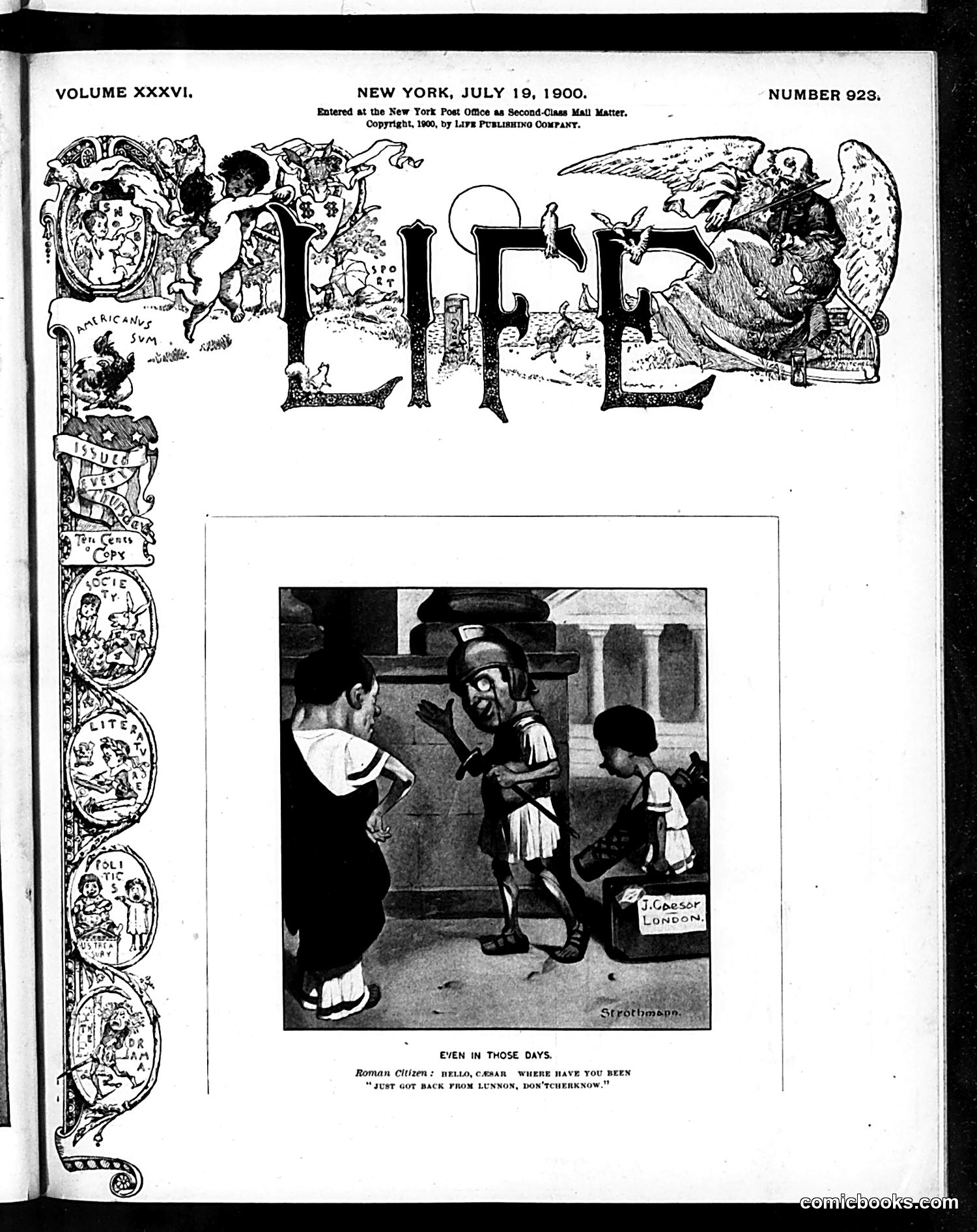
The main cartoon, titled "Even in Those Days," depicts Roman citizens encountering a traveler recently returned from London. The joke plays on timeless human nature: even in ancient Rome, people gossiped about foreign travel experiences. A figure asks the returning traveler, "Hello, Caesar. Where have you been? 'Just got back from London, don't'cherknow.'" The satire targets two things: the pretentiousness of Londoners (or British travelers) who constantly reference their travels to establish sophistication, and the universal human tendency to name-drop and boast about exotic destinations. By setting this in ancient Rome, the cartoonist suggests this behavior is eternal and foolish—not modern affectation, but timeless vanity. The ornamental border and decorative typography are typical Life magazine design elements.
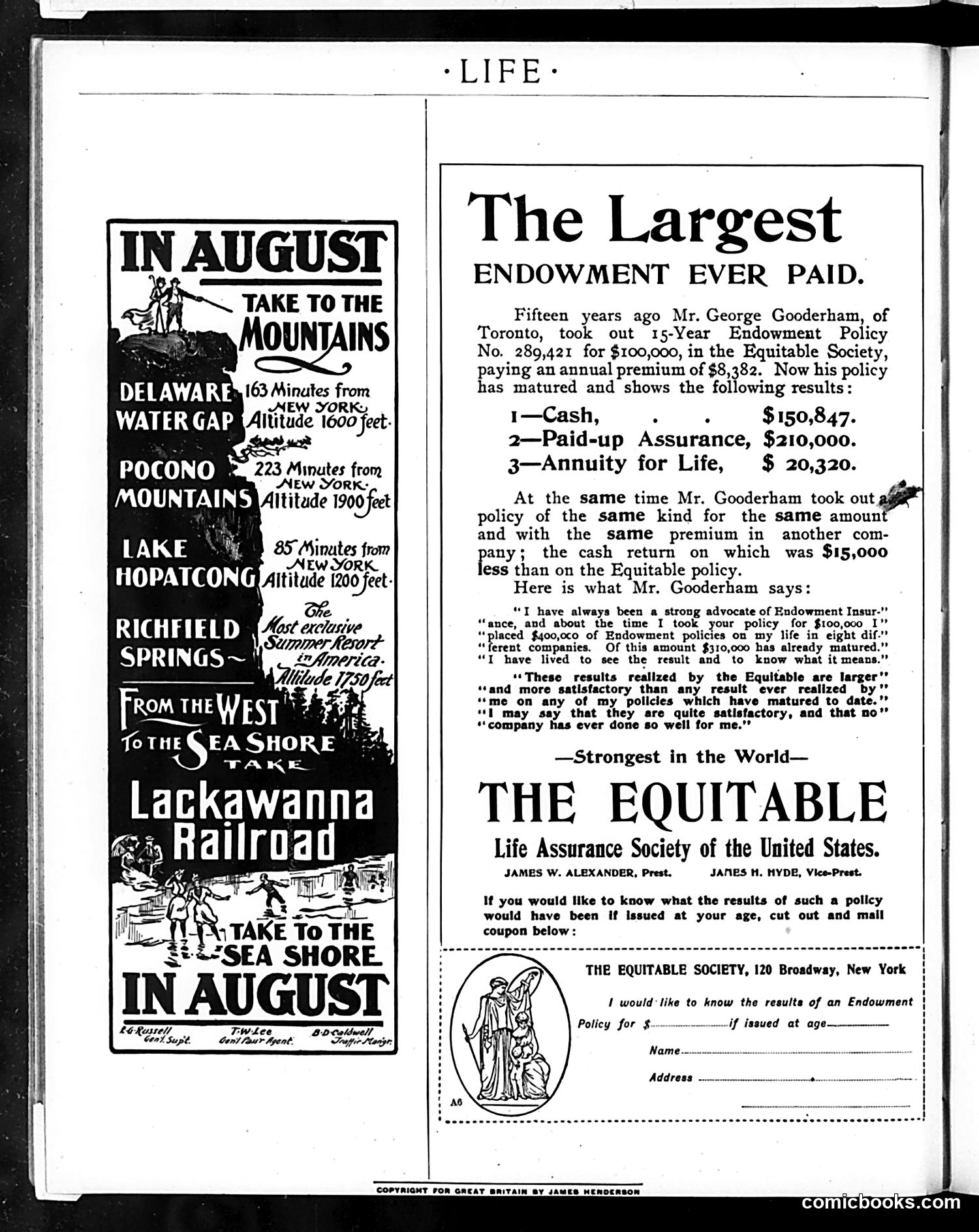
This page contains **two separate advertisements** rather than satirical cartoons. **Left side:** A Lackawanna Railroad travel advertisement promoting summer vacations to mountain and shore destinations (Delaware Water Gap, Pocono Mountains, Lake Hopatcong, Richfield Springs) in August, using dramatic typography and scenic imagery. **Right side:** An Equitable Life Assurance Society advertisement showcasing a successful endowment policy. It presents a real case study of Mr. George Gooderham from Toronto, whose 15-year policy matured with impressive returns ($150,847 cash, $210,000 paid-up assurance, $20,320 annuity). The testimonial emphasizes the company's superiority over competitors. Both are straightforward commercial advertisements typical of early 20th-century Life magazine, which supported itself through advertising revenue rather than satire on this particular page.
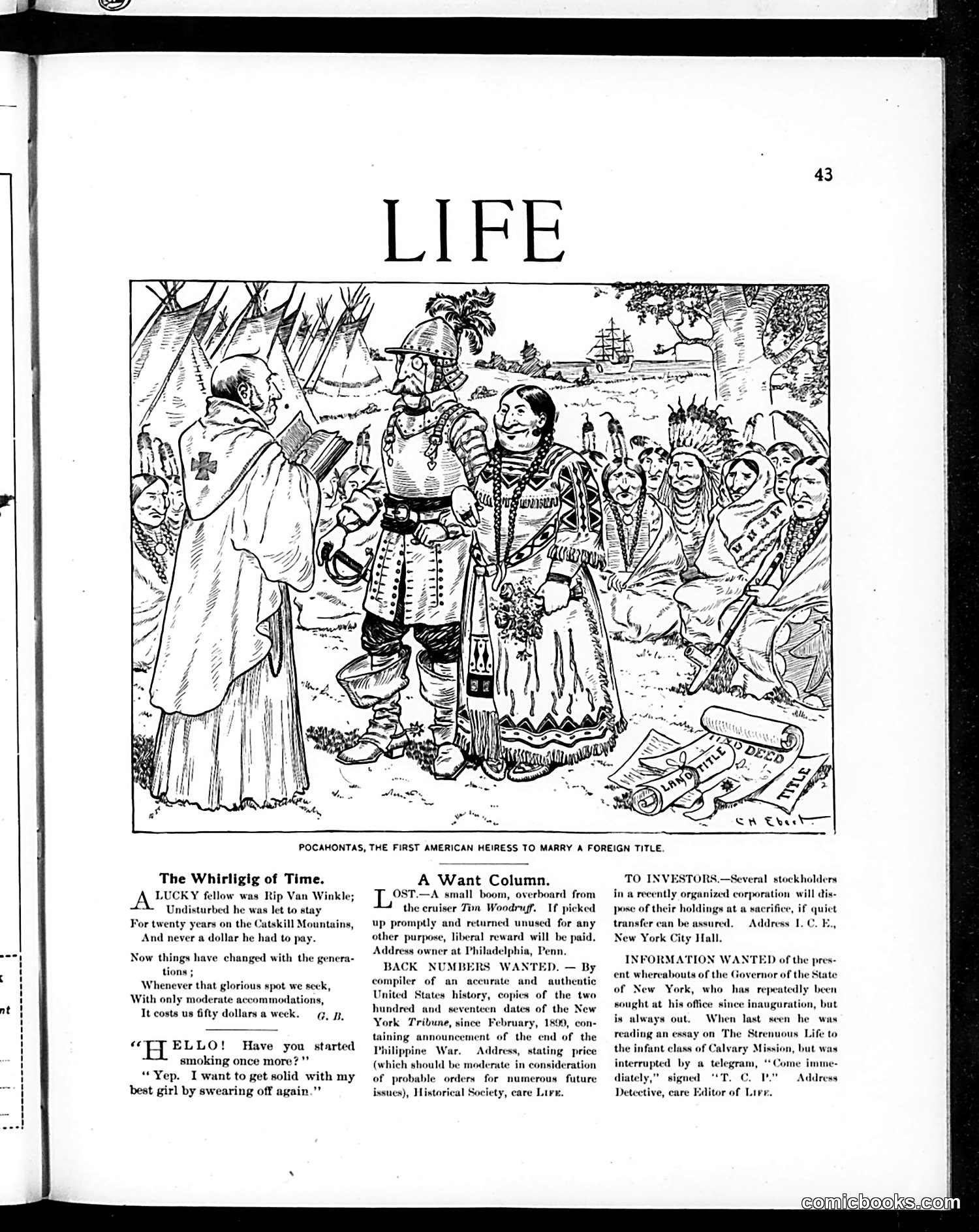
The main illustration depicts "Pocahontas, the First American Heiress to Marry a Foreign Title"—a satirical commentary on wealthy American women marrying European nobility. The scene shows Pocahontas in Native American dress meeting what appears to be a European aristocrat in military regalia, surrounded by onlookers and Native Americans. This is social satire about the Gilded Age phenomenon of American heiresses marrying foreign nobles for titles and prestige. By depicting the historically significant Pocahontas in this absurd scenario, Life magazine mocks this trend as fundamentally ridiculous—suggesting modern American women pursuing foreign titles are as incongruous as the legendary Native American princess doing so. The page also contains unrelated classified advertisements and advice columns typical of period magazines.
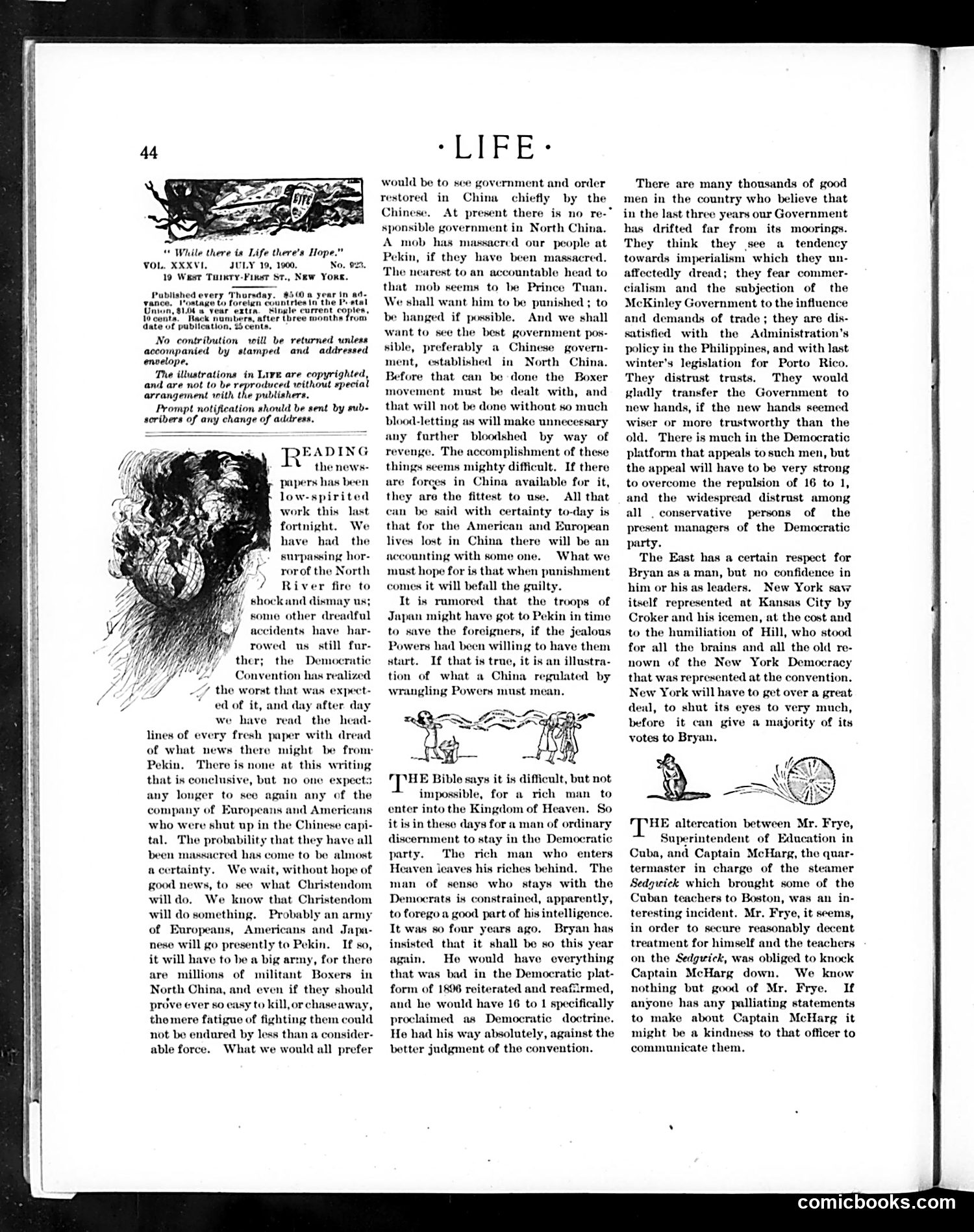
This page discusses Chinese politics following the Boxer Rebellion. The left illustration labeled "Reading the News" depicts a figure reacting to newspaper reports about China. The text argues for establishing a responsible Chinese government in North China rather than pursuing revenge against those who participated in anti-foreign violence. It criticizes excessive bloodshed and advocates for practical governance solutions. The right section critiques William Jennings Bryan's Democratic platform, specifically referencing his 1896 campaign promise to maintain the gold standard at "16 to 1" (currency ratio). The text suggests Bryan and Democratic leaders lack credibility, noting New York's skepticism of his leadership. A brief note mentions a dispute between Cuba's education superintendent and an officer named Captain McFarlane regarding treatment of Cuban teachers.
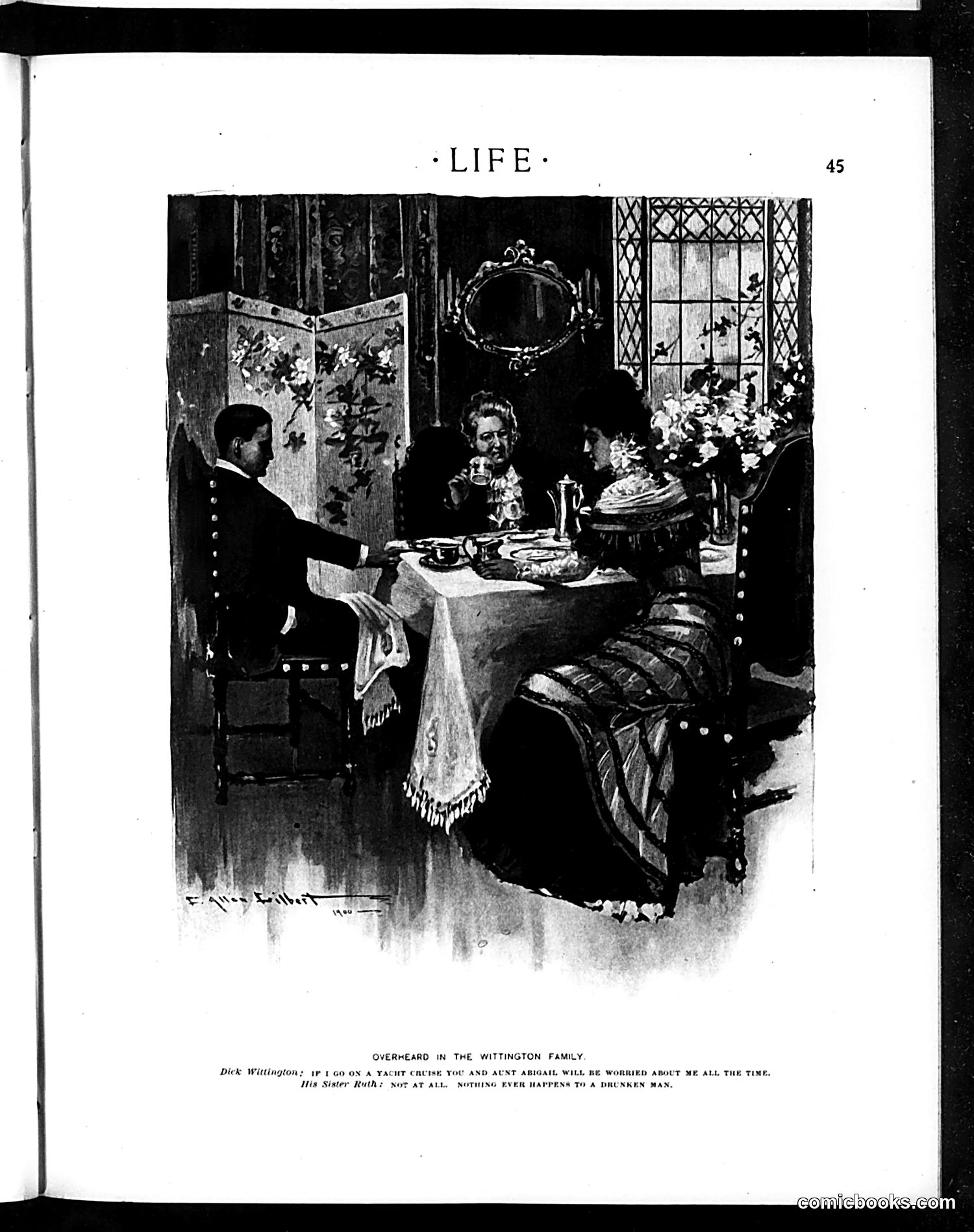
This is a satirical cartoon from *Life* magazine depicting a domestic scene where Dick Wittington (likely referencing the historical/legendary figure) discusses a yacht cruise with his sister Ruth. The humor operates on class anxiety: Dick proposes a carefree yacht vacation, assuring Ruth that "nothing ever happens to a drunken man." Ruth's response—"not at all"—suggests skeptical disagreement, implying that even wealth and intoxication don't protect one from life's consequences. The ornate interior (decorative screen, flowers, formal dress) establishes their upper-class status, making the anxiety about misadventure ironic. The joke satirizes either wealthy families' naive assumptions about their immunity to scandal, or the unreliability of drunkenness as a safety strategy. The specific Wittington reference remains unclear without additional context.
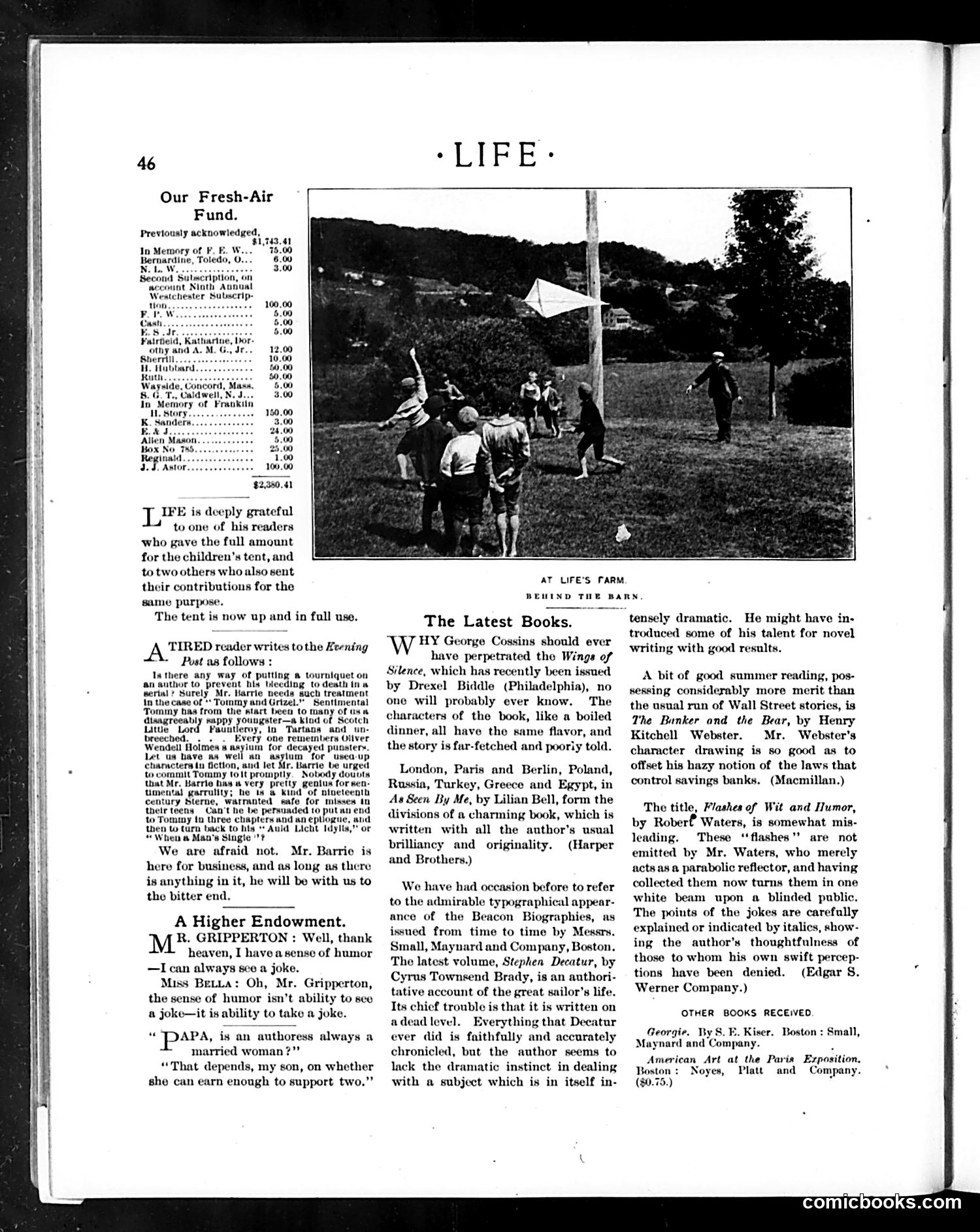
This page contains no political cartoon. Instead, it features: 1. **"Our Fresh-Air Fund"** — a charity donation list totaling $2,390.41, acknowledging contributors who funded fresh-air experiences for children (likely poor urban youth sent to rural areas for health). 2. **Photograph** — "At Life's Farm Behind the Barn" shows children playing outdoors, illustrating the charitable program's purpose. 3. **Book Reviews** — discussing recent publications including George Cossins's *Wings of Silence*, Lilian Bell's *In See By Me*, and Robert Waters's *Flashes of Wit and Humor*. 4. **Two Humorous Anecdotes** — "A Tired Reader" and "A Higher Endowment" offering light comedic observations about writing and parenthood. This is primarily a charitable announcement and literary review page with minimal satirical content.
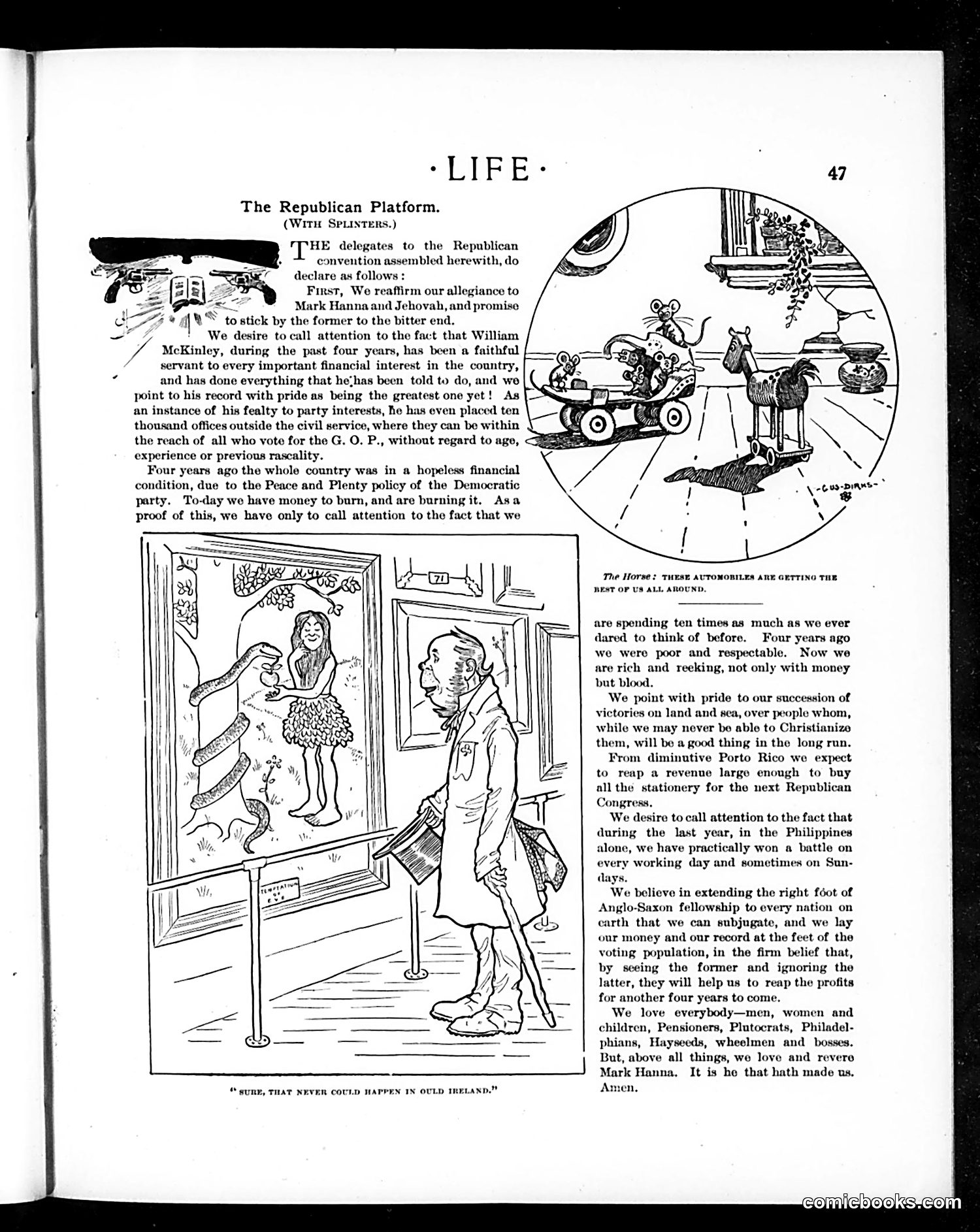
This page satirizes the Republican Party platform through two cartoons. The upper circular illustration shows automobiles and a horse, captioned "These automobiles are getting the best of us all abroad"—likely mocking Republicans' claims about industrial progress and prosperity. The lower cartoon, titled "Sure, that never could happen in ould Ireland," depicts a man viewing a store window display of a woman, suggesting a critique of American materialism or exploitation contrasted with traditional values. The accompanying text mockingly praises Republican achievements under William McKinley, including financial management and colonial expansion (Porto Rico mentioned). The satire emphasizes contradiction between stated ideals and actual policies, particularly regarding imperialism and economic inequality. The tone suggests Life magazine opposed these Republican positions.
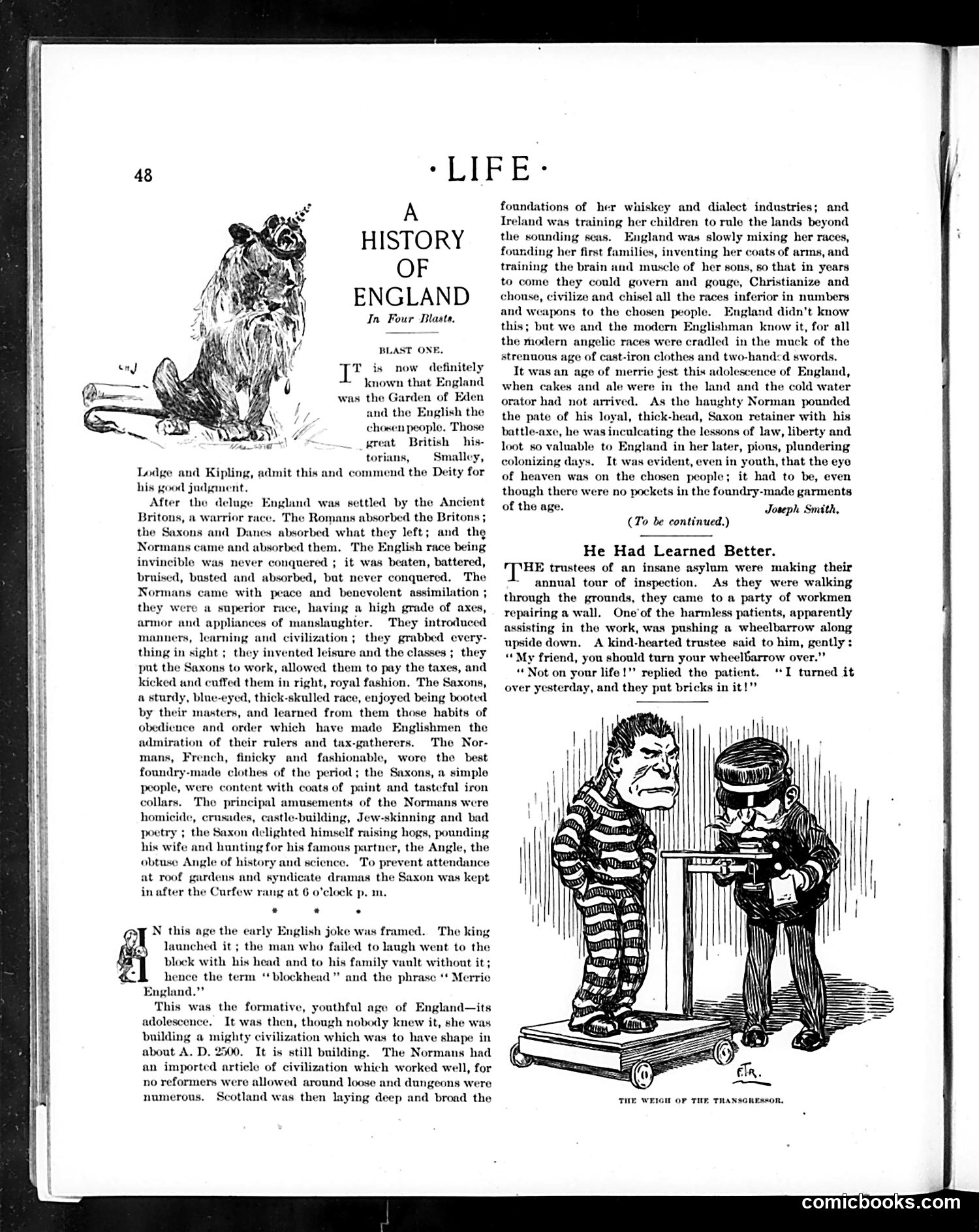
This cartoon illustrates a story titled "He Had Learned Better," about an asylum trustee who suggests a patient turn their wheelbarrow over rather than continue pushing bricks uphill. The patient replies they already tried that yesterday and "they put bricks in it!" The satire targets institutional cruelty disguised as reform. The humor comes from the prisoner's resigned acceptance: no matter what approach he takes, the burden remains unchanged. The trustee's well-meaning suggestion proves useless against a system designed to wear down inmates through futile labor. The image shows the thin, exhausted patient contrasted with the well-fed, comfortable trustee—visually emphasizing their different positions within the asylum hierarchy and the inadequacy of superficial "kindness" in fundamentally unjust systems.
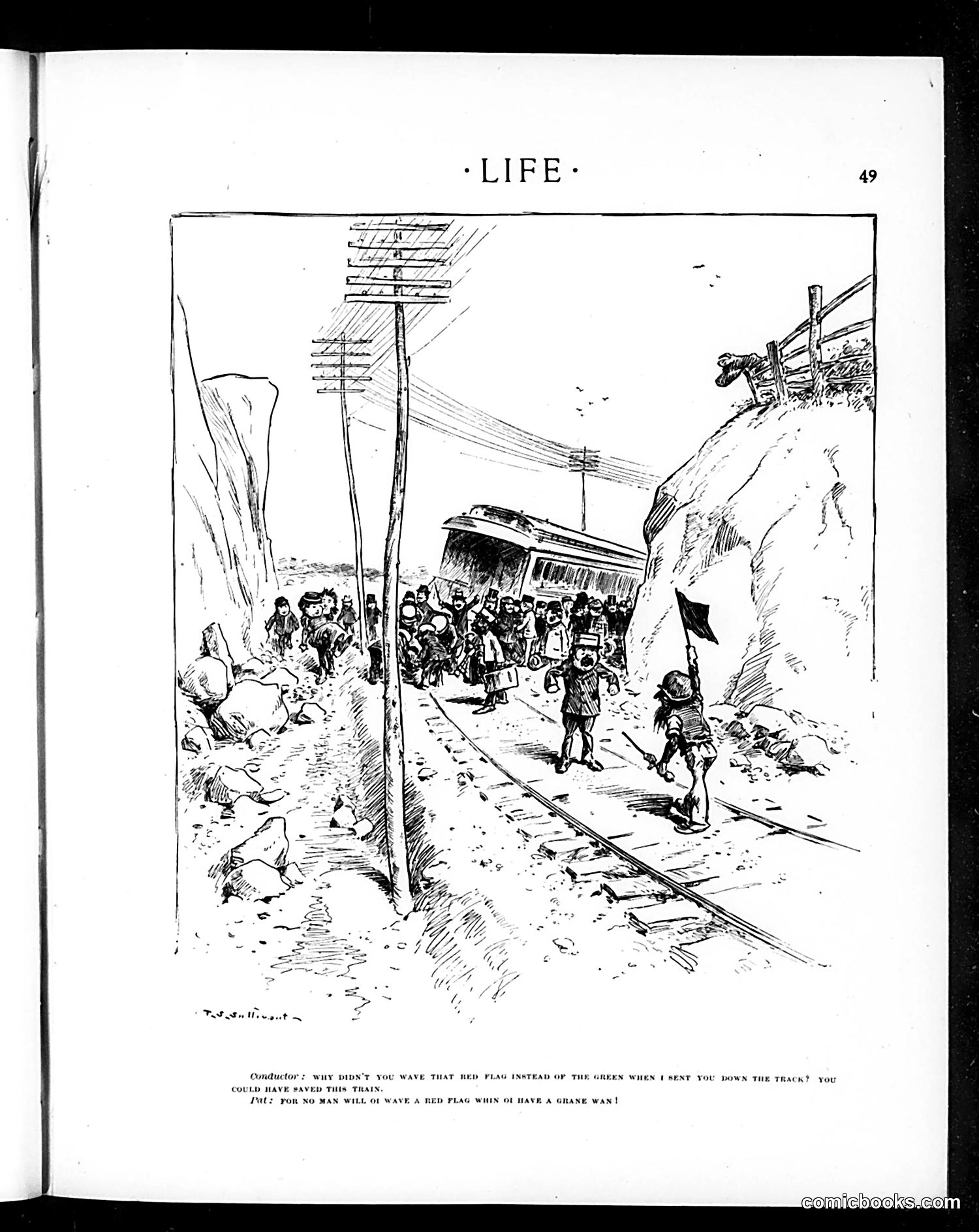
This cartoon depicts a railroad accident scene in a mountain cut, with a conductor and passenger in dispute over flag signals. The conductor claims he sent a *green* flag down the track to warn of the train ahead, but the passenger accuses him of failing to prevent the collision. The conductor's response—"no man will wave a red flag when I have a green one"—appears to satirize bureaucratic obstinacy or rigid protocol. The joke suggests the conductor prioritizes following standard procedure (using green flags) over practical safety measures (using red flags in emergencies). This likely critiques railroad safety practices or management indifference to accident prevention during the early railroad era, when such collisions were common and controversial.
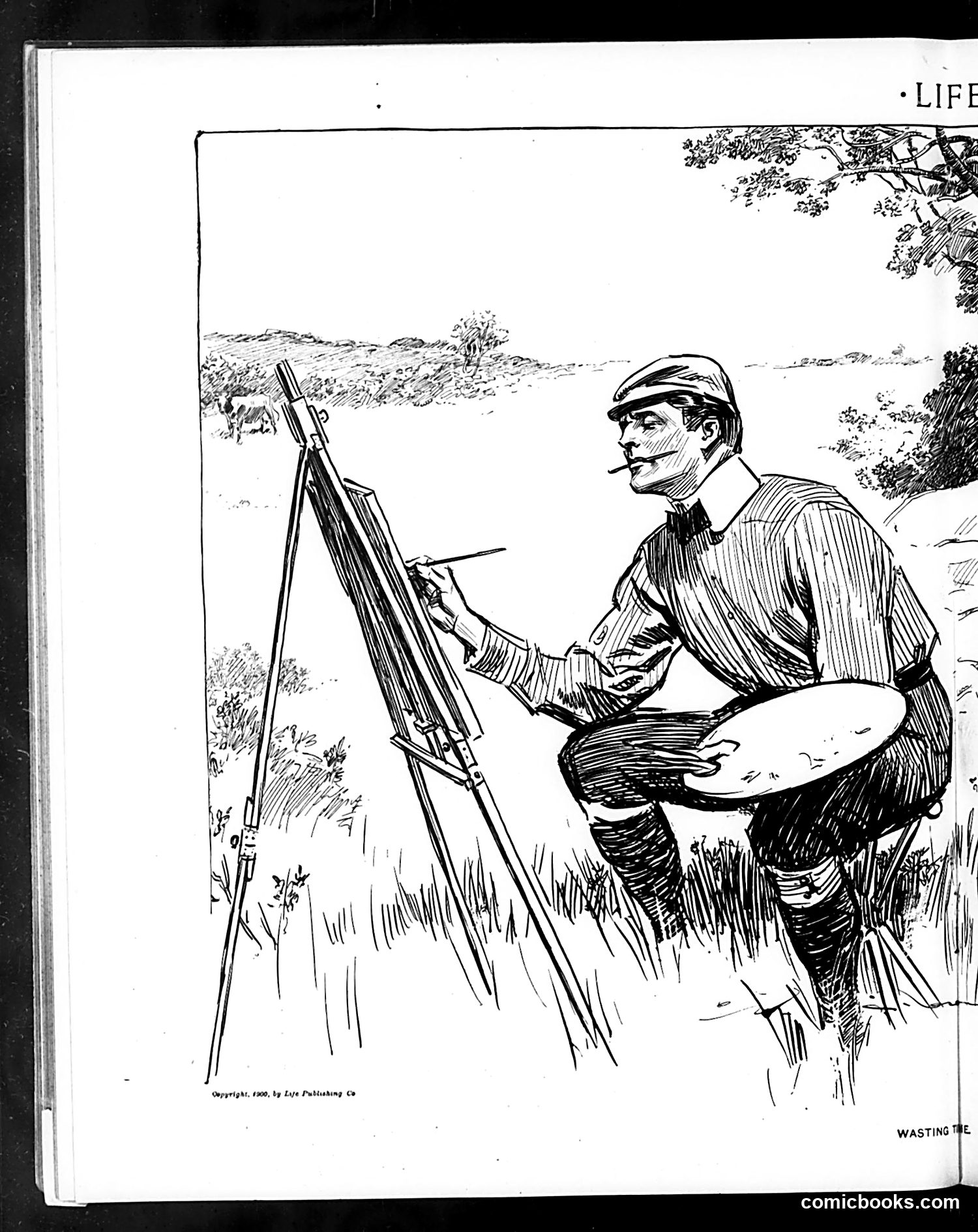
This black-and-white illustration depicts a man in early 20th-century attire (cap, striped shirt, boots) sitting outdoors with an easel, painting palette in hand. He's sketching or painting a landscape. The cartoon's title, "WASTING TIME," appears at bottom right. The satire targets dilettante or amateur artists—likely wealthy or leisured individuals who pursue painting as a casual hobby rather than serious professional work. The figure's somewhat affected posture and the countryside setting suggest someone engaged in genteel leisure activity. The title's implication is that such artistic dabbling represents time squandered on unproductive pursuits, reflecting period attitudes that dismissed amateur artistic endeavor as frivolous compared to "real work."
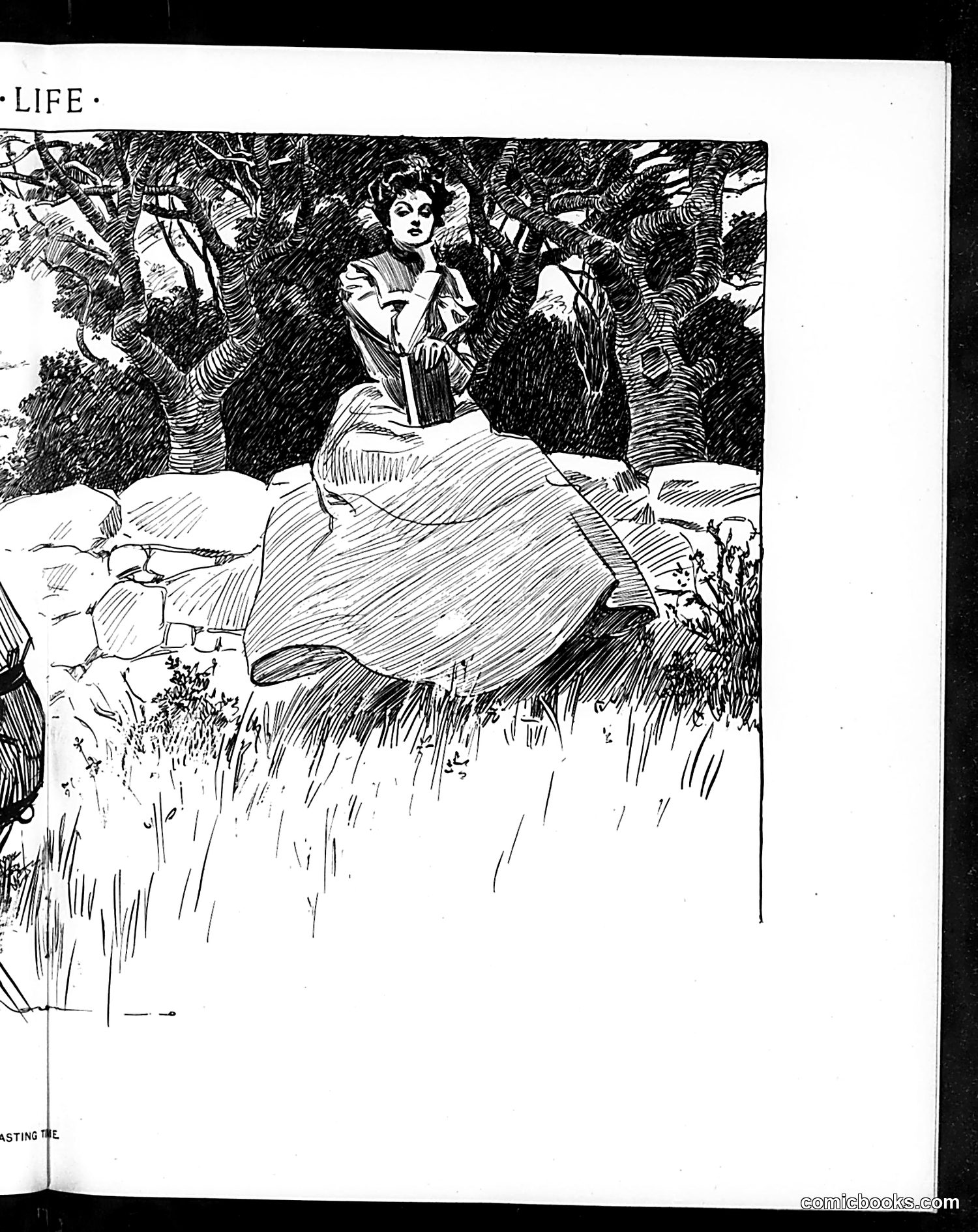
This is a page from Life magazine labeled simply "LIFE" at the top. The illustration shows a woman in early 20th-century dress reclining outdoors among grass and trees, dressed in what appears to be leisurewear or lounging clothes. The artistic style is a detailed pen-and-ink drawing characteristic of the period. Without additional OCR text visible on the page or a clear caption, I cannot definitively identify the specific political or social satire this image references. The drawing appears to be commentary on leisure, fashion, or gender roles of that era, but the exact point of the cartoon remains unclear from the image alone. The magazine's satirical nature suggests social commentary, but asserting specifics would require visible accompanying text or captions.
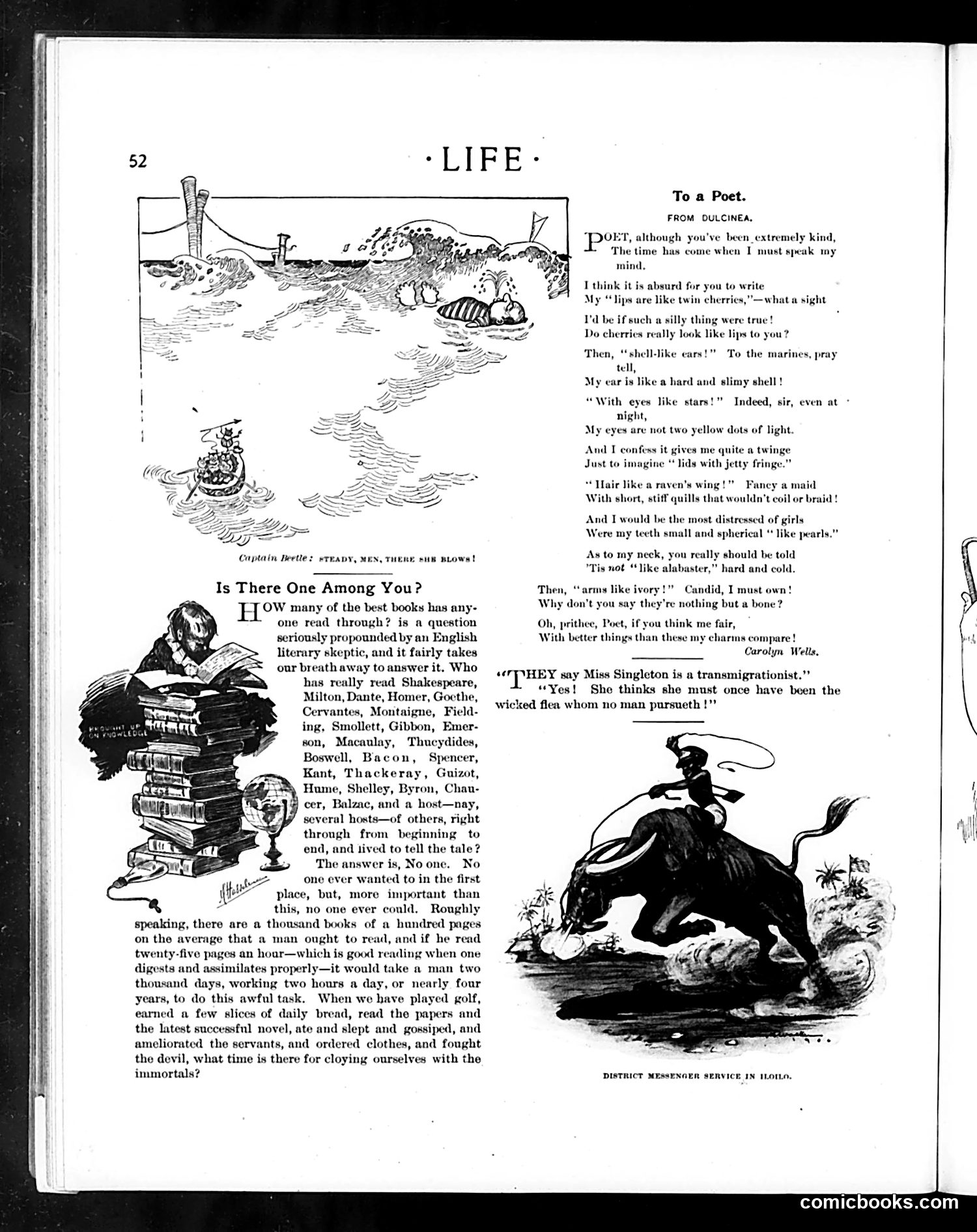
**"To a Poet"** (top right): A poem by Carolyn Wells mocking a male poet's self-aggrandizing descriptions. He claims his "lips are like twin cherries" and his "eyes like stars," but the speaker—apparently a woman—deflates his vanity by pointing out these comparisons are absurd (cherries don't look like lips; his eyes aren't literally starlight). The satire targets overwrought Romantic poetry and masculine pretension. **"Is There One Among You?"** (left): An illustration of stacked books asks whether any reader has actually completed the "great" authors listed (Shakespeare, Milton, Homer, Cervantes, etc.). The accompanying text humorously argues that life is too short to read all these volumes—it would take nearly four years of constant reading. The satire mocks both literary pretension and the impracticality of "serious" reading in modern life.
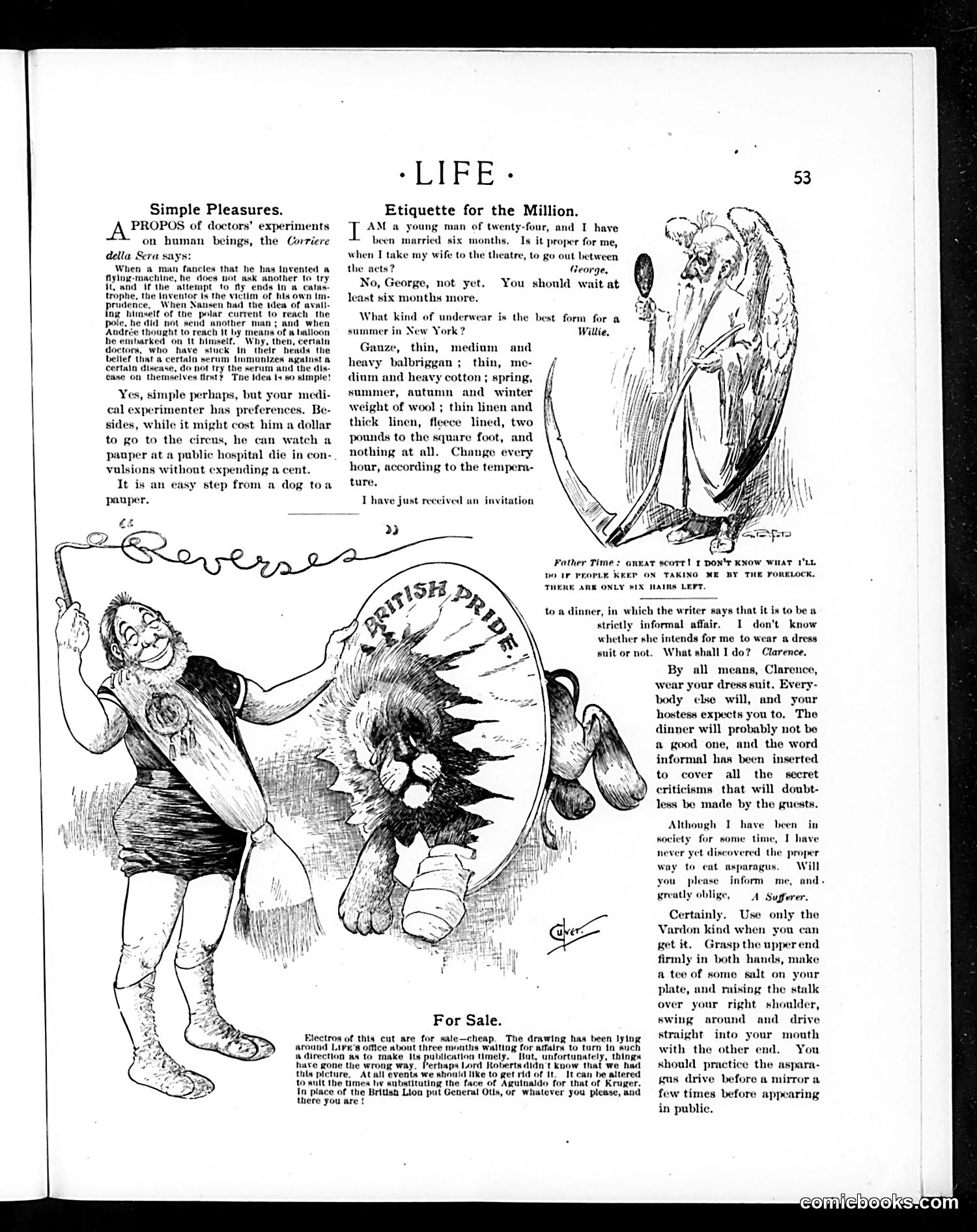
This page contains three distinct pieces of social satire: **"Simple Pleasures"** mocks doctors who experiment on themselves rather than animals or willing subjects, arguing it's hypocritical to risk one's own life for scientific advancement. **"Etiquette for the Million"** parodies advice columns addressing the newly wealthy or socially aspiring. Questions about theater etiquette, underwear choices, and asparagus-eating technique are answered with sardonic guidance—the joke being that "informal" dinner parties are actually formal affairs designed to judge guests' propriety. **"Father Time" cartoon** depicts an elderly, disheveled figure labeled "British Pride" with only six hairs remaining, likely referencing Britain's declining imperial power or military setbacks around the Boer War era. **"For Sale"** advertises electro-cuts (printing plates) of unused political cartoons, noting one has languished unpublished for months—the artist offering to swap faces (Aguinaldo, Otis) to make it timely, satirizing how quickly political satire becomes outdated.
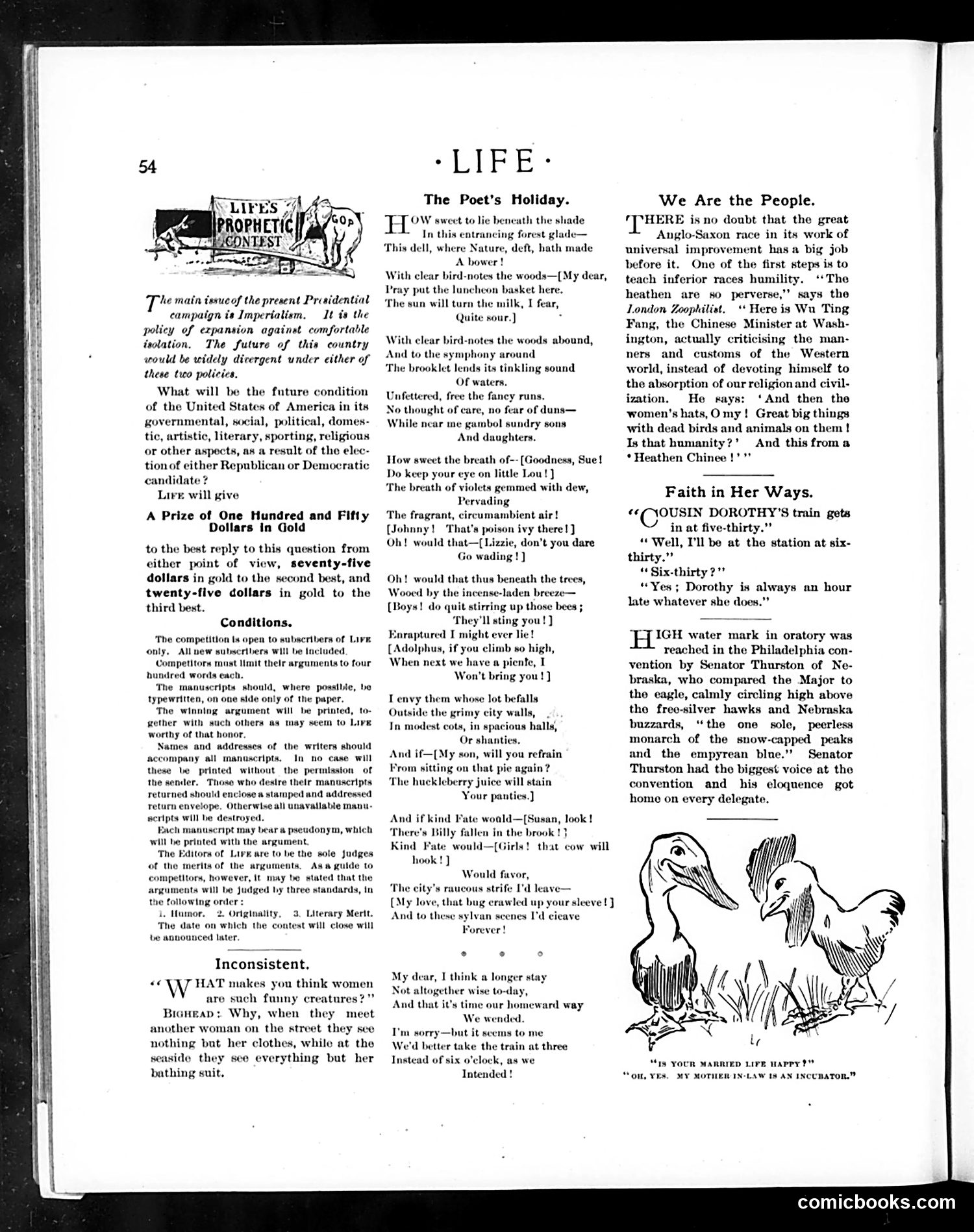
This page from Life magazine presents **early 1900s political satire** centered on **American imperialism**. The dominant feature is a contest soliciting readers' arguments on whether the U.S. should pursue imperial expansion or "comfortable isolation"—a major 1900 election issue, likely between McKinley (expansionist Republican) and anti-imperialist Democrat William Jennings Bryan. The contest offered substantial prize money ($150 total in gold) to encourage public debate on the nation's future direction regarding territorial acquisition and global power. Secondary content includes lighter satirical pieces: "The Poet's Holiday" humorously contrasts romantic poetic ideals with domestic realities (children, spilled milk, danger), and a brief joke about women's inconsistency regarding clothing focus. A small cartoon labeled "Prophetic Contest" appears top-left, though details are unclear from the image quality. The page reflects Life's role as **serious political commentary** alongside entertainment during a pivotal moment in American foreign policy.
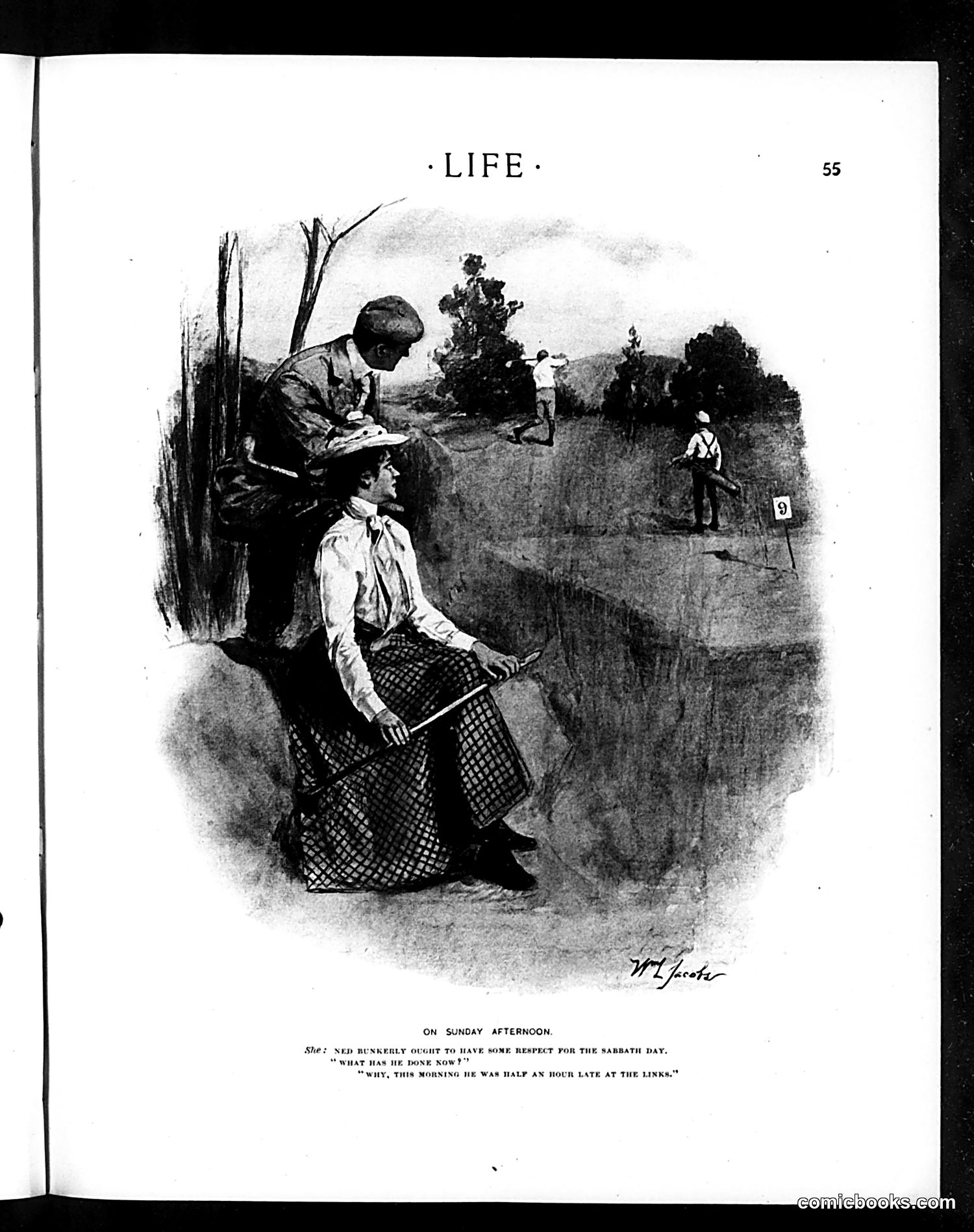
This is a satirical cartoon about Sabbath observance and social hypocrisy. A woman reports to a man (appearing to be her husband or authority figure) that someone named "Ned Bunkerly" lacks respect for Sunday, the Christian Sabbath day traditionally reserved for rest and worship. The "offense": Bunkerly arrived half an hour late to the golf links (golf course) that morning. **The satire's point**: The joke mocks the contradiction in early 20th-century upper-class society—people who publicly claimed to observe the Sabbath religiously were actually spending Sunday morning golfing rather than attending church. Arriving late to golf is presented as violating Sabbath propriety, exposing how the wealthy prioritized leisure over genuine religious observance. The cartoon criticizes this performative morality.
This page contains a satirical dialogue set at the French Chamber of Deputies during what appears to be a Universal Exhibition. A foreign stranger tours the parliament with a French guide, who presents the chamber itself as a curiosity attraction—comparable to other exhibition attractions. The satire mocks French parliamentary conduct: when the opposition member speaks, there are "cries, shrieks and divers imprecations." When the Prime Minister arrives, the tumult becomes even worse, with shouts of "Thief!" "Assassin!" and "Traitor." The guide dismisses this chaos as merely theatrical entertainment staged for foreign visitors, claiming such behavior isn't "serious" but rather performances repeated "two times a week to the end of the Exhibition." The joke targets French political dysfunction—presenting their actual legislative proceedings as too chaotic and absurd to be genuine governance, instead framing them as staged spectacle for tourists. It's satirizing both the perceived incompetence of French politics and the performative nature of parliamentary debate.
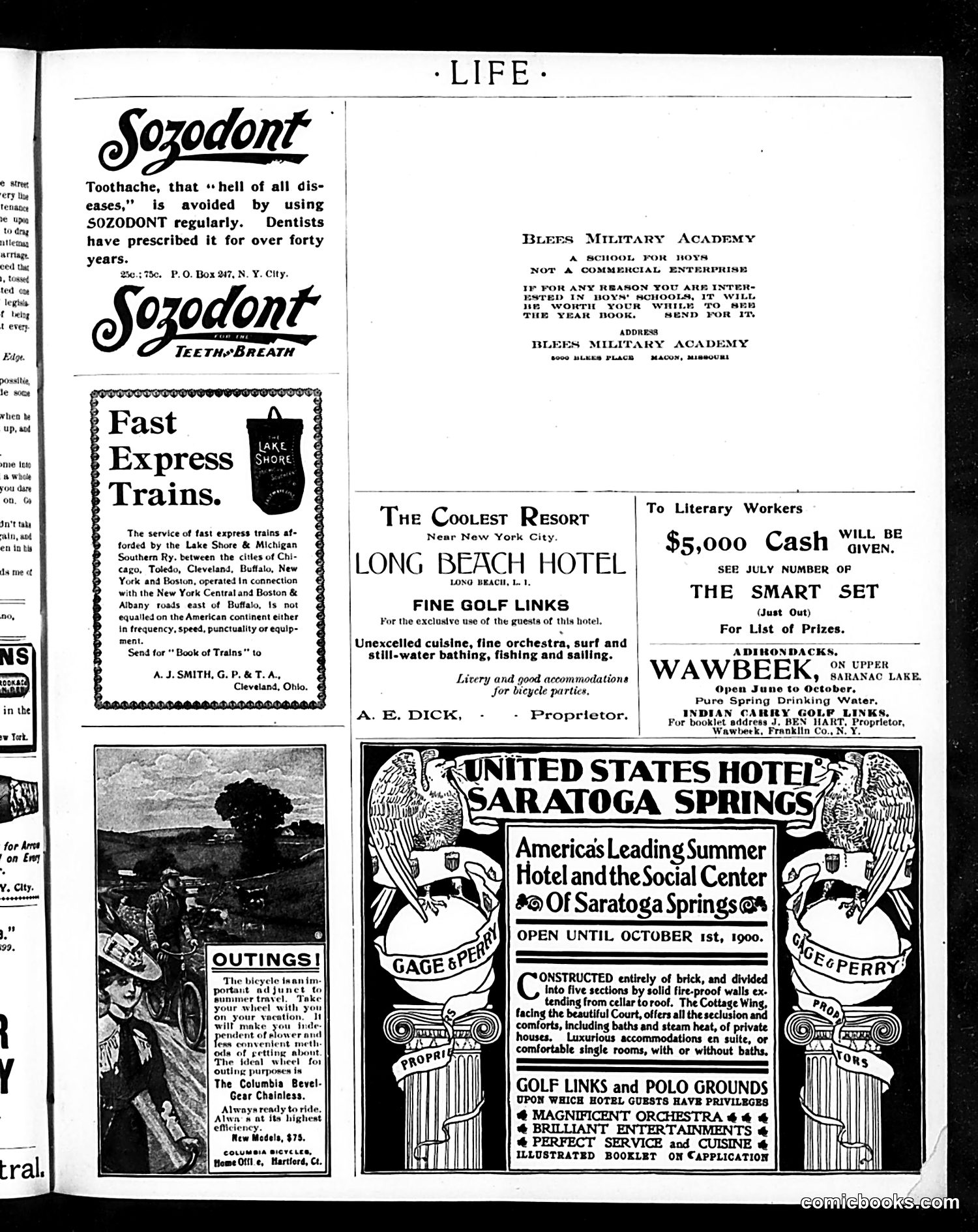
This page is primarily **advertising**, not satire or political commentary. It contains vintage ads from circa 1900 for: - **Sozodont** toothpaste (emphasizing dentist endorsement) - **Lake Shore & Michigan Southern Railway** fast express trains - **Columbia bicycle** with "bevel-gear chainless" technology - **Blees Military Academy** (a boys' school) - **Long Beach Hotel** and **United States Hotel at Saratoga Springs** (luxury resorts) - A literary prize contest offering $5,000 cash There is one small illustration labeled "OUTINGS" showing a cyclist on a Columbia bicycle, but it's decorative rather than satirical. The page reflects **Gilded Age consumer culture**: promoting leisure travel, sports, education, and modern conveniences (bicycles, trains) to affluent Americans. The resorts emphasize golf, polo, and refined accommodations—markers of wealth and status during this era.
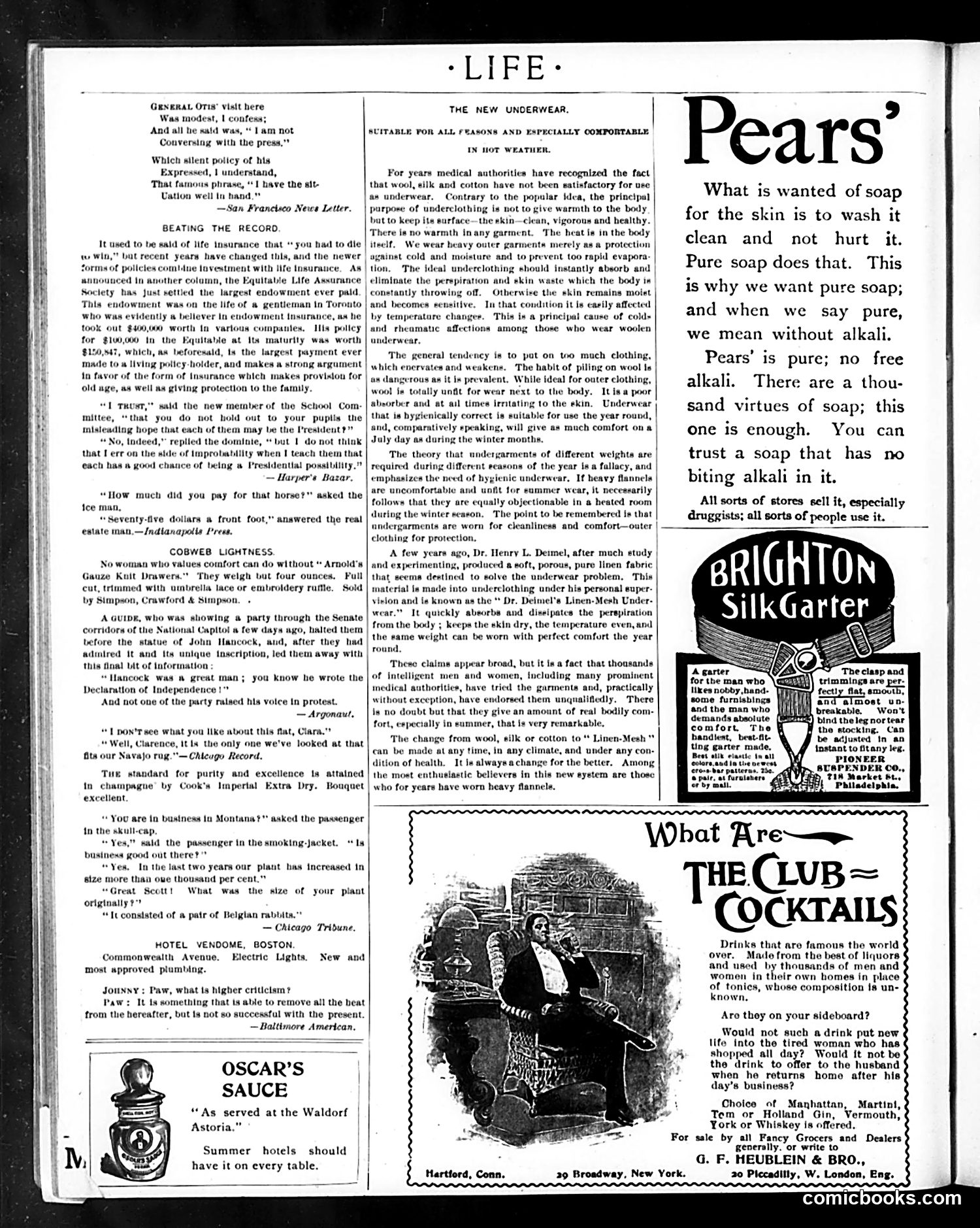
This page is primarily **advertising and humor** rather than political satire. The main content consists of: **Advertisements:** - **Pears' Soap** (large right column): Emphasizes purity and lack of alkali, positioning soap as a skin-care product. This reflects early 1900s marketing of toiletries as health products. - **Brighton Silk Garter**, **Oscar's Sauce**, **Club Cocktails**, and other commercial products occupy significant space. **Humor pieces** scattered throughout are light social commentary: - A joke about a general being modest and saying "I have the situation well in hand" (appears to reference a contemporary politician, unclear which) - Jokes about life insurance payouts, school education, and real estate - A Senate tour guide incorrectly attributing the Declaration of Independence to John Hancock (gentle satire on public ignorance) **The underwear article** discusses medical opinions on fabric choice for undergarments—not satirical but informational advertising copy. This is typical of *Life* magazine's mixed content: mostly commercial with scattered satirical quips about everyday absurdities rather than focused political cartooning.
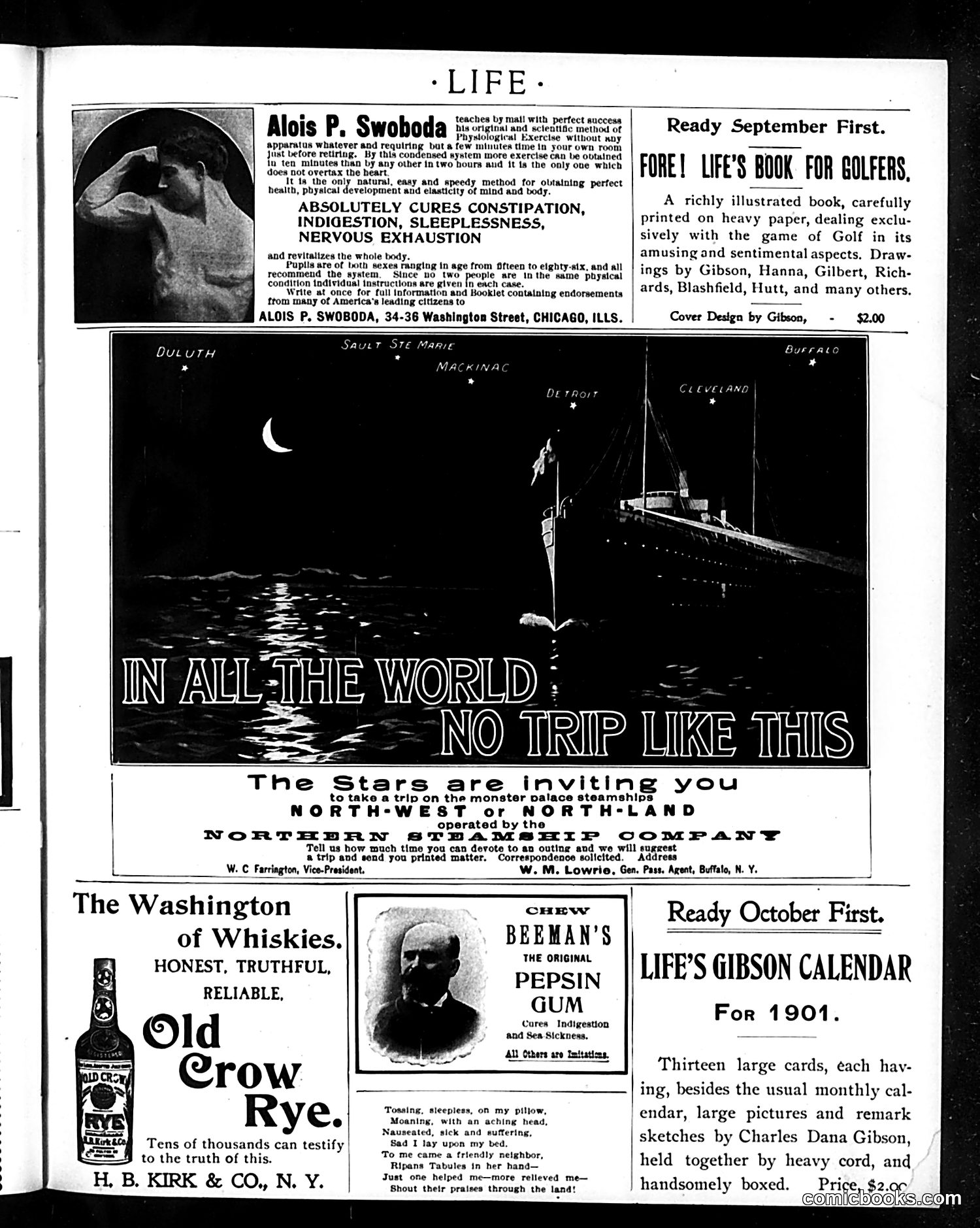
This page is primarily **advertising**, typical of early 1900s magazines. Key content includes: **Main Advertisement**: A steamship line promotes luxury Great Lakes travel on vessels like the "North-West" and "North-Land," with cities labeled (Duluth, Detroit, Cleveland, Buffalo). The tagline "In all the world no trip like this" emphasizes leisure travel's prestige. **Other Advertisements**: - Alois P. Swoboda's mail-order physiological exercise system (claims to cure constipation, insomnia, nervous exhaustion) - Old Crow Rye whiskey - Beeman's Pepsin Gum (advertised for seasickness) - Ripans Tabules (digestive remedy) - Life's Gibson Calendar and Golf book **Historical Context**: These ads reflect turn-of-the-century consumer culture—mail-order fitness, patent medicines, and steamship travel as status symbols. The repeated emphasis on digestive remedies suggests these were common health concerns. Charles Dana Gibson's illustrations were sought-after commercial art. No political satire appears on this page.
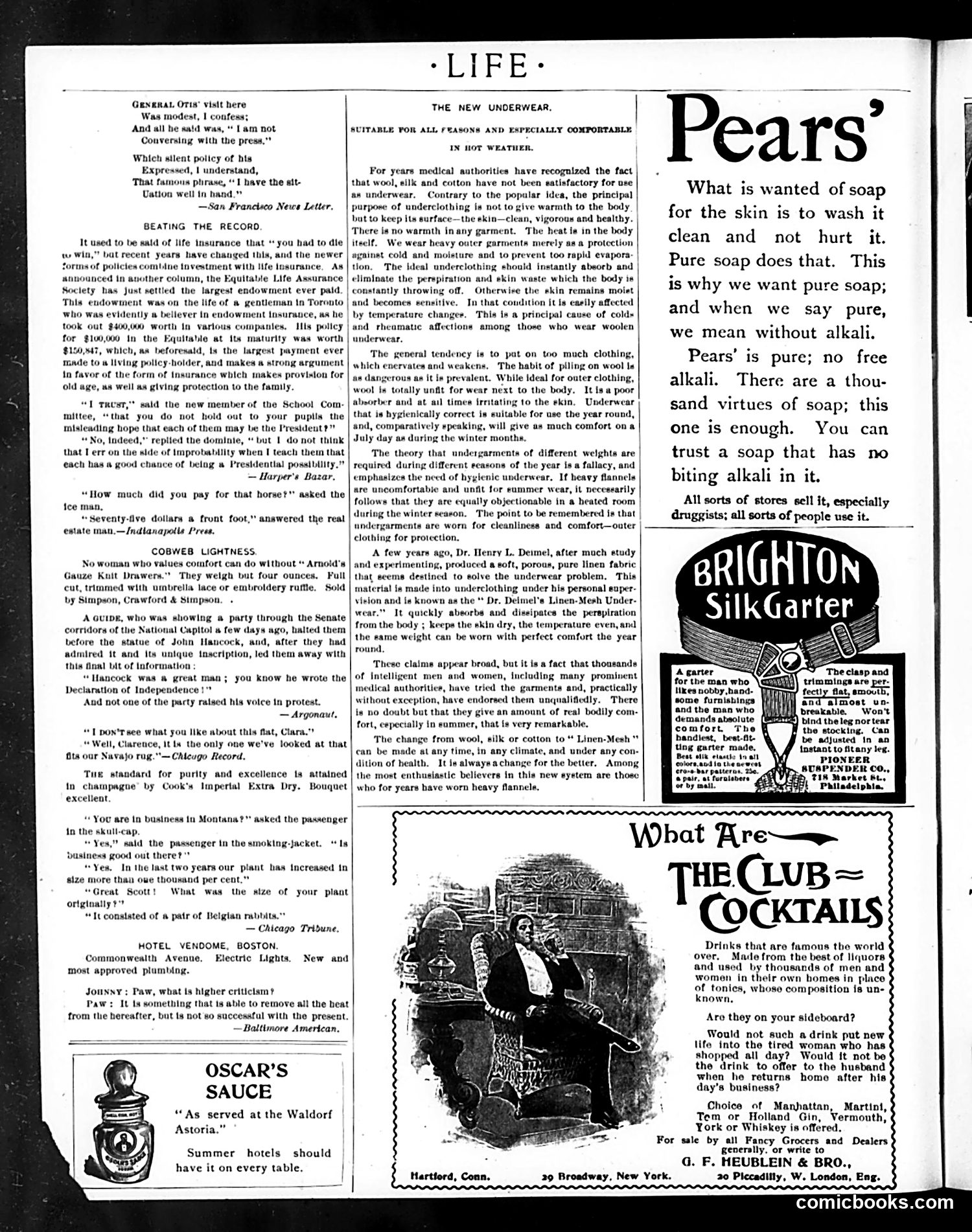
This page is primarily **advertising and light humor** rather than political satire. The content includes: **Small Jokes & Quips:** - A satirical reference to "General Otis" visiting and refusing to speak with press, invoking the phrase "situation well in hand"—likely mocking political evasiveness - Humor about a School Committee member discussing presidential aspirations - Various one-liners about real estate, Montana business, and higher criticism **Main Advertisements:** - **Pears' Soap**: Emphasizing "pure soap" without alkali, marketed as gentle for skin - **Brighton Silk Garter**: For men's hosiery - **Club Cocktails**: Spirits advertised as "famous the world over" - **Oscar's Sauce**: For hotel dining **Context for Modern Readers:** This appears to be early 1900s content (based on typography and tone). The "General Otis" reference is unclear without more context. The page reflects contemporary concerns: endorsement insurance benefits, genteel product marketing, and casual humor typical of the era's satire magazines.
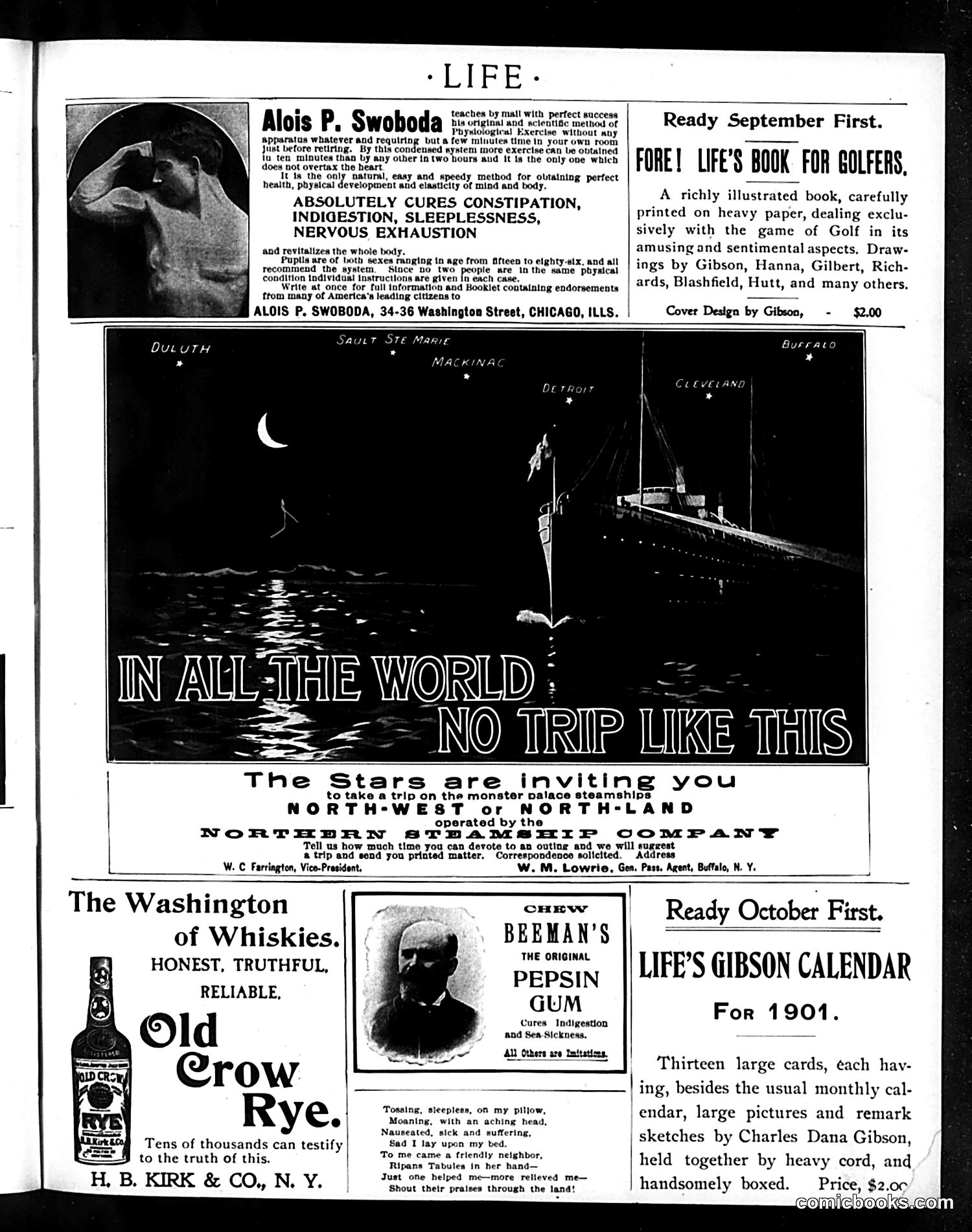
This is primarily an **advertising page** from Life magazine (circa 1900), with no political cartoons or satirical content to analyze. The page features period advertisements for various products and services: - **Alois P. Swoboda's mail-order exercise system** promising to cure constipation, indigestion, and nervous exhaustion through brief daily exercises - **Northern Steamship Company** promoting luxury Great Lakes cruises - **Old Crow Rye whiskey**, marketed with claims of honesty and reliability - **Beeman's Pepsin Gum** for indigestion and seasickness - **Life's Gibson Calendar for 1901**, featuring illustrations by Charles Dana Gibson (the famous illustrator) - **Ripans Tabules** (stomach remedy) with a testimonial poem The ads reflect turn-of-the-century American consumer culture and patent medicine marketing practices. There is no satire or political commentary visible—this is straightforward commercial content typical of Life's revenue model.
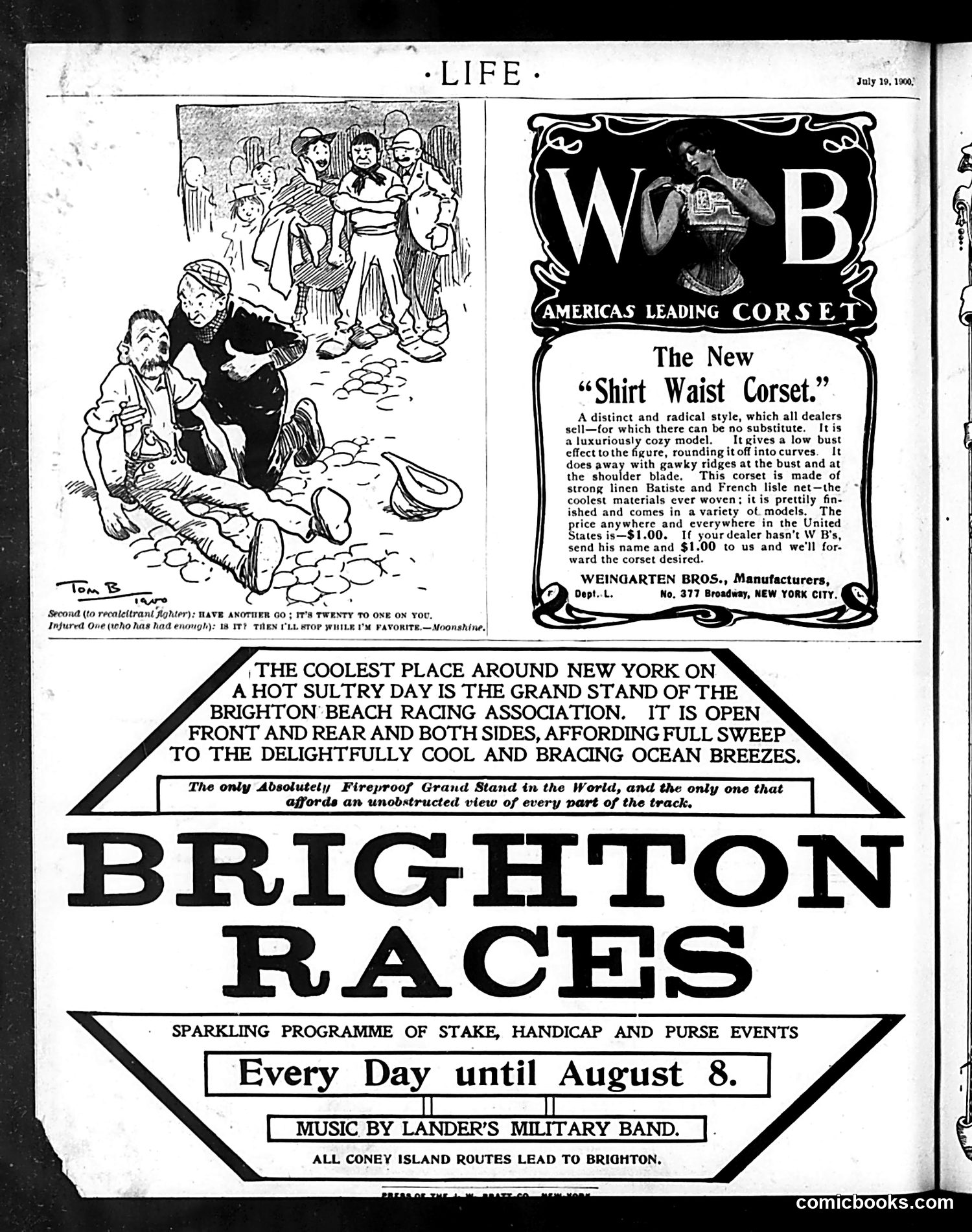
This page combines satire with period advertising. The cartoon by Tom B. (upper left) depicts two boxers—one injured, one fresh—in a sparring match. The captions reference boxing: the uninjured fighter urges "have another go; it's twenty to one on you," while the beaten boxer declares he'll "stop while I'm favorite"—a joke about quitting while still ahead, playing on gambling odds. The page is dominated by **advertisements**: a W.B. corset ad featuring the new "Shirt Waist Corset" (marketed to women seeking a slimmer silhouette without visible ridges), and a large advertisement for Brighton Beach Races in Coney Island, promoting horse racing and the cooling ocean breezes as summer relief from New York heat. The cartoon's boxing theme provided humorous social commentary typical of Life magazine's satirical approach, while the ads reflect turn-of-the-century consumer culture and leisure activities.