
Life, 1900-07-19 · page 4 of 22
Life — July 19, 1900 — page 4: what you’re looking at
What you’re looking at
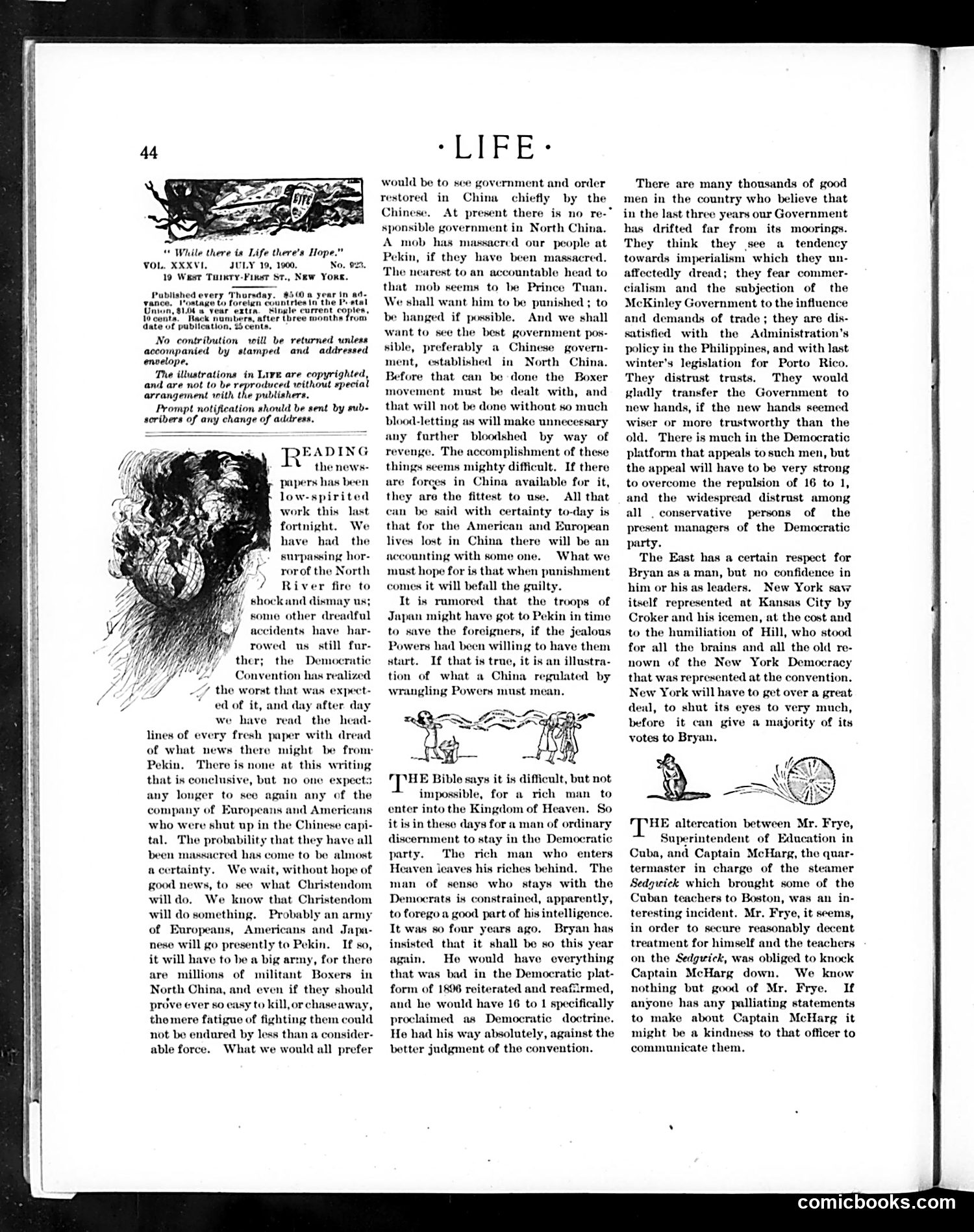
This page discusses Chinese politics following the Boxer Rebellion. The left illustration labeled "Reading the News" depicts a figure reacting to newspaper reports about China. The text argues for establishing a responsible Chinese government in North China rather than pursuing revenge against those who participated in anti-foreign violence. It criticizes excessive bloodshed and advocates for practical governance solutions. The right section critiques William Jennings Bryan's Democratic platform, specifically referencing his 1896 campaign promise to maintain the gold standard at "16 to 1" (currency ratio). The text suggests Bryan and Democratic leaders lack credibility, noting New York's skepticism of his leadership. A brief note mentions a dispute between Cuba's education superintendent and an officer named Captain McFarlane regarding treatment of Cuban teachers.
📄 Transcribed text from this page (OCR, searchable)
Machine-transcribed from the original scan — historical spelling and the odd misread are preserved.
No. New Yore. Published every Thored: a year in ad; .oatage to foreign countries ta ‘al oe 1, $104 a year extra. Single current coy ees Tack numbers, after three months trom date of publication, % cents. No contribution will be returned unless accompanied by stamped and addressed envelope, The illustrations in Live are copyrighted, and are not fo be reproduced without special arrangement with the publishers, Prompt notification should be sent by subs soribers of any change of adress, REapine the news- papers has been low-spirited work this last fortnight. We have had the surpassing hor- ) Torof the North / River fire to shockand dismay us; some other dreadful / accidents have har- rowed us. still fur- the the Democratic Convention has realized <7 the worst that was expect- * ed of it, and day after day we have read the head- lines of every fresh paper with dread of what news there might be from: Pekin, There is none at this writing that is conclusive, but no one expect any longer to seo again any of the company of Enropeans and Americans who were shut up in the Chinese capi- tal. ‘The probability that they have all been massacred has come to be almost. acertainty. We wait, without hope of good news, to seo what Christendom willdo. We know that Christendom will do something. Probably an army of Europeans, Americans and Japa- nese will go presently to Pekin. If so, it will have to be a big armny, for there are millions of militant Boxers in North China, and even if they should prove ever so easy to kill,or chaseaway, tho mere fatigue of fighting them could not be endured by less than a consider- able force. What we would all prefer LIFE would be to sce government and order restored in China chiefly by the Chinese. sponsible government in North China. A mob has massacred our people at Pekin, if they have been massacred. The nearest to an accountable head to that mob xeems to be Prince Tuan. We shall want him to be punished ; to be hanged if possible. And we shall want to see the best government pos- sible, pre bly a Chinese govern- ment, extablixshed in North China. Before that can be done the Boxer movement must be dealt with, and that will not be done without so much blood-letting as will make unnecessary any further bloodshed by way of revenge. The accomplishment of these things seems mighty difficult. If there are forces in China available for it, they are the fittest to use, All that can be said with certainty to-day is that for the American and European lives lost in China there will be an accounting with some on What we must hope for is that when punishment comes it will befall the guilty. It is rumored that the troops of Japan might have got to Pekin in time to save the foreigners, if the jealous Powers had been willing to have them start. If that is true, it is an illustra- tion of what a China regulated by wrangling Powers must mean, THE Bible says it is difficult, but not. impossible, for a rich man to enter into the Kingdom of Heaven, So it is in these days for a man of ordinary discernment to stay in the Democratic party. The rich man who enters Heaven leaves his riches behind. The man of senso who stays with the Democrats is constrained, apparently, to forego a good part of his intelligence. It was so four years ago. Bryan has insisted that it shall be so this year again. He would have everything that was bad in the Democratic plat- form of 1896 reiterated and reafirmed, and he would have 16 to 1 specifically proclaimed as Democratic doctrine. He had his way absolutely, against the better judgment of the convention. At present there is no re-” There are many thousands of good men in the country who believe that in the last three years our Government has drifted far from its moorings. They think they see a tendency towards imperialism which they un affectedly dread; they fear commer- jalism and the subjection of the McKinley Government to the influenc and demands of trade; they are dis- satisfied with the Administration's policy in the Philippines, and with last. winter's legislation for Porto Rico. They distrust trusts. They would gladly transfer the Government to new hands, if the new hands seemed wiser or more trustworthy than the old, There is much in the Democratic platform that appeals to such men, but the appeal will have to be very strong to overcome the repulsion of 16 to 1, and the widespread distrust among all . conservative persons of the present managers of the Democratic party. The East has a certain respect for Bryan as a man, but no confidence in him or his as leaders. New York saw itself represented at Kansas City by Croker and his icemen, at the cost and to the humiliation of Hill, who stood for all the brains and all the old re- nown of the New York Democracy that was represented at the convention. New York will have to get over a great deal, to shut its eyes to very much, before it can give a majority of its votes to Bryan. THE altercation between Mr. Frye, Superintendent of Education in Cuba, and Captain McHarg, the quar- termaster in charge of the steamer Sedgwick which brought some of the Cuban teachers to Boston, was an in- teresting incident. Mr. Frye, it seems, in order to secure reasonably decent treatment for himself and the teachers: on the Sedgwick, was obliged to knock Captain McHarg down. We know nothing but good of Mr. Frye. If anyone has any palliating statements to make about Captain McHarg it might be a kindness to that officer to communicate them, comicbooks.com