
Life, 1900-07-19 · page 8 of 22
Life — July 19, 1900 — page 8: what you’re looking at
What you’re looking at
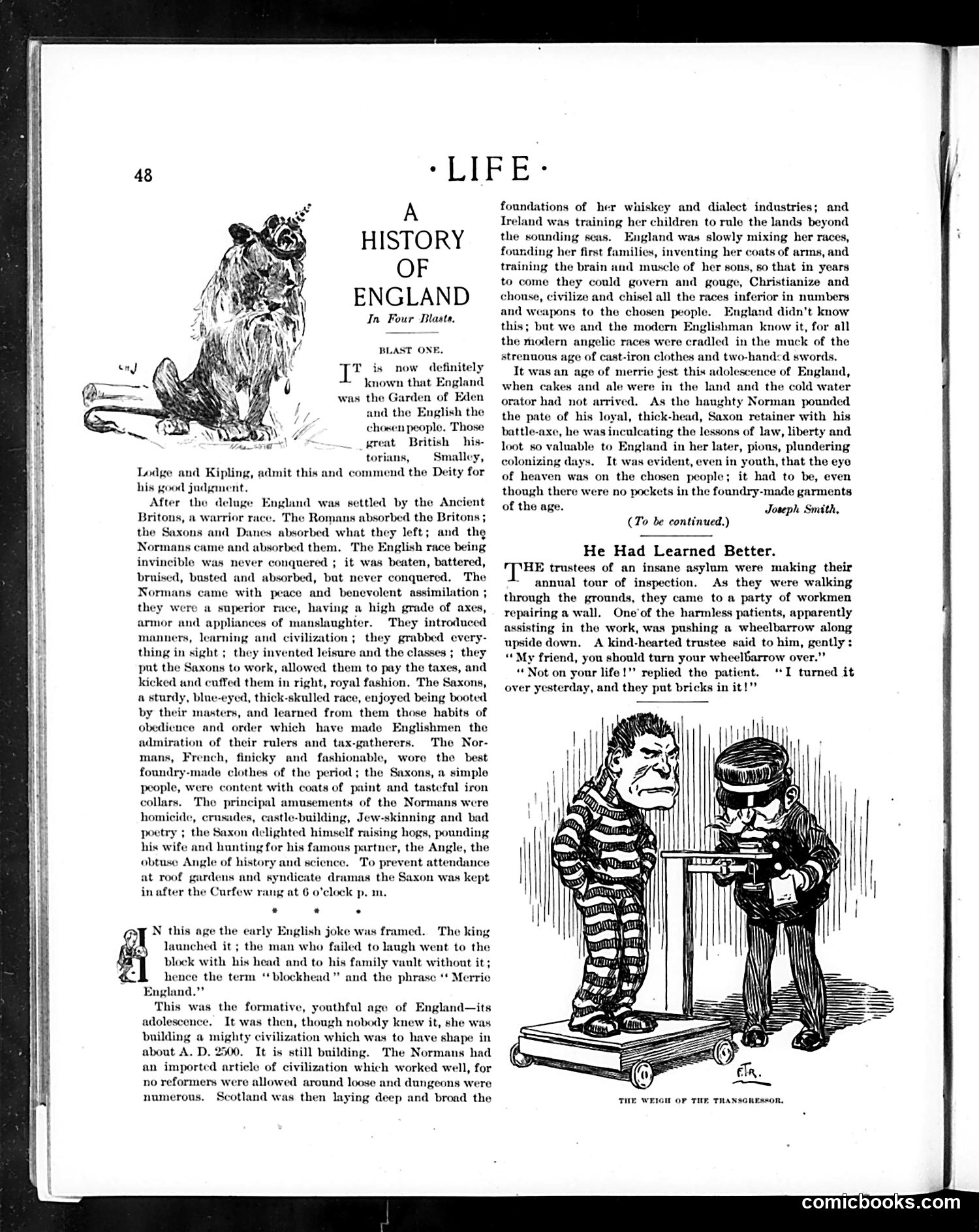
This cartoon illustrates a story titled "He Had Learned Better," about an asylum trustee who suggests a patient turn their wheelbarrow over rather than continue pushing bricks uphill. The patient replies they already tried that yesterday and "they put bricks in it!" The satire targets institutional cruelty disguised as reform. The humor comes from the prisoner's resigned acceptance: no matter what approach he takes, the burden remains unchanged. The trustee's well-meaning suggestion proves useless against a system designed to wear down inmates through futile labor. The image shows the thin, exhausted patient contrasted with the well-fed, comfortable trustee—visually emphasizing their different positions within the asylum hierarchy and the inadequacy of superficial "kindness" in fundamentally unjust systems.
📄 Transcribed text from this page (OCR, searchable)
Machine-transcribed from the original scan — historical spelling and the odd misread are preserved.
LIFE: A HISTORY OF ENGLAND In Four Blasts. BLAST ONE, [tis now definitely known that England was the Garden of Eden and the English the choxen people. Those great British his- torians, Smalley, Lodge and Kipling, admit this and commend the Deity for his good judgment. After the deluge England was settled by the Ancient Britons, a warrior race. The Romans absorbed the Britons ; the Saxons and Danes absorbed what they left; and the ormans came and absorbed them, The glish race being invincible was never conquered ; it was beaten, battered, bruised, busted and absorbed, but never conquered. The Normans came with peace and benevolent assimilation ; they were a superior race, having a high grade of axes, armor and appliances of manslaughter. They introduced manners, learning and lization ; they grabbed ry: thing in sight ; they invented leisure and the classes ; they put the Saxons to work, allowed them to pay the taxes, and kicked and cuffed them in right, royal fashion. The Saxons, a sturdy, blue-eyed, thick-skulled race, enjoyed being booted by their masters, and learned from them those habits of obedience and order which have made Englishmen the admiration of their rulers and tax-gatherers. The Nor- mans, French, finicky and fashionable, wore the best foundry-made clothes of the period; the Saxons, a simple people, were content with coats of paint and tasteful iron collars. The principal amusements of the Normans were homicide, crusades, castle-building, Jew-skinning and bad poetry ; the Saxon delighted himself raising hogs, pounding his wife and hunting for his famous partner, the Angle, the obtuse Angle of history and science. To prevent attendance at roof gardens and syndicate dramas the Saxon was kept in after the Curfew rang at 6 o'clock p,m. . . . N this age the early English joke was framed. The king launched it; the man who failed to laugh went to the block with his head and to his family vault without it; hence the term “blockhead” and the phrase ‘* Merrie England.” This was the formative, youthful age of England—its adolescence. It was then, though nobody knew it, she was building a mighty civilization which was to have shape in about A. D. 2500. It is still building. The Normans had an imported article of civilization which worked well, for no reformers were allowed around loose and dungeons were numerous. Scotland was then laying deep and broad the foundations of her whiskey and dialect industries; and Ireland was training her children to rule the lands beyond the sounding seas. England was slowly mixing her races, founding her first families, inventing her coats of arms, and training the brain and muscle of her sons, so that in years to come they could govern and gouge, Christianize and chonse, civilize and chisel all the races inferior in numbers and weapons to the chosen people. England didn't know this; but we and the modern Englishman know it, for all the modern angelic races were cradled in the muck of the strenuous age of cast-iron clothes and two-hand<d swords. It was an age of merrie jest this adolescence of England, when cakes and ale were in the land and the cold water orator had not arrived, As the haughty Norman pounded the pate of his loyal, thick-head, Saxon retainer with his battle-axe, he was inculcating the lessons of law, liberty and loot so valuable to England in her later, pions, plundering colonizing days. It was evident, even in youth, that the eye of heaven was on the chosen people; it had to be, even though there were no pockets in the foundry-made garments of the age. Joseph Smith, (To be continued.) He Had Learned Better. HE trustees of an insane asylum were making their annual tour of inspection. As they were walking through the grounds, they came to a party of workmen repairing a wall. One’of the harmless patients, apparently assisting in the work, was pushing a wheelbarrow along upside down. A kind-hearted trustee said to him, gently “My friend, you should turn your wheelbarrow over.” “Not on your life!” replied the patient. “I turned it over yesterday, and they put bricks in it!” THE WEIOU OF THY TRANSORES*OR. comicbooks.com