
A complete issue · 21 pages · 1900
Life — June 28, 1900
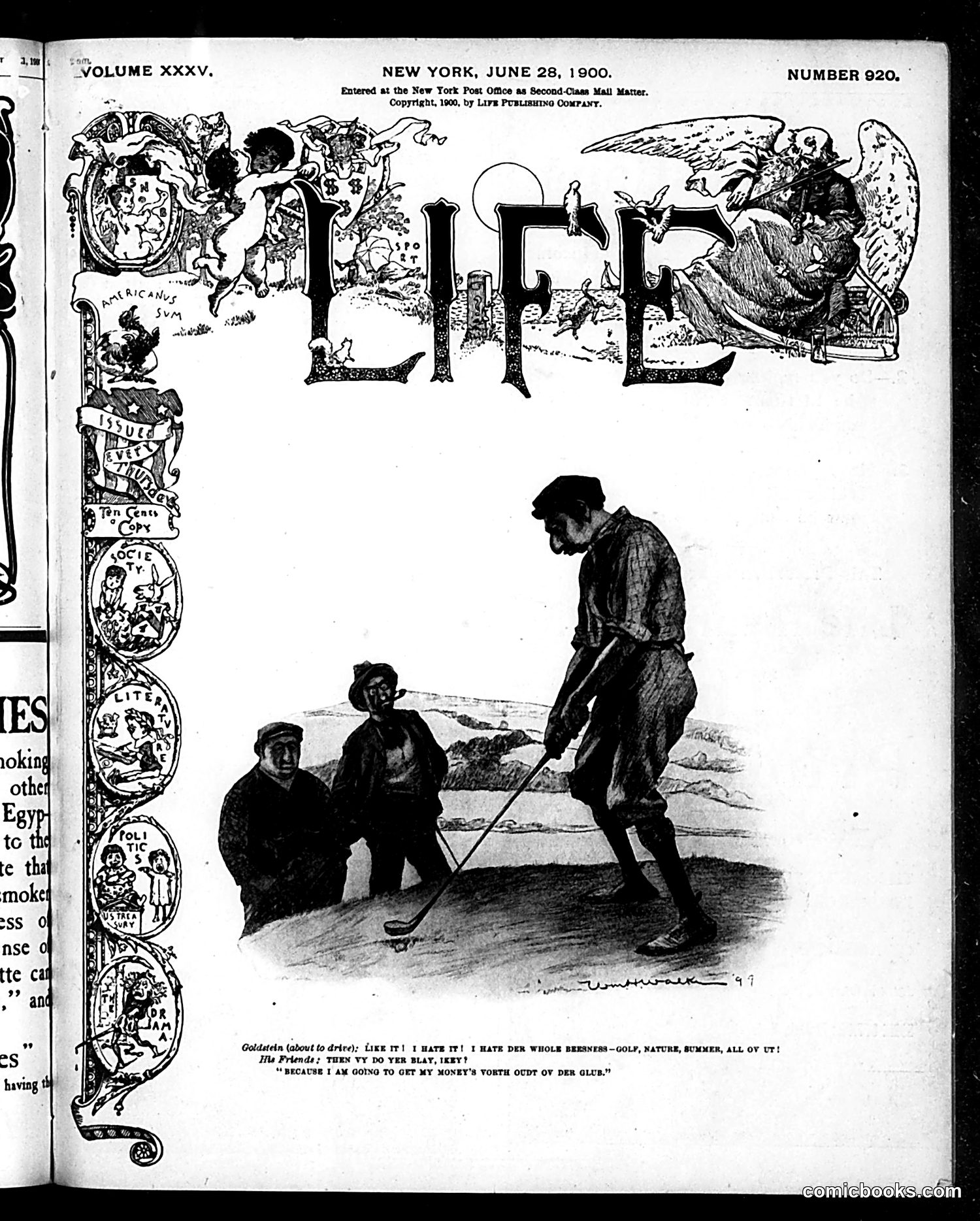
This 1900 *Life* magazine page features a golf cartoon satirizing wealthy men's obsession with the sport. The caption shows "Goldarth" complaining bitterly about golf to friends, claiming he hates "her whole beeness"—yet admits he's determined to win money from "her" (golf personified as female). The satire targets the contradiction between golfers' public complaints about the sport's difficulty and frustration versus their compulsive, obsessive participation. The joke reflects turn-of-century anxieties about golf's explosion among America's upper class, who invested enormous time and emotional energy in the game despite constant frustration. The feminine personification of golf as a seductive but maddening "her" adds another layer of social commentary about masculine vulnerability to its appeal.
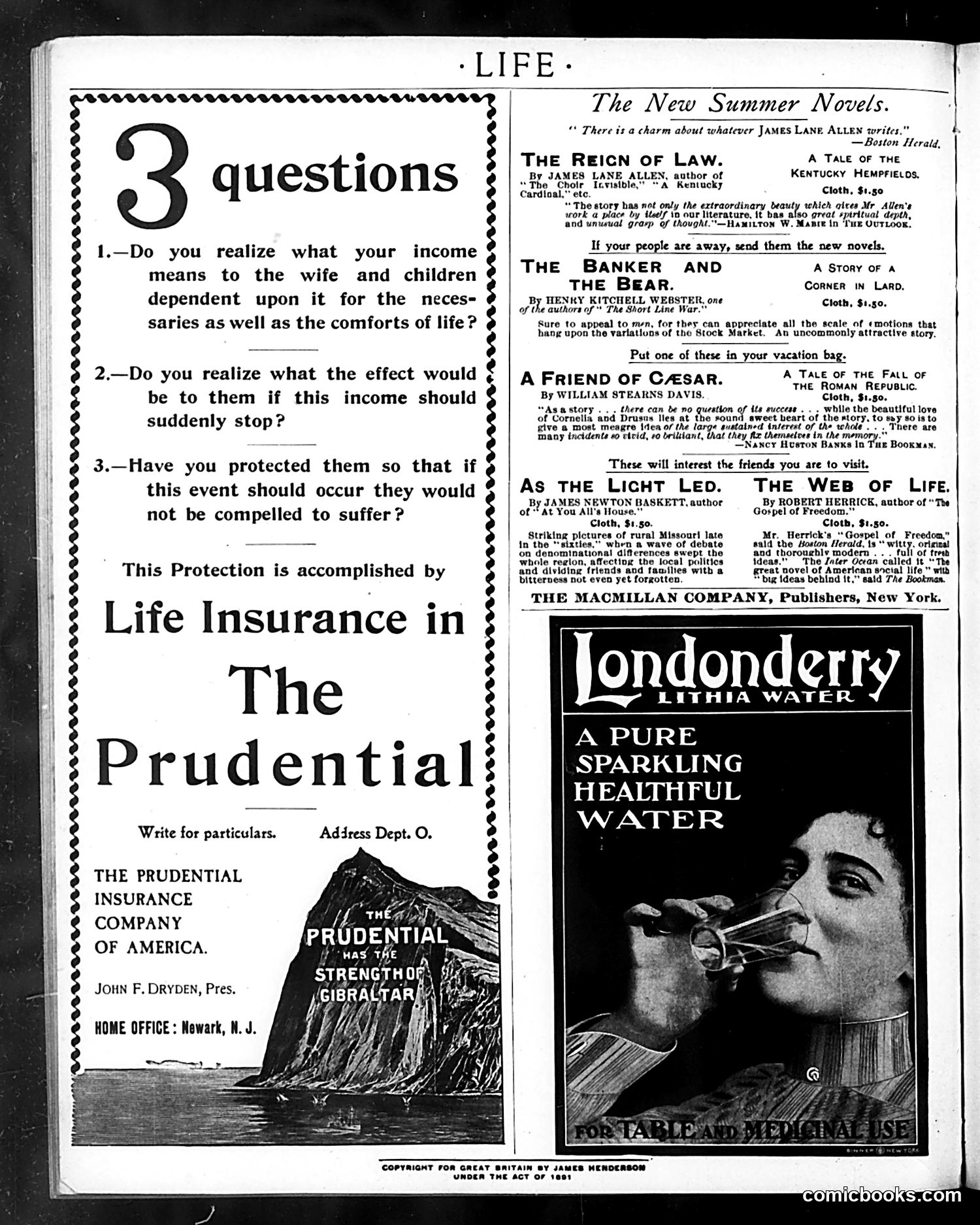
This page is primarily **advertising**, not satire or political commentary. The left side features a life insurance advertisement for The Prudential Insurance Company, using the famous "Rock of Gibraltar" imagery to convey strength and stability—a common advertising approach of the era. The right side advertises summer novels and a product called "Londonderry Lithia Water," described as "a pure sparkling healthful water." The water advertisement shows two people drinking, likely promoting it as a health tonic (lithia water was marketed for various medicinal purposes in this period). There are no political cartoons, caricatures, or satirical commentary visible on this page. It's a straightforward collection of commercial advertisements typical of early 20th-century magazine content.
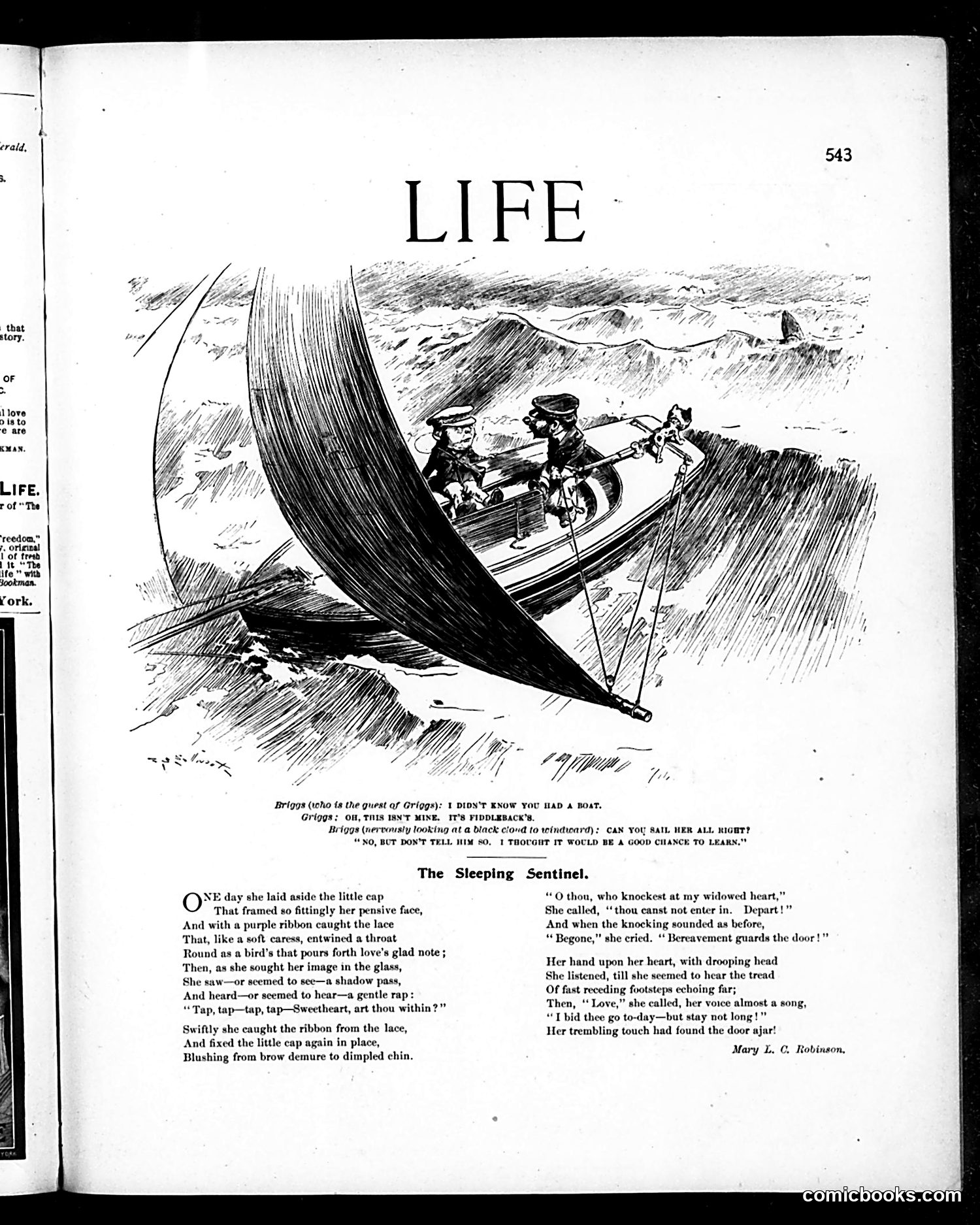
The main illustration shows two figures in a small sailboat with an oversized sail. The dialogue identifies one as "Briggs" (likely a reference to the cartoonist), who claims ignorance about owning a boat. The other figure, "Griggs," sarcastically suggests it's a "fiddleback"—implying the boat is impractical or poorly designed. The joke appears to be about incompetent boat ownership or mistaken identity regarding vessels. Below is a sentimental poem titled "The Sleeping Sentinel" by Mary L.C. Robinson, describing a woman keeping vigil while someone sleeps. This contrasts sharply with the crude sailing joke above, suggesting the page mixes humor with earnest romantic verse—typical of Life's eclectic editorial approach in this era.
This page contains editorial commentary on China and American foreign policy, likely from the early 1900s. The text discusses China's political situation and mentions Major McKinley's role in determining China's future—suggesting this relates to U.S. involvement following the Boxer Rebellion. The decorative illustrations include what appears to be Asian-inspired artwork (dragons or traditional designs) accompanying discussions of China's weakness and Western powers' competing interests there. The page also includes commentary on Admiral Dewey's retirement from presidential politics, treating it as welcome news for American stability. The tone is paternalistic toward China, reflecting period attitudes about Western "civilization" and America's role in Asian affairs. The text criticizes those who deny America's responsibilities in China while defending U.S. intervention as necessary.
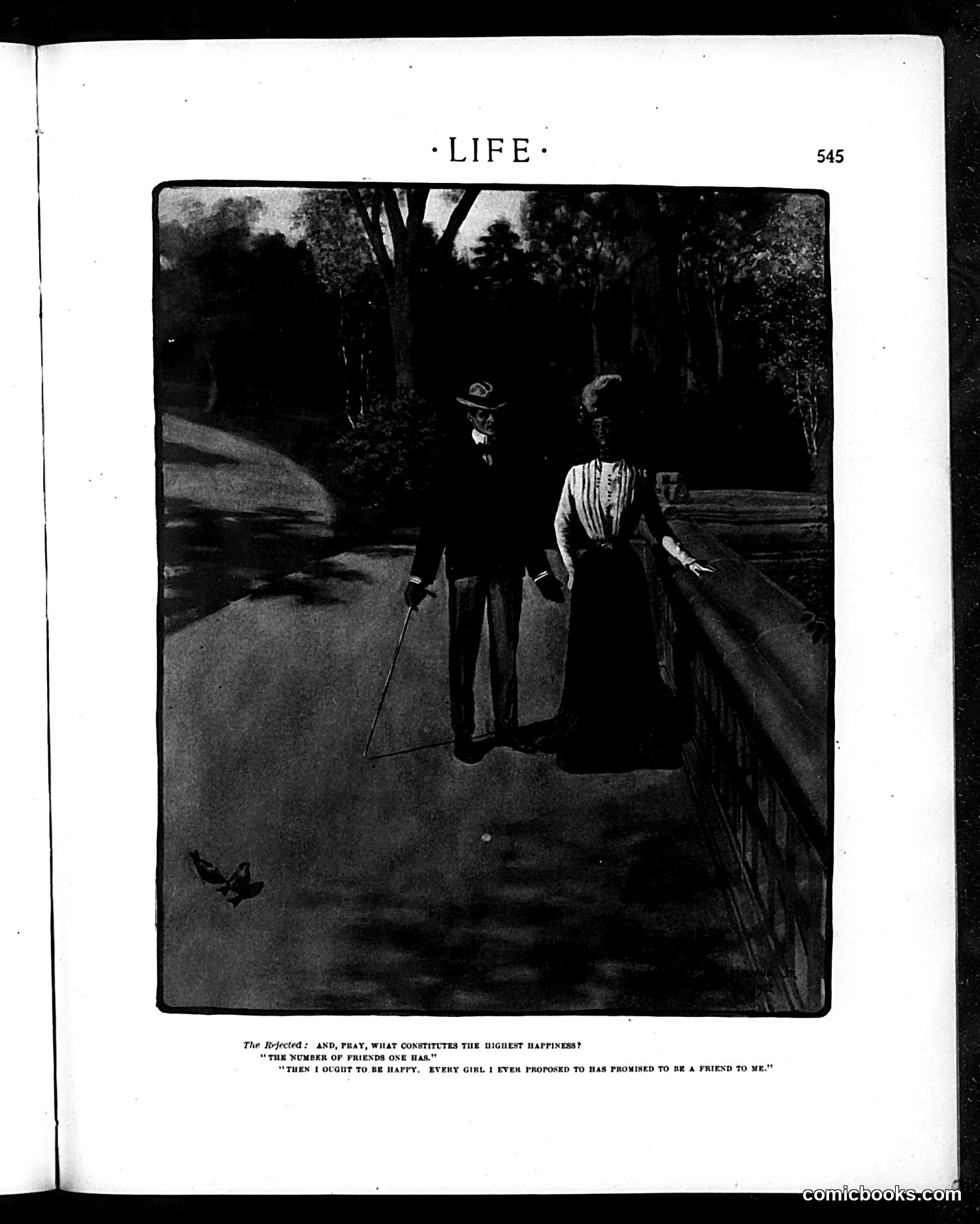
This Life magazine page presents "The Rejected," a scene showing two figures in a wooded setting. The caption quotes dialogue about happiness, friendship, and a rejected marriage proposal: "The number of friends one has" constitutes happiness, and a girl has proposed to a man who promised to be her friend instead. The satire appears to target early 20th-century gender role reversal. At a time when marriage proposals were conventionally initiated by men, this image depicts a woman making the proposal—a socially shocking scenario for the era. The man's gentle rejection (promising friendship instead) gently mocks both the woman's boldness and Victorian courtship conventions. The tone suggests bemused commentary on changing social expectations regarding gender and romance.
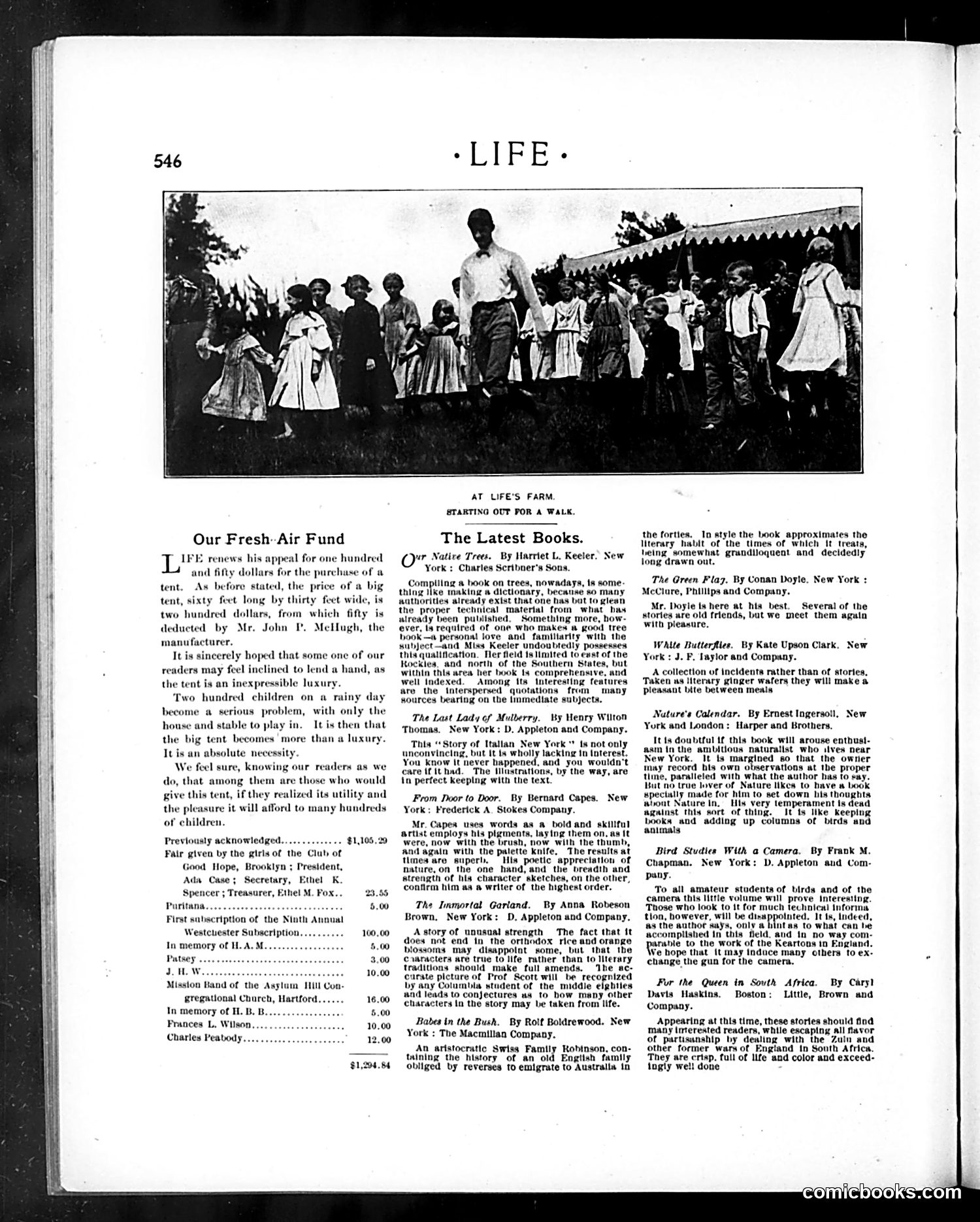
This page from *Life* magazine (page 546) contains a photograph rather than a political cartoon. The image shows a group of people, including children and adults in early 20th-century clothing, standing outdoors near a tent. The caption reads "AT LIFE'S FARM—STARTING OFF FOR A WALK." The main article is "Our Fresh Air Fund," which discusses *Life's* charitable initiative providing tent accommodations and outdoor recreation for children from less privileged urban backgrounds. The piece humorously notes that while the big tent initially seems luxurious to city children, it becomes "more than a luxury" — implying the experience profoundly benefits them. The remainder of the page contains book reviews and acknowledgments of donations to the Fresh Air Fund, reflecting *Life's* role as both satirical publication and charitable advocate.
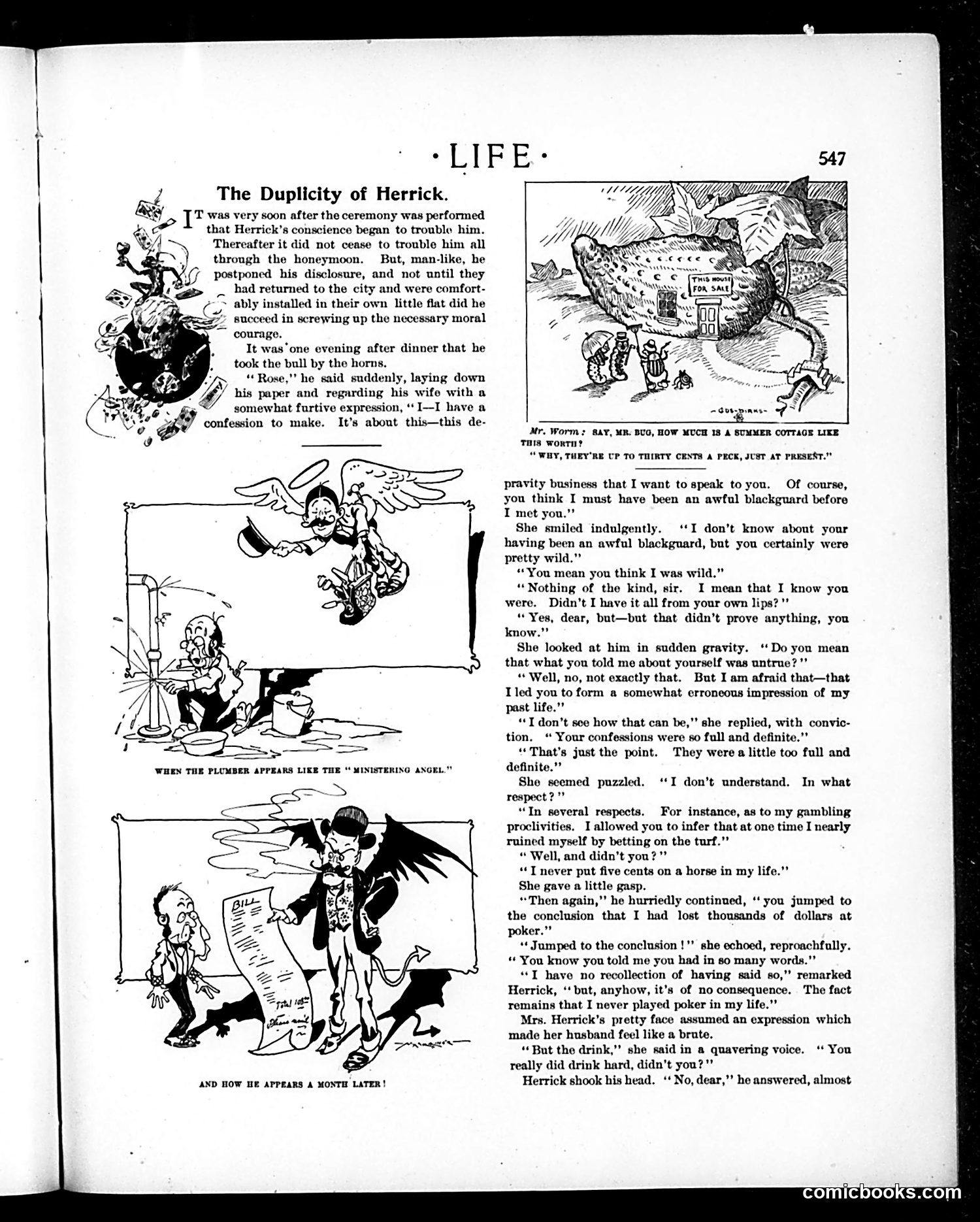
This satirical story depicts a husband (Herrick) confessing marital infidelities to his wife after their honeymoon. The accompanying cartoons use visual metaphor to mock his explanations: he appears successively as an angel ("ministering angel"), then as a devil with horns and papers (suggesting financial/legal troubles), and finally as a "month later" version—implying his excuses have unraveled. The joke centers on the gap between Herrick's elaborate, self-exculpatory confessions and his wife's skepticism. His claims about gambling losses, blackguards, and drink ring hollow given his documented lies. The cartoons visualize his moral degradation from claimed innocence to revealed deception, satirizing men's tendency to rationalize infidelity through elaborate excuses.
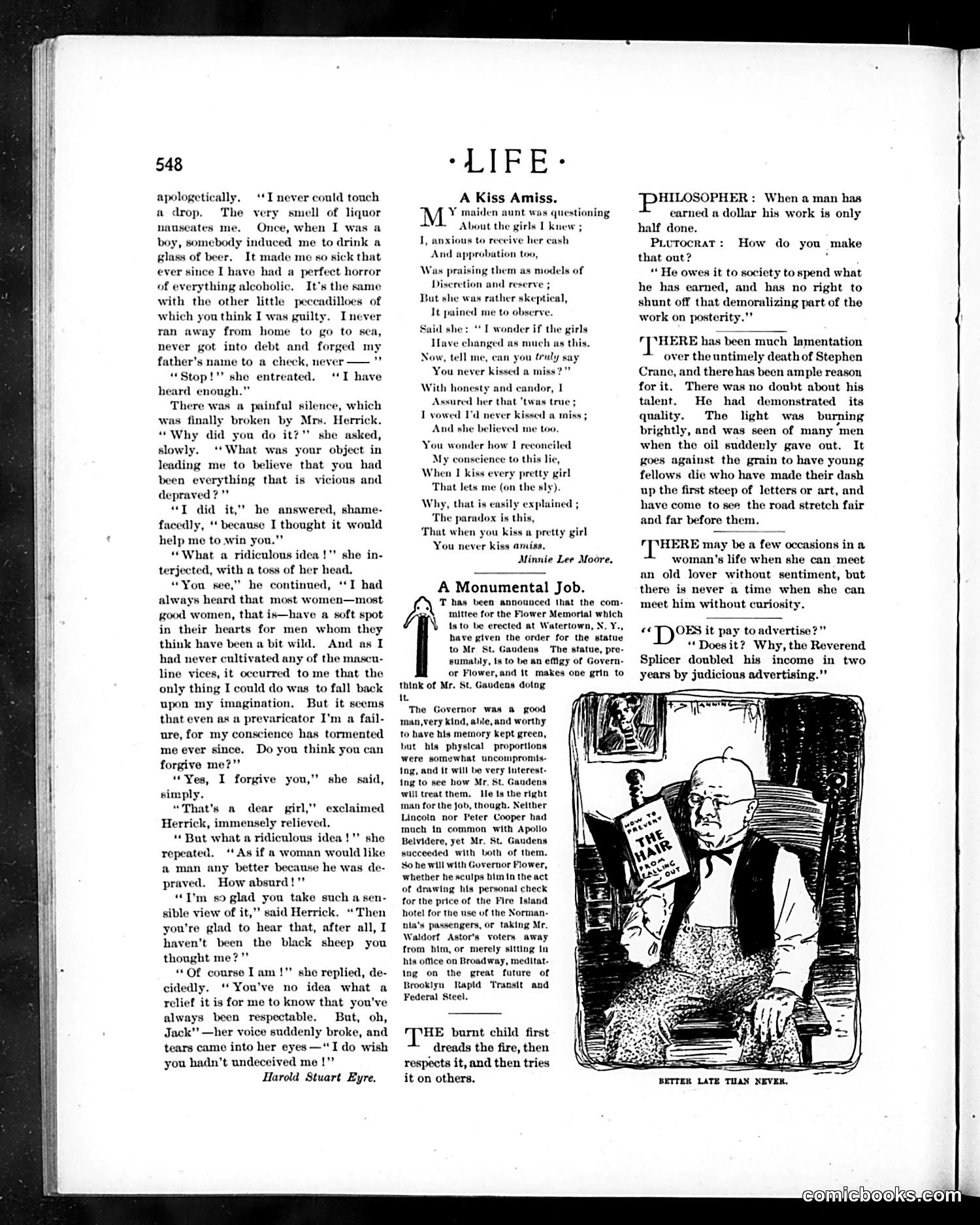
This page contains literary excerpts and one cartoon titled "Better Late Than Never." The cartoon depicts an older man reading what appears to be a newspaper or publication while seated. The figure seems to represent someone catching up with news or information belatedly—hence the title's ironic message about tardiness. The page's main content consists of philosophical and romantic prose pieces, including "A Kiss Amiss" and "A Monumental Job," alongside commentary on Stephen Crane's death and remarks about advertising effectiveness. Without additional context about the specific historical date or prominent figures referenced, I cannot definitively identify the cartoon's subject. The humor appears to rely on timing and delayed awareness—a common satirical theme in Life magazine's commentary on contemporary society.
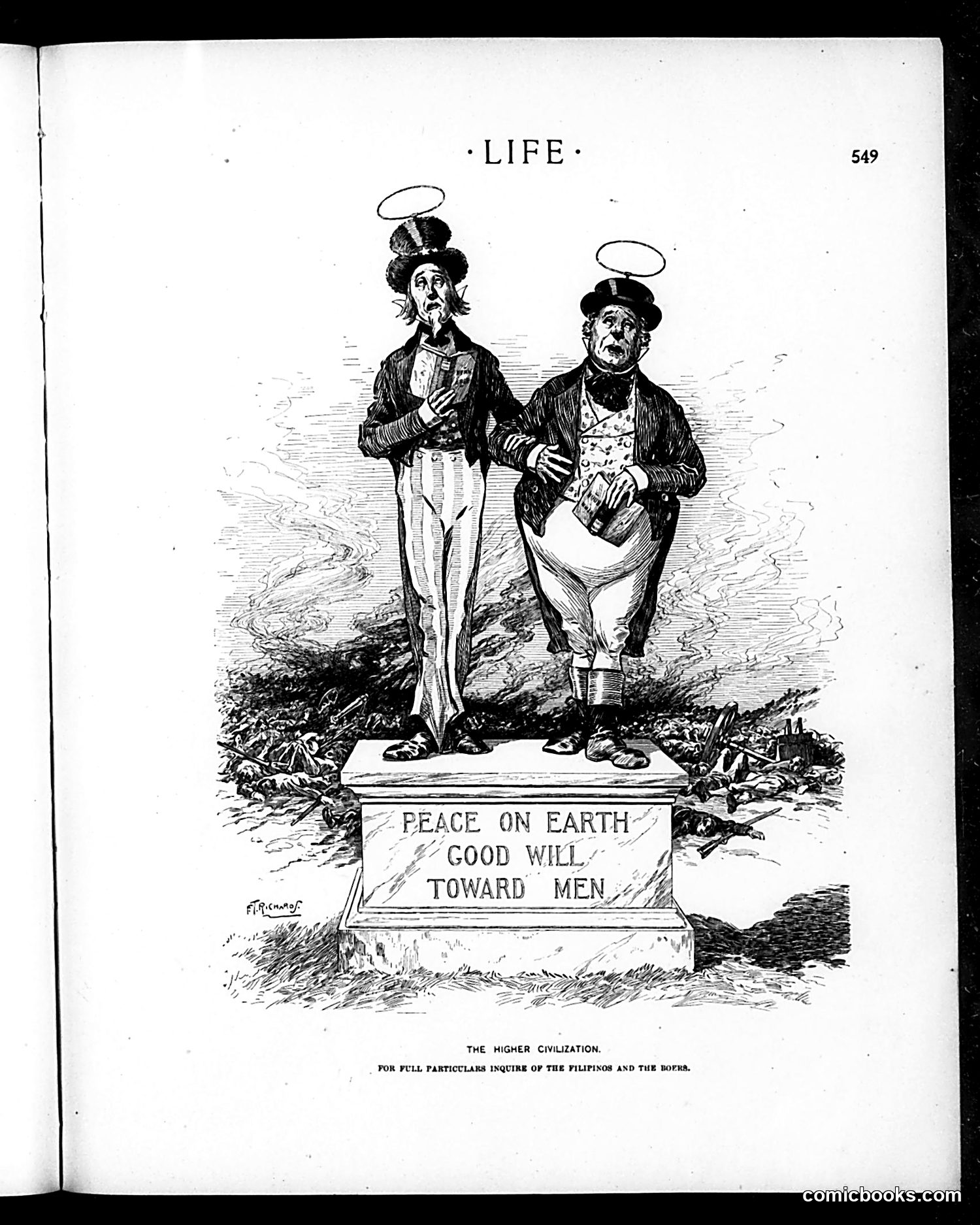
This satirical illustration depicts two grotesque figures standing on a pedestal inscribed "PEACE ON EARTH / GOOD WILL / TOWARD MEN," each wearing halos. Both characters appear disheveled and are holding what seem to be weapons or destructive implements. The caption "THE HIGHER CIVILIZATION" with a subtitle referencing "THE FILIPINOS AND THE BOERS" indicates this critiques Western imperial powers during the Philippine-American War and the Second Boer War (both early 1900s). The satire is biting: it mocks Christian hypocrisy and claims of civilizational superiority by showing supposed "civilized" nations waging brutal colonial wars while literally wearing halos and standing on religious platitudes. The cartoon sarcastically suggests that Western powers' professed moral and religious values contradict their violent imperial practices.
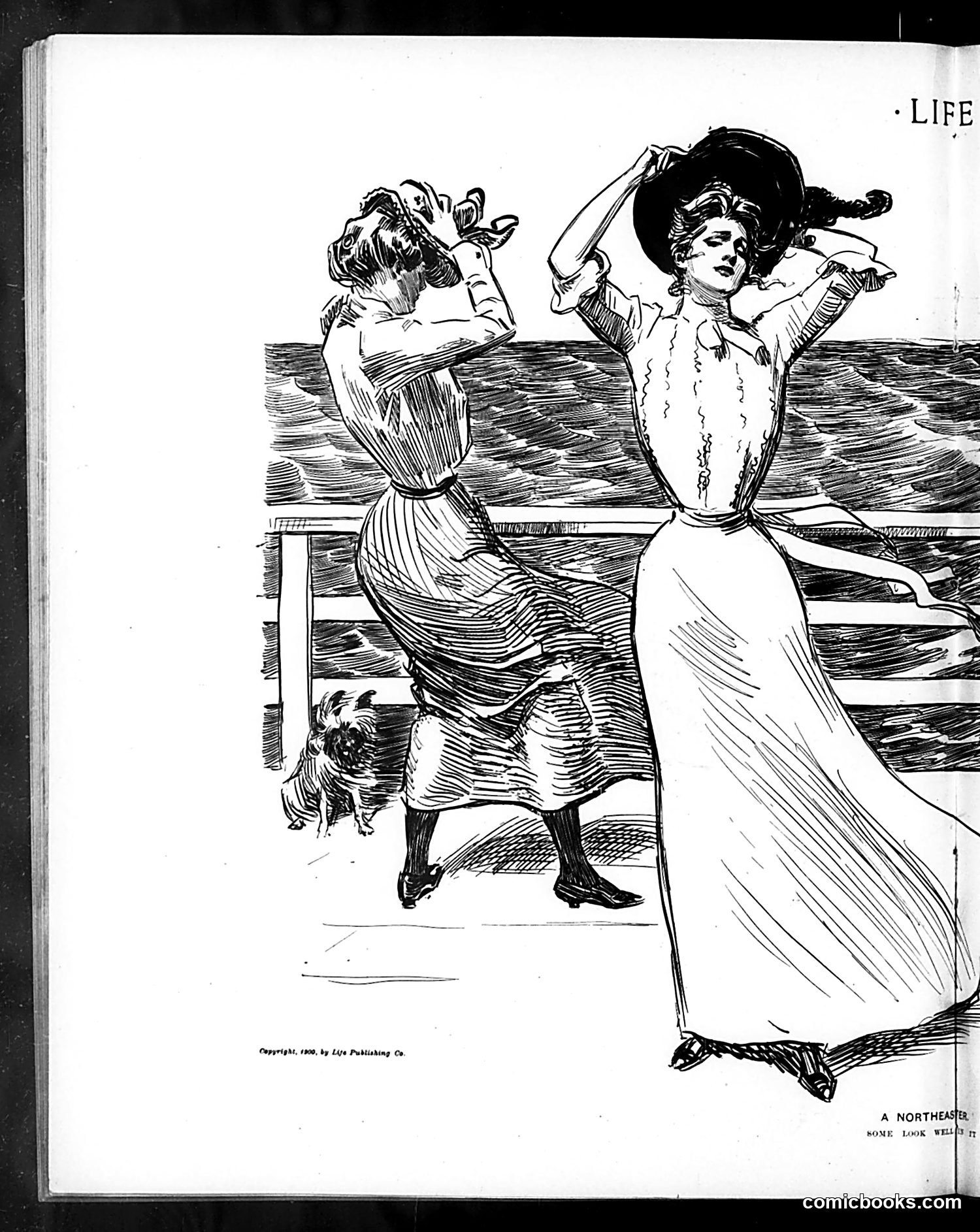
This appears to be a satirical illustration from Life magazine (copyright 1908, Life Publishing Co.) depicting two fashionably-dressed women by the seaside. The caption at bottom reads "A NORTHEASTER" with partial text "SOME LOOK WELL IN IT." The cartoon likely satirizes women's fashion and behavior during the early 1900s. One woman adjusts her elaborate hat against wind, while the other displays her figure in a flowing white gown—both seemingly unconcerned about practical concerns during a nor'easter (strong coastal storm). The small dog adds a humorous touch. The satire appears to target the era's emphasis on aesthetic presentation over practicality, mocking how fashionable women prioritized appearance even in adverse weather conditions. This reflects common Progressive-era critiques of women's fashion excess.
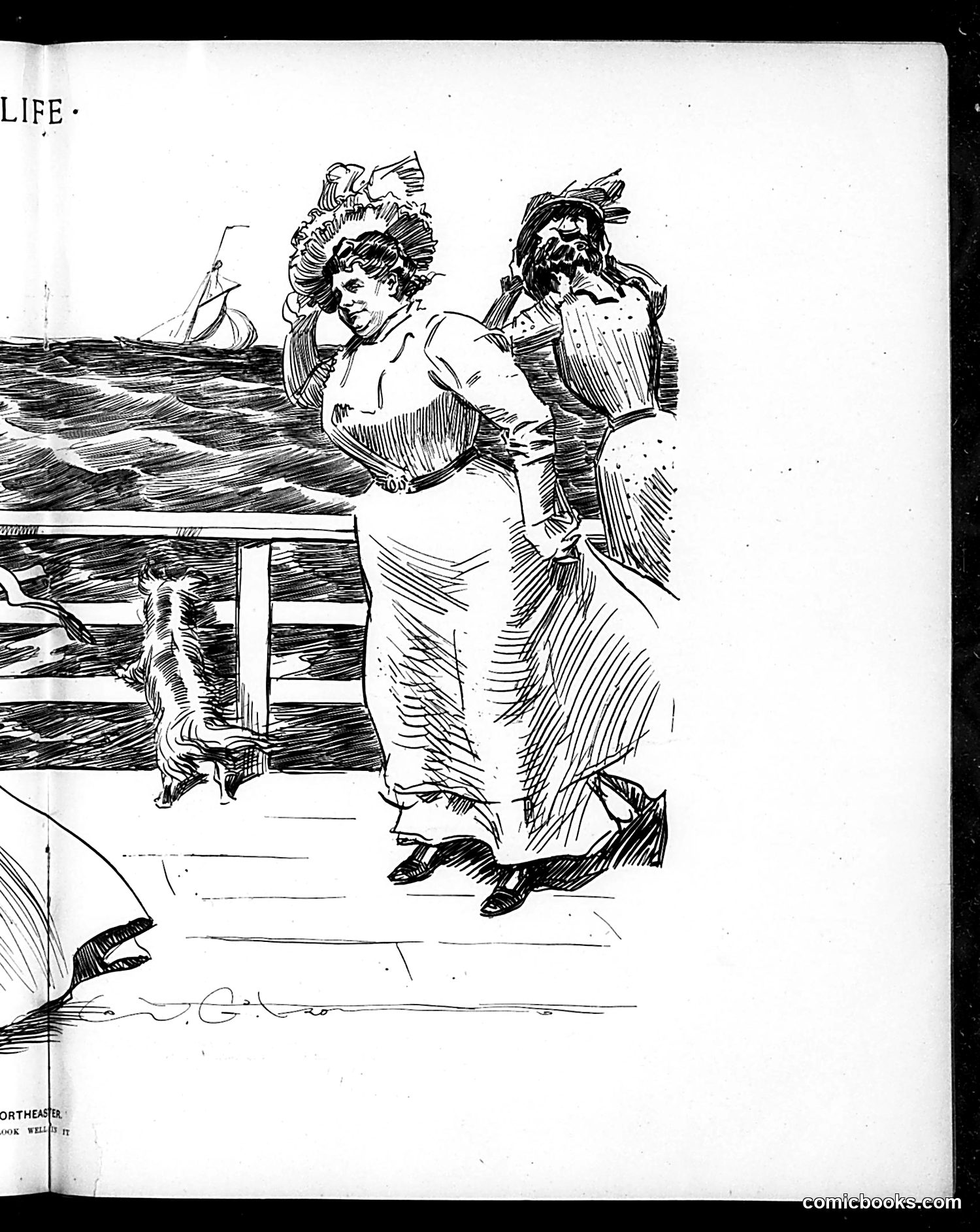
This appears to be a satirical illustration from *Life* magazine showing a social scene at what looks like a seaside or waterfront location. The image depicts a woman in an elegant white dress with an elaborate feathered hat, positioned centrally and confidently, with a bearded man beside her and a small dog at her feet. A sailing vessel appears in the background. Without clearer text or additional context on this page, I cannot definitively identify the specific figures or political/social commentary intended. The styling and composition suggest this is likely social satire from the early 20th century, possibly mocking fashionable society, gender dynamics, or contemporary personalities. However, to accurately explain the specific references and satirical point to a modern reader, I would need more legible text or contextual information from the magazine.
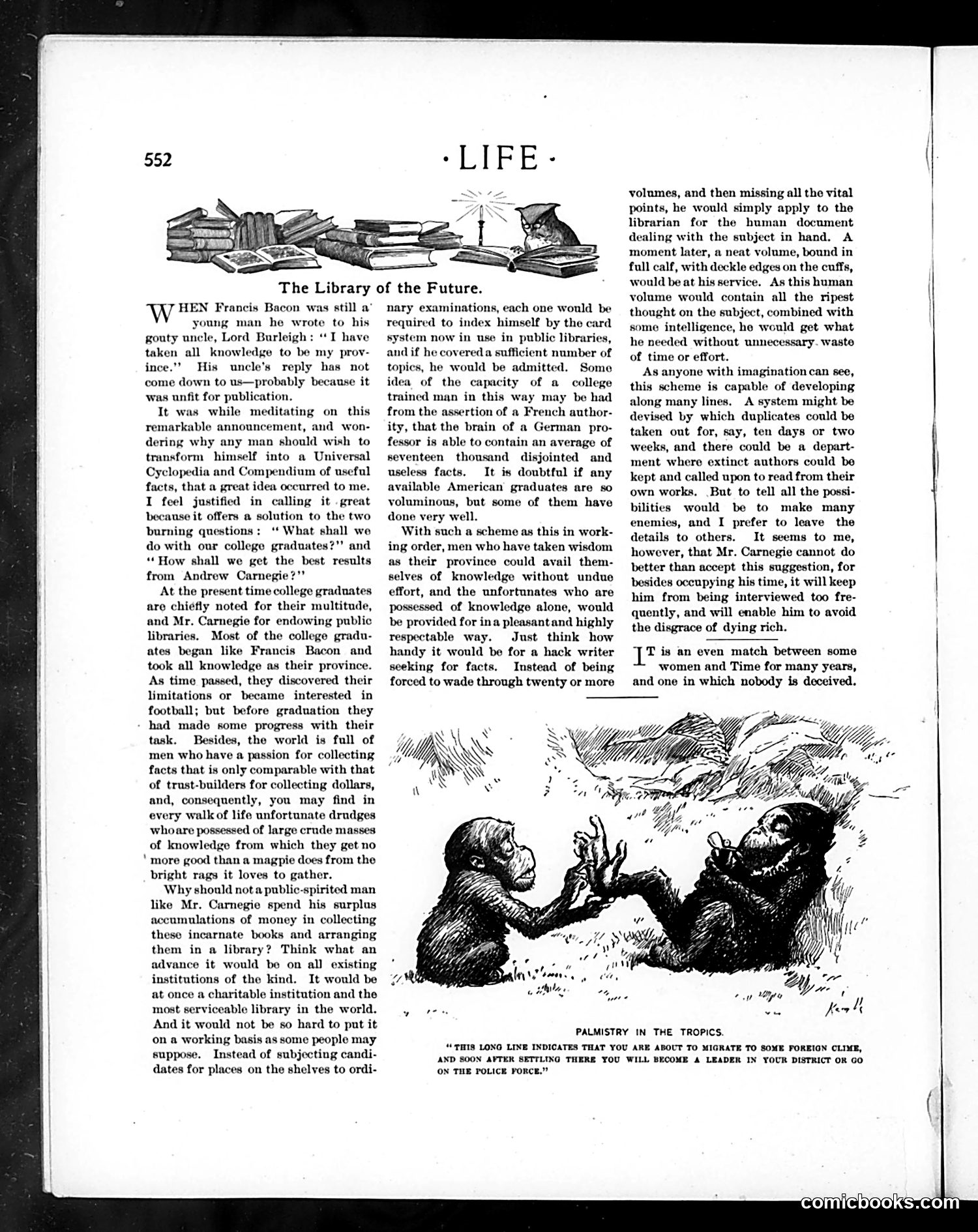
This cartoon depicts two apes examining each other's palms in a tropical setting. The caption reads: "THIS LONG LINE INDICATES THAT YOU ARE ABOUT TO MIGRATE TO SOME FOREIGN CLIME, AND SOON AFTER SETTLING THERE YOU WILL BECOME A LEADER IN YOUR DISTRICT OR GO ON THE POLICE FORCE." The satire appears to mock both fortune-telling (palmistry) and the appointment of unqualified individuals to colonial administrative or police positions. By depicting apes as the subjects, the cartoon implies that such postings attract people of limited ability—suggesting that colonial governance attracts incompetent or buffoonish officials. The humor targets both the pseudoscience of palmistry and colonial administration's apparent disregard for qualifications.
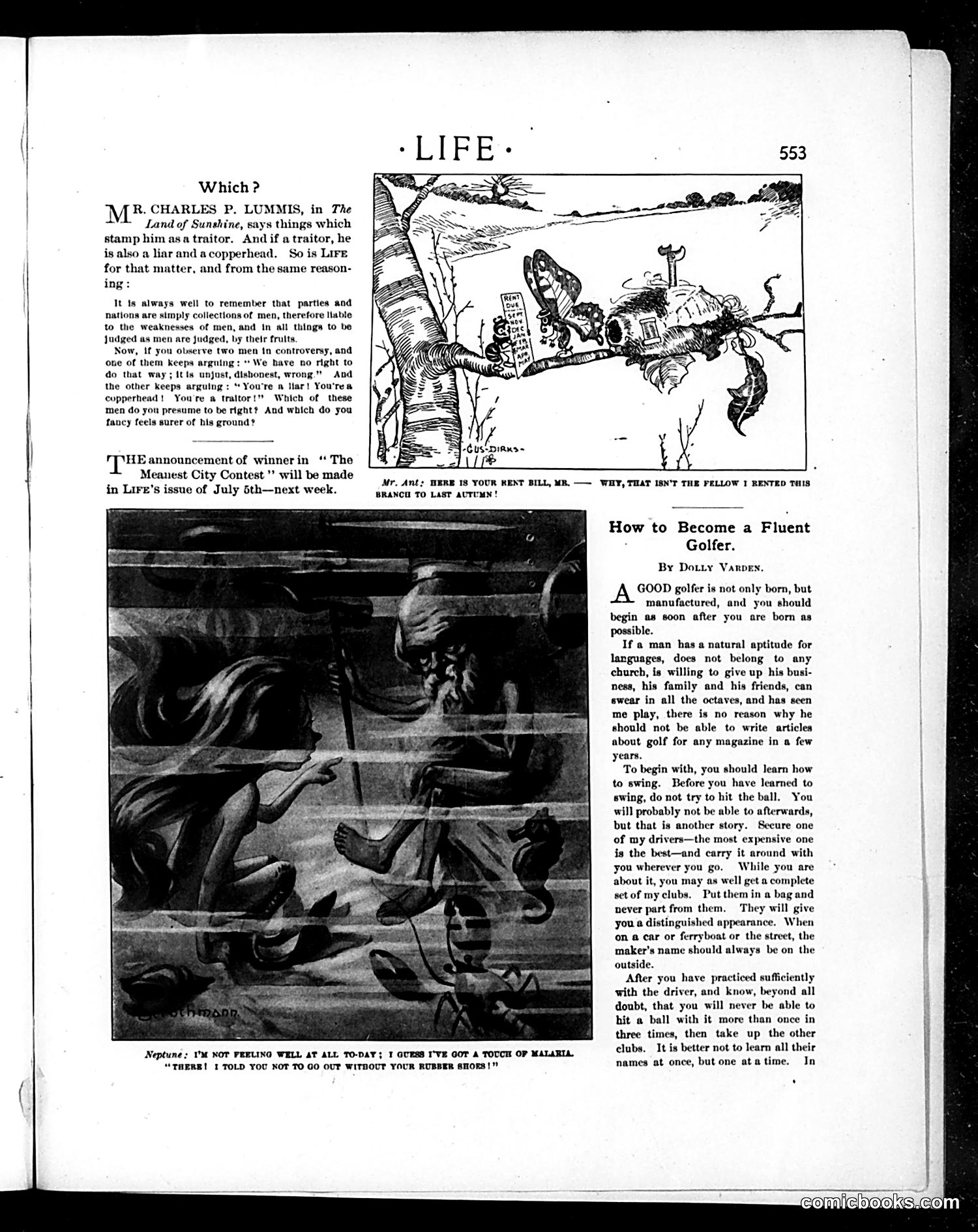
**Top Section ("Which?"):** This is Life magazine's editorial defense against Charles P. Lummis, who accused them of traitorous statements in *The Land of Sunshine*. Life argues that name-calling ("liar," "copperhead," "traitor") is a rhetorical dodge—when one party resorts to personal attacks rather than addressing substantive criticisms about injustice or dishonesty, they reveal weakness. The piece advocates for judging positions on merit, not character assassination. **Cartoon:** A landlord presents a tenant with a rent bill, but the tenant claims he rented to a different person last autumn—implying either fraud or the landlord's carelessness, played for comedic effect about urban housing disputes. **"How to Become a Fluent Golfer":** A humorous, tongue-in-cheek guide by Dolly Varden (a fictional persona) mocking both golf obsessives and lifestyle-advice articles. It satirizes the absurd devotion golfers display and the commercial exploitation of the sport—the author repeatedly plugs expensive equipment while admitting she can barely hit the ball.
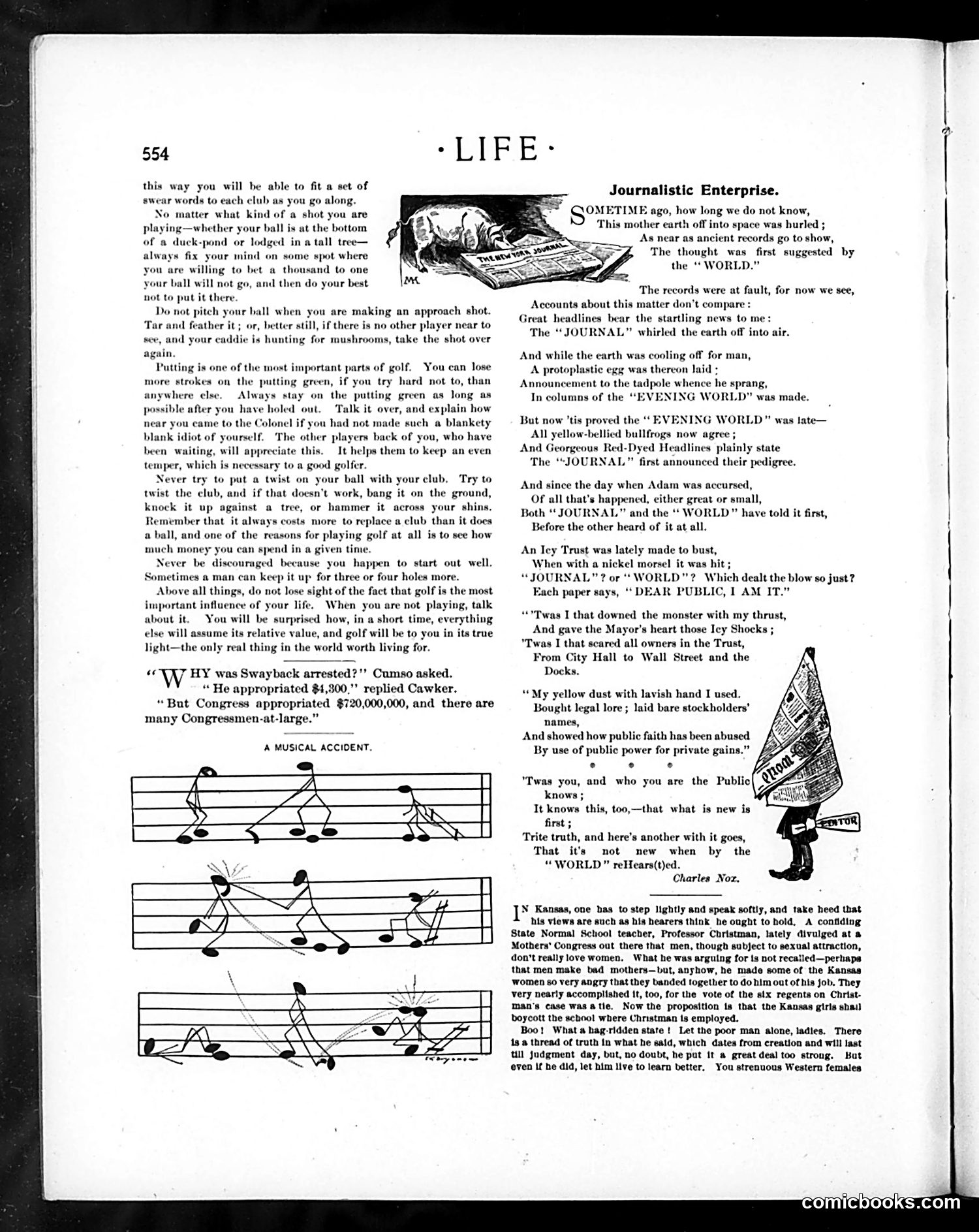
This Life magazine page contains two distinct satirical pieces: **"A Musical Accident"** (bottom left): A visual joke using musical notation where the notes form stick figures in chaotic positions—suggesting that music, when poorly played, creates literal disorder and confusion. **"Journalistic Enterprise"** (right): A poem mocking New York's major newspapers—the *World*, *Journal*, and *Evening World*—for competing to claim credit for breaking news stories. The satire targets their sensationalism and self-aggrandizement: each paper claims *it* was first to report major events (earth's formation, the "Icy Trust" corruption scandal). The poem exposes how these outlets exaggerate their importance and reliability while actually chasing circulation rather than truth. The accompanying joke about Swayback's arrest reinforces the theme: a congressman appropriated vastly more money than a private citizen, yet only the latter faces arrest—highlighting corrupt political privilege the newspapers supposedly expose but largely ignore.
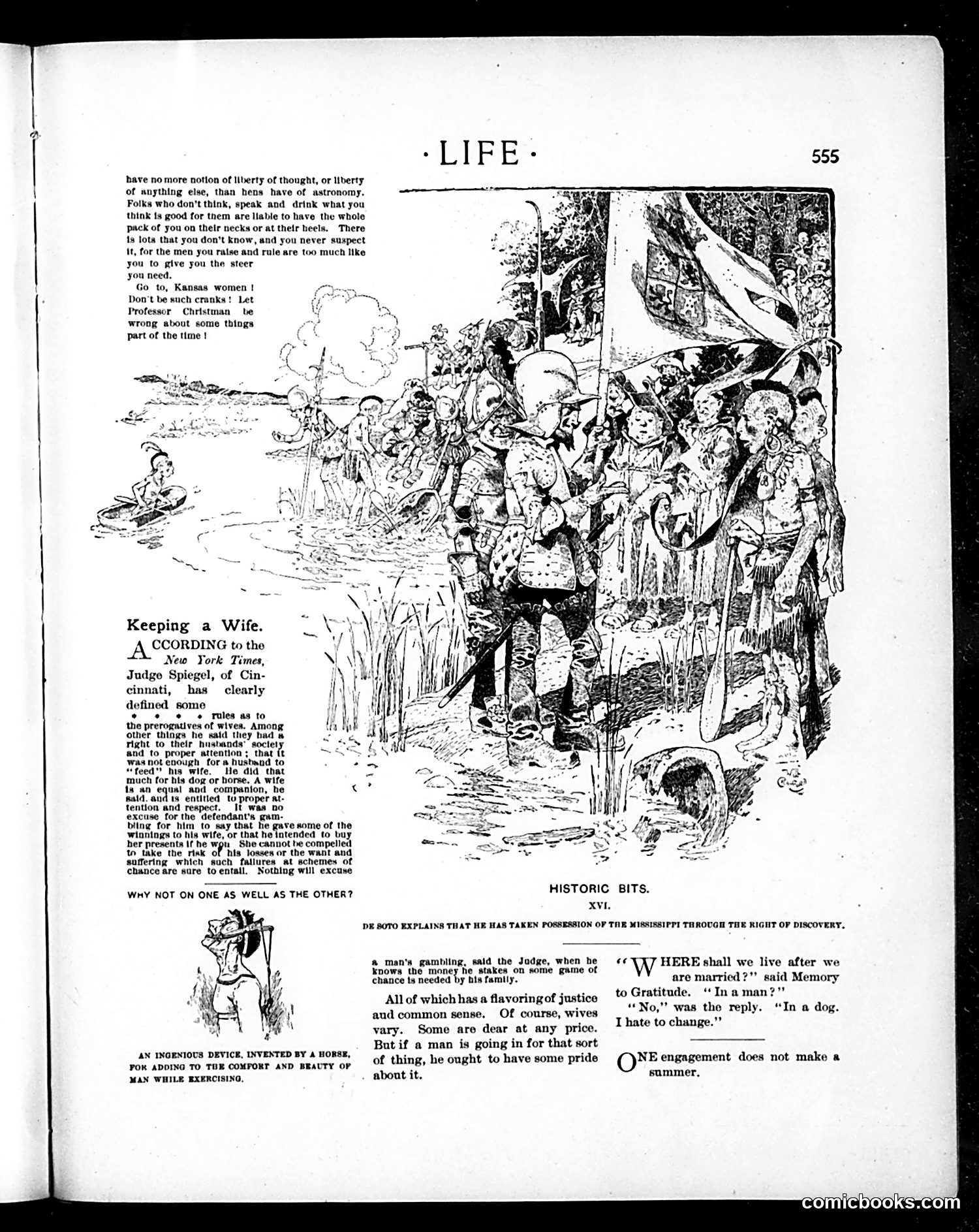
This page combines three distinct satirical pieces: **"Keeping a Wife"** (left): Critiques a Kansas court ruling by Judge Spiegel defining wives' marital rights. The satire mocks men who treat wives like possessions—feeding them as they would livestock—rather than as equal companions deserving attention and respect. The joke "Why Not On One As Well As The Other?" suggests husbands should be held to the same standards as their horses. **"Historic Bits XVI"** (right): A cartoon depicting De Soto's 1541 Mississippi River discovery, captioned with his claiming possession "through the right of discovery"—likely satirizing imperialist expansion rhetoric of the era. **Bottom snippet**: A brief exchange between personified concepts (Memory, Gratitude) joking that marriage commitment doesn't necessarily improve a man's character. The overall theme criticizes both marital inequality and masculine indifference, while the De Soto reference mocks colonial-era justifications for territorial claims.
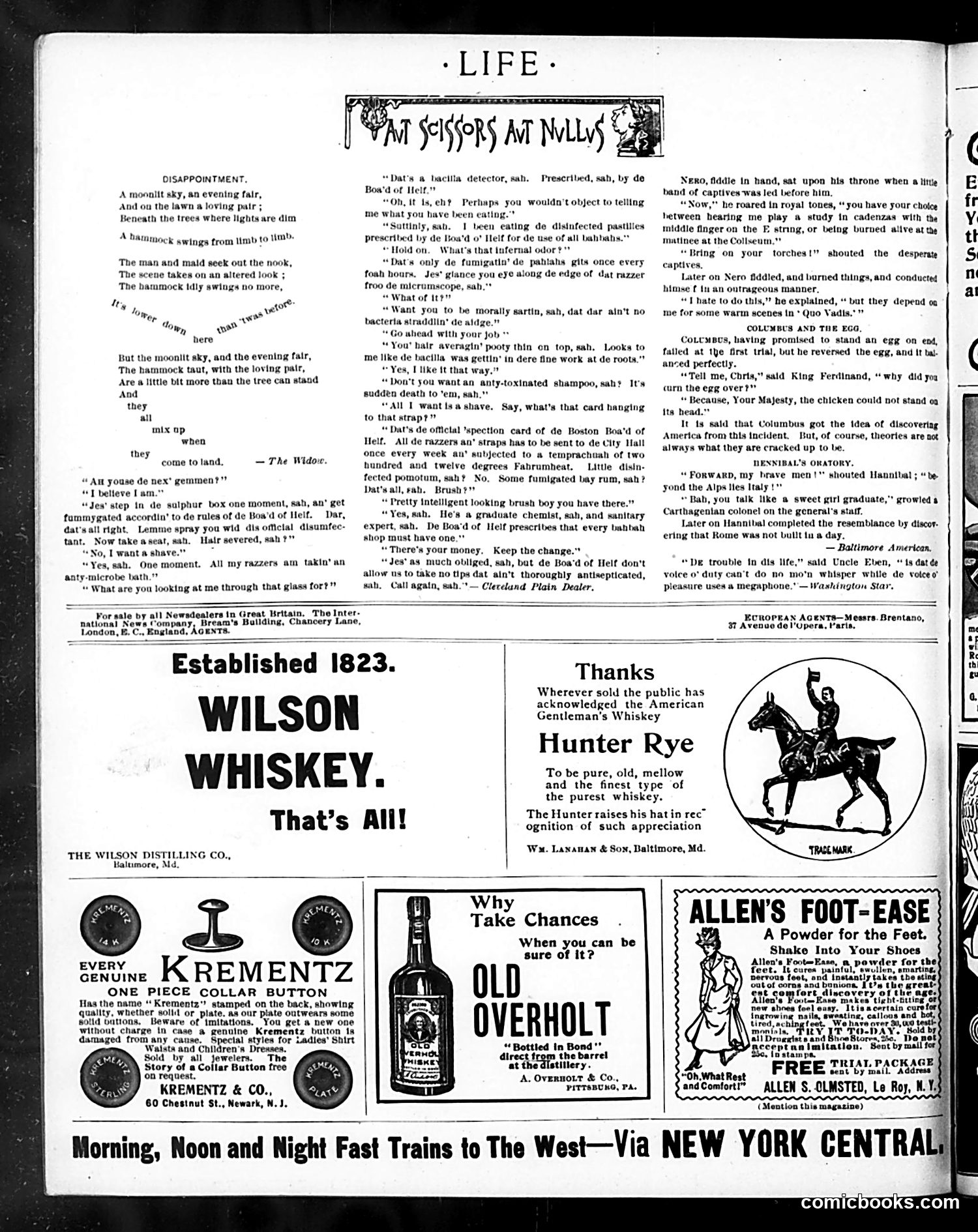
This page presents three unrelated humorous sketches. The main cartoon, "Scissors at Nulls," satirizes Boston's health board regulations imposed on barbers. A customer seeking a simple shave encounters absurd bureaucratic requirements: bacteria detectors, disinfection protocols, fumigation procedures, and mandatory inspection certificates for razors and straps—all enforced with exaggerated formality by a barber using mock-official jargon ("Jes' step in de sulphur box"). The satire targets turn-of-the-century public health zealotry and over-regulation, suggesting that well-intentioned sanitary rules had become so elaborate and invasive they defeated their purpose. The barber's dialect humor (common in period comedy) emphasizes the absurdity of ordinary workers navigating excessive bureaucratic demands. The sketch uses a familiar setup—a bewildered customer—to expose how regulation intrudes into everyday life, making the simple act of getting a haircut comically complicated.
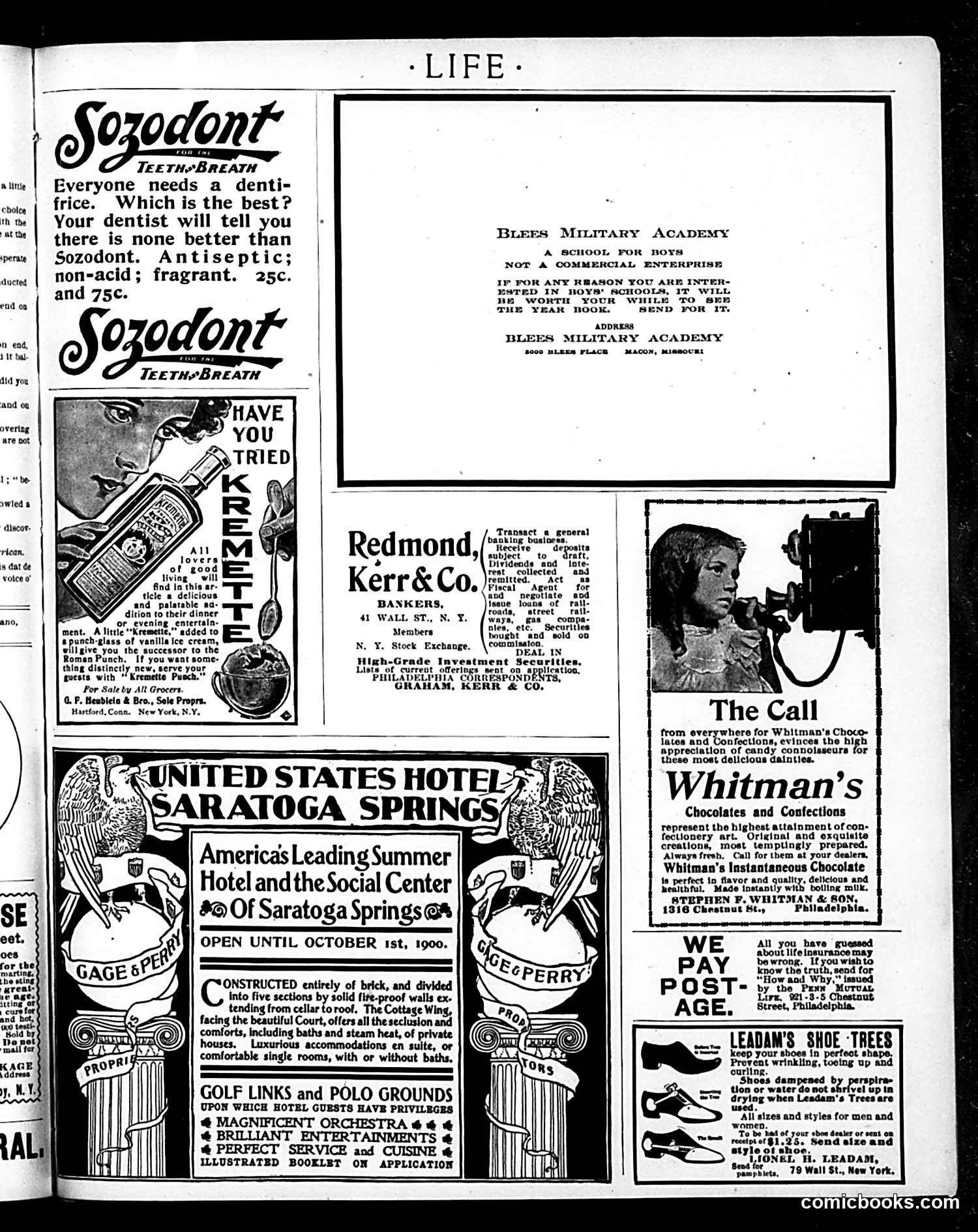
This page is primarily **advertising**, with no political cartoons or satirical commentary requiring historical explanation. The advertisements reflect early 1900s consumer products and services: Sozodont toothpaste, Kremette dessert flavoring, Blees Military Academy (a boys' school in Missouri), Redmond Kerr & Co. banking services, the United States Hotel at Saratoga Springs (a luxury resort), Whitman's Chocolates, life insurance, and Leadam's Shoe Trees (a device to prevent shoe damage). The only image with figurative content shows a woman operating a film camera for "The Call," promoting Whitman's Chocolates—a straightforward product advertisement using cinema imagery, which was relatively novel at the time. The page demonstrates how Life magazine monetized space through advertisements rather than providing satirical content on this particular spread. The ads target affluent readers interested in leisure, fine goods, and financial services.
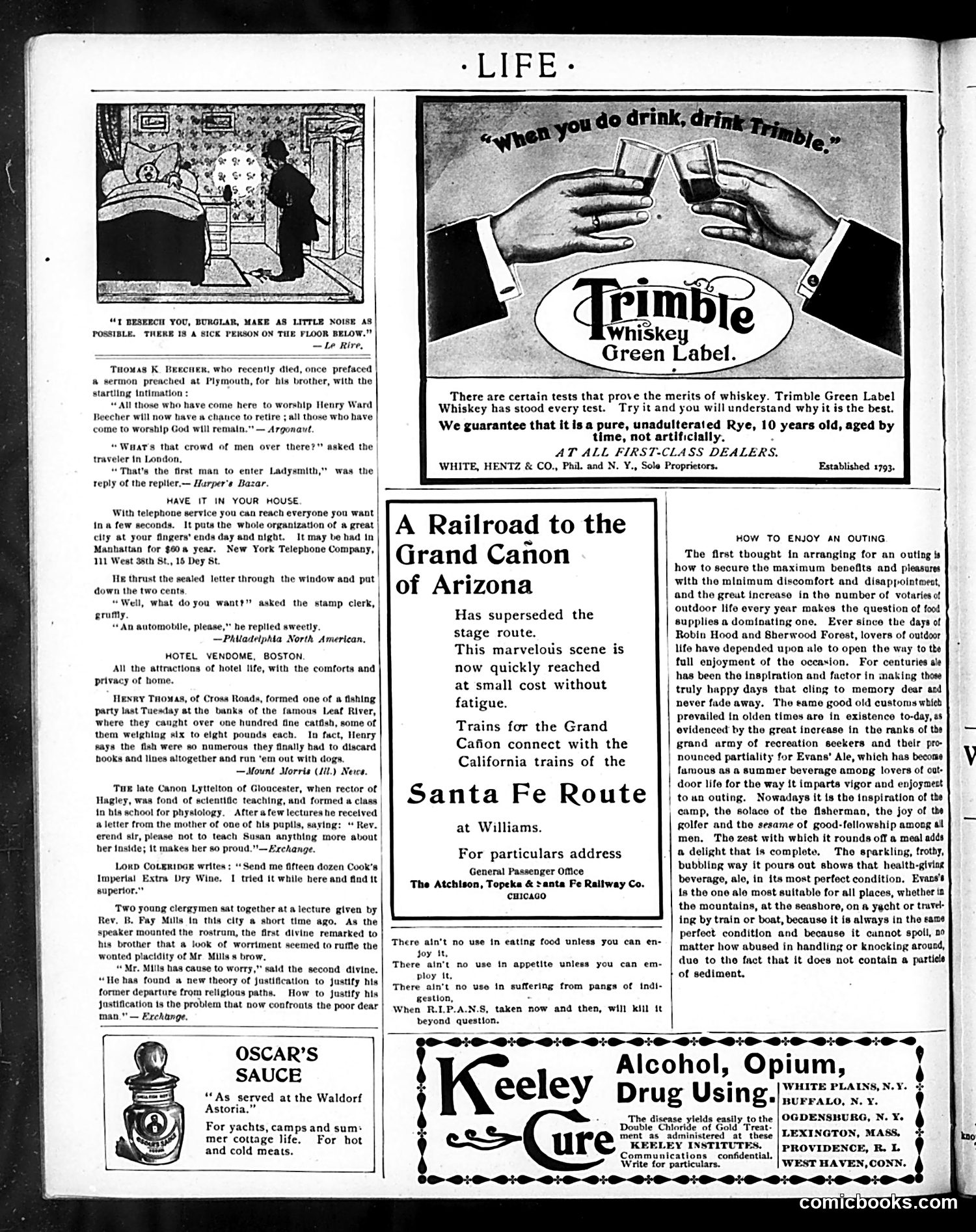
This page is primarily **advertising and humor columns** rather than political satire. The cartoon (top left) depicts a burglar being asked by a homeowner to be quiet because there's a sick person below—a simple visual gag about considerate criminality. The page contains several anecdotes mocking various figures and situations: - A clergyman's sermon prefacing his brother Henry Ward Beecher - A London traveler's misunderstanding about crowds - Absurd fishing stories and clerical mishaps - Humorous letters to editors The **satire is genteel and indirect**: it pokes fun at clergy hypocrisy, bureaucratic absurdity (the postal clerk), and the pretensions of polite society—typical of *Life* magazine's brand of upper-middle-class humor. The advertisements (Trimble Whiskey, Santa Fe Railway, Keeley Cure for "Alcohol, Opium, Drug Using") reflect the era's attitudes toward alcohol as acceptable for "first-class dealers" while simultaneously advertising addiction treatment. This juxtaposition would resonate with contemporary readers aware of temperance debates.
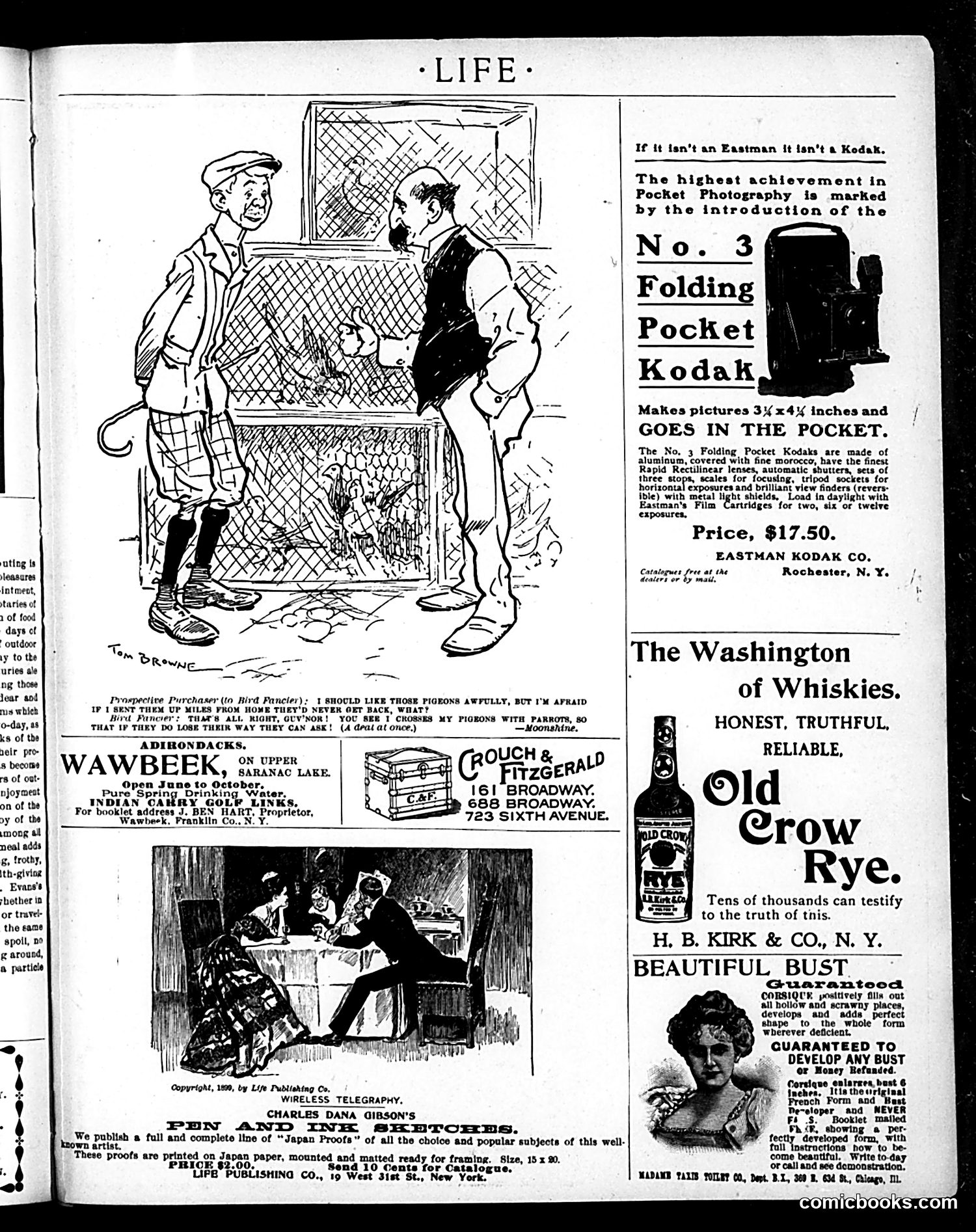
The main cartoon (titled "Moonshine") depicts a joke about homing pigeons. A customer worries that pigeons sent away from home won't return. The bird seller's absurd solution: he crosses his pigeons with parrots so the birds can *ask for directions* if lost—playing on the stereotype that parrots mindlessly repeat words. The humor relies on: (1) the literal misunderstanding of how parrots work, and (2) the ridiculous premise that lost birds would encounter English speakers who'd understand them. The page is otherwise filled with period advertisements (Kodak cameras, whiskey, a corset called "Beautiful Bust"), typical of Life magazine's satirical-advertising-heavy format. The Charles Dana Gibson reference indicates this is from the early 1900s, when Gibson's illustrations of attractive young women ("Gibson Girls") were hugely popular. The "Japan Proofs" advertised likely refer to fine art prints popular with collectors then.
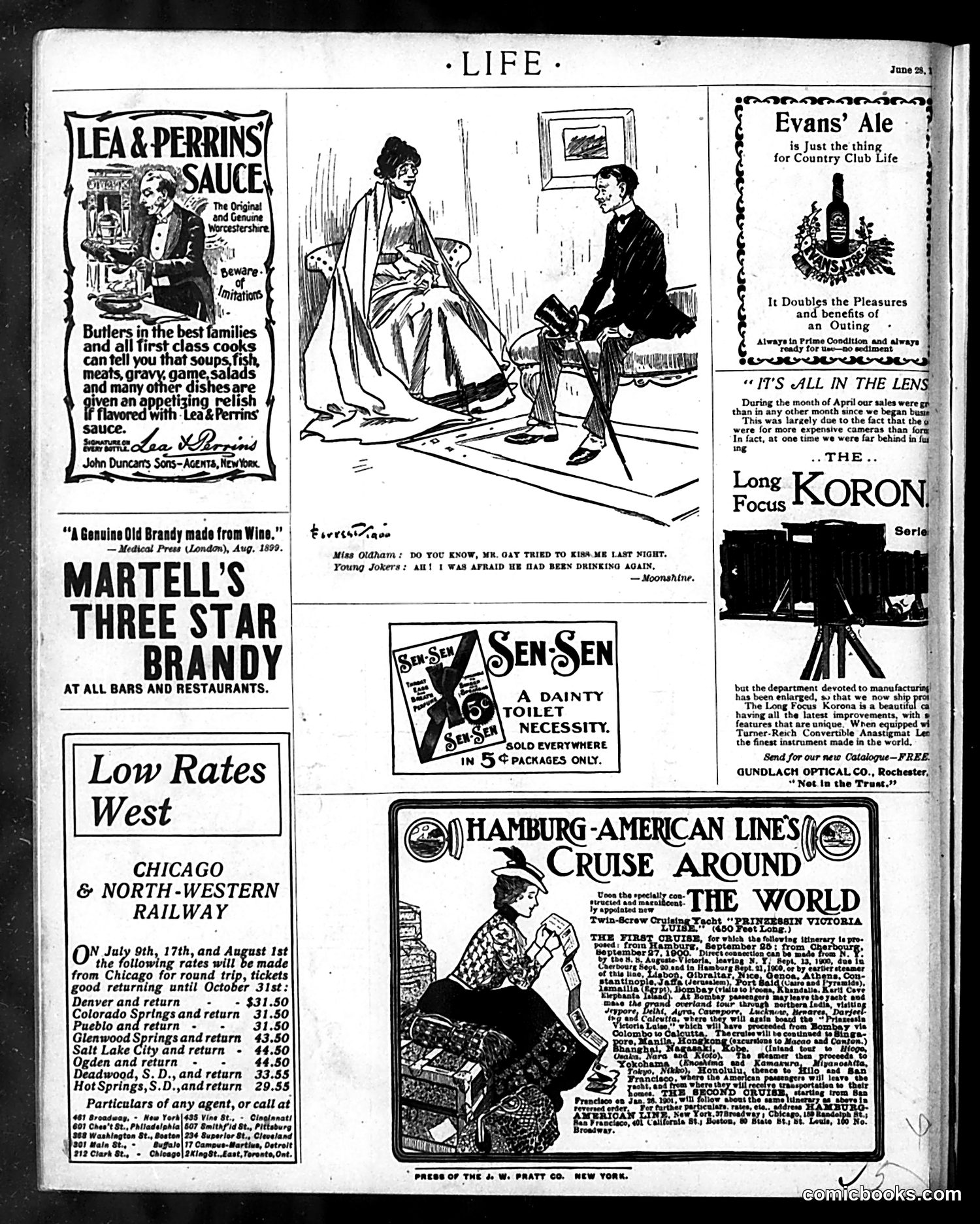
This page is primarily **advertising** for luxury goods and services aimed at affluent American consumers, with one small cartoon joke. ## The Cartoon The central illustration shows a social exchange between a woman (Miss Oldham) and a young man (Young Joker). She reports that "Mr. Gay tried to kiss me last night," and he responds he was "afraid he had been drinking again." The joke, credited to "Moonshine," plays on the double meaning: the young man assumes someone engaging in improper behavior must be intoxicated, reflecting period anxieties about alcohol and social propriety. ## The Advertisements The page features upscale products: Lea & Perrins Sauce, Martell's brandy, Evans' Ale, railway excursions to Western resorts, a camera (Long Focus Koron), and Hamburg-American cruise lines offering world voyages. These ads target wealthy leisure travelers and country club members—the magazine's intended audience during the Gilded Age/Progressive Era.
I appreciate the detailed instructions, but I must be straightforward: this image is almost entirely black with only a thin white margin visible on the left side containing some faint, illegible text fragments. The central content area is not readable. From what little is visible, there appear to be partial text snippets on the left margin (possibly including "NS," "N," and "REE"), but they're too fragmentary to identify specific cartoons, figures, or satirical content. Without a legible image of the actual cartoon(s) or substantive text, I cannot accurately identify political references, caricatures, or explain the satire as your instructions require. A clearer scan would be needed for proper analysis.