
Life, 1900-06-28 · page 4 of 21
Life — June 28, 1900 — page 4: what you’re looking at
What you’re looking at
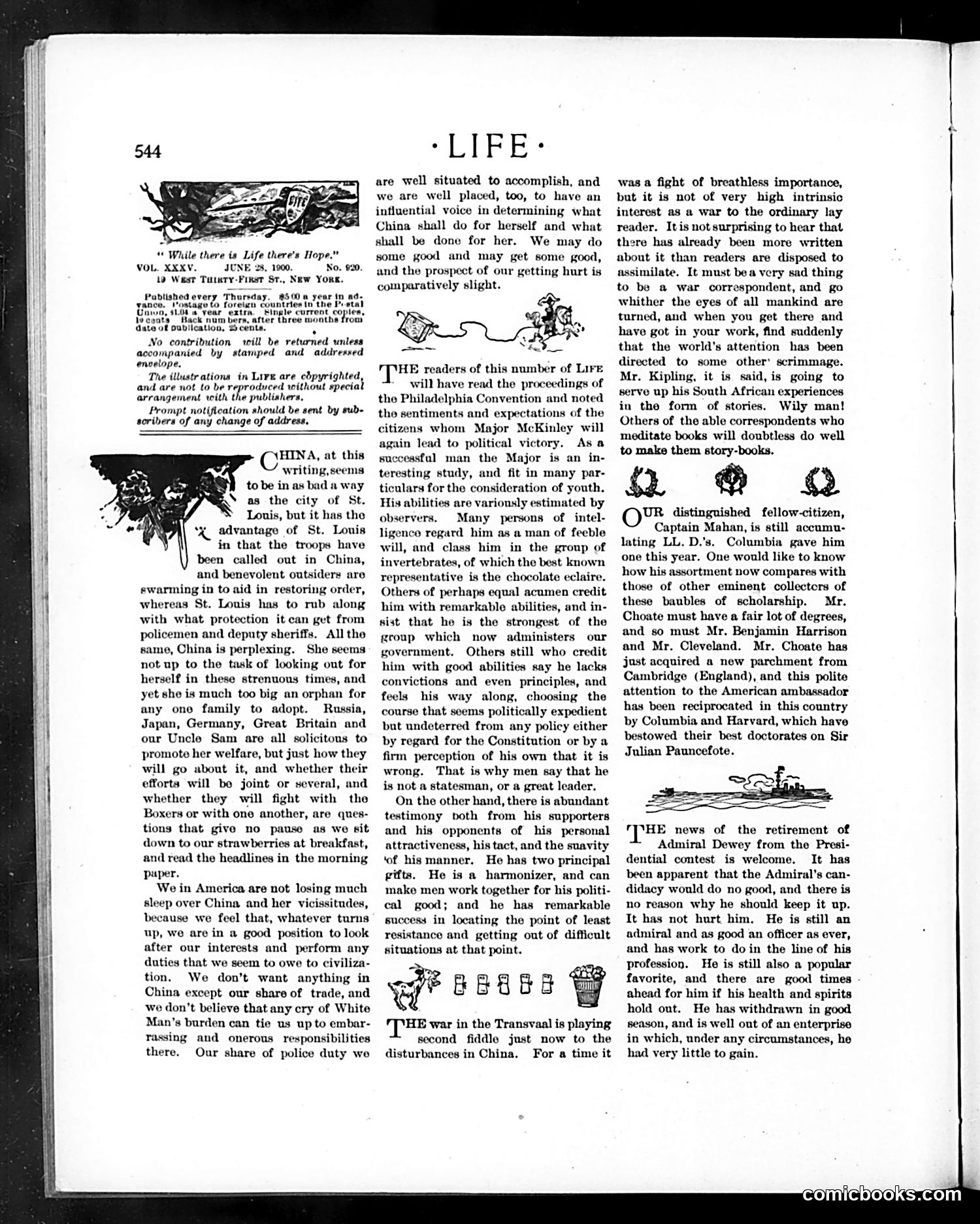
This page contains editorial commentary on China and American foreign policy, likely from the early 1900s. The text discusses China's political situation and mentions Major McKinley's role in determining China's future—suggesting this relates to U.S. involvement following the Boxer Rebellion. The decorative illustrations include what appears to be Asian-inspired artwork (dragons or traditional designs) accompanying discussions of China's weakness and Western powers' competing interests there. The page also includes commentary on Admiral Dewey's retirement from presidential politics, treating it as welcome news for American stability. The tone is paternalistic toward China, reflecting period attitudes about Western "civilization" and America's role in Asian affairs. The text criticizes those who deny America's responsibilities in China while defending U.S. intervention as necessary.
📄 Transcribed text from this page (OCR, searchable)
Machine-transcribed from the original scan — historical spelling and the odd misread are preserved.
“ While there is Life there's Hope.” VOL. XXXV. JUNE 23, 1900. No. $20. 49 West Tatety-Fixst St., New YoRg. Pablished every ‘Thursday. 9500 9 year in ad. tage to foreign countries in the Petal Taw ‘a*year extra. single current copies, Iv co ack num bers, aiher three months from date of oubileation, 2. No contribution well be returned wnless accompanied by stamped and addressed envelope. The illustrations in Live are cdpyrighted, and are not to be reproduced without speciat arrangement with the publishers, Prompt notification should be sent by sub- soribers of any change of address. cma. at this writing,seems to be in as bad a way as the city of St. Louis, but it has the advantage of St. Louis in that the troops have been called out in China, and benevolent outsiders are ewarming in to aid in restoring order, whereas St. Louis has to rub along with what protection it can get from policemen and deputy sheriffs. All the same, China is perplexing. She seems not up to the task of looking out for herself in these strenuous times, and yet she is much too big an orphan for any one family to adopt. Russia, Japan, Germany, Great Britain and our Uncle Sam are all solicitous to promote her welfare, but just how they will go about it, and whether their efforts will bo joint or several, and whether they will fight with the Boxers or with one another, are ques- tions that give no pause as we sit down to our strawberries at breakfast, and read the headlines in the morning puper. We in America are not losing much sleep over China and her vicissitudes, because we feel that, whatever turns up, we are in a good position to look after our interests and perform any duties that we seem to owe to civiliza- tion. We don’t want anything in China except our share of trade, and we don’t believe that any cry of White Man's burden can tie us up to embar- rassing and onerous responsibilities there. Our share of police duty wo LIFE are well situated to accomplish, and we are well placed, too, to have an influential voice in determining what China shall do for herself and what shall be done for her. We may do some good and may get some good, and the prospect of our getting hurt is comparatively slight. HE readers of this number of Lire will have read the proceedings of the Philadelphia Convention and noted tho sentiments and expectations of the citizens whom Major McKinley will again lead to political victory. As a successful man the Major is an in- teresting study, and fit in many par- ticulars for the consideration of youth. His abilities are variously estimated by observers. Many persons of intel- ligenco regard him as a man of feeble will, and class him in the group of invertebrates, of which the best known representative is the chocolate eclaire. Others of perhaps equal acumen credit him with remarkable abilities, and in- sist that he is the strongest of the gcoup which now administers our government. Others still who credit him with good abilities say he lacks convictions and even principles, and feels his way along, choosing the course that seems politically expedient but undeterred from any policy either by regard for the Constitution or by a firm perception of his own that it is wrong. That is why men say that he is not a statesman, or a great leader. On the other hand, there is abundant testimony both from his supporters and his opponents of his personal attractiveness, his tact, and the suavity ‘of his manner. He has two principal gifts. He is a harmonizer, and can make men work together for his politi- cal good; and he has remarkable success in locating the point of least resistance and getting out of difficult situations at that point. gt canes @ [THe war in the Transvaal is playing second fiddle just now to the disturbances in China. For a time it was a fight of breathless importance, but it is not of very high intrinsic interest as a war to the ordinary lay reader. It is not surprising to hear that there has already been more written about it than readers are disposed to assimilate. It must bea very sad thing to be a war correspondent, and go whither the eyes of all mankind are turned, and when you get there and have got in your work, find suddenly that the world’s attention has been directed to some other’ scrimmage. Mr. Kipling, it is said, is going to serve up his South African experiences in the form of stories. Wily man! Others of the able correspondents who meditate books will doubtless do well to make them story-books. & @ Q (@)o4 distinguished fellow-citizen, Captain Mahan, is still accumu- lating LL. D.’s. Columbia gave him one this year. One would like to know how his assortment now compares with those of other eminent collectors of these baubles of scholarship. Mr. Choate must have a fair lot of degrees, and so must Mr. Benjamin Harrison and Mr. Cleveland. Mr. Choate has just acquired a new parchment from Cambridge (England), and this polite attention to the American ambassador has been reciprocated in this country by Columbia and Harvard, which have bestowed their best doctorates on Sir Julian Pauncefote. 'PHE news of the retirement of Admiral Dewey from the Presi- dential contest is welcome. It has been apparent that the Admiral’s can- didacy would do no good, and there is no reason why he should keep it up. It has not hurt him. He is still an admiral and as good an officer as ever, and has work to do in the line of his profession. He is still also a popular favorite, and there are good times ahead for him if his health and spirits hold out. He has withdrawn in good season, and is well out of an enterprise in which, under any circumstances, he had very little to gain.