
Life, 1900-06-28 · page 8 of 21
Life — June 28, 1900 — page 8: what you’re looking at
What you’re looking at
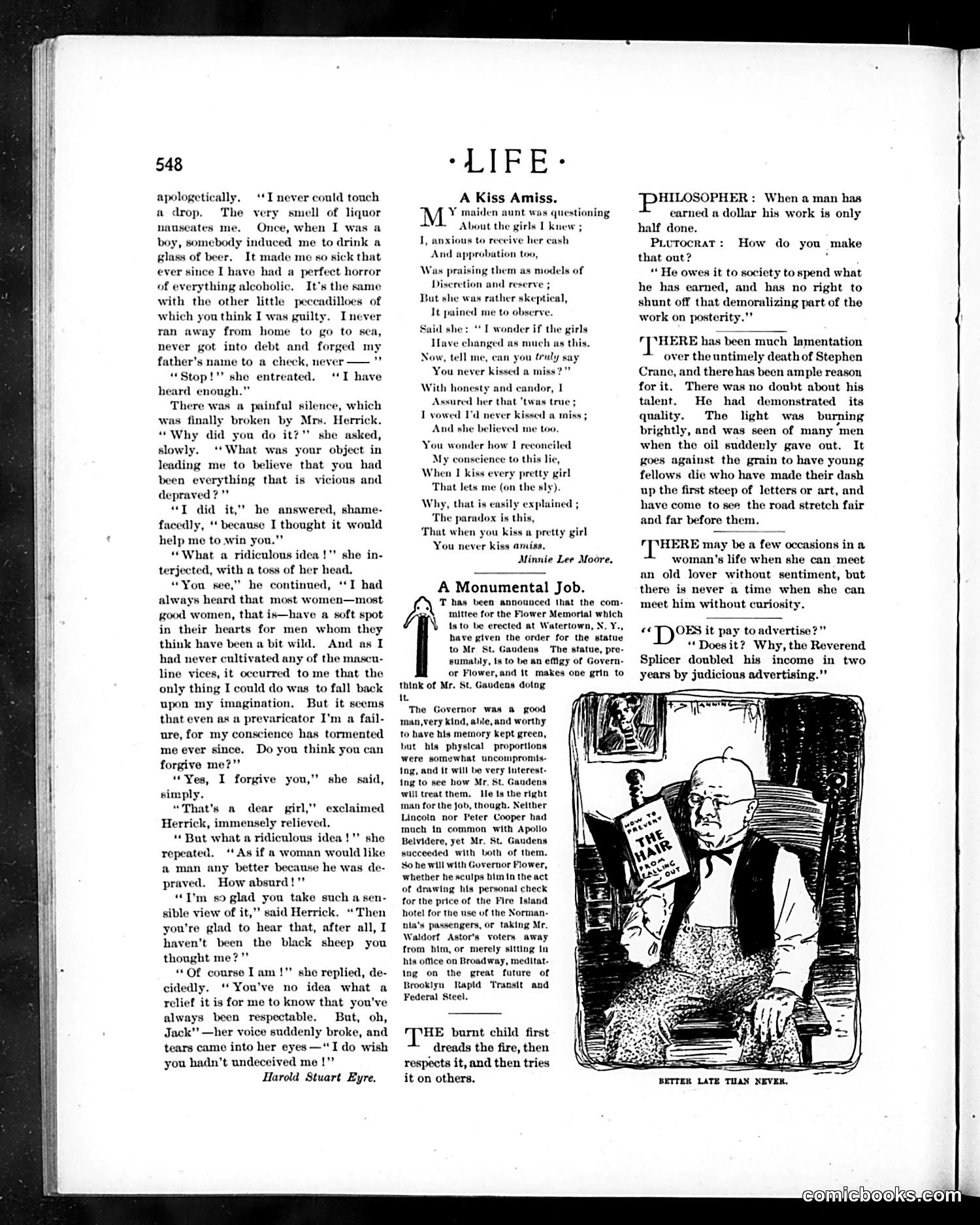
This page contains literary excerpts and one cartoon titled "Better Late Than Never." The cartoon depicts an older man reading what appears to be a newspaper or publication while seated. The figure seems to represent someone catching up with news or information belatedly—hence the title's ironic message about tardiness. The page's main content consists of philosophical and romantic prose pieces, including "A Kiss Amiss" and "A Monumental Job," alongside commentary on Stephen Crane's death and remarks about advertising effectiveness. Without additional context about the specific historical date or prominent figures referenced, I cannot definitively identify the cartoon's subject. The humor appears to rely on timing and delayed awareness—a common satirical theme in Life magazine's commentary on contemporary society.
📄 Transcribed text from this page (OCR, searchable)
Machine-transcribed from the original scan — historical spelling and the odd misread are preserved.
548 apologetically, ‘*I never could touch a drop. The very smell of liquor nauseates me. Once, when I was a boy, somebody induced me to drink a glass of beer. It made me so sick that ever since I have had a perfect horror of everything alcoholic. It’s the same with the other little peccadilloes of which you think I was guilty. I never ran away from home to go to sea, never got into debt and forged my father’s name to a check, never — ” Stop!’’ she entreated. ‘I have heard enough.” There was a painful silence, which was finally broken by Mrs. Herrick. “Why did you do it?” she asked, slowly. ‘What was your object in leading me to believe that you had been everything that is vicious and depraved?” “T did it,” he answered, shame- facedly, ‘ because I thought it would help me to win you.” “What a ridiculous idea!" she in- terjected, with a toss of her head. “You see,” he continued, ‘I had always heard that most women—most good women, that is—have a soft spot in their hearts for men whom they think have been a bit wild. And as I had never cultivated any of the mascu- line vices, it occurred to me that the only thing I could do was to fall back upon my imagination. But it seems that even as a prevaricator I'm a fail- ure, for my conscience has tormented me ever since. Do you think you can forgive me?” “Yes, I forgive you,”’ she said, simply. “That's a dear girl,” exclaimed Herrick, immensely relieved. “But what a ridiculous idea !’’ sho repeated. ‘‘As if a woman would like a man any better because he was de- praved. How absurd!" “Tm so glad you take such a sen- sible view of it,” said Herrick. “Then you're glad to hear that, after all, I haven’t been the black sheep you thought me?’’ “Of course Iam !”” she replied, de- cidedly. ‘You've no idea what a relief it is for me to know that you've always been respectable. But, oh, Jack" —her voice suddenly broke, and tears came into her eyes —**I do wish you hadn’t undeceived me !"” Harold Stuart Eyre. “dP E + A Kiss Amiss. MY maiden aunt was questioning About the girls I knevw ; us to receive her cash ation too, I, anx And appre them as models of It pa me to observe. Said she: “I wonder if the girls Have changed as much as this. tell me, can you truly say You never kissed a miss?” With honesty and candor, I Assured her that "twas tr I vowed I'd ni And she be F how I rec y ience to this lie, When I kiss every pretty girl That lets me (on the sly). Wh kissed a iniss ; that is explained ; » paradox is this, ‘That when you kiss a pretty girl You never kiss amiss, Minnie Lee Moore, A Monumental Job. T has been announced that the com- mittee for the Flower Memorial which is to be erected at Watertown Y., have given the order for the statue to Mr St. Gaudens The statue, pre- sumably, Is to be an eMgy of Govern- or Flower, and it makes one grin to think of Mr. St. Gaudens dotng it The Governor was a good man,very kind, able, and worthy to have his memory kept green, but bis physical proportions were somewhat uncompromis- ing, and it will be very Interest- ing to see how Mr. St. Gaudens will treat them, He ts the right man for the job, though. Neither Lincoln nor Peter Cooper had much in common with Apollo Belvidere, yet Mr. St. Gaudens succeeded with both of them, So he will with Governor Flower, whether he xculps bim tn the act of drawing his personal check for the price of the Fire Island hotel for the use of the Norman- nla's passengers, or taking Mr. Waldorf Astor's voters away from him, or merely sitting in his office on Broadway, meditat- ing on the great future of Brooklyn Rapid Transit and Federal Steel. \ HE burnt child first dreads the fire, then respects it, and then tries it on others, HILOSOPHER : When a man has earned a dollar his work is only half done. Piutocrat: How do you make that out? . “He owes it to society to spend what he has earned, and has no right to shunt off that demoralizing part of the work on posterity.” [HERE has been much lamentation over the untimely death of Stephen Crane, and there has been ample reason for it. There was no doubt about his talent. He had demonstrated its quality. The light was burning brightly, and was seen of many ‘men when the oil suddenly gave out. It goes against the grain to have young fellows die who have made their dash up the first steep of letters or art, and have come to see the road stretch fair and far before them. "THERE may be a few occasions in a woman's life when she can meet an old lover without sentiment, but there is never a time when she can meet him without curiosity. «TOES it pay to advertise?” “Does it? Why, the Reverend Splicer doubled his income in two years by judicious advertising.” BETTER LATE TUAN NEVER.