
Life, 1900-06-28 · page 12 of 21
Life — June 28, 1900 — page 12: what you’re looking at
What you’re looking at
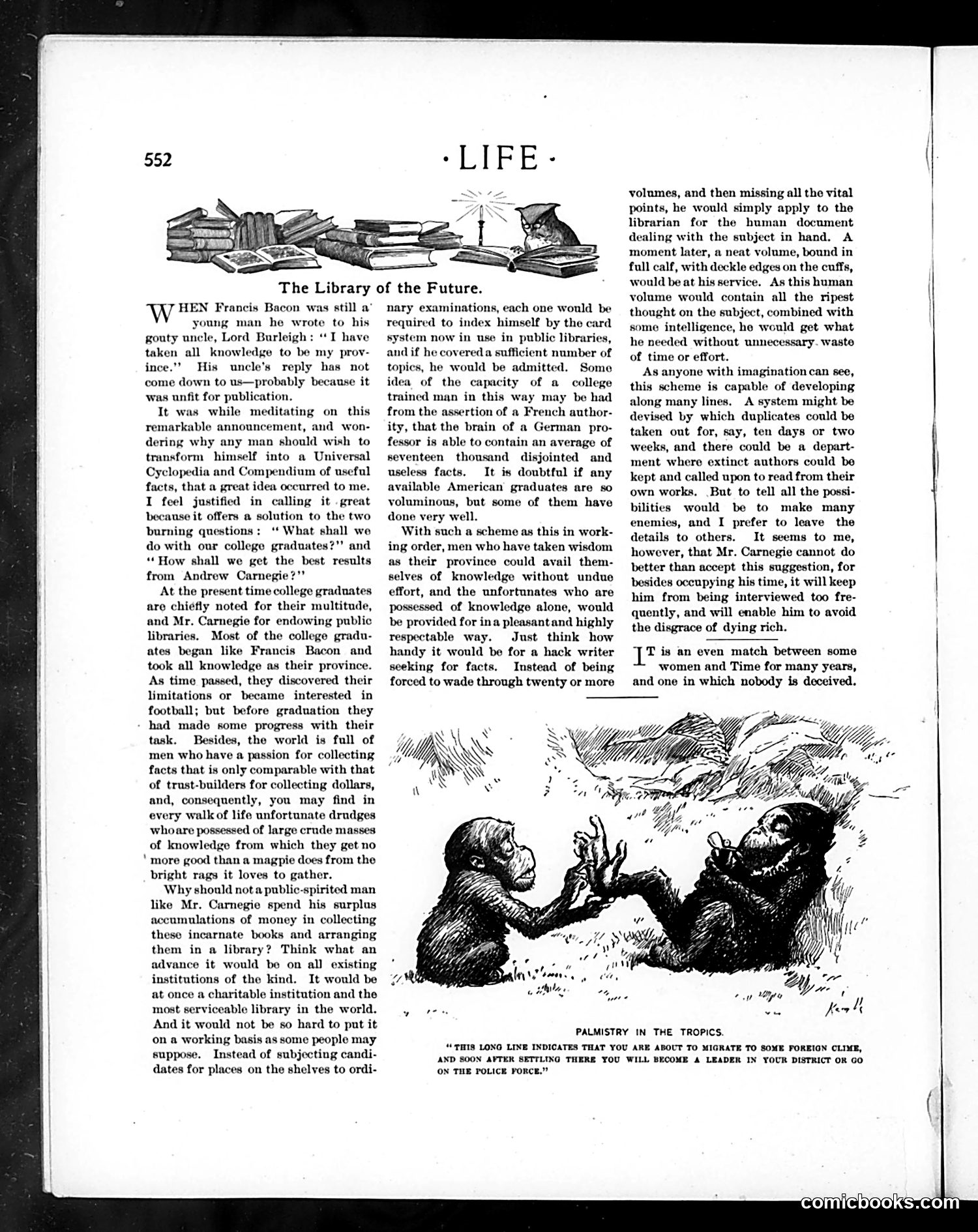
This cartoon depicts two apes examining each other's palms in a tropical setting. The caption reads: "THIS LONG LINE INDICATES THAT YOU ARE ABOUT TO MIGRATE TO SOME FOREIGN CLIME, AND SOON AFTER SETTLING THERE YOU WILL BECOME A LEADER IN YOUR DISTRICT OR GO ON THE POLICE FORCE." The satire appears to mock both fortune-telling (palmistry) and the appointment of unqualified individuals to colonial administrative or police positions. By depicting apes as the subjects, the cartoon implies that such postings attract people of limited ability—suggesting that colonial governance attracts incompetent or buffoonish officials. The humor targets both the pseudoscience of palmistry and colonial administration's apparent disregard for qualifications.
📄 Transcribed text from this page (OCR, searchable)
Machine-transcribed from the original scan — historical spelling and the odd misread are preserved.
The Library of the Future. HEN Francis Bacon was still a’ young man he wrote to his gouty uncle, Lord Burleigh: “I have taken all knowledge to be my prov- ince.” His uncle's reply has not come down to us—probably because it was unfit for publication. It was while meditating on this remarkable announcement, and won- dering why any man should wish to transform himself into a Universal Cyclopedia and Compendium of useful facts, that a great idea occurred to me. I feel justified in calling it .great because it offers a solution to the two burning questions: ‘ What shall we do with our college graduates?” and “How shall we get the best results from Andrew Carnegie?" At the present time college graduates are chiefly noted for their multitude, and Mr. Carnegie for endowing public libraries. Most of the college gradu- ates began like Francis Bacon and took all knowledge as their province. As time passed, they discovered their limitations or became interested in football; but before graduation they had made some progress with their task. Besides, the world is full of men who have a passion for collecting facts that is only comparable with that of trust-builders for collecting dollars, and, consequently, you may find in every walk of life unfortunate drudges whoare possessed of large crude masses of knowledge from which they get no ‘ more good than a magpie does from the bright rags it loves to gather. Why should nota public-spirited man like Mr. Carnegie spend his surplus accumulations of money in collecting these incarnate books and arranging them in a library? Think what an advance it would be on all existing institutions of the kind. It would be at once a charitable institution and the most serviceable library in the world. And it would not be so hard to put it on a working basis as some people may suppose. Instead of subjecting candi- dates for places on the shelves to ordi- nary examinations, each one would be required to index himself by the card system now in use in public libraries, and if he covered a sufficient number of topics, he would be admitted. Some idea of the capacity of a college trained man in this way may be had from the assertion of a French author- ity, that the brain of a German pro- fessor is able to contain an average of seventeen thousand disjointed and useless facts. It is doubtful if any available American graduates are so voluminous, but some of them have done very well. With such a scheme as this in work- ing order, men who have taken wisdom as their province could avail them- selves of knowledge without undue effort, and the unfortunates who are possessed of knowledge alone, would be provided for ina pleasantand highly respectable way. Just think how handy it would be for a hack writer seeking for facts. Instead of being forced to wade through twenty or more volumes, and then missing all the vital points, he would simply apply to the librarian for the human document dealing with the subject in hand. A moment later, a neat volume, bound in full calf, with deckle edges on the cuffs, would be at his service. As this human volume would contain all the ripest thought on the subject, combined with some intelligence, he would get what he needed without unnecessary. waste of time or effort. AS anyone with imagination can see, this scheme is capable of developing along many lines. A system might be devised by which duplicates could be taken out for, say, ten days or two weeks, and there could be a depart- ment where extinct authors could be kept and called upon to read from their own works, .But to tell all the possi- bilities would be to make many enemies, and I prefer to leave the details to others. It seems to me, however, that Mr. Carnegie cannot do better than accept this suggestion, for besides occupying his time, it will keep him from being interviewed too fre- quently, and will enable him to avoid the disgrace of dying rich. ‘7 T is an even match between some women and Time for many years, and one in which nobody is deceived. PALMISTRY IN THE TROPICS. “THIS LONG LINE INDICATES THAT YOU ARE ABOUT TO MIGRATE TO SOME FOREION CLIME, AND SOON AFTER SETTLING THERE YOU WILL BECOME 4 LEADER IN YOUR DISTRICT OR GO ON THE POLICE FORCE.”