
A complete issue · 20 pages · 1900
Life — June 14, 1900
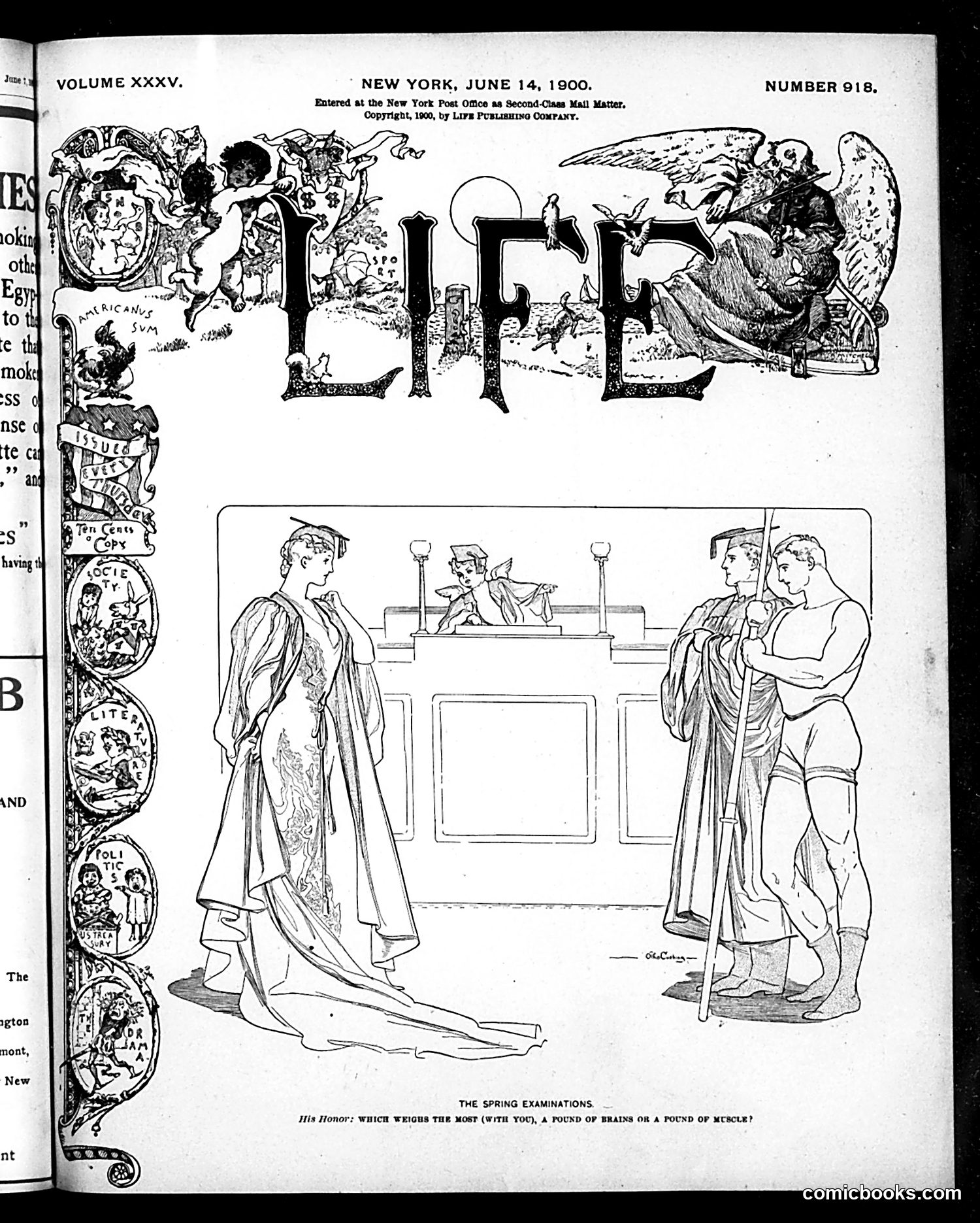
This cartoon satirizes academic testing with a classical allegory. The title's subtitle asks: "His Honor: Which weighs the most (with you), a pound of brains or a pound of muscle?" The scene depicts what appears to be an examination or judgment scenario in classical dress. On the left stands a woman in elaborate robes (likely representing Academia or Learning). On the right are two muscular male figures with a winged authority figure presiding above them. The satire appears to critique how educational institutions weigh intellectual versus physical attributes—suggesting that brains and brawn are being evaluated equally, or that physical prowess may be overvalued in American educational contexts. The classical styling emphasizes the timelessness of this tension between intellectual and athletic achievement in schools.
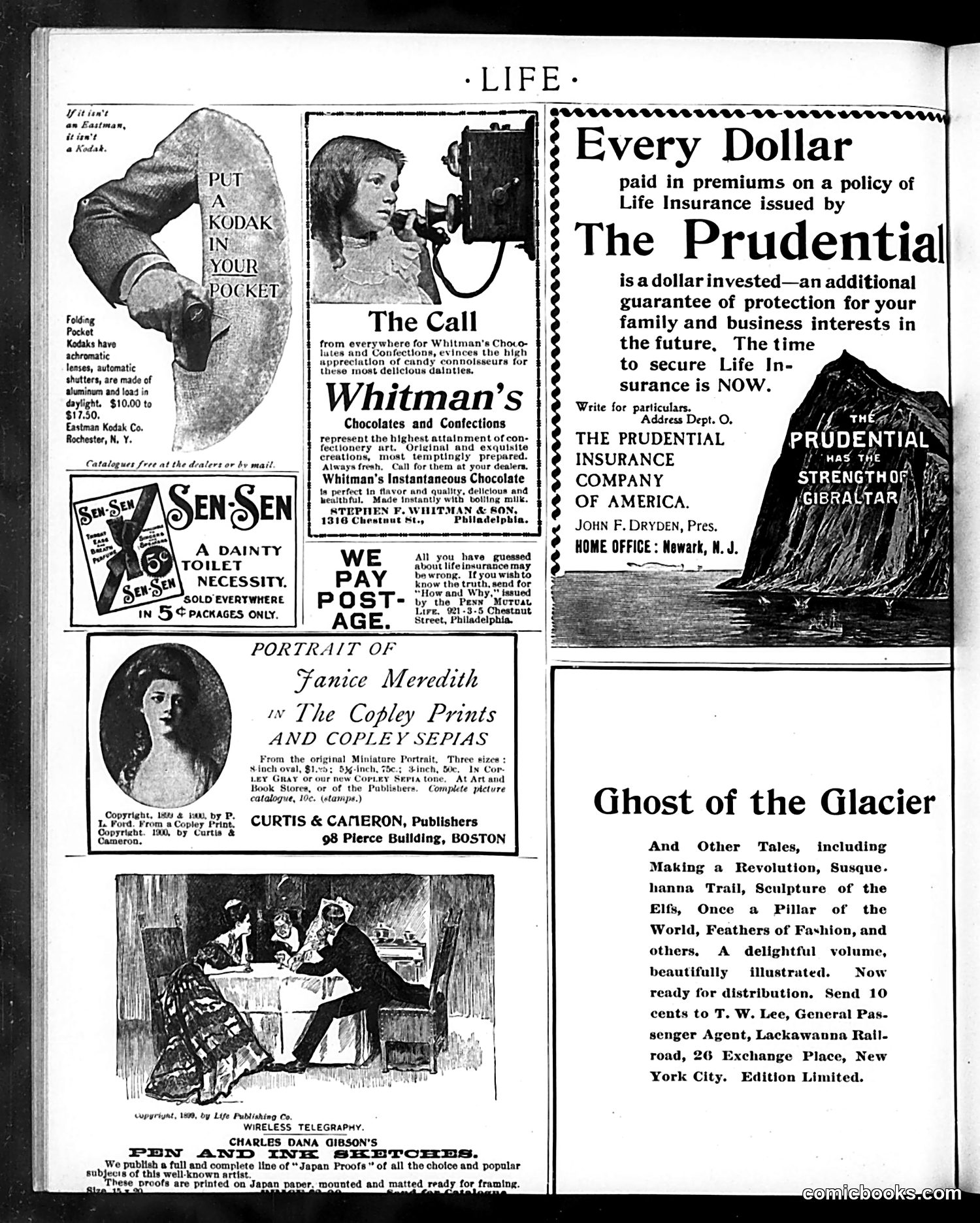
This page is primarily **advertising**, not political satire. The main content includes: 1. **Kodak camera ad** (top left): Promotes pocket-sized Kodak cameras with the slogan "Put a Kodak in Your Pocket"—emphasizing portable photography for everyday use. 2. **Whitman's Chocolates ad** (center): Features a woman using a telephone, advertising their products as gifts ("The Call from everywhere"). 3. **Sen-Sen breath mint ad** (left): A "dainty toilet necessity" sold in 5-cent packages. 4. **The Prudential Insurance ad** (right): Emphasizes life insurance as financial protection with the company's Gibraltar Rock logo. 5. **Book advertisement** (bottom right): Promotes "Ghost of the Glacier" and other tales. The page reflects early 20th-century consumer advertising targeting middle-class households, with no apparent political commentary or satire.
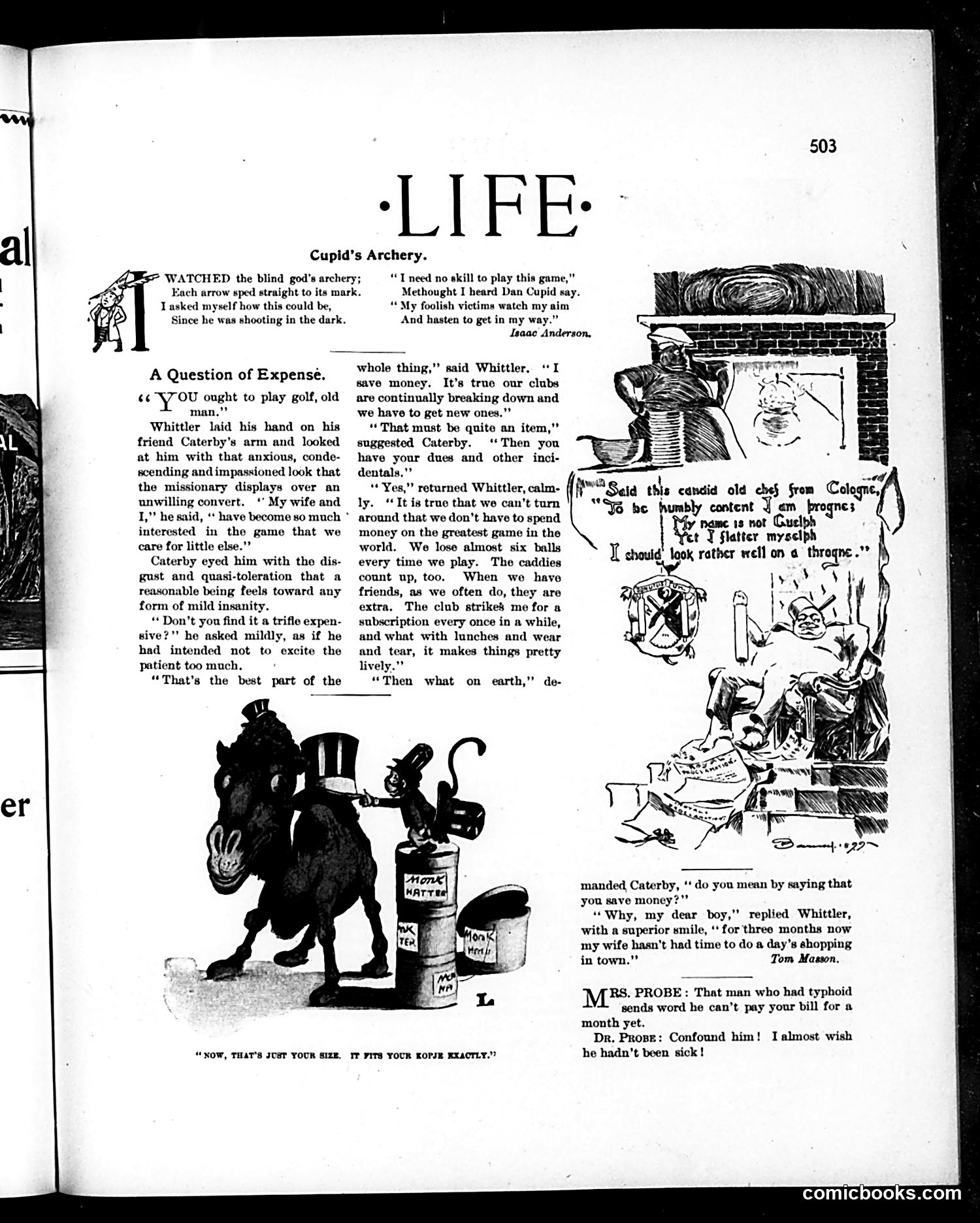
This page contains three distinct pieces of humor: 1. **"Cupid's Archery"** (top left): A brief poem about Cupid's blind marksmanship, playing on the classical trope that love is blind and uncontrolled. 2. **"A Question of Expense"** (main text): A dialogue between Whittler and Caterby about golf club expenses. Whittler argues that constantly replacing broken golf balls is an unavoidable cost. The satire targets upper-class leisure spending and the rationalization of unnecessary expenses—a gentleman justifying frivolous expenditure to his more frugal friend. 3. **Bottom illustration**: Shows a camel or similar creature with bottles labeled "More Hatter" and other items, captioned "Now, that's just your size. It fits your roper exactly." The meaning is unclear without additional context. The page reflects early 20th-century American humor about class, spending habits, and genteel society.
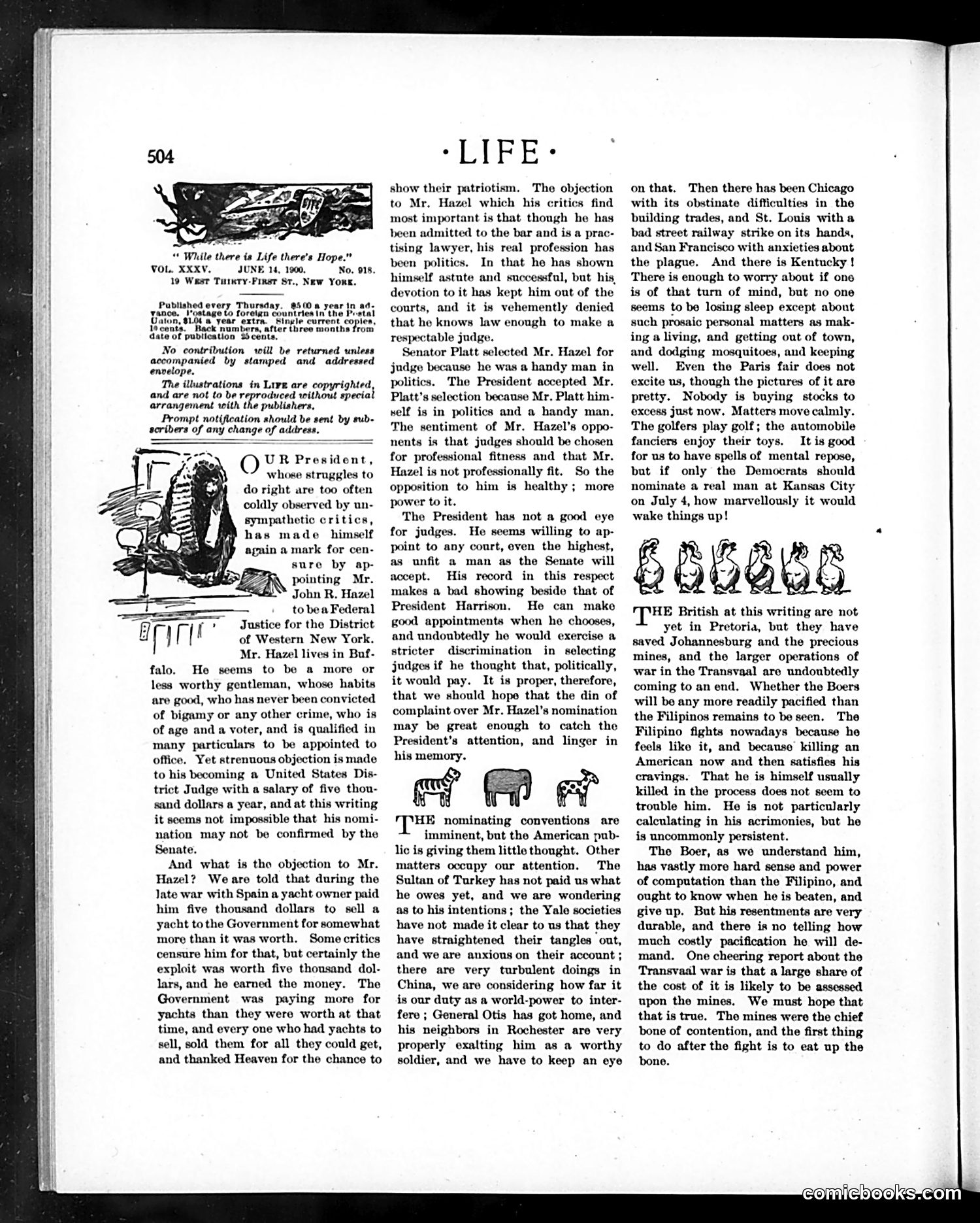
This page from *Life* magazine (Vol. XXXV, June 21, 1900) contains political commentary about President McKinley's judicial appointments, particularly John R. Hazel as District Judge for Western New York. The text criticizes Mr. Hazel's nomination, arguing that while he's "a handy man in politics," judges should be selected for legal fitness, not political service. The article suggests the President shows poor judgment in court appointments and may appoint unqualified candidates if politically convenient. The small cartoons (elephant, donkey figures) appear to illustrate political party concerns. The overall satire critiques the corruption of judicial appointments through partisan politics—a common *Life* magazine theme opposing the spoils system.
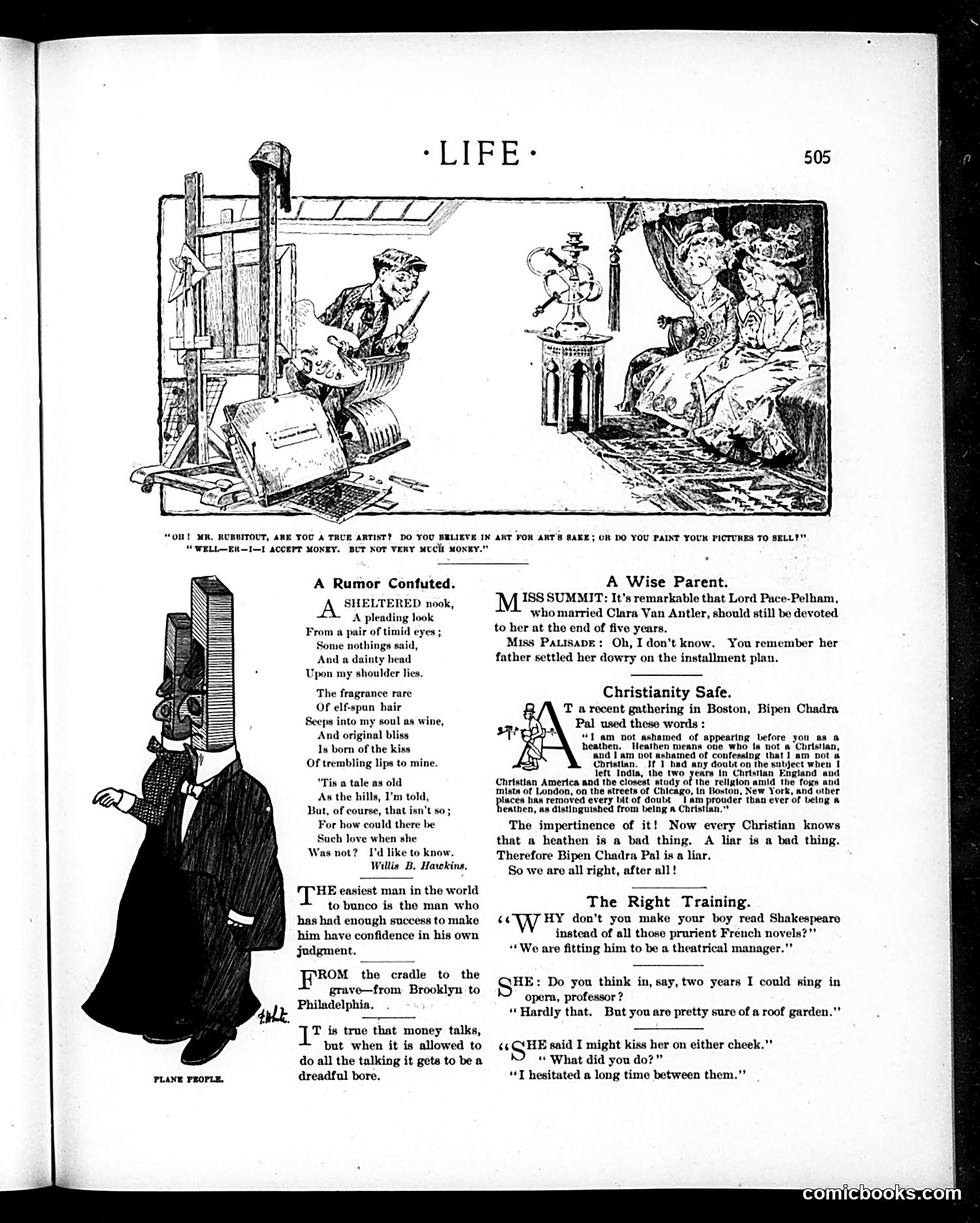
**Top cartoons:** Two scenes satirizing artistic pretension. Left shows a struggling artist at an easel; right depicts wealthy patrons. The caption mocks artists who claim to create "for art's sake" while actually needing to sell work for money—exposing hypocrisy about artistic integrity versus commercial necessity. **"A Rumor Confused":** A poem about gossip and misrepresentation, illustrated by a figure hunched over, suggesting how rumors distort information as they spread. **"Plain Profile":** Caricature (artist unclear) depicting someone's exaggerated features, a common satirical technique of the era. **Bottom sections:** Humorous dialogues about social conventions—parenting, religious hypocrisy, and courtship—typical of Life's gentle domestic satire targeting middle-class manners and pretensions.
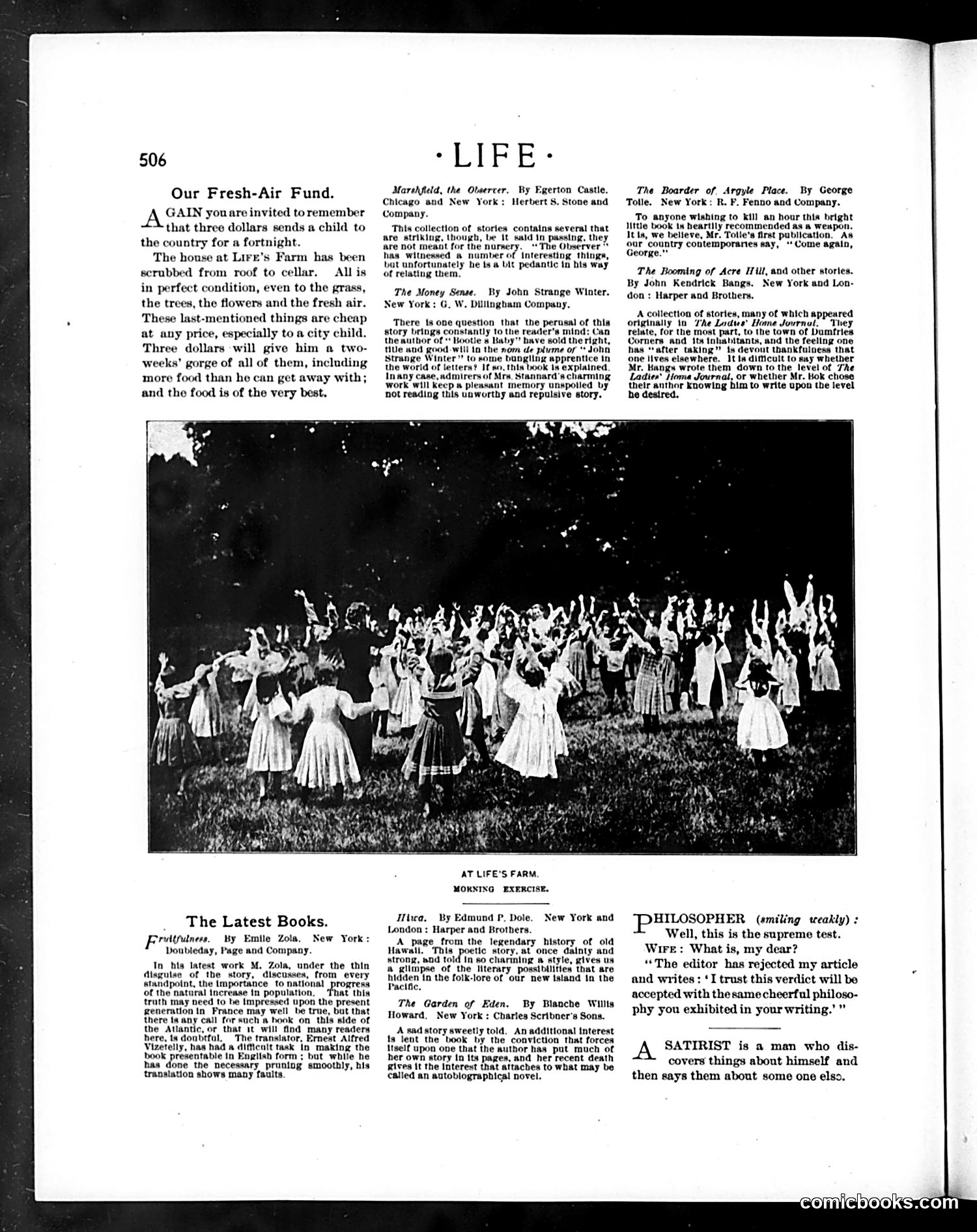
This page contains no political cartoon. Instead, it features: 1. **"Our Fresh-Air Fund"** — A brief editorial praising a charitable initiative sending poor urban children to Life's Farm for outdoor recreation and nutritious food. 2. **A photograph** labeled "AT LIFE'S FARM: MORNING EXERCISE" showing numerous young girls in white dresses exercising outdoors, illustrating the fund's activities. 3. **Book reviews** of contemporary literature, including works by John Strange Winter and Blanche Willis Howard. 4. **A brief humor section** ("Philosopher") containing a satirical definition: a satirist is someone who discovers unflattering truths about himself and publicly attributes them to others. The page primarily documents Life magazine's charitable work and literary criticism rather than political satire.
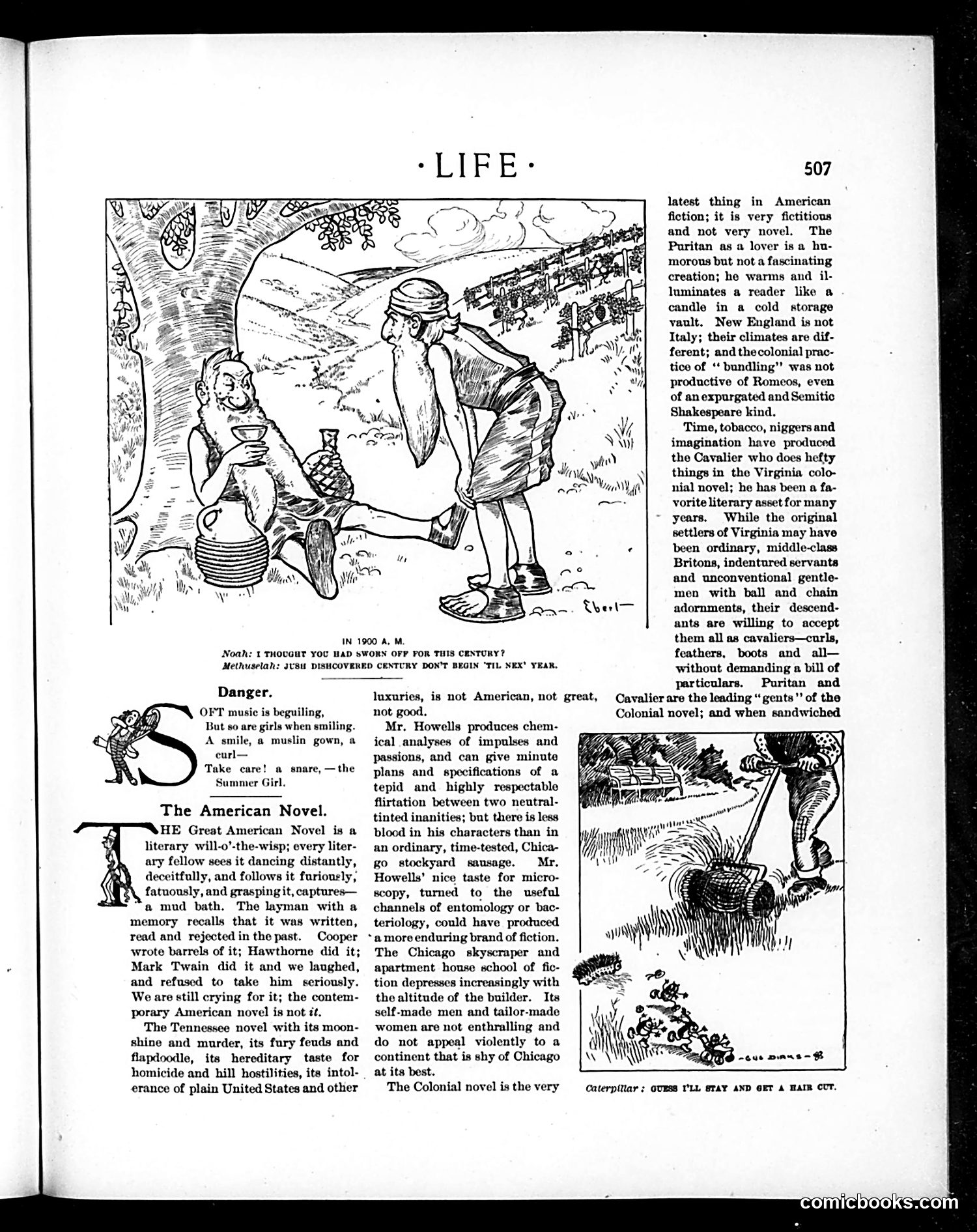
The top cartoon titled "Danger" depicts a flapper-era woman offering a drink to a man in colonial dress, with the caption "Noah: I thought you had sworn off for this century? Methusalem: the disrobed century don't begin 'til next year." This satirizes the contrast between old-fashioned morality (represented by the colonial/biblical figure Noah) and modern 1920s behavior (the flapper offering alcohol). The joke plays on the upcoming year-change: the man claims his abstinence pledge expires at the new year, allowing him to indulge now. It mocks contemporary debates over Prohibition and generational conflict regarding "modern" morals, with the woman embodying the liberated flapper lifestyle that conservative Americans found scandalous. The page's text discusses American novels and literary tastes.
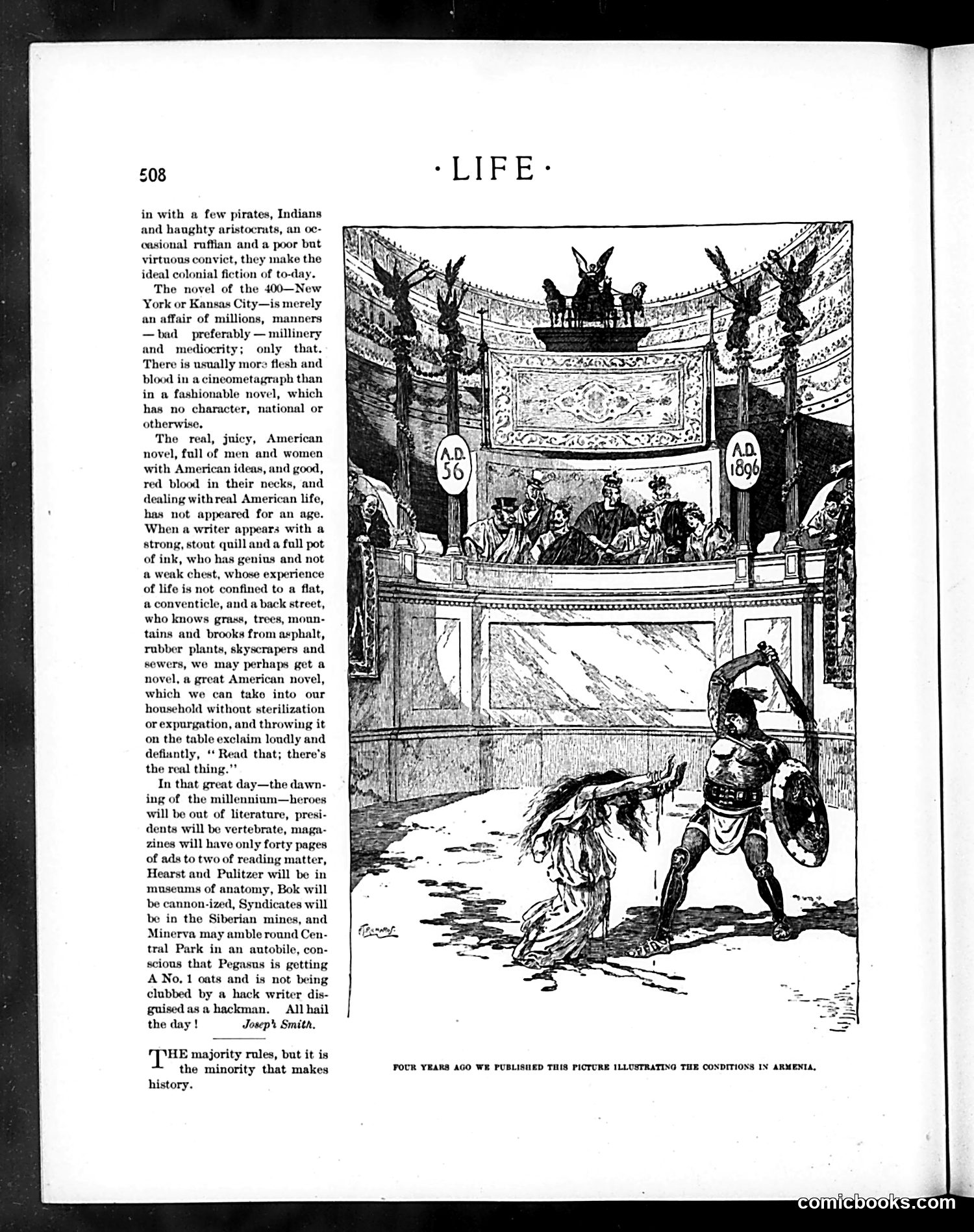
This is a *Life* magazine article and illustration about American novels. The text (bylined Joseph Smith) argues that great American literature doesn't require artificial gentility—it can treat raw subjects like "pirate, Indians and haughty aristocrats" with vernacular authenticity. The accompanying illustration depicts a gladiatorial arena scene labeled "Four years ago we published this picture illustrating the conditions in Armenia." It shows a warrior striking down a fallen figure before a crowded stadium. The juxtaposition appears satirical: the article celebrates unflinching American realism in fiction, while the image references *Life's* own past coverage of real atrocities (the Armenian massacres of 1894-96). The point seems to be that actual historical brutality surpasses what fiction can depict—a commentary on the relationship between literary realism and documented human suffering.
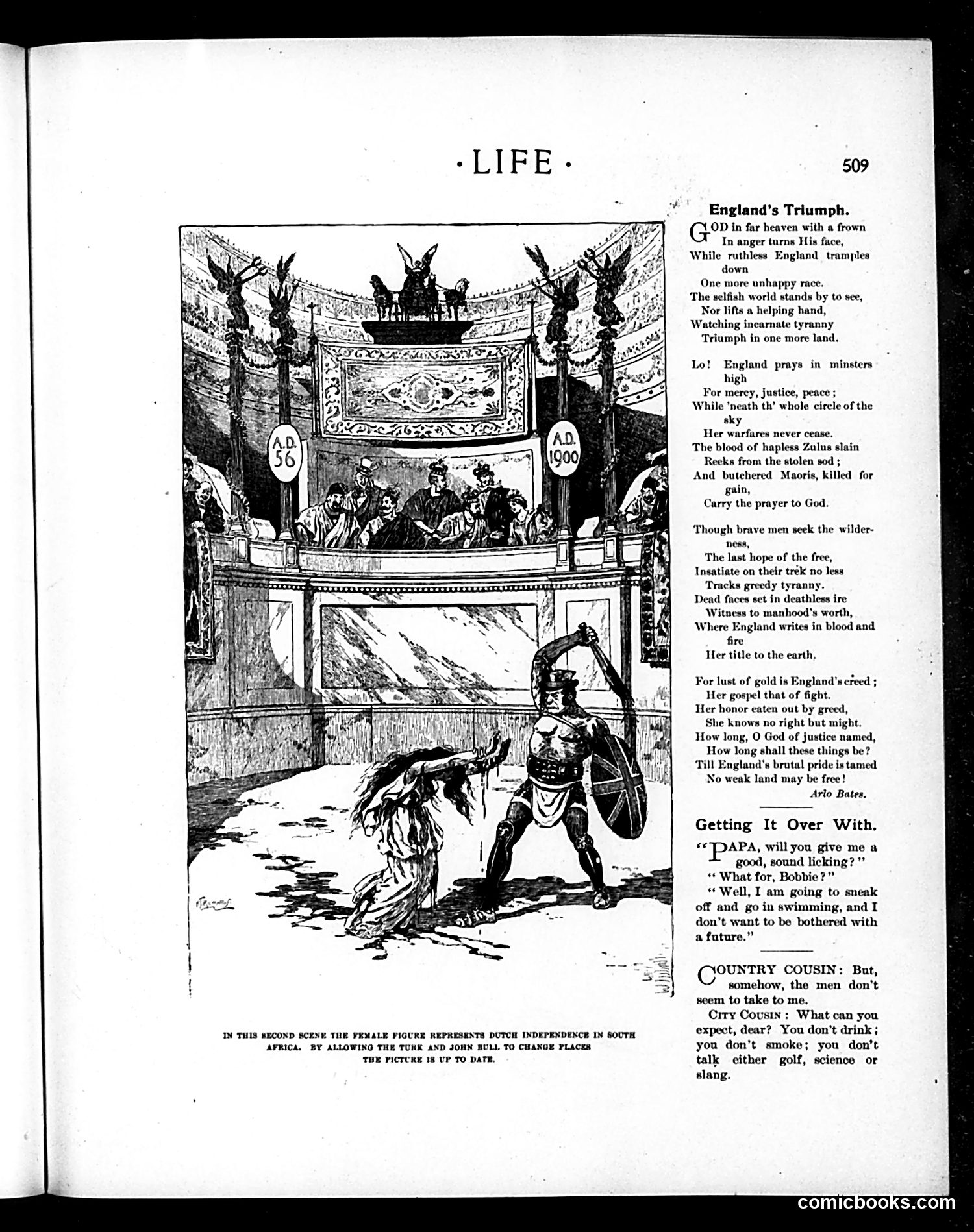
The main illustration depicts a dramatic scene in what appears to be a Roman amphitheater or arena (dated A.D. 56 and A.D. 1900), showing a gladiator standing over a fallen opponent. The caption indicates this references "THE PEACE AFTER THE BOER WAR" with "CECIL RHODES" represented, "ALLOWING THE TIGER AND JOHN BULL TO CHANGE PLACES." The accompanying poem "England's Triumph" satirizes British colonial ambitions, criticizing England's brutality in South Africa. It references "Zulus slain" and "Maoria, killed for gain," condemning imperial violence. The second comic dialogue "Getting It Over With" humorously depicts a father granting his son permission to avoid studying by going swimming instead. This appears to be post-Boer War (1899-1902) commentary criticizing British imperial aggression and colonial practices.
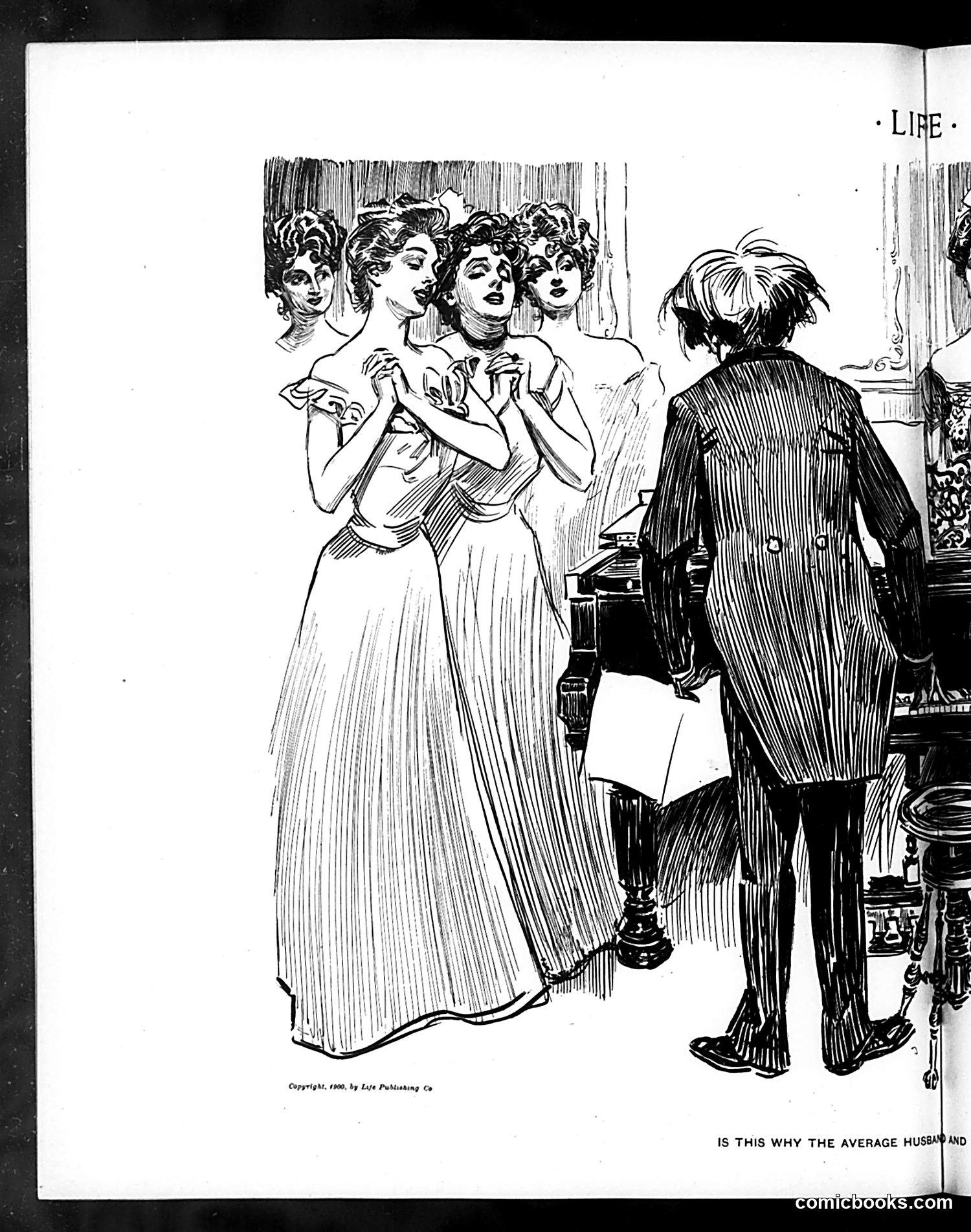
This is a satirical illustration from *Life* magazine (copyright 1900, per visible text). The cartoon depicts a social scene where a man in formal attire views four women in elegant evening gowns. The incomplete caption at bottom reads "IS THIS WHY THE AVERAGE HUSBAND AND—" suggesting social commentary about marital dynamics. The satire appears to target turn-of-the-century gender relations and domestic life. The man's apparent interest in the fashionably-dressed women likely critiques either: male infidelity, the expense of women's clothing and fashion, or the perceived distraction such display causes. The incomplete caption invites readers to complete the joke themselves, a common *Life* technique. Without the full text, the precise target remains somewhat unclear, though it addresses husband-wife social tensions popular in Edwardian-era humor.
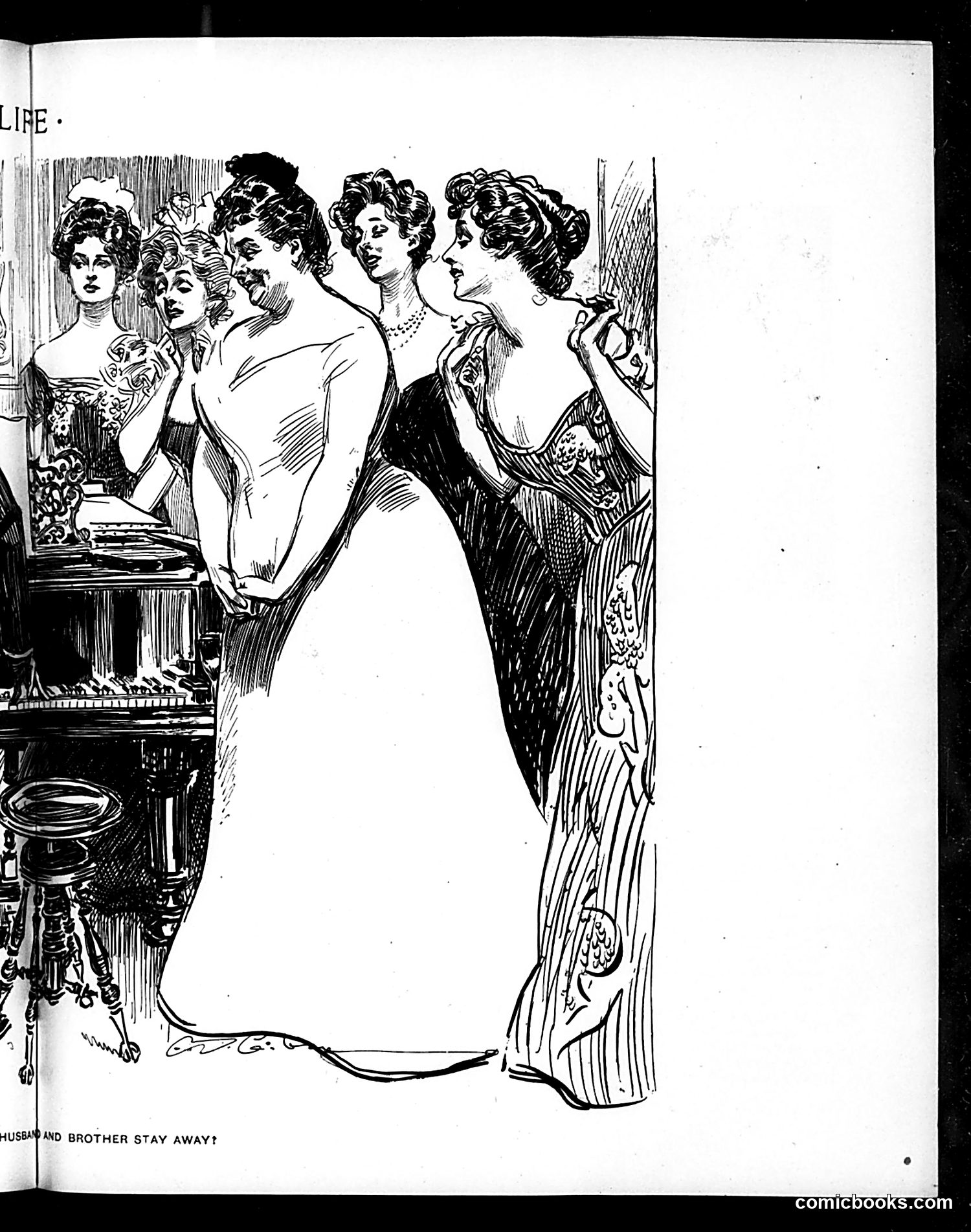
This is a satirical illustration from *Life* magazine depicting a social scene of elegantly dressed women in early 1900s fashion (the "Gibson Girl" era). The caption reads "HUSBAND AND BROTHER STAY AWAY!" The satire targets the exclusivity and social rituals of upper-class women's gatherings. The elaborate gowns, coiffed hair, and refined setting suggest a formal social occasion—likely a tea, luncheon, or receiving line. The caption's emphatic message suggests this is a women-only event where male relatives are deliberately excluded. The humor likely mocks both the pretentiousness of such gatherings and, possibly, anxieties about women's increasing social independence and desire for spaces free from male presence during this period of social change.
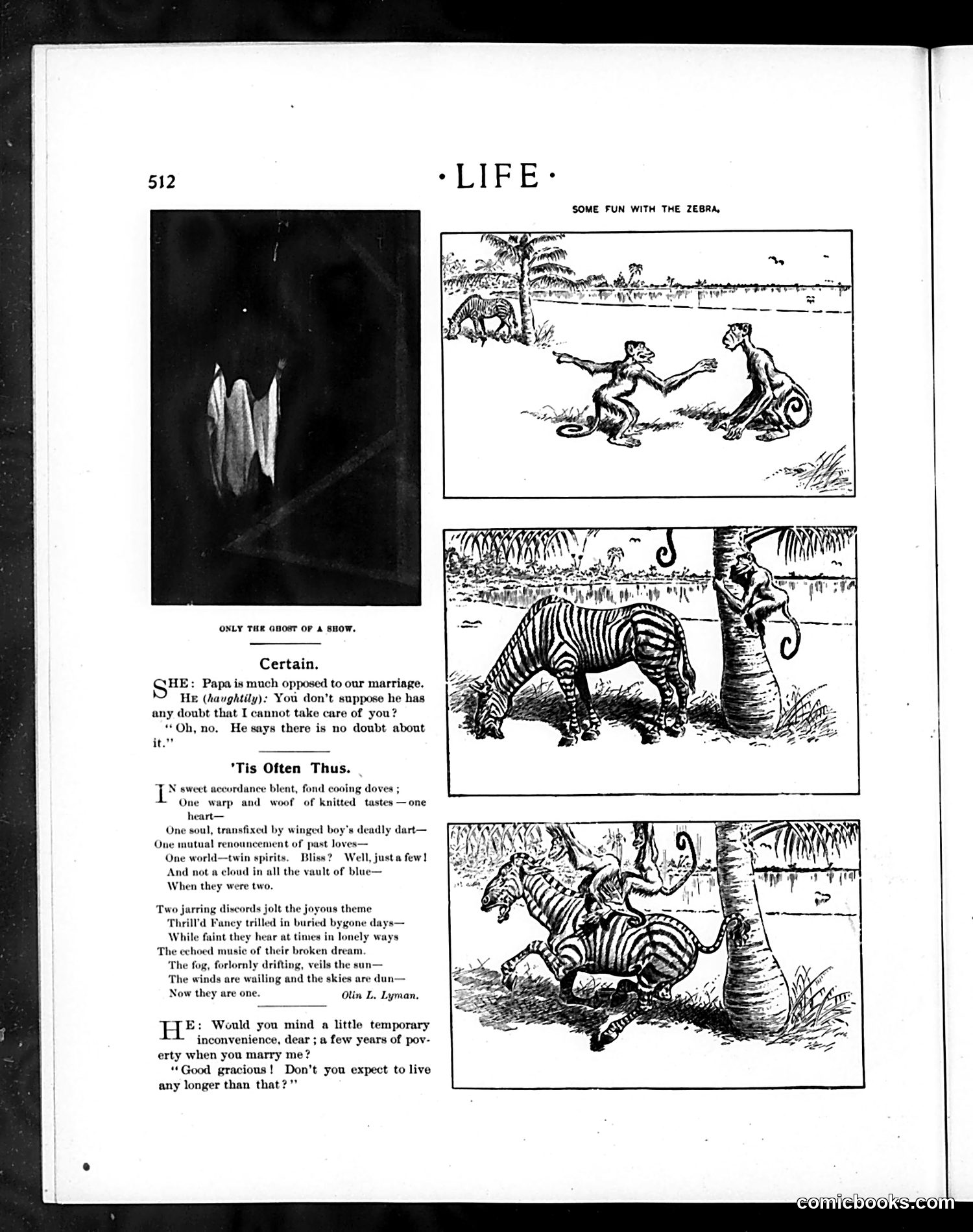
This page combines romantic dialogue with a three-panel comic strip featuring monkeys and a zebra in an African setting. The top section presents a courtship conversation where a man dismisses his fiancée's concerns about her father's opposition to their marriage, claiming he has "no doubt" he can win him over—a confidently naive assertion. The comic strip below satirizes this overconfidence through slapstick: two monkeys interact with a zebra near a palm tree. The visual gag appears to show the monkeys being struck or kicked by the zebra in successive panels, suggesting that naive confidence leads to painful consequences. The juxtaposition implies the romantic dialogue's optimism will similarly backfire. This reflects early 20th-century humor combining human social commentary with animal-based physical comedy.
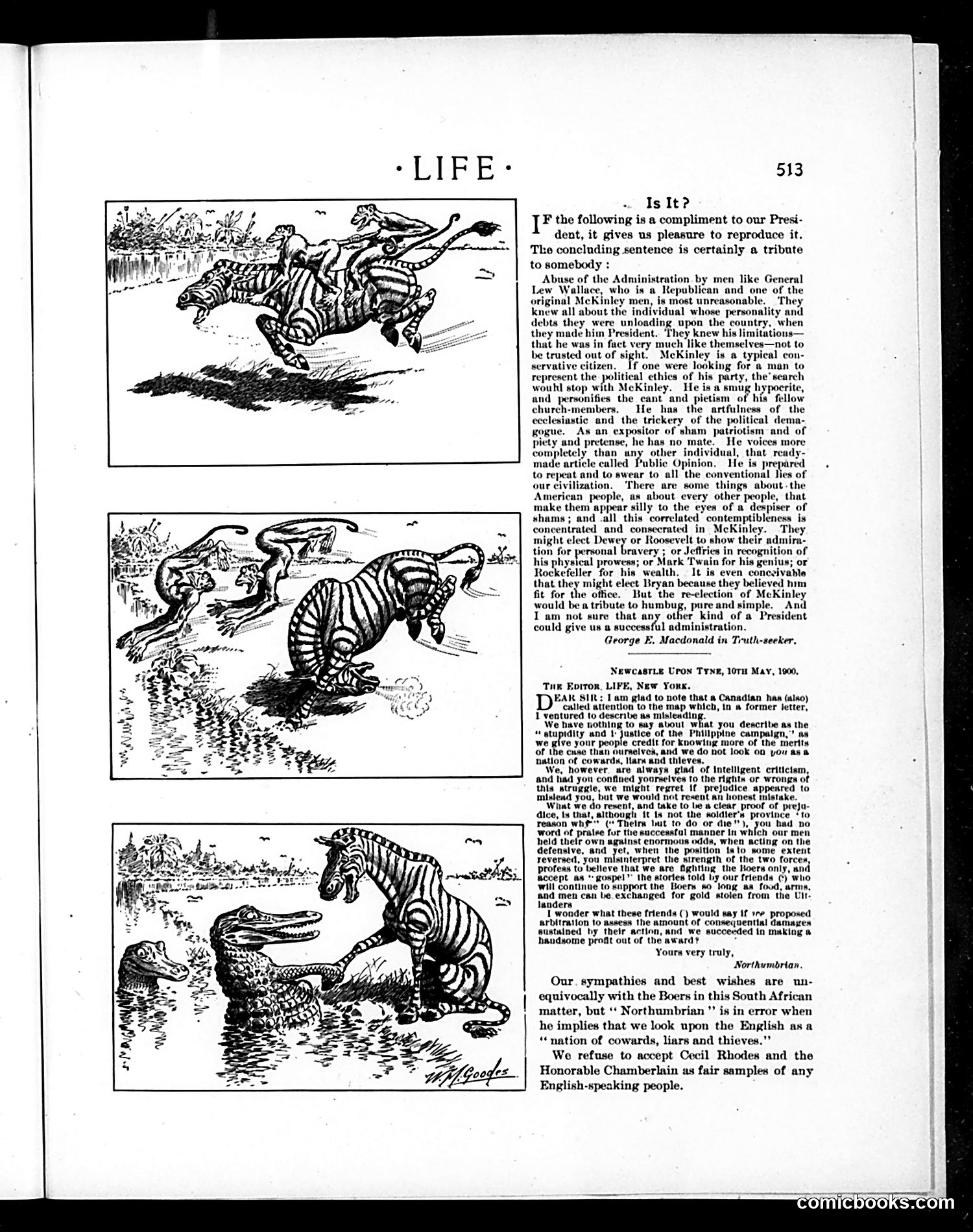
This page contains three political cartoons satirizing American imperialism and the Boer War (1899-1902). The zebra-striped figures represent the British Empire or colonial powers being mauled by their colonial adventures—the striped pattern suggests military uniforms. The cartoons mock the imperial powers' overconfidence and their entanglement in difficult foreign conflicts. The accompanying letters debate President McKinley's administration and British conduct in South Africa. One correspondent viciously attacks McKinley as a "smug hypocrite" embodying "sham patriotism." Another defends British soldiers' conduct against the Boers while criticizing outside observers' prejudiced interpretations of the conflict. The cartoons' visual message: imperial ambitions lead to dangerous, chaotic consequences. The satire targets both American and British foreign policy overreach during this era of expansionism.
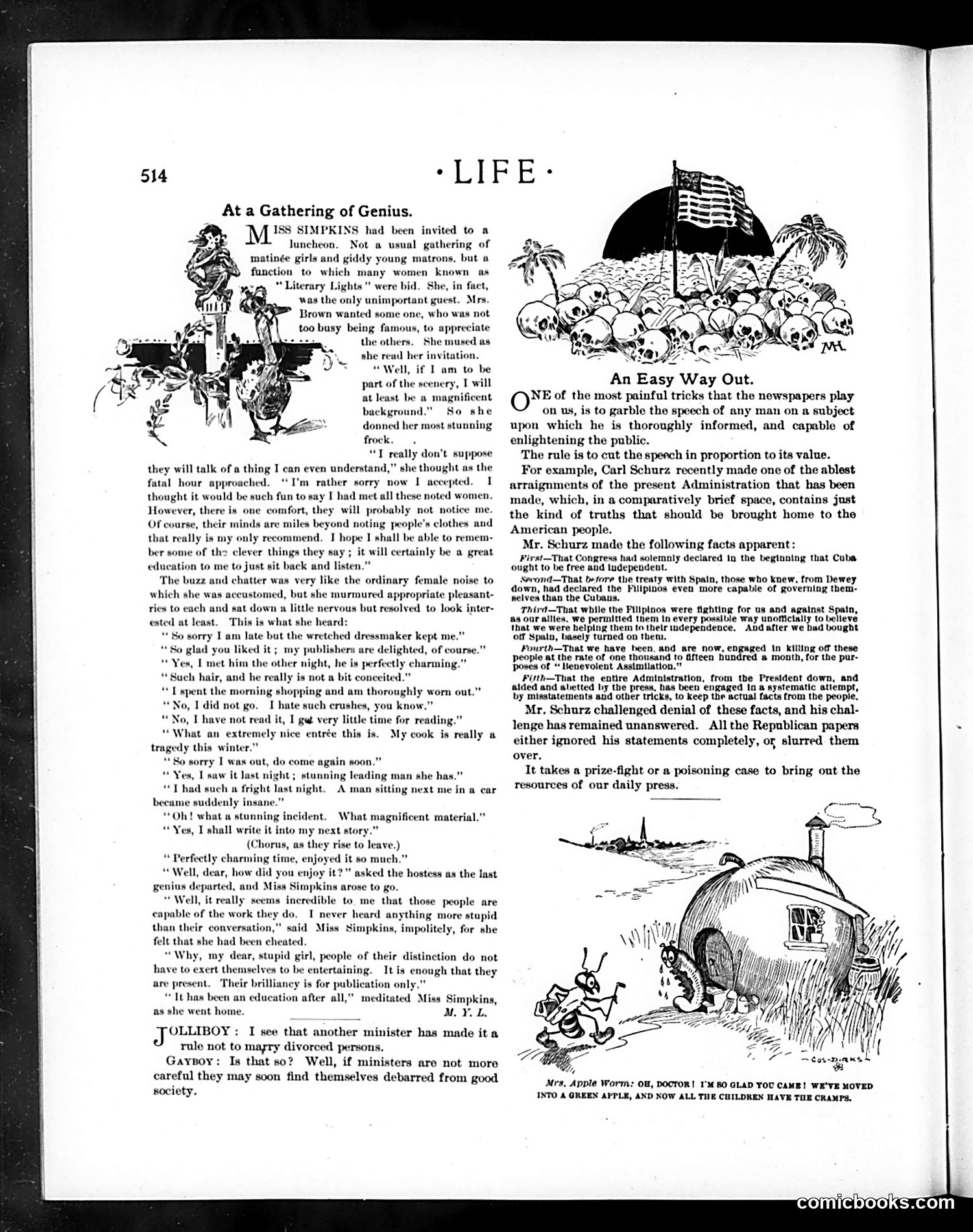
## "At a Gathering of Genius" This story mocks literary pretension. Miss Simpkins, an "unimportant" guest at a luncheon of famous women writers, expects intellectual brilliance but hears only trivial gossip: complaints about dressmakers, shopping exhaustion, and romantic encounters. The joke is that these celebrated "Literary Lights" talk no differently than ordinary women. The hostess defends them by claiming "people of their distinction do not have to exert themselves to be entertaining"—a cutting comment on how fame substitutes for actual wit. ## "An Easy Way Out" Schurz, a prominent political figure, made important criticisms of the Administration, but newspapers deliberately shortened his speech to minimize its impact. The editorial criticizes press manipulation: newspapers truncate valuable speeches "in proportion to its value," suppressing important truths from the public. ## Bottom cartoon A brief joke: a clergyman now refuses to marry divorced persons, prompting the quip that ministers risk being "debarred from good society"—reversing expected moral authority through sarcasm.
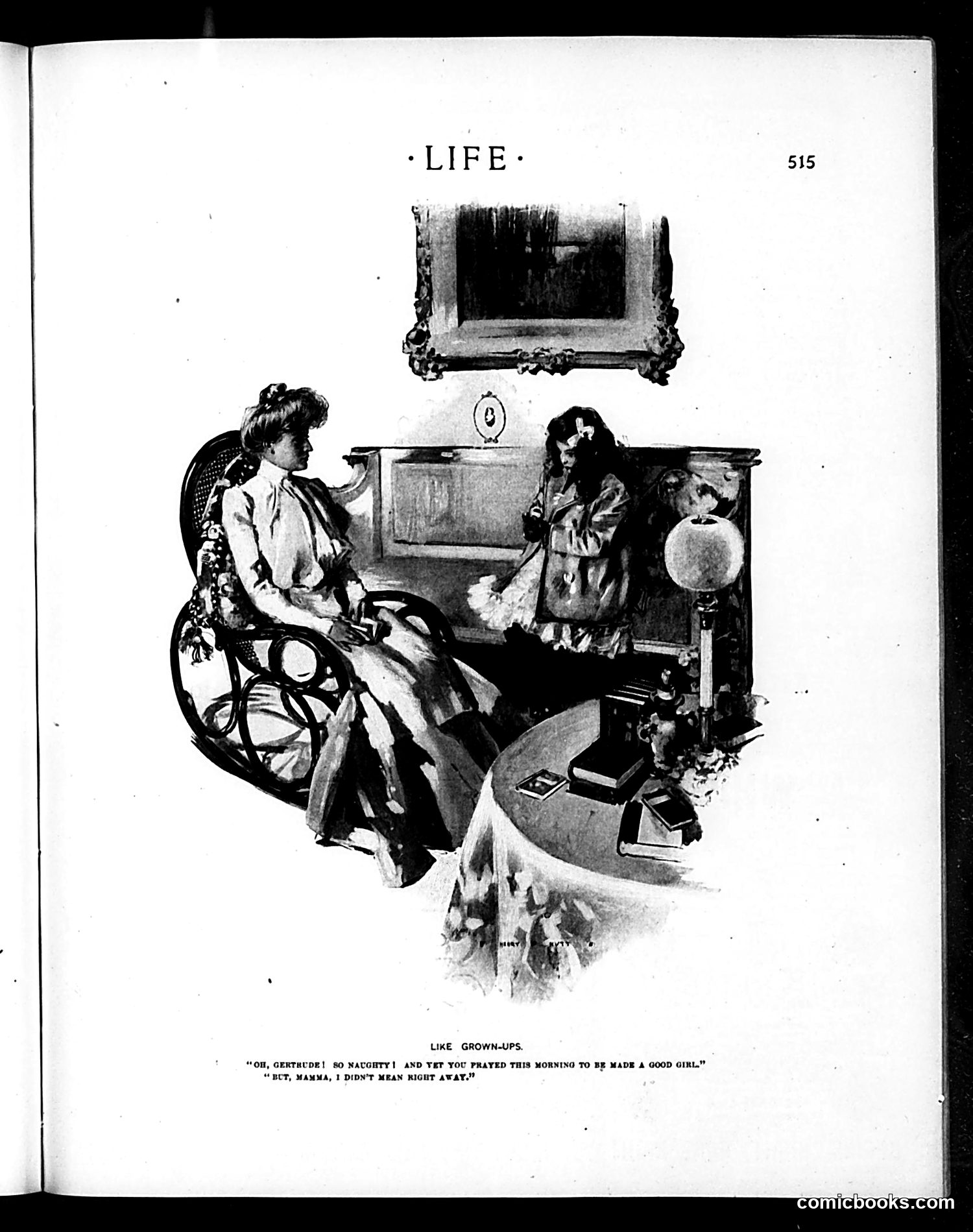
This is a humorous domestic scene satirizing childhood hypocrisy. A mother scolds her daughter Gertrude for misbehaving despite having prayed that morning to become "a good girl." Gertrude's response—"But, Mamma, I didn't mean right away"—is the joke's punch line. The satire works on two levels: it mocks children's selective obedience and their literal interpretation of requests, but also subtly critiques adult behavior by suggesting children merely copy grown-up habits of making good intentions without immediate follow-through. The title "Like Grown-Ups" reinforces this: the child's rationalization mirrors adult excuses for delayed moral improvement—a common satirical target of *Life* magazine's social commentary. The illustration's domestic setting emphasizes the everyday nature of this universal parenting frustration.
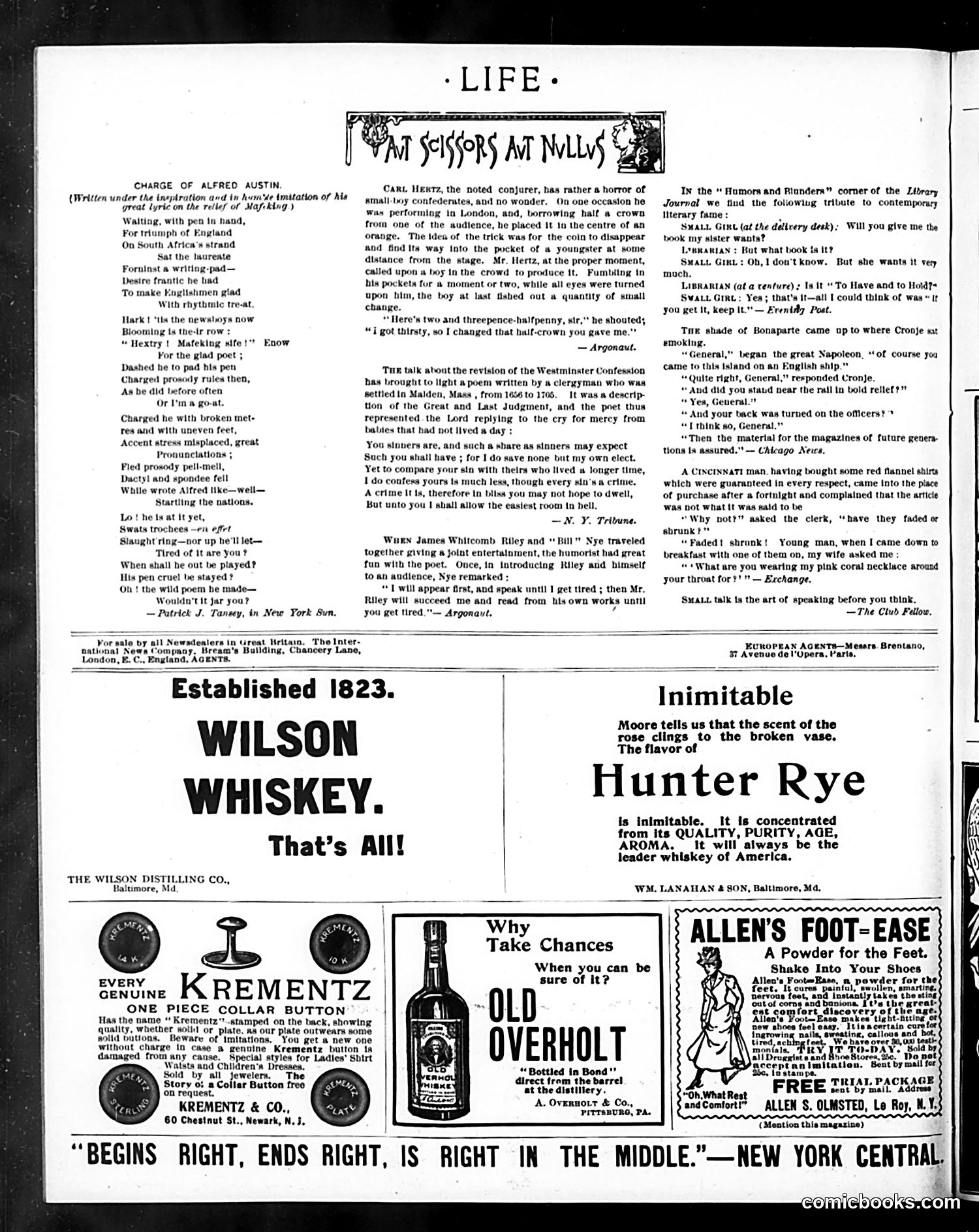
This page is primarily **advertising and miscellaneous literary content**, with limited satirical cartoons. The main text piece is "Charge of Alfredo Austin"—a mock-heroic poem mocking poet Alfred Austin (likely Britain's Poet Laureate) for producing poorly-written patriotic verse about the Boer War relief of Mafeking. The satire attacks his broken meter and mangled prosody, suggesting his enthusiasm for the subject overwhelmed his poetic craft. The page also includes various humorous anecdotes: a conjurer's trick gone wrong with a dishonest boy; a clergyman's harsh 17th-century poem about damnation; and jibes at humorists Riley and Nye. The bulk of the page consists of **period advertisements** for Wilson Whiskey, Hunter Rye, Krementz collar buttons, Old Overholt whiskey, and Allen's Foot-Ease powder—typical of Life's revenue model. The final quote satirizes General Cronje (Boer War commander) posing dramatically for photographers, mocking militaristic image-making.
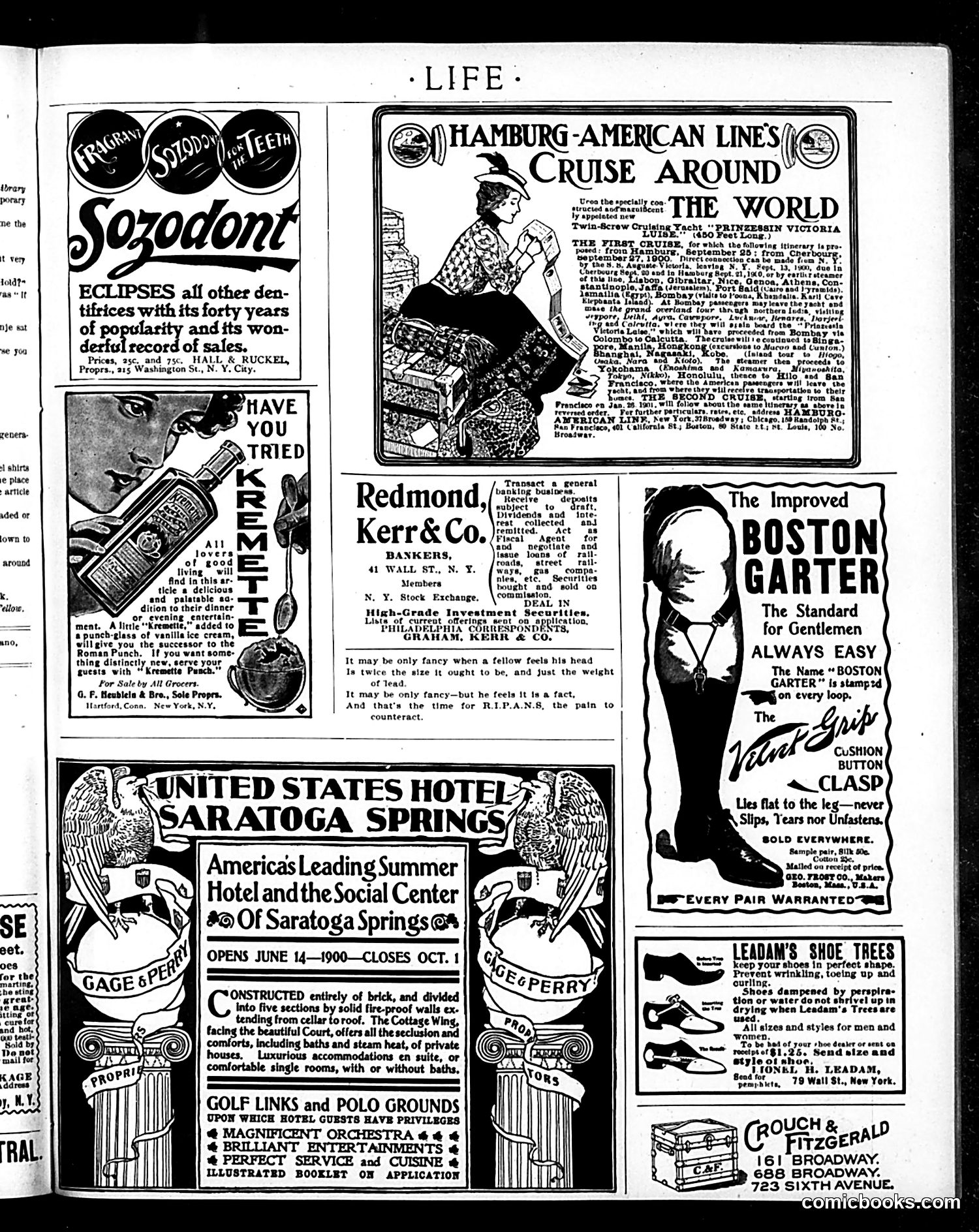
This is primarily an **advertising page** from Life magazine (circa 1900, based on the Hamburg-American cruise listing showing "September 27, 1900"). The page contains no political cartoons or satire. Instead, it features commercial advertisements typical of the era: - **Sozodont toothpaste**: Claims to "eclipse" competitors with 40 years of popularity - **Kemet liqueur**: A digestive drink marketed as a remedy - **Hamburg-American cruise line**: Offering world voyages on luxury vessels - **Redmond, Kerr & Co.**: Investment banking services - **Saratoga Springs Hotel**: A luxury resort opening June 14, 1900 - **Boston Garter**: Men's garters advertised as "always easy" - **Leadam's Shoe Trees**: Shoe care products - **Ripans**: A pain reliever (the text jokes about headaches) The advertisements reflect upper-class leisure travel and personal grooming products marketed to wealthy American readers in 1900. No satire or political content is evident.
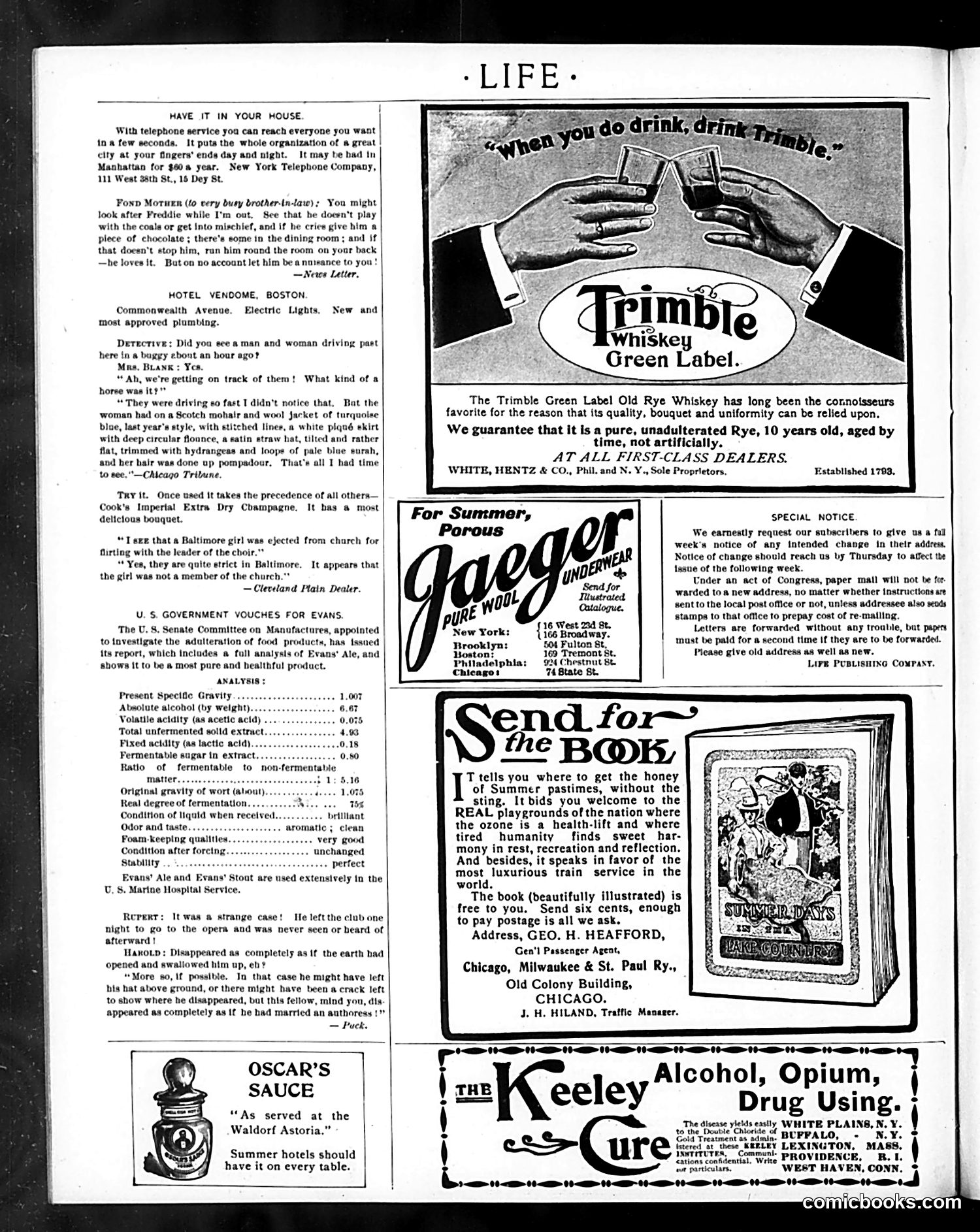
This page from Life magazine (early 1900s) combines satirical commentary with period advertisements. **The Satire:** The "Detective" cartoon mocks society's obsession with fashion minutiae. When a detective asks a witness about a suspicious couple, the woman can only describe the female suspect's clothing in exhaustive detail—turquoise jacket, piqué skirt, straw hat, hydrangeas, pompadour hair—but cannot identify the horse or provide useful investigative information. The joke satirizes how upper-class women were defined by their elaborate wardrobes and how superficial fashion concerns dominated conversation, even in serious situations. **The Advertisements:** The page is dominated by period ads: Trimble Whiskey, Jaeger wool underwear, "Send for the Book" promoting railroad recreation, and Oscar's Sauce. Notably, "The Keeley Cure" advertises treatment for "Alcohol, Opium, Drug Using"—highlighting contemporary social concerns about substance abuse that were openly marketed as medical solutions. The content reflects early-20th-century middle-class anxieties about consumption, fashion, and social propriety.
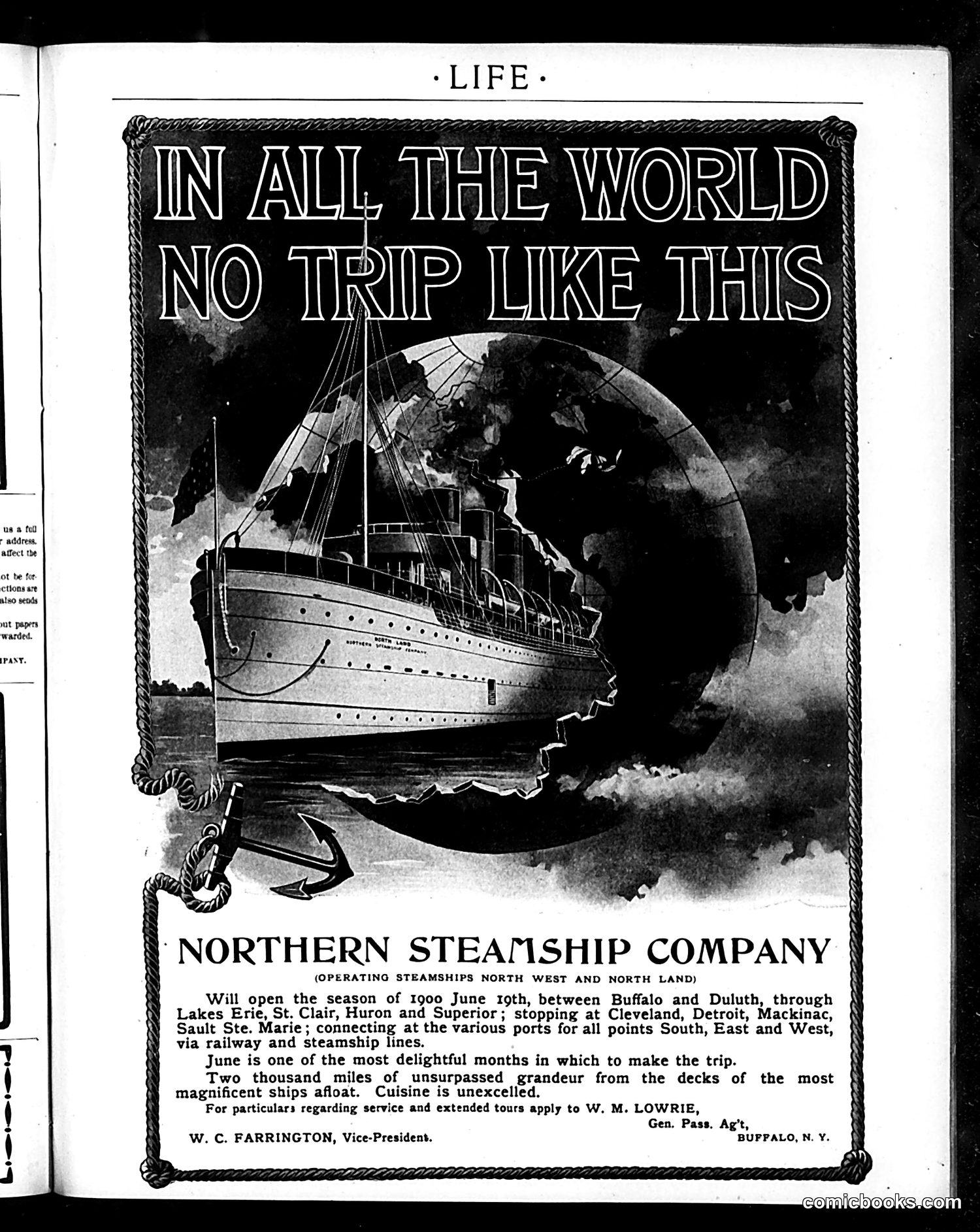
This is primarily a **full-page advertisement**, not satire or political commentary. It promotes the Northern Steamship Company's 1900 shipping season between Buffalo and Duluth. **The Image:** Shows a large steamship positioned within a globe, emphasizing global travel reach. An anchor decorates the border—typical maritime advertising imagery. **The Headline** ("In All the World No Trip Like This") uses hyperbolic marketing language common to Gilded Age advertising, claiming superiority for Great Lakes steamship travel. **The Content:** Lists practical details—route, ports of call, season opening date (June 19, 1900), and amenities ("unexcelled" cuisine, "unsurpassed grandeur"). Contact information for W.C. Farrington and W.M. Lowrie appears at bottom. **Historical Context:** This represents early 1900s American tourism advertising, when Great Lakes shipping was a major leisure travel option. The lavish ship illustration and promotional tone reflect period advertising conventions before modern skepticism of marketing claims.
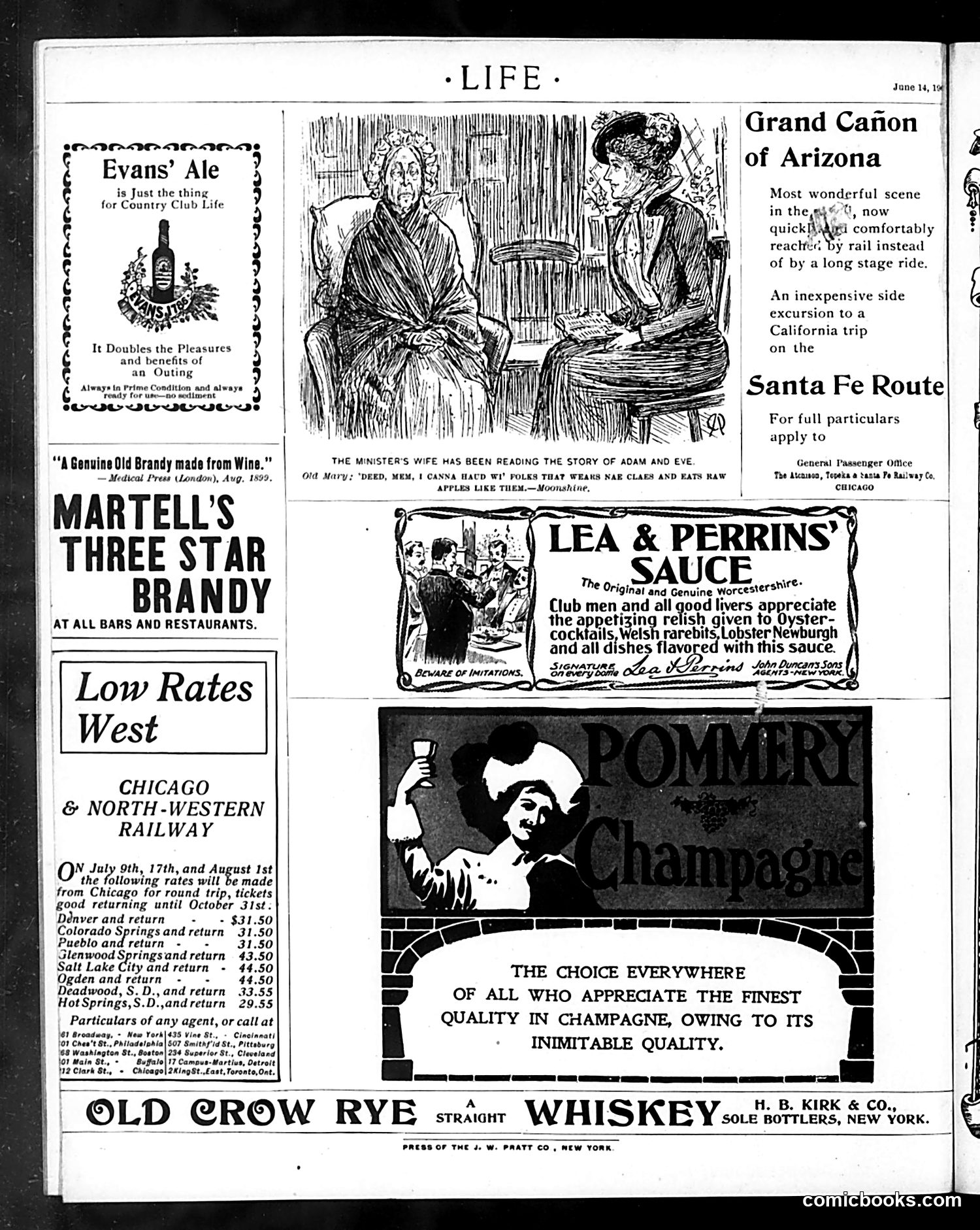
This is primarily an advertising page from Life magazine (June 14, 1904) with one small cartoon at center-top. The cartoon depicts a minister's wife reading the biblical story of Adam and Eve to what appears to be an elderly couple. The caption reads: "Old Mary: 'DEED, MEM, I CANNA HAUD WI' FOLKS THAT WEARS NAE CLAES AND EATS RAW APPLES LIKE THEM.'" The joke plays on Scottish dialect ("I canna haud wi'" = "I can't abide with") and refers to Adam and Eve's nudity and their eating of the forbidden apple. The implied humor is that Old Mary—likely a working-class Scottish woman—finds the biblical couple's primitive state morally shocking, with her comment about "raw apples" serving as a euphemistic complaint about their nakedness and uncivilized condition. The rest of the page contains liquor and travel advertisements (Martell's Brandy, Old Crow Whiskey, Champagne, the Santa Fe railway route to the Grand Canyon, etc.), reflecting early 1900s consumer marketing.