
Life, 1900-06-14 · page 6 of 20
Life — June 14, 1900 — page 6: what you’re looking at
What you’re looking at
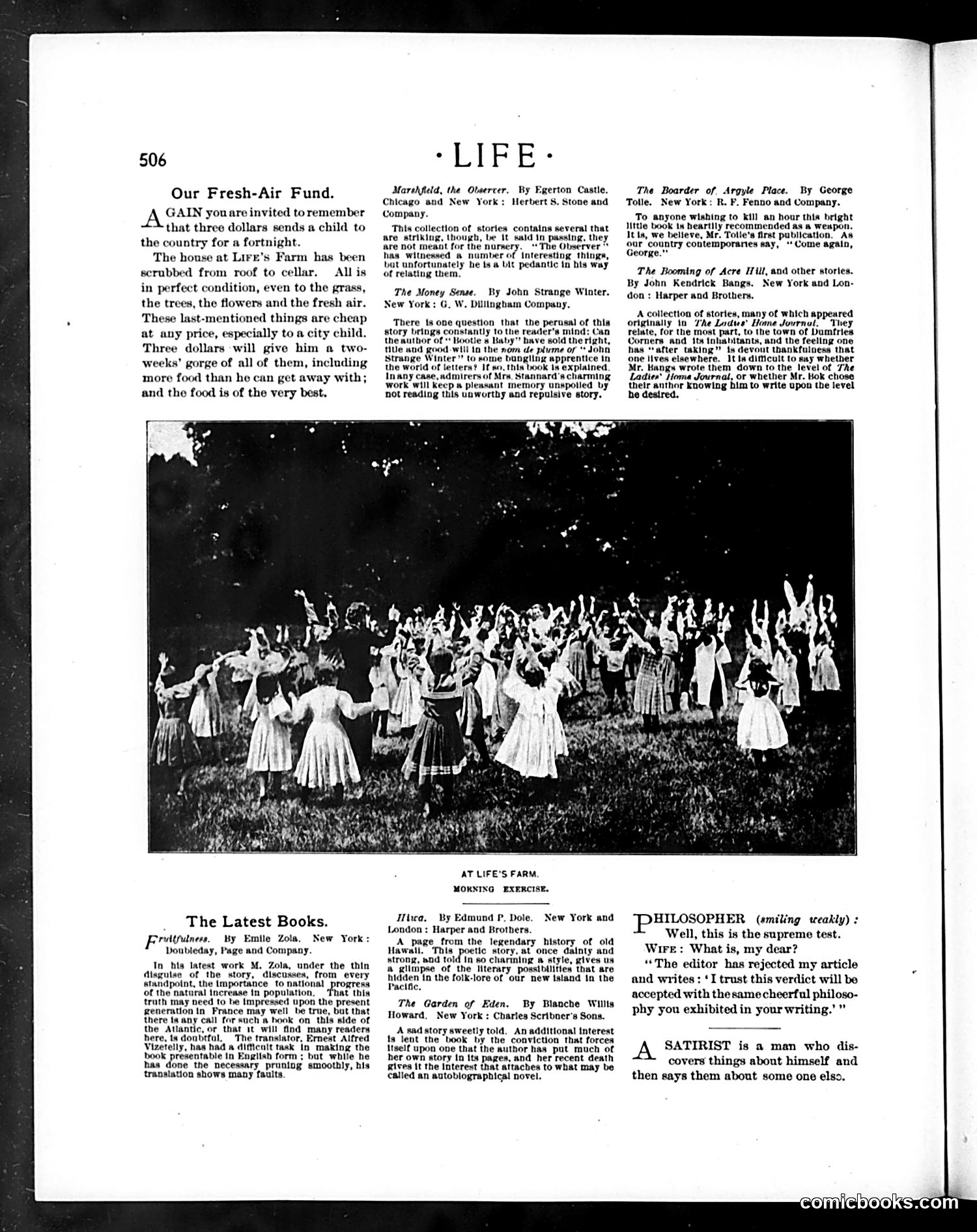
This page contains no political cartoon. Instead, it features: 1. **"Our Fresh-Air Fund"** — A brief editorial praising a charitable initiative sending poor urban children to Life's Farm for outdoor recreation and nutritious food. 2. **A photograph** labeled "AT LIFE'S FARM: MORNING EXERCISE" showing numerous young girls in white dresses exercising outdoors, illustrating the fund's activities. 3. **Book reviews** of contemporary literature, including works by John Strange Winter and Blanche Willis Howard. 4. **A brief humor section** ("Philosopher") containing a satirical definition: a satirist is someone who discovers unflattering truths about himself and publicly attributes them to others. The page primarily documents Life magazine's charitable work and literary criticism rather than political satire.
📄 Transcribed text from this page (OCR, searchable)
Machine-transcribed from the original scan — historical spelling and the odd misread are preserved.
506 Our Fresh-Air Fund. GAIN youare invited toremember that three dollars sends a child to the country for a fortnight. The house at Lire’s Farm has been scrubbed from roof to cellar, All is in perfect condition, even to the g the trees, the flowers and the fresh air. These last-mentioned things are cheap at any price, especially to a city child. Three dollars will give him a tw weeks’ gorge of all of them, including more food than he can get away with; and the food is of the very best. The Latest Books. Frratfuness. By Emile Zola, New York : Doubleday, Page and Company. In his latest work M. Zola, under the thin Aisgulae of the story, ‘discusses, from every standpoint, the {mportance to national progress of the natural increase in population, ‘That this truth may need to be Impressed upon the present generation in France may well be true, but that there {s any cail for such a book on this alde of the Atlantic, or that it will find many readers here, ts donbtfal, The translator, Ernest Alfred Vizeielly, has had a dimtcnit task in making the boc resentable in English form ; but while he has done the necessary pruning smoothly, his translation shows many faults, * LIFE: Marshfield, the Otsercer. By Egerton Castle, Chicago and New York: Herbert 8. Stone and Company. This collection of stories contains several that are striking, though, be it sald in passing, they are not meant for the nursery. “The Observer * has witnessed a number of Interesting things, Yat unfortunately he ts a bit pedantic in his way of relating them, The Money Sense. By John Strange Winter. New York: G, W. Dillingham Company, There 1s one question that the perusal of this story brings constantly to the reader’s mind: Can the author of * Bootle & Baby” bave sold the right, tiUe and good-will In the nom de plume of * John Strange Winter” to some bungiling apprentice in 1e Worid of letters? If Ko, this book Is explained. Inany case, admirers of Mrs, Stannard’s charming work will Keep ® pleasant memory unspotied by not reading this unworthy and repulsive story. AT LIFE’S FARM. MOKNING EXERCISE. Hiva, By Edmund P, Dole. London : Harper and Brothers. A page from the legendary history of old Hawall. This poetic story. at once dainty and strong, sod told In so charining @ style, gives us @ glimpse of the literary possibilities that are hidden tn the folk-lore of our new Island In the Pacific. The Garden of Eden. By Blanche Willis Howard, New York : Charles Scribner's Sons. A sad story sweetly told. An additional interest 4s lent the book by the conviction that forces {tself upon ove that the author has pat much of her own story tn its pages, and her recent death gives it the loterest that aftaches to what may be called an autoblographical novel. New York and The Boarder of Argyle Place. By George Tolle. New York: R. P. Fenno and Company. To anyone wishing to kill an hour this bright little book ts heartily recommended as a Weapon. It is, we believe, Mr. Totle's first publication. Ai our ‘country contemporanes say, ‘Come again, George." The Booming of Acre Hill, and other stories. By John Kendrick Bangs. New York and Lon- don : Harper and Brothers. A collection of stories, many of which appeared originally 10 The Ladies’ Home Journal, ‘They relate, for the most part, to the town of Damfries Corners and ita tohabitants, and the feeling one has “after taking” 1s devout thankfulness that one lives elsewhere. It is diMcult to say whether Mr. Bangs wrote them down to the level of The Ladies’ Homa Journal, or whether Mr. Kok chose their anthor knowing him to write upon the level he desired. ‘PHILOSOPH ER (smiling weakly): Well, this is the supreme test. Wire: What is, my dear? “The editor has rejected my article and writes : ‘I trust this verdict will be accepted with the same cheerful philoso- phy you exhibited in your writing.’ ” SATIRIST is a man who dis- covers things about himself and then says them about some one elso.