
Life, 1900-06-14 · page 7 of 20
Life — June 14, 1900 — page 7: what you’re looking at
What you’re looking at
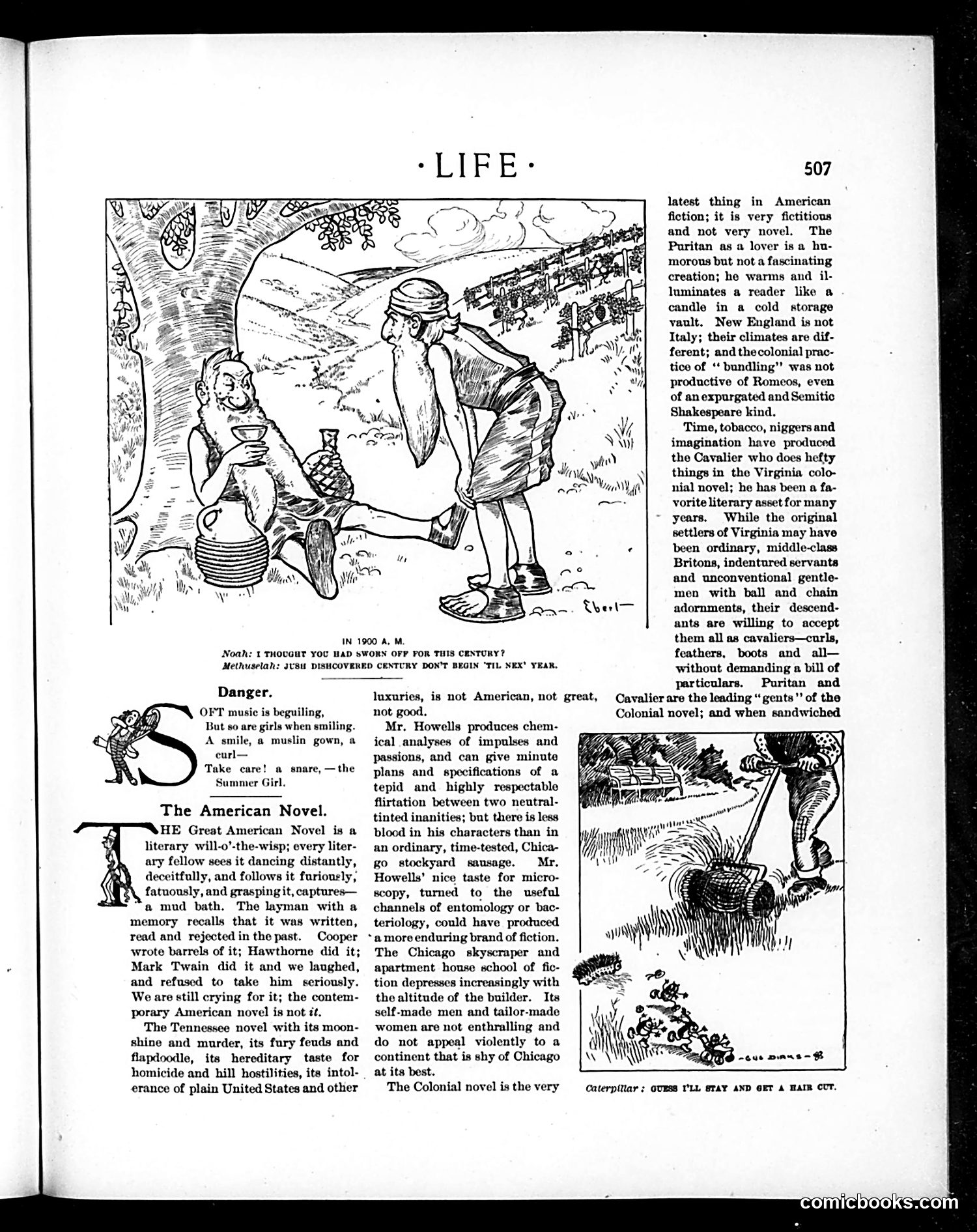
The top cartoon titled "Danger" depicts a flapper-era woman offering a drink to a man in colonial dress, with the caption "Noah: I thought you had sworn off for this century? Methusalem: the disrobed century don't begin 'til next year." This satirizes the contrast between old-fashioned morality (represented by the colonial/biblical figure Noah) and modern 1920s behavior (the flapper offering alcohol). The joke plays on the upcoming year-change: the man claims his abstinence pledge expires at the new year, allowing him to indulge now. It mocks contemporary debates over Prohibition and generational conflict regarding "modern" morals, with the woman embodying the liberated flapper lifestyle that conservative Americans found scandalous. The page's text discusses American novels and literary tastes.
📄 Transcribed text from this page (OCR, searchable)
Machine-transcribed from the original scan — historical spelling and the odd misread are preserved.
Noah: 1 THOLGUT YOU HAD SWORN OFF FOR THIS CENTURY? Methuselah: IUBU DISHCOVERED CENTURY DON'T BEGIN “TIL NEX’ YEAR. Danger. OFT music is beguiling, But so are girls when smiling. A smile, a muslin gown, a curl— Take care! a snare,—the Summer Girl. The American Novel. HE Great American Novel is a literary will-o’-the-wisp; every liter- ary fellow sees it dancing distantly, deceitfully, and follows it furiously, fatuously, and grasping it, captures— “a mud bath. The layman with a memory recalls that it was written, read and rejected in the past. Cooper wrote barrels of it; Hawthorne did it; Mark Twain did it and we laughed, and refused to take him seriously. We are still crying for it; the contem- porary American novel is not it. The Tennessee novel with its moon- shine and murder, its fury feuds and flapdoodle, its hereditary taste for homicide and hill hostilities, its intol- erance of plain United States and other luxuries, is not American, not not good. Mr. Howells produces chem- ical analyses of impulses and passions, and can give minute plans and specifications of a tepid and highly respectable flirtation between two neutral- tinted inanities; but there is less blood in his characters than in an ordinary, time-tested, Chica- go stockyard sausage. Mr. Howells’ nice taste for micro- scopy, turned to the useful channels of entomology or bac- teriology, could have produced ‘amore enduring brand of fiction. The Chicago skyscraper and apartment house school of fic- tion depresses increasingly with the altitude of the builder. Its self-made men and tailor-made women are not enthralling and do not appeal violently to a continent that is shy of Chicago at its best. The Colonial novel is the very 507 latest thing in American fiction; it is very fictitious and not very novel. The Puritan as a lover isa hu- morous but not a fascinating creation; he warms and il- luminates a reader like a candle in a cold storage vault. New England is not Italy; their climates are dif- ferent; and thecolonial prac- tice of “ bundling”’ was not productive of Romeos, even of anexpurgated and Semitic Shakespeare kind. Time, tobacco, niggers and imagination have produced the Cavalier who does hefty things in the Virginia colo- nial novel; he has been a fa- vorite literary asset for many years. While the original settlers of Virginia may have been ordinary, middle-class Britons, indentured servants and unconventional gentle- men with ball and chain adornments, their descend- ants are willing to accept them all as cavaliers—carls, feathers, boots and all— without demanding a bill of particulars. Puritan and Cavalier are the leading “ gents” of the Colonial novel; and when sandwiched Vari, \ ake Malye 7, us | ee ae Caterpitlar ; GUESS I'LL STAY AND GET 4 HAIR CUT.