
Life, 1900-06-14 · page 8 of 20
Life — June 14, 1900 — page 8: what you’re looking at
What you’re looking at
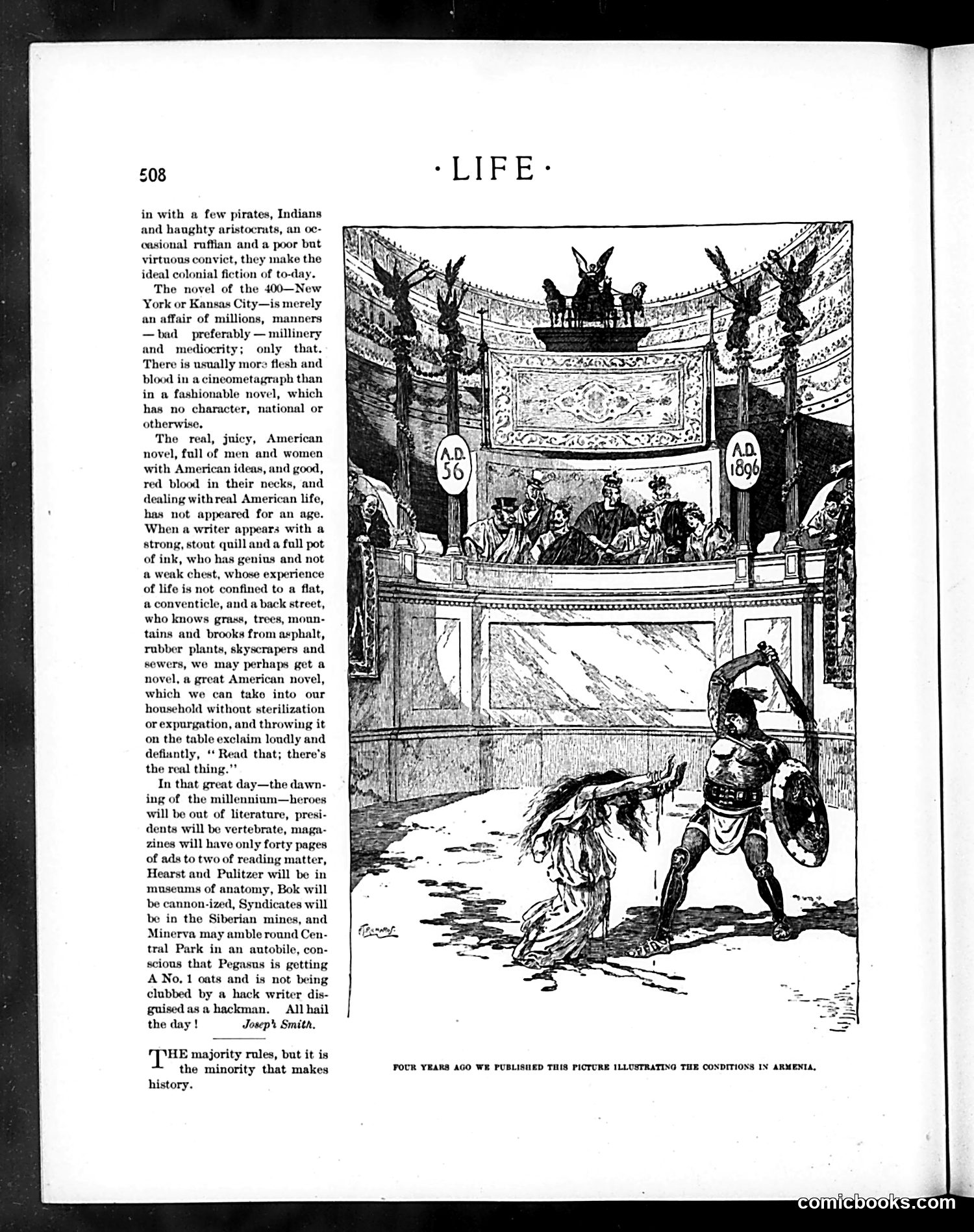
This is a *Life* magazine article and illustration about American novels. The text (bylined Joseph Smith) argues that great American literature doesn't require artificial gentility—it can treat raw subjects like "pirate, Indians and haughty aristocrats" with vernacular authenticity. The accompanying illustration depicts a gladiatorial arena scene labeled "Four years ago we published this picture illustrating the conditions in Armenia." It shows a warrior striking down a fallen figure before a crowded stadium. The juxtaposition appears satirical: the article celebrates unflinching American realism in fiction, while the image references *Life's* own past coverage of real atrocities (the Armenian massacres of 1894-96). The point seems to be that actual historical brutality surpasses what fiction can depict—a commentary on the relationship between literary realism and documented human suffering.
📄 Transcribed text from this page (OCR, searchable)
Machine-transcribed from the original scan — historical spelling and the odd misread are preserved.
£08 in with a few pirates, Indians and haughty aristocrats, an oc- casional raffian and a poor but virtuous convict, they make the ideal colonial fiction of to-day. The novel of the 400—New York or Kansas City—is merely an affair of millions, manners —bad preferably — millinery and mediocrity; only that. ‘There is usually more flesh and blood in a cineometagraph than in a fashionable novel, which has no character, national or otherwise, The real, juicy, American novel, full of men and women with American ideas, and good, red blood in their necks, and dealing withreal American life, has not appeared for an age. When a writer appears with a strong, stout quill and a full pot of ink, who has genius and not a weak chest, whose experience of life is not confined to a flat, a conventicle, and a back street, who knows grass, trees, moun- tains and brooks from asphalt, rubber plants, skyscrapers and sewers, We may perhaps get a novel, a great American novel, which we can tako into our household withont sterilization or expurgation, and throwing it on the table exclaim loudly and defiantly, ‘‘ Read that; there's the real thing.”* In that great day—the dawn- ing of the millenniam—heroes will be out of literature, presi- dents will be vertebrate, maga- zines will have only forty pages of ads to two of reading matter, Hearst and Pulitzer will be in museums of anatomy, Bok will be cannon-ized, Syndicates will be in the Siberian mines, and Minerva may amble round Cen- tral Park in an autobile, con- scious that Pegasus is getting A No. 1 oats and is not being clubbed by a hack writer dis- guisedasahackman. All hail the day! Josep’ Smith, ‘THE majority rules, but it is the minority that makes history. FOUR YEARS AGO WE PUBLISHED THIS PICTURE ILLUSTRATING THE CONDITIONS IN ARMENIA,