
Life, 1900-06-14 · page 4 of 20
Life — June 14, 1900 — page 4: what you’re looking at
What you’re looking at
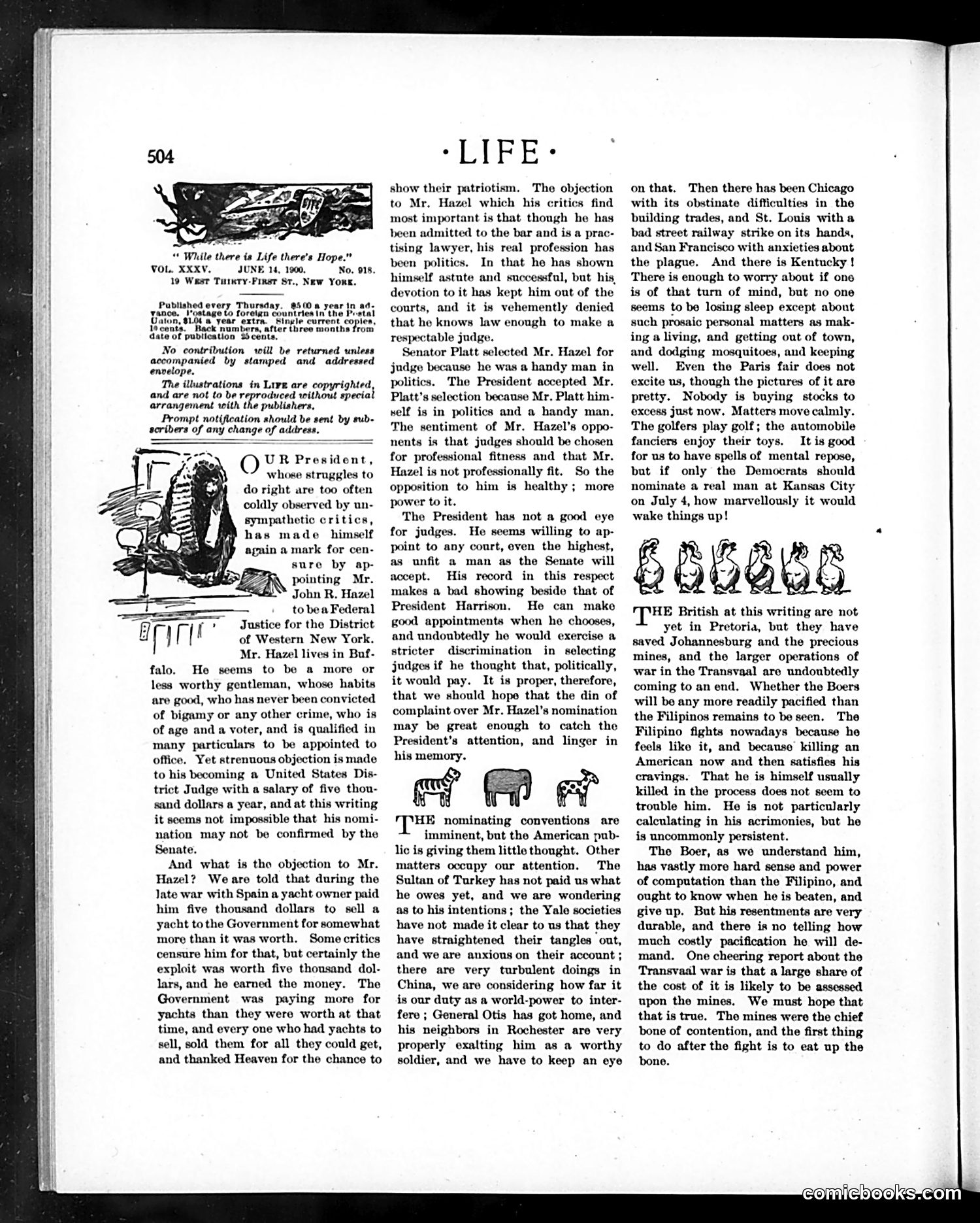
This page from *Life* magazine (Vol. XXXV, June 21, 1900) contains political commentary about President McKinley's judicial appointments, particularly John R. Hazel as District Judge for Western New York. The text criticizes Mr. Hazel's nomination, arguing that while he's "a handy man in politics," judges should be selected for legal fitness, not political service. The article suggests the President shows poor judgment in court appointments and may appoint unqualified candidates if politically convenient. The small cartoons (elephant, donkey figures) appear to illustrate political party concerns. The overall satire critiques the corruption of judicial appointments through partisan politics—a common *Life* magazine theme opposing the spoils system.
📄 Transcribed text from this page (OCR, searchable)
Machine-transcribed from the original scan — historical spelling and the odd misread are preserved.
“ While there is Life there's Hope.” VOL. XXXV. JUNE 14, 1900, 19 Wasr Tuiery-Pinst St., New Youre. Published. every Thursday. @5(0 a year in ad- oatage to foreign countries in the Ps. sal “9100 @ year extra. Single current copies, Back numbers, after three months: 0 from ‘publication 2 cents. No contribution will be returned unless accompanied by stamped and addressed envelope. The illustrations in Lrve are copyrighted, and are not to be reproduced without special arrangement with the publishers, Prompt notification should be sent by sub- soribers of any change of address. UR President, whose struggles to do right are too often coldly observed by un- sympathetic critic has made himself again a mark for cen- sure by ap- pointing Mr. John R. Hazel to bea Federal Justice for the District of Western New York. Mr. Hazel lives in Buf- falo. He seems to be a more or less worthy gentleman, whose habits are good, who has never been convicted of bigamy or any other crime, who is of age and a voter, and is qualified in many particulars to be appointed to office. Yet strenuous objection is made to his becoming a United States Dis- trict Judge with a salary of five thou- sand dollars a year, and at this writing it seems not impossible that his nomi- nation may not be confirmed by the Senate. And what is tho objection to Mr. Hazel? Weare told that during the Jate war with Spain a yacht owner paid him five thousand dollars to sell a yacht to the Government for somewhat more than it was worth. Some critics censure him for that, but certainly the exploit was worth five thousand dol- lars, and he earned the money. The Government was paying more for yachts than they were worth at that time, and every one who had yachts to sell, sold them for all they could get, and thanked Heaven for the chance to “i No. 918. *EIPE show their patriotism. The objection to Mr, Hazel which his critics find most important is that though he has been admitted to the bar and is a prac- tising lawyer, his real profession has been politics. In that he has shown himself astute and successful, but his, devotion to it has kept him out of the courts, and it is vehemently denied that he knows law enough to make a respectable judge. Senator Platt selected Mr. Hazel for judge because he was a handy man in politics. The President accepted Mr. Platt’s selection because Mr. Platt him- self is in politics and a handy man, The sentiment of Mr. Hazel’s oppo- nents is that judges should be chosen for professional fitness and that Mr. Hazel is not professionally fit. So the opposition to him is healthy ; more power to it. The President has not a good eye for judges. He seems willing to ap- point to any court, even the highest, as unfit a man as the Senate will accept. His record in this respect makes a bad showing beside that of President Harrison. He can make good appointments when he chooses, and undoubtedly he would exercise a stricter discrimination in selecting judges if he thought that, politically, it would pay. It is proper, therefore, that we should hope that the din of complaint over Mr. Hazel’s nomination may be great enough to catch the President's attention, and linger in his memory. ey Fl ef [Ts nominating conventions are imminent, but the American pub- lic is giving them little thought. Other matters occupy our attention. The Sultan of Turkey has not paid us what he owes yet, and we are wondering as to his intentions; the Yale societies have not made it clear to us that they have straightened their tangles out, and we are anxious on their account ; there are very turbulent doings in China, we are considering how far it is our duty as a world-power to inter- fere ; General Otis has got home, and his neighbors in Rochester are very properly exalting him as a worthy soldier, and we have to keep an eye on that. Then there has been Chicago with its obstinate difficulties in the building trades, and St. Louis witha bad street railway strike on its hands, and San Francisco with anxieties about the plague. And there is Kentucky ! There is enough to worry about if one is of that turn of mind, but no one seems to be losing sleep except about such prosaic personal matters as mak- ing a living, and getting out of town, and dodging mosquitoes, and keeping well, Even the Paris fair does not excite us, though the pictures of it are pretty. Nobody is buying stocks to excess just now. Matters move calmly. The golfers play golf; the automobile fanciers enjoy their toys. It is good for us to have spells of mental repose, but if only the Democrats should nominate a real man at Kansas City on July 4, how marvellously it would wake things up! 660060 Ts British at this writing are not yet in Pretoria, but they have saved Johannesburg and the precious mines, and the larger operations of war in the Transvaal are undoubtedly coming to an end. Whether the Boers will be any more readily pacified than the Filipinos remains to be seen. The Filipino fights nowadays because he feels like it, and because killing an American now and then satisfies his cravings. That he is himself usually killed in the process does not seem to trouble him. He is not particularly calculating in his acrimonies, but he is uncommonly persistent. The Boer, as we understand him, has vastly more hard sense and power of computation than the Filipino, and ought to know when he is beaten, and give up. But his resentments are very durable, and there is no telling how much costly pacification he will de- mand. One cheering report about the Transvaal war is that a large share of the cost of it is likely to be assessed upon the mines. We must hope that that is true. Tho mines were the chief bone of contention, and the first thing to do after the fight is to eat up the bone.