
A complete issue · 28 pages · 1900
Life — June 7, 1900
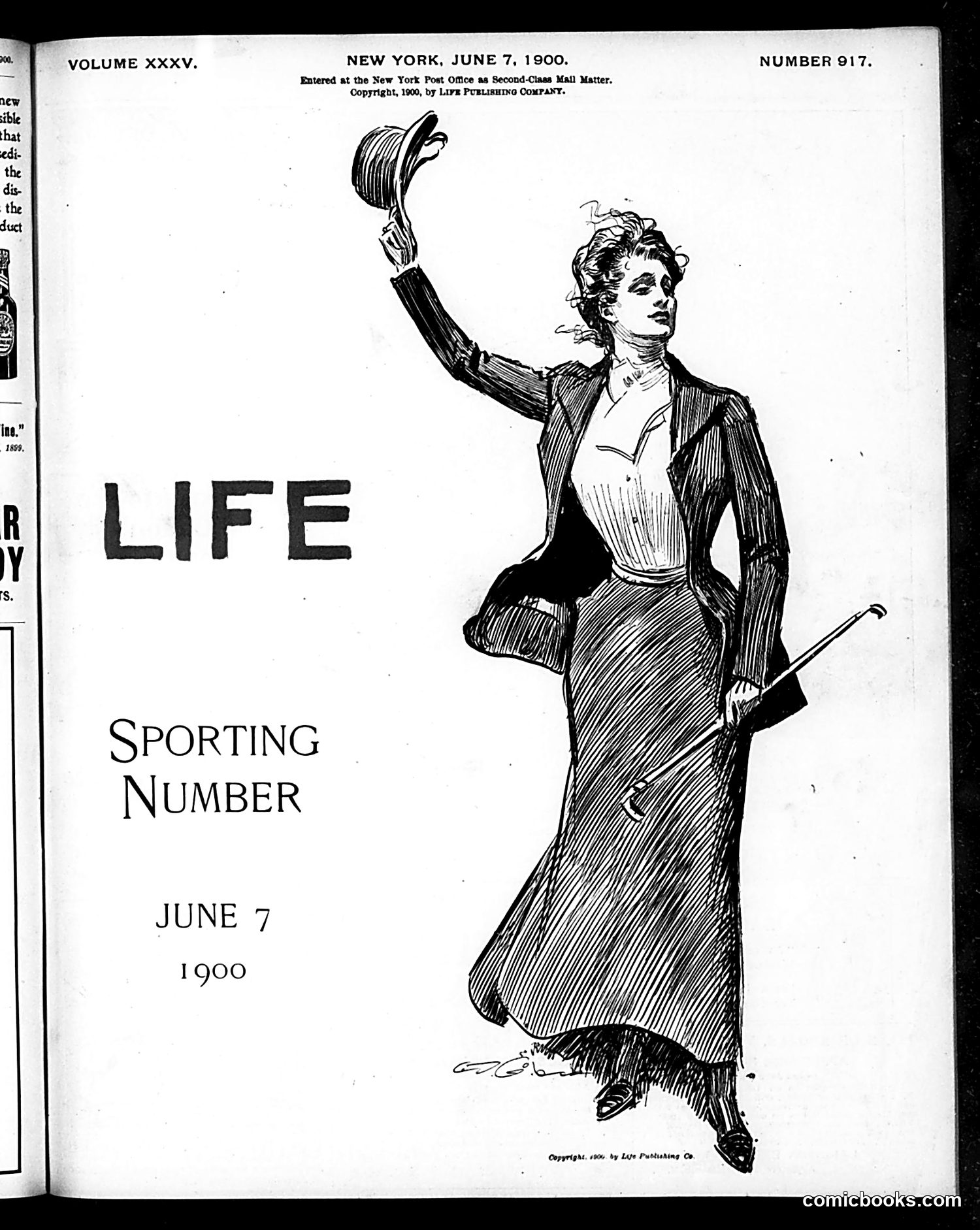
This is the cover of *Life*'s "Sporting Number," featuring an illustrated Gibson Girl–style woman in elegant athletic attire holding a rifle aloft triumphantly. She wears a tailored jacket and long skirt typical of 1900s women's fashion, with her hair styled fashionably upswept. The image celebrates the "New Woman" of the era—an emerging figure of female independence and athleticism that challenged Victorian gender norms. By depicting her with sporting equipment (rifle and what appears to be a golf club), the cover satirizes the growing participation of women in outdoor sports and leisure activities previously considered exclusively male domains. This reflects the period's social anxieties and fascinations with changing women's roles around 1900.
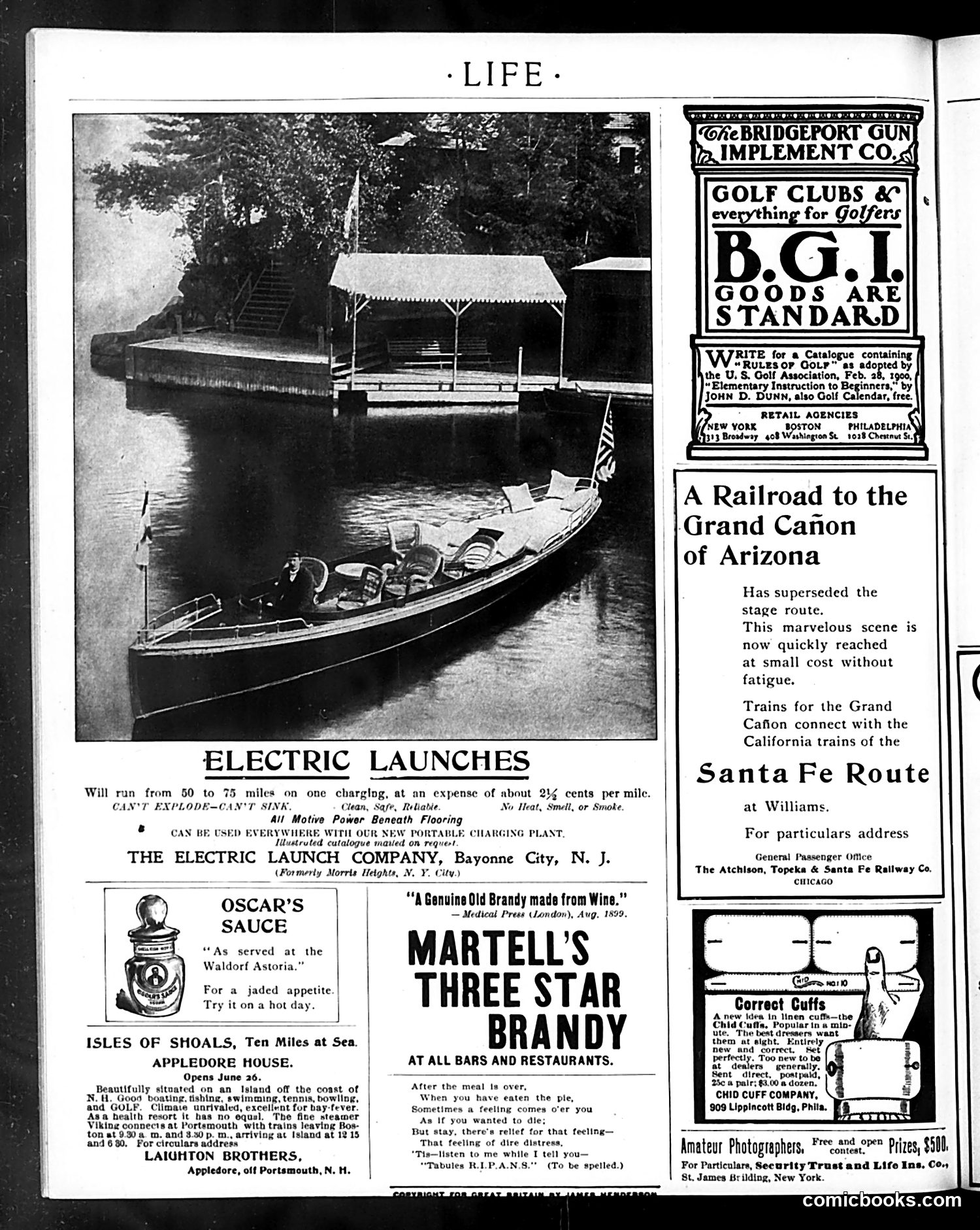
This page is primarily **advertising content**, not political satire or comics. It contains several period advertisements: 1. **Electric Launches** - promoting battery-powered boats from The Electric Launch Company in Bayonne, N.J., emphasizing low operating costs (2½ cents per mile) 2. **Oscar's Sauce** - a condiment advertisement 3. **Martell's Three Star Brandy** - liquor advertisement (notable as this appears to be during or near Prohibition era) 4. **Isles of Shoals/Appledore House** - tourism advertisement for New Hampshire seaside resort 5. **Railroad to Grand Canyon** - Santa Fe Route travel advertisement 6. **Additional ads** for golf clubs, correct cuffs, and amateur photography contests There is **no political cartoon or satirical content** visible on this page—it's a standard early 20th-century magazine advertising section.
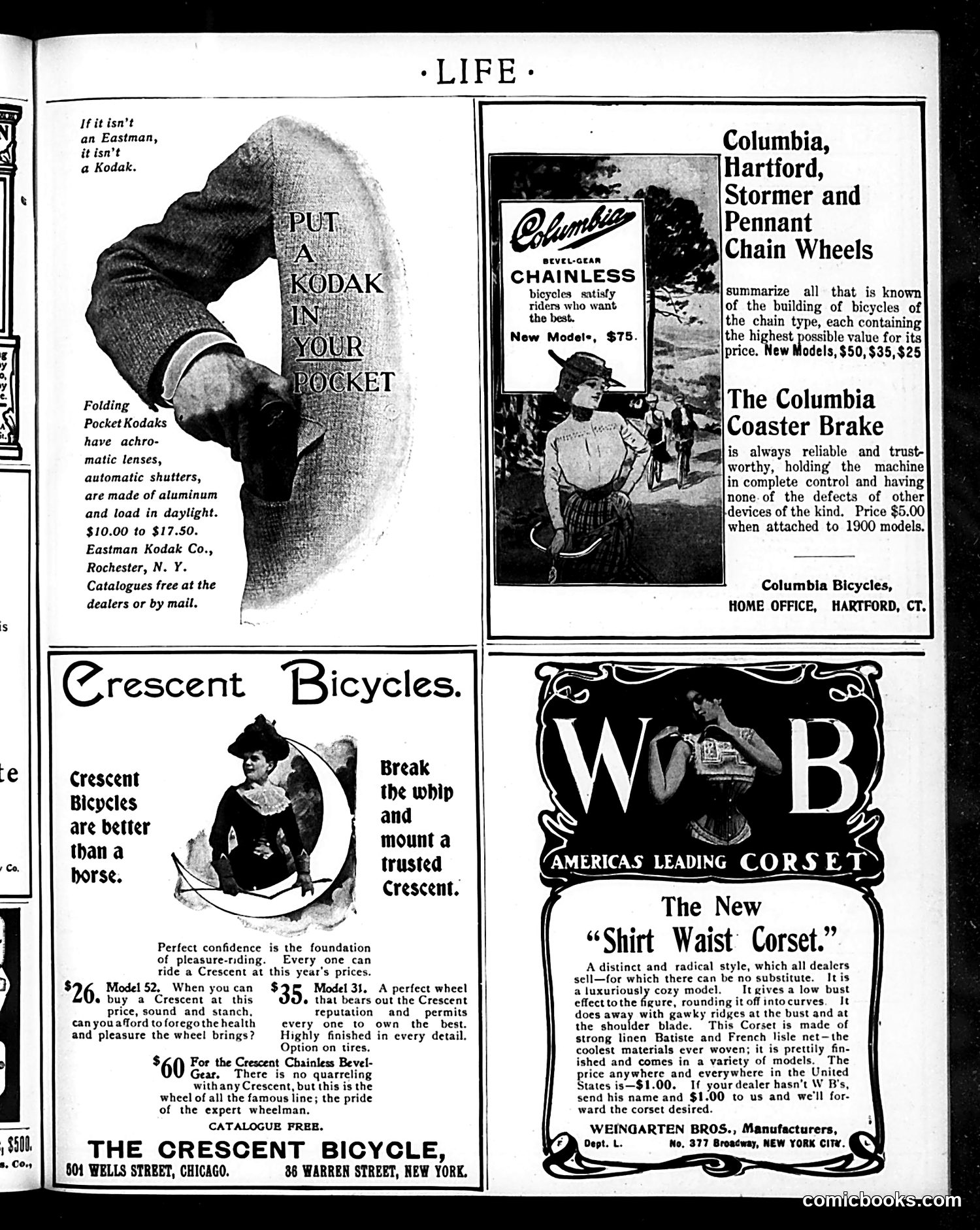
This page is primarily **advertising**, not satirical content. The top-left features a Kodak camera ad with the slogan "If it isn't an Eastman, it isn't a Kodak" — promoting portable folding cameras ($10-$17.50). The remaining ads showcase bicycles and related products: Columbia chain wheels and coaster brakes (Hartford, CT), Crescent Bicycles ("better than a horse," priced $26-$60), and a W.B. corset advertisement. The only potentially humorous element is Crescent's tagline comparing bicycles favorably to horses, reflecting late-19th/early-20th-century transportation debates. Otherwise, this represents typical period advertising targeting middle-class consumers interested in bicycles and photography — both relatively new consumer technologies of the era.
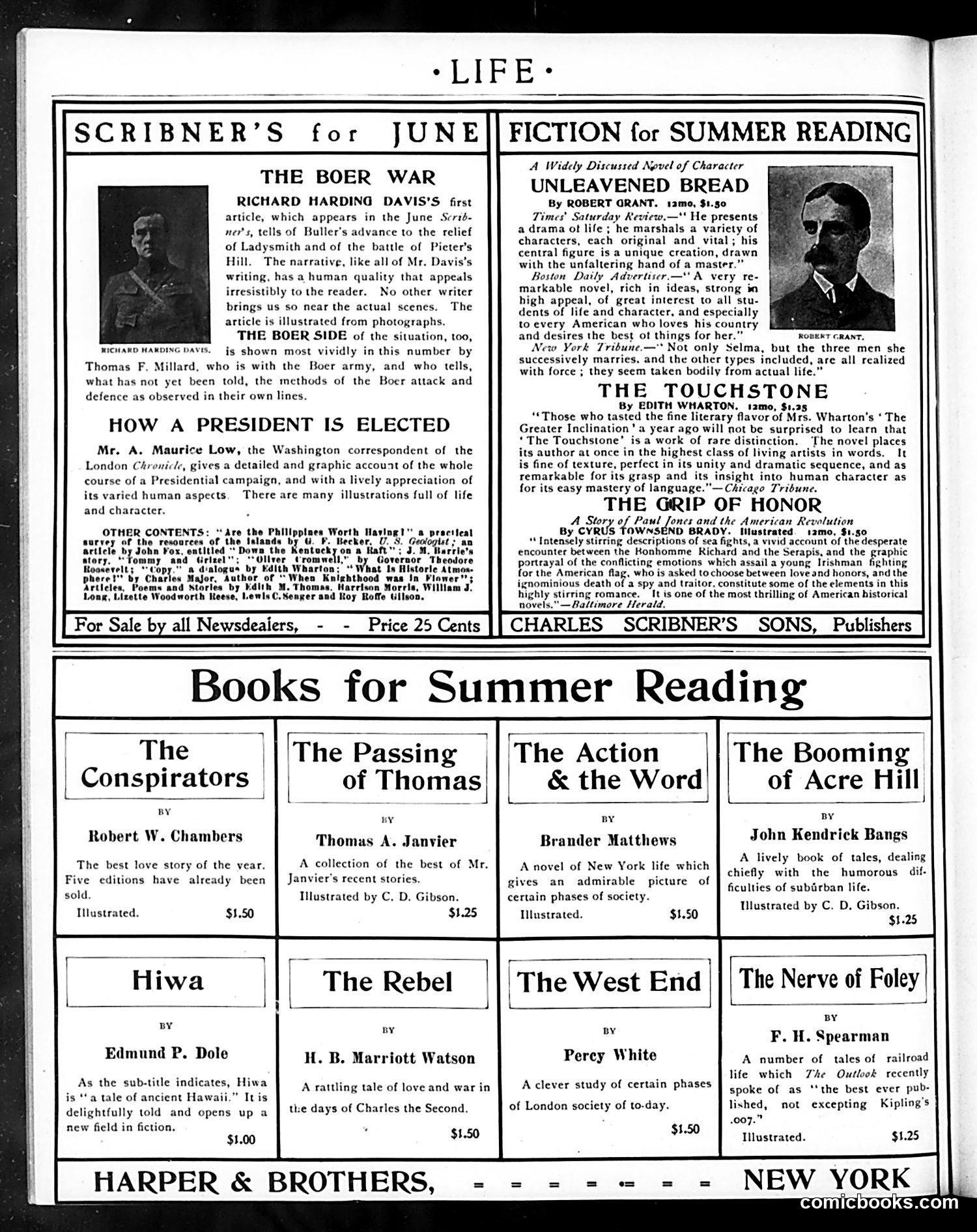
This page is primarily **advertising for books**, not political satire. The top section features Scribner's magazine contents for June, including articles on the Boer War and presidential elections. The main content advertises summer reading from two publishers: Charles Scribner's Sons and Harper & Brothers. The featured fiction titles include *Unleavened Bread* by Robert Grant and *The Touchstone* by Edith Wharton. Below are eight additional books with prices ranging from $1.00 to $1.50, illustrated by C.D. Gibson. There are **no political cartoons on this page**. The single photograph shows what appears to be a portrait accompanying one of the book advertisements. This is a straightforward commercial advertisement page rather than satirical content.
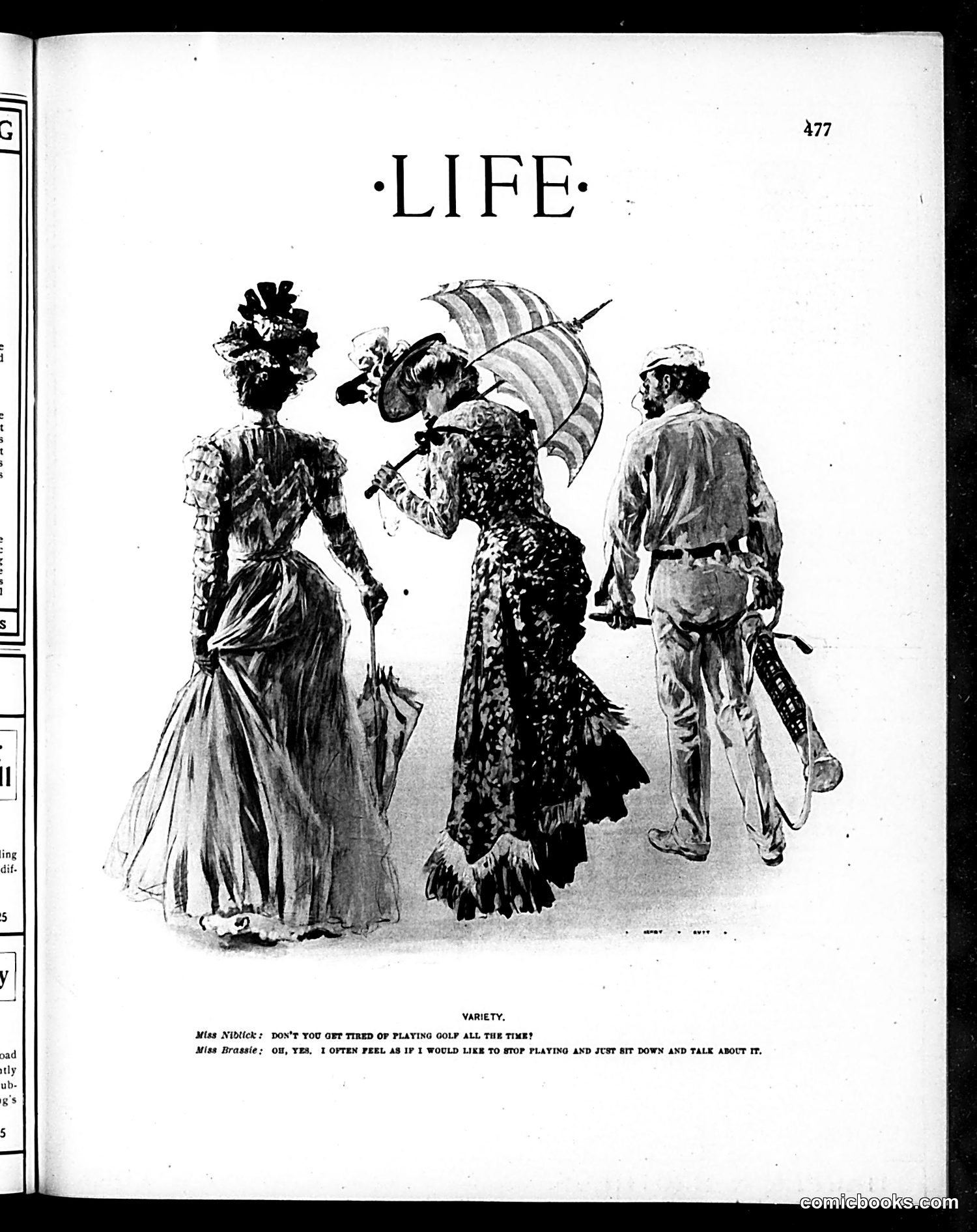
This cartoon satirizes early 20th-century gender roles and leisure activities. The illustration shows three figures—two elegantly dressed women and a man in casual attire—in what appears to be a social encounter. The dialogue reveals the satire's point: Miss Nibick complains that her male companion won't stop playing golf, while Miss Brassie suggests women could enjoy the same relief if they simply quit playing golf themselves and instead "sit down and talk about it." The joke targets the era's gender double standards regarding recreation. Men could pursue sports obsessively without criticism, but women's activities were subject to different social expectations. The cartoon mocks both the unequal standards and women's acceptance of these limitations, using golf as the vehicle for this social critique.
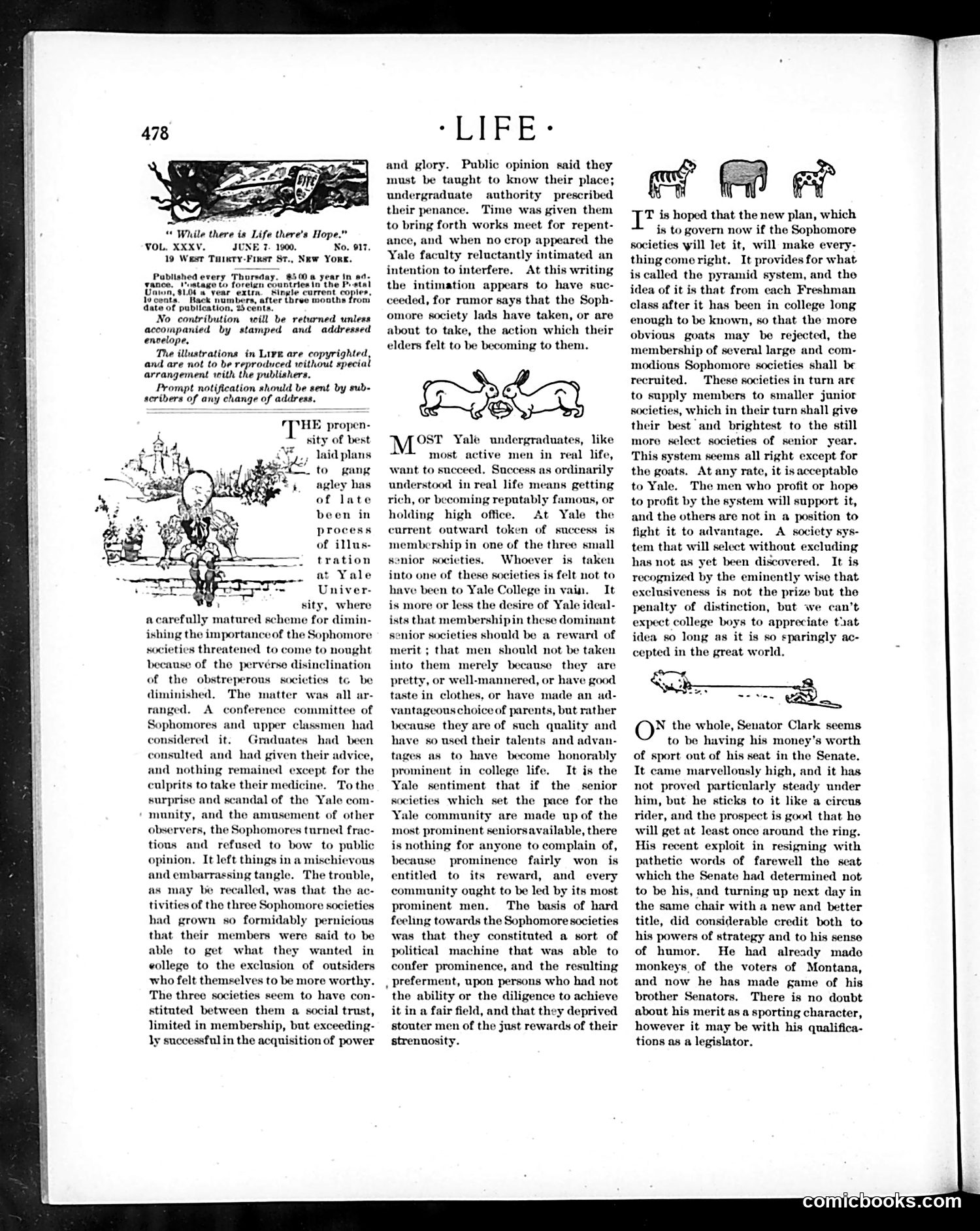
This page discusses Yale University's sophomore societies and their role in campus hierarchy. The main text critiques how these exclusive clubs function as a "political machine" for advancing members' ambitions rather than rewarding genuine merit. The left illustration appears to be decorative satirical artwork typical of Life's visual style—possibly depicting the pretensions of collegiate social climbing, though specific figures aren't clearly identifiable. The right column discusses Senator Clark's recent resignation and political maneuvering, suggesting he's been using his Senate position strategically. The tone is sardonic about how power operates in both academic and political spheres. **Overall point**: The satire equates Yale's social system with political corruption—both reward connections over competence, with similar consequences for public life.
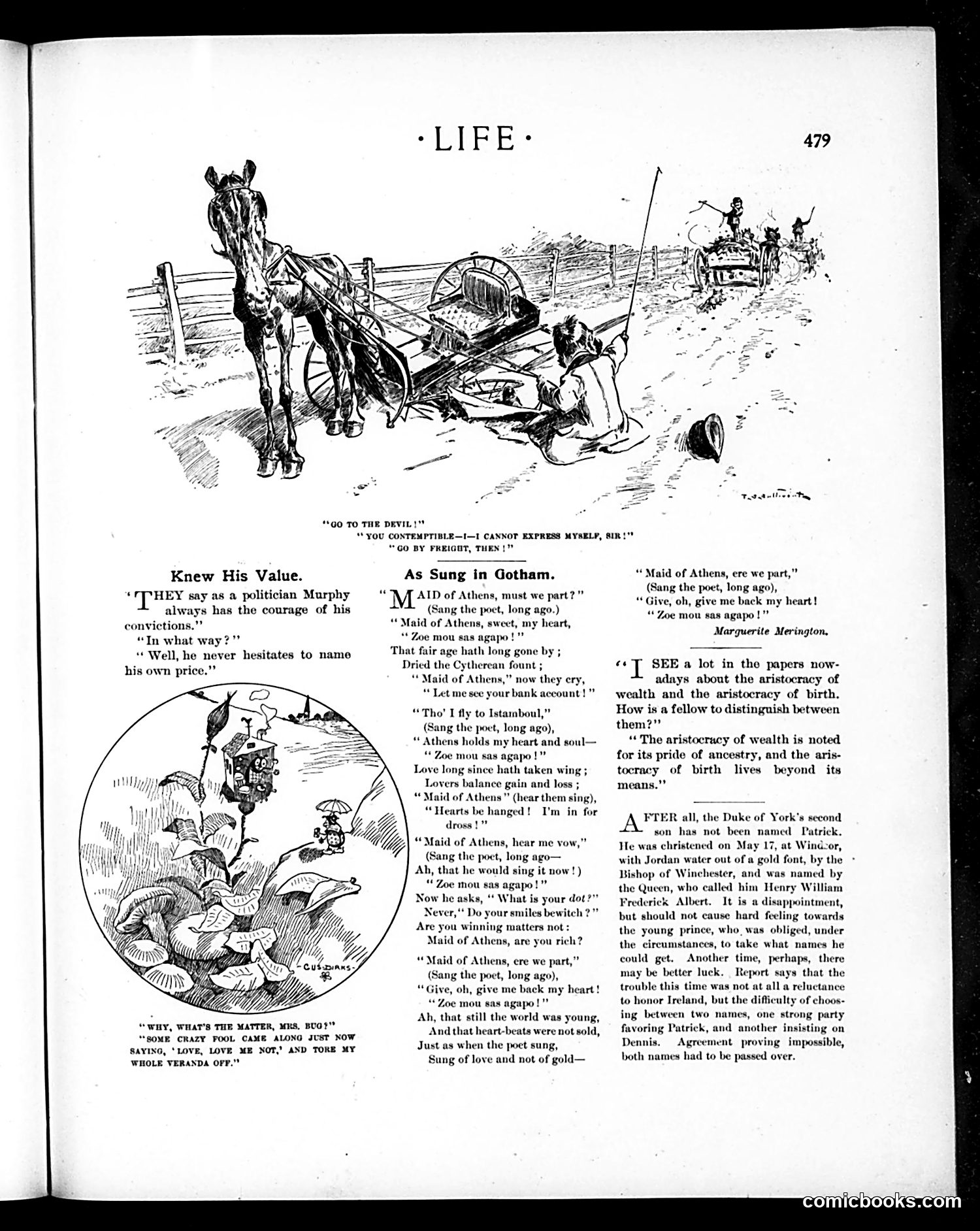
This page contains three distinct pieces: a sketch showing a horse-drawn cart accident, and two separate humor pieces with accompanying illustrations. The top cartoon appears to satirize rural life or labor, depicting someone thrown from a cart—likely mocking working-class mishaps. "Knew His Value" (left) is a brief joke about a politician named Murphy who boldly names his own price, suggesting shameless self-promotion or corruption—a common satirical target. "As Sung in Gotham" (center) presents song lyrics about the "Maid of Athens," likely parodying romantic poetry with mundane modern concerns (bank accounts, wealth), mocking both pretentious art and urban materialism. The right column discusses aristocratic naming conventions in Ireland, explaining social tensions between old landed families and new money—commentary on class hierarchy. The overall page mixes political corruption jokes with class satire typical of Life's satirical approach.
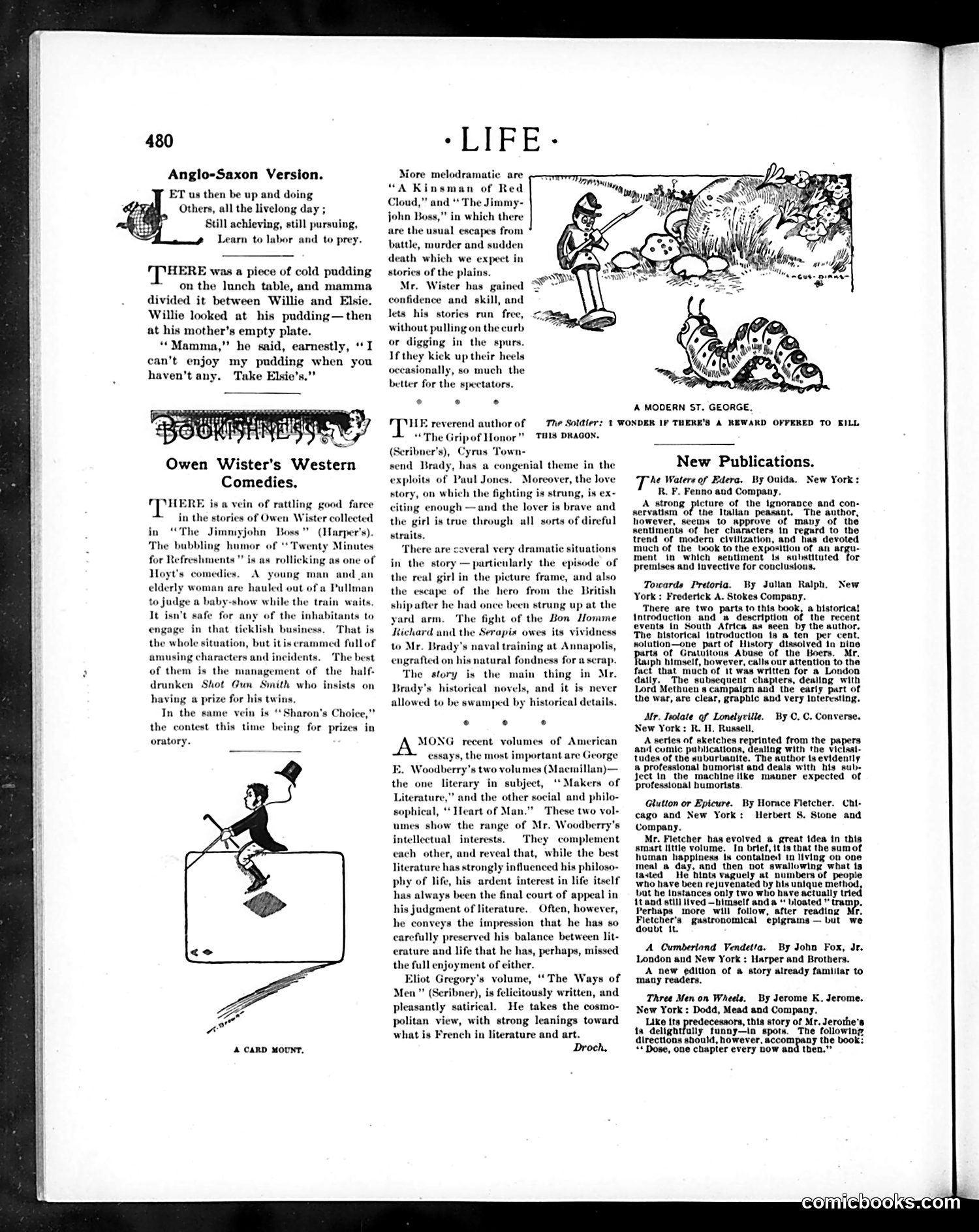
This page contains **book reviews and literary criticism**, not political cartoons. The main content discusses Owen Wister's Western comedies and reviews of recent American publications. The illustrations are **decorative rather than satirical**: one shows a figure in period dress (Anglo-Saxon style), another depicts "A Modern St. George" with a knight confronting a spotted dragon, and a small image labeled "A Card Mount" shows a figure doing a headstand. These appear to be **generic illustrations accompanying literary discussion** rather than political commentary. The page functions as a **literary journal section**, reviewing works by Paul Jones, George E. Woodberry, and others—typical content for Life magazine's satirical but literature-focused format of this era.
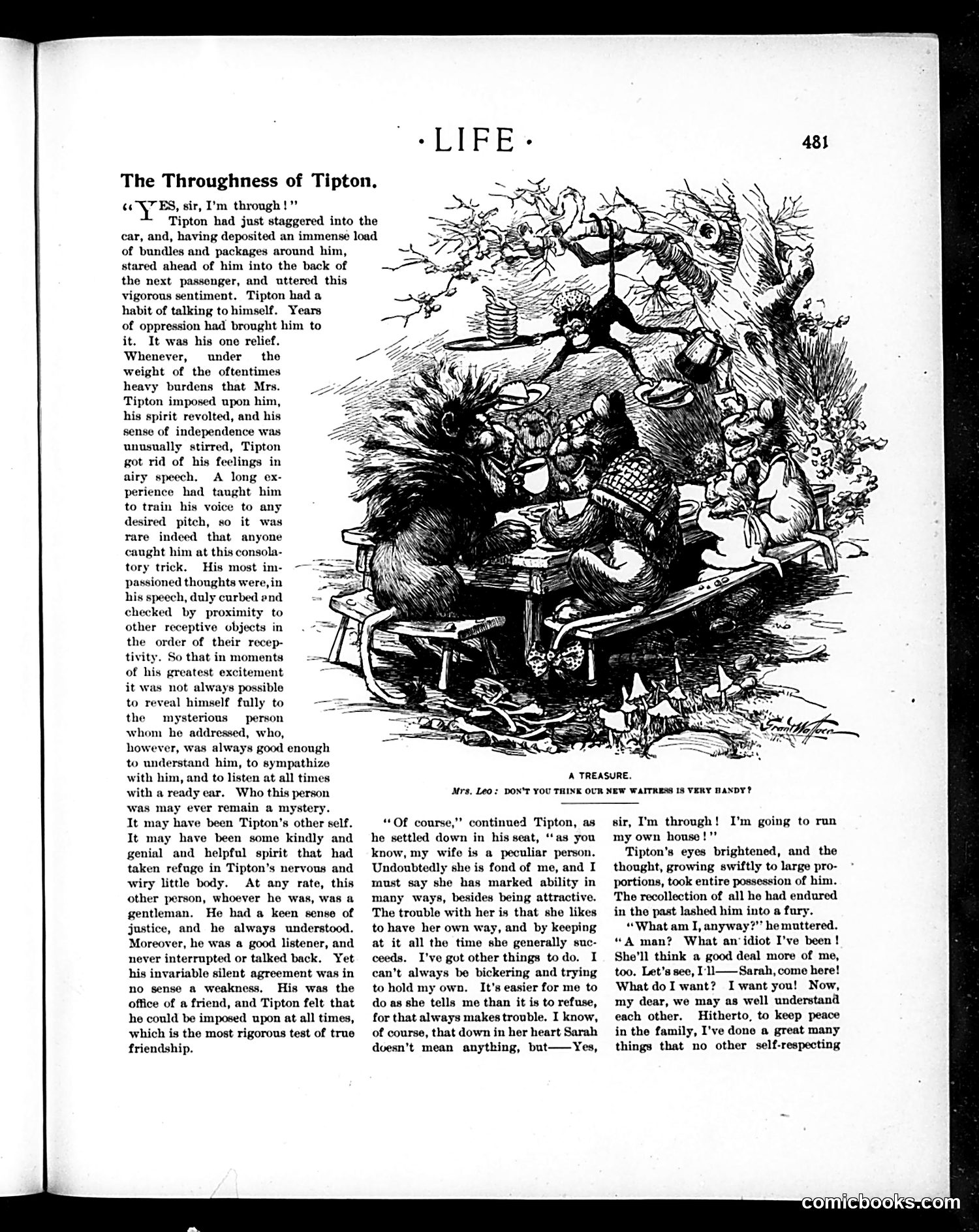
This is a humorous short story about a character named Tipton, a porter or baggage handler who has just completed loading passengers onto a train. The accompanying illustration shows Tipton surrounded by chaos—passengers, luggage, and various items strewn about a train compartment. The satire targets Tipton's verbose, self-satisfied manner of speaking. The text explains that Tipton habitually talks to himself as relief from his demanding job, and that his wife finds this annoying. The joke centers on his inability to remain silent and his tendency toward grandiose self-justification. The illustration humorously depicts the disorder and confusion that characterizes his work environment, contrasting with his proud declaration that he's "through"—suggesting his work is never truly finished.
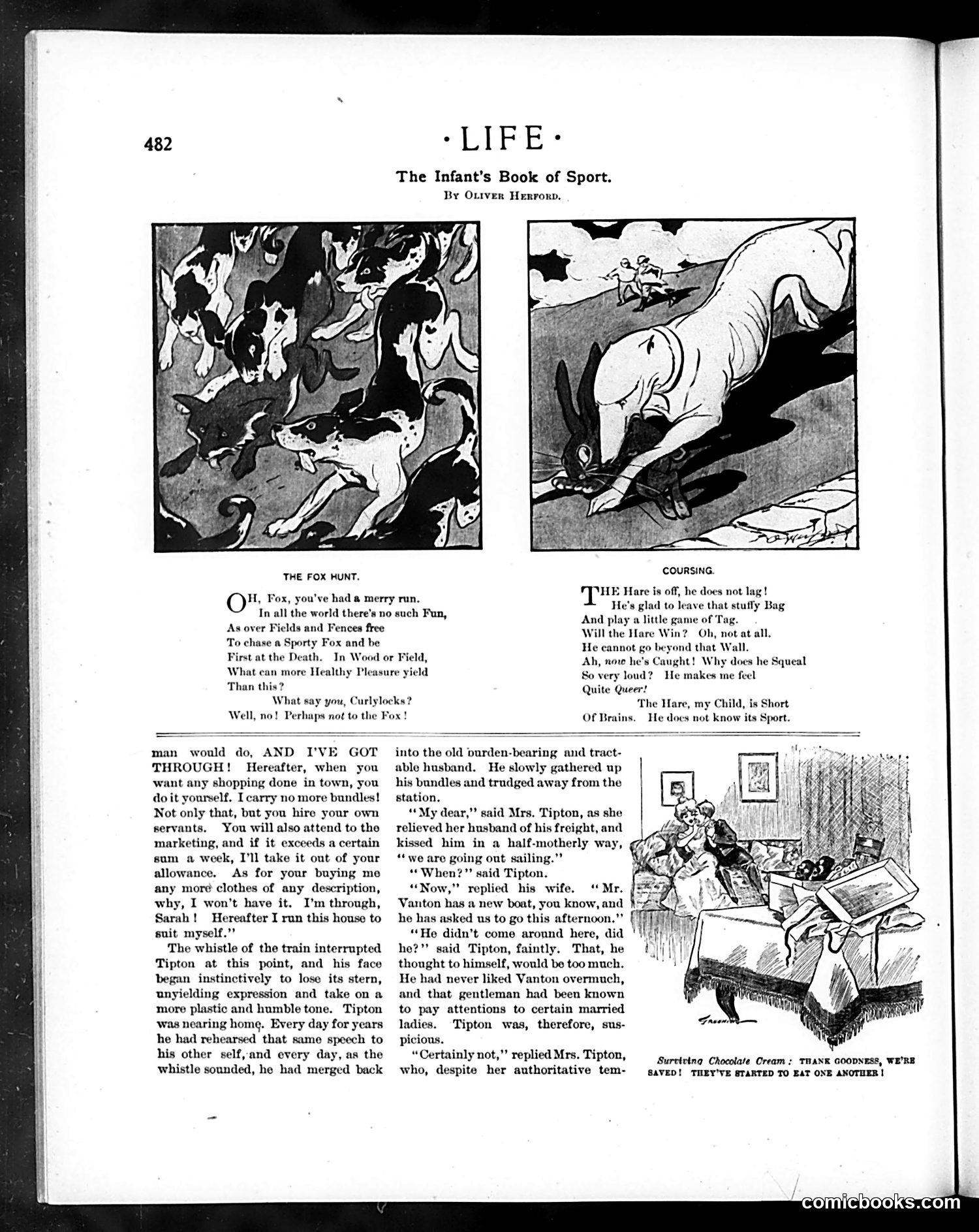
This page presents two illustrated poems about animals and hunting, written for children. **"The Fox Hunt"** depicts dogs chasing a fox, celebrating the sport as "Healthky Pleasure." The poem mocks the fox's predicament while presenting hunting as entertaining and wholesome. **"Coursing"** shows a hare escaping, with commentary that the hare is "Short / Of Brains" and doesn't understand sport—implying the animal should accept being hunted as natural. Both pieces exemplify early 20th-century attitudes normalizing blood sports for young readers. The illustrations present predator-prey dynamics as morally neutral entertainment. The condescending tone toward the animals (calling the hare "Queer") reflects period assumptions about animal inferiority and human sporting rights that modern readers would find troubling.
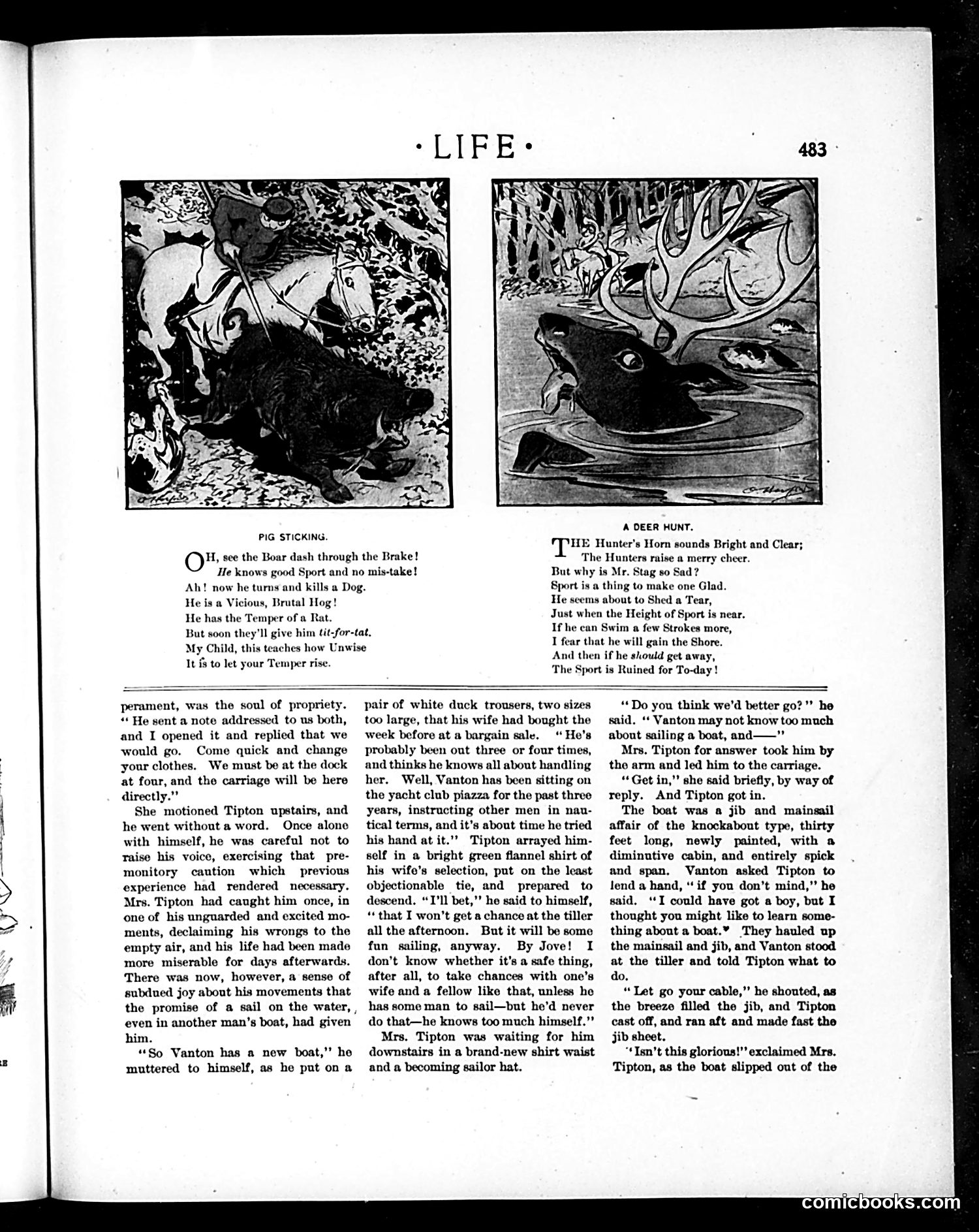
This page contains two illustrated poems with accompanying narrative text, not political cartoons. **Left image ("Pig Sticking"):** Shows a mounted hunter with a spear confronting a boar. The poem mocks a character who claims expertise in hunting but makes foolish mistakes—killing a dog instead of the boar, behaving temperamentally, and generally demonstrating poor sportsmanship. The satire targets pretentious hunters who lack actual skill. **Right image ("A Deer Hunt"):** Depicts a stag with elaborate antlers. The accompanying poem suggests the hunter's pride in the sport is misplaced—the stag escapes and "the Sport is Ruined for To-day!" Both pieces satirize the sporting pretensions and incompetence of wealthy leisure-class hunters, suggesting their activities are more about social posturing than genuine prowess.
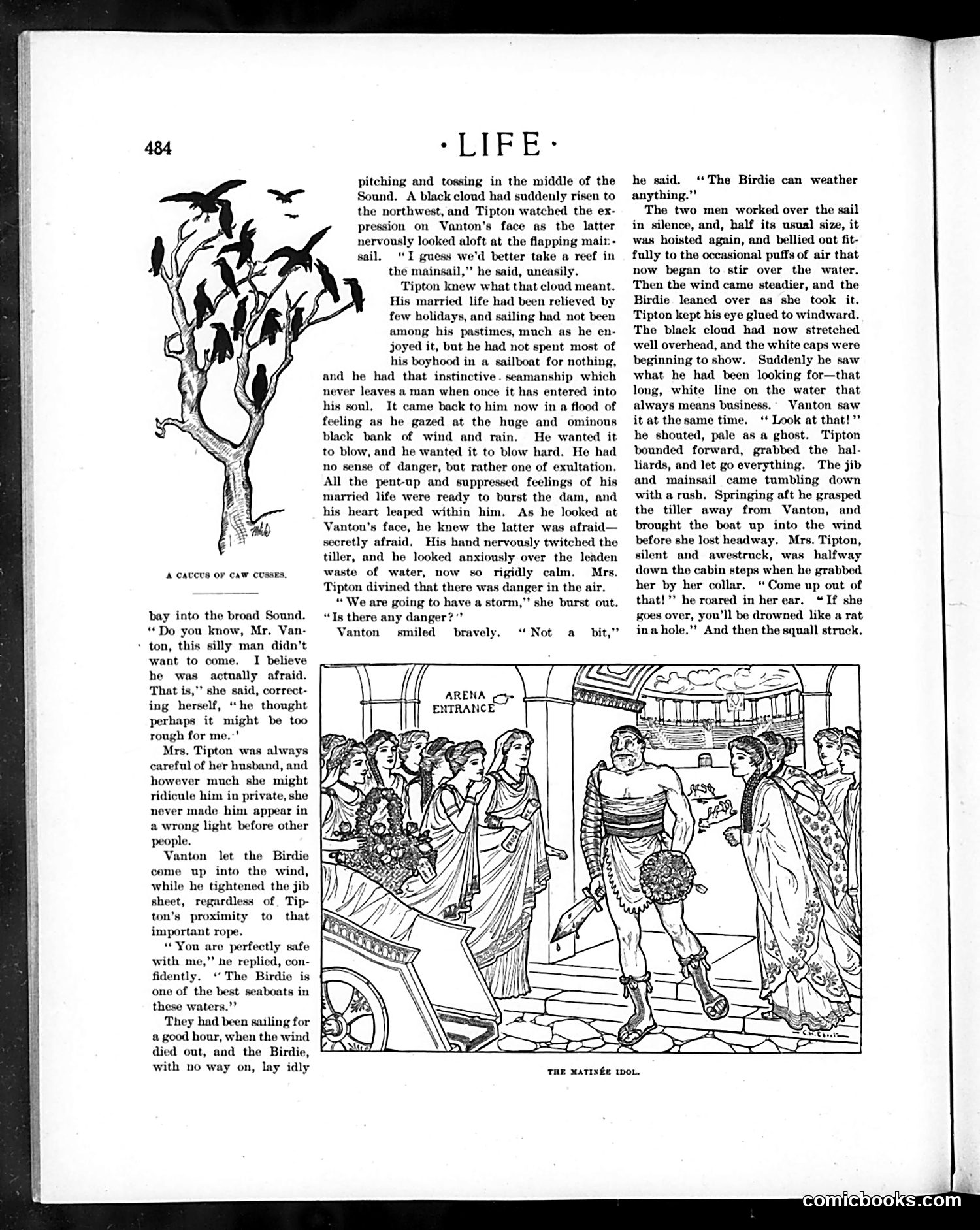
This page contains a narrative text excerpt about sailing (featuring characters named Tipton and Vanton) alongside an illustration labeled "THE MATINEE IDOL." The illustration depicts a classical or Roman arena scene with spectators and a central male figure. The caption "THE MATINEE IDOL" suggests satire of theater culture—likely mocking popular leading men of the era who drew devoted female audiences. The specific identity of which actor is caricatured is unclear from the image alone. However, the scene's theatrical setting and the term "matinee idol" (popular stage actors, typically young and handsome) indicates social commentary on celebrity worship and the devotion of female theatergoers to attractive performers. The satirical point appears to mock both the performers' appeal and audiences' romantic fantasies about them.
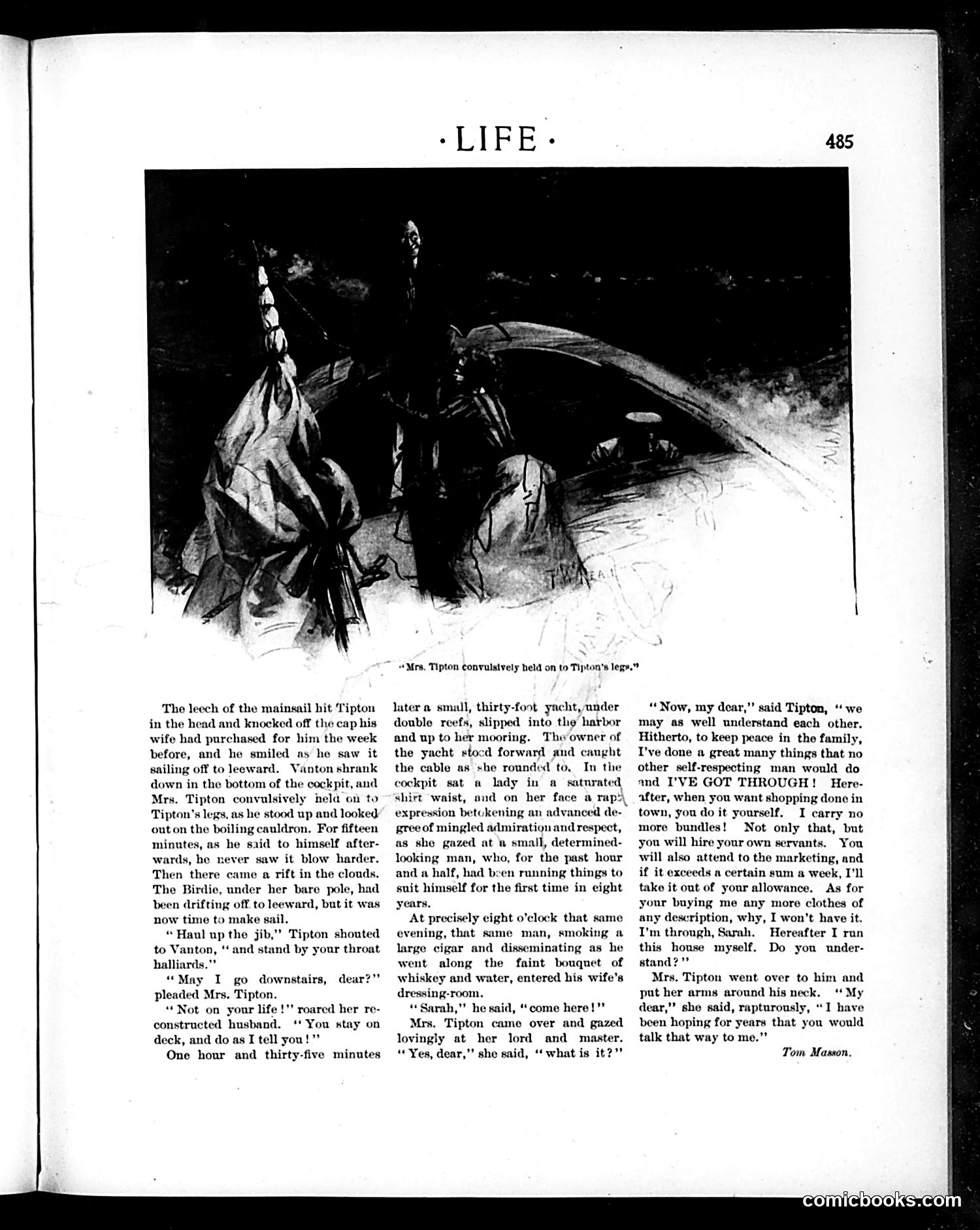
This is a humorous domestic story-cartoon satirizing the "New Woman" movement of the early 20th century. **The Setup:** Weak-willed Mr. Tipton is bullied by his wife into household tasks. During a sailing trip, he finally asserts authority—commanding the yacht during a storm while Mrs. Tipton clings to his legs in fear and admiration. **The Satire:** The story mocks conventional gender roles by suggesting that *both* parties actually want the husband to dominate. When Tipton declares he'll no longer shop, hire servants, or buy clothes at his wife's whim, Mrs. Tipton responds with rapture: "I've been hoping for years that you would talk that way to me." **The Joke:** Despite contemporary discourse about women's independence and rights, the story suggests wives secretly desire authoritarian husbands. The title "Reconstructed Husband" ironically means a husband who has "reconstructed" his masculine authority—precisely the opposite of progressive change. This reflects anti-feminist anxieties of the era.
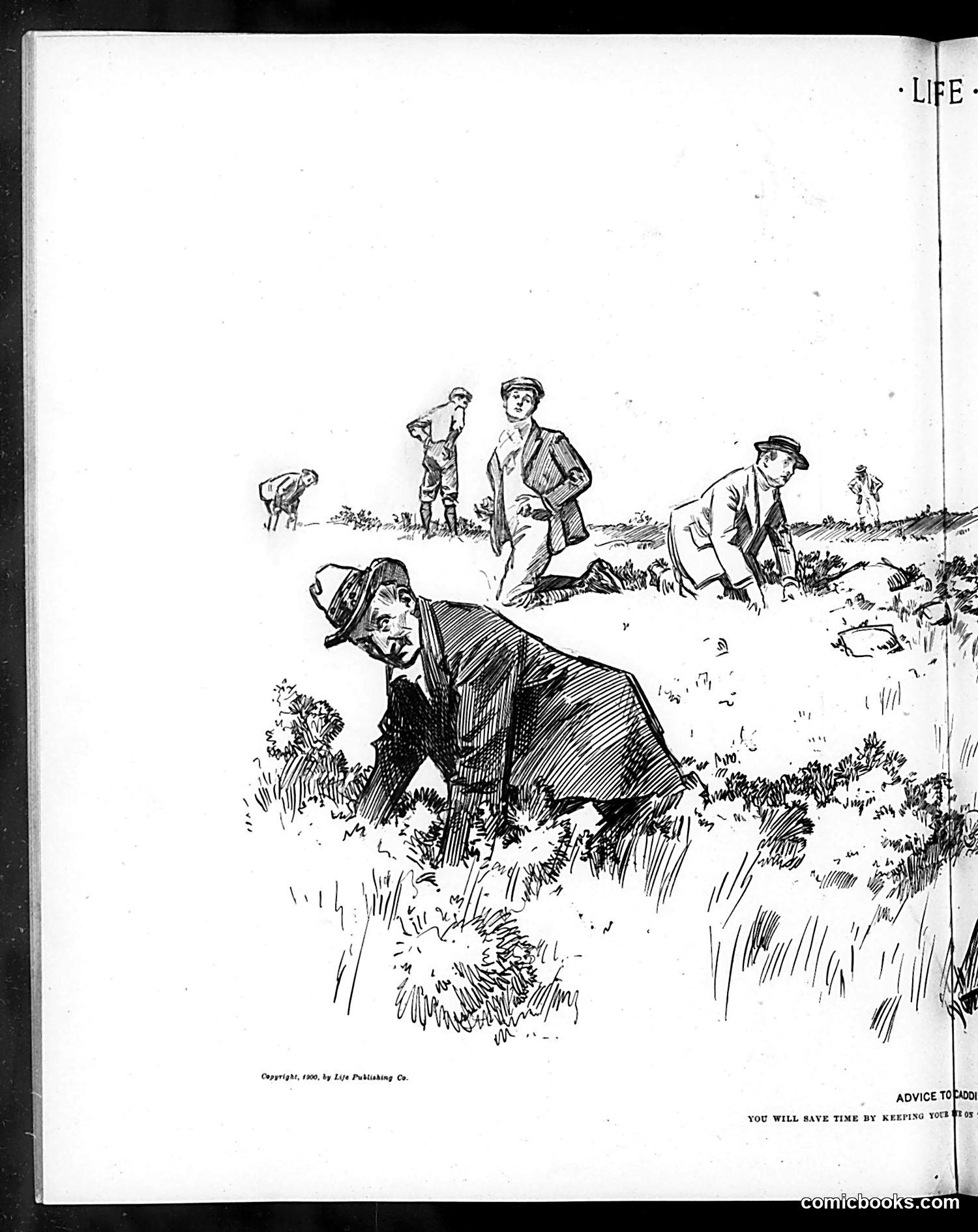
This appears to be a satirical illustration showing a well-dressed man in the foreground examining or bending over vegetation in a field, while several other figures stand in the background observing him. The style suggests early 20th-century social commentary. The partially visible text at bottom right reads "ADVICE TO EACH" and mentions "YOU WILL HAVE TIME BY KEEPING YOUR" (text cuts off), suggesting this offers some form of practical advice or satirical guidance. Without clearer OCR text or additional context, the specific political or social target remains unclear. The scene appears to mock either agricultural practices, business inspection, or working-class activities, but I cannot definitively identify the intended satirical point or which public figures (if any) are being caricatured from the image alone.
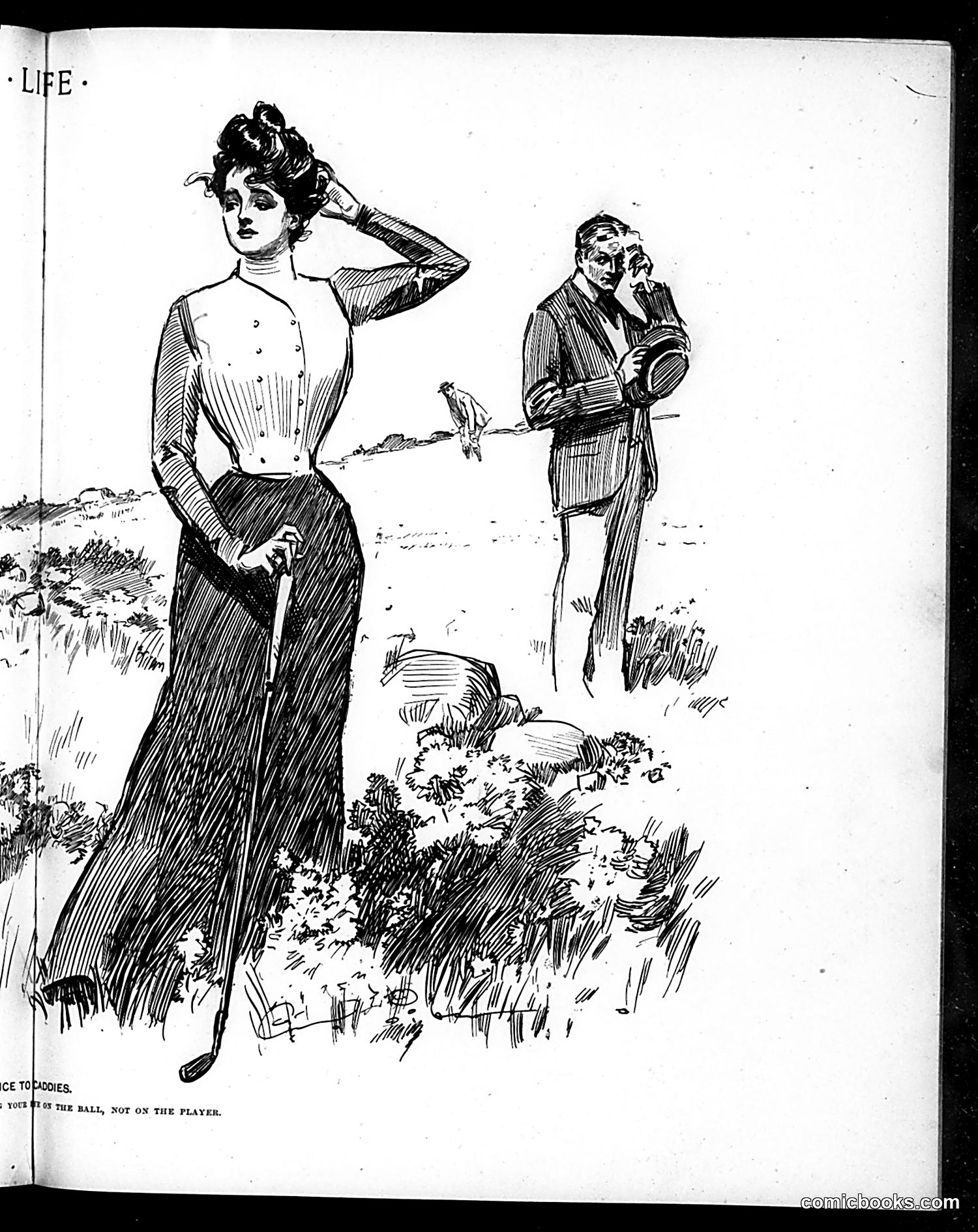
This satirical illustration depicts a woman in early 1900s attire standing prominently in a landscape, while a man in the background holds binoculars. The partially legible caption references "your eyes on the ball, not on the player," suggesting commentary on misdirected attention or focus. The cartoon likely satirizes the distraction caused by an attractive woman—a common theme in period humor. The man's use of binoculars and the woman's confident pose suggest she represents either a celebrity, athlete, or public figure drawing inappropriate male attention away from actual events or responsibilities. The gendered nature of the joke reflects early 20th-century social attitudes about women's visibility in public spaces and the "distraction" their presence supposedly caused.
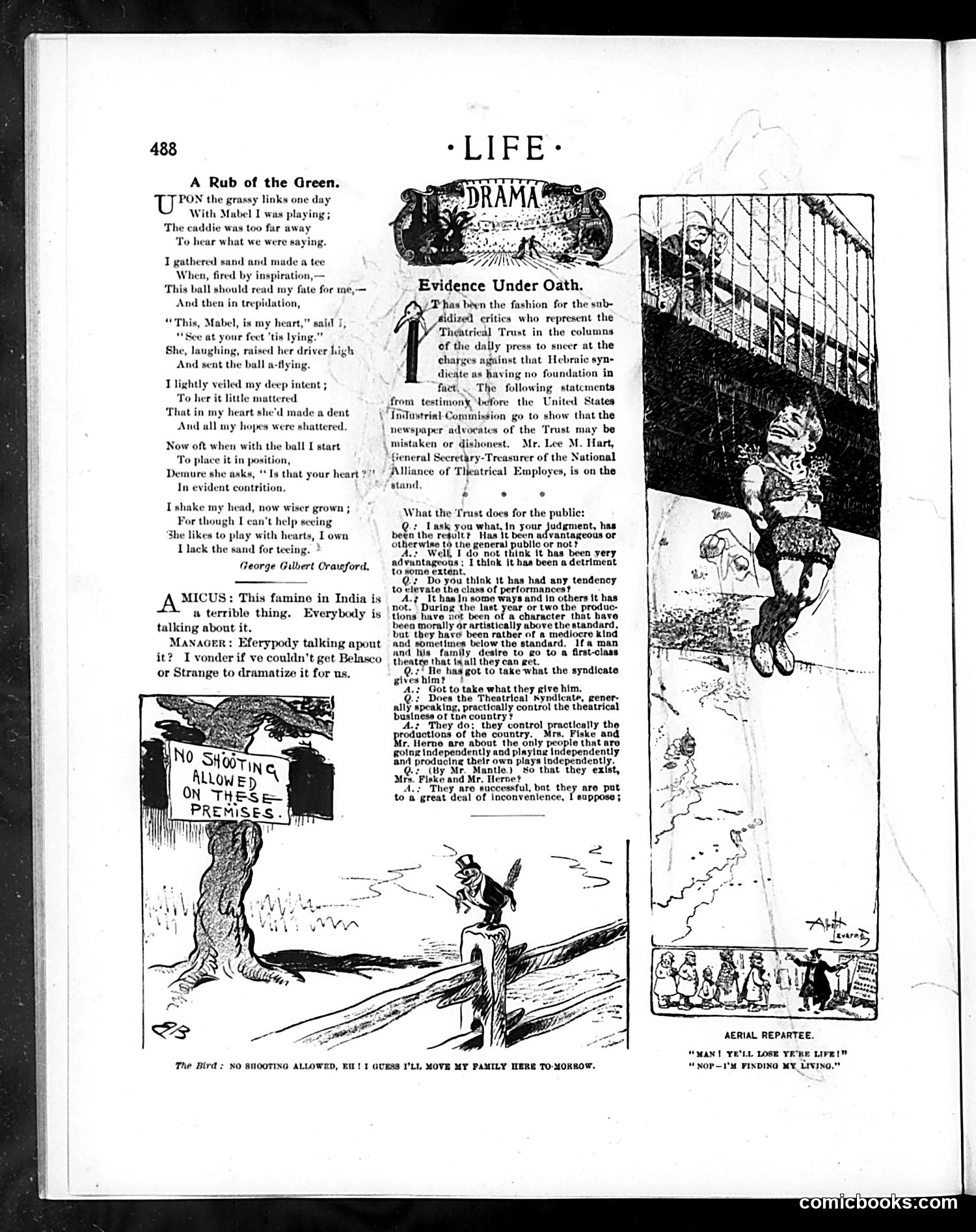
**"A Rub of the Green"** (top left): A romantic golf poem where a man uses his golf ball as a metaphor for his heart, asking his companion Mabel to determine his fate by hitting it. She laughs and drives it away, symbolizing his romantic hopes being dashed. The wordplay on "sand for teeing" (golf) versus lacking courage mirrors the rejected proposal. **"Evidence Under Oath"** (center/right): This section quotes testimony from Lee M. Hart, General Secretary-Treasurer of the National Alliance of Theatrical Employes, before a U.S. Industrial Commission. Hart testifies that the Theatrical Syndicate (a monopoly controlling American theater) has been detrimental to the public, producing mediocre plays and forcing audiences to accept whatever the syndicate offers. He notes only Mrs. Fiske and Mr. Herne operate independently, though with great difficulty. This supports accusations that the "Hebraic syndicate" operates without legitimate foundation—a contemporary reference to anti-Semitic criticism of Jewish theater operators. **Bottom cartoons**: Humorous sketches about bird shooting restrictions and aerial navigation.
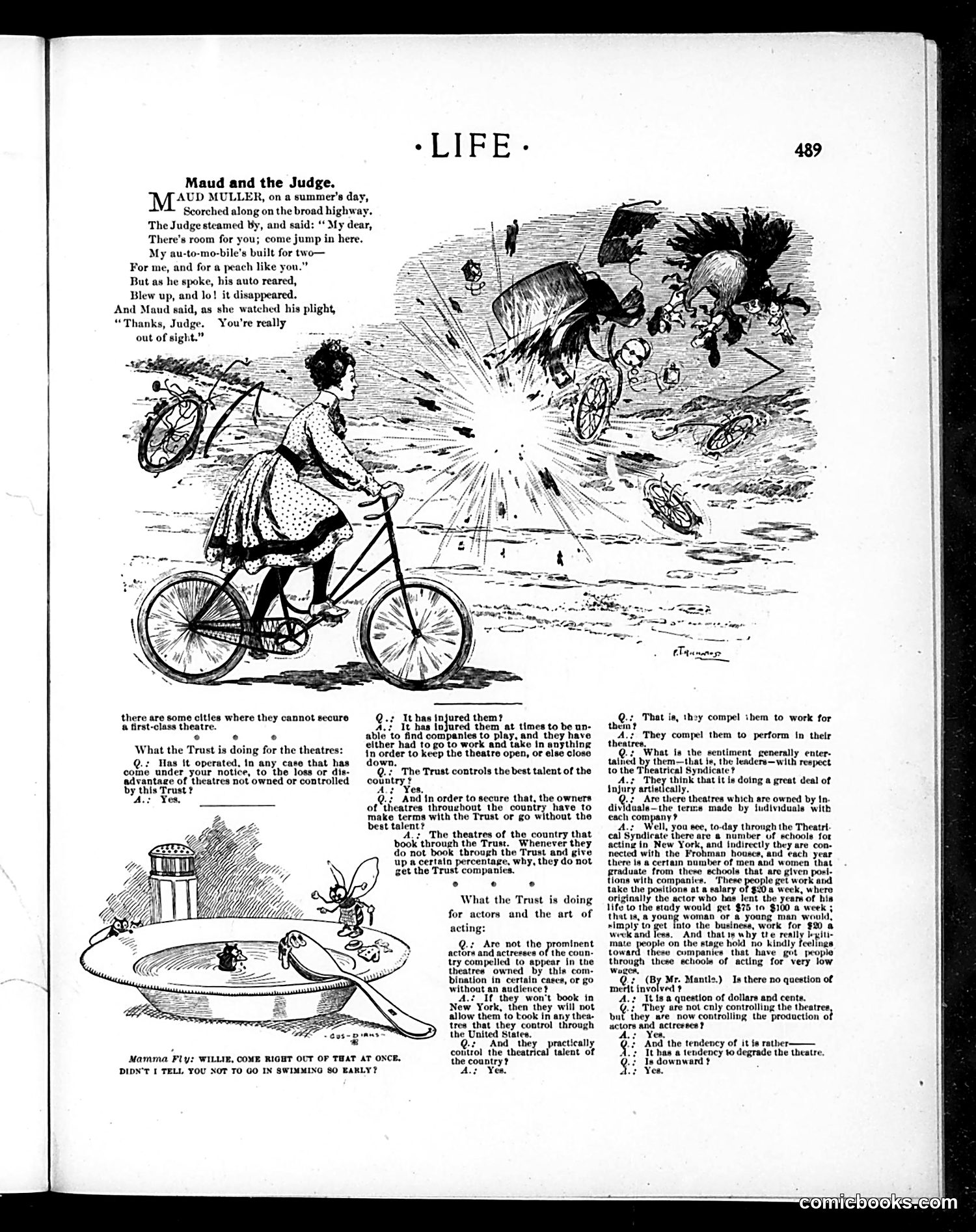
This page contains two satirical pieces attacking the "Theatrical Trust" (a monopoly controlling American theaters in the early 1900s). The top cartoon depicts Maud Muller rejecting a Judge's advances when his automobile explodes—a pun on his being "out of sight." This illustrates the Trust's removal of competition: just as the Judge disappears, the Trust eliminates independent theaters. The bottom section presents testimony (likely from actual congressional hearings) exposing the Trust's anti-competitive practices: it controls the best actors, forces theaters to either book through the Trust or fail, pays young actors pittance ($20/week vs. $75-100), and degrades theatrical art by reducing it to profit. The "Mamma Fly" cartoon mocks the Trust's predatory control—like a parent removing a child from danger. The satire argues the Trust functions as a monopoly that harms both theaters and actors, reducing art to "dollars and cents" rather than merit.
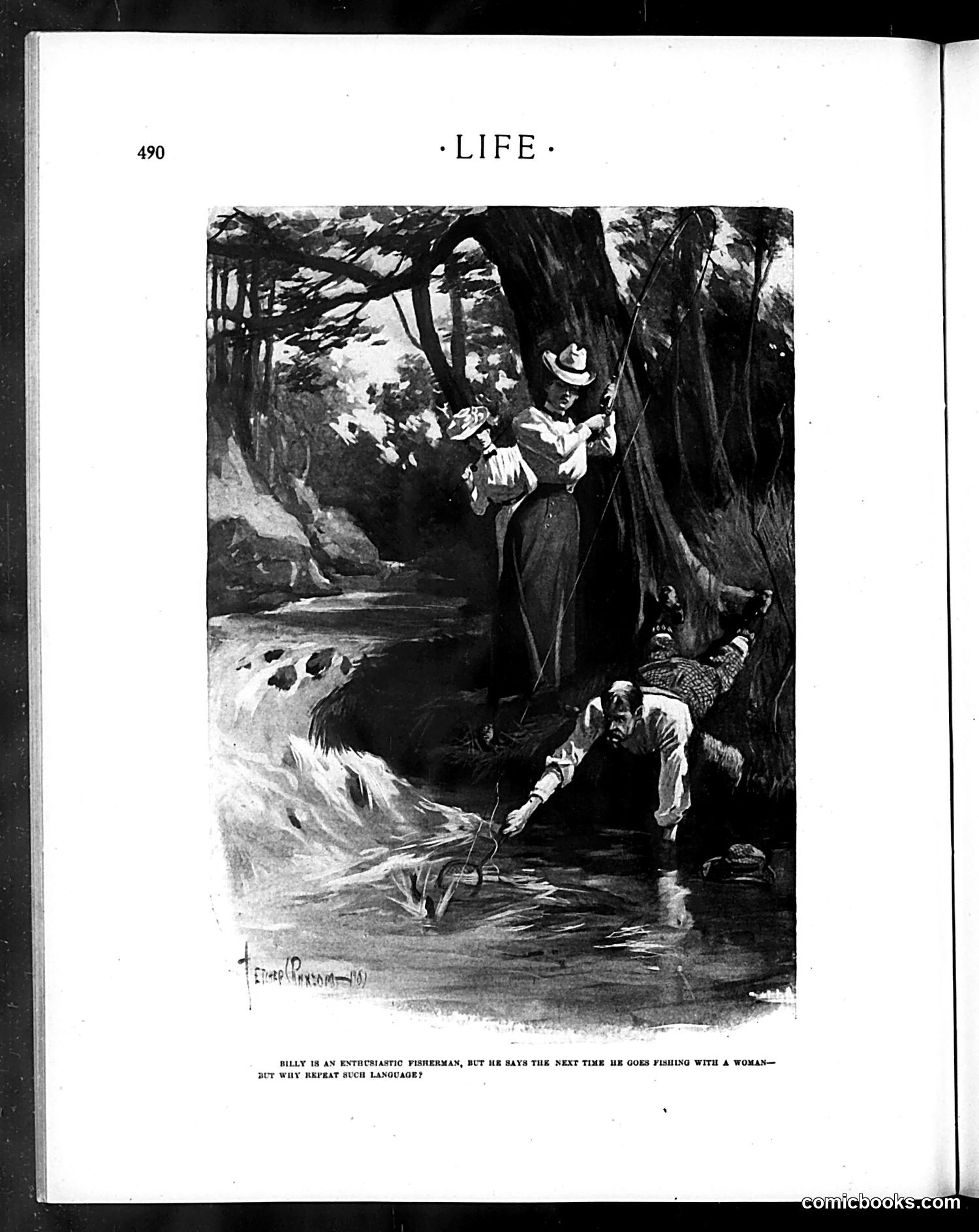
This is a satirical illustration about gender and fishing. The caption establishes that "Billy" is an enthusiastic fisherman who, after fishing with a woman, has apparently used such profane language that the magazine won't repeat it in print ("But why repeat such language?"). The joke relies on the implication that fishing with a woman—likely because of perceived incompetence, complaints, or simply her presence disrupting the activity—frustrated Billy enough to swear extensively. The humor targets both Billy's outburst and, implicitly, the assumption that women don't belong in traditionally male recreational spaces like fishing. The illustration shows figures by a stream beneath large trees, consistent with a fishing scene. This reflects early 20th-century gender attitudes about separate spheres for men's and women's activities.
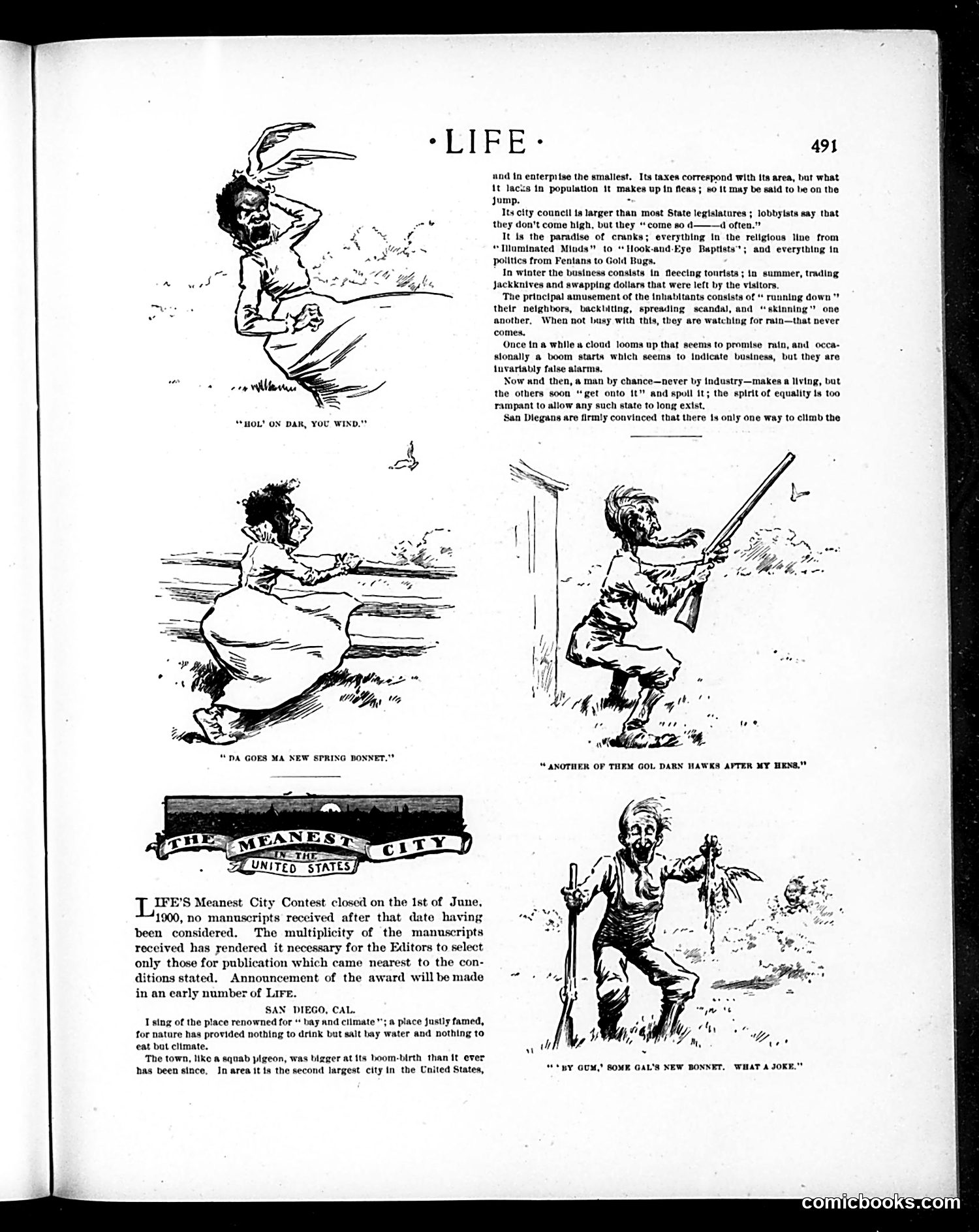
This page contains a vicious satirical attack on San Diego, California, presented as the winning entry in Life's "Meanest City Contest" (closed June 1, 1900). The text mocks San Diego as a place of economic stagnation, social dysfunction, and environmental harshness—famous only for its bay and climate, yet offering nothing drinkable but salt water and nothing edible but the climate itself. The accompanying cartoons illustrate the text's themes through exaggerated caricatures of San Diego residents: figures in ragged clothing, depicted as desperate and impoverished. The humor relies on depicting the city's inhabitants as failed entrepreneurs, scandal-mongering neighbors, and people who punish anyone attempting self-improvement through collective jealousy. The satire reflects turn-of-the-century skepticism about speculative Western boomtowns that promised prosperity but delivered poverty and social decay.
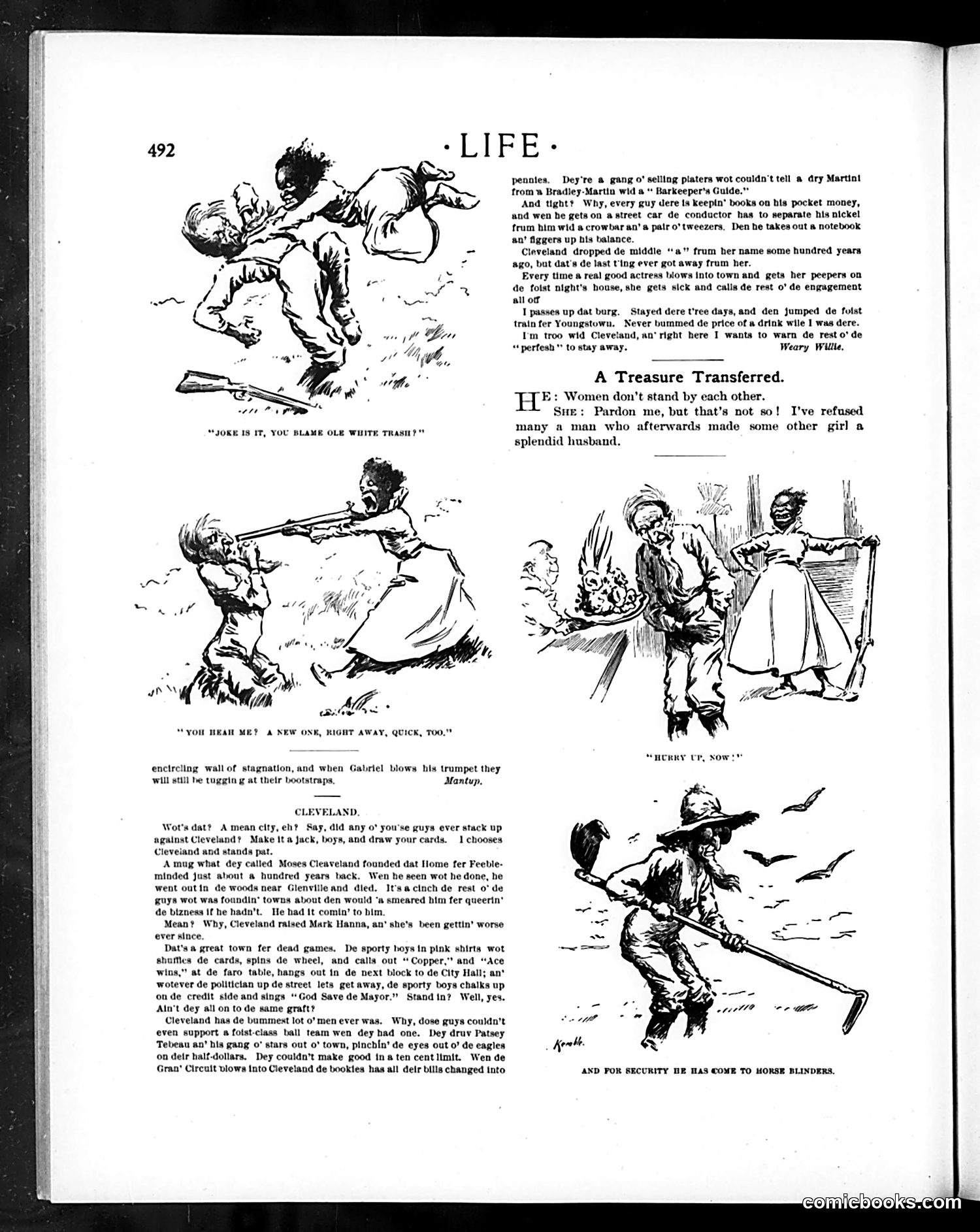
This 1900s Life magazine page satirizes Cleveland, Ohio through the voice of "Weary Willie," a hobo character. The crude dialect and stereotypes reflect period attitudes; the satire targets the city's moral corruption and mediocrity. **The Cleveland section** attacks: - Rampant gambling and graft among politicians and "sporty boys" - Poor civic support (the baseball team couldn't retain talent) - Miserliness and penny-pinching among residents - General decay from its founding by Moses Cleaveland The illustrations show street scenes of gambling, poverty, and urban vice. "Weary Willie" concludes Cleveland is so corrupt and stingy he won't even beg there—the ultimate insult. **"A Treasure Transferred"** presents a brief domestic joke: a woman boasts of refusing men who later became good husbands to other women, asserting female loyalty. The cartoon's point is ironic commentary on women's actual behavior. The page exemplifies Life's muckraking style, using exaggerated dialect humor to critique urban corruption and class dynamics.
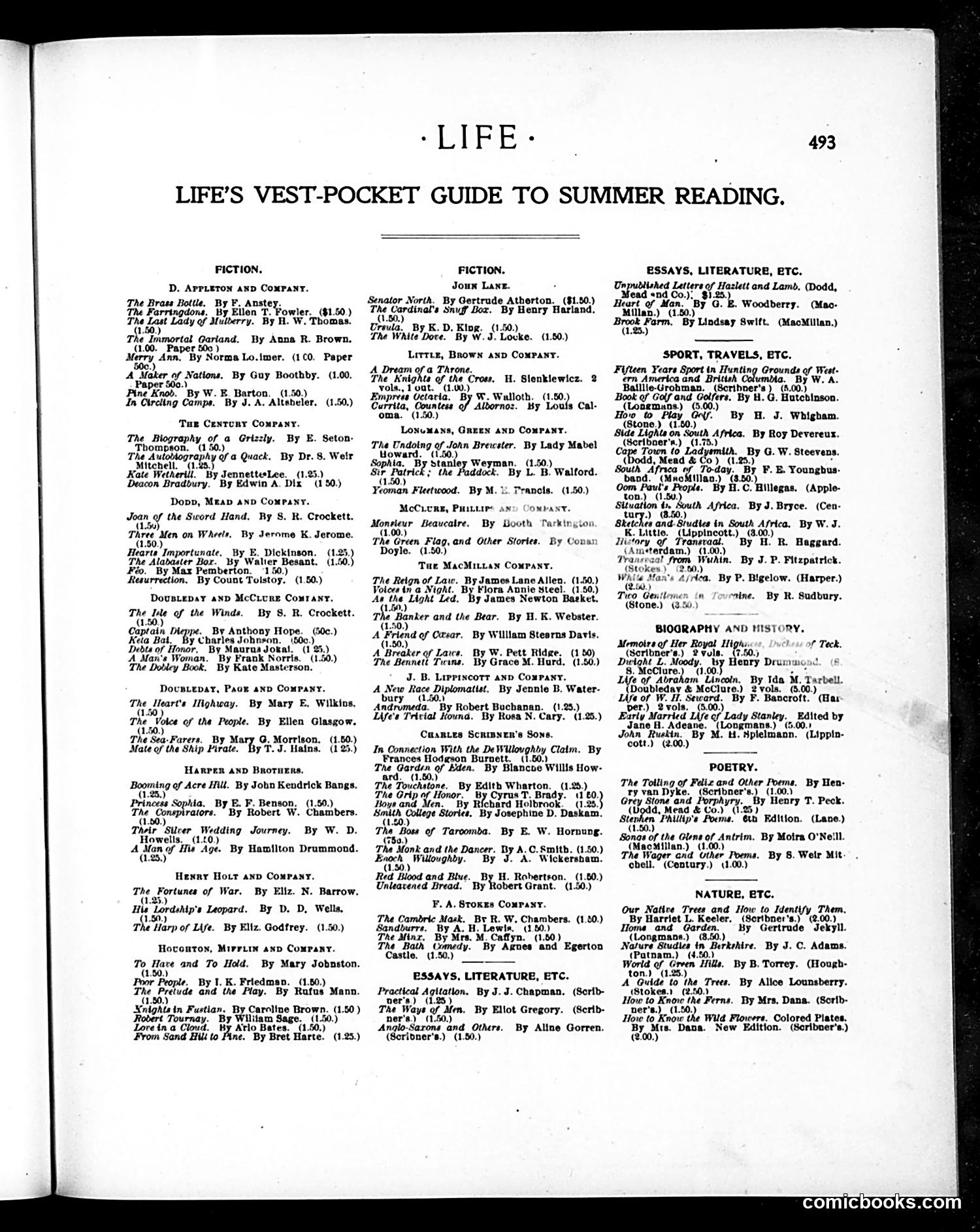
This page is **not a cartoon or satirical content** — it's a practical reference guide titled "Life's Vest-Pocket Guide to Summer Reading." The page lists hundreds of books organized by category (Fiction, Essays/Literature, Sports/Travel, Biography/History, Poetry) with publishers, authors, and prices (typically $1.00-$1.50). Notable authors include Conan Doyle, Tolstoy, Henry James, Bret Harte, and Gertrude Atherton. The "vest-pocket guide" format suggests this was a handy reference for middle-class readers planning summer leisure reading. The inclusion of both serious literature and popular adventure stories reflects Life magazine's audience of educated but entertainment-minded Americans circa early 1900s. This represents Life's function beyond satire — as a general-interest weekly magazine providing cultural guidance to contemporary readers.
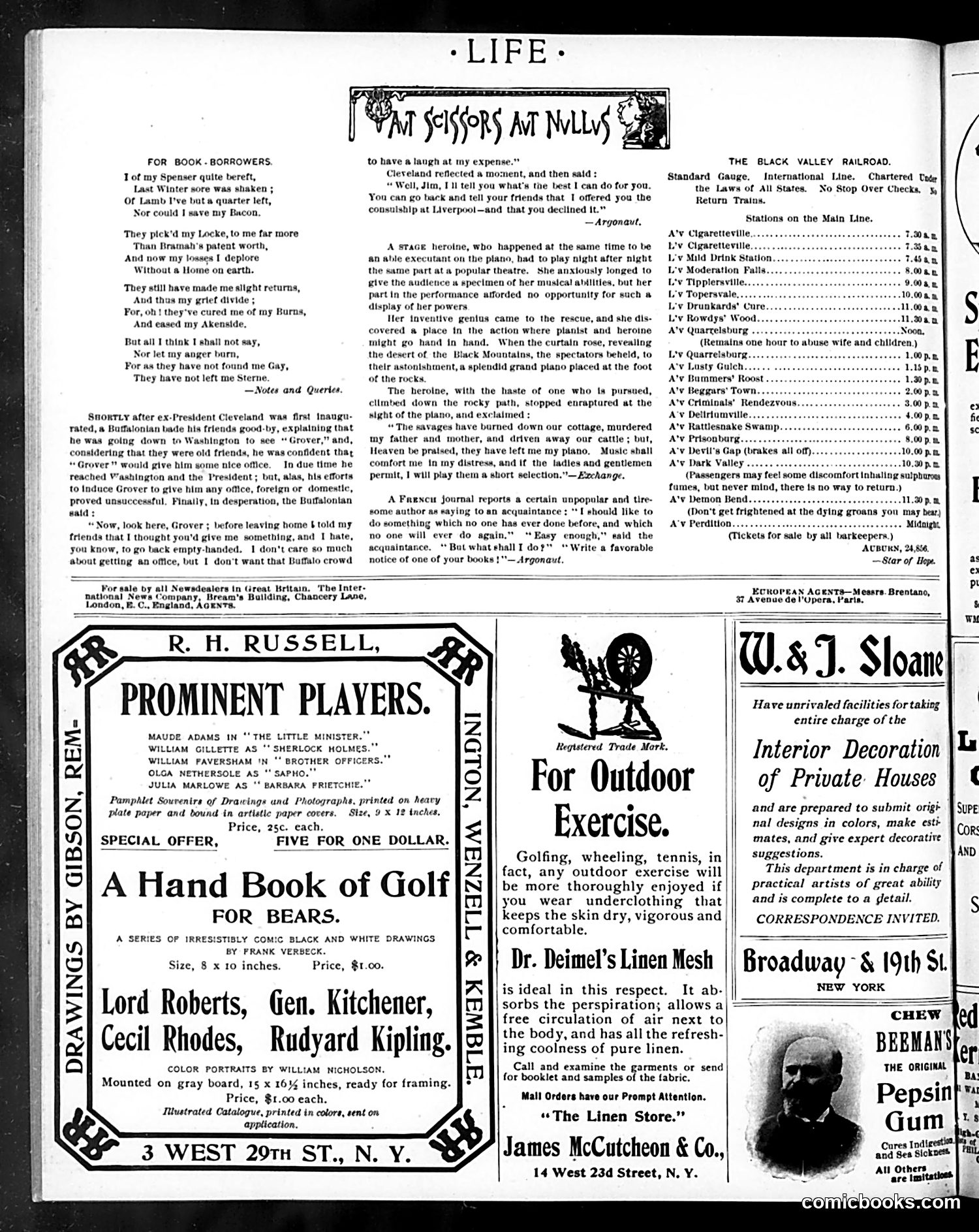
This page is primarily **advertising and light humor** rather than political satire. The content consists of three distinct sections: **Poetry and Anecdotes:** The top half contains humorous verse and short stories mocking book borrowers (who steal or fail to return books), a disappointed office-seeker under President Cleveland, and a vain actress who places a piano on stage during a desert scene. These are genteel period humor pieces. **"The Black Valley Railroad":** This is a **temperance/morality satire**—a mock railroad schedule where each station represents progressive moral degradation: from "Cigaretteville" through "Drunkards' Corner" to "Devil's Gap," ending in "Dark Valley." It's a Victorian-era warning about vice and alcohol's corrupting path. **Advertisements:** The lower half features books, golf guides, and interior decoration services—typical turn-of-century ads. The page reflects *Life's* dual identity as both satirical magazine and advertising vehicle, with gentle mockery of social follies rather than hard political commentary.
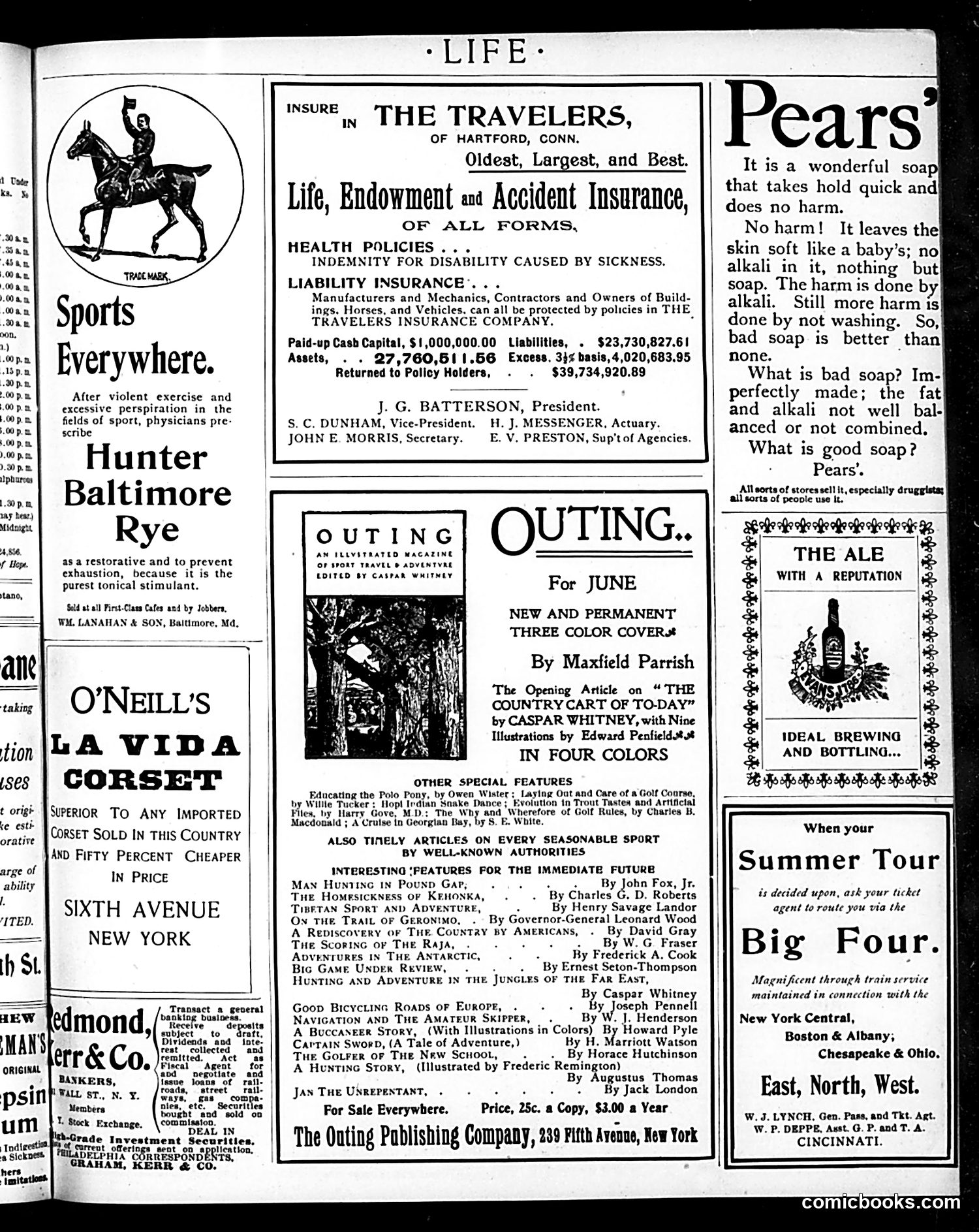
This page is primarily **advertising** rather than editorial content or satire. It contains no political cartoons. The top left features a **Sports logo** showing a rider on horseback—the trademark of *The Travelers Insurance Company*, which dominates the center with a large institutional ad promoting life, endowment, and accident insurance products. Additional advertisements include: - **Hunter Baltimore Rye** whiskey, marketed to athletes as a "restorative" after exercise (reflecting early 20th-century attitudes toward alcohol as medicinal) - **O'Neill's La Vida Corset** - **Pears' Soap**, which reassures readers of its safety and purity - **Outing Magazine**, a sporting/adventure publication edited by Caspar Whitney, featuring nature writing and outdoor activities - **Summer Tour** travel services The page reflects Gilded Age consumer culture and the era's marketing strategies, positioning products as health aids and lifestyle enhancers for the affluent readers of *Life*.
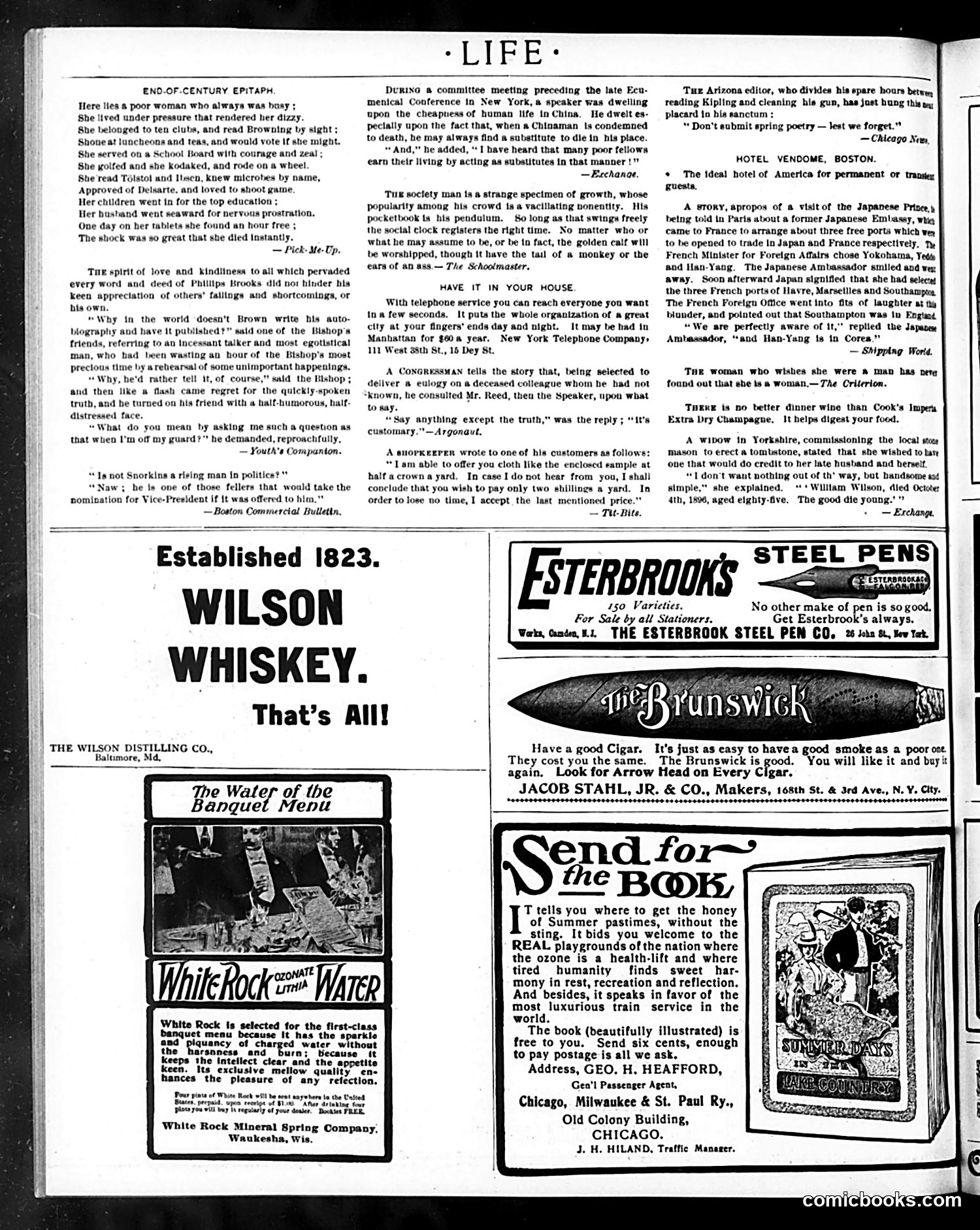
This page from *Life* magazine (a satirical publication, not the photo magazine) contains several short humorous pieces rather than a single cartoon. The main content includes satirical anecdotes mocking late-19th-century American society: a woman's epitaph criticizing the "New Woman" overextended by clubs, education, and activities; a story about Bishop Phillips Brooks catching himself gossiping; and a joke about Chinese capital punishment where condemned men hire substitutes to die in their place. The satire targets contemporary anxieties: the independent woman juggling too many social obligations, political hypocrisy (a congressman told to lie at a funeral), and the dehumanizing effects of poverty in foreign lands. The page is primarily text-based social commentary typical of *Life*'s format during this era—witty observations on manners, morality, and modern life, interspersed with advertisements for whiskey, cigars, and mineral water.
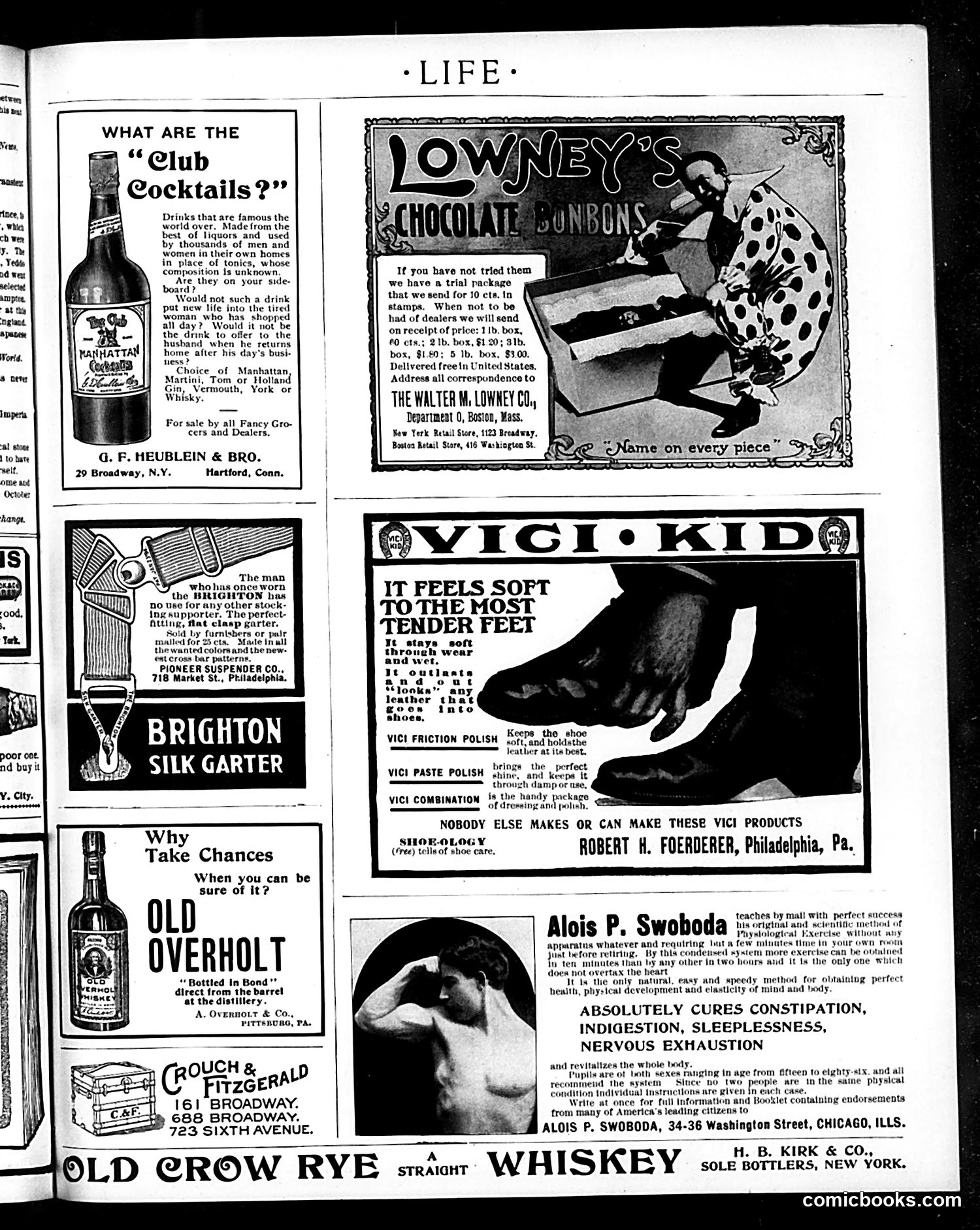
This page is **primarily advertisements** with no political cartoons. The content reflects early 20th-century commercial products and dubious health claims: **Notable ads include:** - **Club Cocktails** and liquor (Overholt whiskey, Old Crow Rye)—marketed as tonics for tired housewives and returning husbands - **Vici Kid shoe polish**—promises soft feet through various polishing products - **Alois P. Swoboda's "Apparatus"**—a pseudoscientific device claiming to cure constipation, insomnia, and "nervous exhaustion" through mysterious "condensed system" exercise, marketed to people aged 15-86 - **Brighton Silk Garter**—men's hosiery product **The satire (implicit, not explicit):** These ads reflect the era's snake-oil marketing—alcohol sold as medicine, fake exercise machines promising health miracles, and exaggerated product claims. Modern readers should note the casual acceptance of dubious health remedies and the gendered marketing (alcohol for weary wives).
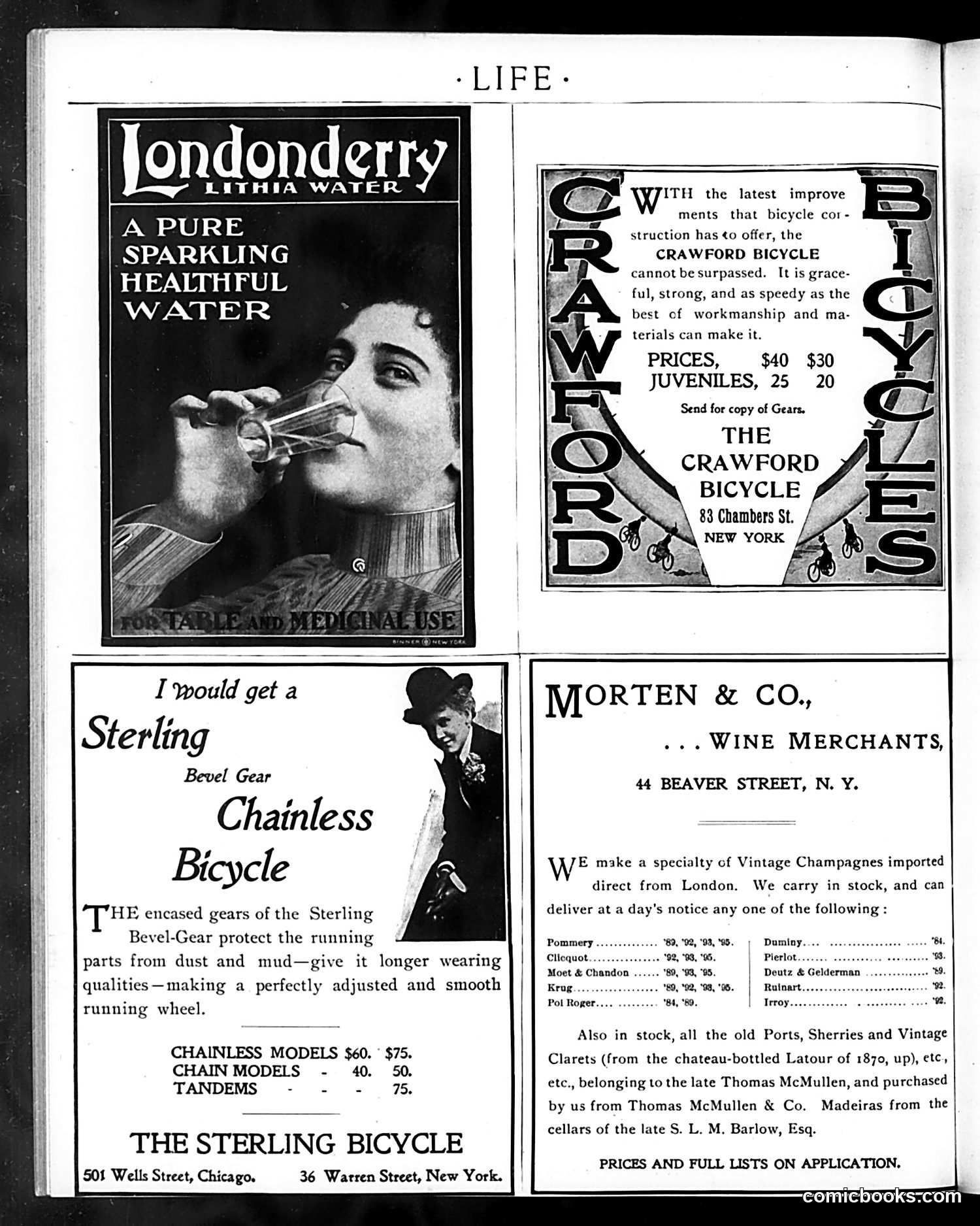
This page is primarily **advertising**, not satire or political commentary. It contains four advertisements from what appears to be an early 1900s issue: 1. **Londonderry Lithia Water**: Markets "pure sparkling healthful water" with an image of a woman drinking, emphasizing health benefits—reflecting the era's enthusiasm for patent medicines and mineral waters. 2. **Crawford Bicycle**: Standard product advertisement highlighting bicycle models and prices ($25-$40). 3. **Sterling Bicycle**: Features a chainless bevel-gear design, positioning it as mechanically superior to competitors. 4. **Morten & Co.**: Wine merchant specializing in vintage champagnes and ports, listing specific years and brands imported from London. The page reflects turn-of-the-century consumer culture: bicycles were fashionable transportation, mineral waters promised health remedies (dubious by modern standards), and imported wines signaled luxury. No political satire or caricature is present—this is straightforward commercial advertising typical of Life magazine's revenue model.
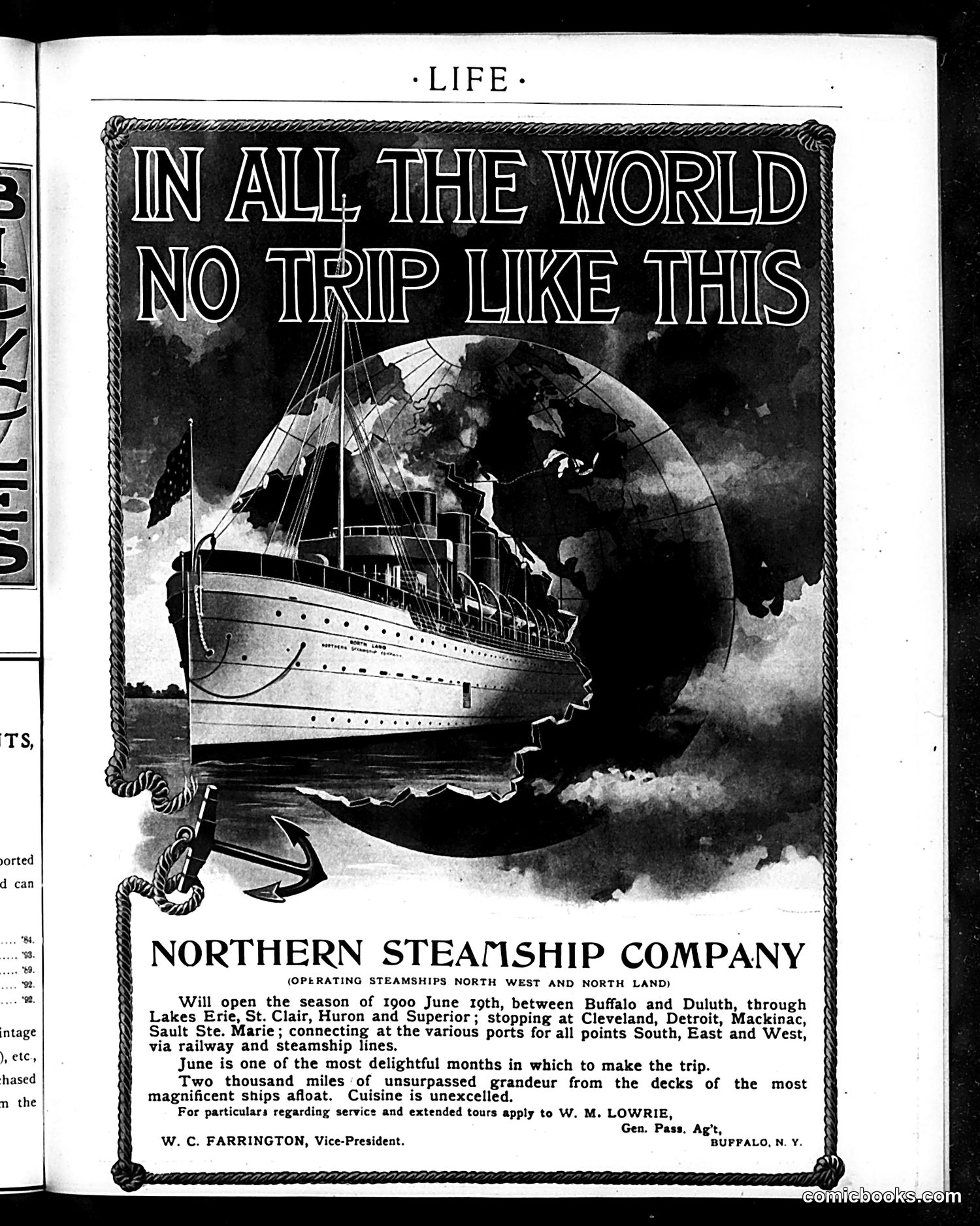
This is primarily a **steamship advertisement**, not political satire. The Northern Steamship Company is marketing luxury Great Lakes cruises for 1900. The image shows a large ocean liner positioned against a globe, with the slogan "In All the World No Trip Like This." The decorative border includes an anchor, emphasizing the maritime theme. The advertisement targets affluent travelers, promoting a 2,000-mile journey through Lakes Erie, St. Clair, Huron, and Superior, with stops at major cities (Buffalo, Cleveland, Detroit, Duluth). It emphasizes June travel and "unexcelled" cuisine aboard "magnificent ships." This reflects the **Gilded Age leisure culture** when steamship cruises represented prestige travel for the wealthy. The globe imagery suggests cosmopolitan ambitions, though the actual route was domestic North American lakes. There is **no political cartoon or satire** visible on this page—it's straightforward commercial promotion typical of early 1900s magazine advertising.
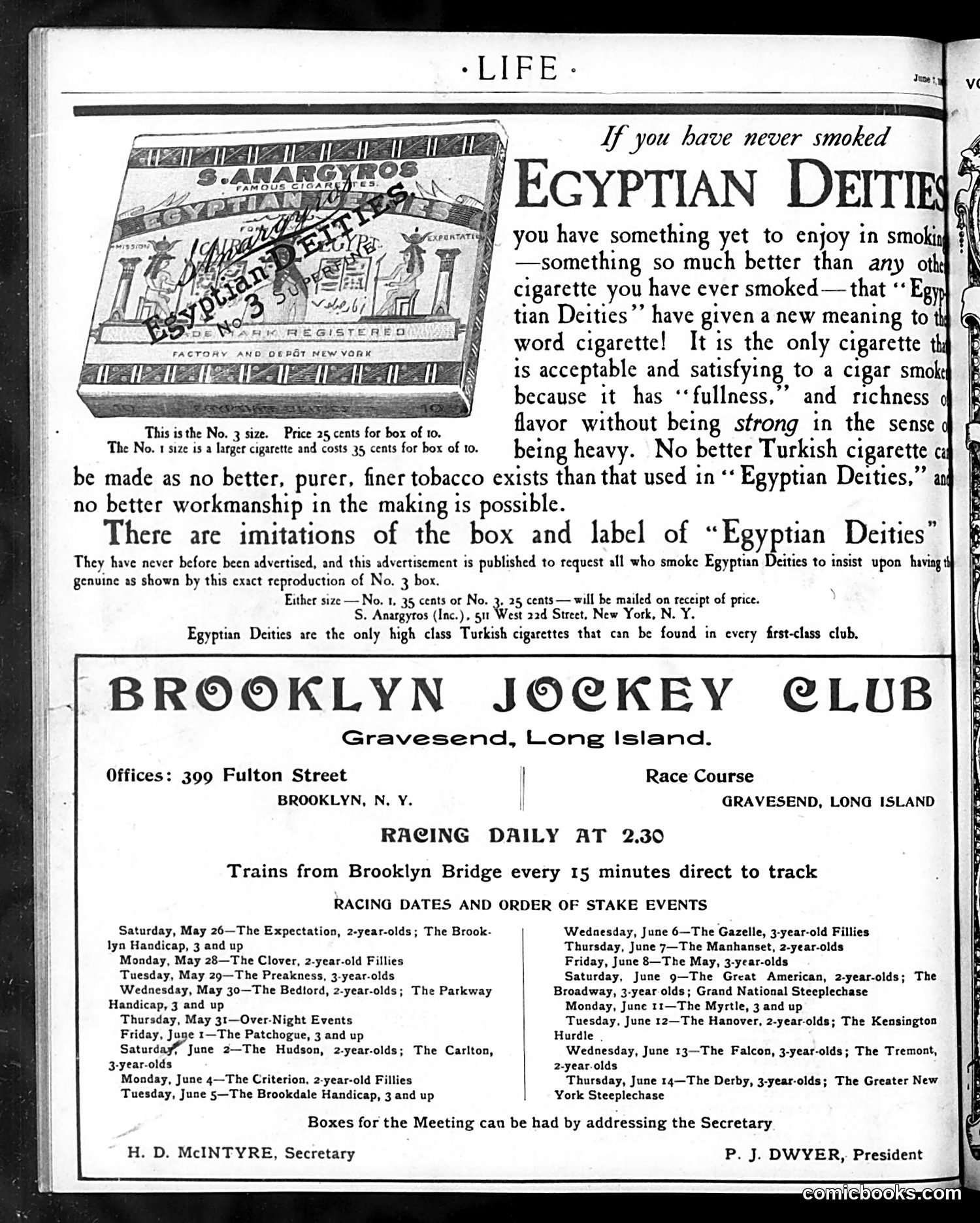
This page is primarily **advertising**, not satire or cartooning. It contains two ads: **Egyptian Deities Cigarettes** (top): A luxury Turkish cigarette brand marketed to cigar smokers. The ad claims superior tobacco quality and "fullness" without heaviness. Notably, it warns against counterfeit imitations—suggesting the brand was popular enough to be copied. Prices listed: 25 cents (No. 3) or 35 cents (No. 1) per box of 10. The manufacturer warns customers to verify authenticity by exact box reproduction. **Brooklyn Jockey Club** (bottom): Announces horse racing at Gravesend, Long Island, with daily 2:30 PM races and detailed spring/early-summer stake event schedules (May 26–June 14). Trains ran from Brooklyn Bridge directly to track. Both ads reflect early 1900s luxury leisure culture targeting affluent New York audiences.