
Life, 1900-06-07 · page 9 of 28
Life — June 7, 1900 — page 9: what you’re looking at
What you’re looking at
This is a humorous short story about a character named Tipton, a porter or baggage handler who has just completed loading passengers onto a train. The accompanying illustration shows Tipton surrounded by chaos—passengers, luggage, and various items strewn about a train compartment. The satire targets Tipton's verbose, self-satisfied manner of speaking. The text explains that Tipton habitually talks to himself as relief from his demanding job, and that his wife finds this annoying. The joke centers on his inability to remain silent and his tendency toward grandiose self-justification. The illustration humorously depicts the disorder and confusion that characterizes his work environment, contrasting with his proud declaration that he's "through"—suggesting his work is never truly finished.
📄 Transcribed text from this page (OCR, searchable)
Machine-transcribed from the original scan — historical spelling and the odd misread are preserved.
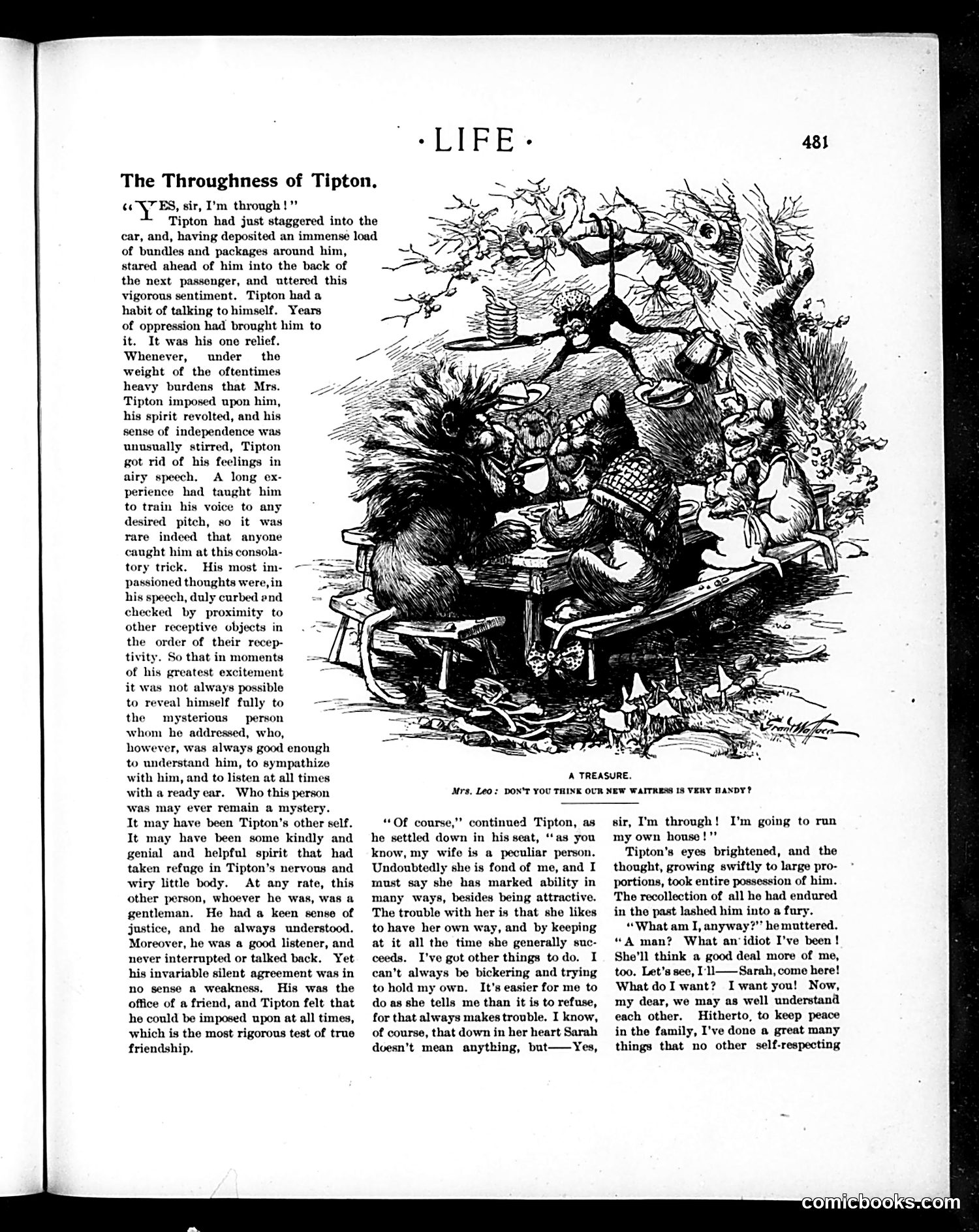
The Throughness of Tipton, WV sir, I’m through!”’ Tipton had just staggered into the car, and, having deposited an immense load of bundles and packages around him, stared ahead of him into the back of the next passenger, and uttered this vigorous sentiment. Tipton had a habit of talking to himself. Years of oppression had brought him to it. It was his one relief. Whenever, under the weight of the oftentimes heavy burdens that Mrs. Tipton imposed upon him, his spirit revolted, and his sense of independence was unusually stirred, Tipton got rid of his feelings in airy speech. A long ex- perience had taught him to train his voice to any desired pitch, so it was rare indeed that anyone caught him at this consola- tory trick. His most im- passioned thoughts were, in his speech, duly curbed end checked by proximity to other receptive objects in the order of their recep- tivity. So that in moments of his greatest excitement it was not always possible to reveal himself fully to the mysterious person whom he addressed, who, however, was always good enough to understand him, to sympathize with him, and to listen at all times with a ready ear. Who this person was may ever remain a mystery. It may have been Tipton’s other self. It may have been some kindly and genial and helpful spirit that had taken refuge in Tipton’s nervous and wiry little body. At any rate, this other person, whoever he was, was a gentleman. He had a keen sense of justice, and he always understood. Moreover, he was a good listener, and never interrupted or talked back. Yet his invariable silent agreement was in no sense a weakness. His was the office of a friend, and Tipton felt that he could be imposed upon at all times, which is the most rigorous test of true friendship. A TREASURE. Mrs, Leo: DON'T YOU THINK OUR NEW WAITRESS 13 VERY DANDY? “Of course,’ continued Tipton, as he settled down in his seat, ‘‘as you know, my wife is a peculiar person. Undoubtedly she is fond of me, and I must say she has marked ability in many ways, besides being attractive. The trouble with her is that she likes to have her own way, and by keeping at it all the time she generally suc- ceeds. I've got other things todo. I can’t always be bickering and trying to hold my own. It’s easier for me to do as she tells me than it is to refuse, for that always makes trouble. I know, of course, that down in her heart Sarah doesn’t mean anything, but——Yes, sir, I'm through! my own house!” Tipton’s eyes brightened, and the thought, growing swiftly to large pro- portions, took entire possession of him. The recollection of all he had endured in the past lashed him into a fury. “What am I, anyway?’ he muttered. “A man? What an‘ idiot I've been! She'll think a good deal more of me, too. Let’s see, I'1——Sarah, come here! What doI want? I want you! Now, my dear, we may as well understand each other. Hitherto, to keep peace in the family, I've done a great many things that no other self-respecting I'm going to run