
Life, 1900-06-07 · page 7 of 28
Life — June 7, 1900 — page 7: what you’re looking at
What you’re looking at
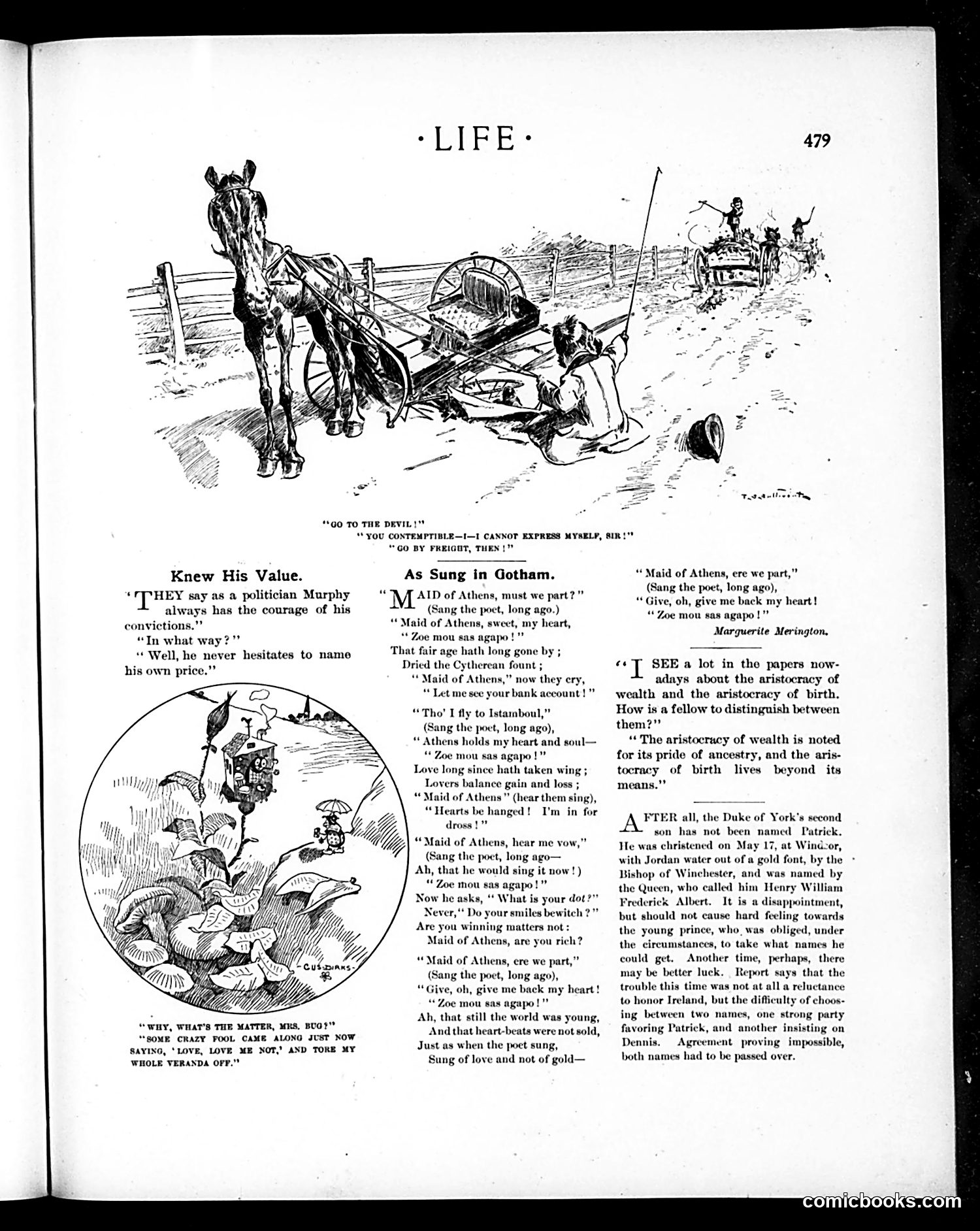
This page contains three distinct pieces: a sketch showing a horse-drawn cart accident, and two separate humor pieces with accompanying illustrations. The top cartoon appears to satirize rural life or labor, depicting someone thrown from a cart—likely mocking working-class mishaps. "Knew His Value" (left) is a brief joke about a politician named Murphy who boldly names his own price, suggesting shameless self-promotion or corruption—a common satirical target. "As Sung in Gotham" (center) presents song lyrics about the "Maid of Athens," likely parodying romantic poetry with mundane modern concerns (bank accounts, wealth), mocking both pretentious art and urban materialism. The right column discusses aristocratic naming conventions in Ireland, explaining social tensions between old landed families and new money—commentary on class hierarchy. The overall page mixes political corruption jokes with class satire typical of Life's satirical approach.
📄 Transcribed text from this page (OCR, searchable)
Machine-transcribed from the original scan — historical spelling and the odd misread are preserved.
G0 TO THE DEVIL!" Knew His Value. “TP HEY say as a politician Murphy always has the courage of his convictions.” “In what way?” ‘Well, he never hesitates to name his own price.” “WHY, WHAT'S THE MATTER, Mu, BUG?" “SOME CRAZY FOOL CAME ALONG JUST NOW SAYING, ‘LOVE, LOVE ME NOT,' AND TORE MY WHOLE VERANDA OFF."* “GO BY FREIGUT, THEN |” As Sung in Gotham. N AID of Athens, must we part?” (Sang the poet, long ago.) “Maid of Athens, sweet, my heart, “Zoe mou sas agapo That fair age hath long gone by ; Dried the Cytherean fount ; “ Maid of Athens,” now they ery, “ Let me see your bank account!" “ Tho’ I fly to Istamboul,” (Sang the poet, long ago), “ Athens holds my heart and soul— “ Zoe mou sas agapo !”” Love long since hath taken wing; Lovers balance gain and loss ; “ Maid of Athens” (hear them si “Hearts be hanged! I'm in for dross!” “Maid of Athens, hear me vow,” (Sang the poct, long ago— Ab, that he would sing it now!) * Zoe mou sas agapo!” Now he asks, “ What is your dot?” Never,‘ Do your smiles bewiteh ?” Are you winning matters not : Maid of Athens, are you rich? “Maid of Athens, ere we part,” ‘ang the poet, long ago), “Give, oh, give me back my heart! “Zoe mou sas agapo!"” Ah, that still the world was young, And that heart-beats were not sold, Just as when the poet sung, Sung of love and not of gold— “YOU CONTEMPTIBLE—I—I CANNOT EXPRESS MYSELP, SIR!" “ Maid of Athens, ere we part,” (Sang the poet, long ago), “ Give, oh, give me back my heart! ‘Zoe mou sas agapo!” Marguerite Merington, “os IT SEE a lot in the papers now- adays about the aristocracy of wealth and the aristocracy of birth. How is a fellow to distinguish between them?” “The aristocracy of wealth is noted for its pride of ancestry, and the aris- tocracy of birth lives means.”” beyond its FTER all, the Duke of York's second son has not been named Patrick. He was christened on May 17, at Windzor, with Jordan water out of a gold font, by the Bishop of Winchester, and was named by the Queen, who called him Henry William Frederick Albert. It is a disappointment, but should not cause hard fee the young prince, who, was obliged, under the circumstances, to take what names he could get. Another time, perhaps, there may be better luck. Report says that the trouble this time was not at alla reluctance to honor Ireland, but the difficulty of choos- ing between two names, one strong party favoring Patrick, and another insisting on Dennis. Agreement proving impossible, both names had to be passed over.