
Life, 1900-06-07 · page 8 of 28
Life — June 7, 1900 — page 8: what you’re looking at
What you’re looking at
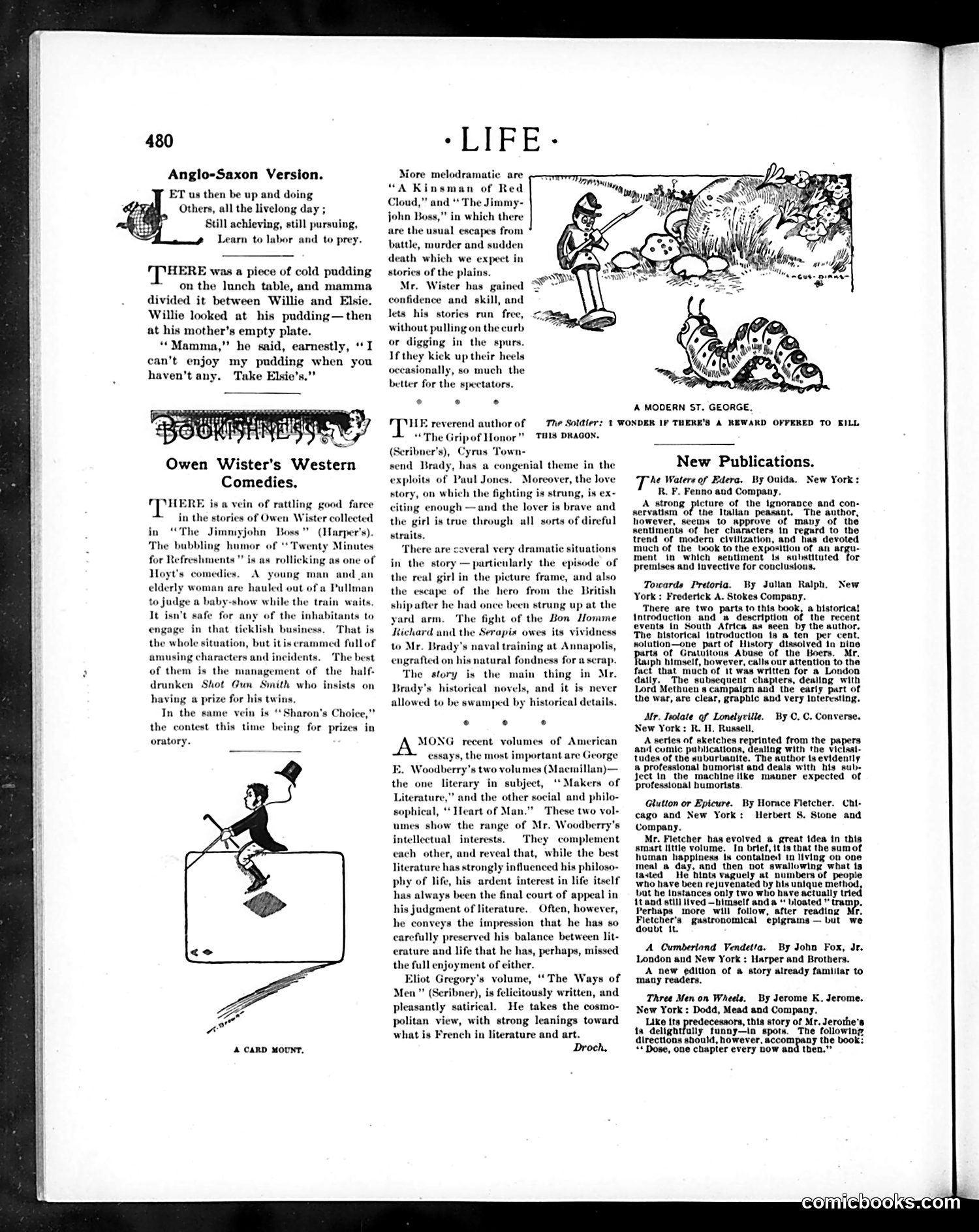
This page contains **book reviews and literary criticism**, not political cartoons. The main content discusses Owen Wister's Western comedies and reviews of recent American publications. The illustrations are **decorative rather than satirical**: one shows a figure in period dress (Anglo-Saxon style), another depicts "A Modern St. George" with a knight confronting a spotted dragon, and a small image labeled "A Card Mount" shows a figure doing a headstand. These appear to be **generic illustrations accompanying literary discussion** rather than political commentary. The page functions as a **literary journal section**, reviewing works by Paul Jones, George E. Woodberry, and others—typical content for Life magazine's satirical but literature-focused format of this era.
📄 Transcribed text from this page (OCR, searchable)
Machine-transcribed from the original scan — historical spelling and the odd misread are preserved.
480 Anglo-Saxon Version. ET us then be up and doing Others, all the livelong day ; Still achieving, still pursuing, Learn to labor and to prey. (THERE was a piece of cold pudding on the lunch table, and mamma divided it between Willie and Elsie. Willie looked at his pudding—then at his mother’s empty plate. “Mamma,” he said, earnestly, I can’t enjoy my pudding when you haven’t any. Take Elsio’s. Owen Wister’s Western Comedies, [eres isa vein of rattling good farce in the stories of Owen Wister collected in “The Jimmyjohn Loss The bubbling humor of “T for Refresh Hoyt's elder! (Harper's). enty Minute nts" is as rolli A you ing as one of edies. gg man and an y woman are hauled out of a Pullman to judge a baby-show while the train waits. It isn’t safe for any of the inhabitants to engage in that ticklish business. That is the whole situation, but itis crammed fullof amusing characters and incidents. The best of them is the management of the half- drunken Shot Gun Smith who insists on having a prize for his twins. In the same vein is “Sharon's Choice,” the contest this time being for prizes in oratory. 4 CARD MOUNT. -LIFE- More melodramatic are “A Kinsman of Red and * The Jim john Boss,” in which there are the usual escapes from battle, murder and sudden death which we expect in stories of the plains. Mr. Wister has gained confidence and skill, and lets his stories run free, without pulling on the curb or digging in the spurs. If they kick up their heels occasionally, so much the better for the spectators. ° ° ° PUNE reverend author of “The Gripof Honor” (Scribner's), Cyrus Town- send Brady, has a congenial theme in the exploits of Paul Jones. Moreover, the love story, on which the fighting is strung, is ex- ng enough —and the lover is brave and the girl is true through all sorts of direful straits, ‘There are ceveral very dramatic situations in the story —particularly the episode of the real girl in the picture frame, and also the escape of the hero from the British shipafter he had once been strung up at the yard arm. The fight of the Bon Homme Richard and the Serapix owes its vividness to Mr. Brady's naval training at Annapolis, engrafted on his natural fondness for a scrap. The story is the main thing in Mr. Brady's historical novels, and it is never allowed to be swamped by historical details. THIS DRAGON. e e ° MONG recent volumes of American essays, the most important are George E. Woodberry’s two volumes (Macmillan)— the one literary in subject, ‘Makers of Literature,” and the other social and philo- sophical, ‘* Heart of Man.” These two vol- umes show the range of Mr. Woodberry’s intellectual interests. They complement each other, and reveal that, while the best literature has strongly influenced his philoso- phy of life, his ardent interest in life itself has always been the final court of appeal in his judgment of literature. Often, however, he conveys the impression that he has so carefully preserved his balance between lit- erature and life that he has, perhaps, missed the full enjoyment of either. Eliot Gregory's volume, “The Ways of Men ” (Scribner), is felicitously written, and pleasantly satirical. He takes the cosmo- politan view, with strong leanings toward what is French in literature and art. Droch. A MODERN ST. GEORGE. The Soldter: 1 WONDER IF THERE'S A REWARD OFFERED TO KILL New Publications. Til Waters of Edera. By Ouida, New York: R. F. Fenno and Company. A trong plcture of the Ignorance and con- servatixm of the Itallan peasant. The author, however, seems to approve of many of the sentiments of her characters in regard to the trend of modern civilization, and has devoted much of the book to the exposition of an argu- ment tn which sentiment ix substituted for premises and Invective for conclustous. Towards Pretoria. By Jullan Ralph, New York : Frederick A. Stokes Company. ‘There are two parts to this book, a historical Introduction and a description of the recent events in South Africa as seen by the author, ‘The historical tntroduction 1s a ten per cent. solution—one part of History dissolved 1 nine ta of Gratuitous Abuse of the Boers. Mr, Raiph himself, however, calls our attention to the fact that much of tt was written for a London dally. The subsequent chapters, dealing with Lord Methuen s campaign and the early part of the war, are clear, graphic and very Ipteresting. Mr. Teolate of Lonelyville. New York: R. H. Russell, series of sketches reprinted from the papers and comic publications, dealing with the viclast- tudes of the suburbanite. The author ts evidently & professional humorist and deals with his sub: Ject in the machine iike manner expected of professional humortsts. Glutton or Epicure. By Horace Fletcher. Cht- cago and New York: Herbert S. Stone and Company. Mr. Fletcher has evolved a great {dea in this smart little volume. In brief, Its that the sumof human happiness ix contatned tn living on one eal @ day. and then not swallowing what is fasted He hints vaguely at numbers of peopie ‘who have been rejuvenated by bis unique method, Lut he Instances only two who have actually tried it and still lived —bimself and a * bloated " tramp, Perhaps more will follow, Fletcher's gustronomical doubt tt. A Cumberland Vendetta. By John Fox, Jr. London and New York : Harper and Brothers. A new edition of ® story already famiilar to many readers. By ©, C. Converse. Three Menon Wheels, By Jerome K. Jerome. New York : Dodd, Mead and Company. Like Its predecessors, this story of Mr. Jerothe’s 14 delightfully tunny—in spots. The following directions should, however, accompany the book: ++ Dose, one chapter every bow and then.”