
Life, 1900-06-07 · page 11 of 28
Life — June 7, 1900 — page 11: what you’re looking at
What you’re looking at
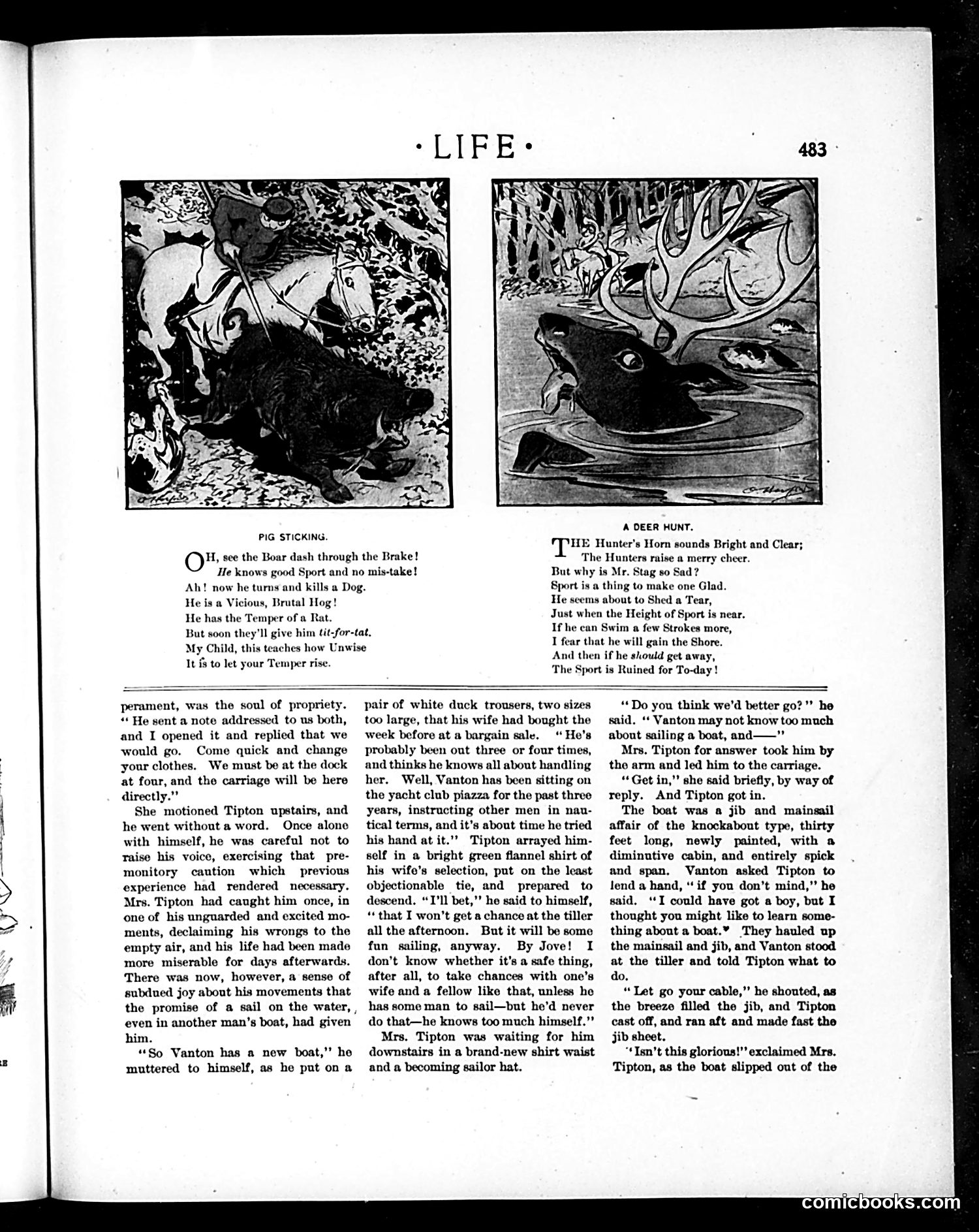
This page contains two illustrated poems with accompanying narrative text, not political cartoons. **Left image ("Pig Sticking"):** Shows a mounted hunter with a spear confronting a boar. The poem mocks a character who claims expertise in hunting but makes foolish mistakes—killing a dog instead of the boar, behaving temperamentally, and generally demonstrating poor sportsmanship. The satire targets pretentious hunters who lack actual skill. **Right image ("A Deer Hunt"):** Depicts a stag with elaborate antlers. The accompanying poem suggests the hunter's pride in the sport is misplaced—the stag escapes and "the Sport is Ruined for To-day!" Both pieces satirize the sporting pretensions and incompetence of wealthy leisure-class hunters, suggesting their activities are more about social posturing than genuine prowess.
📄 Transcribed text from this page (OCR, searchable)
Machine-transcribed from the original scan — historical spelling and the odd misread are preserved.
A DEER HUNT. TPPHE Hunter's Hor sounds Bright and Clear; ‘The Hunters raise a merry cheer. PIG STICKING. HH, see the Boar dash through the Brake! He knows good Sport and no mis-take! Ah! now he turns and kills a Dog. He is a Vicious, Brutal Hog! He has the Temper of a Rat. But soon they'll give him tit It f3 to let your Temper rise. or-tat, My Child, this teaches how Unwise But why is Mr. Stag so Sad? Sport is a thing to make one Glad. He seems about to Shed a Tear, Just when the Height of Sport is near. If he can Swim a few Strokes more, I fear that he will gain the Shore. And then if he should get away, The Sport is Ruined for To-day ! perament, was the soul of propriety. ** He sent a note addressed to us both, and I opened it and replied that we would go. Come quick and change your clothes. We must be at the dock at four, and the carriage will be here directly.”” She motioned Tipton upstairs, and he went without a word. Once alone with himself, he was careful not to raise his voice, exercising that pre- monitory caution which previous experience had rendered necessary. Mrs. Tipton had caught him once, in one of his unguarded and excited mo- ments, declaiming his wrongs to the empty air, and his life had been made more miserable for days afterwards. There was now, however, a sense of subdued joy about his movements that the promise of a sail on the water, , even in another man’s boat, had given him. “So Vanton has a new boat,” he muttered to himself, as he put on a pair of white duck trousers, two sizes too large, that his wife had bought the week before at a bargain sale. ‘ He’s probably been out three or four times, and thinks he knows all about handling her. Well, Vanton has been sitting on the yacht club piazza for the past three years, instructing other men in nau- tical terms, and it’s about time he tried his hand at it.’ Tipton arrayed him- self in a bright green flannel shirt of his wife’s selection, put on the least objectionable tie, and prepared to descend. “I'll bet,’’ he said to himself, “that I won’t get a chance at the tiller all the afternoon. But it will be some fun sailing, anyway. By Jove! I don’t know whether it’s a safe thing, after all, to take chances with one’s wife and a fellow like that, unless he has some man to sail—but he’d never do that—he knows too much himself.’”” Mrs. Tipton was waiting for him downstairs in a brand-new shirt waist and a becoming sailor hat. “Do you think we'd better go?’’ he said. ‘* Vanton may not know too much about sailing a boat, and——” Mrs. Tipton for answer took him by the arm and led him to the carriage. “Get in,’”’ she said briefly, by way of reply. And Tipton got in. The boat was a jib and mainsail affair of the knockabout type, thirty feet long, newly painted, with a diminutive cabin, and entirely spick and span. Vanton asked Tipton to lend a hand, “if you don’t mind,” he said. ‘I could have got a boy, but I thought you might like to learn some- thing about a boat.¥ They hauled up the mainsail and jib, and Vanton stood at the tiller and told Tipton what to do, “Let go your cable,” he shouted, as the breeze filled the jib, and Tipton cast off, and ran aft and made fast the jib sheet. “¢Isn’t this glorious!’ exclaimed Mrs. Tipton, as the boat slipped out of the