
A complete issue · 20 pages · 1900
Life — April 19, 1900
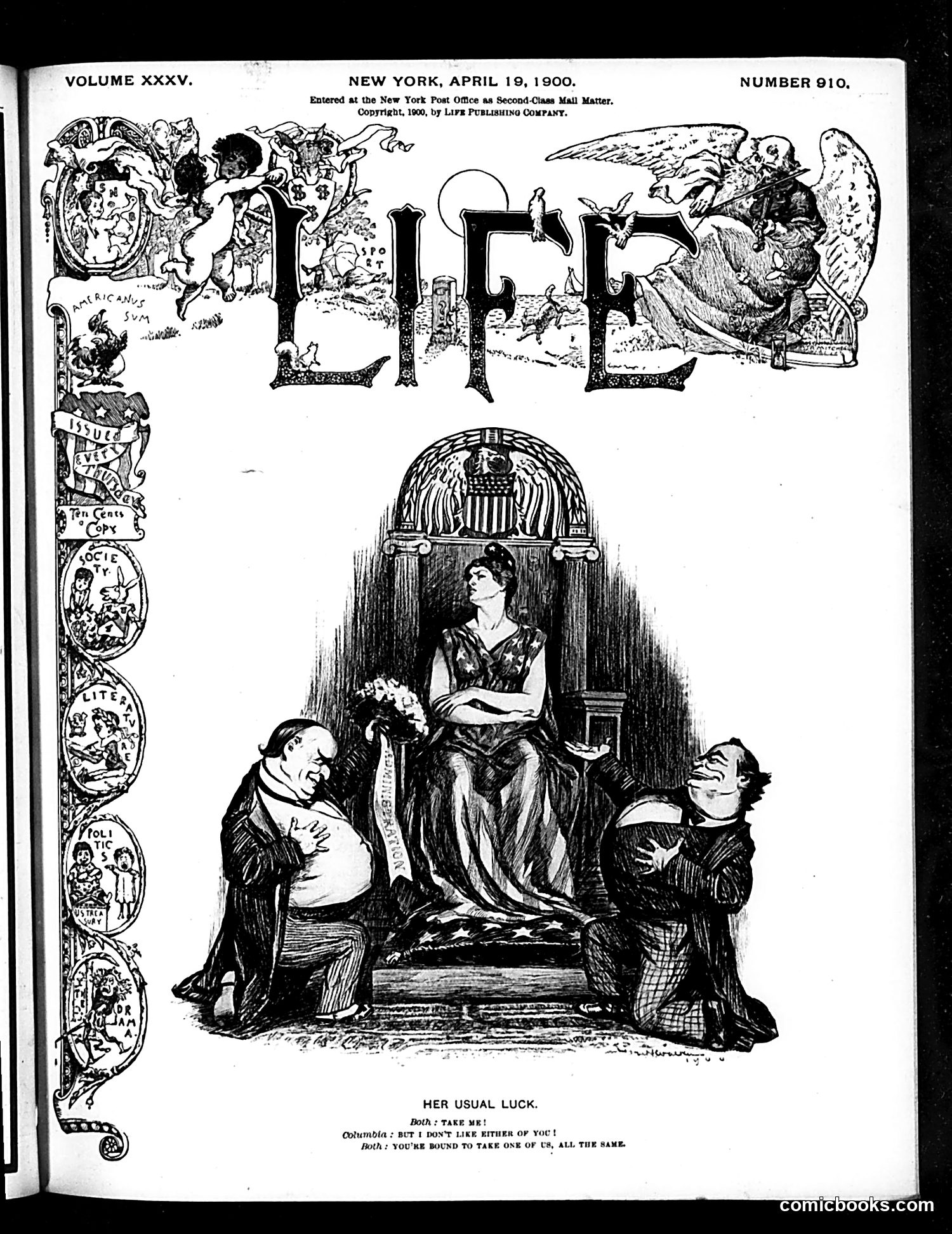
This political cartoon depicts Lady Columbia (the female personification of America, identified by her classical dress and crown) seated on a throne, flanked by two men in suits who appear to be politicians or statesmen. The caption reads "TAKE ME!" and "I DON'T LIKE EITHER OF YOU!" with a response "YOU'RE BOUND TO TAKE ONE OF US, ALL THE SAME." The cartoon likely satirizes the 1900 U.S. presidential election, suggesting Columbia (the nation) is unhappy with both major party candidates but has no choice but to accept one. The "usual luck" title implies America repeatedly finds itself in this predicament—forced to choose between undesirable political options. The ornate left border contains decorative satirical vignettes typical of Life's design.
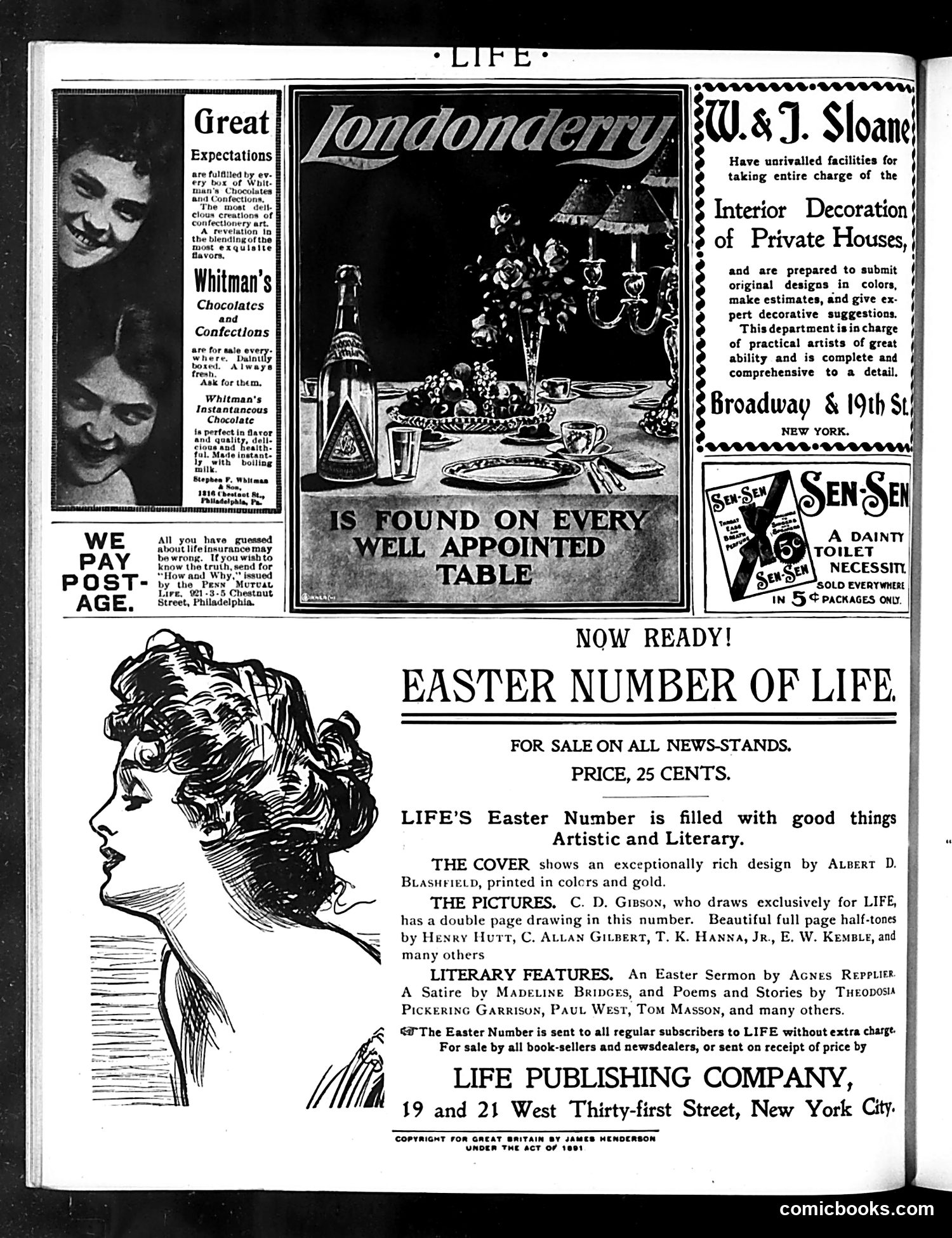
This page is primarily **advertising and promotional content** rather than political cartoons. The main elements include: 1. **Whitman's Chocolates ad** (left): Features smiling faces promoting their confectionery products, appealing to the common consumer practice of giving chocolates as gifts. 2. **Londonderry advertisement** (center): Promotes this brand as appearing "on every well appointed table," reflecting early 20th-century aspirational dining culture. 3. **W. & J. Sloane ad** (right): Interior decoration services for wealthy households. 4. **Sen-Sen advertisement** (lower right): A breath mint product marketed as a "dainty toilet necessity." 5. **Easter Number promotion** (bottom half): The dominant content advertises Life magazine's Easter special issue, priced at 25 cents, featuring cover art and literary contributions. The page reflects **consumer culture and class aspirations** typical of this era's magazine advertising.
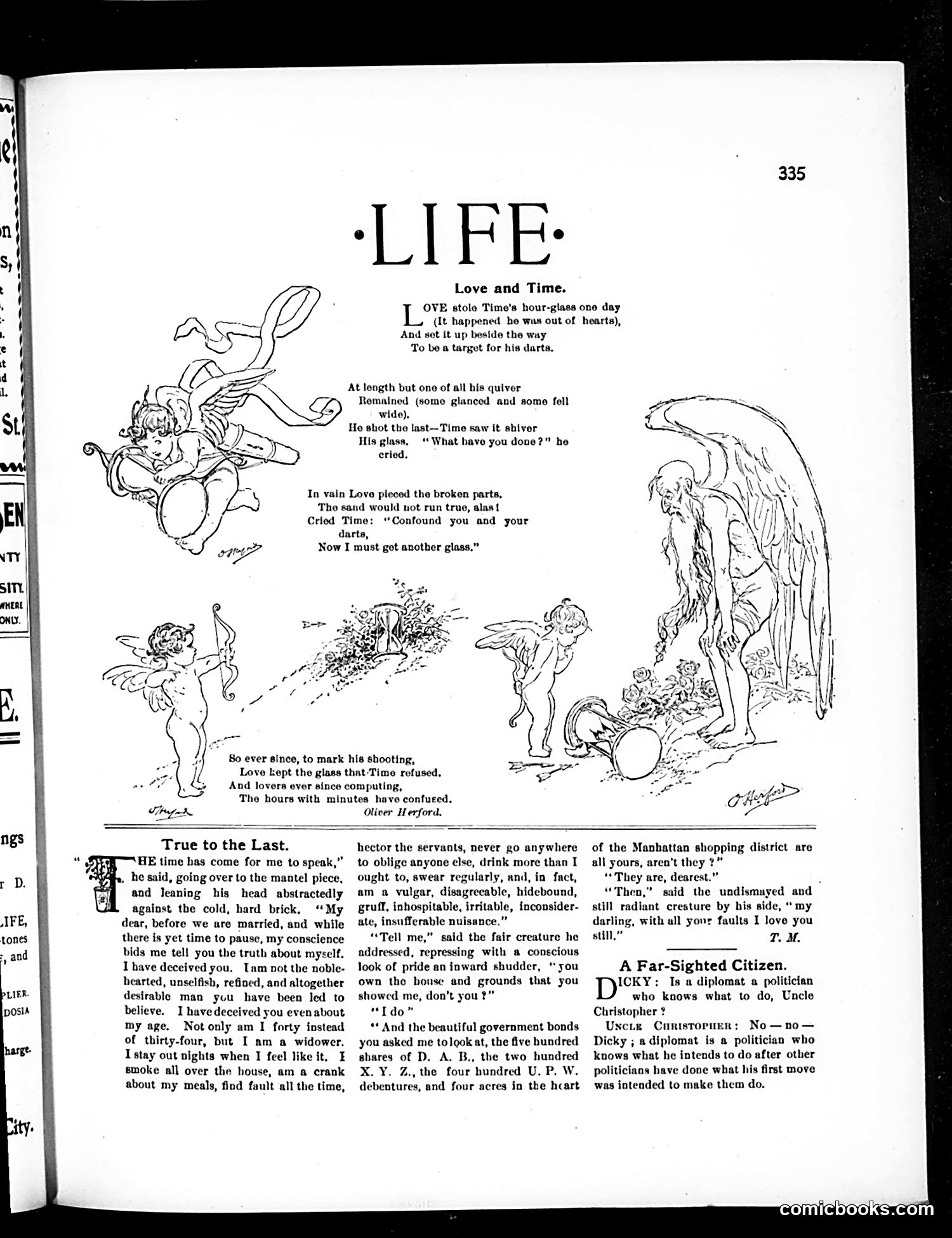
The top cartoon illustrates the poem "Love and Time" by Oliver Herford. It depicts Cupid attempting to repair Time's broken hourglass after Love has damaged it—a metaphorical commentary on how romantic love disrupts temporal order and natural progression. The bottom section contains two pieces: "True to the Last" presents a monologue from an apparently wealthy or aristocratic man defending his character to his wife, emphasizing his constancy despite financial and personal failings. "A Far-Sighted Citizen" is a brief dialogue joke about a diplomat (Dicky) who, when asked about government bonds, reveals his ignorance of their actual purpose—satirizing political incompetence and the disconnect between politicians' authority and their understanding of policy.
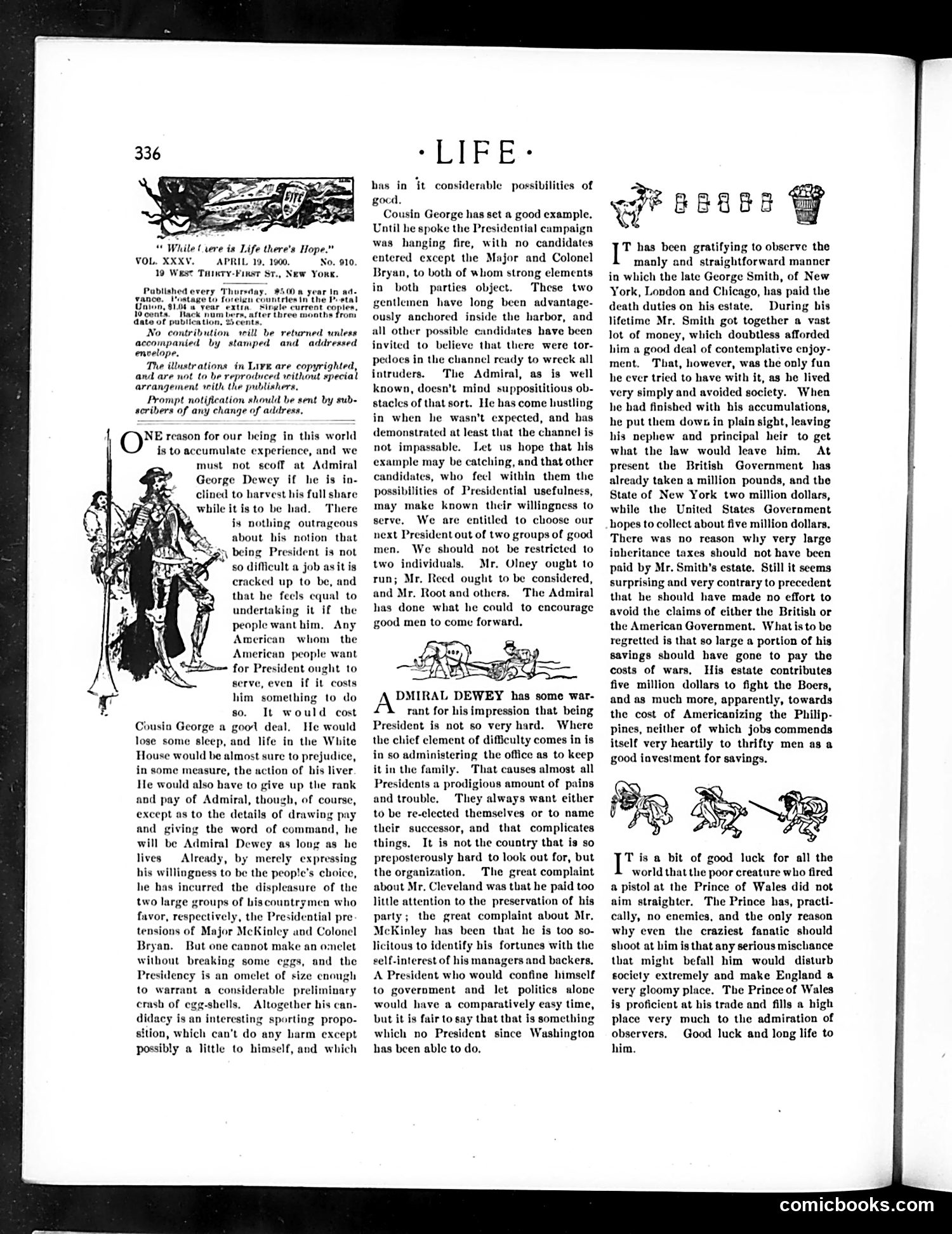
The page features an editorial discussing Presidential succession and political fitness. The text references "Admiral Dewey" and debates whether military heroes should become President, mentioning that Dewey's success in battle doesn't necessarily qualify him for high office. The illustrated figure on the left appears to be a caricatured military or political figure in formal dress, likely representing Admiral Dewey or a similar candidate being discussed. The editorial argues against restricting Presidential choices to "two groups of good men" (presumably Major and Colonel Bryan, mentioned in the text), advocating instead for open consideration of various candidates who demonstrate Presidential capability. The satire critiques the idea that military accomplishment automatically translates to governmental competence—a relevant debate during the 1900 election cycle.
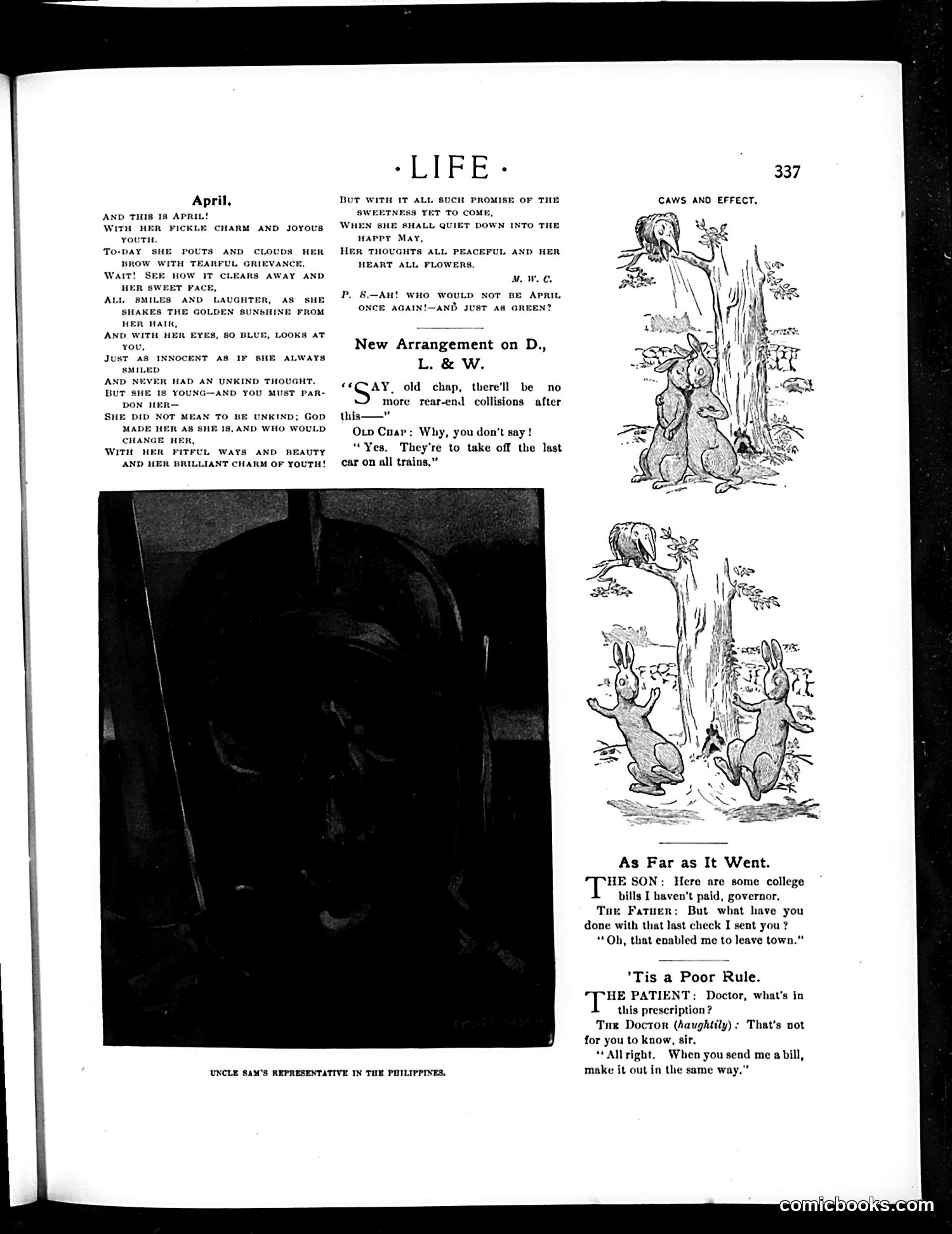
This page contains several humorous short pieces rather than a single political cartoon. The photograph captioned "UNCLE SAM'S REPRESENTATIVE IN THE PHILIPPINES" shows a dark, unclear image—likely meant as satire about American colonial administration in the Philippines (a contemporaneous U.S. possession). The three text jokes address everyday topics: a conversation between an old conductor and ticket agent about eliminating rear-end train collisions; a father confronting his son about unpaid college bills; and a doctor's cryptic prescription advice. The animal illustrations show a girl with birds and rabbits near a tree—charming but unrelated to the textual humor. The page primarily offers social satire on transportation safety, generational financial responsibility, and medical practice rather than partisan political commentary.
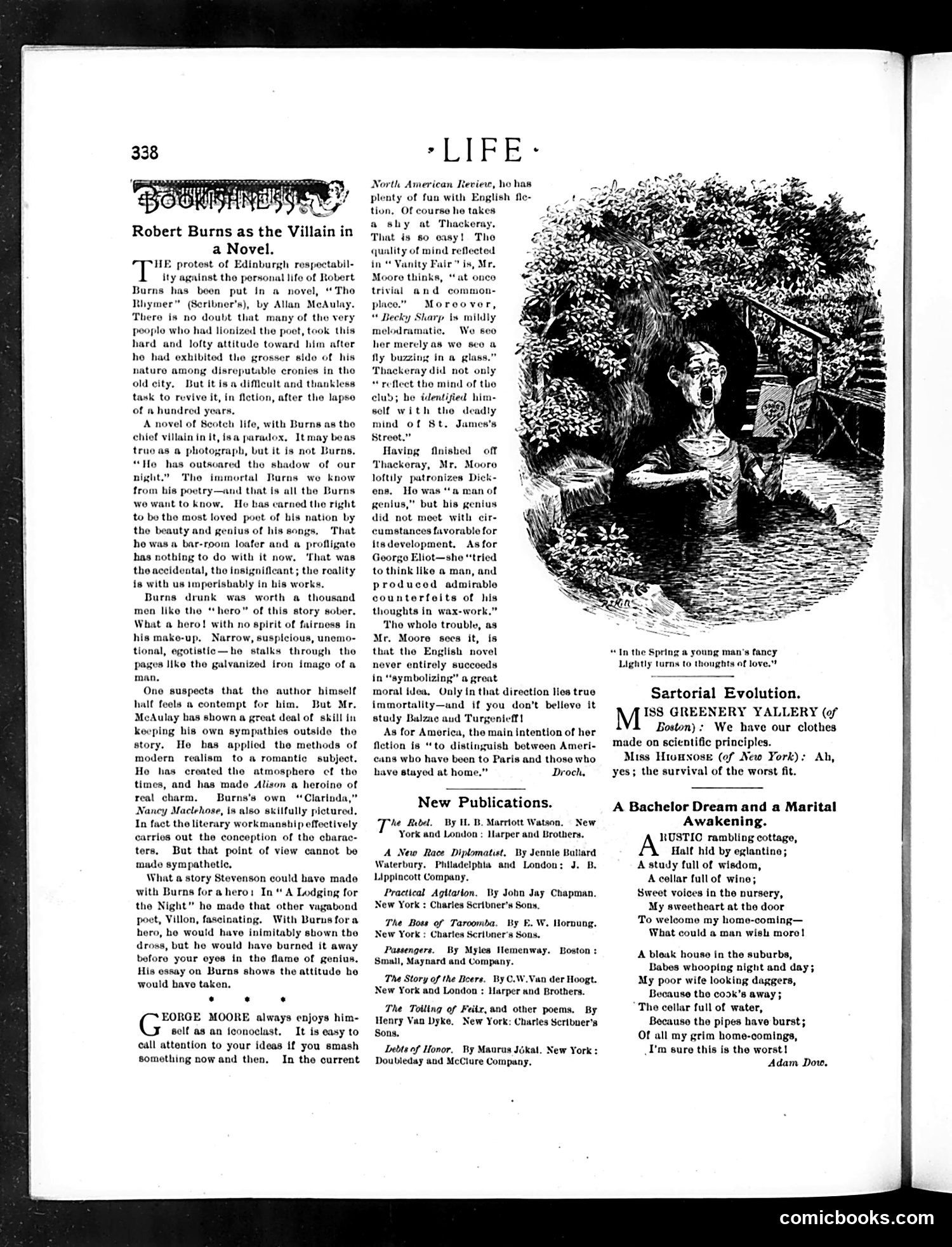
This page contains a literary review section rather than political cartoons. The main article discusses a novel featuring Robert Burns as a villain, critiquing the author's portrayal of the Scottish poet. The review argues the novelist fails to capture Burns's true character—his complexity and genius—reducing him to a caricature. The single illustration shows a romantic scene of a young man and woman in spring, captioned "In the Spring a young man's fancy lightly turns to thoughts of love"—a literary reference rather than satire. Below are announcements for new book publications. The right column contains a poem titled "Sartorial Evolution" and another poem, "A Bachelor Dream and a Marital Awakening," presenting humorous verse about courtship and marriage expectations versus domestic reality.
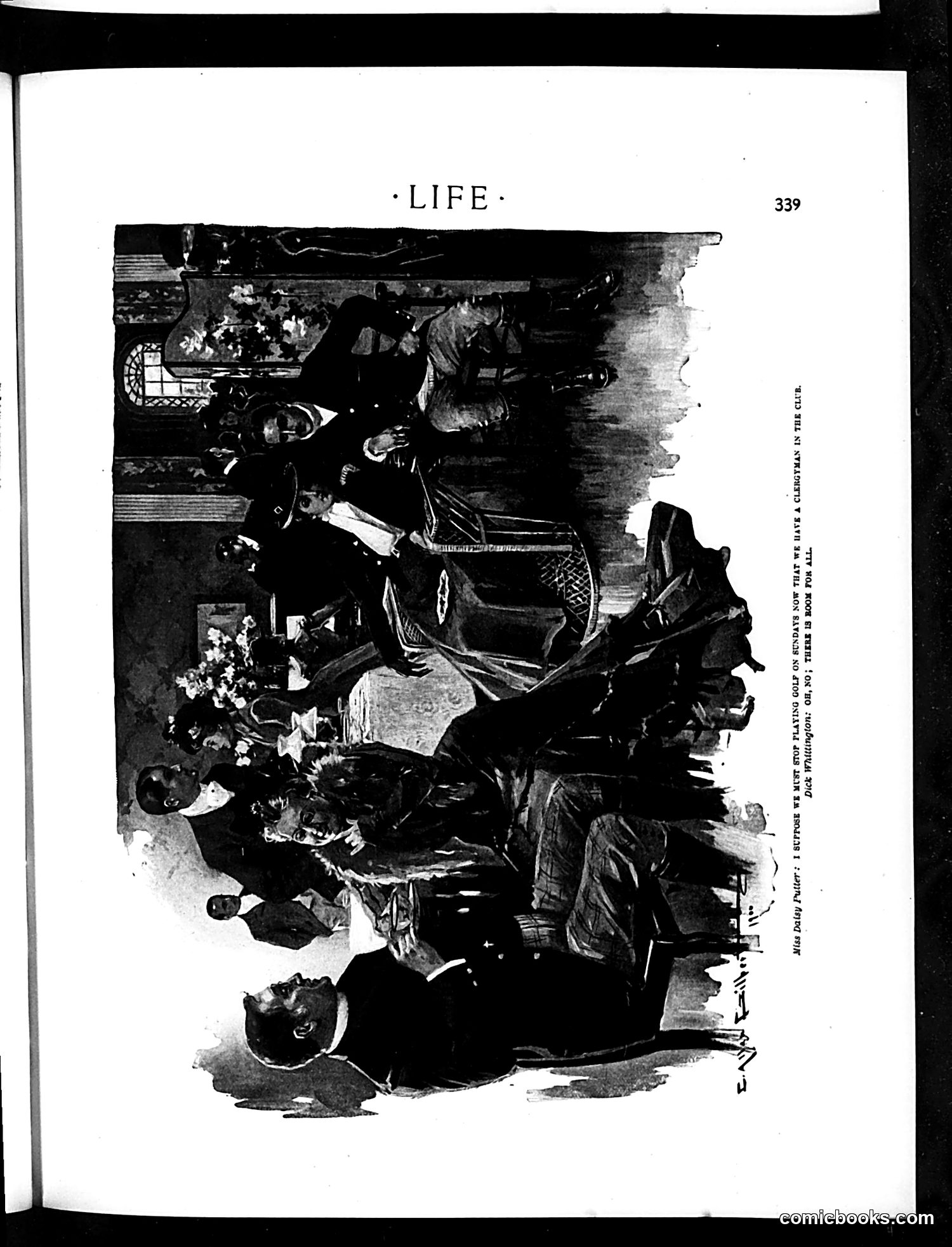
I can see this is a page from *Life* magazine (page 339) with a black and white illustration that appears to be rotated 90 degrees. The image shows multiple figures in what seems to be an interior domestic scene, though the rotation makes detailed interpretation challenging. The caption text along the right margin is partially legible but difficult to read completely due to the image quality and rotation. It appears to reference something about "English soil" and possibly a "German" subject, suggesting this may be a satirical commentary on international relations or wartime themes. However, without being able to read the caption clearly or identify specific figures with certainty, I cannot reliably explain the cartoon's particular political references or satirical intent. The image quality and rotation significantly limit my ability to provide accurate historical context per your rules.
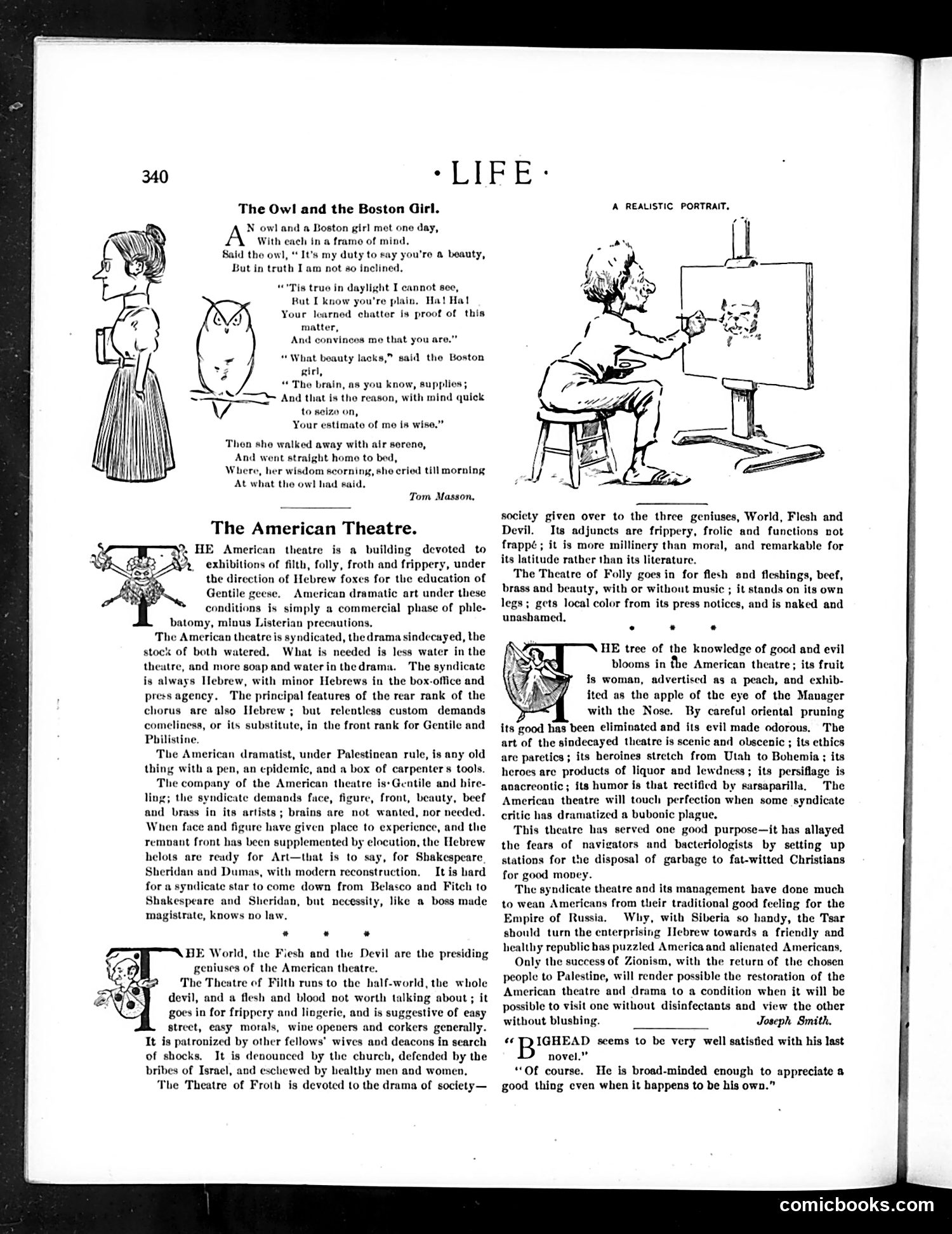
This illustrated poem by Tom Mason depicts a humorous encounter between an owl and a Boston woman. The owl compliments the woman's beauty, but she dismissively insists she lacks beauty—her brain is her asset, not her appearance. The woman then leaves for bed, where she cries until morning, undermining her own argument about valuing intellect over looks. The satire targets Boston women (or educated women generally) of the era, mocking the contradiction between feminist intellectual aspirations and traditional vanity. The joke hinges on the woman's emotional reaction contradicting her rational self-presentation—a common satirical trope suggesting women's claims to pure intellectualism are hypocritical or superficial.
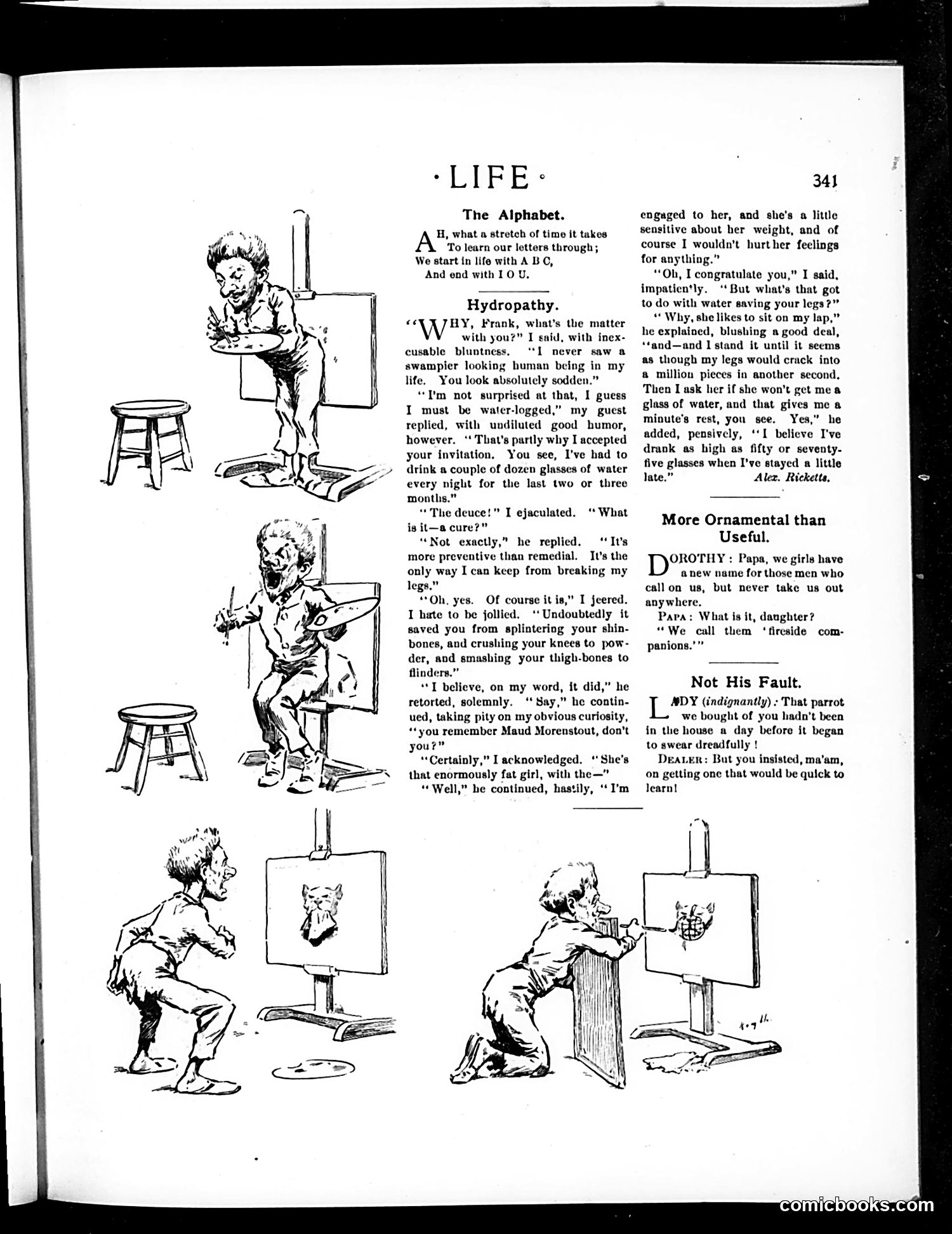
This page contains three separate humorous pieces typical of Life's satirical format: 1. **"The Alphabet"** - A brief joke about learning letters, with an illustration of a child at a desk. 2. **"Hydropathy"** - A dialogue between two characters discussing excessive water-drinking as a health cure. One character claims to drink "a couple dozen glasses" nightly for two or three months, attributing this to hydropathy (water-based medical treatment). The joke mocks this fad health practice by exaggerating its adherents' devotion. 3. **"More Ornamental than Useful"** and **"Not His Fault"** - Brief domestic comedy dialogues about women's names and a difficult parrot. The bottom illustrations appear to show someone learning to draw or paint, likely depicting art instruction humor. The satire targets contemporary health fads and domestic situations with gentle, period-appropriate comedy.
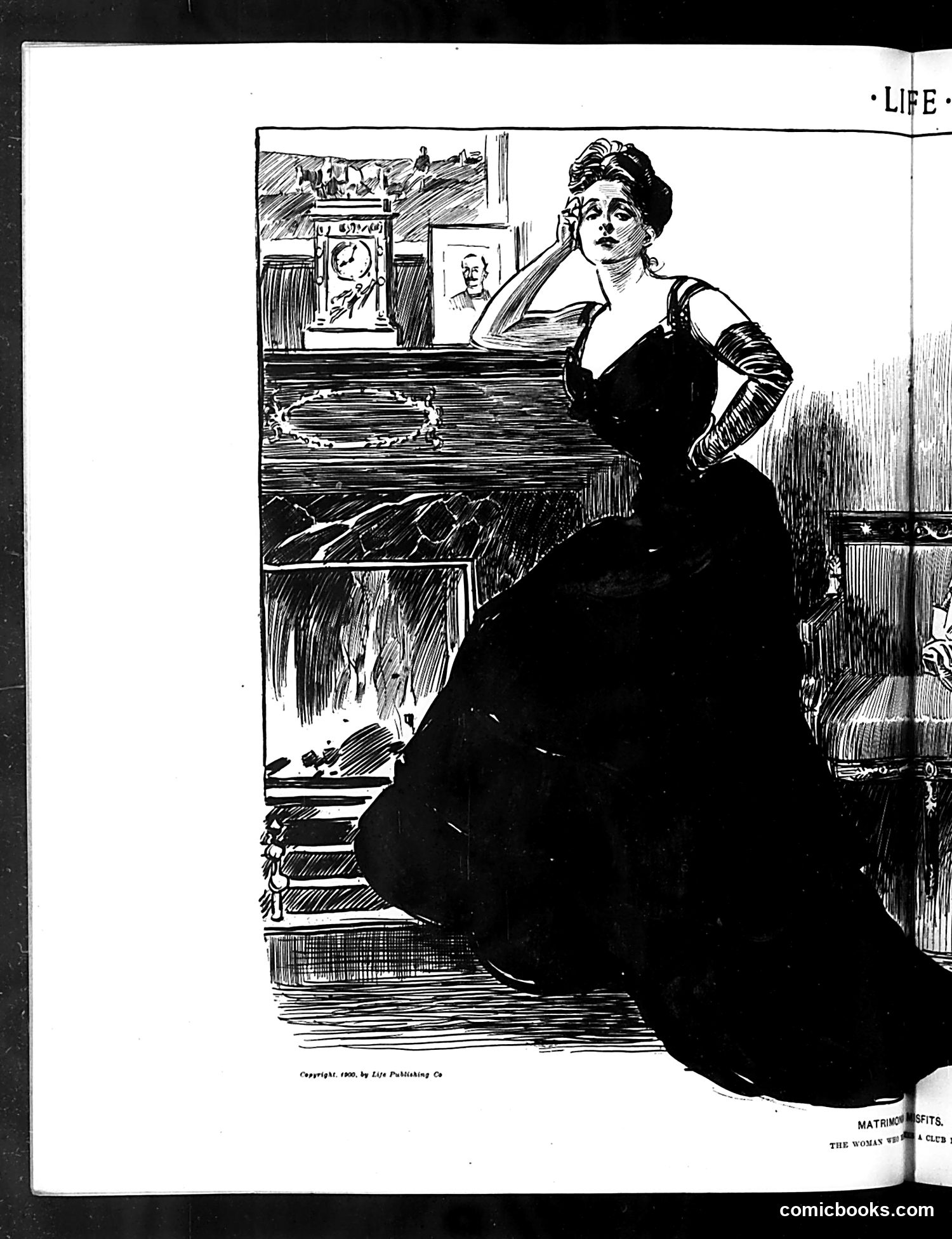
This is a satirical illustration from *Life* magazine (copyright 1900, per the visible text). The cartoon depicts a well-dressed woman in an elegant black gown posing confidently in what appears to be a bedroom or dressing room, with furniture and a mirror visible behind her. The caption reads "MATRIMONIAL SIFTS" and references "THE WOMAN WHO GETS A GIFT," suggesting this satirizes women's materialism or mercenary attitudes toward marriage. The woman's confident, self-satisfied pose and fashionable attire imply she is being mocked for viewing marriage as a financial transaction—specifically, for the gifts and material benefits she can obtain. This reflects early 1900s anxieties about women's economic independence and changing attitudes toward matrimony, common themes in *Life*'s satirical commentary on gender relations.
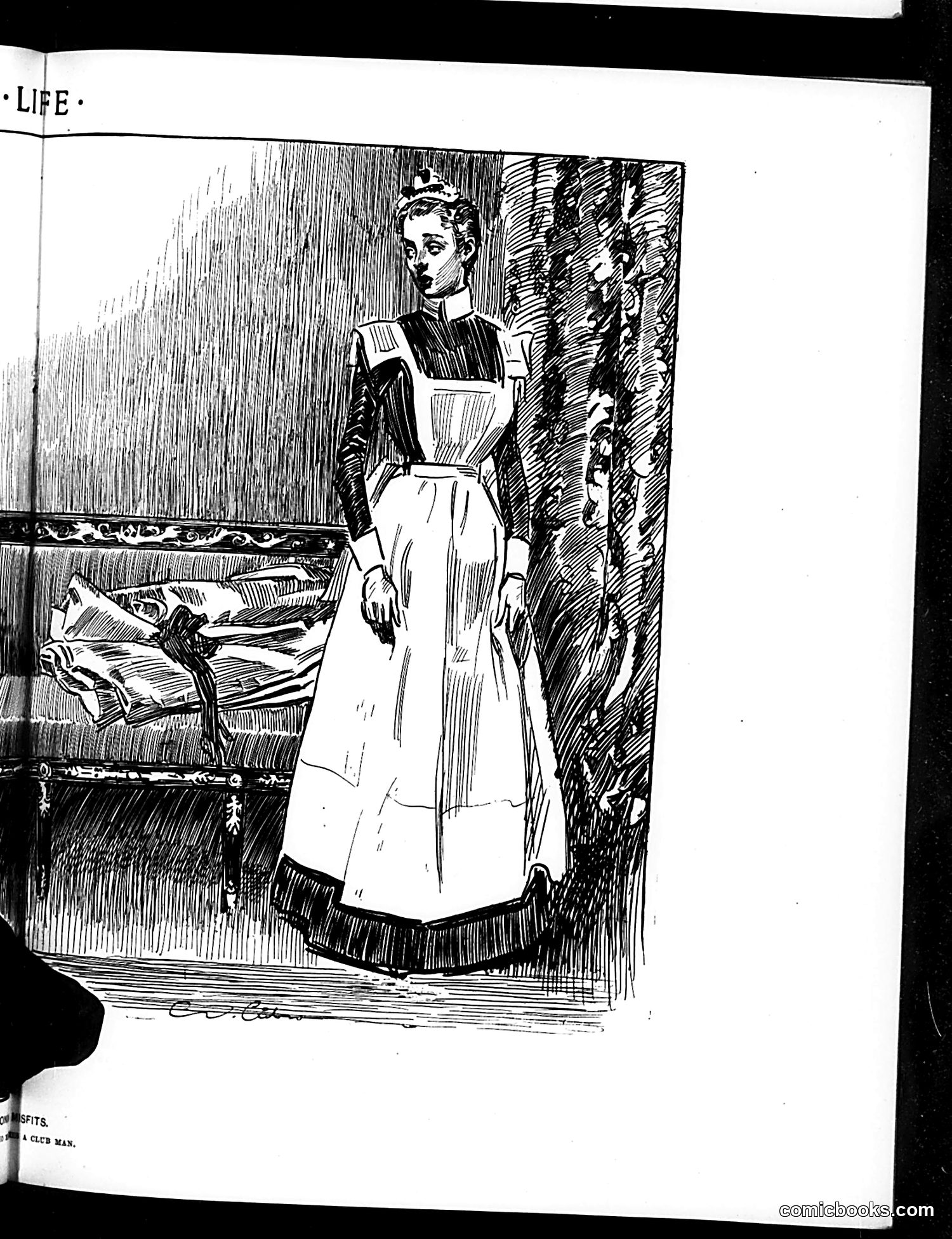
This appears to be a fashion illustration from *Life* magazine rather than political satire. The image shows a woman in early 20th-century domestic attire—a white apron worn over a dark dress with puffy sleeves, typical servant or housemaid clothing of the era. She stands in an interior setting with furniture and draped fabric visible. The "LIFE" header indicates this is from the satirical magazine's fashion or lifestyle section. Without additional visible text on the page, the specific satirical point is unclear, though the formal presentation of working-class servant wear in a fashion context may comment on class distinctions or domestic labor standards of the period.
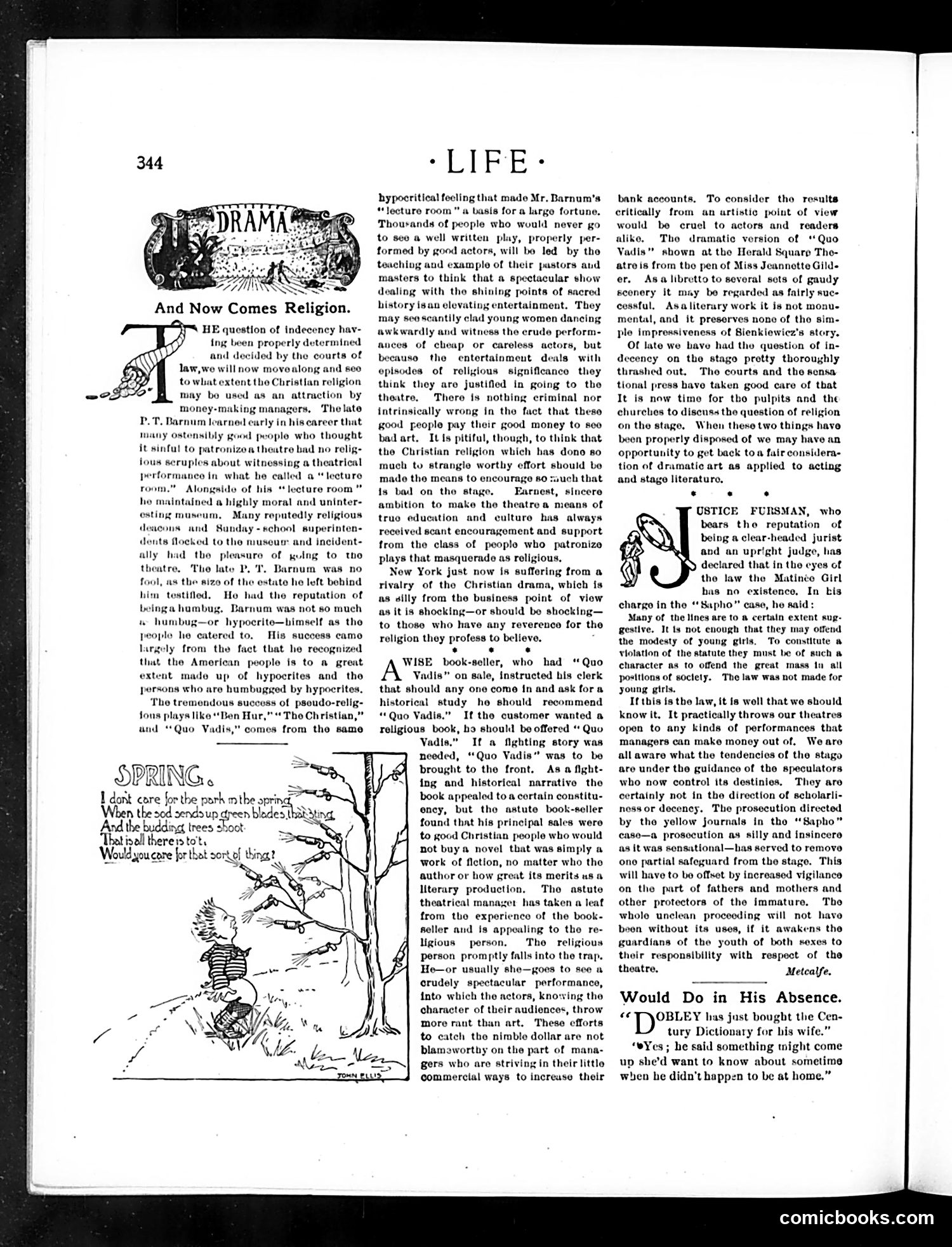
This page discusses theatrical censorship regarding religious content. The main article critiques efforts to restrict plays with religious themes, particularly those that don't align with Christian doctrine. The text references P.T. Barnum's early career and mentions a book-seller's experience selling "Quo Vadis" (a novel with Christian themes). The article argues that religious organizations shouldn't dictate what theaters present, though it acknowledges some plays may be genuinely offensive. The cartoon labeled "Spring" (bottom left, by Tony Sarg) appears unrelated—it's a whimsical seasonal illustration. A brief anecdote at page's end jokes about someone buying a dictionary, presumably for consulting when absent from home. The satire targets religious censorship attempts and theatrical hypocrisy rather than targeting specific individuals or events.
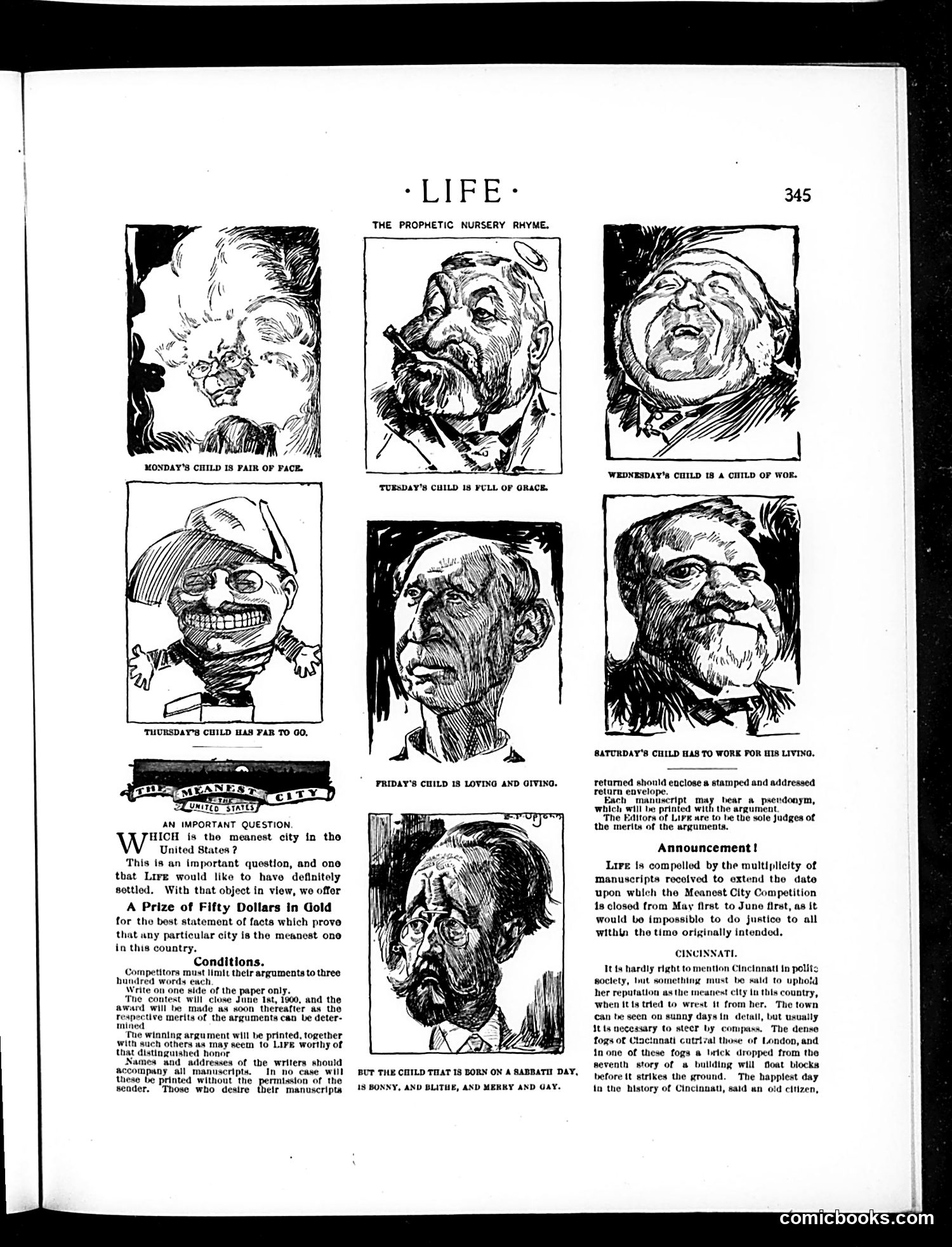
This page presents two connected features. The upper section shows a satirical take on the nursery rhyme about children born on each day of the week, with caricatured faces illustrating the poem's predictions—each face depicting the supposed character of that day's child. Below, **Life** announces a contest offering fifty dollars in gold for the best essay identifying "the meanest city in the United States." The magazine sought factual arguments (300 words maximum) proving which American city deserved this dubious title. An extension notice indicates the contest deadline was moved from May 1 to June 1, 1900, due to manuscript volume. The page includes a preliminary entry satirizing **Cincinnati**, mocking its notorious air pollution ("dense fogs"), filthy conditions visible only on sunny days, and overall griminess. This suggests Cincinnati was already infamous for urban decay and pollution during this era—making it a likely competitor for the "meanest city" title.
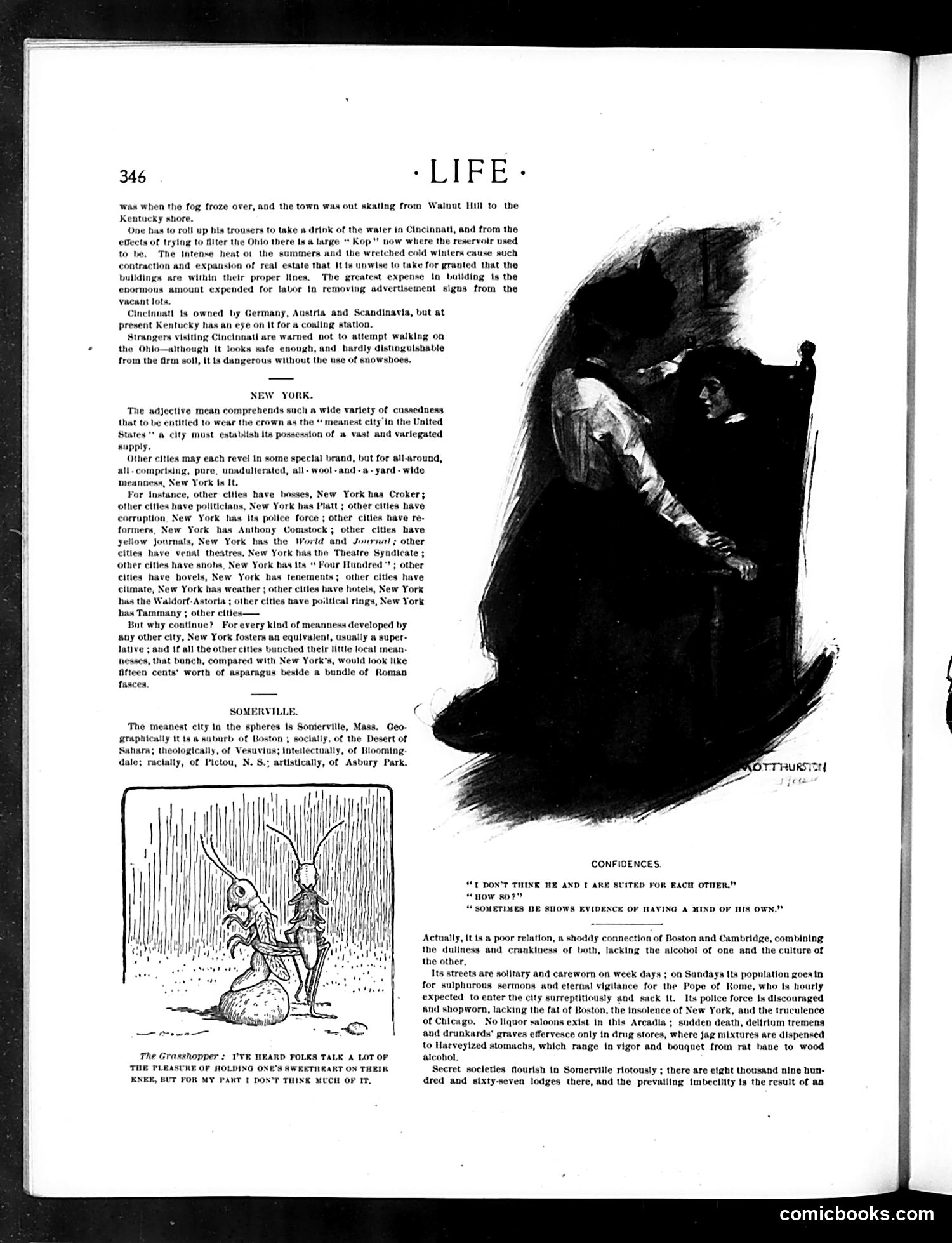
This page from Life magazine contains satirical commentary on American cities, primarily Cincinnati, New York, and Somerville, Massachusetts. **Cincinnati section:** Mocks the city's polluted Ohio River (so contaminated it requires "snowshoes" to walk on safely) and its climate's extreme effects on buildings. The criticism is exaggerated but reflects genuine concerns about industrial pollution. **New York section:** The longest piece uses a comparative structure to argue New York is the "meanest city" in America—not physically, but morally and socially. It catalogs the city's notorious figures and institutions: Croker (likely referring to Tammany Hall politics), Comstock (the anti-vice crusader), yellow journalism papers (the World and Journal), and the Theatre Syndicate monopoly. This reflects genuine Progressive Era anxieties about corruption and corporate control. **Somerville section:** Sarcastically describes this Boston suburb as a joyless, puritanical place lacking Boston's sophistication or New York's vitality. **The cartoon** (lower left) depicts gossip, with one figure whispering to another—illustrating the "confidences" section about relationship incompatibility.
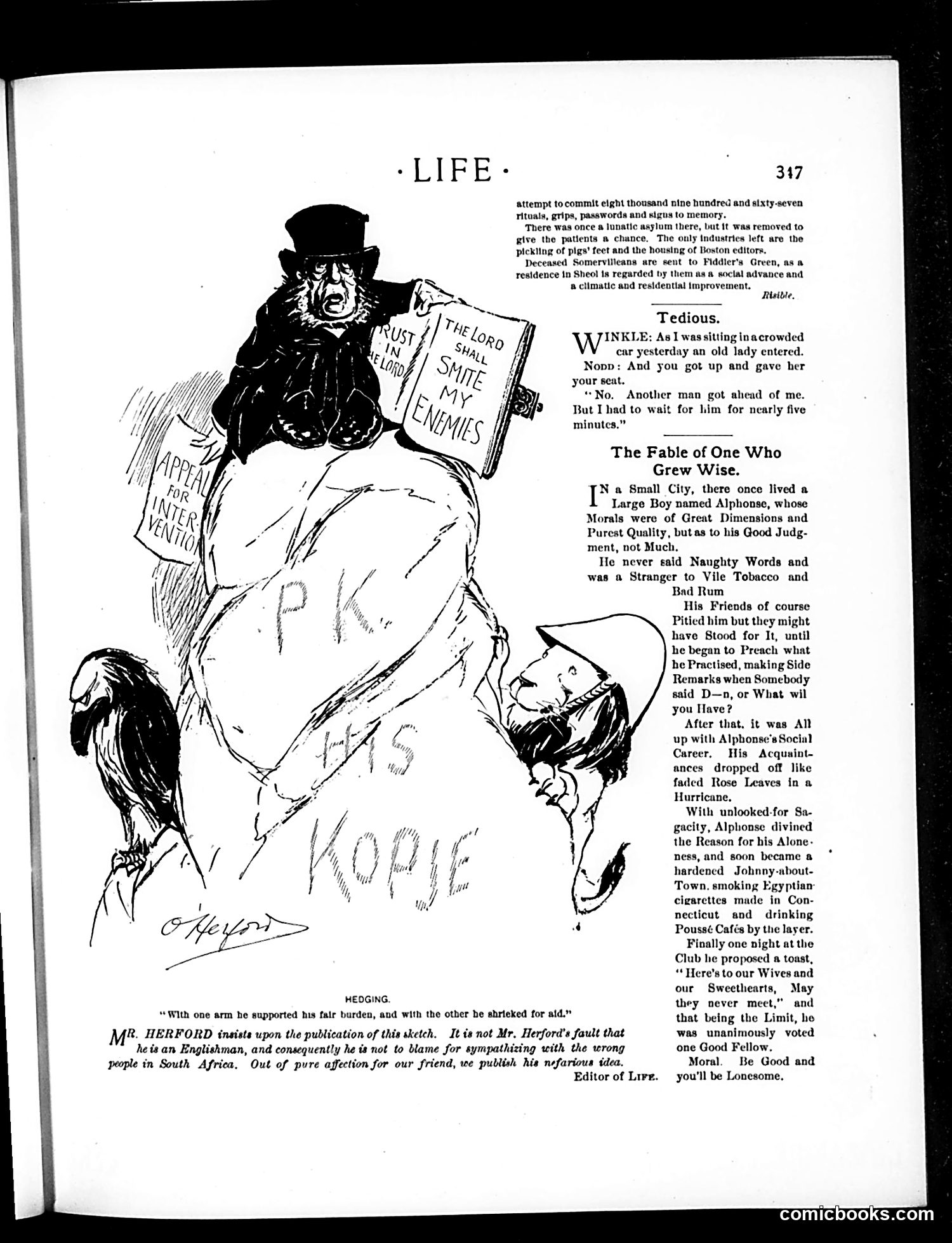
**The Main Cartoon ("Hedging"):** Depicts a large, rotund figure labeled as supporting a "fair burden" while shrieking for aid. Two smaller figures flank him. The satirical point appears to address the Boer War in South Africa—the editor's note indicates cartoonist Herford is English and "sympathizing with the wrong people in South Africa," suggesting the cartoon takes a pro-British stance that Life's American editors find objectionable. They publish it "out of pure affection" while distancing themselves from Herford's pro-imperialist views. **"The Fable of One Who Grew Wise":** A moral tale about Alphonse, a virtuous young man whose moral superiority alienates his peers. When he begins preaching morality to others ("making Side Remarks"), his social life collapses. He adapts by becoming debauched, and is eventually voted "one Good Fellow"—satirizing how society rewards compromise and social conformity over principled stands. The moral's irony: "Be Good and you'll be Lonesome." Both pieces mock rigid positions while revealing period attitudes about propriety, social acceptance, and imperialism.
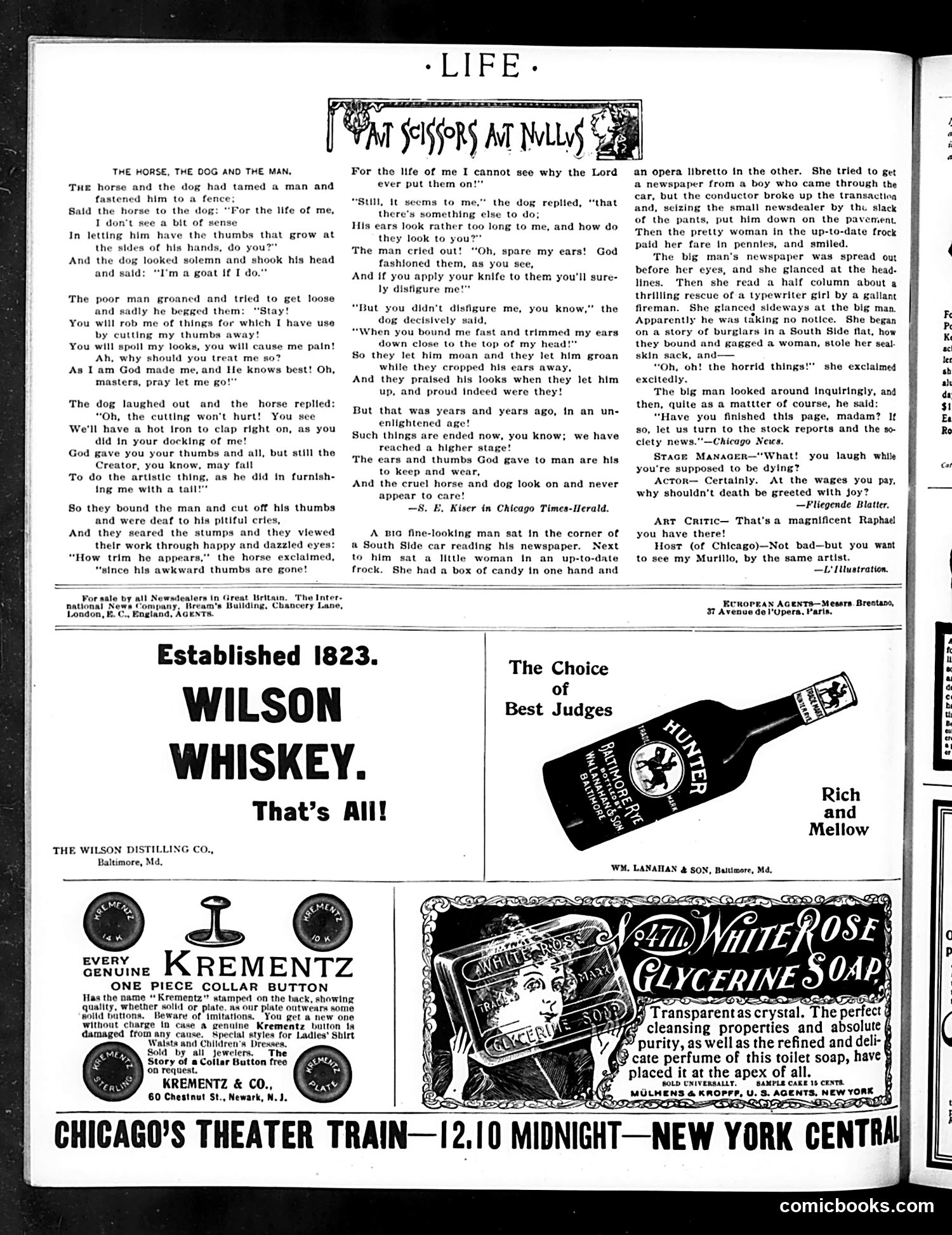
This page consists primarily of **three separate satirical pieces** rather than a single unified cartoon: 1. **"The Horse, the Dog and the Man"** (main poem): An allegory by S.E. Kiser criticizing animal mutilation practices. Animals justify docking horses' tails and cropping dogs' ears, then threaten to remove a man's thumbs and ears. The satire's point: society accepts these cruel practices on animals while claiming to be "enlightened," revealing hypocrisy about animal welfare. 2. **Two brief anecdotes** about urban life: One mocks a woman passenger who reads a man's newspaper without permission; another jokes about an underpaid actor who greets death with joy given his meager wages. The page is primarily **text-based satire** with minimal illustration. The messaging targets animal cruelty, gender behavior, and labor exploitation—common early-1900s *Life* magazine concerns. The surrounding advertisements (Wilson Whiskey, soap, buttons) are incidental.
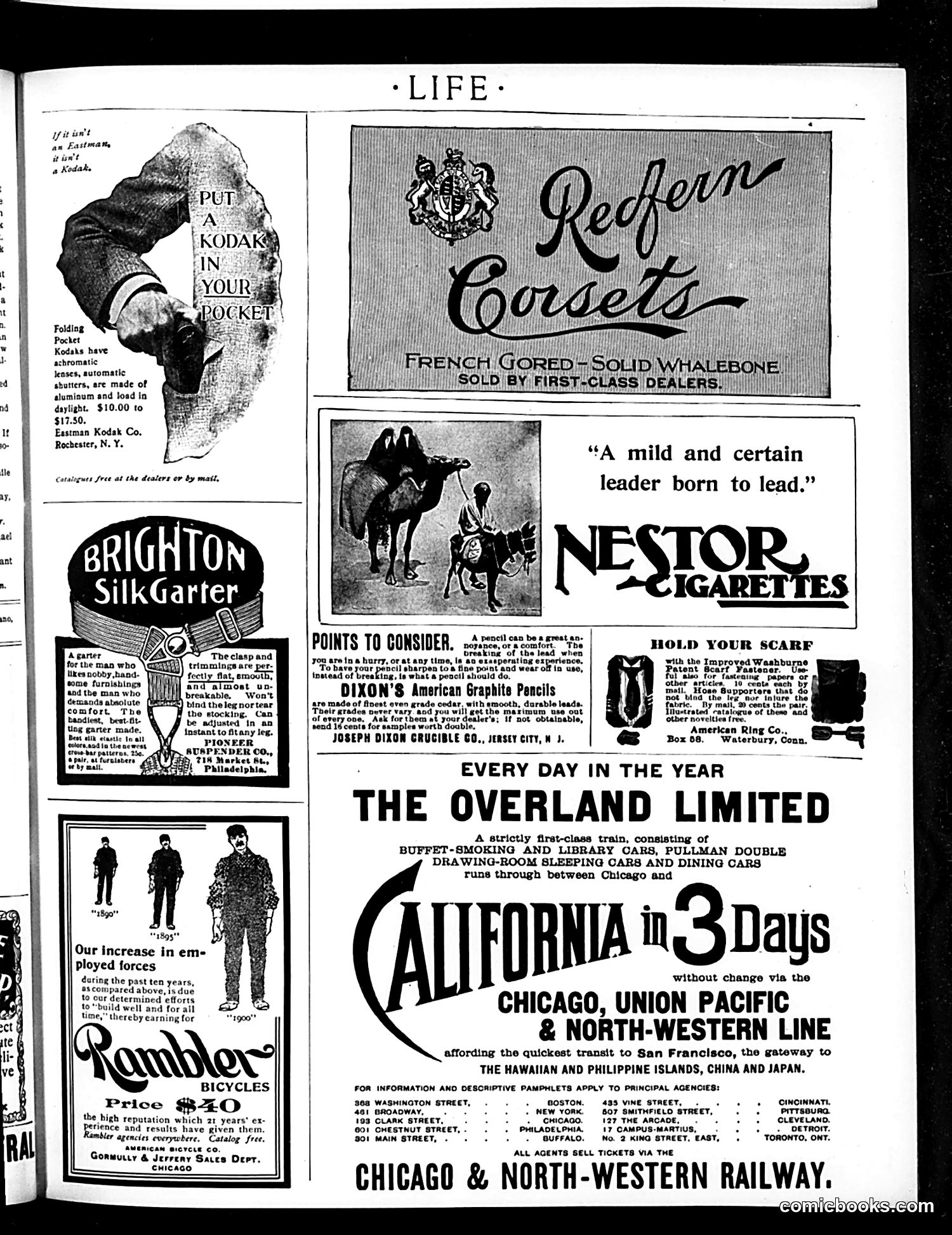
This is primarily a **advertising page** from Life magazine, featuring commercial promotions for products and services of the era (likely early 1900s based on visual style and references). The few images present are **not political cartoons**—they're commercial illustrations: 1. **Kodak pocket camera** advertisement with product image 2. **Rambier Bicycles** showing employment growth ("1883" to "1900") as a business success narrative 3. **Nestor Cigarettes** with an orientalist camel image and leadership slogan 4. Various product ads for corsets, pencils, scarves, and railroad services The only content approaching social commentary is the Rambier Bicycles section, which presents employment expansion as evidence of the company's reliable quality and trustworthiness—reflecting turn-of-century attitudes that equated business growth with virtue. The page is dominated by **commercial messaging** rather than satire or political content.
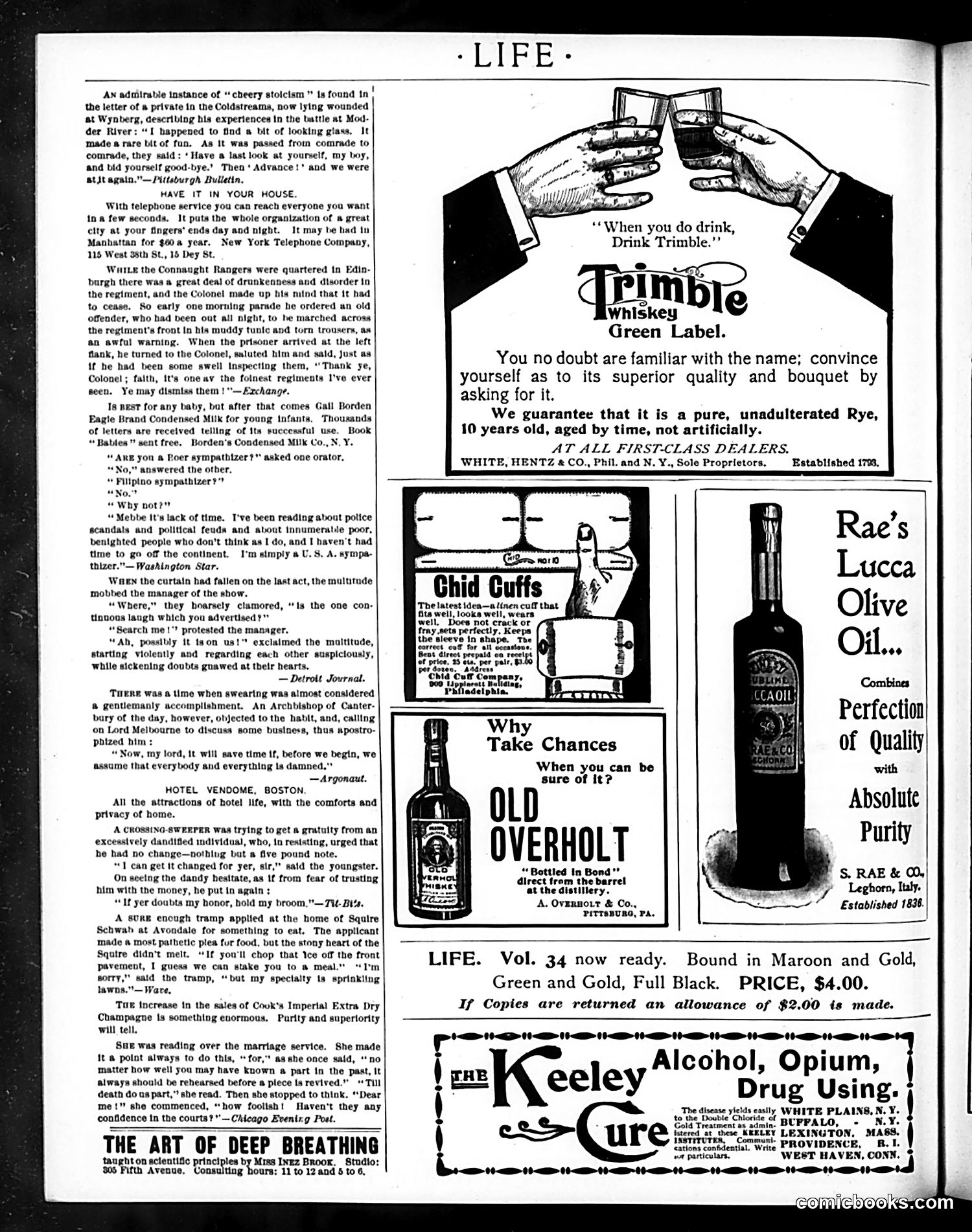
This is primarily an **advertising page** from *Life* magazine, with scattered humorous anecdotes rather than political cartoons. The content reflects turn-of-the-century attitudes: **Main Advertisements:** - **Trimble Whiskey**: A straightforward liquor ad emphasizing quality ("pure, unadulterated Rye, 10 years old") - **Child Cuffs** and **Old Overholt Whiskey**: Period product ads - **Rae's Lucca Olive Oil** and **Keeley Cure for Alcohol, Opium, Drug Using**: The juxtaposition is notable—alcohol ads alongside an addiction treatment advertisement, reflecting contemporary ambivalence about substance use **Anecdotes included** are light humor about military life, telephones, sympathizers to various causes, and working-class characters—typical *Life* magazine content mocking social pretension and bureaucratic absurdity. **For modern readers**: This page illustrates how openly alcohol was marketed while simultaneously acknowledging addiction as a treatable medical problem. There are no satirical cartoons here; it's a commercial/humor-filled page typical of early-1900s magazine layout.
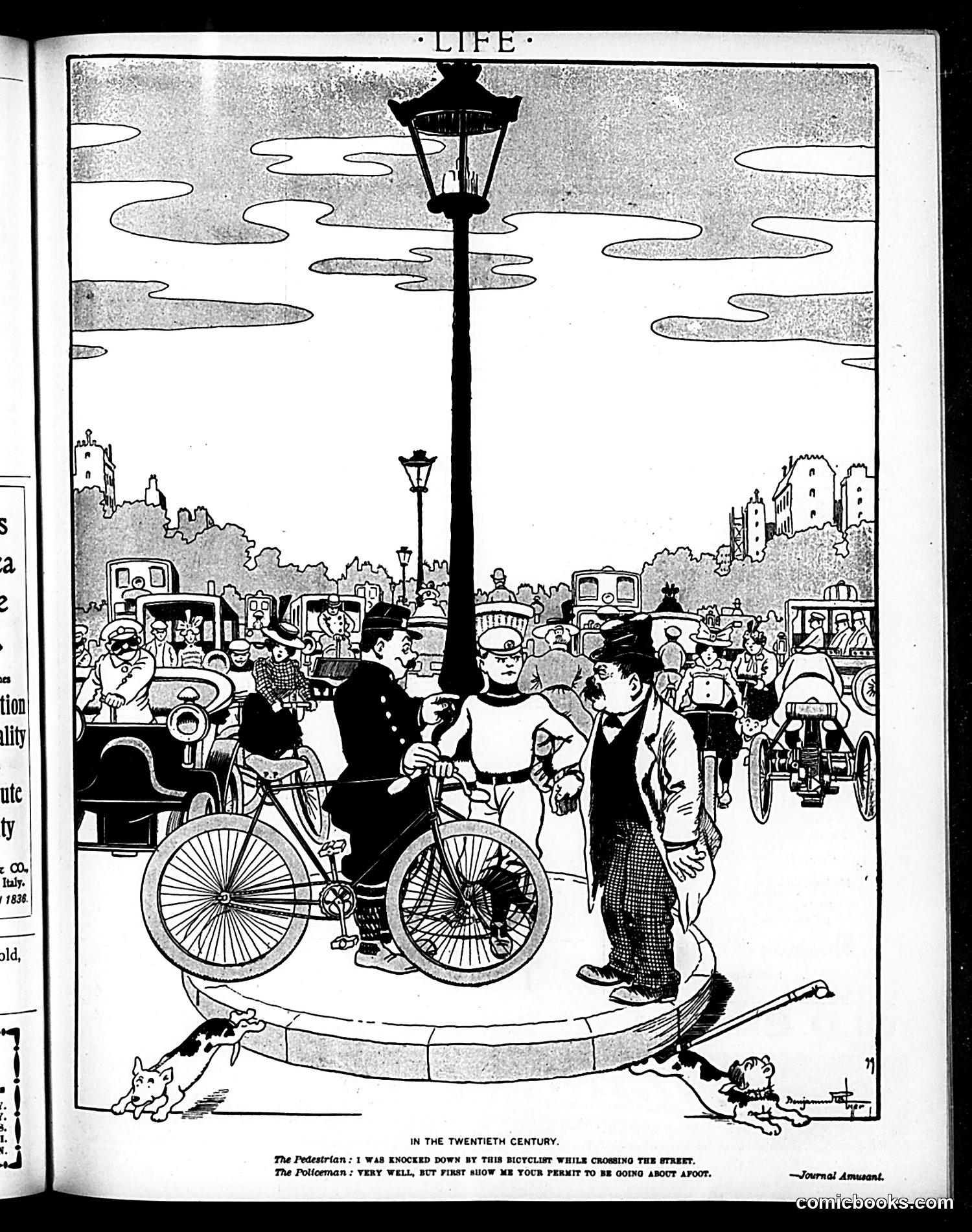
This is a satirical cartoon titled "In the Twentieth Century" depicting a street scene where a pedestrian has been hit by a bicyclist. The humor lies in the policeman's absurd response: rather than addressing the bicyclist's reckless behavior, he demands the pedestrian show a permit for simply walking. The satire mocks the early 20th-century trend toward over-regulation and bureaucratic absurdity. As automobiles and bicycles proliferated, cities were imposing various permits and regulations on transportation. The cartoon exaggerates this regulatory impulse to ridiculous extremes—suggesting that even pedestrians might eventually need permits to exist in public spaces. The crowded urban street filled with vehicles emphasizes how technology was transforming city life, often prioritizing mechanical transport over human beings on foot.
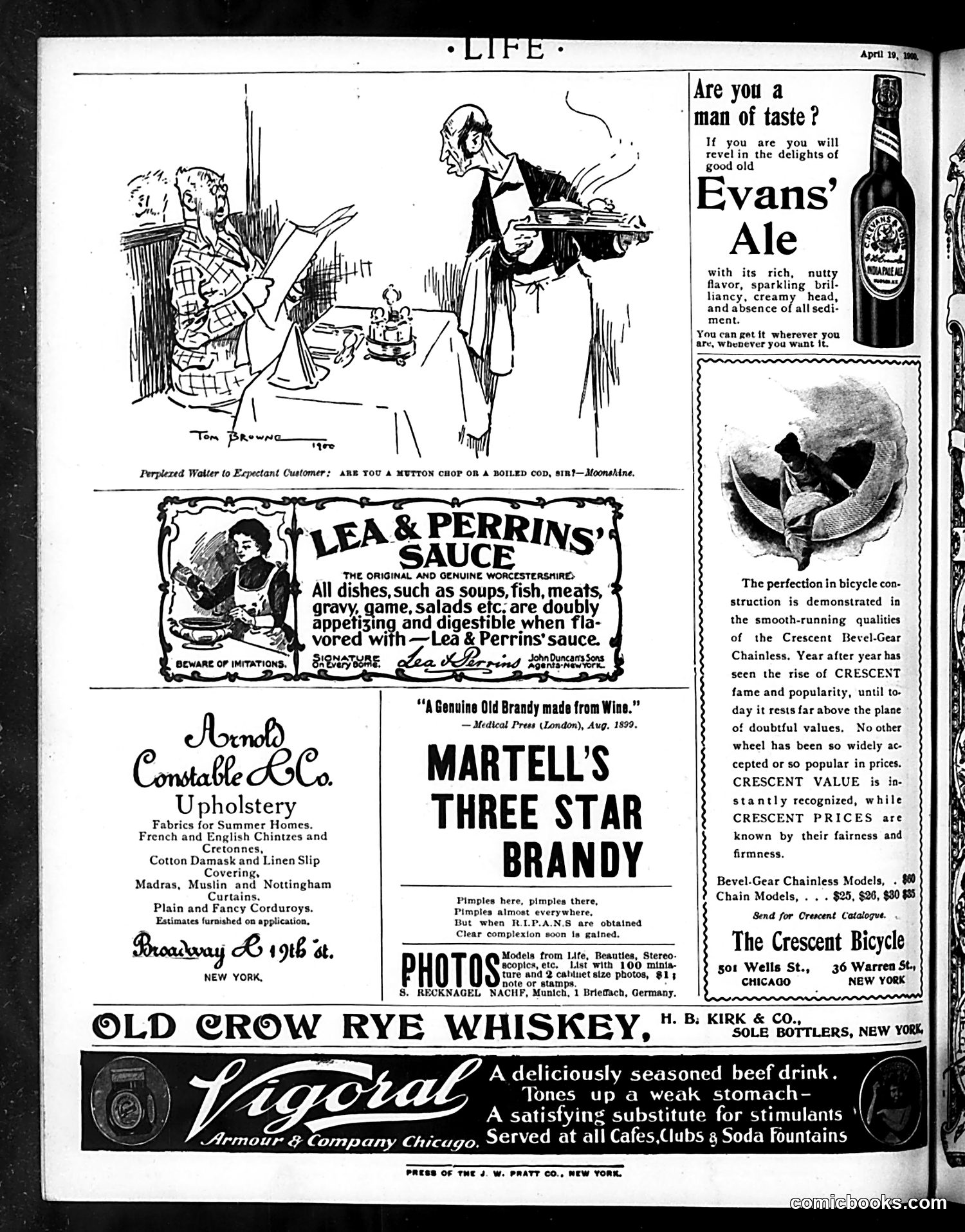
This page is primarily **advertising**, not political satire. The single cartoon at top depicts a restaurant scene: a waiter asks a confused diner whether he wants "a mutton chop or a boiled cod, sir?"—captioned "Moonshine," suggesting the humor lies in the diner's bewilderment at the choice or perhaps the waiter's unclear diction. The bulk of the page features period product advertisements: Evans' Ale, Lea & Perrins sauce, Martell's brandy, Old Crow whiskey, and Vigoral beef drink. These ads reflect early-1900s consumer culture and marketing appeals to "taste" and health claims. Notable is the Ripans advertisement promising clear complexion ("Pimples here, pimples there..."), typical of patent medicine marketing of the era. The Crescent Bicycle ad emphasizes "bevel-gear chainless" innovation, suggesting contemporary technological advancement in bicycle design. **No significant political or social satire is present**—this is a standard commercial magazine page from the period.