
Life, 1900-04-19 · page 12 of 20
Life — April 19, 1900 — page 12: what you’re looking at
What you’re looking at
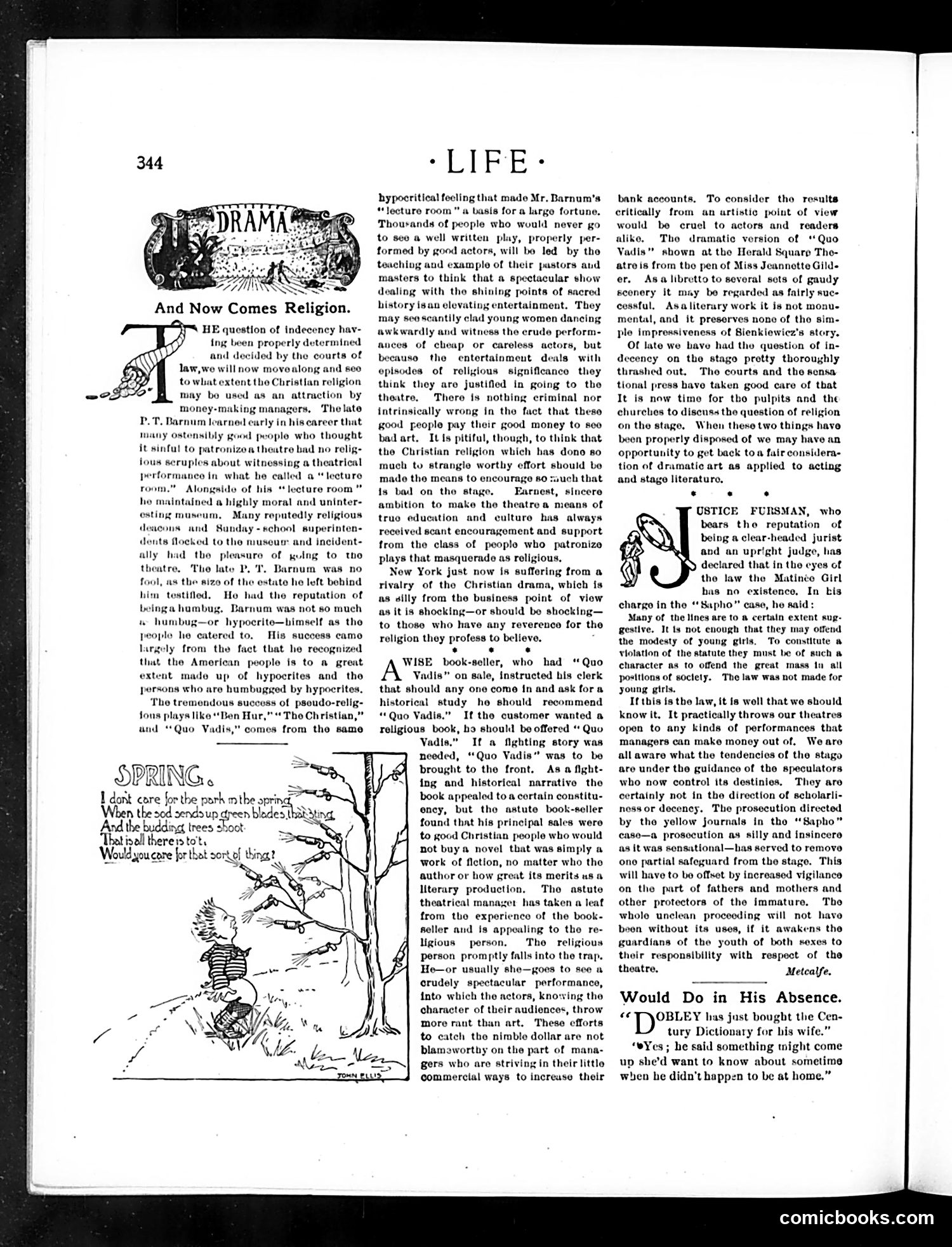
This page discusses theatrical censorship regarding religious content. The main article critiques efforts to restrict plays with religious themes, particularly those that don't align with Christian doctrine. The text references P.T. Barnum's early career and mentions a book-seller's experience selling "Quo Vadis" (a novel with Christian themes). The article argues that religious organizations shouldn't dictate what theaters present, though it acknowledges some plays may be genuinely offensive. The cartoon labeled "Spring" (bottom left, by Tony Sarg) appears unrelated—it's a whimsical seasonal illustration. A brief anecdote at page's end jokes about someone buying a dictionary, presumably for consulting when absent from home. The satire targets religious censorship attempts and theatrical hypocrisy rather than targeting specific individuals or events.
📄 Transcribed text from this page (OCR, searchable)
Machine-transcribed from the original scan — historical spelling and the odd misread are preserved.
properly de and decided by the courts of law,we will now movoalong and seo to what extent the Christian religion may be used as an attraction by money-making managers, ‘The late P.T. Barnum learned early in his career that many ostensibly good people who thought it sinful to patronizoa theatre bad no relig- ious seruples about witnessing a theatrical performance in what he called a “lecture ” Aongside of his lecture room intained a highly moral and uninter- museum, Many reputedly religious 18 and Sunday- school superinten- dents flocked to the museum and incident- ally had the pleasure of guing to tho theatre. Tho late PT. Barnum was no fool, as the sizo of the estate he left bebind him testifled. Ho had the reputation of beinga hambug, Barnum was not 50 much & humbug—or hypocrite—bimself as tho people he catered to, His success camo largely from the fact that he recognized that the American people is to a great extent made up of hypocrites and tho persons who are humbugged by hypocrites. The tremendous success of pseudo-rell fons plays like “Ben Hur," “ Tho Christian, and ‘Quo Vadis," comes from the same SPRING. I dont care for the pork mthe spring” e When the Ard te adel sendoup dreen blades tha Ng trees shoot: ‘That isall theres tot, Would youcare for that sorte thing? ; A Ke LIFE hypocritical fecling that made Mr. Barnum's “lecture room” a basis for a largo fortune. Thousands of people who would never go to seo a well written play, properly per- formed by good actors, will bo led by the teaching and example of their pastors and masters to think that a spectacular show dealing with tho shining points of sacred history isan elevating entertainment. They may seo scantily clad young women dancing awkwardly and witness the crude perform- ances of cheap or careless actors, but becauso the entertainment deals with episodes of religious significance they think they are justified in going to the theatre, There is nothing criminal nor intrinsically wrong in the fact that these good people pay their good money to sco bad art. It is pitiful, though, to think that the Christian religion which has dono so much to strangle worthy effort should bo made the means to encourage 80 sauch that is bad on tho stage, Earnest, sincere ambition to make the theatre a means of truo education and culture has always received scant encouragement and support from the class of people who patronizo plays that masquerade as religious, Now York just now is suffering from a rivalry of the Christian drama, which is as silly from the business point of view as it is shocking—or should be shocking— to those who have any reverenco for tho religion they profess to be lieve. WISE book: -soller, who had “Quo Vadis” on sale, instructed bis clerk that should any one come in and ask for a historical study hoe should recommend **Quo Vadis.” If tho customer wanted a religious book, ho should be offered “ Quo Vadis.” If a fighting story was needed, “Quo Vadis” was to be brought to the front. As a fight- ing and historical narrative tho book appealed to a certain constitu- ency, but tho astute book-seller found that his principal sales were to good Christian people who would not buy a novel that was simply a work of fiction, no matter who tho author or how great its merits us a literary production, Tho astute theatrical manager has taken a leat from tho experience of the book- seller and is appealing to the re- ligious person, Tho religious person promptly falls into the trap, He—or usually she—goes to see a crudely spectacular performance, into which the actors, knowing the character of their audiences, throw more rant than art. These efforts to catch tho nimble dollar are not blamaworthy on the part of mana- gers who aro striving in their little Commercial ways to increuse their bank accounts. To consider tho results critically from an artistic point of view would be cruel to actors and readers alike, Tho dramatic version of “Quo Vadis” shown at the Horald Square The- atrois from tho pen of Miss Jeannette Gilde er. Asa libretto to several sets of gaudy scenery it may be regarded as fairly suc cessful. Asaliterary work it is not monu. mental, and it preserves nono of the sim- ple impressiveness of Bienkiewicz's story. Of late we have had the question of in- decency on the stago pretty thoroughly thrashed out, Tho courts and the sensa tional press have taken good care of that It is now timo for tho pulpits and the churches to discuss the question of religion on the stage, When these two things have been properly disposed of we may have an opportunity to get back toa fair considera- tion of dramatic art as applied to acting and stage literaturo, . . . USTICE FURSMA bears tho reputation of being a clear-headed jurist and an upright judge, has declared that in the eyes of the law the Matinée Girl bas no existence, In bis chargo in the “Sapho” case, he said: Many of the lines are to a certain extent sug- gestive. It ts not enough that they may offend the modesty of young girls, To constitute # violation of the statute they must be of such & character as to offend the great mass tn all positions of soctety. The law was not made for young girls. If this is the law, it is well that we should know it, It practically throws our theatres open to any kinds of performances that managers can make money out of. We aro all aware what the tendencies of the stago taro under the guidance of the speculators who now control its destinies. Thoy aro certainly not in the direction of scholarli- nossor decency. The prosecution directed by tho yellow journals in tho “Sapho” case—a prosecution as silly and insincero as it was sensational—has served to removo ono partial safeguard from the stage. This will have to be offset by increased vigilance on the part of fathers and mothers and other protectors of the immature, Tho whole unclean proceeding will not havo been without its uses, if it awakens the guardians of the youth of both sexes to their responsibility with respect of the theatre, Metcalfe. Would Do in His Absence. OBLEY has just bought the Cen- tury Dictionary for his wife.” ‘eYcs ; he said something might come up she’d want to know about sometime when he didn’t happen to be at home.” comicbooks.com