
Life, 1900-04-19 · page 6 of 20
Life — April 19, 1900 — page 6: what you’re looking at
What you’re looking at
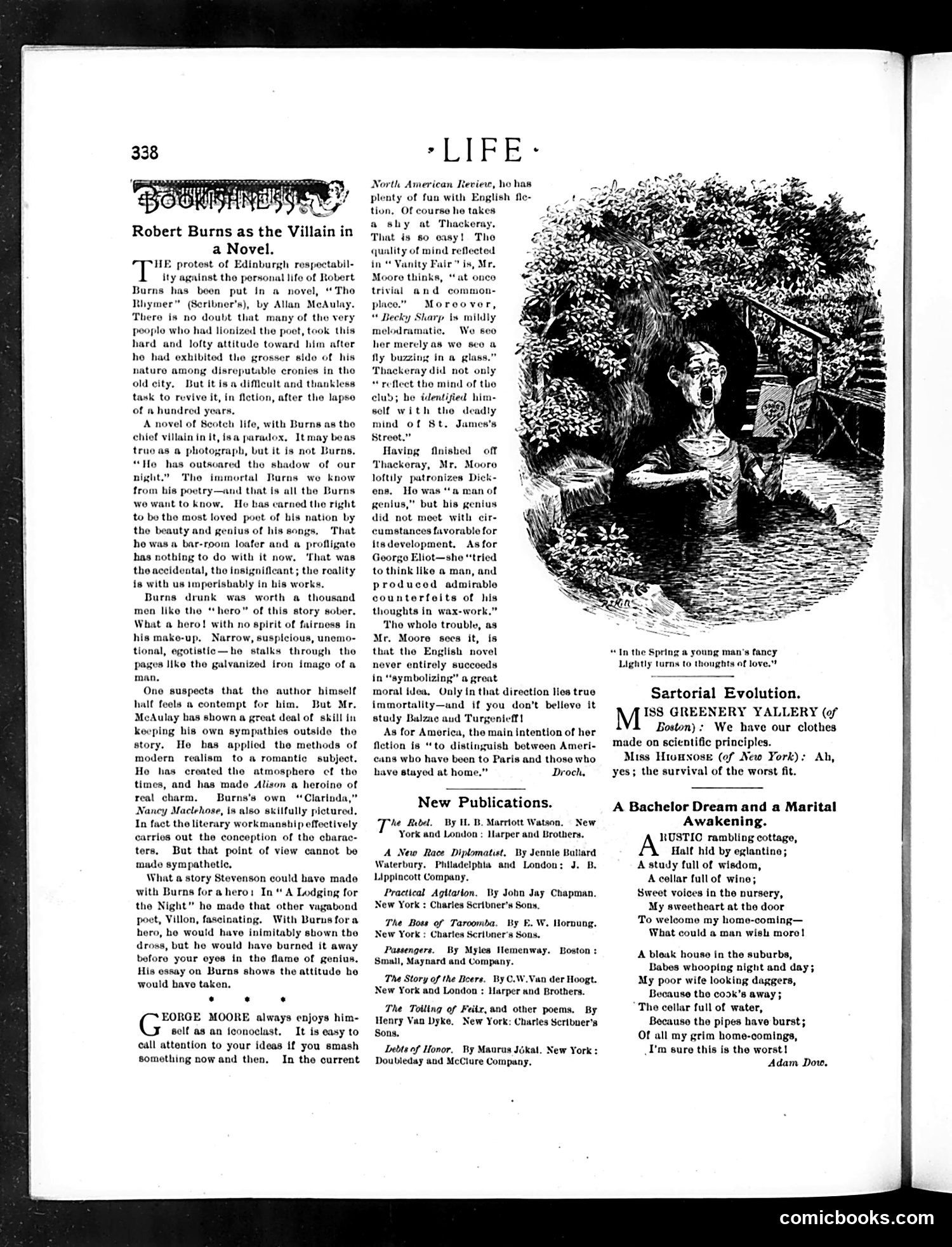
This page contains a literary review section rather than political cartoons. The main article discusses a novel featuring Robert Burns as a villain, critiquing the author's portrayal of the Scottish poet. The review argues the novelist fails to capture Burns's true character—his complexity and genius—reducing him to a caricature. The single illustration shows a romantic scene of a young man and woman in spring, captioned "In the Spring a young man's fancy lightly turns to thoughts of love"—a literary reference rather than satire. Below are announcements for new book publications. The right column contains a poem titled "Sartorial Evolution" and another poem, "A Bachelor Dream and a Marital Awakening," presenting humorous verse about courtship and marriage expectations versus domestic reality.
📄 Transcribed text from this page (OCR, searchable)
Machine-transcribed from the original scan — historical spelling and the odd misread are preserved.
Robert Burns as the Villain in a Novel. HE protest of Edinburgh respectabil- ity against the personal life of Robert Burns has been put In a novel, “Tho Rhymer” (Scribner's), by Allan McAulay. There is no doubt that many of the very people who had lionized the poet, took this hard and lofty attitude toward him after he had exhibited the grosser side of his nature among disreputable cronies in the old city. But it isa diMcult and thankless task to revive it, in fletion, after the lapse of a hundred years, A novel of Scotch life, with Burns as tho chief villain in it, isa paradox, Itmay beas true as a photograph, Lut it is not Burns. “He has outsoared tho shadow of our night.” The immortal Rurns wo know from his poetry—and that is all the Burns wo want to know. He bas carned the right to be the most loved poet of bis nation by the beauty and genius of his songs, That ho was a bar-rootn loafer and a profligate has nothing to do with it now, ‘That was the accidental, tho insignificant; the reality is with us imperisbably in bis works. Burns drunk was worth a thousand men like the “hero” of this story sober. What a hero! with no spirit of fairness in his make-up. Narrow, suspicious, unemo- tional, egotistic—he stalks through the pages like the galvanized iron imago of a man. One suspects that the author himself half feels a contempt for him. But Mr, McAulay bas shown a great deal of skill in keeping his own sympathies outside the story. He bas applied tho methods of modern realism to a romantic subject. Ho has created the atmosphero cf tho times, and has made Alison a heroine of real charm. Burns's own “Clarinda,” Nancy Mactrhose, is also skilfully pictured, In fact the literary workmanship effectively carries out the conception of the cbarac- ters, But that point of view cannot be made sympathetic, What a story Stevenson could have made with Burns for ahero: In“ A Lodging for the Night” ho made that other vagabond poet, Villon, fascinating. With Burns fora hero, he would have inimitably shown tho dross, but he would have burned it away before your oyes in tho flame of genius. His essay on Burns shows the attitude be would have taken, . . . EORGE MOORE always enjoys him- self as an iconoclast, It is easy to call attention to your ideas if you smash something now and then. In the current «LIFE - North American Review, ho has plenty of fun with English fle- Of course he takes a shy at Thackeray, That is 80 easy! Tho tion, quality of mind reflected Vanity Fair” is, Mr. at once and common- Moroovor, in’ Moore thinks, trivial place.” * Becky Sharp is mildly melodramatic. We seo her merely a8 wo seo a fly buzzing in a glass.” Thackeray did not only * reflect the mind of the elud; he identified him- solf with tho deadly mind of St. James's Street.” Having Mnished off Thackeray, Mr, Mooro loftily patronizes Dick- ens, Ho was “a man of genius,” but bis genius did not meet with cir- cumstances favorable for itsdevelopment. As for Goorgo Eliot—sho “tried to think like a man, and produced admirablo counterfeits of his thoughts in wax-work,” Tho whole trouble, as Mr. Moore secs it, {5 that the English novel never entirely succoeds in “symbolizing” a great moral idea, Only in that direction lies true immortality—and if you don’t belleve it study Bulzae aud Turgenteff! As for America, the main intention of her fiction is “to distinguish between Ameri- cans who have been to Paris and those who have stayed at home.” Droch. New Publications. Tle Beod. By Ht. B. Marriott Watson. New York and London ; Harper and Brothers, A New Race Diplomatist, By Jennte Bullard Waterbury, Philadelptia and London: J. B. Lippincott Company. Practical Agitation. By John Jay Chapman. New York : Charles Scribner's Sons, The Boss of Taroomba. By E,W. Hornung. New York ; Charles Scribner's Sons, Passengers. By Mylea Hemenway. Boston: Small, Maynard and Company. The Story of the Beers. By C.W.Vun der Hoogt. New York and London : Harper and Brothers. The Toiling of Feix, and other poems. By Henry Van Dyke. New York: Charies Scribuer’s Sons. Debts of Honor, By Maurus Jokal. New York : Doubleday and McClure Company, * In the Spring a young man’s fancy Lightly turns to thoughts of love."? Sartorial Evolution. ISS GREENERY YALLERY (of Boston): We have our clothes made on scientific principles. Miss Hiunnose (of New York); Ah, yes; the survival of the worst fit. A Bachelor Dream and a Marital Awakening. RUSTIC rambling cottage, Halt hid by eglantine; A study full of wisdom, A cellar full of wine; Sweet voices in the nursery, My sweetheart at the door To welcome my home-coming— What could a man wish moro! ‘A bleak house in the suburbs, Babes whooping night and day; My poor wife looking daggers, Because the cook’s away ; The cellar full of water, Becauso the pipes have burst; Of all my grim home-comings, I'm sure this is the worst! Adam Dow, comicbooks.com