
Life, 1900-04-19 · page 3 of 20
Life — April 19, 1900 — page 3: what you’re looking at
What you’re looking at
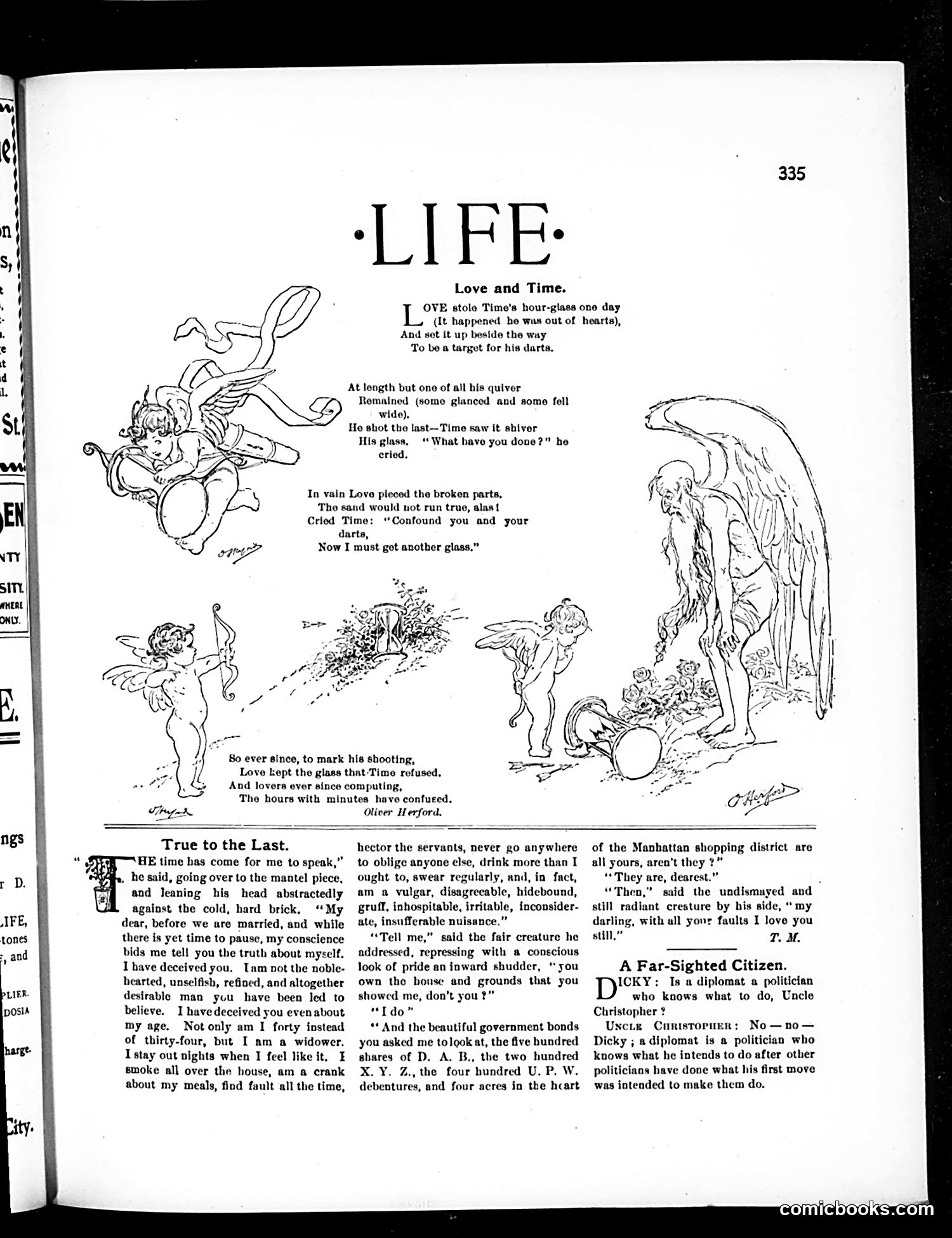
The top cartoon illustrates the poem "Love and Time" by Oliver Herford. It depicts Cupid attempting to repair Time's broken hourglass after Love has damaged it—a metaphorical commentary on how romantic love disrupts temporal order and natural progression. The bottom section contains two pieces: "True to the Last" presents a monologue from an apparently wealthy or aristocratic man defending his character to his wife, emphasizing his constancy despite financial and personal failings. "A Far-Sighted Citizen" is a brief dialogue joke about a diplomat (Dicky) who, when asked about government bonds, reveals his ignorance of their actual purpose—satirizing political incompetence and the disconnect between politicians' authority and their understanding of policy.
📄 Transcribed text from this page (OCR, searchable)
Machine-transcribed from the original scan — historical spelling and the odd misread are preserved.
Love and Time. OVE stole Time's hour-glass one day (It happened ho was out of hearts), And sot it up beside the way To be a target for his darts, At longth but ono of all his quiver Remained (some glanced and some fell wide). Ho shot the last—Time saw it shiver His glass, cried. “What havo you done?” he In vain Lovo pieced the broken parte, Tho sand wi Id not run true, alas! Cried Time: “Confound you and your darte, Now I must got another glass.” Bo ever since, to mark his shooting, Love kept the glass that-Timo rofused. And lovers ever since computing, Tho hours with minutes have confueed. Seg Oliver Herfora. True to the Last. HE time has come for me to speak,” NA, he said, going over to the mantel piece, and leaning his head abstractedly against the cold, hard brick, ‘My dear, before we ure married, and while there is yet time to pause, my conscience bids me tell you the truth about myself. Ihave deceived you. Tam not the noble- hearted, unselfish, refined, and altogether desirable man you have been led to believe. I havedeceived you even about my age. Not only am I forty instead of thirty-four, but I am a widower. Istay out nights when I feel like it, E smoke all over the house, am a crank about my meals, find fault all the time, hector the servants, never go anywhere to oblige anyone else, drink more than I ought to, swear regularly, and, in fact, am a vulgar, disagreeable, hidebound, gruff, inhospitable, irritable, inconsider- ate, insufferable nuisance.” “Tell me,” said the fair creature he addressed, repressing with a conscious look of pride an inward shudder, “you own the honse and grounds that you showed me, don’t you?” “Ido” ** And the beautiful government bonds you asked me tolgok at, the five hundred shares of D. A. B., the two hundred X. Y. Z., the four hundred U. P. W. debentures, and four acres in the hcart of the Manhattan shopping district are all yours, aren't they ¢” “They are, dearest.” : “Then,” said the undismayed and still radiant cresture by his side, “my darling, with all your faults I love you still,” T. M. A Far-Sighted Citizen. ICKY: Is a diplomat a politician who knows what to do, Uncle Christopher ¢ Uxcte Cuntstopnen: No —no— Dicky ; a diplomat is a politician who knows what he intends to do after other politicians have done what his first move was intended to make them do.