
A complete issue · 22 pages · 1900
Life — March 8, 1900
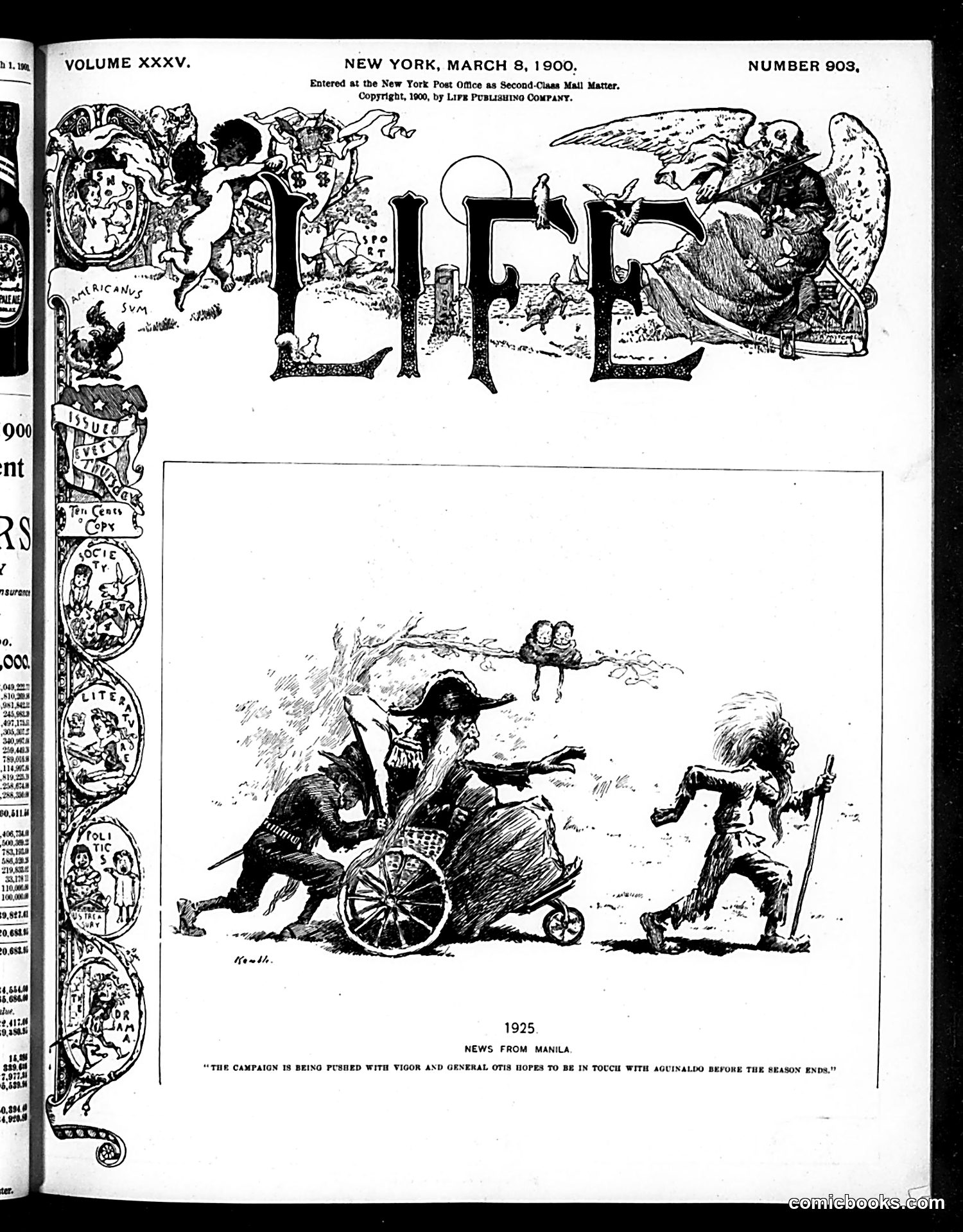
This 1900 *Life* magazine cover features a satirical cartoon labeled "NEWS FROM MANILA" referencing the Philippine-American War (1899-1902). The caricature shows a bearded figure (likely representing American military leadership or colonial interests) pushing a cart containing two children, while another figure pulls from behind with a walking stick. The caption states: "THE CAMPAIGN IS BEING PUSHED WITH VIGOR AND GENERAL OTIS HOPES TO BE IN TOUCH WITH AGUINALDO BEFORE THE SEASON ENDS." The satire criticizes the prolonged military campaign against Filipino independence leader Emilio Aguinaldo. The cart-pushing imagery suggests the awkward, difficult progress of American forces in the archipelago, while the children likely represent civilians caught in the conflict. The cartoon mocks the optimistic military rhetoric about quickly concluding the unpopular colonial campaign.
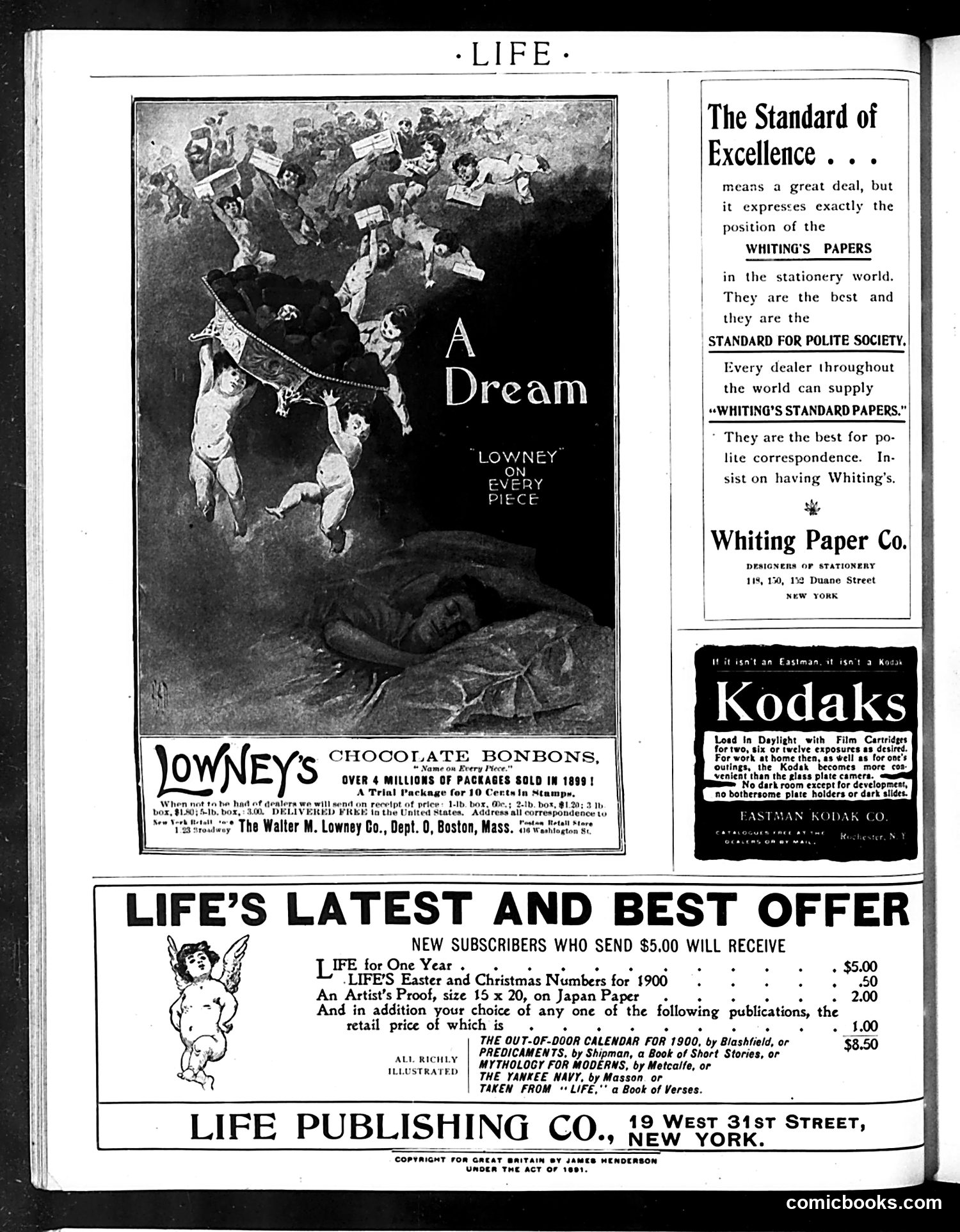
This page is primarily **advertising**, not political satire. The large central illustration depicts a fantastical dream scene with cherubs and figures floating above a sleeping man—a romanticized, whimsical image typical of turn-of-the-century commercial art. The image advertises **Lowney's Chocolate Bonbons**, a Boston-based confectionery company. The "dream" concept functions as marketing copy suggesting the product's desirability and pleasure. The surrounding ads promote stationery (Whiting's Papers), photography equipment (Kodaks), and Life magazine subscriptions. There is **no apparent political or social satire** on this page. It represents typical early-1900s magazine advertising layout, combining aspirational imagery with product promotion for middle and upper-class consumers.
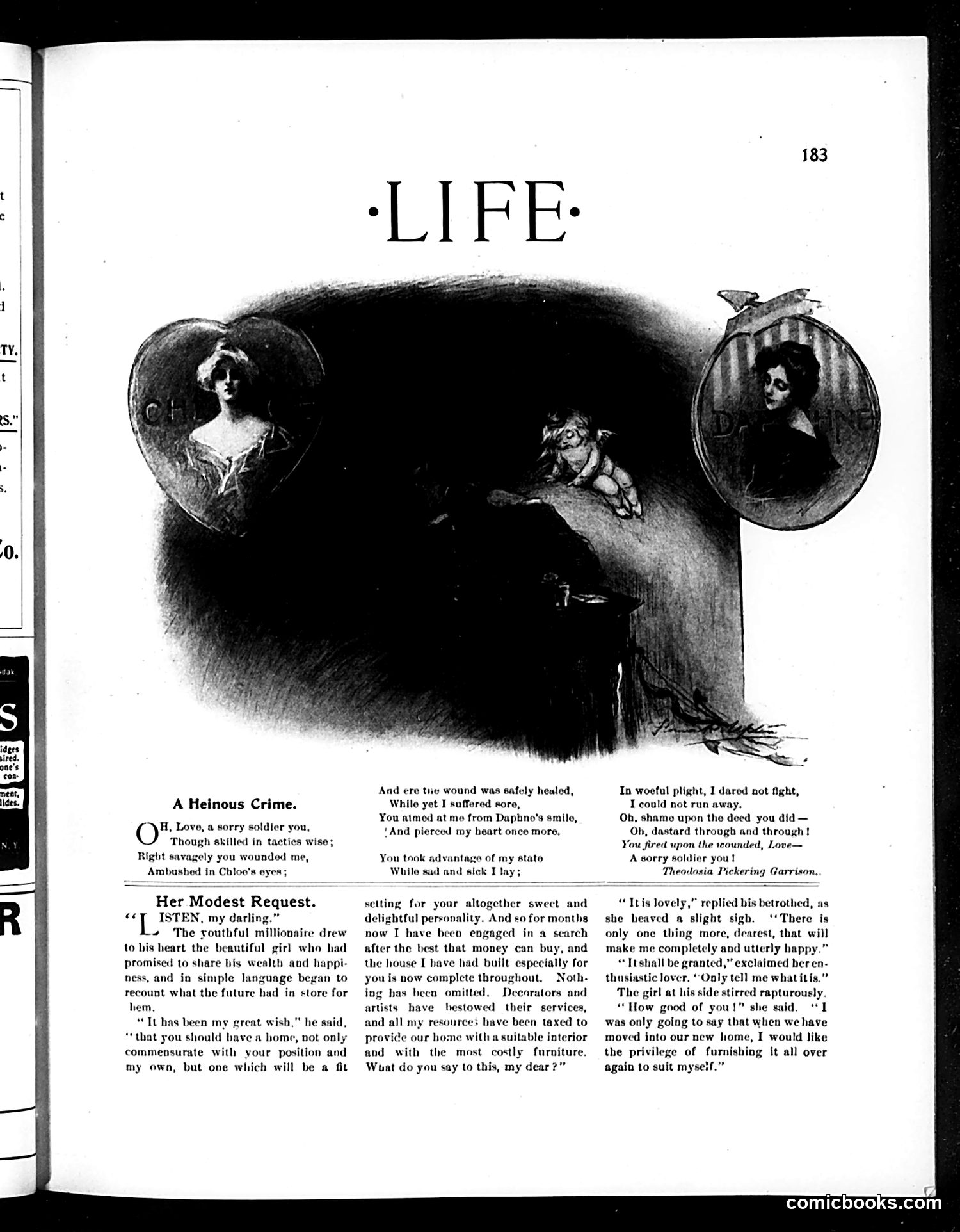
This page contains two short stories rather than political cartoons. "A Heinous Crime" depicts a romantic betrayal—a soldier accuses his lover of infidelity while he served, referencing "Daphne's smile" and claiming she "took advantage of my state / While sad and sick I lay." The accompanying illustration shows a woman holding portraits of two figures. "Her Modest Request" presents a wealthy man offering to furnish a house for his lover, asking only that she provide "suitable interior" decoration. She responds by requesting he furnish the *entire* house instead, framing her request as modest when it's actually quite demanding. Both stories employ ironic humor about romance, betrayal, and financial negotiations between lovers—typical satirical content for *Life* magazine's middle-class readership.
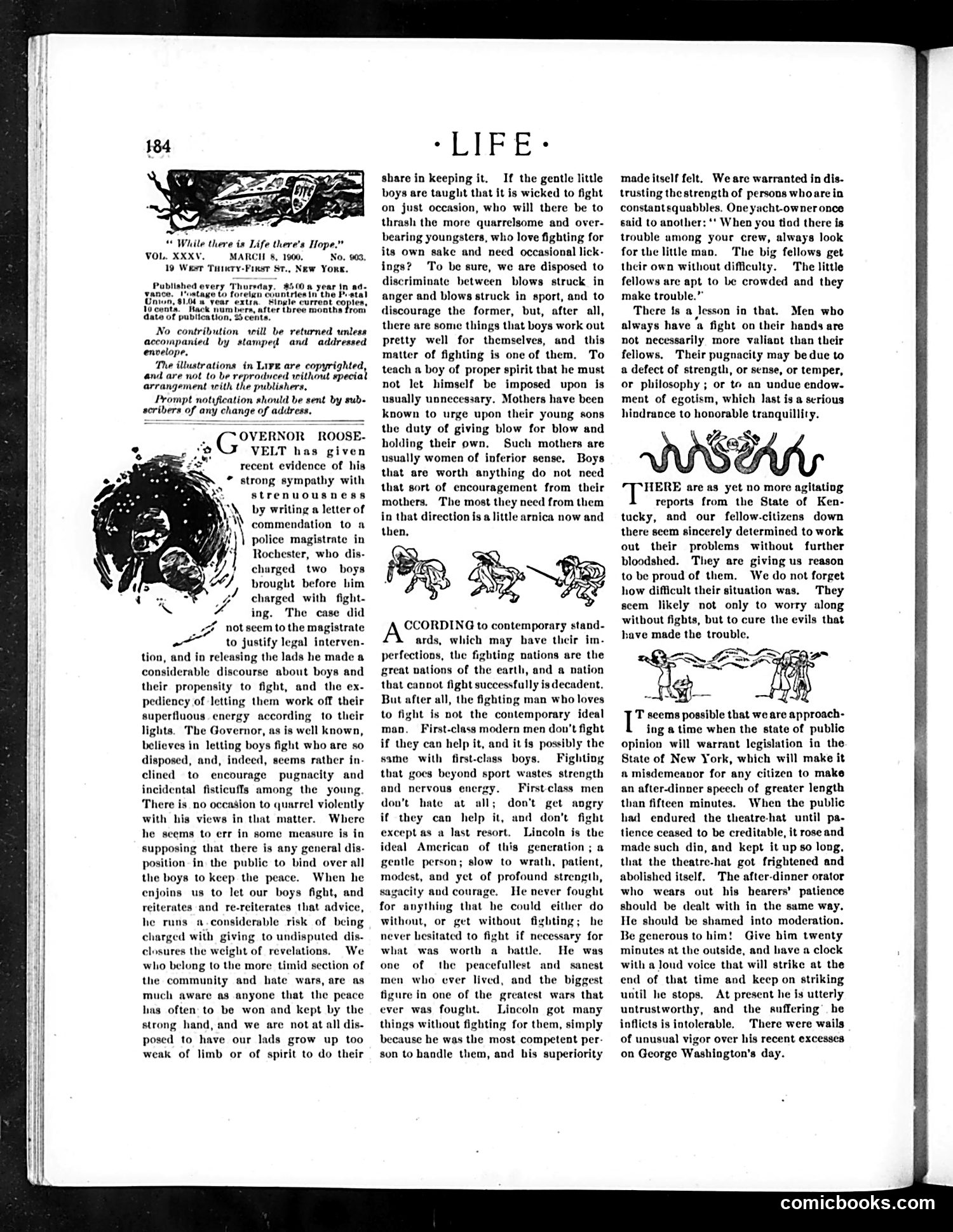
The page features an editorial about Governor Roosevelt's sympathy letter regarding two boys charged with fighting. The main cartoon shows Roosevelt's large head with a stern expression, illustrating his role as a public figure commenting on youth discipline. The editorial argues that fighting among boys is natural and shouldn't be criminalized—that mothers shouldn't coddle sons, and that boys need to "work out their own problems" through occasional physical conflict. It contrasts first-class men (who don't fight unnecessarily) with "first-class boys" (who need to develop strength through combat). The piece appears critical of over-intervention in boys' lives while defending fighting as character-building, reflecting early 20th-century attitudes about masculinity and youth development that would seem harsh to modern readers.
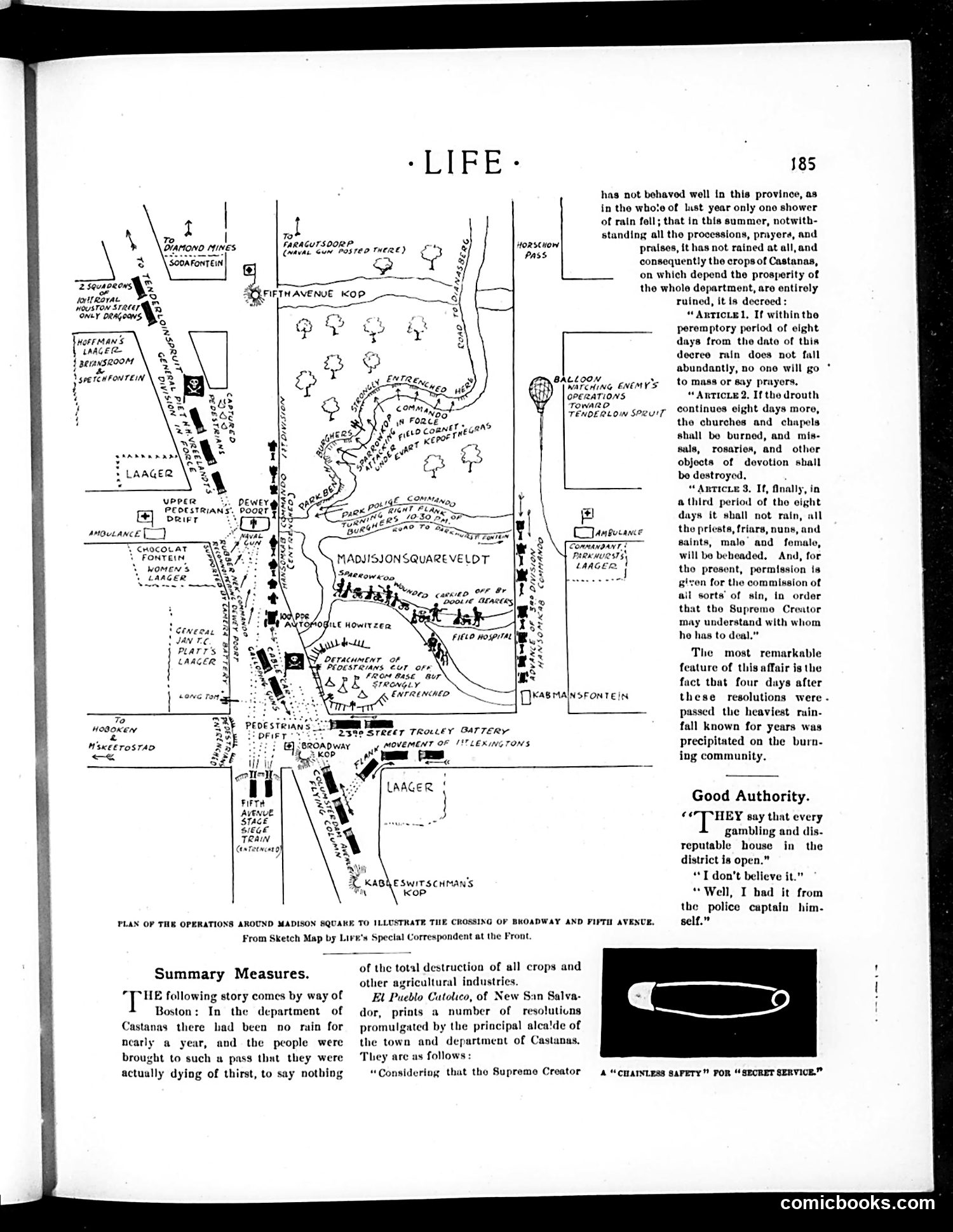
This page contains a **detailed map** of Madison Square area operations during a religious procession, showing the crossing of Broadway and Fifth Avenue. The map includes locations of ambulances, lagers (gathering spaces), and various street features. The accompanying text describes a **drought in Castanaya** (likely fictional) where no rain fell for nearly a year, creating dire conditions. Church officials issued resolutions—presented as darkly humorous "articles"—essentially asking divine permission to suspend religious observances if drought continues, and granting parishioners absolution for sins if rain doesn't arrive within eight days. The satire mocks **institutional religion's helplessness** against natural disaster and the absurdity of ecclesiastical bargaining with God.
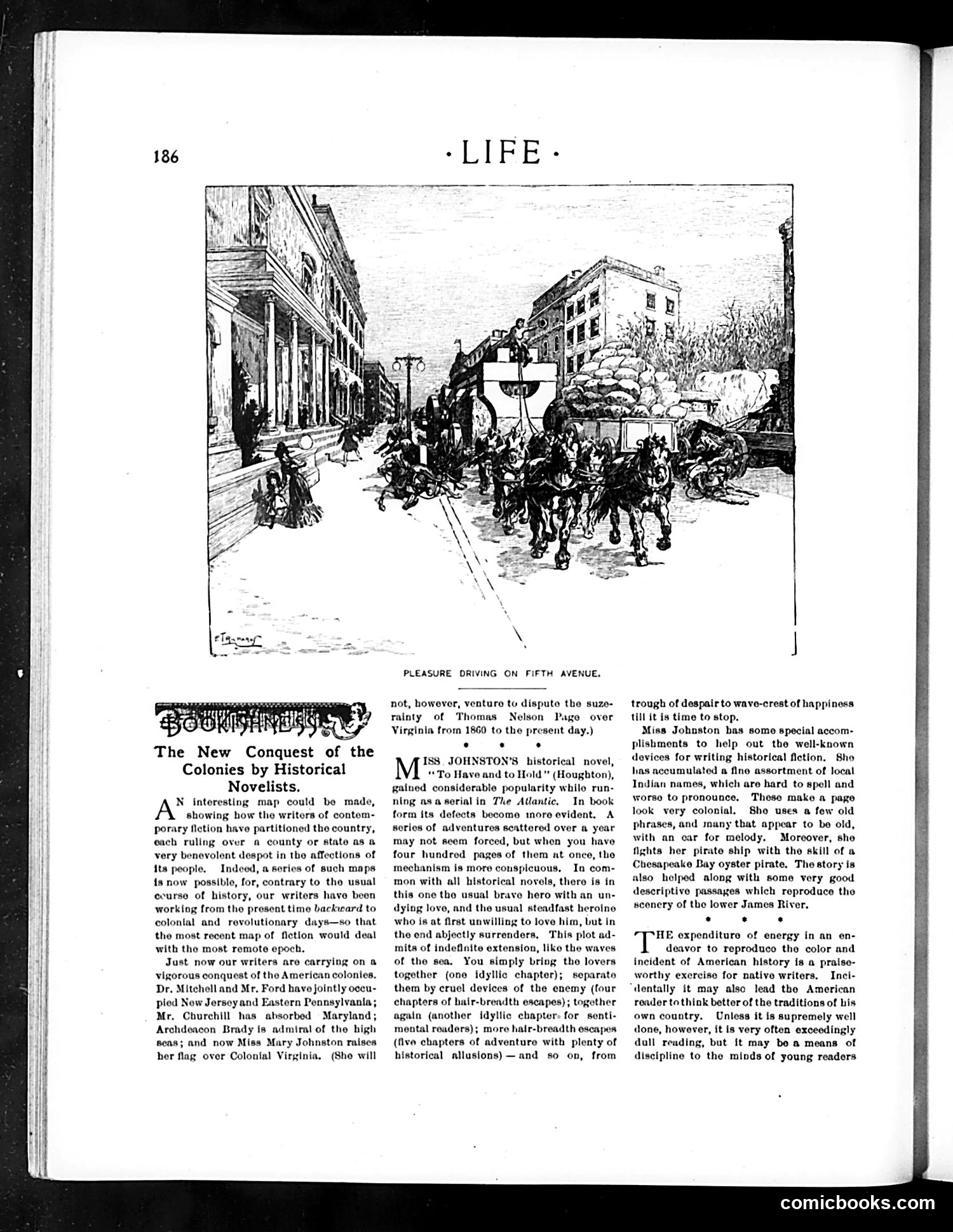
This illustration depicts a chaotic street scene on Fifth Avenue, New York's most prestigious thoroughfare. The cartoon satirizes the collision of urban transportation methods in the early 20th century: horse-drawn carriages compete with what appears to be early automobiles, while pedestrians navigate the congestion. The caption's irony is key—"pleasure driving" suggests leisurely, refined activity befitting Fifth Avenue's wealthy residents, yet the image shows disorder and crowding. The satire likely critiques either the disruptive introduction of motorized vehicles into established carriage culture, or mocks the pretense of "pleasure" amid urban chaos. The accompanying text discusses historical fiction about American colonists, unrelated to the cartoon.
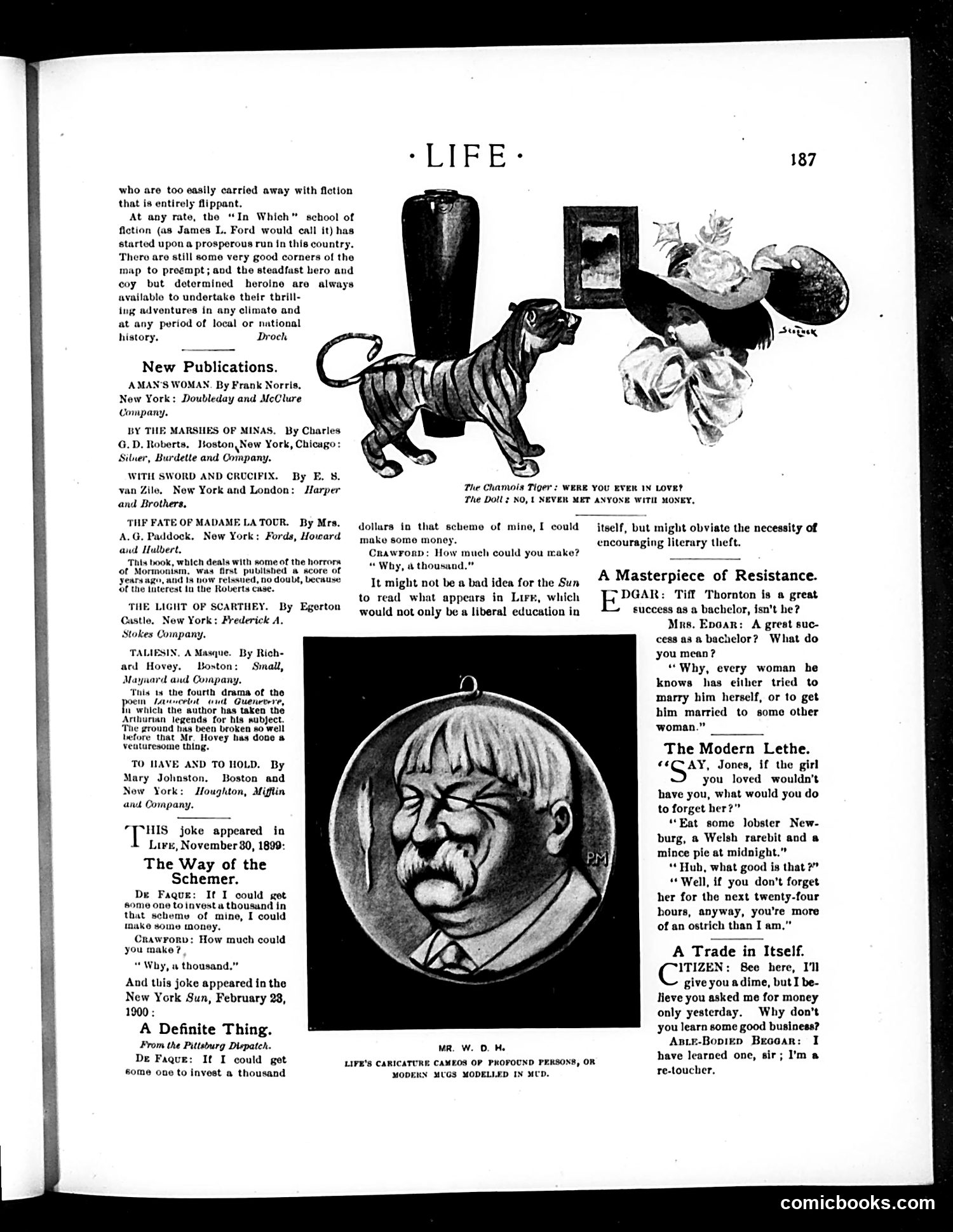
This page contains literary reviews and satirical humor pieces rather than political cartoons. The main illustrations show: 1. **Upper illustration**: A dachshund carrying a large vase or urn, with text asking "WERE YOU EVER IN LOVE?" This appears to be a visual pun about the dog's elongated body shape. 2. **Lower illustration**: A caricatured face labeled "MR. W. D. H." described as "LIFE'S CARICATURE CAMEOS OF PROFOUND PERSONS, OR MODERN MUGS MODELLED IN MUD." The page primarily features book reviews (including works by Frank Norris and E.B. Van Dine) and humorous dialogue exchanges under headings like "A Masterpiece of Resistance," "The Modern Lethe," and "A Trade in Itself." These appear to be satirical commentaries on contemporary social attitudes rather than political satire.
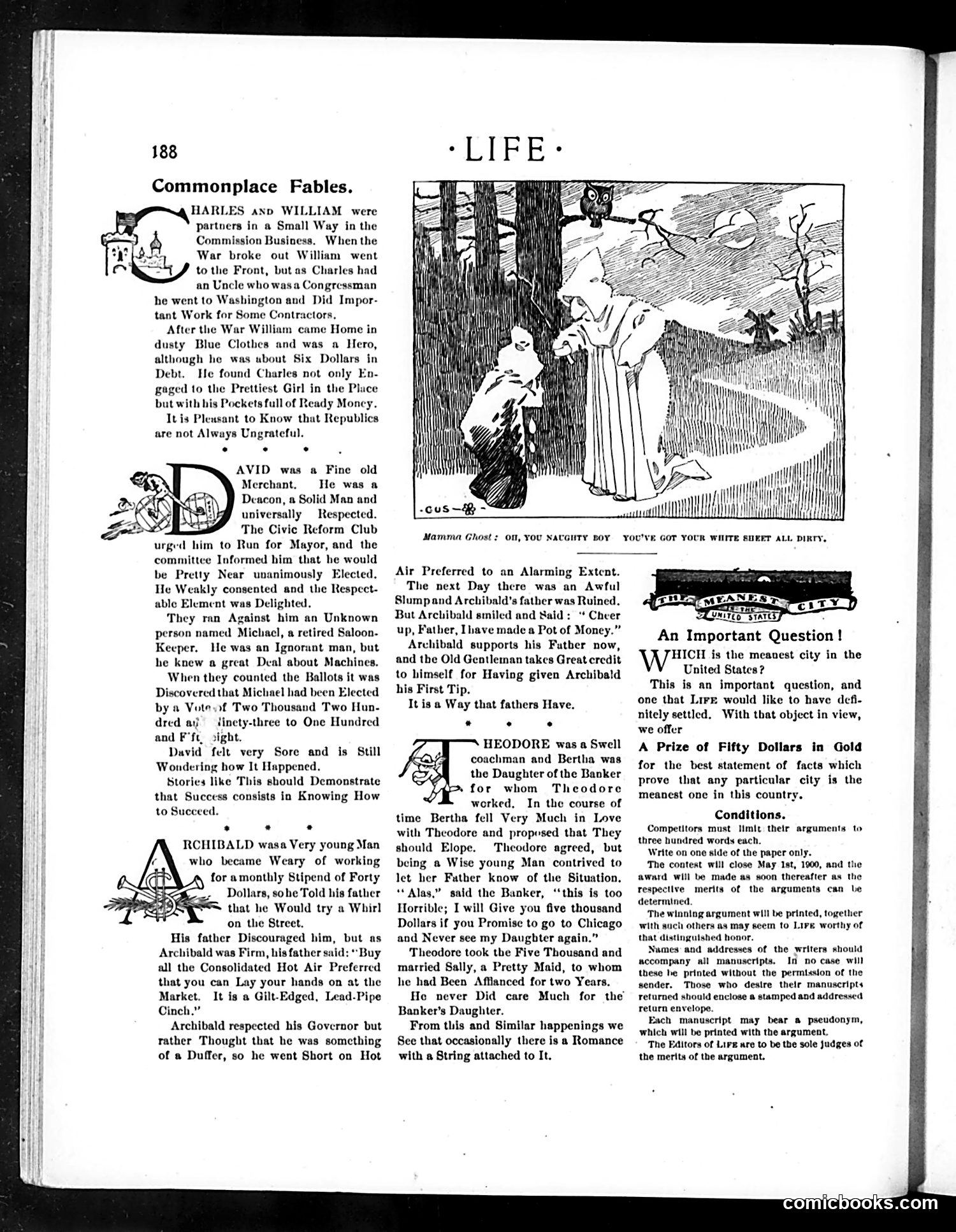
This page contains satirical "Commonplace Fables"—moral tales mocking contemporary figures and situations. The visible stories include: **"Archibald"**: A young man seeking work receives a monthly stipend from his father instead of earning honestly. The satire criticizes idle wealthy sons dependent on parental support rather than genuine employment. **"Theodore"**: A wealthy suitor courts a banker's daughter, but her father demands Theodore prove he can support her by earning five thousand dollars. Theodore elopes with her instead—satirizing mercenary marriage negotiations among the wealthy. The cartoon illustration (top right) shows a ghost confronting a boy about his dirty white sheet—likely a reference to period social commentary, though the specific context is unclear. The page mocks upper-class entitlement, parental indulgence, and transactional marriage practices of the era.
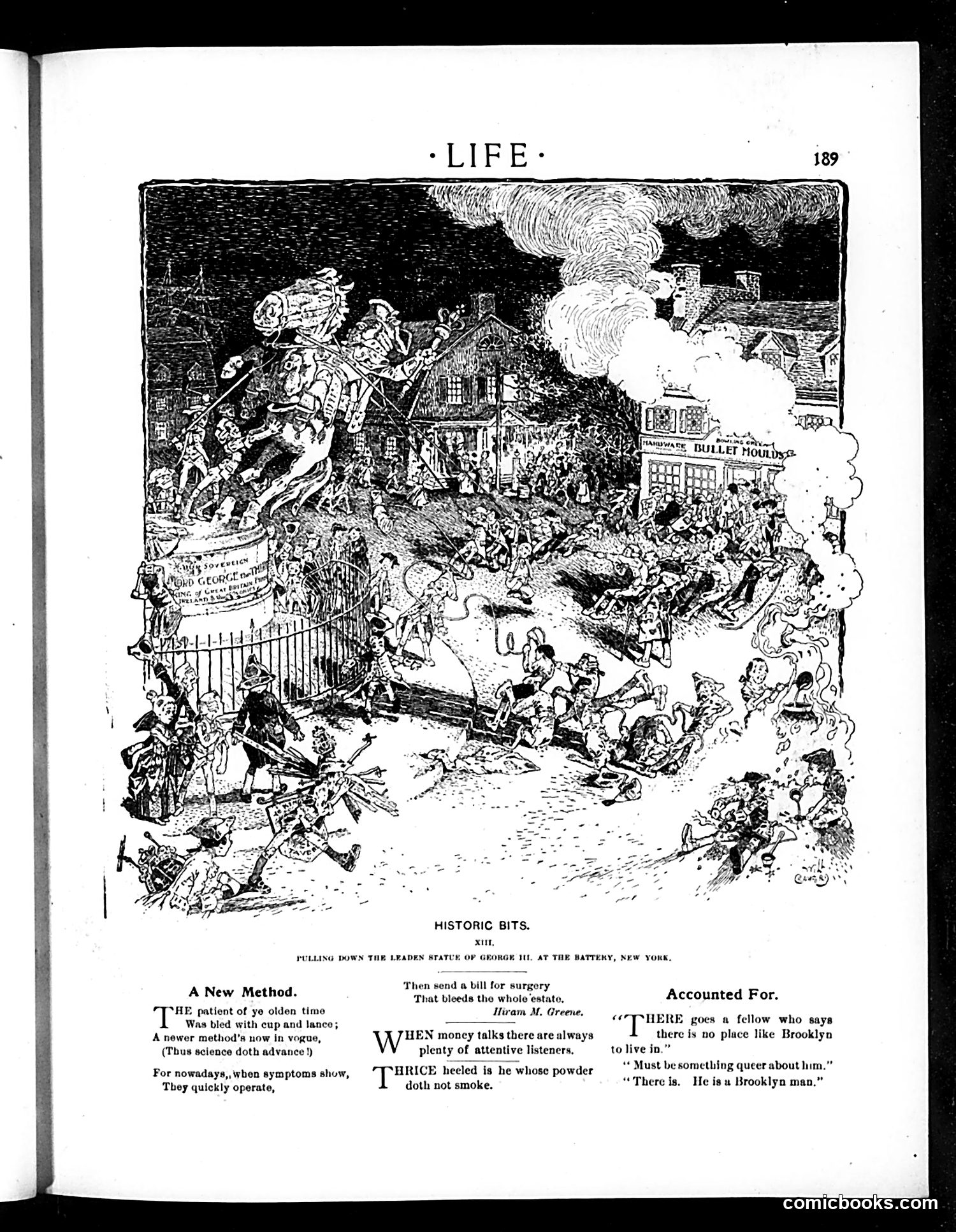
The main illustration, titled "Historic Bits XIII," depicts the "Pulling Down the Leaden Statue of George III at the Battery, New York"—a Revolutionary War-era event when colonists destroyed a British royal statue. The chaotic scene shows crowds and destruction, likely used satirically to comment on contemporary unrest or radical action. Below are three brief humorous items: "A New Method" jokes about old-fashioned medical bleeding treatments; "When Money Talks" offers a cynical quip about wealth's persuasive power (attributed to Hiram M. Greene); and "Accounted For" presents a joke about Brooklyn identity and character. The page blends historical illustration with modern humor, typical of Life's satirical approach.
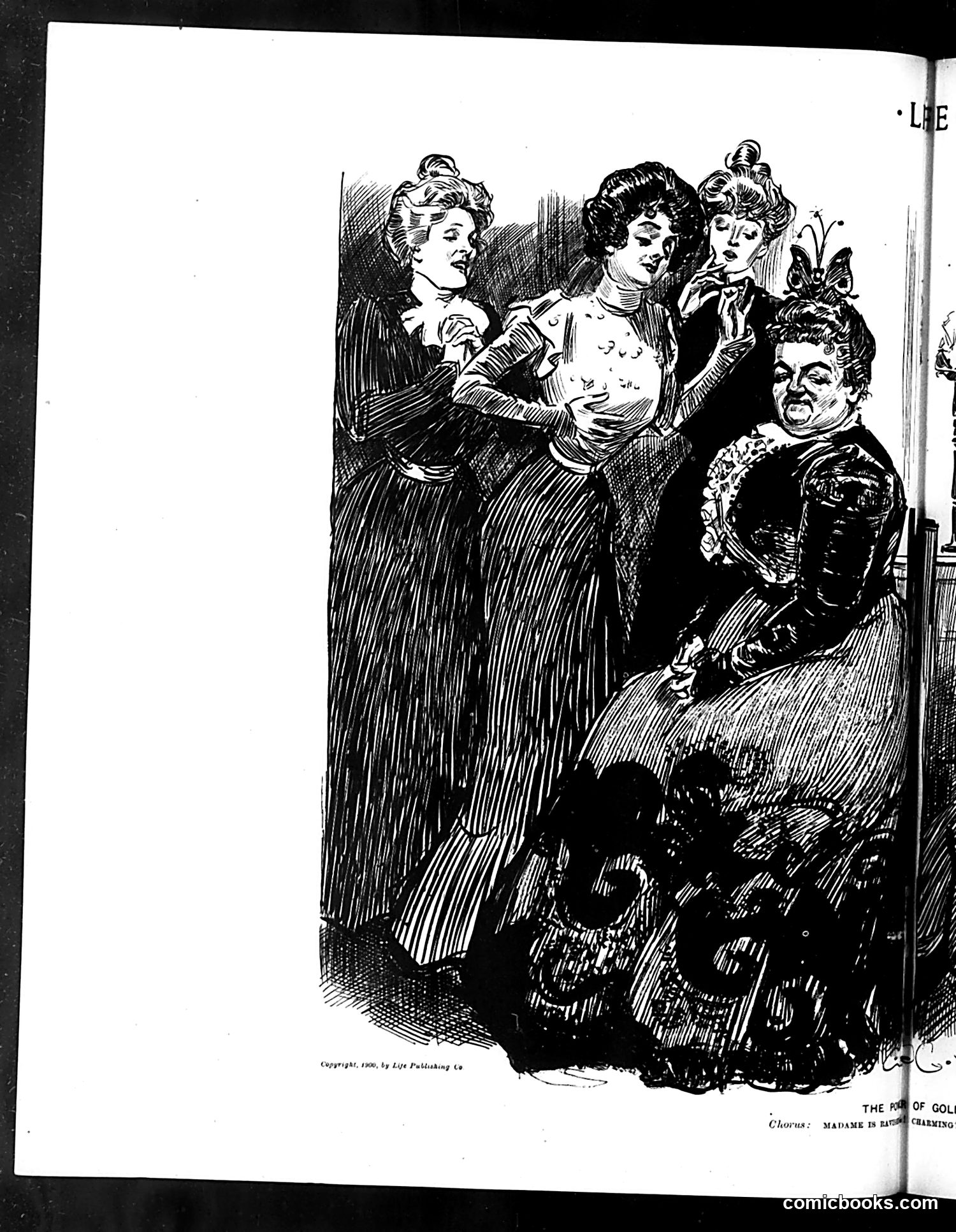
This appears to be an illustration from Life magazine's satirical section, likely early 1900s based on the artistic style and copyright notation visible. The image shows four women in elaborate Edwardian-era dress and hairstyles, depicted in an exaggerated manner typical of period satire. The caption references "Madame is Ravishing" and "Charming," suggesting mockery of affected social pretension among wealthy women. The sketch style and composition indicate this is satirizing contemporary fashion, beauty standards, or social behavior among the upper classes. The exaggerated facial expressions and theatrical poses emphasize the artificiality being lampooned. Without complete caption text visible, the specific social target remains somewhat unclear, but the satire targets women's vanity or fashionable society's obsession with appearance and affected mannerisms.
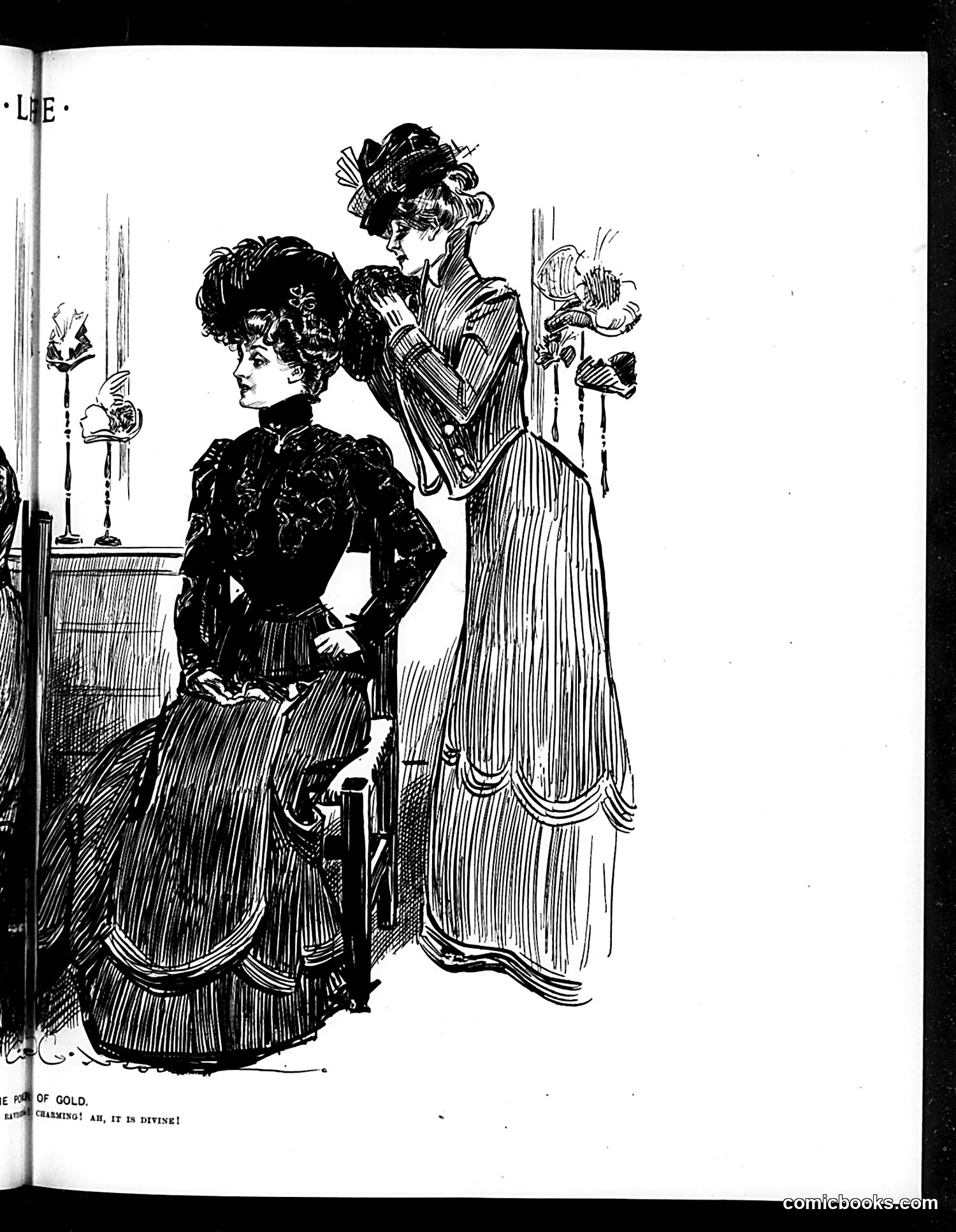
This appears to be a satirical illustration from Life magazine's "Gibson Girl" era (early 1900s), based on the distinctive art style and fashion depicted. The image shows two fashionably dressed women in elaborate Edwardian clothing, examining what seems to be decorative objects (possibly candlesticks or ornamental pieces visible on the left). The partially visible text at bottom references "pot of gold" and something "charming," suggesting commentary on women's consumer habits or materialism. The satire likely mocks the era's wealthy women and their obsession with luxurious goods and fashionable display. The carefully rendered details of their clothing and poses emphasize the superficiality being critiqued. Without seeing complete caption text, the specific social commentary remains somewhat unclear, but the tone appears mockingly critical of upper-class feminine consumption and vanity.
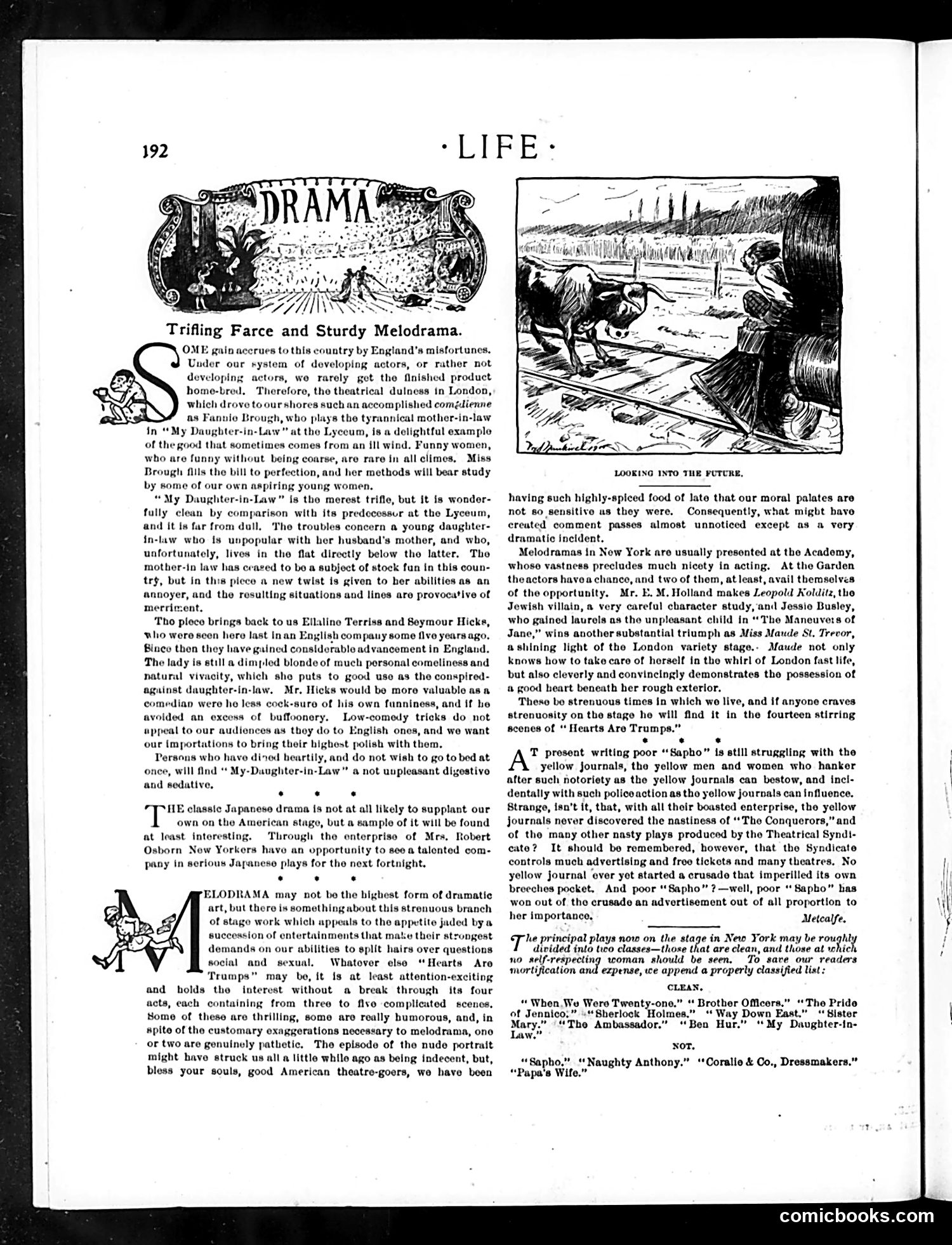
This page discusses theatrical productions, specifically trifling farces and melodramas on the London and New York stages. The text critiques how England produces "finished products" of actors while American theater relies on developing talent. The article references specific plays and performers, including Miss Fiorella in "My Daughter-in-Law" at the Lyceum. It discusses melodramas at the Academy in New York and praises Mr. E.M. Holland's performance in *Leopold Kohling*. The piece satirizes yellow journalism's influence on theater, claiming yellow newspapers and their sensationalism affect which plays succeed. It mocks the "yellow journals" for their control over theatrical popularity while acknowledging some melodramas genuinely merit attention for their emotional impact and craftsmanship, despite their exaggerated nature.
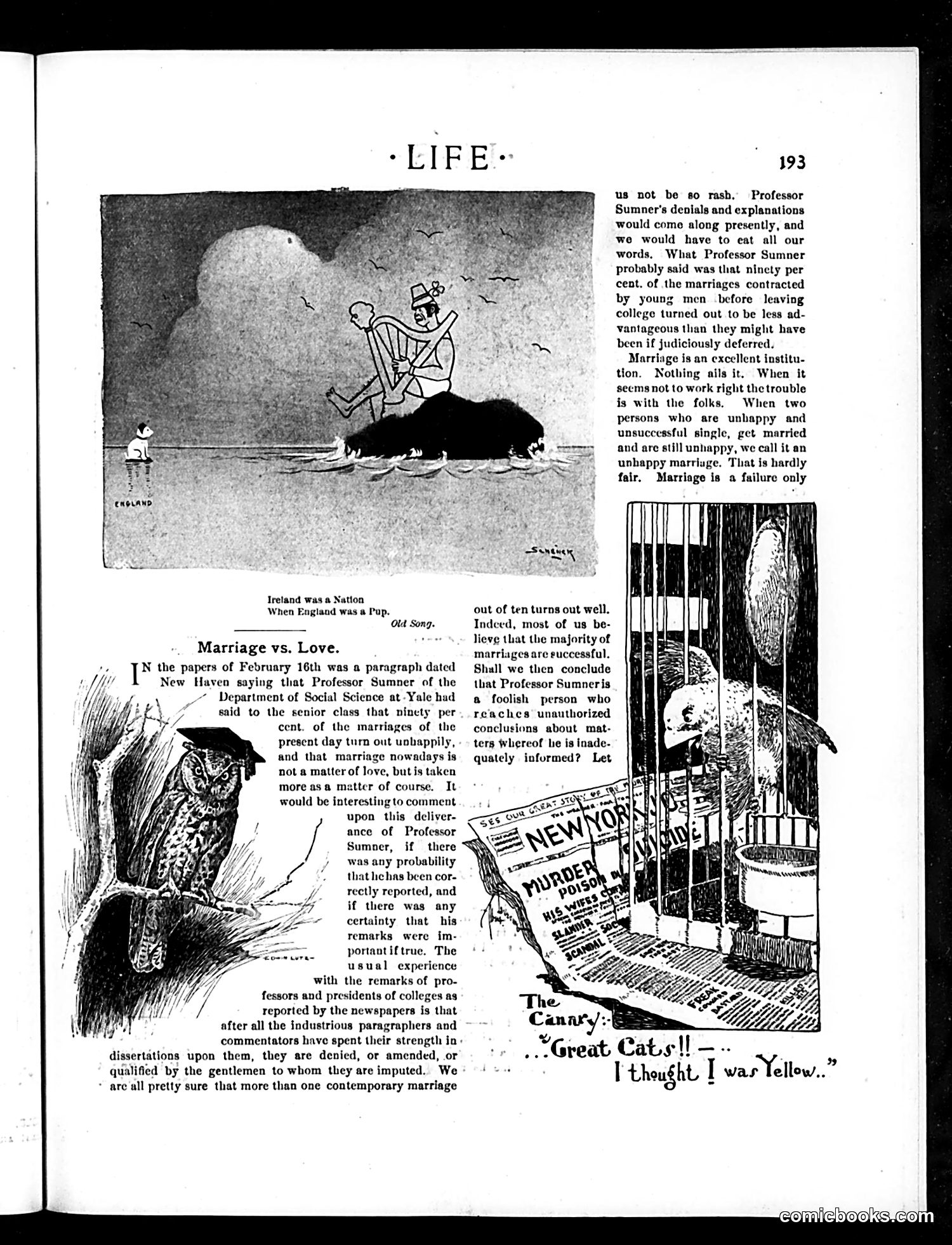
This page contains editorial commentary on a reported statement by Professor William Graham Sumner of Yale's Department of Social Science, who allegedly told students that 90% of modern marriages fail and result from practicality rather than love. The article's tone is skeptical—the author suspects Sumner's remarks were misreported, as newspapers habitually distort academic statements. The piece defends marriage as "an excellent institution," arguing that unhappy marriages reflect people's problems, not marriage itself. The cartoons illustrate marital discord: the top image shows a couple in conflict, while the bottom depicts a cat in jail reading a newspaper headline about a "murder," with the caption "Great Cats! I thought I was yellow"—a pun suggesting the cat expected cowardice rather than criminal behavior, likely satirizing how people's expectations about relationships often prove wrong.
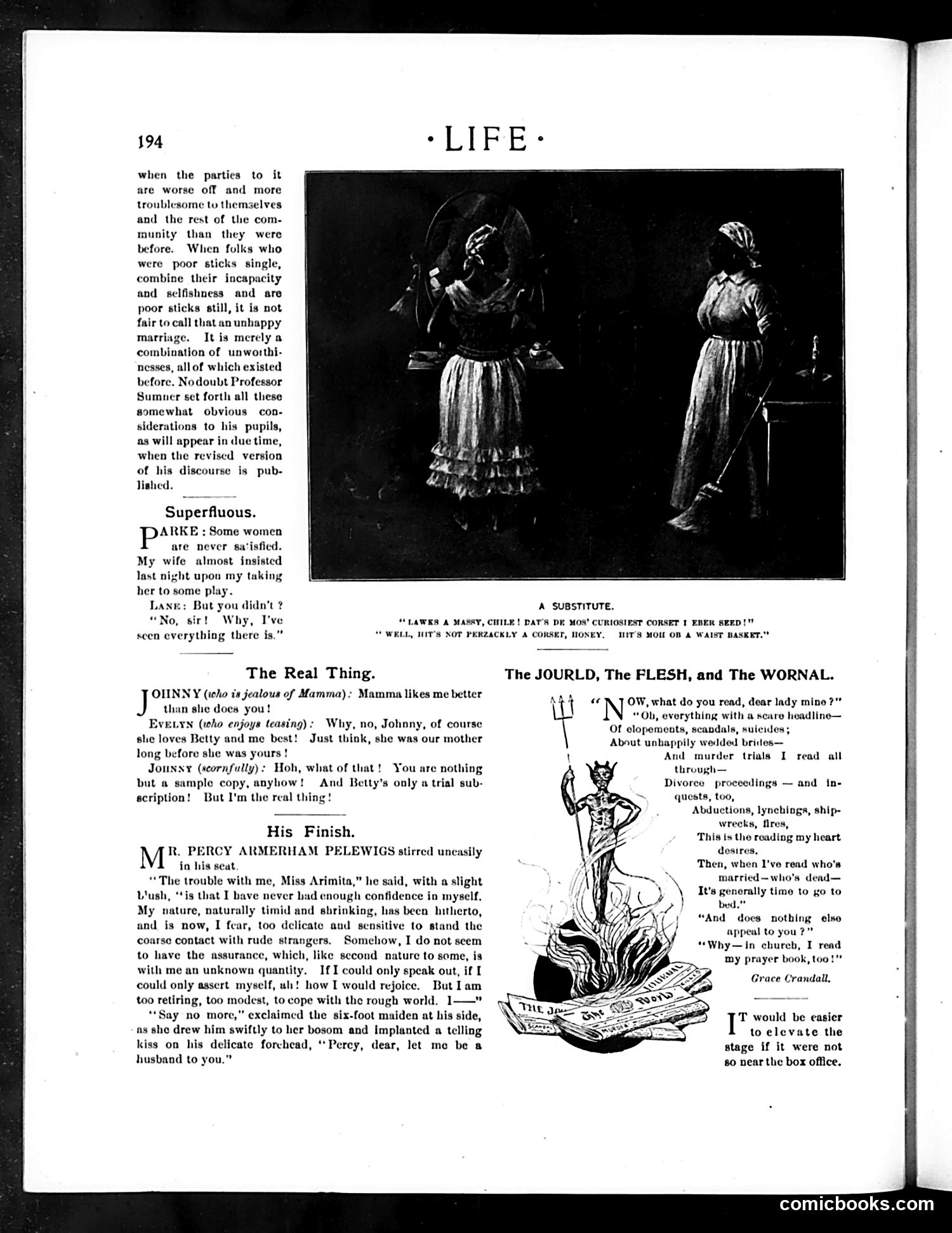
This page contains four separate humorous sketches satirizing American social conventions circa the early 1900s. **"Superfluous"** mocks married men's lack of consideration—a husband refuses to take his wife to theater, claiming he's seen "everything there is." **"The Real Thing"** uses children's sibling rivalry as commentary on marriage and legitimacy. A stepchild boasts of being "the real thing," while stepsiblings are merely "copies" and "trial subscriptions"—poking fun at blended families and shifting notions of familial authenticity. **"His Finish"** reverses gender expectations: a timid, verbose man is silenced and dominated by an assertive "six-foot maiden" who becomes "husband" to him—satirizing anxieties about changing gender roles. **"The World, The Flesh, and The Wornal"** (a pun on "The World, The Flesh, and The Devil") criticizes women's appetite for sensationalist newspaper content—scandals, murders, divorces—over substantive reading, ending with ironic piety about prayer books. The page reflects period anxieties about marriage, gender dynamics, and mass media's influence on taste.
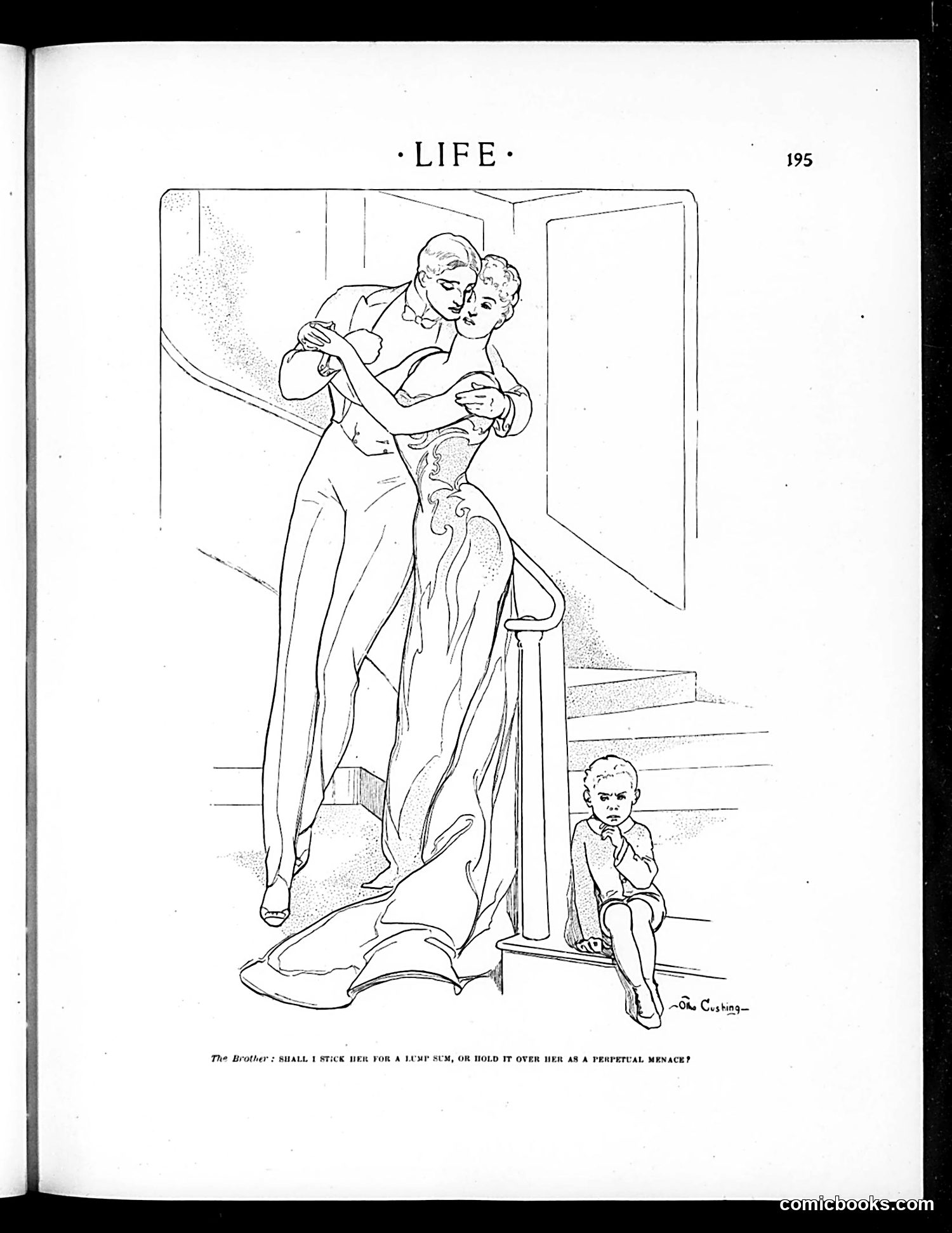
This is a satirical cartoon from *Life* magazine (page 195) titled "The Brother," with the caption: "SHALL I STICK HER FOR A LUMP SUM, OR HOLD IT OVER HER AS A PERPETUAL MENACE?" The cartoon depicts a man in formal dress threatening a woman while holding her aloft, with a small child sitting nearby watching. The satire concerns **blackmail or extortion within a family relationship**—specifically, a brother threatening his sister with either demanding a one-time payment ("lump sum") or using knowledge of some transgression to extort money indefinitely ("perpetual menace"). The joke critiques predatory family dynamics and the casual cruelty of using leverage against vulnerable relatives, particularly women. The child's presence emphasizes how such behavior corrupts family bonds. The cartoon satirizes both masculine entitlement and the exploitation of women's vulnerability in early 20th-century society.
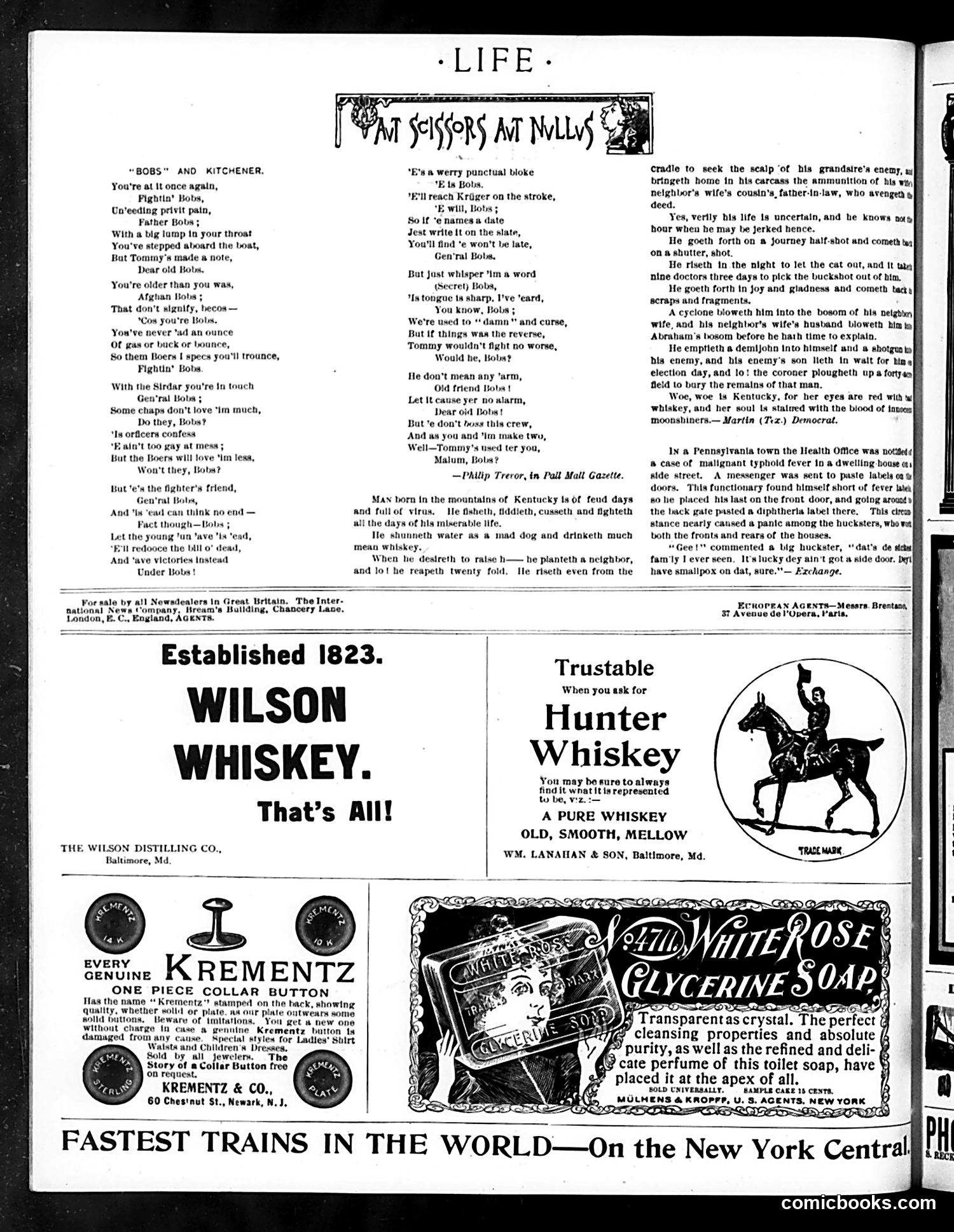
This page contains a humorous poem by Philip Trevor celebrating British General Frederick "Fighting Bob" Roberts, who appears to be deploying to fight in the Boer War (the OCR text references "Boers" and "Kriger"). The poem uses cockney dialect ("'E's werry punctual bloke") to affectionately mock Roberts while praising his military competence and reputation as soldiers' friend. The satire pokes fun at Roberts' age and physical wear while reassuring readers he'll effectively defeat the Boers. References to "Tommy" (British soldiers) suggest the poem addresses public confidence in Roberts' leadership. The accompanying text about a Kentucky man is an unrelated satirical piece about American frontier violence and lawlessness. The page is primarily advertisements for Wilson Whiskey, Hunter Whiskey, and other products, typical of Life's revenue model.
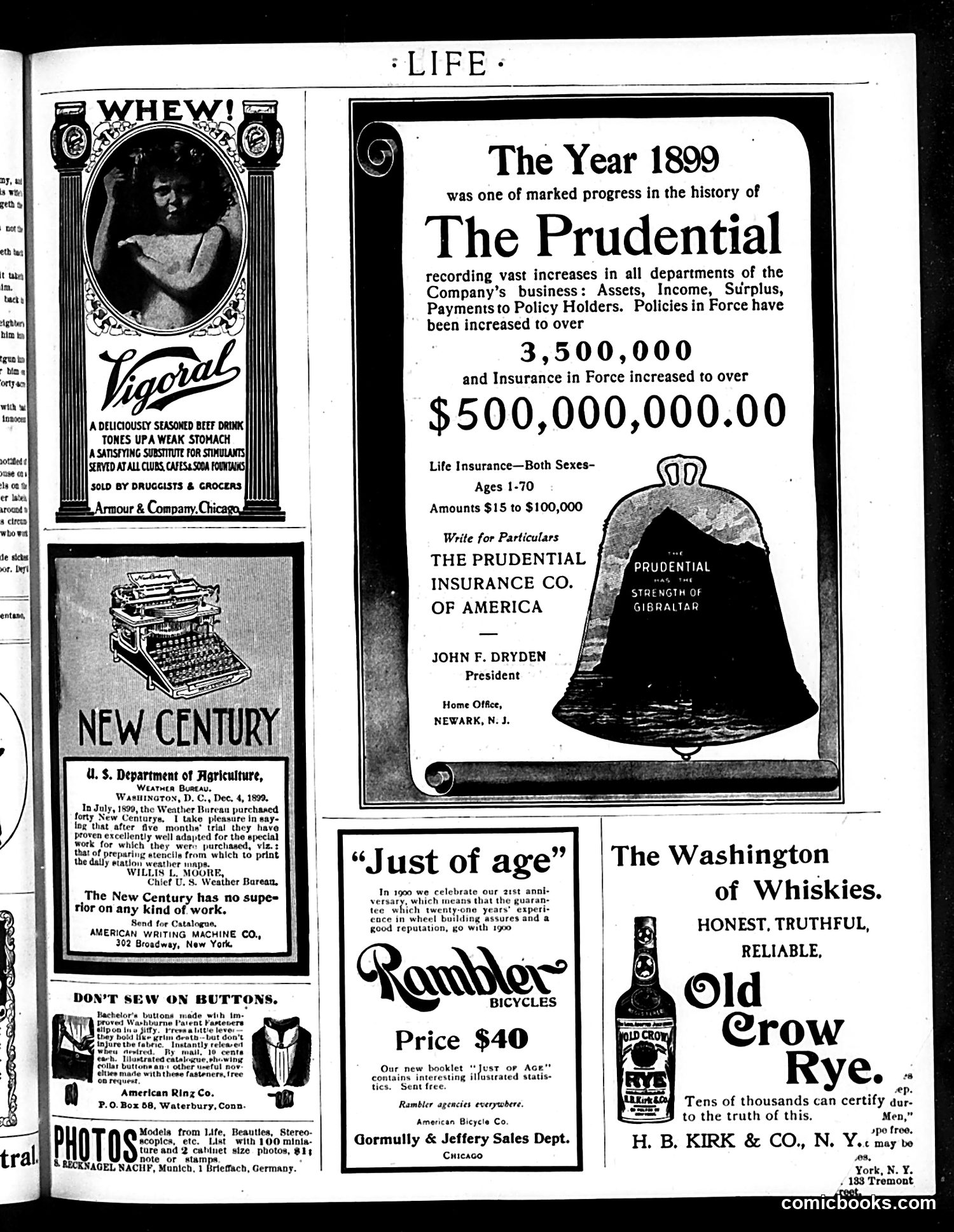
This is primarily a **advertising page** rather than satirical content. The page celebrates the turn of the century with commercial announcements. **Main content:** The Prudential Insurance Company advertisement dominates, announcing their 1899 growth—3.5 million policies and $500 million in force. The "Gibraltar" bell logo emphasizes stability and strength, appealing to fin-de-siècle anxieties about financial security. **Surrounding ads** reflect **millennial-themed marketing** (the year 1900 approaching): - Rambler Bicycles mark their "21st anniversary," equating the new century with coming-of-age - New Century typewriters advertise federal government endorsement - Products pitch reliability and progress **Implicit message:** These ads reassure readers that American institutions and businesses are sound as society enters a new century. The focus on insurance, durability, and government approval suggests concerns about modernization and trustworthiness during rapid industrial change. No political cartoon or satire is present—this is straightforward period advertising.
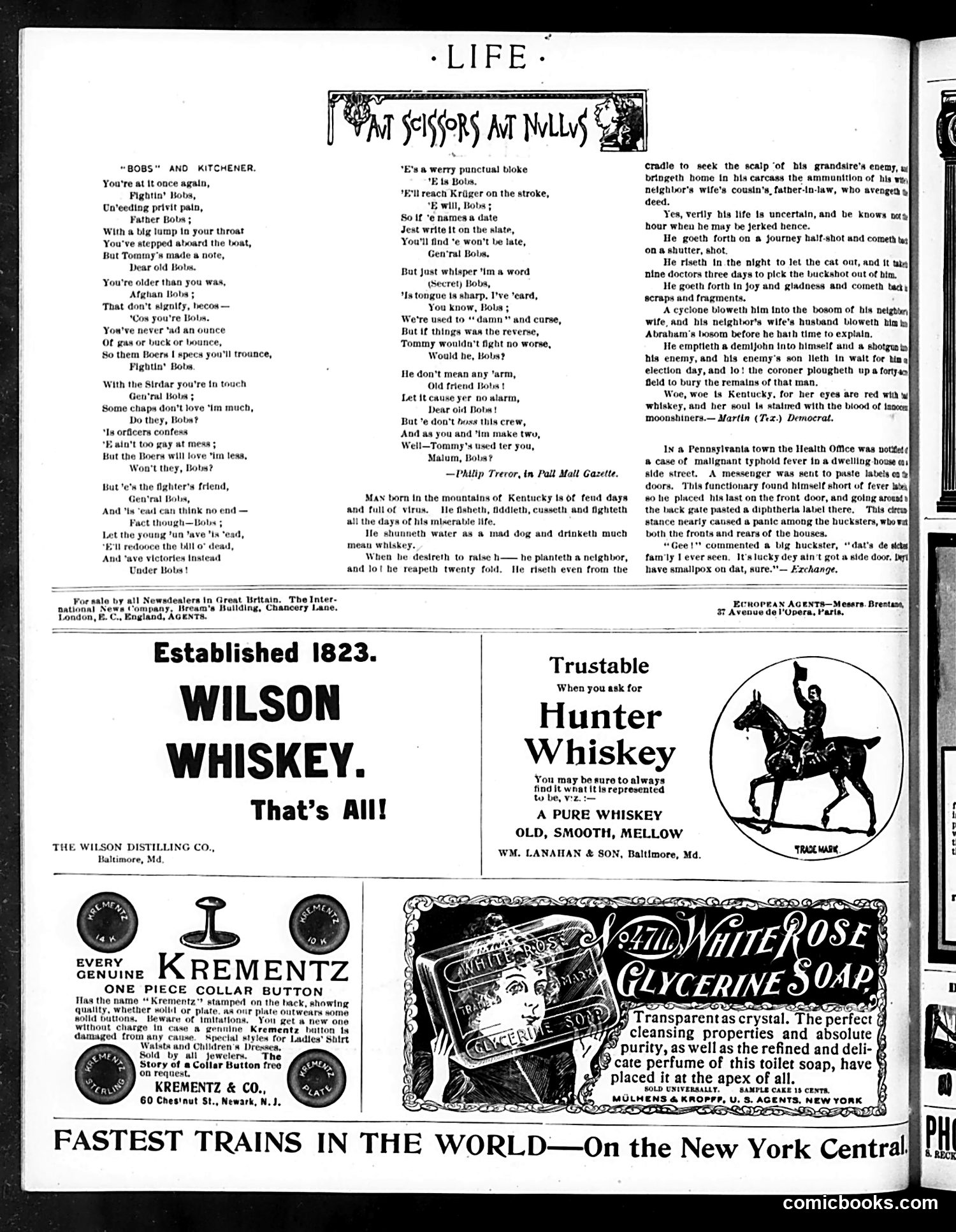
This page contains two main satirical pieces: **"Bobs and Kitchener"** (top poem by Philip Trevor): A comic tribute to General Frederick Roberts ("Fighting Bobs"), praising his military competence during the Boer War. The verses use working-class dialect ("'im," "'e") to celebrate Roberts as a reliable commander who will defeat the Boers. References "Kruger" (Boer leader) and "Tommy" (British soldiers), reflecting contemporary British patriotic sentiment during the Second Boer War. **"Man Born in the Mountains of Kentucky"** (right): A harsh satirical piece mocking Appalachian stereotypes—depicting mountain folk as violent, alcoholic, feuding, and illiterate. Uses biblical parody language ("He fisheth, fiddieth") to ridicule the lifestyle, culminating in a dark joke about Kentucky violence and whiskey culture. The remainder is period advertising (Wilson Whiskey, Krementz buttons, soap) typical for Life magazine's revenue model. No significant political cartoons appear; the satire is literary rather than visual.
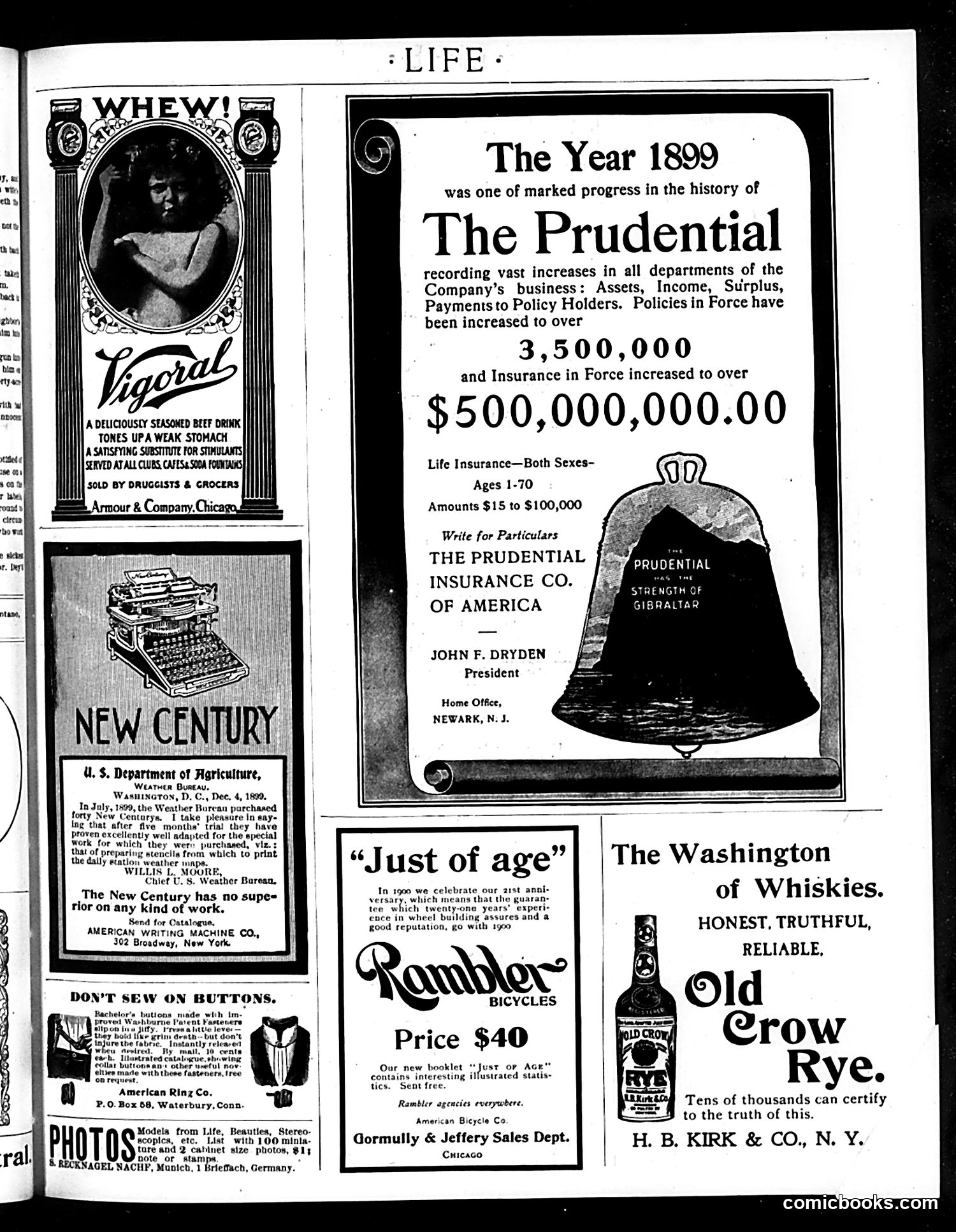
This is primarily a **advertising page** from Life magazine (circa 1899). Rather than satirical content, it features commercial advertisements for products popular at the turn of the century. Key advertisements include: - **Vigorol**: A beef drink marketed as a stomach tonic and alcohol substitute - **New Century typewriter**: Endorsed by the U.S. Weather Bureau for official use - **Rambler bicycles**: Marking their "21st anniversary" (1879-1900), priced at $40 - **The Prudential Insurance Company**: Celebrating 1899's business growth, with over $500 million in force - **Old Crow Rye whiskey**: Positioned as "honest" and "reliable" - **American Ring Co.**: Offering a "bachelor's button" sewing solution The page reflects 1890s consumer culture—typewriters, bicycles, insurance, and patent medicines were major growth industries. The advertisements reveal contemporary attitudes: bicycles as exciting new technology, "tonic" drinks as health solutions, and life insurance as progress.
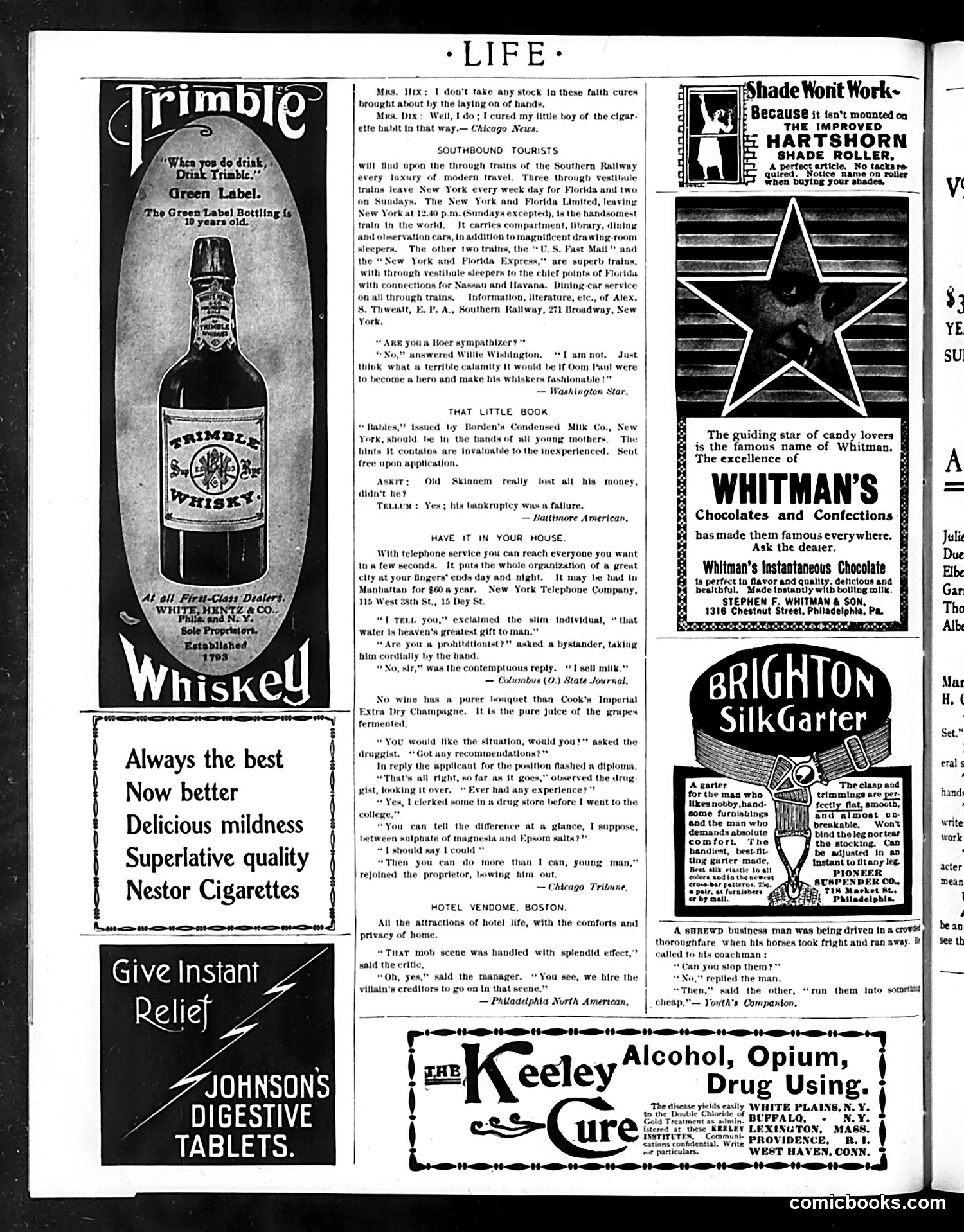
This page is primarily advertising with brief comedic anecdotes scattered throughout. The notable content includes a joke about "faith cures": Mrs. Mix dismisses faith healing, while Mrs. Dix claims she cured her son's cigarette habit through laying on of hands—satirizing contemporary belief in faith-based medical treatments. Another joke references the Second Boer War (1899-1902), with "Oom Paul" (Paul Kruger, Boer leader) mentioned as potentially becoming a hero figure. Americans debated which side to support in this conflict. Most other anecdotes are mild wordplay: a man selling milk insisting water is "heaven's greatest gift" while profiting from milk sales; a druggist testing an applicant's chemistry knowledge; theater producers hiring creditors as extras in mob scenes for dramatic effect. The page is dominated by period product advertisements (whiskey, cigarettes, digestive tablets, chocolates, silk garters), typical of *Life* magazine's revenue model.
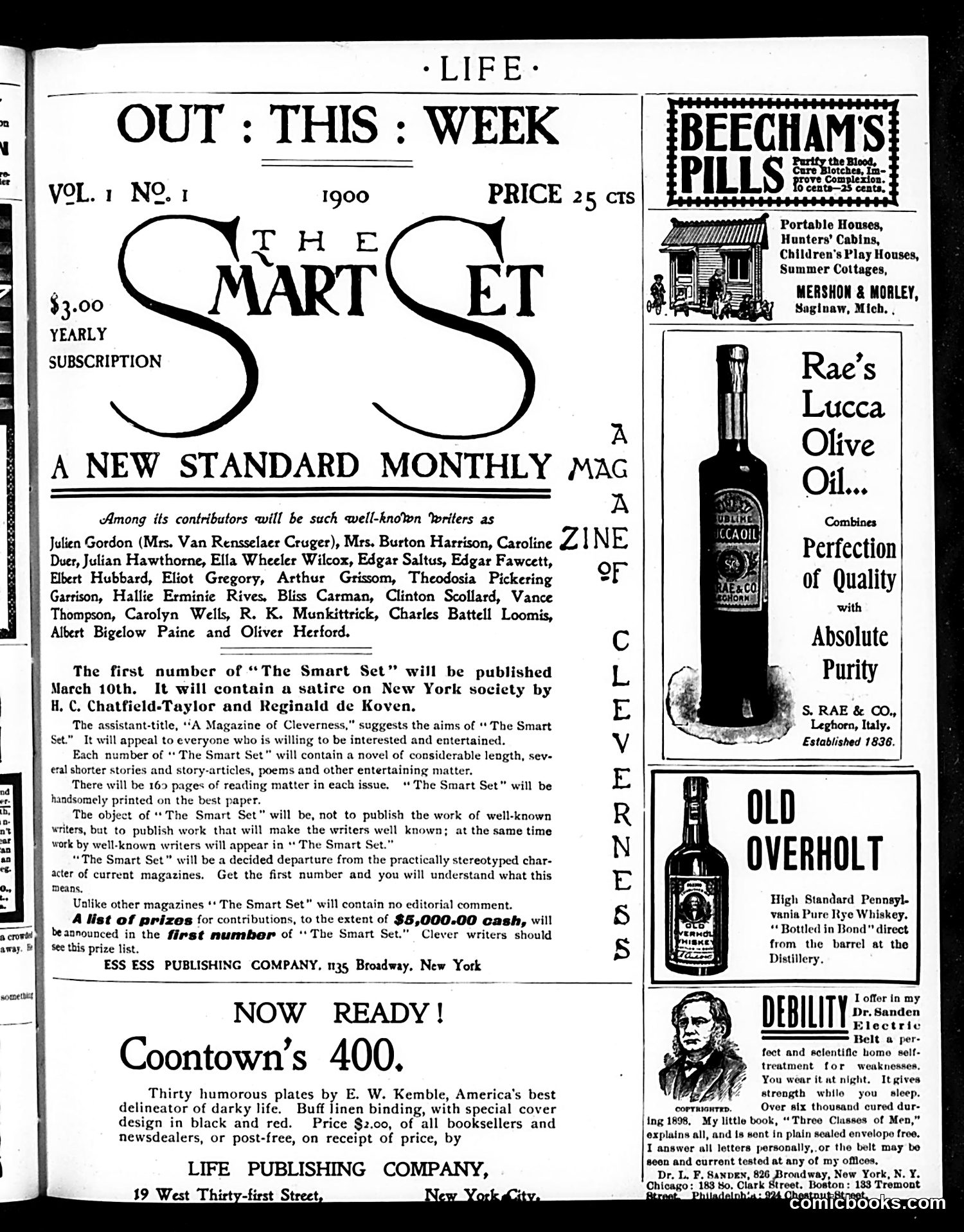
This is primarily a **title/advertisement page** for Life magazine's inaugural 1900 issue, not a political cartoon page. The main content announces "The Smart Set," a new monthly literary magazine emphasizing cleverness and entertainment over editorial commentary. It lists prominent contemporary writers as contributors and promises satirical content about New York society. The page includes period **advertisements** for products now considered problematic or obsolete: patent medicines (Beecham's Pills, a debility cure), an illustrated book titled "Coontown's 400" by E.W. Kemble featuring racist caricatures of Black Americans, whiskey, and an electric belt marketed as a health treatment. The "Coontown's 400" title appears to mock New York's high society "400" (the elite) by substituting a racist reference—reflecting the casual racism embedded in 1900s American entertainment and advertising. Modern readers should recognize these advertisements as documents of widespread, normalized discrimination in that era.
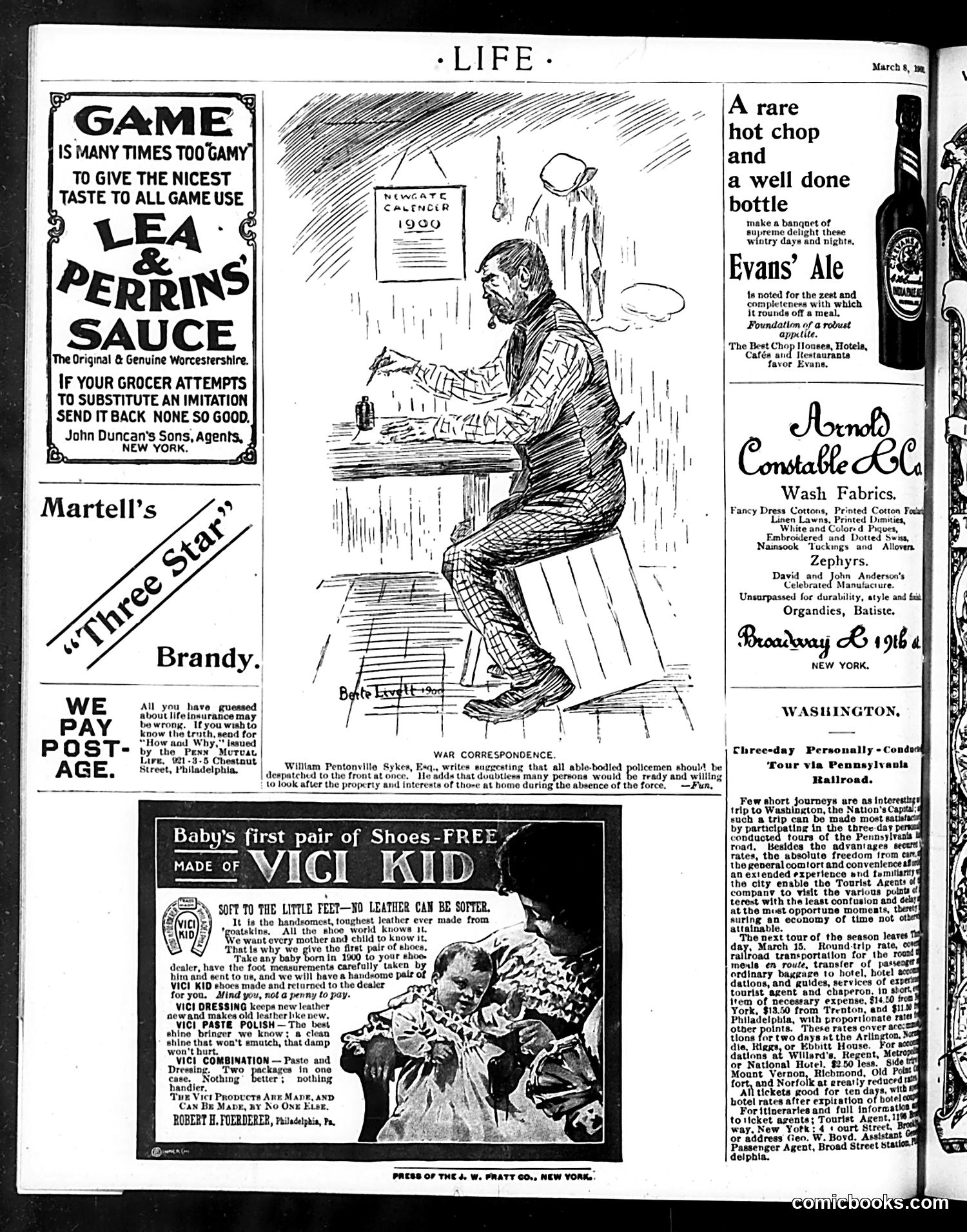
This page is predominantly **advertising** for consumer products of the Edwardian era, with one small editorial cartoon. The central cartoon depicts a man in shabby clothes sitting indoors during rain, appearing to contemplate theft or mischief. The accompanying text from "Fun" suggests satirical commentary on police absence: a correspondent proposes sending able-bodied policemen to the front (likely referring to the Boer War), assuming criminals will "look after the property" of those away. The joke is absurdist—expecting criminals to act as custodians in the police's absence. The surrounding advertisements showcase period consumer goods: Lea & Perrins Sauce, Evans' Ale, Arnold Constable fabrics, Martell Brandy, and Vici Kid baby shoes. These reflect late Victorian/Edwardian marketing emphasizing quality, sophistication, and brand authenticity (notably warning against substitutions). A Pennsylvania Railroad tour announcement advertises Washington, D.C. travel packages. The overall page reflects early 1900s commercial culture and mild satire about contemporary concerns like wartime and public safety.