
Life, 1900-03-08 · page 12 of 22
Life — March 8, 1900 — page 12: what you’re looking at
What you’re looking at
This page discusses theatrical productions, specifically trifling farces and melodramas on the London and New York stages. The text critiques how England produces "finished products" of actors while American theater relies on developing talent. The article references specific plays and performers, including Miss Fiorella in "My Daughter-in-Law" at the Lyceum. It discusses melodramas at the Academy in New York and praises Mr. E.M. Holland's performance in *Leopold Kohling*. The piece satirizes yellow journalism's influence on theater, claiming yellow newspapers and their sensationalism affect which plays succeed. It mocks the "yellow journals" for their control over theatrical popularity while acknowledging some melodramas genuinely merit attention for their emotional impact and craftsmanship, despite their exaggerated nature.
📄 Transcribed text from this page (OCR, searchable)
Machine-transcribed from the original scan — historical spelling and the odd misread are preserved.
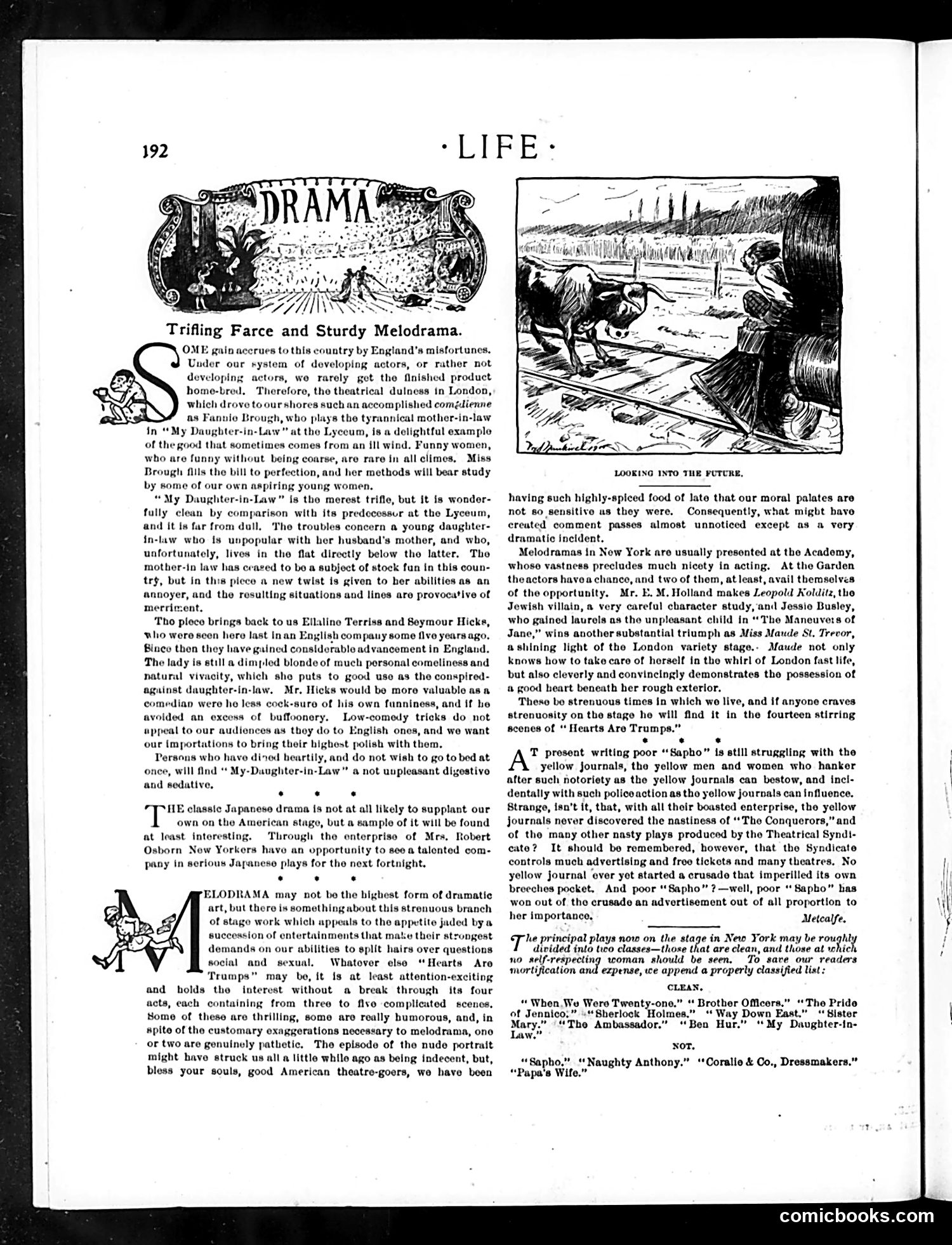
a elodrama. OME gain accrues to this country by England's misfortunes. Under our system of developing actors, or rather not developing actors, we rarely get the Mnished product home-bred. Therefore, the theatrical dulness in London, which drove toour shores such an accomplished comédienne as Fanuio Brough, who plays the tyrannical mother-in-law in “My Daugbter-in-Law" at the Lyccum, is a delightful example of the good that sometimes comes from an ill wind. Funny women, who are funny without being coarse, are rare in all climes, Miss Brough fills the bill to perfection, and her methods will bear study by some of our own aspiring young women, “My Daughter-in-Law” is the merest trifle, but it is wonder- fully clean by comparison with its predecessur at the Lyceum, and It {8 far from dull, ‘The troubles concern a young daughter- in-law who {8 unpopular with Ler husband's mother, and who, unfortunately, lives in the flat directly below tho latter, Tho mother-in law has crazed to be a subject of stock fun in this coun- try, but in this piece a new twist is given to ber abilities as an Annoyer, and the resulting situations and lines are provocative of merriment. Tho pleco brings back to us Ellalino Terriss and Seymour Hicks, ‘Who were seen here last inan English compauy some flv years. ago, Binco then they have gained considerable advancement in England. The lady is still a dimpled blonde of much porsonal comeliness and natural vivacity, which sho puts to good use as the conspired- against daughter-in-law. Mr. Hicks would be more valuable as a comedian were he less cock-sure of his own funniness, and if he avoided an excess of buffoonery. Low-comedy tricks do not appeal to our audiences as thoy do to English ones, and we want our (mportations to bring their bighest polish with them, Persons who havo dined heartily, and do not wish to go to bed at onee, will find My-Duughter-in-Law” a not unpleasant digestivo and sedative, . . . HE classic Japaneso drama {4 not at all likely to supplant our own on the American stage, but a sample of it will be found at least interesting. Through the enterprise of Mrs, Robert Osborn New Yorkers have an opportunity to seo a talented com- pany in serious Japanese plays for tho next fortnight. ° . . ELODRAMA may not bo the bighest form of dramatic art, but there is something about this strenuous branch of stage work which appeals to tho appetite jaded by a succession of entertainments that make their strongest demands on our abilities to split hairs over questions social and sexual, Whatover elso “Hearts Aro Trumps” may be, it is at least attention-exciting and holds the interest without a break through its four acts, each containing from three to five complicated scenos, Some of these are thrilling, some aro really humorous, and, in spite of the customary exaggerations necessary to melodrama, ono or two are genuinely pathetic. Tho episode of tho nude portrait might have struck us alla little while ago as being indecent, but, bless your souls, good American theatre-goers, we have been LOOKING INTO THE FUTURE, having such highly-spiced food of Jato that our moral palates are not 80 sensitive us they were. Consequently, what might bavo created comment passes almost unnoticed except a8 a vory dramatic incident. Melodramas in New York are usually presented at the Academy, whose vastness precludes much nicety in acting, At the Garden theactors havoa chance, and two of them, at least, avail themselves of the opportunity, Mr. E. M. Holland makes Leopold Kolditz, tho Jewish villain, a very careful character study,ani Jessio Busley, who gained laurols as tho unpleasant child in “Tho Maneuvers of Jane,” wins another substantial triumph as Miss Maude St. Trevor, ashining light of tho London variety stage.. Maude not only knows how to take caro of horself in tho whirl of London fast life, but also cleverly and convineingly demonstrates the possession of 4 good heart beneath her rough exterior, Theso bo strenuous times In which we live, and if anyone craves strenuosity on the stago ho will find it in the fourteen stirring scones of “ Hearts Aro Trumps.” . . * T prosent writing poor “Sapho” is still struggling with the yellow Journals, the yellow men and women who hanker after such notoriety as the yellow Journals can bestow, and incl- dentally with such policeaction as tho yellow journals can influence. Strange, isn’t it, that, with all thoir boasted enterprise, tho yellow journals never discovered the nastiness of “The Conquerors,” and of the many other nasty plays producod by the Theatrical Syndt- cate? It should be remembered, however, that the Syndicate controls much advertising and freo tickets and many theatres, No yellow journal ever yot started a crusade that imperilled its own breeches pocket. And poor *Sapho” ?—well, poor “Sapho” has won out of the crusade an advertisement out of all proportion to her importance. Metcalfe. The principal plays nov on the stage in New York may be roughly divided into co classes—those that are clean, and those at which no self-respecting woman should be seen. To save our readers mortification and expense, we append a properly classified list: CLEAN, “ When, We Were Twenty-one.” “ Brother OMicers.” “Tho Prido ot Jennico,” «Sherlock Holmes.” ‘ Way Down East.” “Sister Mary,” “Tho Ambassador.” ‘Ben Hur.” ‘My Daughter-in- Law.” NOT, “Sapbo.” “Naughty Anthony.” ‘Coralie & Co., Dressmakers.” “Papa's Wife.” comicbooks.com