
Life, 1900-03-08 · page 4 of 22
Life — March 8, 1900 — page 4: what you’re looking at
What you’re looking at
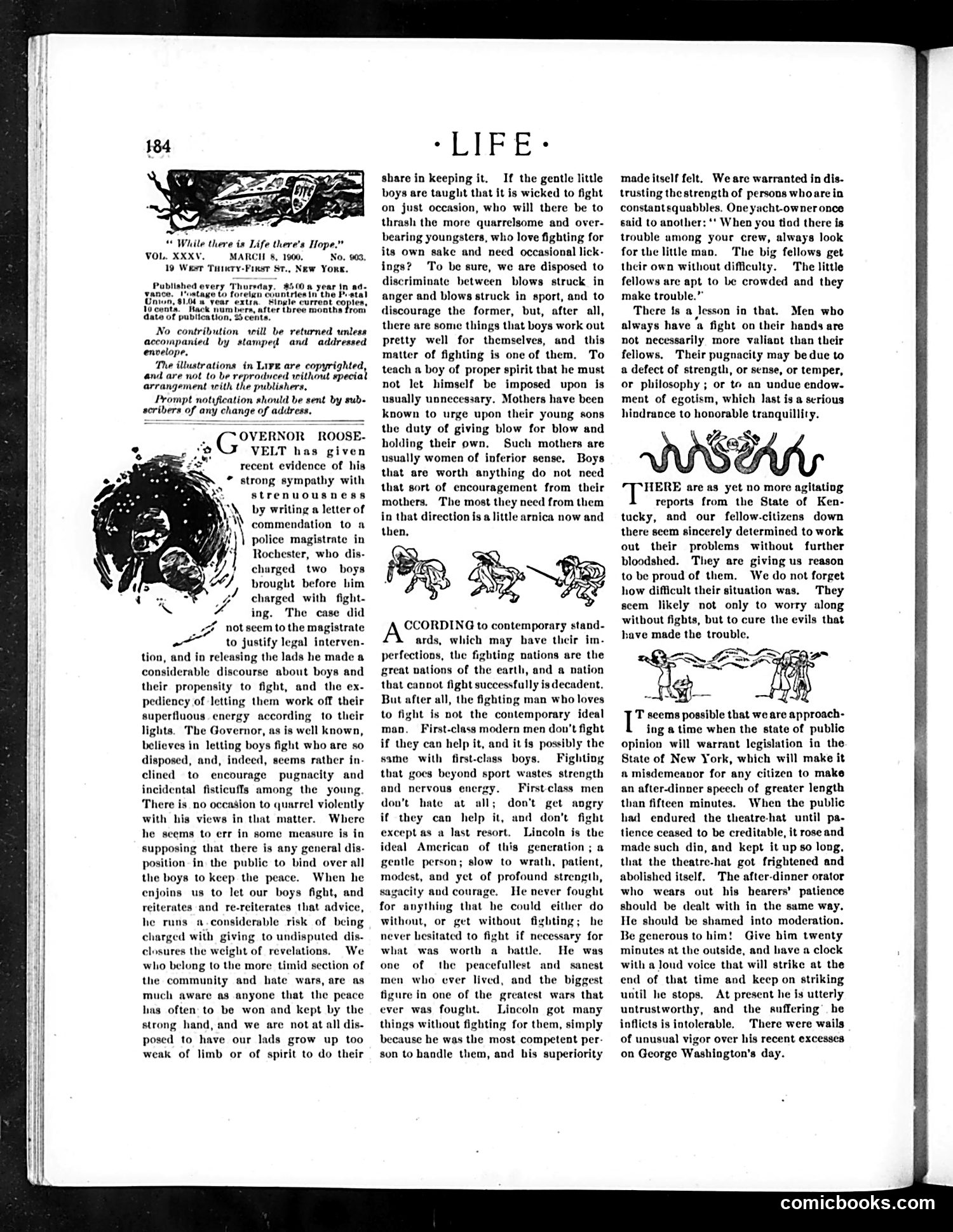
The page features an editorial about Governor Roosevelt's sympathy letter regarding two boys charged with fighting. The main cartoon shows Roosevelt's large head with a stern expression, illustrating his role as a public figure commenting on youth discipline. The editorial argues that fighting among boys is natural and shouldn't be criminalized—that mothers shouldn't coddle sons, and that boys need to "work out their own problems" through occasional physical conflict. It contrasts first-class men (who don't fight unnecessarily) with "first-class boys" (who need to develop strength through combat). The piece appears critical of over-intervention in boys' lives while defending fighting as character-building, reflecting early 20th-century attitudes about masculinity and youth development that would seem harsh to modern readers.
📄 Transcribed text from this page (OCR, searchable)
Machine-transcribed from the original scan — historical spelling and the odd misread are preserved.
“ While there is Life there's Hope.” VOL. XXXV. MARCI 8, 1900, No, 903, 19 Weer Tuiery-Finst St., New Yore. Published every Thursday, #5(0 n ye . Moatage to foreign countries tn Union, 81.00'a "year extra. Single current cop! Jo cents. “Hack numbe ef three months from dato of publication, 2 cent No contribution sill be returned unless accompanied by stamped and addressed envelope, ‘The illustrations in Live are copyrighted, and are not to be reproduced without special arrangement with the publishers, Prompt notification should be sent by sub- scribers of any change of address. OVERNOR ROOSE- VELT has given recent evidence of his * strong sympathy with “ strenuousness by writing a letter of commendation to a police magistrate in Rochester, who dis- charged two boys brought before him charged with fight- ing. The case did A notseem to the magistrate ~~ to justify legal interven. tion, and in releasing the lads he made a considerable discourse about boys and their propensity to fight, and the ex- pediency of letting them work off their superfluous energy according to their lights. The Governor, as is well known, believes in letting boys fight who are so disposed, and, indeed, seems rather in clined to encourage pugnacity and incidental fisticuffs among the young. There is no occasion to quarrel violently with his views in that matter. Where he seems to err in some measure is in supposing that there is any general dis- position in the public to bind over all the boys to keep the peace. When he enjoins us to let our boys fight, and reiterates and re-reiterates that advice, he runs a.considerable risk of being charged with giving to undisputed dis. closures the weight of revelations. We who belong to the more timid section of the community and hate wars, are as much aware as anyone that the peace has often to be won and kept by the strong hand, and we are not at all dis- posed to have our lads grow up too weak of limb or of spirit to do their se LIFE share in keeping it. If the gentle little boys are taught that it is wicked to fight on just occasion, who will there be to thrash the more quarrelsome and over- bearing youngsters, who love fighting for its own sake and need occasional lick- ings? To be sure, we are disposed to discriminate between blows struck in anger and blows struck in sport, and to discourage the former, but, after all, there are some things that boys work out pretty well for themselves, and this matter of fighting is one of them. To teach a boy of proper spirit that he must not Iet himself be imposed upon is usually unnecessary. Mothers have been known to urge upon their young sons the duty of giving blow for blow and holding their own, Such mothers are usually women of inferior sense. Boys that are worth anything do not need that sort of encouragement from their mothers, The most they need from them in that direction is a little arnica now and then, Sep CCORDING to contemporary stand- ards, which may bave their im- perfections, the fighting nations are the great nations of the earth, and a nation that cannot fight successfully is decadent. But after all, the fighting man who loves to fight is not the contemporary ideal map. First-class modern men dou't fight if they can help it, and itis possibly the same with first-class boys. Fighting that goes beyond sport wastes strength and nervous encrgy. First-class. men don’t hate at all; don't get angry if they can help it, and don't fight except as a last resort. Lincoln is the ideal American of this gencration ; a gentle person; slow to wrath, patient, modest, and yet of profound strength, sagacity and courage. He never fought for anything that he could either do without, or get without fighting; he never hesitated to fight if necessary for what was worth a battle. He was one of the peacefullest- and sanest men who ever lived, and the biggest figure in one of the greatest wars that ever was fought. Lincoln got many things without fighting for them, simply because he was the most competent per- son to handle them, and bis superiority made itself felt. We are warranted in dis- trusting the strength of persons whoare in constantsquabbles. One yacht-owner once said to another: ‘‘ When you tiad there is trouble umong your crew, always look for the little man. The big fellows get their own without difficulty. The little fellows are apt to be crowded and they make trouble.” There is a lesson in that. Men who always have a fight on their hands are not necessarily more valiant than their fellows, Their pugnacity may be due to a defect of strength, or sense, or temper, or philosophy ; or to an undue endow. ment of egotism, which last is a serious hindrance to honorable tranquillity. WISH HERE are as yet no more agitating reports from the State of Ken- tucky, and our fellow-citizens down there seem sincerely determined to work out their problems without further bloodshed. They are giving us reason to be proud of them. We do not forget how difficult their situation was. They scem likely not only to worry along witbout fights, but to cure the evils that have made the trouble, 1" seems possible that we are approach- ing a time when the state of public opinion will warrant legislation in the State of New York, which will make it a misdemeanor for any citizen to make an after-dinner specch of greater length than fifteen minutes. When the public had endured the theatre-hat until pa- tience ceased to be creditable, it rose and made such din, and kept it up so long, that the theatre-hat got frightened and abolished itself. The after-dinner orator who wears out his hearers’ patience should be dealt with in the same way, He should be shamed into moderation. Be generous to him! Give him twenty minutes at the outside, and have a clock with a loud voice that will strike at the end of that time and keep on striking until he stops, At present he is utterly untrustworthy, and the suffering’ he inflicts is intolerable. There were wails of unusual vigor over his recent excesses on George Washington's day. comicbooks.com