
Life, 1900-03-08 · page 6 of 22
Life — March 8, 1900 — page 6: what you’re looking at
What you’re looking at
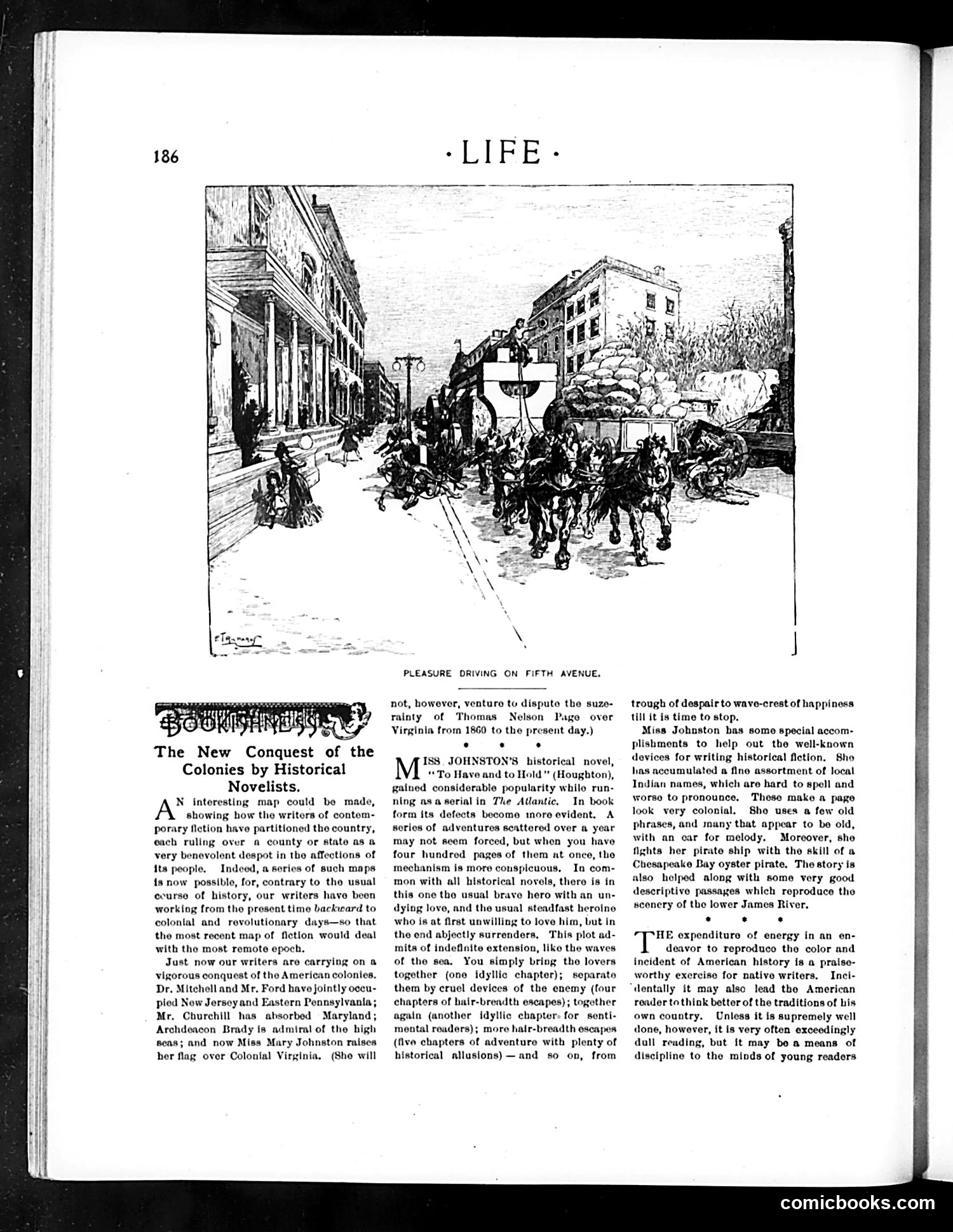
This illustration depicts a chaotic street scene on Fifth Avenue, New York's most prestigious thoroughfare. The cartoon satirizes the collision of urban transportation methods in the early 20th century: horse-drawn carriages compete with what appears to be early automobiles, while pedestrians navigate the congestion. The caption's irony is key—"pleasure driving" suggests leisurely, refined activity befitting Fifth Avenue's wealthy residents, yet the image shows disorder and crowding. The satire likely critiques either the disruptive introduction of motorized vehicles into established carriage culture, or mocks the pretense of "pleasure" amid urban chaos. The accompanying text discusses historical fiction about American colonists, unrelated to the cartoon.
📄 Transcribed text from this page (OCR, searchable)
Machine-transcribed from the original scan — historical spelling and the odd misread are preserved.
The New Conquest of the Colonies by Historical Novelists. N interesting map could be made, A showing how tho writers of contem- porary fiction havo partitioned the country, cach ruling over a county or state as a very benevolent despot in the affections of its people. Indeed, a series of such maps is now possible, for, contrary to tho usual course of history, our writers have been working from the present time backward to colonial and revolutionary days—so that the most recent map of fiction would deal with tho most remote epoch. Just now our writers aro carrying on & vigorous conquest of the American colonies, Dr. Mitchell and Mr. Ford have jointly occu- pled Now Jersey and Eastern Pennsylvania; Mr. Churchill has absorbed Maryland; Archdeacon Brady is admiral of the high seas; and now Miss Mary Johnston raises ber flag over Colonial Virginia, (She will PLEASURE DRIVING ON FIFTH AVENUE, not, howover, venturo to dispute the suzo- rainty of Thomas Nelson Pago over Virginia from 1860 to the present day.) ° . . I88. JOHNSTON'S historical novel, “To Have and to Hold" (Houghton), gained considerable popularity while run- ning asaserial in The Alantic. In book form its defects become inore evident. A sories of adventures scattored over a year may not seem forced, but when you havo four hundred pages of them at once, the mechanism is more conspicuous, In com- mon with all historical novels, there is in this one tho usual brave hero with an un- dying love, and the usual steadfast heroine who is at first unwilling to love him, but in the ond abjectly surrenders, This plot ad- mits of indeflnite extension, liko the waves of the sea, You simply bring tho lovers together (ono idyllic chapter); soparato them by cruel devices of the enemy (four chapters of bair-breadth escapes) ; together again (another idyllic chapter. for senti- mental readers); more halr-breadth escapes: (five chapters of adventure with plenty of historical allusions) —and so on, from trough of despair to wave-crest of happiness till it is time to stop. Miss Johnston bas somo special accom- plishments to help out the well-known dovices for writing historical fiction. Sho has accumulated a fine assortment of local Indian names, which aro hard to spell and worso to pronounce. These make a page look very colonial, Sho uses a few old phrases, and smuny that appear to be old, with an car for melody. Moreover, sho fights her pirate ship with tho skill of a Chesapeake Bay oyster pirate, The story is also helped along with some very good descriptive passages which reproduce the sconery of the lower James River. . * oe HE oxpendituro of energy in an en- deavor to reproduco the color and incident of American history is a praiso- worthy exercise for native writers. Inci- “dentally it may also lead tho American reader tothiok better of the traditions of his own country, Unless it is supremely well done, however, it is very often exceedingly dull reading, but it may be a means of discipline to the minds of young readers comicbooks.com