
A complete issue · 20 pages · 1899
Life — October 19, 1899
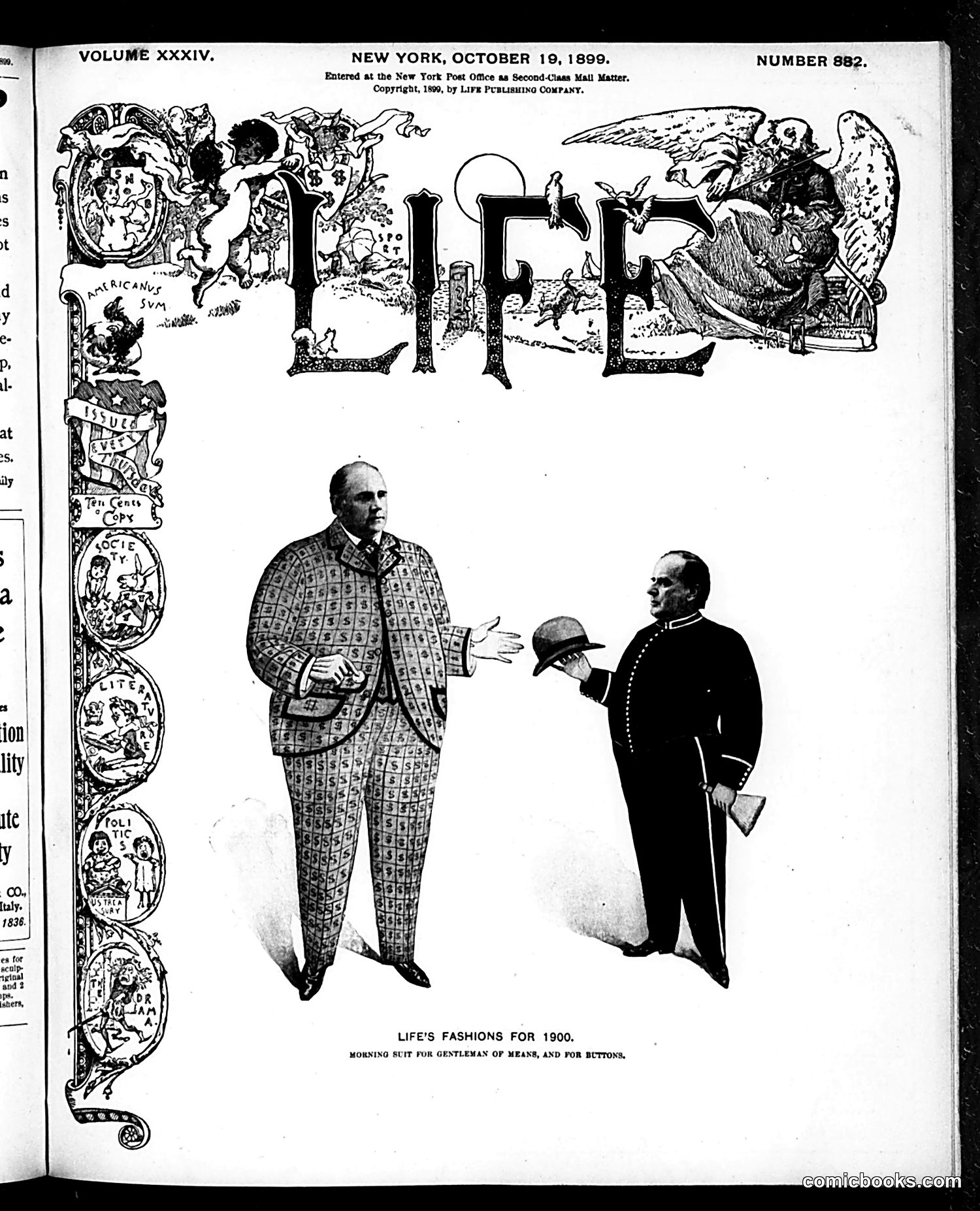
This is the cover of Life magazine from October 19, 1899. The caption reads "LIFE'S FASHIONS FOR 1900: MORNING SUIT FOR GENTLEMAN OF MEANS, AND FOR BUTTONED." The cartoon satirizes wealth inequality through fashion. A portly, well-dressed gentleman in an expensive checkered suit represents a man of means. Beside him stands a much smaller, impoverished figure in a dark, worn coat—"buttoned" likely refers to someone unable to afford proper clothing and forced to keep their coat buttoned to hide rags beneath. The joke critiques the stark contrast between rich and poor at the turn of the century, suggesting that 1900's "fashions" for different classes reflect the fundamental divide between wealthy and destitute citizens. The size difference emphasizes the disparity.
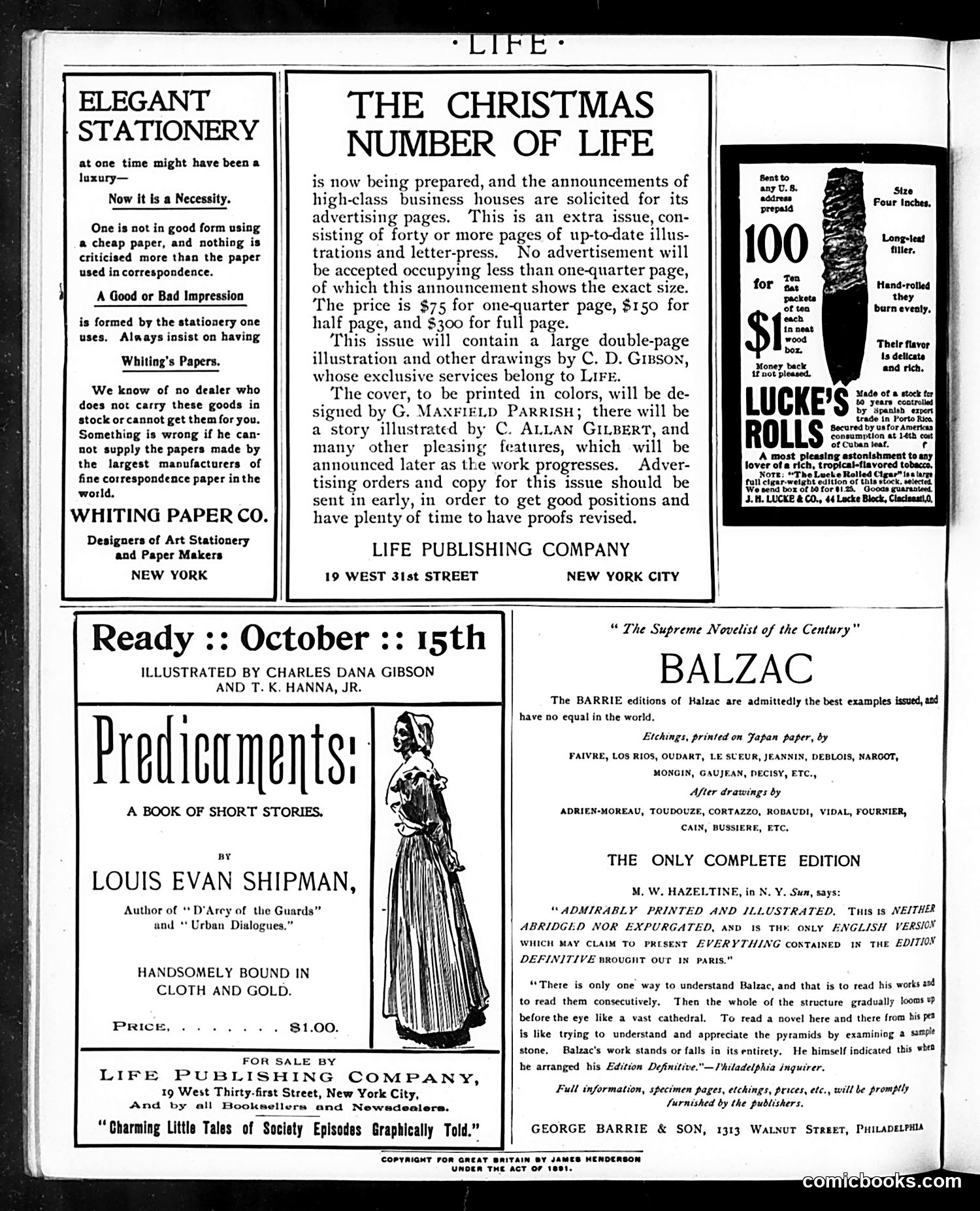
This page is primarily **advertising**, not satire or political commentary. It contains: 1. **Elegant Stationery ad** (Whiting Paper Co.) - promotes quality correspondence paper as a necessity rather than luxury 2. **Life Magazine's Christmas Issue announcement** - soliciting advertisements for their upcoming expanded holiday edition 3. **Lucke's Rolls advertisement** - a food product 4. **"Predicaments" book ad** - promoting a short-story collection by Louis Evan Shipman, illustrated with a period-appropriate sketch of a woman in formal dress 5. **Balzac edition advertisement** - promoting the Barrie edition of Balzac's works as "the only complete edition" The page reflects early-20th-century publishing and consumer culture. The only potentially humorous element is the "Predicaments" title, but without the actual story content, the joke remains unclear. Overall, this is a commercial page typical of *Life* magazine's revenue model.
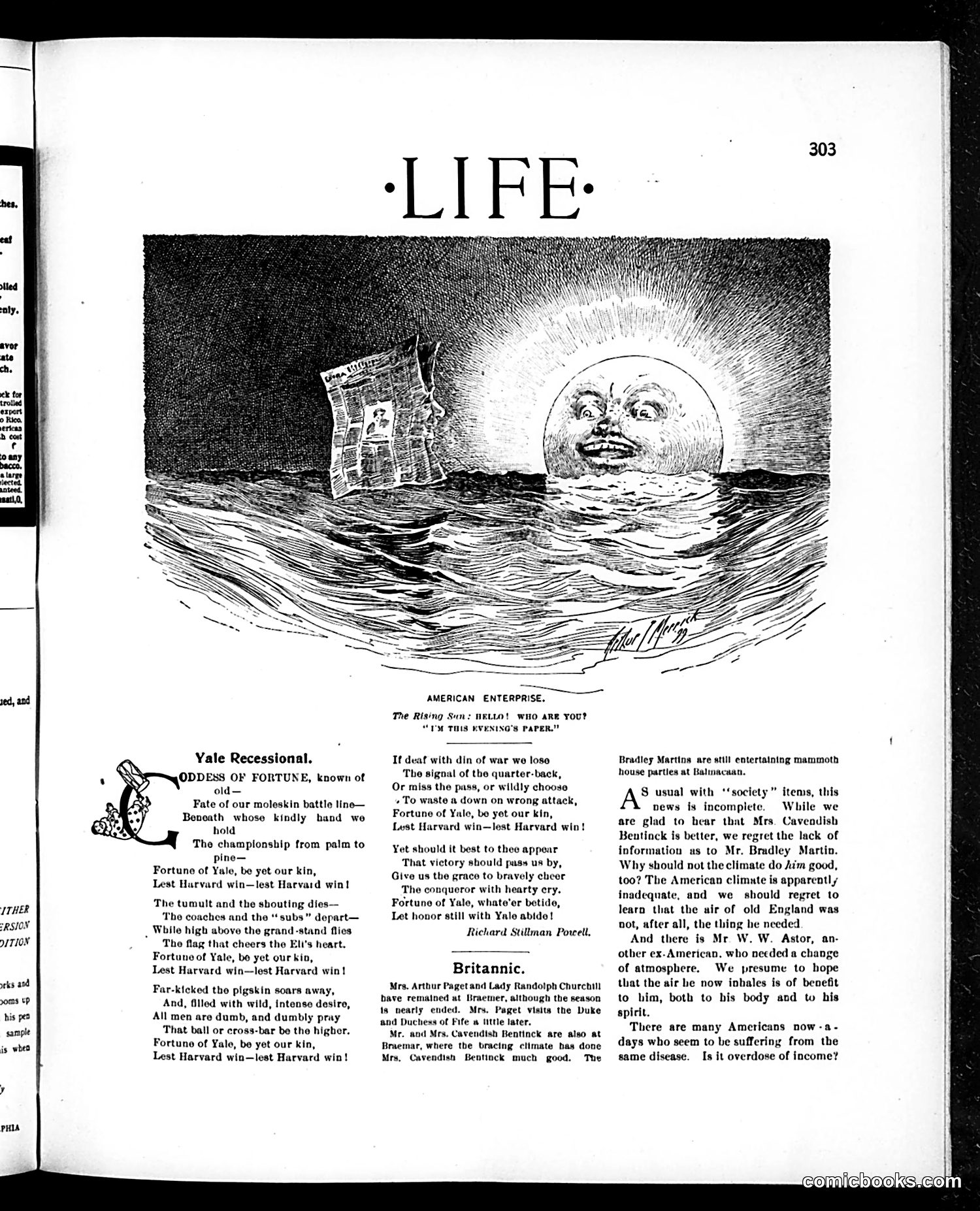
The main cartoon titled "American Enterprise" shows a personified sun with a human face rising from the ocean, holding a newspaper labeled "LIFE." The caption reads: "The Rising Sun: 'HELLO! WHO ARE YOU?' 'I'M THIS EVENING'S PAPER.'" This appears to be satirizing the relationship between American newspapers and Japan during a period of growing U.S.-Japan tensions (likely early 1900s). The "rising sun" is Japan's national symbol; the joke suggests American journalism (represented by the Life newspaper) is claiming dominance or prominence, meeting Japan's own expansionist imagery head-on. The page also contains a "Yale Recessional" poem mocking Harvard, and a "Britannic" section discussing American expatriates abroad—reflecting Life's focus on satirizing contemporary political and social issues.
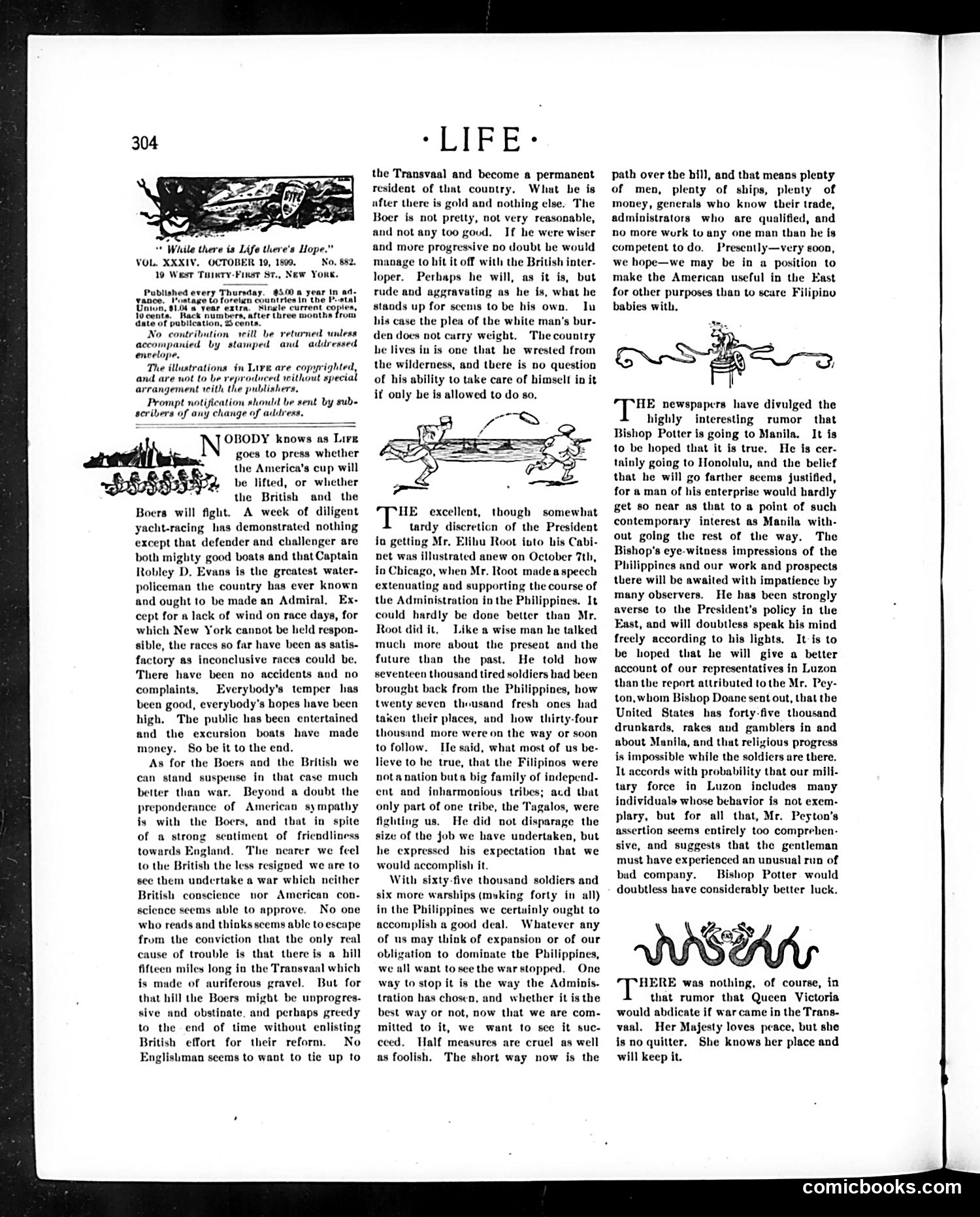
This page contains editorial commentary on the Philippine-American War and colonial administration. The text discusses Elihu Root's October speech in Chicago supporting U.S. administration of the Philippines, praising his articulate defense of American policy there. The small decorative cartoons (appearing as dividers) show exaggerated figures in comic poses—typical of Life's satirical style—though their specific political targets are unclear from this image alone. The editorial defends American military presence while criticizing inefficiency in the occupation. It references Bishop Potter's expected visit to Manila and discusses whether American forces can effectively govern the Philippines, touching on debates about imperial expansion that dominated American politics in 1900.
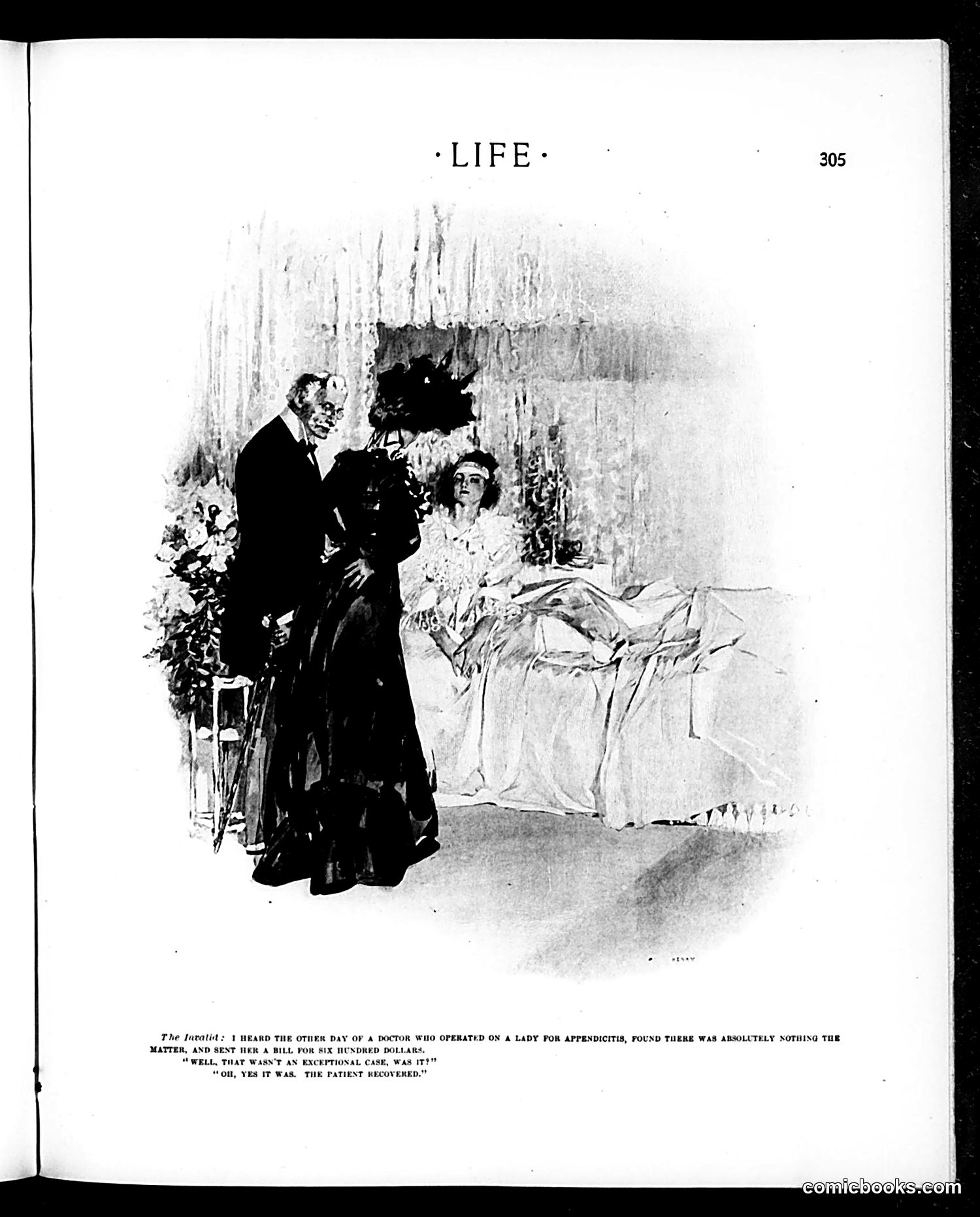
This illustration depicts a medical malpractice scenario. The caption describes a doctor who performed surgery on a woman for appendicitis but found "absolutely nothing the matter, and sent her a bill for six hundred dollars." The cartoon shows a bedside scene: a well-dressed man (the doctor) converses with a woman (the patient) while a nurse or attendant stands nearby. The patient lies in bed, presumably recovering from unnecessary surgery. The satire critiques two issues: (1) unethical medical practices—performing surgery without genuine medical need, and (2) exorbitant medical fees. The joke's punch line questions whether the patient recovered, implying the unnecessary procedure may have caused harm rather than healing. This reflects early 20th-century concerns about medical profession accountability and patient exploitation.
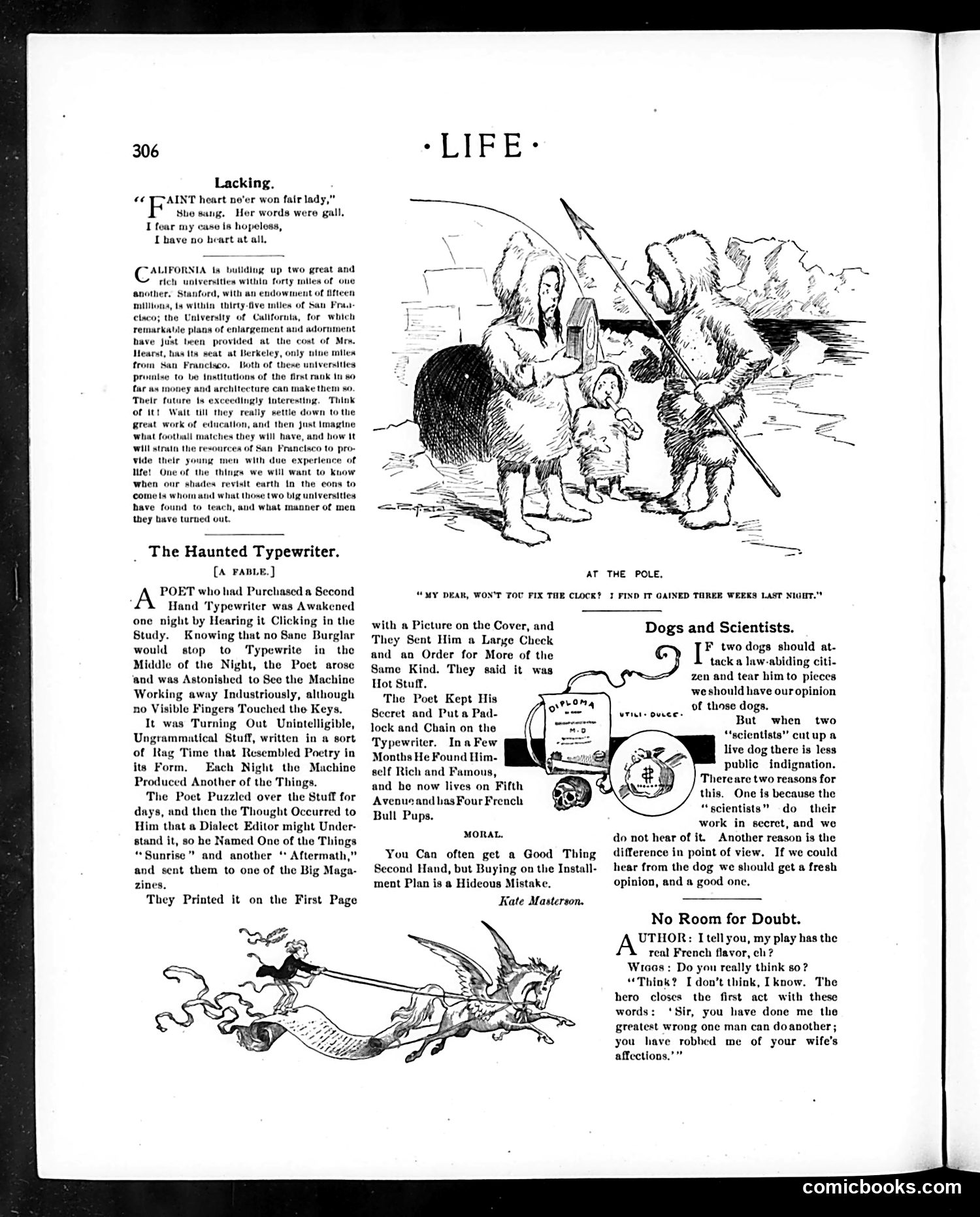
This page contains three distinct pieces: 1. **"Lacking"** — A poem about a woman rejecting a suitor, accompanying an illustration of figures in what appears to be Arctic conditions. 2. **"The Haunted Typewriter"** — A fable about a poet who purchases a secondhand typewriter that mysteriously produces poetry and becomes famous. The satire targets publishing industry absurdities and the commercialization of literature. 3. **"Dogs and Scientists"** — A brief commentary suggesting that when scientists publicly dissect dogs for research, it generates public outcry, whereas private vivisection goes unnoticed. This appears to critique selective moral outrage and the hidden nature of laboratory animal testing. 4. **"No Room for Doubt"** — A dialogue joke where a theater hero's opening line inadvertently insults his wife's fidelity. The page demonstrates Life's satirical approach to literature, science ethics, and social conventions of the era.
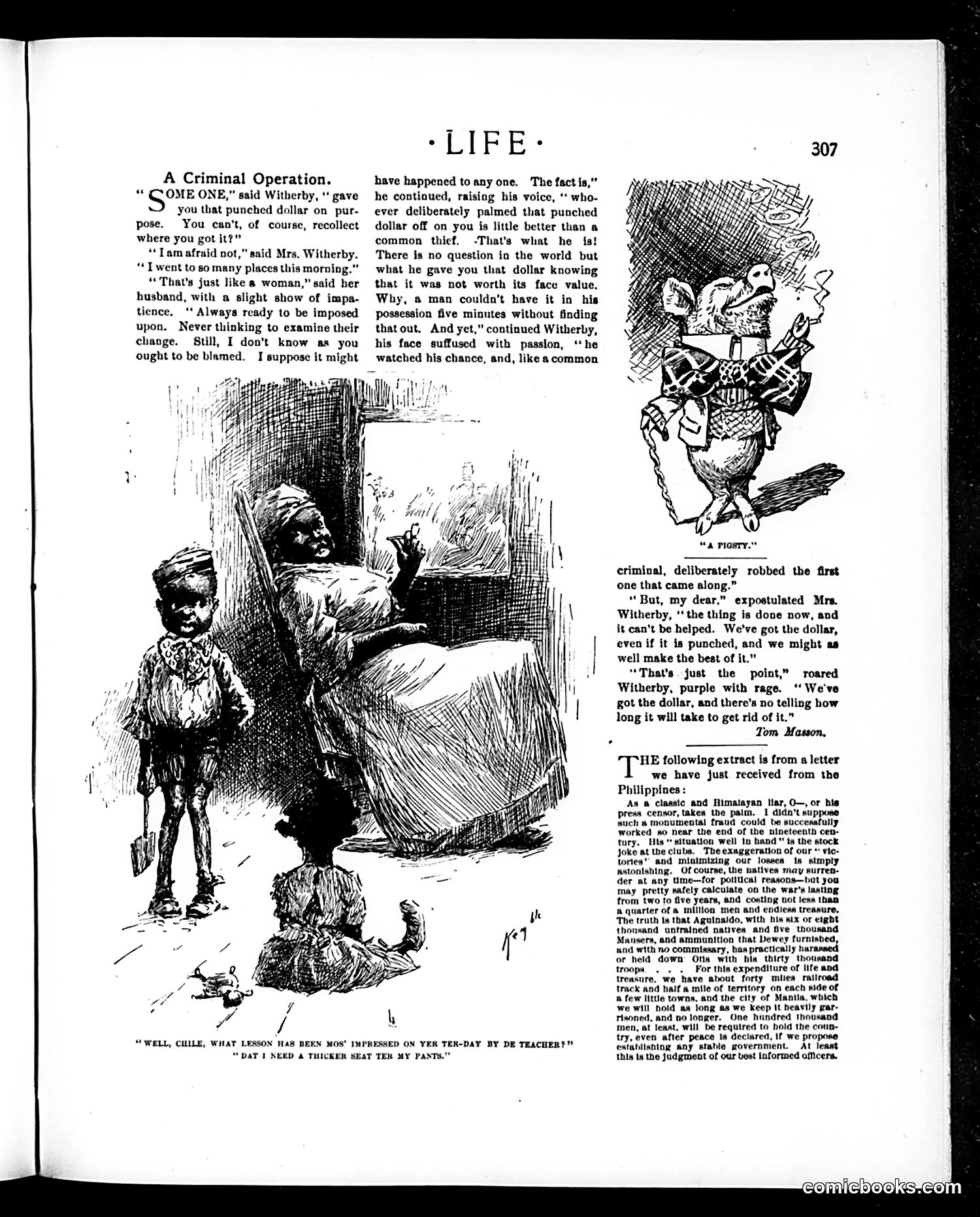
This page satirizes a debate about punching someone over a dollar. The dialogue between characters named Witherby and Mrs. Witherby presents two positions: one argues that striking someone for a dollar is "little better than a common thief," while the other counters that possession of money one didn't earn justifies any response—even violence. The accompanying illustration depicts children in poverty, emphasizing the satirical point: the wealthy debate morality over small sums while poor children suffer real deprivation. The humor lies in the absurdity of Witherby's passionate defense of committing assault over currency, exposing class hypocrisy about property and violence. The page also includes a separate article about the Philippines, suggesting editorial content on colonialism.
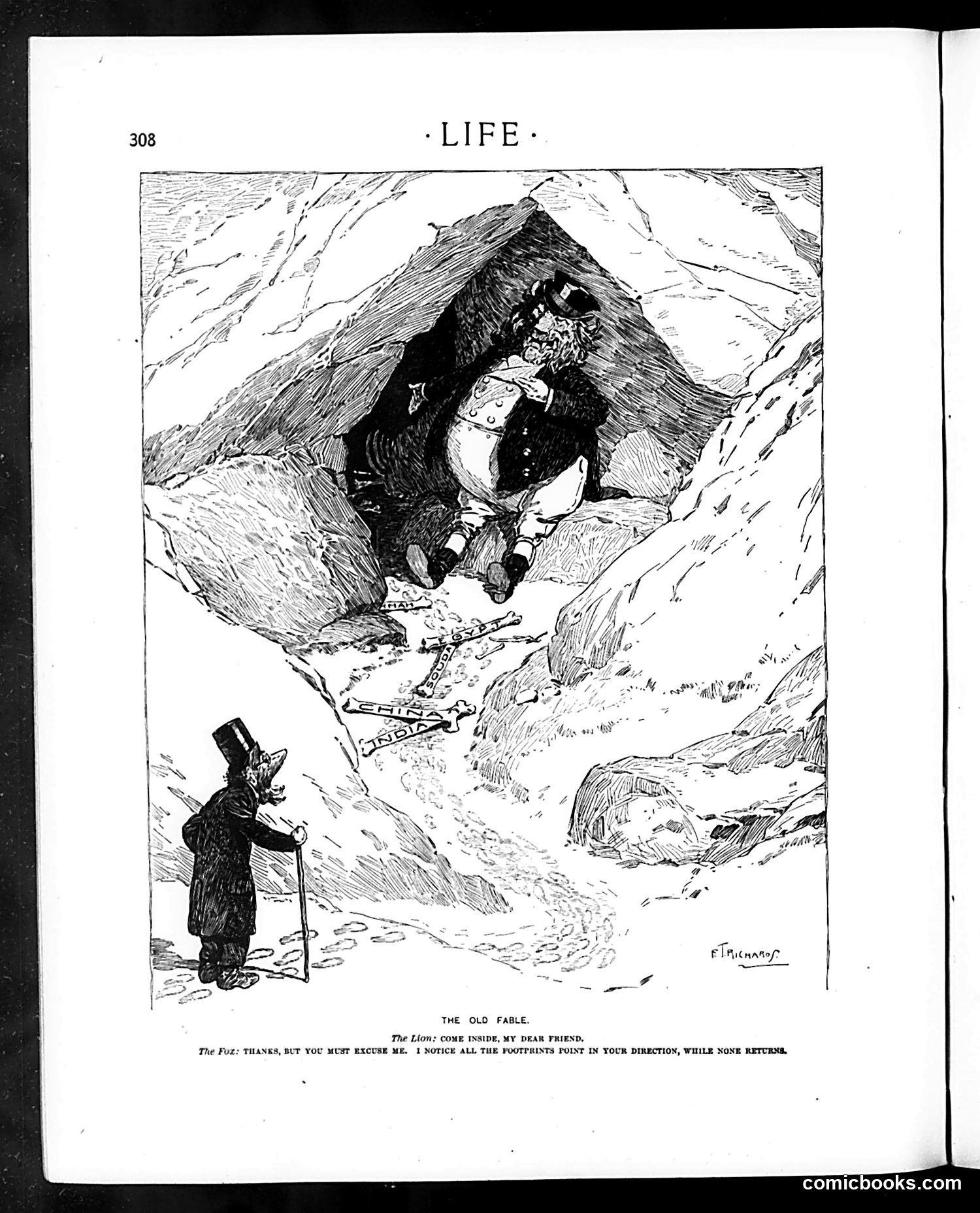
This cartoon illustrates Aesop's fable of the lion and the fox. A well-dressed gentleman with a top hat (the fox) stands outside a cave, addressing a large, shaggy creature within (the lion). The lion instructs the fox to enter, noting that "all the footprints point in your direction, while none returns." The satire warns of a deceptive trap: the lion observes that many have entered but none have exited, suggesting danger within. The fox represents a foolish or gullible person being lured into a dangerous situation by false promises. This fable was commonly used in satirical publications to critique political naïveté or warn against entering suspicious agreements—likely referencing contemporary political or social entrapments of the era.
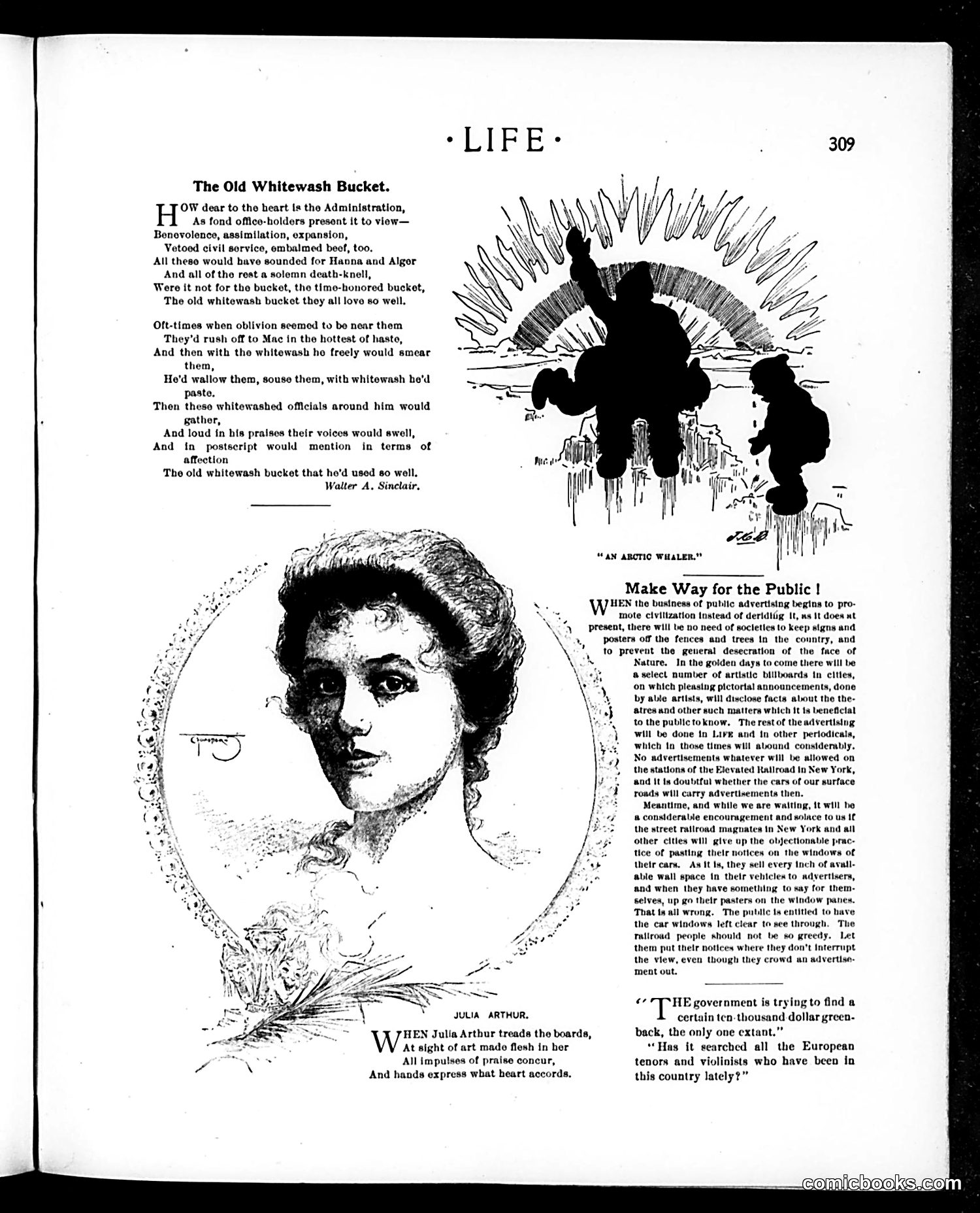
This page contains two distinct pieces: **"The Old Whitewash Bucket"** (poem by Walter A. Sinclair): A satirical poem criticizing the Administration's use of the "whitewash bucket"—a metaphor for covering up scandals and misconduct. It mocks how officials would gather around praising whitewashed (concealed) truths. **"An Arctic Whaler"**: A cartoon showing what appears to be Arctic explorers discovering a whale, with humorous commentary about public perception. **"Make Way for the Public!"**: An editorial arguing against advertising clutter in public spaces (billboards, railroad stations, vehicle advertisements). It advocates for keeping public views clear of commercial signage. **Portrait of Julia Arthur**: A sketch of the actress with accompanying verse about her artistic talent. The page's primary satire targets governmental deception and commercial encroachment on public spaces.
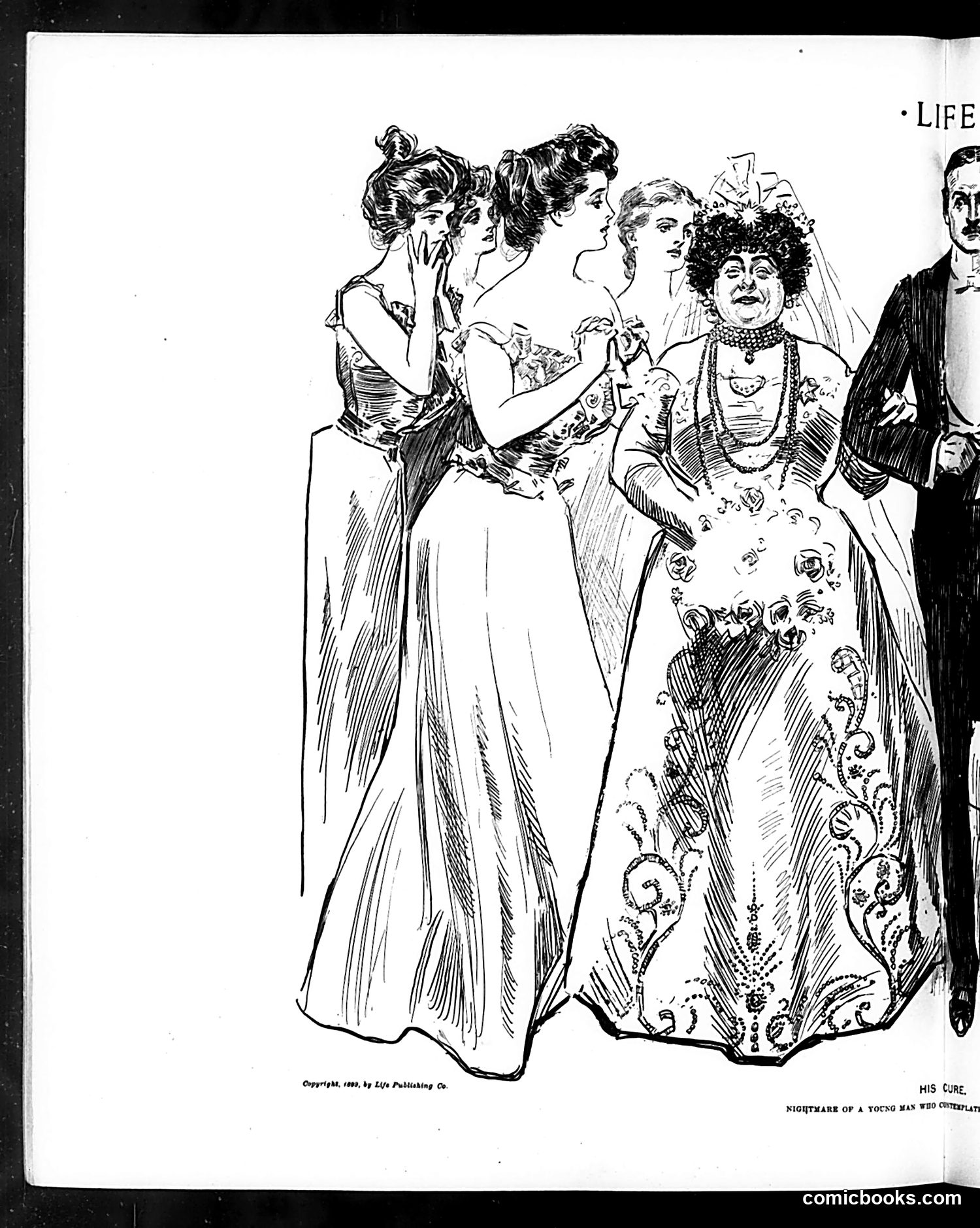
This appears to be a satirical cartoon from Life magazine (copyright 1903, per the visible text). The title reads "His Cure: Nightmare of a Young Man Who Contemplates" — though the full caption is partially cut off. The image depicts a young man's anxious vision of marriage, showing him surrounded by fashionably-dressed women in elaborate Edwardian gowns. The central figure appears distressed, while the women around him—possibly representing different types of wives or marriage prospects—display various expressions and styles of dress and jewelry. The satire targets young men's anxieties about matrimony during the Gilded Age, when marriage often involved complex social expectations and financial considerations. The elaborate clothing and jewelry suggest concerns about the costs and social demands of supporting a wife in wealthy society.
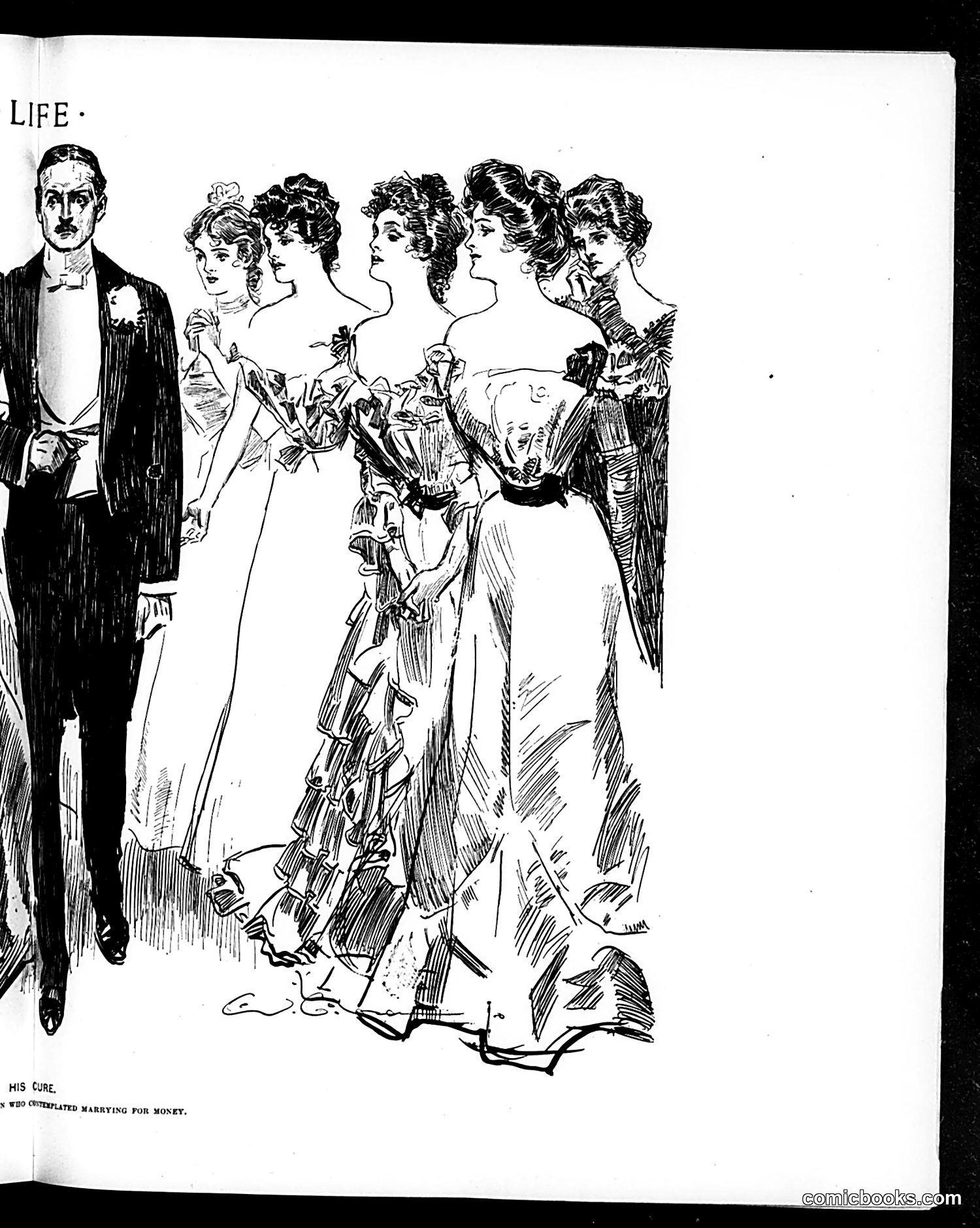
This satirical cartoon depicts a well-dressed man in formal evening wear observing a group of fashionably-dressed women. The caption reads: "A MAN WHO CONTEMPLATED MARRYING FOR MONEY." The satire suggests that the man's consideration of marrying for financial gain serves as its own "cure"—presumably meaning the sight of these women and the associated social obligations and expenses of courtship/marriage dissuade him from the scheme. The cartoon mocks both men who marry for money and the expensive, elaborate fashion and social expectations surrounding women of means. It's social commentary on financial motivations in marriage and the costly nature of upper-class courtship in early 20th-century America.
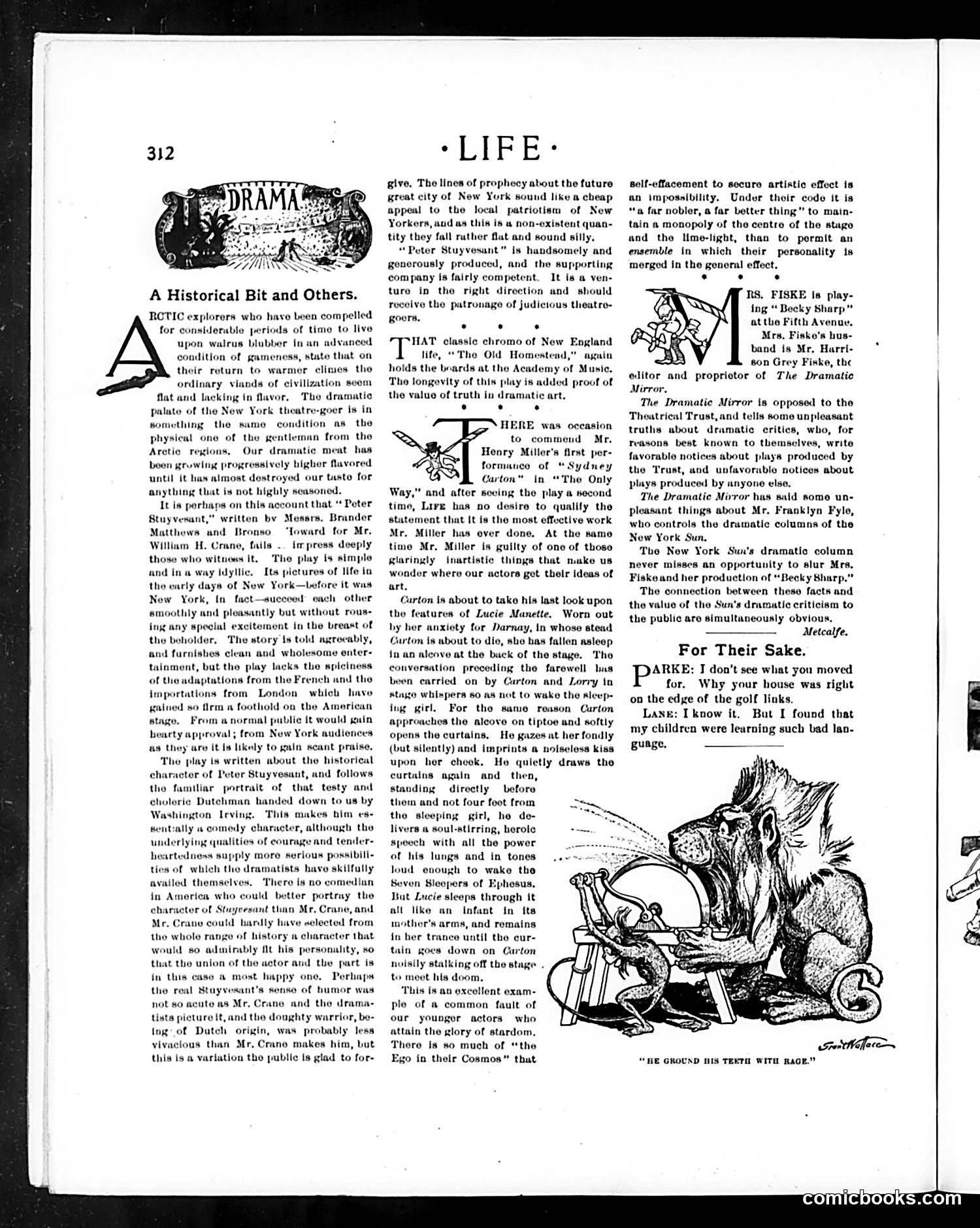
This page contains dramatic criticism and theater commentary rather than political cartoons. The main illustrated feature shows a scene labeled "HE GROUND HIS TEETH WITH RAGE," depicting what appears to be a theatrical moment of emotional intensity. The text discusses Henry Miller's play "Sydney Carton" and critiques both the production and contemporary acting practices. The reviewer praises the play's historical value while criticizing actors' tendency toward excessive ego and self-aggrandizement on stage. A sidebar titled "For Their Sake" humorously addresses parents concerned about children witnessing inappropriate theatrical content, with the illustration showing what appears to be a frustrated audience member. The page primarily serves as arts criticism rather than political satire.
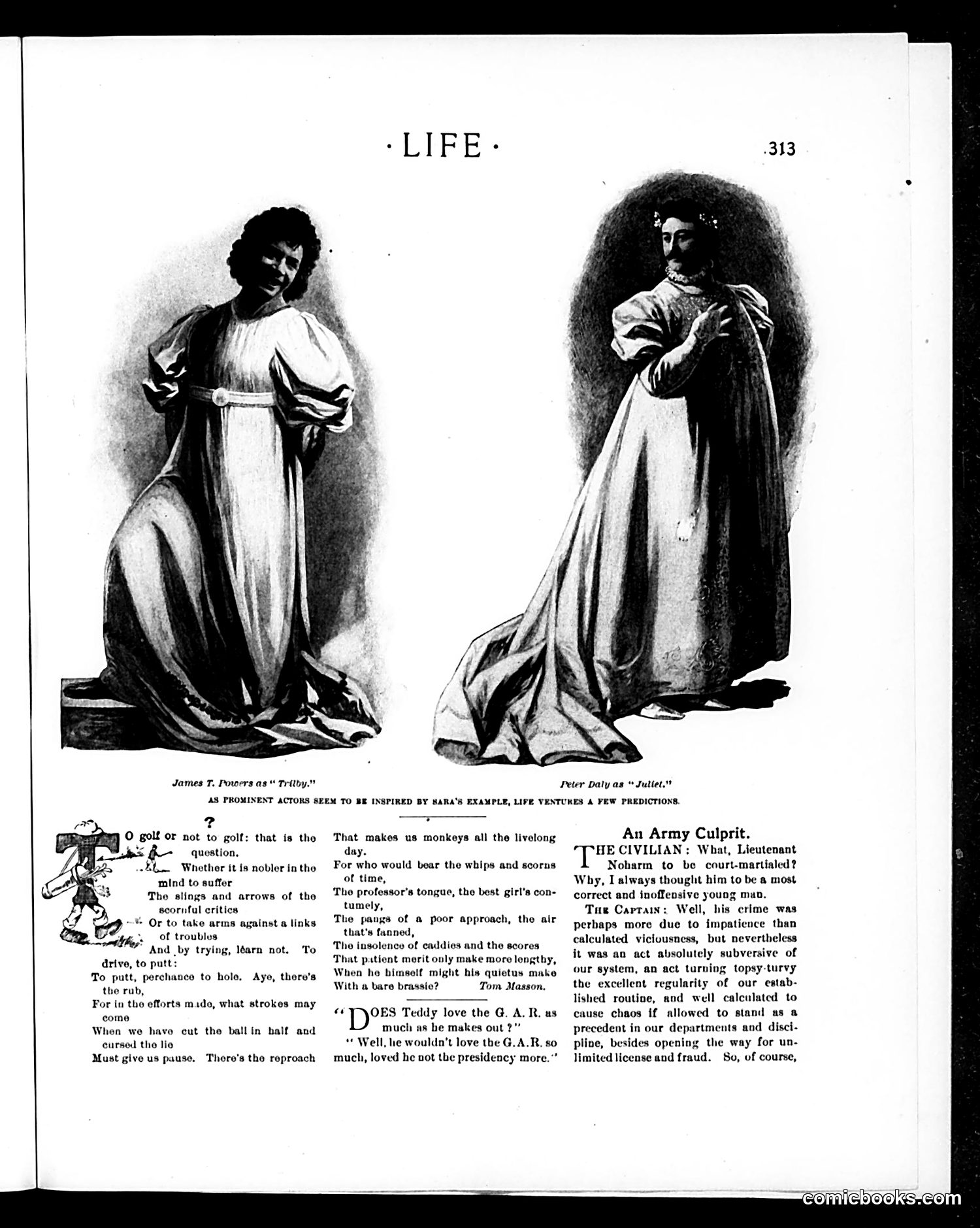
This page from *Life* magazine features theatrical and political satire. The top shows two actors—James T. Powers and Peter Daly—in costume, presumably from productions inspired by "Trilby" (a popular 1894 novel that sparked theatrical adaptations). The main text is a comedic parody of Hamlet's "To be or not to be" soliloquy, rewritten as "To golf or not to golf" by Tom Masson. It mocks the obsessive golf craze among prominent figures of the era, treating the sport's frustrations with mock-Shakespearean gravity. The bottom section, "An Army Culprit," presents a brief dialogue satirizing military bureaucracy: a civilian expresses surprise that a young officer faces court-martial for a minor infraction, but the captain explains that even small rule-breaking threatens military order and must be harshly punished. The satire critiques rigid institutional thinking and disproportionate responses to minor infractions.
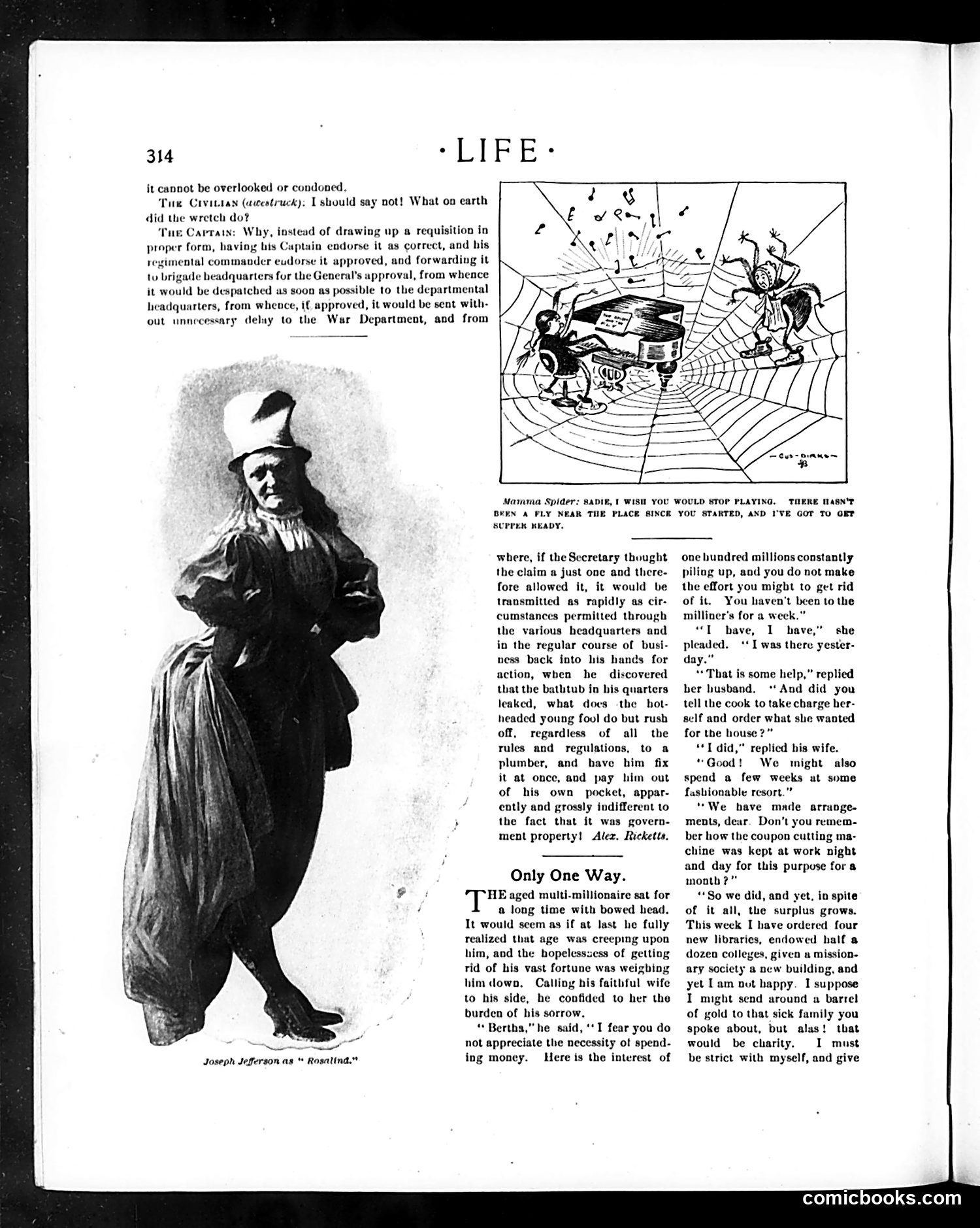
This page contains two separate satirical pieces: **Top cartoon**: A military bureaucracy satire. A civilian complains that a young officer solved a practical problem (fixing a leaky bathtub) by directly hiring a plumber and paying out-of-pocket, rather than filing requisitions through proper military channels. The Captain's response mocks the absurd red tape: requisitions must pass through captain, regimental commander, brigade headquarters, the General, the War Department, and the Secretary before returning down the chain—all to authorize simple action. The satire targets excessive military bureaucracy that prioritizes procedure over common sense. **Bottom story, "Only One Way"**: A wealthy elderly man laments his inability to spend down his fortune. Despite generous charitable giving—libraries, colleges, missionary societies—his wealth continues growing from interest. His wife suggests spending on luxuries and vacations. The satire critiques both extreme wealth accumulation and the moral paralysis it creates, suggesting that even philanthropy cannot exhaust inherited fortunes. The image shows Joseph Jefferson as "Rosalind," a theatrical reference.
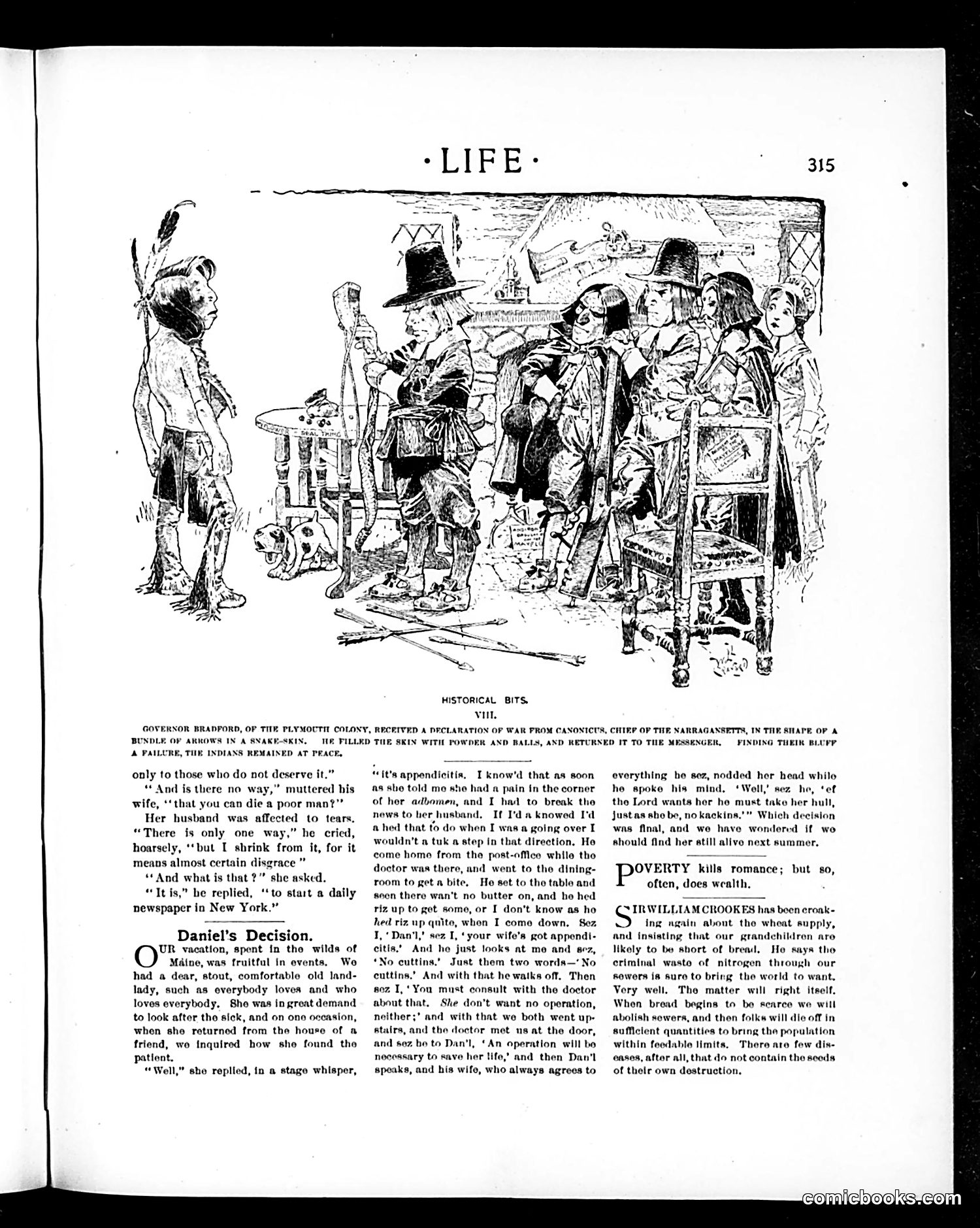
This page contains two satirical pieces: **"Daniel's Decision"** (main story): A humorous anecdote about a Maine landlady describing her neighbor Daniel's reaction to his wife's appendicitis diagnosis. The satire centers on Daniel's religious fatalism—when told his wife needs surgery to survive, he refuses ("No cutting"), declaring "ef tho Lord wants hor ho must take her hull." The joke mocks rigid religious determinism that rejects medical intervention, presented through dialect humor typical of early 1900s American magazines. **"Historical Bits, VII"** (top illustration): References a colonial-era incident involving Native Americans and a snake-skin filled with powder and ammunition, though context is limited. **Brief social commentary** appears at bottom, including William Crookes' warnings about nitrogen depletion threatening wheat supplies, which the magazine dismisses sarcastically. The page exemplifies Life's blend of narrative humor, social commentary, and gentle mockery of rural American attitudes and scientific alarmism.
This page contains multiple satirical fables by Frank Crane, typical of Life magazine's early 20th-century moral humor. The cartoons use exaggerated scenarios to mock hypocrisy and human nature: 1. **"Bale"**: A rhymed love story where a woman repeatedly tells her suitor "wait," then after marriage demands kisses while he refuses—satirizing how relationships reverse after commitment. 2. **The Sanctimonious Man**: Mocks religious hypocrisy. A missionary claims to spread the Gospel while carrying a Gatling gun and booze to "convert" people—satire on using force and intoxication under moral pretense. 3. **The Large Man's "Benevolence"**: Criticizes paternalism and colonialism. A large man "helps" a small man, then exploits him completely while claiming to do good—commentary on imperial "civilization" missions. 4. **The Cunning Schemer**: Brief jab at using patriotic symbols (the flag) as cover for unethical schemes. The page also advertises whiskey brands, typical period advertising.
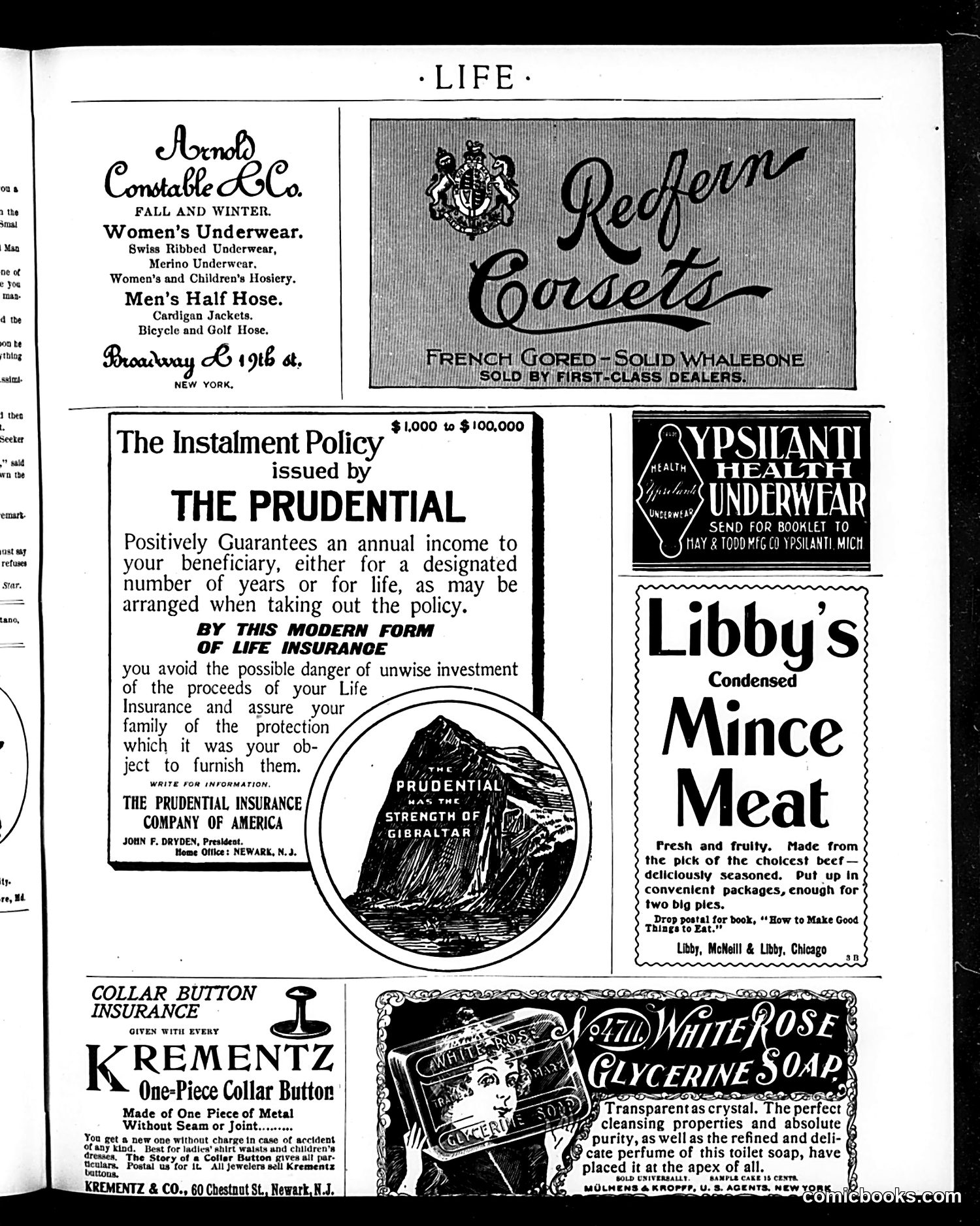
This is **primarily an advertising page** from an early 20th-century issue of Life magazine, not a satirical cartoon page. It contains no political commentary or jokes requiring historical context. The page features **standard product advertisements** of the era: - Women's and men's undergarments and hosiery (Arnold, Constable & Co.) - **Redfern Corsets** (a luxury brand) - Life insurance from The Prudential Company - Ypsilanti Health Underwear - Libby's Condensed Mince Meat - Krementz collar buttons (a jewelry/haberdashery item) - White Rose Glycerine Soap The only notable visual element is **The Prudential's circular emblem** showing Gibraltar's Rock, used as their corporate symbol ("Has the Strength of Gibraltar"). **No satire or caricature is present.** This appears to be a commercial page reflecting consumer goods and financial services typical of the 1910s-1920s period.
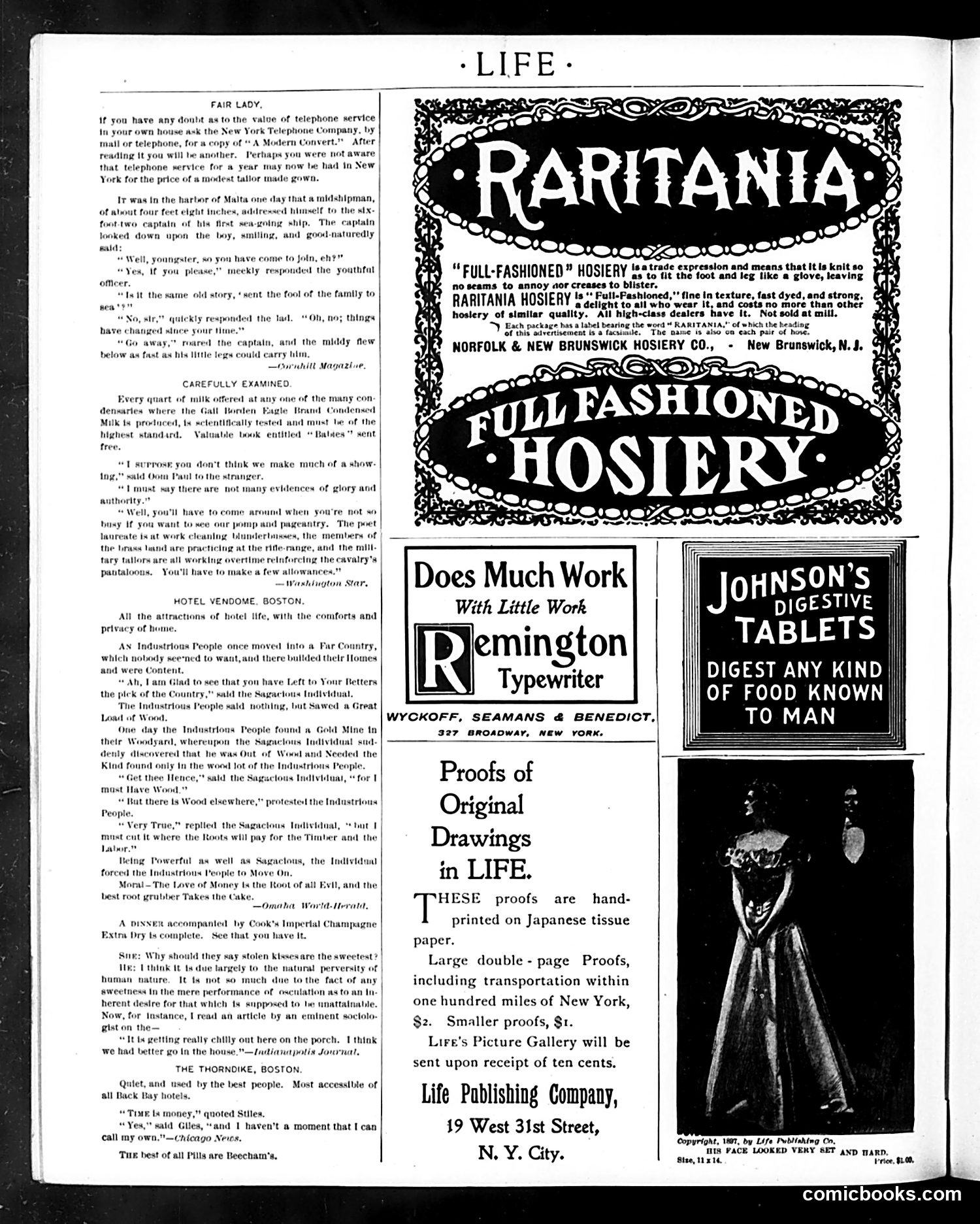
This page is primarily **advertising and miscellaneous content** rather than political satire. The dominant visual elements are commercial advertisements for Raritania Hosiery, Remington Typewriters, Johnson's Digestive Tablets, and Life Publishing Company's art proofs. The text content consists of several unrelated humor columns and anecdotes—brief jokes about telephone service, a naval officer and midshipman, industrial workers and a scheming individual, and romantic banter. These are typical of Life's satirical magazine format from this era, offering light social commentary through short fictional scenarios. The **"Industrious People" fable** appears to be gentle social satire about capitalist exploitation: a shrewd individual manipulates honest workers who discover gold, then uses legal/financial pressure to steal their wealth. The moral explicitly states: "The Love of Money is the Root of all Evil." Otherwise, the page reflects early 20th-century consumer culture and domestic humor rather than pointed political commentary.
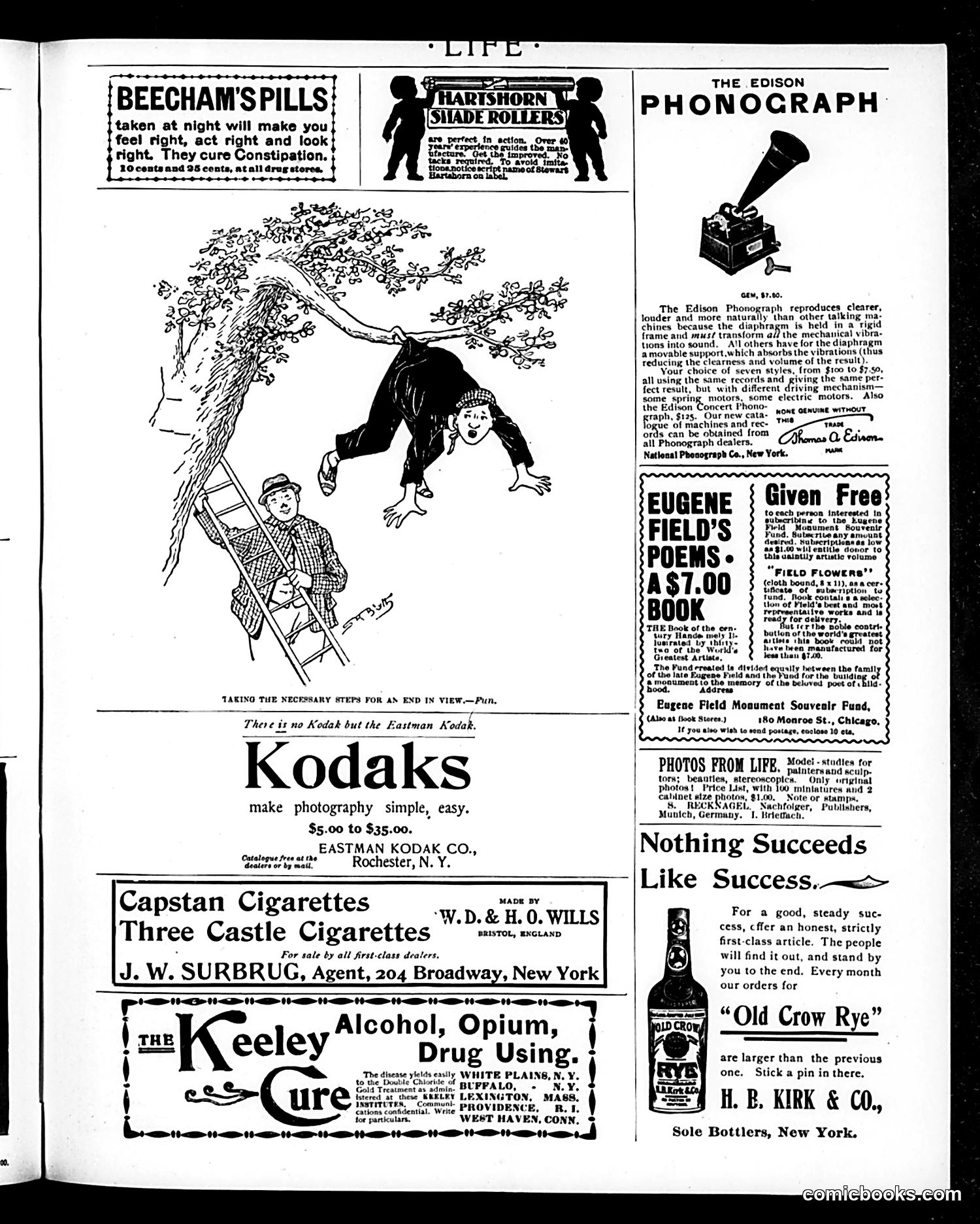
## Main Cartoon The central illustration shows two figures climbing a gnarled tree, titled "TAKING THE NECESSARY STEPS FOR AN END IN VIEW." The caption is a pun: "steps" refers both to the climbing action and to taking steps (actions) toward a goal. The cartoon appears to satirize the effort and struggle required to achieve objectives—the twisted tree and awkward climbing positions suggest difficulty and desperation in pursuit of aims. ## Page Content This is primarily an **advertising page** from an early 1900s Life magazine. It features period product advertisements including: - Patent medicines (Beecham's Pills for constipation) - Photography equipment (Kodak cameras, Edison Phonographs) - Cigarettes and alcohol - The Keeley Cure for addiction The "nothing succeeds like success" ad is notably self-referential advertising copy—ironic product placement on a satirical magazine page. The cartoon's pun about "steps" and effort fits Life's satirical tradition of commentary on American ambition and consumer culture.
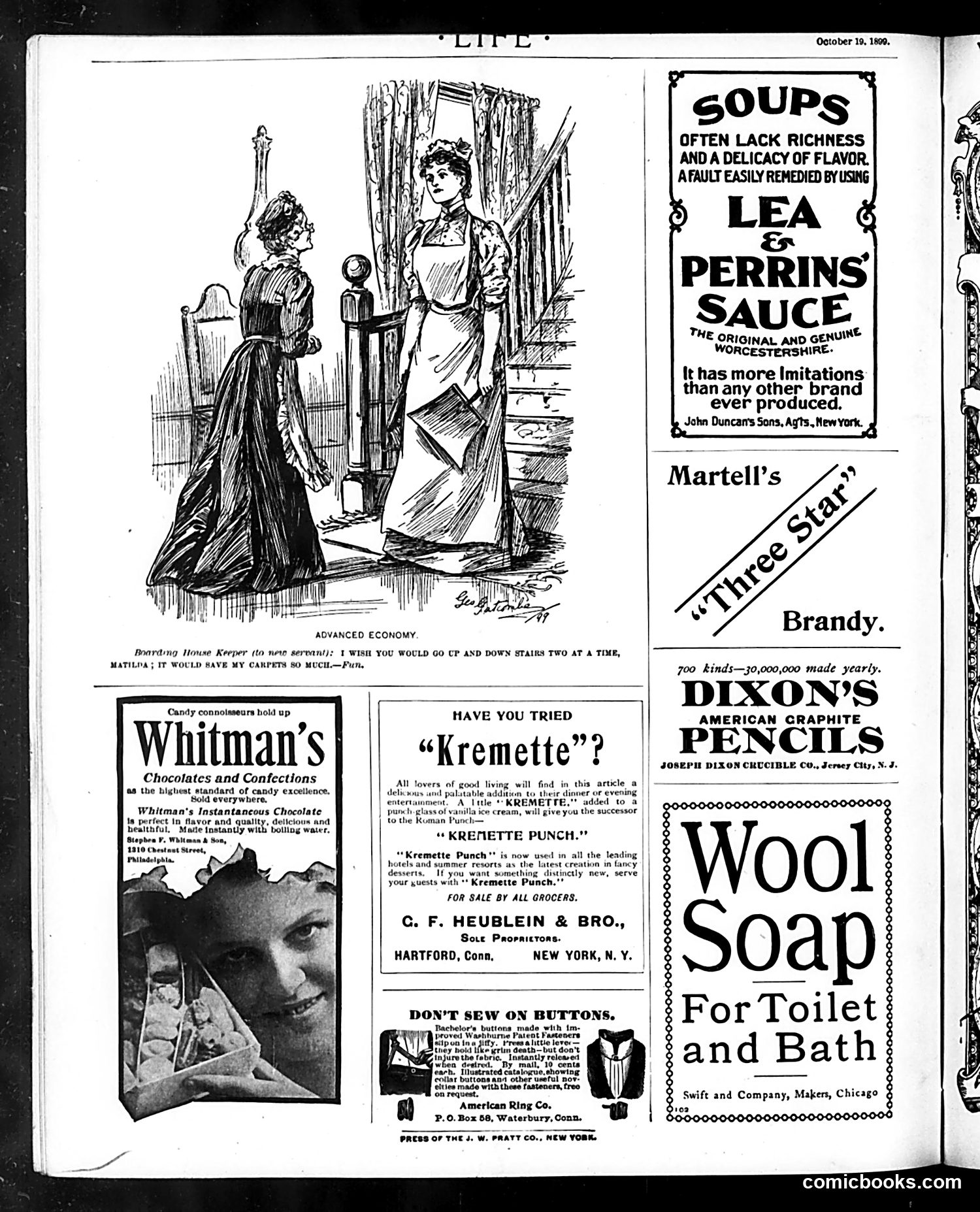
This page is primarily **advertisements with one cartoon**. The cartoon, titled "Advanced Economy," satirizes penny-pinching landlords. A boarding house keeper instructs a new servant (Matilda) to go up and down stairs two steps at a time to save wear on the carpets. The joke is absurd: the servant's footfalls would cause *more* damage, not less. The satire mocks how miserly boarding house operators pursued false economies—prioritizing carpet preservation over logical sense or worker efficiency. The surrounding advertisements showcase typical early-1900s products: Whitman's chocolate, Kremette punch flavoring, "don't sew on buttons" fasteners, Lea & Perrins sauce, Dixon's pencils, and wool soap. These ads reveal consumer goods and domestic concerns of the era, including labor-saving devices for middle-class households.